Dynamic compressive sensing
2
Part1
Dynamic updating
Use previous solutions and
dynamics to quickly solve the
recovery problems
Part 2
Dynamic modeling
Use the dynamical signal
structure to improve the
reconstruction
“warm start”
final solution
3.
Dynamic compressive sensing
Part2
Dynamic modeling
Use the dynamical signal
structure to improve the
reconstruction
3
Part 1
Dynamic updating
Use previous solutions and
dynamics to accelerate the
recovery process
.
.
.
Results
[A., Romberg, “DynamicL1 updating”, c. 2009]
20
Signal type
DynamicX
(nProdAtA, CPU)
LASSO
(nProdAtA, CPU)
GPSR-BB
(nProdAtA, CPU)
FPC_AS
(nProdAtA, CPU)
N = 1024
M = 512
T = m/5, k ~ T/20
Values = +/- 1
(23.72, 0.132) (235, 0.924) (104.5, 0.18) (148.65, 0.177)
Blocks (2.7, 0.028) (76.8, 0.490) (17, 0.133) (53.5, 0.196)
Pcw. Poly. (13.83, 0.151) (150.2, 1.096) (26.05, 0.212) (66.89, 0.25)
House slices (26.2, 0.011) (53.4, 0.019) (92.24, 0.012) (90.9, 0.036)
nProdAtA: avg. number of matrix-vector products with and T
CPU: average cputime to solve
¿ = 0:01kAT
yk1
GPSR: Gradient Projection for Sparse Reconstruction. M. Figueiredo, R. Nowak, S. Wright
FPC_AS: Fixed-point continuation and active set. Z. Wen, W. Yin, D. Goldfarb, and Y. Zhang
21.
“If all youhave is a hammer, everything looks like a nail.”
Sparse Kalman filter
Reweighted `1
Dictionary update
`1 analysis
Streaming signal
Positivity/affine
constraint
Dantzig selector
21
`1 decoding
Sequential
measurements
22.
Sparse Kalman filter
Reweighted`1
Dictionary update
`1 analysis
Streaming signal
Positivity/affine
constraint
Dantzig selector
22
`1 decoding
Sequential
measurements
minimize ¿kxk1 +
1
2
kAx ¡ yk2
2 +
1
2
kBx ¡ (1 ¡ ²)Bb
xold ¡ ²wk2
2
• Sequential measurements: Homotopy parameter: 0 ! 1
Dummy vector used to ensure
optimality of previous solution
with the changes
[A., Romberg, 2010]
Previous work on single measurement update: [Garrigues & El Ghaoui ’08; A., Romberg, ‘08]
-homotopy
• System model:
•Instead, use the following versatile homotopy:
26
is sparse
Optimization problem to solve Homotopy part
A “dummy” variable that maintains
optimality of the starting point at
Sparse recovery: streamingsystem
• Signal observations:
• Sparse representation:
34
LOT
coefficients
LOT representation bases
Signal
LOT
windows
Measurement matrices Signal
Measurements Error
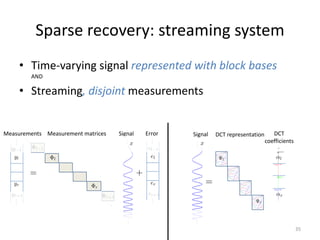
35.
Sparse recovery: streamingsystem
• Time-varying signal represented with block bases
AND
• Streaming, disjoint measurements
35
DCT
coefficients
DCT representation
Signal
Measurement matrices Signal
Measurements Error
36.
Sparse recovery: streamingsystem
• Time-varying signal represented with lapped bases
OR
• Streaming, overlapping measurements
36
LOT
coefficients
LOT representation bases
Signal
LOT
windows
Measurement matrices Signal
Measurements Error
37.
Sparse recovery: streamingsystem
• Time-varying signal represented with lapped bases
OR
• Streaming, overlapping measurements
37
LOT
coefficients
LOT representation bases
Signal
LOT
windows
active
interval
Measurement matrices Signal
Measurements Error
active
interval
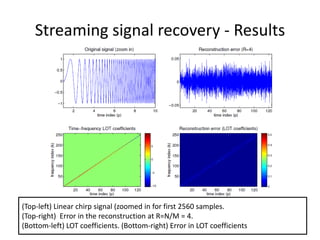
Streaming signal recovery- Results
39
(Top-left) Linear chirp signal (zoomed in for first 2560 samples.
(Top-right) Error in the reconstruction at R=N/M = 4.
(Bottom-left) LOT coefficients. (Bottom-right) Error in LOT coefficients
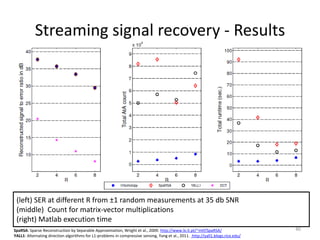
40.
Streaming signal recovery- Results
40
(left) SER at different R from ±1 random measurements at 35 db SNR
(middle) Count for matrix-vector multiplications
(right) Matlab execution time
SpaRSA: Sparse Reconstruction by Separable Approximation, Wright et al., 2009. http://www.lx.it.pt/~mtf/SpaRSA/
YALL1: Alternating direction algorithms for L1-problems in compressive sensing, Yang et al., 2011. http://yall1.blogs.rice.edu/
41.
Streaming signal recovery- Results
41
(Top-left) Mishmash signal (zoomed in for first 2560 samples.
(Top-right) Error in the reconstruction at R=N/M = 4.
(Bottom-left) LOT coefficients. (Bottom-right) Error in LOT coefficients
42.
Streaming signal recovery- Results
42
(left) SER at different R from ±1 random measurements at 35 db SNR
(middle) Count for matrix-vector multiplications
(right) Matlab execution time
43.
Sparse recovery: dynamicalsystem
• Signal observations:
• Sparse representation:
• Linear dynamic model:
43
Dynamic model
Related work: [Vaswani ’08; Carmi et al. ’09; Angelosante et al. ’09; Zaniel et al. ’10; Charles et al. ’11]
Dynamic signal recovery- Results
45
(Top-left) HeaviSine signal (shifted copies) in image
(Top-right) Error in the reconstruction at R=N/M = 4.
(Bottom-left) Reconstructed signal at R=4.
(Bottom-right) Comparison of SER for the L1- and the L2-regularized problems
46.
Dynamic signal recovery- Results
46
(left) SER at different R from ±1 random measurements at 35 db SNR
(middle) Count for matrix-vector multiplications
(right) Matlab execution time
47.
Dynamic signal recovery- Results
47
(Top-left) Piece-Regular signal (shifted copies) in image
(Top-right) Error in the reconstruction at R=N/M = 4.
(Bottom-left) Reconstructed signal at R=4.
(Bottom-right) Comparison of SER for the L1- and the L2-regularized problems
48.
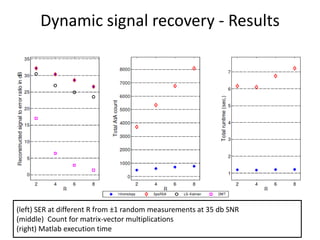
Dynamic signal recovery- Results
48
(left) SER at different R from ±1 random measurements at 35 db SNR
(middle) Count for matrix-vector multiplications
(right) Matlab execution time
49.
Part 2: Dynamicmodels in video
49
x1 x2 x3
.
.
.
xT
F1 F2 FT¡1
B2 B3 BT
Video compression
Compression isachieved by removing the spatio-temporal redundancies in the videos 52
Motion
comp.
I frame P or B frames
…
53.
Video coding paradigm
Majorblocks in the encoder:
Motion estimation, Transform coding, Entropy coding
53
Low
complexity
encoder
“Smart”
decoder
In Out
Standard compliant
bitstream
‘Smart’
encoder
“Dumb”
decoder
In Out
Shift processing burden from the encoder to the decoder!
54.
Compressive encoder
video frame
withN pixels
vector
vector
Encoder complexity is minimal, while all the
computational load is shifted to the decoder
x y
M £ 1
N £ 1
A y
x =
Random Sensing matrix
M £ N
54
55.
Structure in video(for recovery)
• Frame-by-frame recovery (same as recovery of independent images).
• Spatial structure:
– Wavelets
– Total-variation
DWT
• Recovery of multiple frames (images are temporally correlated)
• Temporal structure:
– Frame difference
– Inter-frame motion
x1 x2 x3
.
.
.
xT
F1 F2 FT¡1
B2 B3 BT 55
56.
Structure…
DWT
Linear dynamical system:
x1x2 x3
.
.
.
xT
F1 F2 FT¡1
B2 B3 BT
yi = Aixi + ei
xi = Fi¡1xi¡1 + fi
xi = Bi+1xi+1 + bi
A y
x =
Random
Sensing matrix
M £N
(Linear measurements)
(forward motion pred.)
(backward motion pred.)
56
Accelerated acquisition inMRI?
• How the cardiac MRI works:
Fourier plane---Phase-encoding step
samples rows in the Fourier plane
Temporal
resolution
One cardiac cycle
A small spatial area is
scanned in every heart beat
(e.g., 8 lines per heartbeat)
Acquisition during breathholds
Direct tradeoff between temporal resolution and lines per heart beat segment
Number of lines per frame are the same 58
Motion-adaptive Spatio-temporal
Regularization (MASTeR)
•We model temporal variations in the images using
inter-frame motion!
• This way we are not using some fixed global model,
instead, we learn the structure directly from the
data.
Motion vectors
60
61.
Motion-adaptive Spatio-temporal
Regularization (MASTeR)
•Spatial structure: wavelets
• Temporal structure: inter-frame motion
• Linear dynamical system model:
yi = Aixi + ei
xi = Fi¡1xi¡1 + fi
xi = Bi+1xi+1 + bi
(Linear measurements)
(forward motion pred.)
(backward motion pred.)
61
Video reconstruction
DWT x1x2 x3
.
.
.
xT
F1 F2 FT¡1
B2 B3 BT
63
DWT
yi = Aixi + ei
xi = Fi¡1xi¡1 + fi
xi = Bi+1xi+1 + bi
(Linear measurements)
(forward motion pred.)
(backward motion pred.)
64.
Pseudocode:
0. Find Initialframe estimates
Repeat
1. Calculate motion from frame estimates
2. Use the motion information to refine estimates
Video reconstruction
DWT x1 x2 x3
.
.
.
xT
F1 F2 FT¡1
B2 B3 BT
Backward motion diff.
Spatial regularity
Data fidelity
Forward motion diff.
minimize
x1;:::;xT
X
k
kAkxk ¡ ykk2 + ¿kkxkkª1
+
®kkFkxk ¡ xk+1kª2
+ ¯kkBkxk ¡ xk¡1kª3
64
DWT
65.
Comparison of low-complexityencoders
coastguard
foreman
container
hall
65
CS-MC: L1 with motion compensation
CS-DIFF: L1 with frame difference
CS: frame-by-frame
qJPEG: mask-based DCT thresholding
ldct: linear DCT (zigzag) thresholding
CS measurements: partial wavelets + noiselets
compression ratio = N/M
66.
Results
(short axis):
R =8
R = 4
MASTeR
k-t
FOCUSS
with
ME/MC
(e)
(f)
(b)
(b)
(c)
(d)
(a)
y
x
k-t FOCUSS with ME/MC:
-Temporal DFT sparsity
-Motion residual with a
reference frame or temporal
average.
66
MASTeR: Motion-adaptive
spatio-temporal
regularization:
R: acceleration factor
Sampling: 8 low-freq. lines
+ random sampling
[Jung et al., k-t FOCUSS: a general compressed
sensing framework for high resolution
dynamic MRI. MRM, 2009]
67.
67
k-t FOCUSS with
ME/MC(full)
k-t FOCUSS with
ME/MC (ROI)
MASTeR
k-t
FOCUSS
with
ME/MC
t
y
(a)
(b)
R=4
(c)
(e)
R=8
(d)
(f)
MASTeR (ROI)
MASTeR (full)
Results (short axis)
68.
Conclusion
68
Dynamic modeling
Improve reconstructionby exploiting
the dynamical signal structure
• Motion-adaptive dynamical
system
1. Low-complexity video
compression
2. Accelerated dynamic MRI
Dynamic updating
Quickly update the solution to
accommodate changes
• homotopy
– Breaks updating into piecewise
linear steps
– Simple, inexpensive (rank-one
update)
“warm start”
final
solution
.
.
.
The more we know about the signal (dynamics)
the faster and/or more accurately we can reconstruct
Select publications
• Dynamicupdating
– M. Asif and J. Romberg, ``Sparse recovery algorithm for streaming signals using L1-
homotopy,'' Submitted to IEEE Trans. Sig. Proc., June 2013. [Arxiv]
– M. Asif and J. Romberg, ``Fast and accurate algorithm for re-weighted L1-norm
minimization,'' Submitted to IEEE Trans. Sig. Proc., July 2012. [Arxiv]
– M. Asif and J. Romberg, ``Dynamic updating for L1 minimization,'' IEEE Journal of
Selected Topics in Signal Processing, 4(2) pp. 421--434, April 2010.
– M. Asif and J. Romberg, ``Sparse signal recovery and dynamic update of the
underdetermined system,'' Asilomar Conf. on Signals, Systems, and Computers, Pacific
Grove, November 2010.
– M. Asif and Justin Romberg, ``Basis pursuit with sequential measurements and time-
varying signals,'' in Proc. Computational Advances in Multi-Sensor Adaptive Processing
(CAMSAP), Aruba, December 2009.
– M. Asif and J. Romberg, ``Dynamic updating for sparse time-varying signals,'' Conference
on inf. sciences and systems (CISS), Baltimore, March 2009.
– M. Asif and J. Romberg, ``Streaming measurements in compressive sensing: L1 filtering,''
Asilomar Conf. on Signals, Systems, and Computers, Pacific Grove, CA, October 2008.
• Dynamic model in video
– M. Asif, L. Hamilton, M. Brummer, and J. Romberg, ``Motion-adaptive spatio-temporal
regularization (MASTeR) for accelerated dynamic MRI,'' accepted in Magnetic Resonance
in Medicine, November 2012 [Early view DOI: 10.1002/mrm.24524].
– M. Asif, F. Fernandes, and J. Romberg, ''Low-complexity video compression and
compressive sensing,'' preprint 2012. 70
71.
Select publications
• Sparsityand dynamics
– M. Asif, A. Charles, J. Romberg, and C. Rozell, ``Estimating and dynamic updating of
time-varying signals with sparse variations,'' in Proc. IEEE Int. Conf. on Acoustics, Speech,
and Signal Processing (ICASSP), Prague, Czech Republic, May 2011.
– A. Charles, M. Asif, J. Romberg, and C. Rozell, ``Sparse penalties in dynamical system
estimation,'', Conference on Inf. Sciences and Systems (CISS), Baltimore, Maryland,
March 2011.
• Streaming greedy pursuit
– P. Boufounos and M. Asif, ``Compressive sensing for streaming signals using the
streaming greedy pursuit,'' in Proc. Military Commun. Conf. (MILCOM), San Jose,
California, October 2010.
– M. Asif, D. Reddy, P. Boufounos, and A. Veeraraghavan, ``Streaming compressive sensing
for high-speed periodic videos,'' in Proc. IEEE Int. Conf. on Image Processing (ICIP), Hong
Kong, September 2010.
– P. Boufounos and M. Asif, ``Compressive sampling for streaming signals with sparse
frequency content,'' Conference on Inf. Sciences and Systems (CISS), Princeton, New
Jersey, March 2010.
• Channel protection
– M. Asif, W. Mantzel, and J. Romberg, ``Random channel coding and blind
deconvolution,'' Allerton Conf. on Communication, Control, and Computing, Monticello,
Illinois, October 2009.
– M. Asif, W. Mantzel, and J. Romberg, ``Channel protection: Random coding meets sparse
channels,'' Information Theory Workshop, Taormina, Italy, October 2009.
71
72.
Acknowledgements
• Special thanksto my collaborators
– William Mantzel
– Petros Boufonous
– Felix Fernandes
– Adam Charles and Chris Rozell
– Lei Hamilton and Marijn Brummer
• and my advisor, Justin Romberg
72


![Compressive sensing
• A theory that deals with signal recovery from
underdetermined systems:
y = ©x =
M < N
underdetermined
M £ N system
[Candes, Romberg, Tao, Donoho, Tropp, Baraniuk, Gilbert, Vershynin, Rudelson, …]
4
=
M < N
underdetermined
M £ N system
Incoherent measurement matrix
(e.g., subGaussian matrices)
Sparse signal
2. Sparse representation in a redundant dictionary
Similar principles: structure and incoherence
1. Compression with sampling](https://image.slidesharecdn.com/asif-phd-slides-251230045646-75f29fd1/85/asif-phd-slides-compressed-sensing-tutorial-4-320.jpg)





![Time-varying signals
y1 = ©x1 + e1
• System model:
minimize ¿kxk1 +
1
2
k©x ¡ y2k2
2
• New `1 problem:
16
x1 ! x2 ) y1 ! y2
• Signal varies:
“Sparse innovations”
minimize ¿kxk1 +
1
2
k©x ¡ y1k2
2
• `1 problem:
minimize ¿kxk1 +
1
2
k©x ¡ (1 ¡ ²)y1 ¡ ²y2k2
2
• Homotopy:
Homotopy parameter: 0 ! 1
[A., Romberg, “Dynamic L1 updating”, c. 2009]](https://image.slidesharecdn.com/asif-phd-slides-251230045646-75f29fd1/85/asif-phd-slides-compressed-sensing-tutorial-16-320.jpg)


![Results
[A., Romberg, “Dynamic L1 updating”, c. 2009]
20
Signal type
DynamicX
(nProdAtA, CPU)
LASSO
(nProdAtA, CPU)
GPSR-BB
(nProdAtA, CPU)
FPC_AS
(nProdAtA, CPU)
N = 1024
M = 512
T = m/5, k ~ T/20
Values = +/- 1
(23.72, 0.132) (235, 0.924) (104.5, 0.18) (148.65, 0.177)
Blocks (2.7, 0.028) (76.8, 0.490) (17, 0.133) (53.5, 0.196)
Pcw. Poly. (13.83, 0.151) (150.2, 1.096) (26.05, 0.212) (66.89, 0.25)
House slices (26.2, 0.011) (53.4, 0.019) (92.24, 0.012) (90.9, 0.036)
nProdAtA: avg. number of matrix-vector products with and T
CPU: average cputime to solve
¿ = 0:01kAT
yk1
GPSR: Gradient Projection for Sparse Reconstruction. M. Figueiredo, R. Nowak, S. Wright
FPC_AS: Fixed-point continuation and active set. Z. Wen, W. Yin, D. Goldfarb, and Y. Zhang](https://image.slidesharecdn.com/asif-phd-slides-251230045646-75f29fd1/85/asif-phd-slides-compressed-sensing-tutorial-20-320.jpg)

![Sparse Kalman filter
Reweighted `1
Dictionary update
`1 analysis
Streaming signal
Positivity/affine
constraint
Dantzig selector
22
`1 decoding
Sequential
measurements
minimize ¿kxk1 +
1
2
kAx ¡ yk2
2 +
1
2
kBx ¡ (1 ¡ ²)Bb
xold ¡ ²wk2
2
• Sequential measurements: Homotopy parameter: 0 ! 1
Dummy vector used to ensure
optimality of previous solution
with the changes
[A., Romberg, 2010]
Previous work on single measurement update: [Garrigues & El Ghaoui ’08; A., Romberg, ‘08]](https://image.slidesharecdn.com/asif-phd-slides-251230045646-75f29fd1/85/asif-phd-slides-compressed-sensing-tutorial-22-320.jpg)
![Sparse Kalman filter
Reweighted `1
Dictionary update
`1 analysis
Streaming signal
Positivity/affine
constraint
Dantzig selector
23
`1 decoding
Sequential
measurements
minimize k[(1 ¡ ²)W + ² f
W]xk1 +
1
2
k©x ¡ yk2
2
• Iterative reweighting :
Homotopy parameter: 0 ! 1
Weights are updated
[A., Romberg, 2012]
Adaptive reweighting in
Chapter VI in the thesis](https://image.slidesharecdn.com/asif-phd-slides-251230045646-75f29fd1/85/asif-phd-slides-compressed-sensing-tutorial-23-320.jpg)
![Sparse Kalman filter
Reweighted `1
Dictionary update
Streaming signal
Positivity/affine
constraint
Dantzig selector
24
`1 decoding
Sequential
measurements
minimize kWxk1 +
1
2
k©x ¡ yk2
2 + (1 ¡ ²)uT
x
“ ne homotopy to rule them all”
[A., Romberg, 2013]](https://image.slidesharecdn.com/asif-phd-slides-251230045646-75f29fd1/85/asif-phd-slides-compressed-sensing-tutorial-24-320.jpg)






![Sparse recovery: dynamical system
• Signal observations:
• Sparse representation:
• Linear dynamic model:
43
Dynamic model
Related work: [Vaswani ’08; Carmi et al. ’09; Angelosante et al. ’09; Zaniel et al. ’10; Charles et al. ’11]](https://image.slidesharecdn.com/asif-phd-slides-251230045646-75f29fd1/85/asif-phd-slides-compressed-sensing-tutorial-43-320.jpg)





![Parallel imaging
• Parallel imaging [SENSE, SMASH, SPACE-RIP, GRAPPA, …]:
2
6
6
6
4
y1
y2
.
.
.
yT
3
7
7
7
5
=
2
6
6
6
4
A1 0 : : : 0
0 A2 : : : 0
.
.
.
.
.
.
...
.
.
.
0 0 : : : AT
3
7
7
7
5
2
6
6
6
4
x1
x2
.
.
.
xT
3
7
7
7
5
+
2
6
6
6
4
e1
e2
.
.
.
eT
3
7
7
7
5
´ y = Ax + e
yi = Aixi + ei
Ai ´
2
6
4
F-i S1
i
.
.
.
F-i SC
i
3
7
5
Receiver coils
MRI data courtesy: Hamilton and Brummer
59](https://image.slidesharecdn.com/asif-phd-slides-251230045646-75f29fd1/85/asif-phd-slides-compressed-sensing-tutorial-59-320.jpg)


![Results
(short axis):
R = 8
R = 4
MASTeR
k-t
FOCUSS
with
ME/MC
(e)
(f)
(b)
(b)
(c)
(d)
(a)
y
x
k-t FOCUSS with ME/MC:
-Temporal DFT sparsity
-Motion residual with a
reference frame or temporal
average.
66
MASTeR: Motion-adaptive
spatio-temporal
regularization:
R: acceleration factor
Sampling: 8 low-freq. lines
+ random sampling
[Jung et al., k-t FOCUSS: a general compressed
sensing framework for high resolution
dynamic MRI. MRM, 2009]](https://image.slidesharecdn.com/asif-phd-slides-251230045646-75f29fd1/85/asif-phd-slides-compressed-sensing-tutorial-66-320.jpg)


![Select publications
• Dynamic updating
– M. Asif and J. Romberg, ``Sparse recovery algorithm for streaming signals using L1-
homotopy,'' Submitted to IEEE Trans. Sig. Proc., June 2013. [Arxiv]
– M. Asif and J. Romberg, ``Fast and accurate algorithm for re-weighted L1-norm
minimization,'' Submitted to IEEE Trans. Sig. Proc., July 2012. [Arxiv]
– M. Asif and J. Romberg, ``Dynamic updating for L1 minimization,'' IEEE Journal of
Selected Topics in Signal Processing, 4(2) pp. 421--434, April 2010.
– M. Asif and J. Romberg, ``Sparse signal recovery and dynamic update of the
underdetermined system,'' Asilomar Conf. on Signals, Systems, and Computers, Pacific
Grove, November 2010.
– M. Asif and Justin Romberg, ``Basis pursuit with sequential measurements and time-
varying signals,'' in Proc. Computational Advances in Multi-Sensor Adaptive Processing
(CAMSAP), Aruba, December 2009.
– M. Asif and J. Romberg, ``Dynamic updating for sparse time-varying signals,'' Conference
on inf. sciences and systems (CISS), Baltimore, March 2009.
– M. Asif and J. Romberg, ``Streaming measurements in compressive sensing: L1 filtering,''
Asilomar Conf. on Signals, Systems, and Computers, Pacific Grove, CA, October 2008.
• Dynamic model in video
– M. Asif, L. Hamilton, M. Brummer, and J. Romberg, ``Motion-adaptive spatio-temporal
regularization (MASTeR) for accelerated dynamic MRI,'' accepted in Magnetic Resonance
in Medicine, November 2012 [Early view DOI: 10.1002/mrm.24524].
– M. Asif, F. Fernandes, and J. Romberg, ''Low-complexity video compression and
compressive sensing,'' preprint 2012. 70](https://image.slidesharecdn.com/asif-phd-slides-251230045646-75f29fd1/85/asif-phd-slides-compressed-sensing-tutorial-70-320.jpg)


