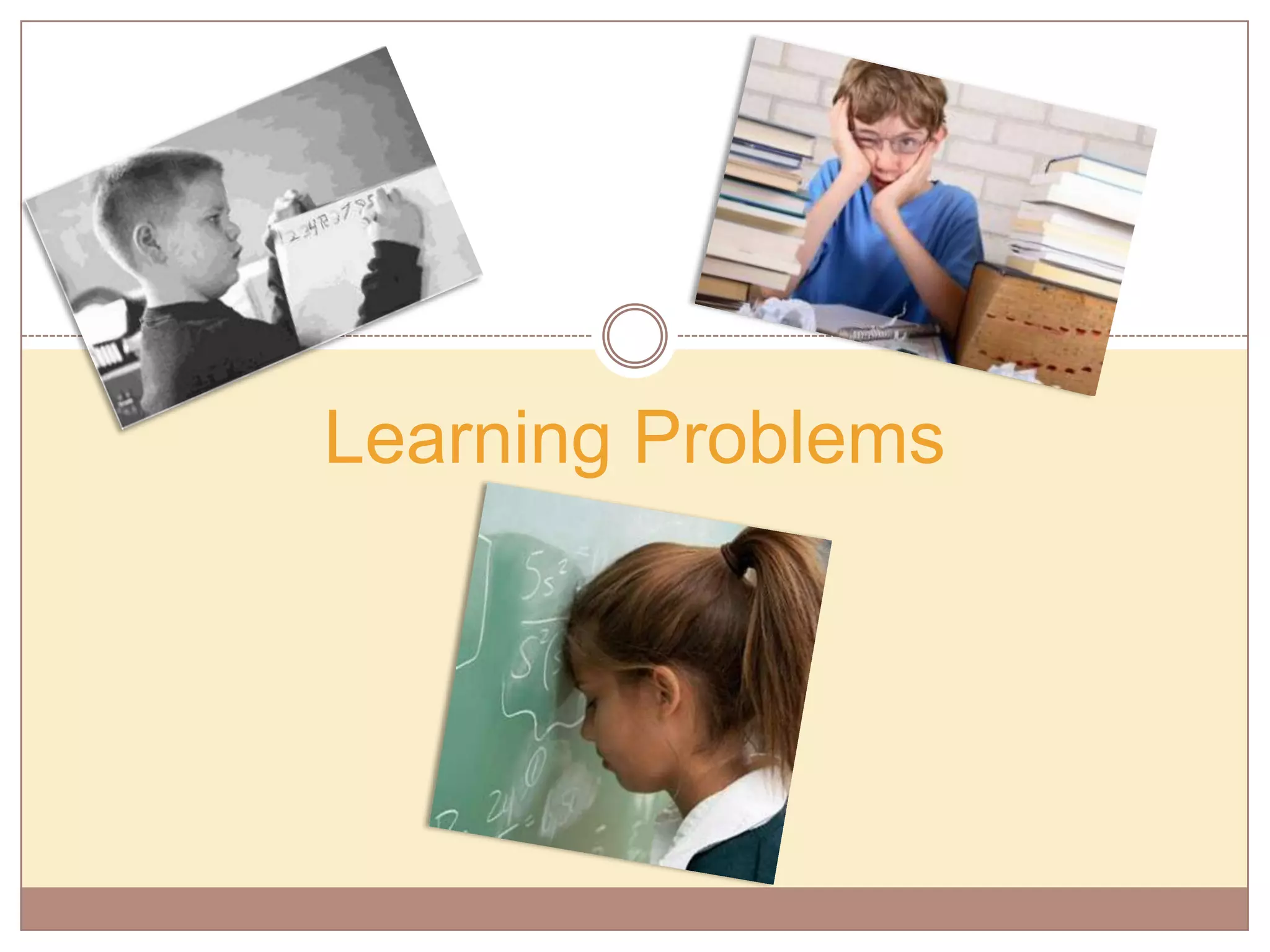
Learning Problems
Learning Disorders

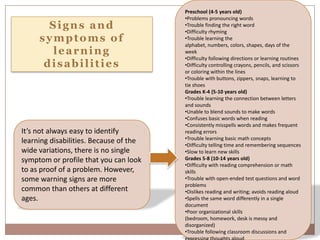
Learning disabilities are problems
that affect the brain's ability to
receive, process, analyze, or store
information. These problems can
make it difficult for a student to
learn as quickly as someone who
isn't affected by learning disabilities.
                                    For someone diagnosed with a learning
                                    disability, it can seem scary at first. But a
                                    learning disorder doesn't have anything to do
                                    with a person's intelligence — kids with
                                    learning disabilities aren’t lazy or dumb. In
                                    fact, most are just as smart as everyone else.
                                    Their brains are simply wired differently. After
                                    all, successful people such as Walt
                                    Disney, Alexander Graham Bell, and Winston
                                    Churchill all had learning disabilities.
Preschool (4-5 years old)
                                        •Problems pronouncing words
       Signs and                        •Trouble finding the right word
                                        •Difficulty rhyming
     symptoms of                        •Trouble learning the
                                        alphabet, numbers, colors, shapes, days of the
       learning                         week
                                        •Difficulty following directions or learning routines
      disabilities                      •Difficulty controlling crayons, pencils, and scissors
                                        or coloring within the lines
                                        •Trouble with buttons, zippers, snaps, learning to
                                        tie shoes
                                        Grades K-4 (5-10 years old)
                                        •Trouble learning the connection between letters
                                        and sounds
                                        •Unable to blend sounds to make words
                                        •Confuses basic words when reading
                                        •Consistently misspells words and makes frequent
It’s not always easy to identify        reading errors
                                        •Trouble learning basic math concepts
learning disabilities. Because of the   •Difficulty telling time and remembering sequences
wide variations, there is no single     •Slow to learn new skills
symptom or profile that you can look    Grades 5-8 (10-14 years old)
                                        •Difficulty with reading comprehension or math
to as proof of a problem. However,      skills
some warning signs are more             •Trouble with open-ended test questions and word
                                        problems
common than others at different         •Dislikes reading and writing; avoids reading aloud
ages.                                   •Spells the same word differently in a single
                                        document
                                        •Poor organizational skills
                                        (bedroom, homework, desk is messy and
                                        disorganized)
                                        •Trouble following classroom discussions and
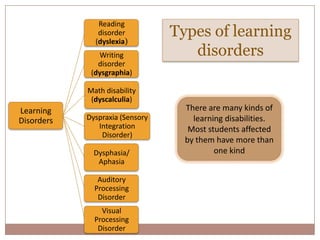
Reading
               disorder
              (dyslexia)
                                 Types of learning
               Writing              disorders
               disorder
             (dysgraphia)

            Math disability
             (dyscalculia)
Learning                           There are many kinds of
Disorders   Dyspraxia (Sensory       learning disabilities.
               Integration          Most students affected
                Disorder)
                                   by them have more than
              Dysphasia/                   one kind
               Aphasia

               Auditory
              Processing
               Disorder
                Visual
              Processing
               Disorder
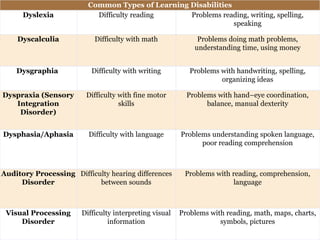
Common Types of Learning Disabilities
      Dyslexia             Difficulty reading     Problems reading, writing, spelling,
                                                               speaking

    Dyscalculia            Difficulty with math              Problems doing math problems,
                                                            understanding time, using money


    Dysgraphia            Difficulty with writing          Problems with handwriting, spelling,
                                                                    organizing ideas

Dyspraxia (Sensory      Difficulty with fine motor        Problems with hand–eye coordination,
   Integration                     skills                       balance, manual dexterity
    Disorder)


Dysphasia/Aphasia        Difficulty with language       Problems understanding spoken language,
                                                              poor reading comprehension


Auditory Processing Difficulty hearing differences       Problems with reading, comprehension,
     Disorder              between sounds                               language


 Visual Processing     Difficulty interpreting visual   Problems with reading, math, maps, charts,
     Disorder                   information                         symbols, pictures
Dyslexia
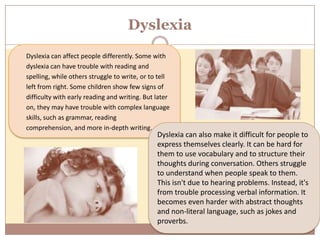
Dyslexia can affect people differently. Some with
dyslexia can have trouble with reading and
spelling, while others struggle to write, or to tell
left from right. Some children show few signs of
difficulty with early reading and writing. But later
on, they may have trouble with complex language
skills, such as grammar, reading
comprehension, and more in-depth writing.
                                               Dyslexia can also make it difficult for people to
                                               express themselves clearly. It can be hard for
                                               them to use vocabulary and to structure their
                                               thoughts during conversation. Others struggle
                                               to understand when people speak to them.
                                               This isn't due to hearing problems. Instead, it's
                                               from trouble processing verbal information. It
                                               becomes even harder with abstract thoughts
                                               and non-literal language, such as jokes and
                                               proverbs.
Learning styles for people with dyslexia


  Learning should be structured and multisensory
 (use sight, sound, and touch)
  Practice till automatic (people with dyslexia have short-term
 memory difficulties)
  Work on one problem at a time.
  Use right brain skills: like imagination, patterns, colour and
 visualisation to augment learning.
 Make sure there is nothing disturbing in the room you are
 studying in - dyslexics need to concentrate much more than other
 students
  Use technology e.g. spelling dictionaries, movies, computer
 programs
Dysgraphia

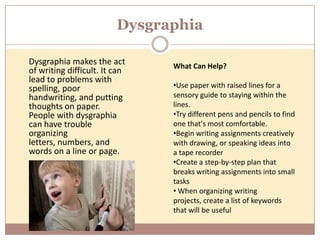
Dysgraphia makes the act       What Can Help?
of writing difficult. It can
lead to problems with
spelling, poor                 •Use paper with raised lines for a
handwriting, and putting       sensory guide to staying within the
thoughts on paper.             lines.
People with dysgraphia         •Try different pens and pencils to find
can have trouble               one that's most comfortable.
organizing                     •Begin writing assignments creatively
letters, numbers, and          with drawing, or speaking ideas into
words on a line or page.       a tape recorder
                               •Create a step-by-step plan that
                               breaks writing assignments into small
                               tasks
                               • When organizing writing
                               projects, create a list of keywords
                               that will be useful
Dyscalculia What Can Help?
                                                  •Use graph paper for
Dyscalculia refers to a wide range of             students who have difficulty
lifelong learning disabilities involving math.    organizing ideas on paper.
There is no single type of math disability.       •Work on finding different
Dyscalculia can vary from person to person.       ways to approach math facts.
And, it can affect people differently at          •Introduce new skills
different stages of life.                         beginning with concrete
                                                  examples and later moving
                                                  to more abstract
Two major areas of weakness can contribute        applications.
to math learning disabilities:                    •For language
                                                  difficulties, explain ideas and
•Visual-spatial difficulties, which result in a   problems clearly and
person having trouble processing what the         encourage students to ask
eye sees                                          questions as they work.
•Language processing difficulties, which          •Provide a place to work with
result in a person having trouble processing      few distractions and have
and making sense of what the ear hears            pencils, erasers and other
                                                  tools on hand as needed.
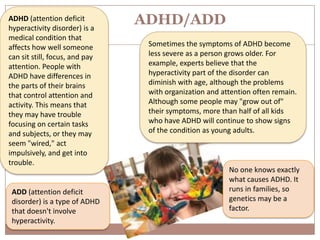
ADHD (attention deficit
hyperactivity disorder) is a
                                ADHD/ADD
medical condition that
affects how well someone         Sometimes the symptoms of ADHD become
can sit still, focus, and pay    less severe as a person grows older. For
attention. People with           example, experts believe that the
ADHD have differences in         hyperactivity part of the disorder can
the parts of their brains        diminish with age, although the problems
that control attention and       with organization and attention often remain.
activity. This means that        Although some people may "grow out of"
they may have trouble            their symptoms, more than half of all kids
focusing on certain tasks        who have ADHD will continue to show signs
and subjects, or they may        of the condition as young adults.
seem "wired," act
impulsively, and get into
trouble.
                                                         No one knows exactly
                                                         what causes ADHD. It
 ADD (attention deficit                                  runs in families, so
 disorder) is a type of ADHD                             genetics may be a
 that doesn't involve                                    factor.
 hyperactivity.
Bibliography

http://www.helpguide.org
http://www.nlm.nih.gov
http://en.wikipedia.org/wiki/Learning_disability#Typ
  es_of_learning_disabilities
http://kidshealth.org
http://www.ncld.org
Thank you for
  watching!
     

Learning problems

  • 1.
  • 2.
    Learning Disorders Learning disabilitiesare problems that affect the brain's ability to receive, process, analyze, or store information. These problems can make it difficult for a student to learn as quickly as someone who isn't affected by learning disabilities. For someone diagnosed with a learning disability, it can seem scary at first. But a learning disorder doesn't have anything to do with a person's intelligence — kids with learning disabilities aren’t lazy or dumb. In fact, most are just as smart as everyone else. Their brains are simply wired differently. After all, successful people such as Walt Disney, Alexander Graham Bell, and Winston Churchill all had learning disabilities.
  • 3.
    Preschool (4-5 yearsold) •Problems pronouncing words Signs and •Trouble finding the right word •Difficulty rhyming symptoms of •Trouble learning the alphabet, numbers, colors, shapes, days of the learning week •Difficulty following directions or learning routines disabilities •Difficulty controlling crayons, pencils, and scissors or coloring within the lines •Trouble with buttons, zippers, snaps, learning to tie shoes Grades K-4 (5-10 years old) •Trouble learning the connection between letters and sounds •Unable to blend sounds to make words •Confuses basic words when reading •Consistently misspells words and makes frequent It’s not always easy to identify reading errors •Trouble learning basic math concepts learning disabilities. Because of the •Difficulty telling time and remembering sequences wide variations, there is no single •Slow to learn new skills symptom or profile that you can look Grades 5-8 (10-14 years old) •Difficulty with reading comprehension or math to as proof of a problem. However, skills some warning signs are more •Trouble with open-ended test questions and word problems common than others at different •Dislikes reading and writing; avoids reading aloud ages. •Spells the same word differently in a single document •Poor organizational skills (bedroom, homework, desk is messy and disorganized) •Trouble following classroom discussions and
  • 4.
    Reading disorder (dyslexia) Types of learning Writing disorders disorder (dysgraphia) Math disability (dyscalculia) Learning There are many kinds of Disorders Dyspraxia (Sensory learning disabilities. Integration Most students affected Disorder) by them have more than Dysphasia/ one kind Aphasia Auditory Processing Disorder Visual Processing Disorder
  • 5.
    Common Types ofLearning Disabilities Dyslexia Difficulty reading Problems reading, writing, spelling, speaking Dyscalculia Difficulty with math Problems doing math problems, understanding time, using money Dysgraphia Difficulty with writing Problems with handwriting, spelling, organizing ideas Dyspraxia (Sensory Difficulty with fine motor Problems with hand–eye coordination, Integration skills balance, manual dexterity Disorder) Dysphasia/Aphasia Difficulty with language Problems understanding spoken language, poor reading comprehension Auditory Processing Difficulty hearing differences Problems with reading, comprehension, Disorder between sounds language Visual Processing Difficulty interpreting visual Problems with reading, math, maps, charts, Disorder information symbols, pictures
  • 6.
    Dyslexia Dyslexia can affectpeople differently. Some with dyslexia can have trouble with reading and spelling, while others struggle to write, or to tell left from right. Some children show few signs of difficulty with early reading and writing. But later on, they may have trouble with complex language skills, such as grammar, reading comprehension, and more in-depth writing. Dyslexia can also make it difficult for people to express themselves clearly. It can be hard for them to use vocabulary and to structure their thoughts during conversation. Others struggle to understand when people speak to them. This isn't due to hearing problems. Instead, it's from trouble processing verbal information. It becomes even harder with abstract thoughts and non-literal language, such as jokes and proverbs.
  • 7.
    Learning styles forpeople with dyslexia  Learning should be structured and multisensory (use sight, sound, and touch)  Practice till automatic (people with dyslexia have short-term memory difficulties)  Work on one problem at a time.  Use right brain skills: like imagination, patterns, colour and visualisation to augment learning. Make sure there is nothing disturbing in the room you are studying in - dyslexics need to concentrate much more than other students  Use technology e.g. spelling dictionaries, movies, computer programs
  • 8.
    Dysgraphia Dysgraphia makes theact What Can Help? of writing difficult. It can lead to problems with spelling, poor •Use paper with raised lines for a handwriting, and putting sensory guide to staying within the thoughts on paper. lines. People with dysgraphia •Try different pens and pencils to find can have trouble one that's most comfortable. organizing •Begin writing assignments creatively letters, numbers, and with drawing, or speaking ideas into words on a line or page. a tape recorder •Create a step-by-step plan that breaks writing assignments into small tasks • When organizing writing projects, create a list of keywords that will be useful
  • 9.
    Dyscalculia What CanHelp? •Use graph paper for Dyscalculia refers to a wide range of students who have difficulty lifelong learning disabilities involving math. organizing ideas on paper. There is no single type of math disability. •Work on finding different Dyscalculia can vary from person to person. ways to approach math facts. And, it can affect people differently at •Introduce new skills different stages of life. beginning with concrete examples and later moving to more abstract Two major areas of weakness can contribute applications. to math learning disabilities: •For language difficulties, explain ideas and •Visual-spatial difficulties, which result in a problems clearly and person having trouble processing what the encourage students to ask eye sees questions as they work. •Language processing difficulties, which •Provide a place to work with result in a person having trouble processing few distractions and have and making sense of what the ear hears pencils, erasers and other tools on hand as needed.
  • 10.
    ADHD (attention deficit hyperactivitydisorder) is a ADHD/ADD medical condition that affects how well someone Sometimes the symptoms of ADHD become can sit still, focus, and pay less severe as a person grows older. For attention. People with example, experts believe that the ADHD have differences in hyperactivity part of the disorder can the parts of their brains diminish with age, although the problems that control attention and with organization and attention often remain. activity. This means that Although some people may "grow out of" they may have trouble their symptoms, more than half of all kids focusing on certain tasks who have ADHD will continue to show signs and subjects, or they may of the condition as young adults. seem "wired," act impulsively, and get into trouble. No one knows exactly what causes ADHD. It ADD (attention deficit runs in families, so disorder) is a type of ADHD genetics may be a that doesn't involve factor. hyperactivity.
  • 11.
  • 12.
    Thank you for watching! 