Language and
Literacy Disorders
Blasco, Joy Marie D.
OVERVIEW OF THE NORMAL
DEVELOPMENT OF LANGUAGE
• As the speech mechanism (jaw, lips and tongue) and voice
mature, an infant is able to make controlled sounds.
• By 6 months, an infant usually babbles or produces repetitive
syllables such as "ba, ba, ba" or "da, da, da."
• By the end of their first year, most children have mastered the
ability to say a few simple words.
• By 18 months of age, most children can say eight to ten
words.
• By age 2, most are putting words together in crude sentences
such as "more milk."
• At ages 3, 4, and 5, a child's vocabulary rapidly increases, and
she or he begins to master the rules of language.
COMMUNICATION DISORDER
Communication disorders
may range from simple
sound repetitions such as
stuttering to occasional
misarticulation of words to
complete inability to use
speech and language for
communications (aphasia).
CAUSES
• Hearing impairment
• Learning disabilities
• Autism
• Schizophrenia
• Cerebral palsy
• Physical disability: cleft lip and palate, or malformations of the mouth
or nose
• Significant behavior or emotional problems, including deficits in
social skills
• Vocal cord injury
• Neurological disorders and diseases
• Head trauma
• Stroke
How do speech, language,
and hearing disorders
affect learning?
Why are speech and
language skills so critical
for literacy?
What are signs that a
communication disorder is
affecting school performance?
A communications disorder can affect
the way a child talks, hears, processes,
and understands information and can even
influence behavior and emotional
problems. Gone unchecked, a
communications disorder can hinder a child
on the playground, the classroom, and
eventually, in the workplace
Communication disorders can be
in the form of:
1.) Hearing disorders
a.) Deafness
b.) Hearing loss of various degrees and origins
c.) Auditory processing problems
-Sometimes it is referred to as central auditory
processing disorder (CAPD), auditory perception problem, auditory
comprehension deficit, central auditory dysfunction, central deafness
and so-called "word deafness."
Cannot process the information although it is loud and clear which
leads to difficulties in recognizing and interpreting sounds
Communication disorders can be
in the form of:
2.) Speech and language disorders
a.) Articulation problems
difficulty learning to physically produce the intended phonemes.
b.) Voice disorders
difficulties with the quality, pitch and loudness of the voice (prosody)
Pitch deviations
Deviations in loudness of the voice
Quality deviations
Communication disorders can be
in the form of:
3.) Fluency Problems
Stuttering
- a disruption in the flow of speech. It includes repetitions
of speech sounds, hesitations before and during speaking and, or,
prolongations of speech sounds.
Communication disorders can
be in the form of:
4.) Aphasia
-the loss of previously learned communication skills that results from
damage to portions of the brain responsible for language
A)EXPRESSIVE APHASIA: you know what you want to say, but you
have trouble saying or writing what you mean. Understands another person's
speech but has trouble responding quickly.
B) RECEPTIVE APHASIA: you hear the voice or see the print, but you
can't make sense of the words. Usually speaks in long sentences that have
no meaning or content. People with this type of aphasia often have trouble
understanding other's speech and generally do not realize that they are not
making any sense.
Communication disorders can be
in the form of:
C.) ANOMIC APHASIA: you have trouble using the correct
words for objects, places or event.
-also known as nominal aphasia.
- has difficulty remembering or recognizing names which the subject
should know well. The subject speaks fluently, grammatically, has
normal comprehension, and the only deficit is trouble with "word
finding," that is, finding appropriate words for what they mean to say.
a.) Averbia- specific type of anomia in which the subject has trouble
remembering verbs.
b.) Color anomia- Specific type of anomic where the patient can
distinguish between colors but cannot identify them by name
D.) GLOBAL APHASIA: you can't speak, understand speech,
read or write.
Communication disorders can be
in the form of:
5.) DELAYED LANGUAGE:
-characterized by a marked slowness in the
development of language skills necessary for
expressing and understanding thoughts and ideas.
LEARNING
DISABILITIES
LEARNING DISABILITIES
1.) Dyslexia
-A learning disability that can hinder a person's ability to
read, write, spell, and sometimes speak
- Children with dyslexia have difficulty in learning to read
despite traditional instruction, average intelligence, and an
adequate opportunity to learn. It is caused by an impairment in the
brain's ability to translate images received from the eyes or ears
into understandable language. It does not result from vision or
hearing problems.
TYPES OF DYSLEXIA
A.) PRIMARY DYSLEXIA- This type of dyslexia is a
dysfunction of, rather than damage to, the left side of the brain
(cerebral cortex) and does not change with age. Individuals with this
type are rarely able to read above a fourth-grade level and may
struggle with reading, spelling, and writing as adults. Primary dyslexia
is passed in family lines through their genes (hereditary). It is found
more often in boys than in girls.
B.) SECONDARY OR DEVELOPMENTAL
DYSLEXIA
-caused by hormonal development during the early stages of fetal
development. Developmental dyslexia diminishes as the child matures.
It is also more common in boys.
DYSLEXIA MAY AFFECT SEVERAL
DIFFERENT FUNCTIONS
Visual dyslexia is characterized by number and
letter reversals and the inability to write symbols in the
correct sequence.
Auditory dyslexia involves difficulty with sounds
of letters or groups of letters. The sounds are perceived
as jumbled or not heard correctly
WHAT ARE THE SIGNS AND
SYMPTOMS OF DYSLEXIA?
Letter and number reversals are the most common warning
sign. Such reversals are fairly common up to the age of 7 or
8 and usually diminish by that time.. Difficulty copying from
the board or a book can also suggest problems. There may
be a general disorganization of written work. A child may not
be able to remember content, even if it involves a favorite
video or storybook.
LEARNING
DISABILITIES
2.) Dysgraphia
-A learning disability that affects writing, which requires a
complex set of motor and information processing skills. Dysgraphia
makes the act of writing difficult. It can lead to problems with
spelling, poor handwriting and putting thoughts on paper. People
with dysgraphia can have trouble organizing letters, numbers and
words on a line or page.
THIS CAN RESULT PARTLY FROM:
Visual-spatial difficulties: trouble processing what the eye
sees
Language processing difficulty: trouble processing and
making sense of what the ear hears
YOUNG CHILDREN
TROUBLE WITH:
•Tight, awkward pencil
grip and body
position
•Avoiding writing or
drawing tasks
•Trouble forming letter
shapes
•Inconsistent spacing
between letters or
words
•Poor understanding
of uppercase and
lowercase letters
•Inability to write or
draw in a line or
within margins
•Tiring quickly while
writing
SCHOOL-AGE
CHILDREN
TROUBLE WITH:
•Illegible handwriting
•Mixture of cursive
and print writing
•Saying words out
loud while writing
•Concentrating so
hard on writing that
comprehension of
what's written is
missed
•Trouble thinking of
words to write
•Omitting or not
finishing words in
sentences
TEENAGERS AND
ADULTS
TROUBLE WITH:
•Trouble organizing
thoughts on paper
•Trouble keeping track of
thoughts already written
down
•Difficulty with syntax
structure and grammar
•Large gap between
written ideas and
understanding
demonstrated through
speech
Dysgraphia: Warning Signs By Age
LEARNING
DISABILITIES
3.) Dyscalculia
-A condition that affects the ability to acquire
arithmetical skills. Dyscalculic learners may have
difficulty understanding simple number concepts, lack
an intuitive grasp of numbers, and have problems
learning number facts and procedures. Even if they
produce a correct answer or use a correct method,
they may do so mechanically and without confidence.’
-Dyscalculia is like dyslexia for numbers
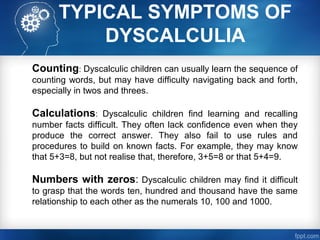
TYPICAL SYMPTOMS OF
DYSCALCULIA
Counting: Dyscalculic children can usually learn the sequence of
counting words, but may have difficulty navigating back and forth,
especially in twos and threes.
Calculations: Dyscalculic children find learning and recalling
number facts difficult. They often lack confidence even when they
produce the correct answer. They also fail to use rules and
procedures to build on known facts. For example, they may know
that 5+3=8, but not realise that, therefore, 3+5=8 or that 5+4=9.
Numbers with zeros: Dyscalculic children may find it difficult
to grasp that the words ten, hundred and thousand have the same
relationship to each other as the numerals 10, 100 and 1000.
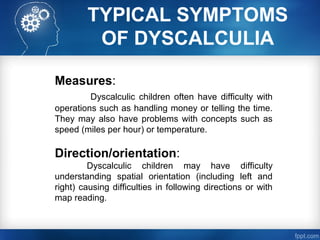
TYPICAL SYMPTOMS
OF DYSCALCULIA
Measures:
Dyscalculic children often have difficulty with
operations such as handling money or telling the time.
They may also have problems with concepts such as
speed (miles per hour) or temperature.
Direction/orientation:
Dyscalculic children may have difficulty
understanding spatial orientation (including left and
right) causing difficulties in following directions or with
map reading.
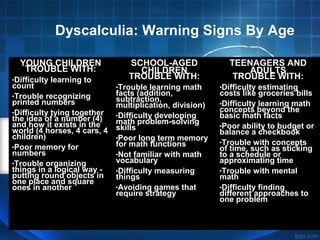
YOUNG CHILDREN
TROUBLE WITH:
•Difficulty learning to
count
•Trouble recognizing
printed numbers
•Difficulty tying together
the idea of a number (4)
and how it exists in the
world (4 horses, 4 cars, 4
children)
•Poor memory for
numbers
•Trouble organizing
things in a logical way -
putting round objects in
one place and square
ones in another
SCHOOL-AGED
CHILDREN
TROUBLE WITH:
•Trouble learning math
facts (addition,
subtraction,
multiplication, division)
•Difficulty developing
math problem-solving
skills
•Poor long term memory
for math functions
•Not familiar with math
vocabulary
•Difficulty measuring
things
•Avoiding games that
require strategy
TEENAGERS AND
ADULTS
TROUBLE WITH:
•Difficulty estimating
costs like groceries bills
•Difficulty learning math
concepts beyond the
basic math facts
•Poor ability to budget or
balance a checkbook
•Trouble with concepts
of time, such as sticking
to a schedule or
approximating time
•Trouble with mental
math
•Difficulty finding
different approaches to
one problem
Dyscalculia: Warning Signs By Age

Language and literacy disorders

  • 1.
  • 2.
    OVERVIEW OF THENORMAL DEVELOPMENT OF LANGUAGE • As the speech mechanism (jaw, lips and tongue) and voice mature, an infant is able to make controlled sounds. • By 6 months, an infant usually babbles or produces repetitive syllables such as "ba, ba, ba" or "da, da, da." • By the end of their first year, most children have mastered the ability to say a few simple words. • By 18 months of age, most children can say eight to ten words. • By age 2, most are putting words together in crude sentences such as "more milk." • At ages 3, 4, and 5, a child's vocabulary rapidly increases, and she or he begins to master the rules of language.
  • 3.
    COMMUNICATION DISORDER Communication disorders mayrange from simple sound repetitions such as stuttering to occasional misarticulation of words to complete inability to use speech and language for communications (aphasia).
  • 4.
    CAUSES • Hearing impairment •Learning disabilities • Autism • Schizophrenia • Cerebral palsy • Physical disability: cleft lip and palate, or malformations of the mouth or nose • Significant behavior or emotional problems, including deficits in social skills • Vocal cord injury • Neurological disorders and diseases • Head trauma • Stroke
  • 5.
    How do speech,language, and hearing disorders affect learning? Why are speech and language skills so critical for literacy? What are signs that a communication disorder is affecting school performance?
  • 6.
    A communications disordercan affect the way a child talks, hears, processes, and understands information and can even influence behavior and emotional problems. Gone unchecked, a communications disorder can hinder a child on the playground, the classroom, and eventually, in the workplace
  • 7.
    Communication disorders canbe in the form of: 1.) Hearing disorders a.) Deafness b.) Hearing loss of various degrees and origins c.) Auditory processing problems -Sometimes it is referred to as central auditory processing disorder (CAPD), auditory perception problem, auditory comprehension deficit, central auditory dysfunction, central deafness and so-called "word deafness." Cannot process the information although it is loud and clear which leads to difficulties in recognizing and interpreting sounds
  • 8.
    Communication disorders canbe in the form of: 2.) Speech and language disorders a.) Articulation problems difficulty learning to physically produce the intended phonemes. b.) Voice disorders difficulties with the quality, pitch and loudness of the voice (prosody) Pitch deviations Deviations in loudness of the voice Quality deviations
  • 9.
    Communication disorders canbe in the form of: 3.) Fluency Problems Stuttering - a disruption in the flow of speech. It includes repetitions of speech sounds, hesitations before and during speaking and, or, prolongations of speech sounds.
  • 10.
    Communication disorders can bein the form of: 4.) Aphasia -the loss of previously learned communication skills that results from damage to portions of the brain responsible for language A)EXPRESSIVE APHASIA: you know what you want to say, but you have trouble saying or writing what you mean. Understands another person's speech but has trouble responding quickly. B) RECEPTIVE APHASIA: you hear the voice or see the print, but you can't make sense of the words. Usually speaks in long sentences that have no meaning or content. People with this type of aphasia often have trouble understanding other's speech and generally do not realize that they are not making any sense.
  • 11.
    Communication disorders canbe in the form of: C.) ANOMIC APHASIA: you have trouble using the correct words for objects, places or event. -also known as nominal aphasia. - has difficulty remembering or recognizing names which the subject should know well. The subject speaks fluently, grammatically, has normal comprehension, and the only deficit is trouble with "word finding," that is, finding appropriate words for what they mean to say. a.) Averbia- specific type of anomia in which the subject has trouble remembering verbs. b.) Color anomia- Specific type of anomic where the patient can distinguish between colors but cannot identify them by name D.) GLOBAL APHASIA: you can't speak, understand speech, read or write.
  • 12.
    Communication disorders canbe in the form of: 5.) DELAYED LANGUAGE: -characterized by a marked slowness in the development of language skills necessary for expressing and understanding thoughts and ideas.
  • 13.
  • 14.
    LEARNING DISABILITIES 1.) Dyslexia -Alearning disability that can hinder a person's ability to read, write, spell, and sometimes speak - Children with dyslexia have difficulty in learning to read despite traditional instruction, average intelligence, and an adequate opportunity to learn. It is caused by an impairment in the brain's ability to translate images received from the eyes or ears into understandable language. It does not result from vision or hearing problems.
  • 15.
    TYPES OF DYSLEXIA A.)PRIMARY DYSLEXIA- This type of dyslexia is a dysfunction of, rather than damage to, the left side of the brain (cerebral cortex) and does not change with age. Individuals with this type are rarely able to read above a fourth-grade level and may struggle with reading, spelling, and writing as adults. Primary dyslexia is passed in family lines through their genes (hereditary). It is found more often in boys than in girls. B.) SECONDARY OR DEVELOPMENTAL DYSLEXIA -caused by hormonal development during the early stages of fetal development. Developmental dyslexia diminishes as the child matures. It is also more common in boys.
  • 16.
    DYSLEXIA MAY AFFECTSEVERAL DIFFERENT FUNCTIONS Visual dyslexia is characterized by number and letter reversals and the inability to write symbols in the correct sequence. Auditory dyslexia involves difficulty with sounds of letters or groups of letters. The sounds are perceived as jumbled or not heard correctly
  • 17.
    WHAT ARE THESIGNS AND SYMPTOMS OF DYSLEXIA? Letter and number reversals are the most common warning sign. Such reversals are fairly common up to the age of 7 or 8 and usually diminish by that time.. Difficulty copying from the board or a book can also suggest problems. There may be a general disorganization of written work. A child may not be able to remember content, even if it involves a favorite video or storybook.
  • 18.
    LEARNING DISABILITIES 2.) Dysgraphia -A learningdisability that affects writing, which requires a complex set of motor and information processing skills. Dysgraphia makes the act of writing difficult. It can lead to problems with spelling, poor handwriting and putting thoughts on paper. People with dysgraphia can have trouble organizing letters, numbers and words on a line or page. THIS CAN RESULT PARTLY FROM: Visual-spatial difficulties: trouble processing what the eye sees Language processing difficulty: trouble processing and making sense of what the ear hears
  • 19.
    YOUNG CHILDREN TROUBLE WITH: •Tight,awkward pencil grip and body position •Avoiding writing or drawing tasks •Trouble forming letter shapes •Inconsistent spacing between letters or words •Poor understanding of uppercase and lowercase letters •Inability to write or draw in a line or within margins •Tiring quickly while writing SCHOOL-AGE CHILDREN TROUBLE WITH: •Illegible handwriting •Mixture of cursive and print writing •Saying words out loud while writing •Concentrating so hard on writing that comprehension of what's written is missed •Trouble thinking of words to write •Omitting or not finishing words in sentences TEENAGERS AND ADULTS TROUBLE WITH: •Trouble organizing thoughts on paper •Trouble keeping track of thoughts already written down •Difficulty with syntax structure and grammar •Large gap between written ideas and understanding demonstrated through speech Dysgraphia: Warning Signs By Age
  • 20.
    LEARNING DISABILITIES 3.) Dyscalculia -A conditionthat affects the ability to acquire arithmetical skills. Dyscalculic learners may have difficulty understanding simple number concepts, lack an intuitive grasp of numbers, and have problems learning number facts and procedures. Even if they produce a correct answer or use a correct method, they may do so mechanically and without confidence.’ -Dyscalculia is like dyslexia for numbers
  • 21.
    TYPICAL SYMPTOMS OF DYSCALCULIA Counting:Dyscalculic children can usually learn the sequence of counting words, but may have difficulty navigating back and forth, especially in twos and threes. Calculations: Dyscalculic children find learning and recalling number facts difficult. They often lack confidence even when they produce the correct answer. They also fail to use rules and procedures to build on known facts. For example, they may know that 5+3=8, but not realise that, therefore, 3+5=8 or that 5+4=9. Numbers with zeros: Dyscalculic children may find it difficult to grasp that the words ten, hundred and thousand have the same relationship to each other as the numerals 10, 100 and 1000.
  • 22.
    TYPICAL SYMPTOMS OF DYSCALCULIA Measures: Dyscalculicchildren often have difficulty with operations such as handling money or telling the time. They may also have problems with concepts such as speed (miles per hour) or temperature. Direction/orientation: Dyscalculic children may have difficulty understanding spatial orientation (including left and right) causing difficulties in following directions or with map reading.
  • 23.
    YOUNG CHILDREN TROUBLE WITH: •Difficultylearning to count •Trouble recognizing printed numbers •Difficulty tying together the idea of a number (4) and how it exists in the world (4 horses, 4 cars, 4 children) •Poor memory for numbers •Trouble organizing things in a logical way - putting round objects in one place and square ones in another SCHOOL-AGED CHILDREN TROUBLE WITH: •Trouble learning math facts (addition, subtraction, multiplication, division) •Difficulty developing math problem-solving skills •Poor long term memory for math functions •Not familiar with math vocabulary •Difficulty measuring things •Avoiding games that require strategy TEENAGERS AND ADULTS TROUBLE WITH: •Difficulty estimating costs like groceries bills •Difficulty learning math concepts beyond the basic math facts •Poor ability to budget or balance a checkbook •Trouble with concepts of time, such as sticking to a schedule or approximating time •Trouble with mental math •Difficulty finding different approaches to one problem Dyscalculia: Warning Signs By Age