Understanding & Supporting Students with
Reading Difficulties/Dyslexia
Module XXD017


Introduction to the Dyslexia module; definitions and descriptions


Colin Harrison and Jackie Dearden
School of Education
colin.harrison@nottingham.ac.uk
jackie.dearden@nottingham.ac.uk
Introduce yourself:
1. Fill in the personal information sheet
2. Then introduce yourself to the others on
your table
3. Try to be able to say and spell the names
of everyone on your table
The ten units:
1. The nature of dyslexia; definitions and diagnosis
2. Assessment and dyslexia
3. The reading process: how do fluent readers read,
and what models of the reading process are useful?
4. Learning to read: how does it work with most
readers, and what has gone wrong when it does not?
5.Supporting students with reading difficulties (1) Kits,
schemes, lenses and pedagogies; inclusivity and the
dyslexia-friendly classroom
6. Supporting students with reading difficulties (2) The
uses of ICT to support readers
7.Is dyslexia a myth? Watch the video; evaluate the
arguments
8. Developing criticality, assignment planning; essay
titles
9. Assessing learning opportunities for the individual
10. Social and emotional issues/ Establishing a
dyslexia-friendly classroom and school + course
review
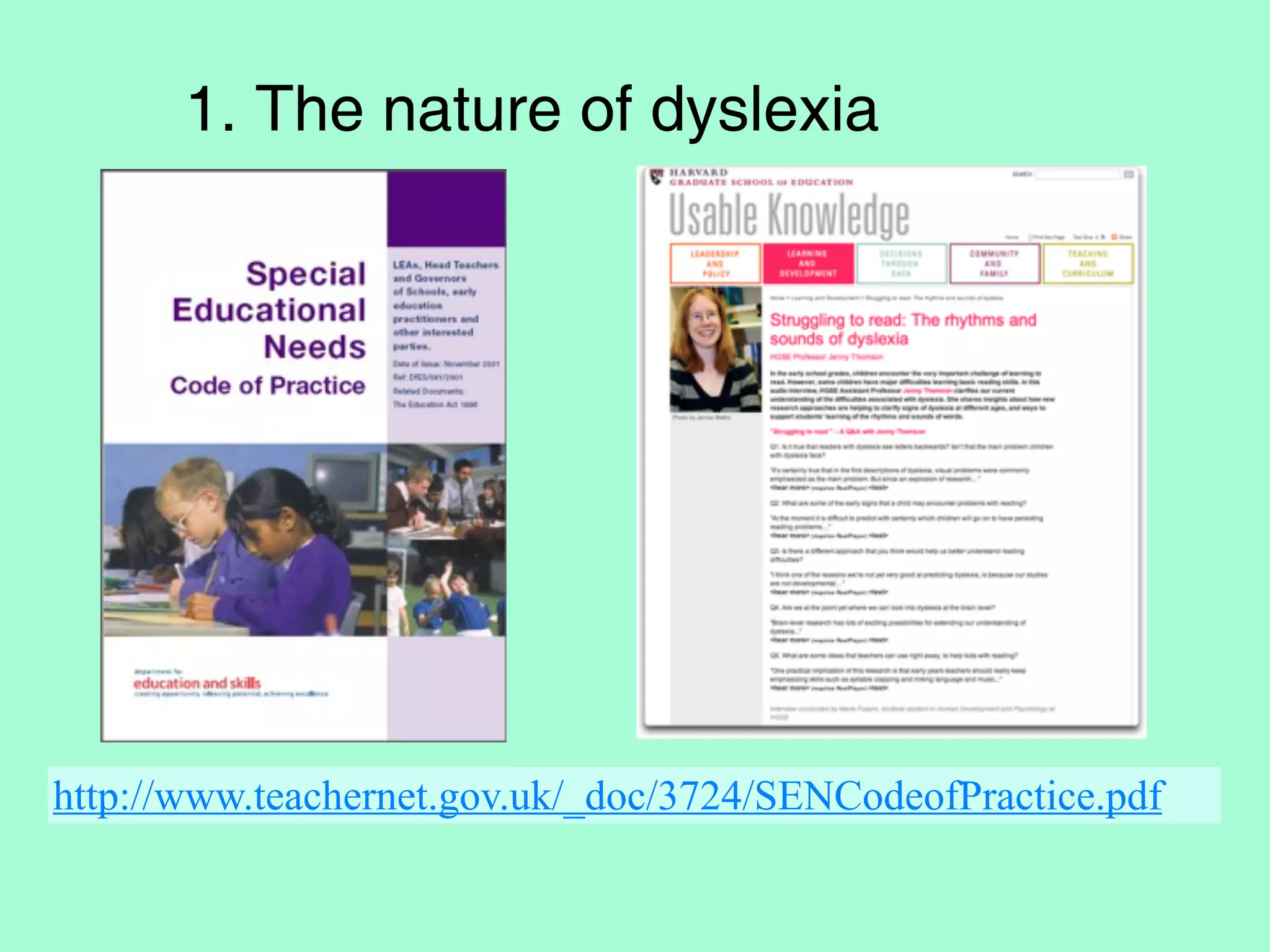
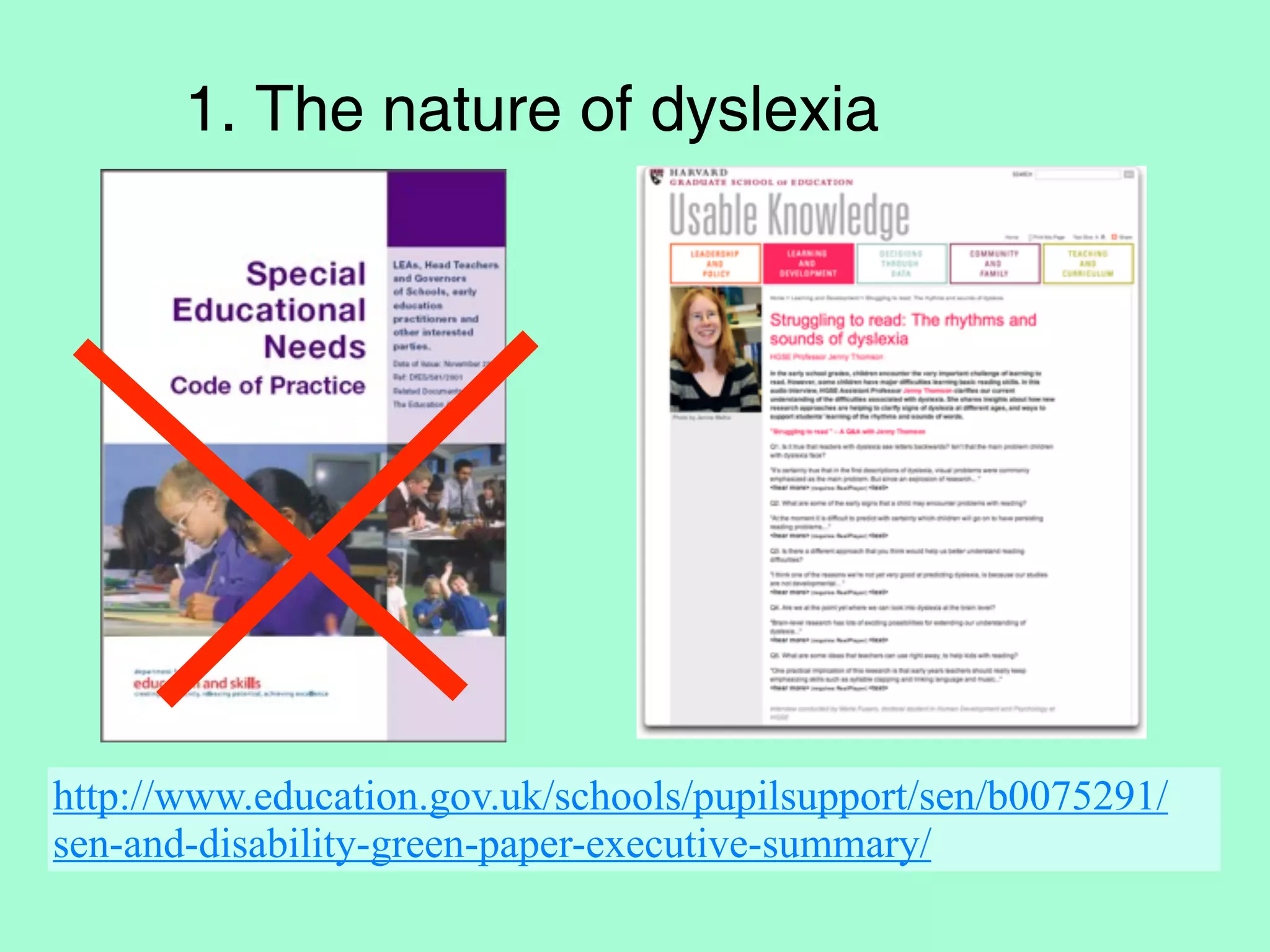
1. The nature of dyslexia


http://www.teachernet.gov.uk/_doc/3724/SENCodeofPractice.pdf
1. The nature of dyslexia


http://www.education.gov.uk/schools/pupilsupport/sen/b0075291/
sen-and-disability-green-paper-executive-summary/
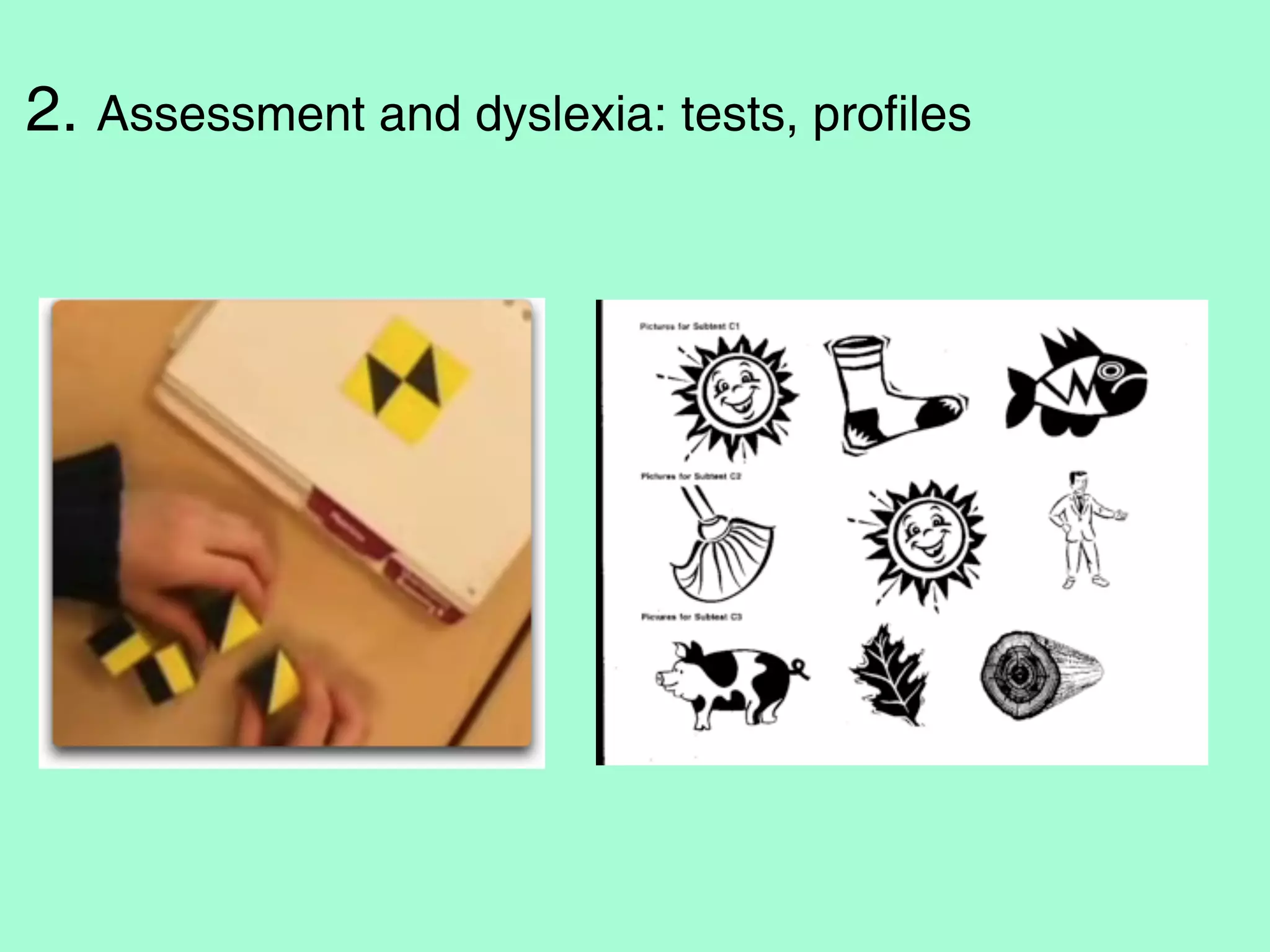
2. Assessment and dyslexia: tests, profiles
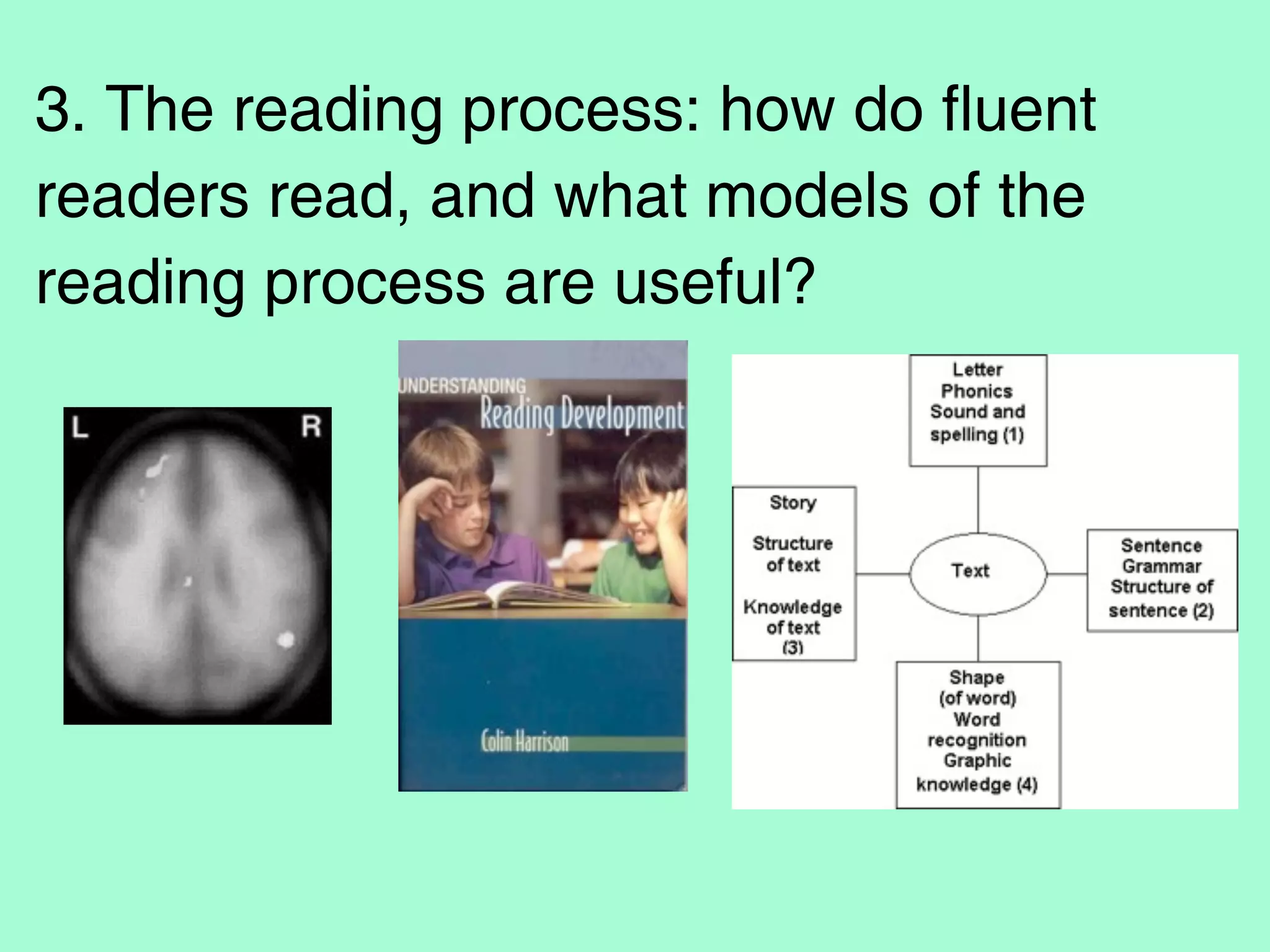
3. The reading process: how do fluent
readers read, and what models of the
reading process are useful?
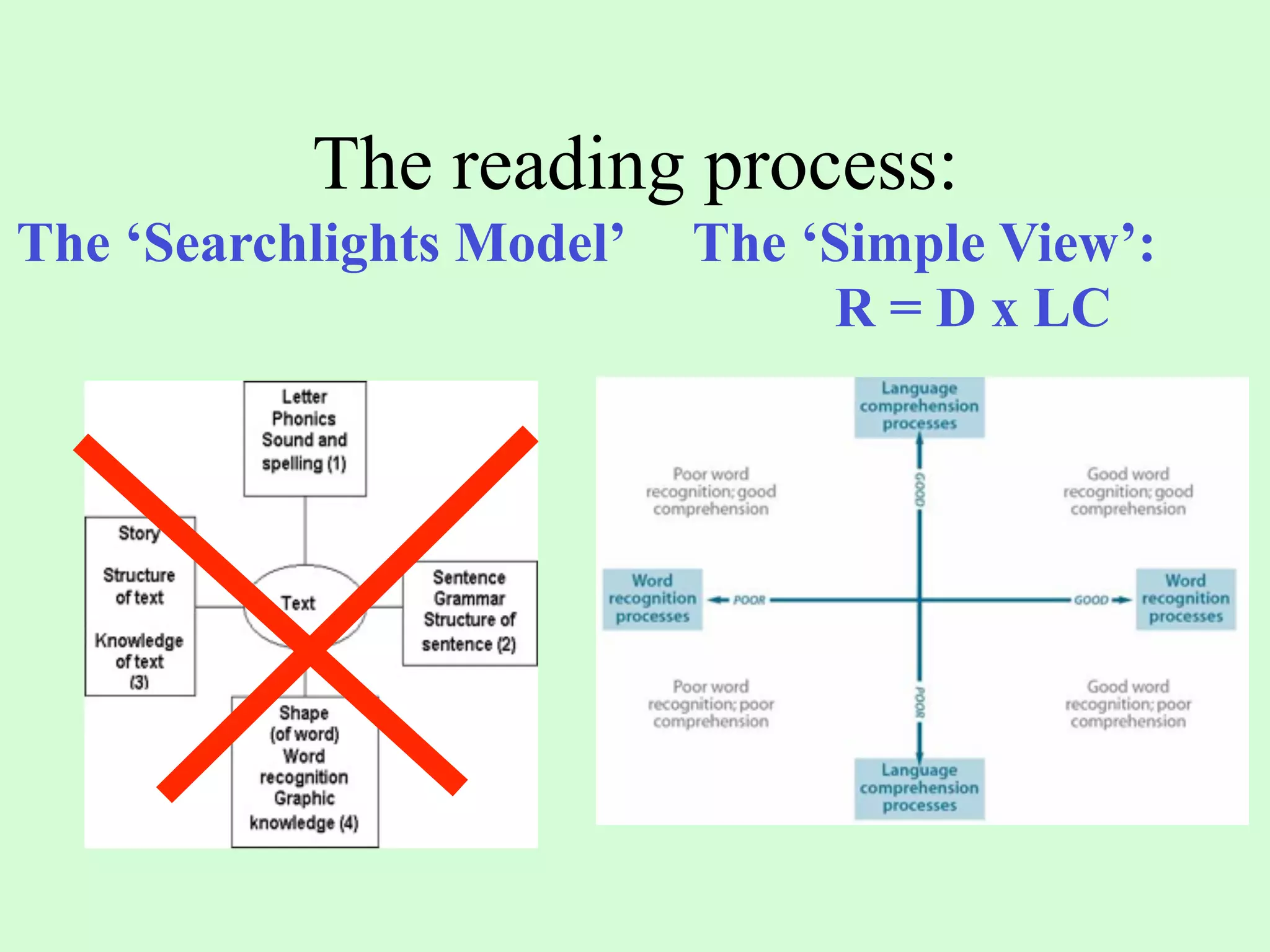
The reading process:
The ‘Searchlights Model’   The ‘Simple View’:
                                R = D x LC
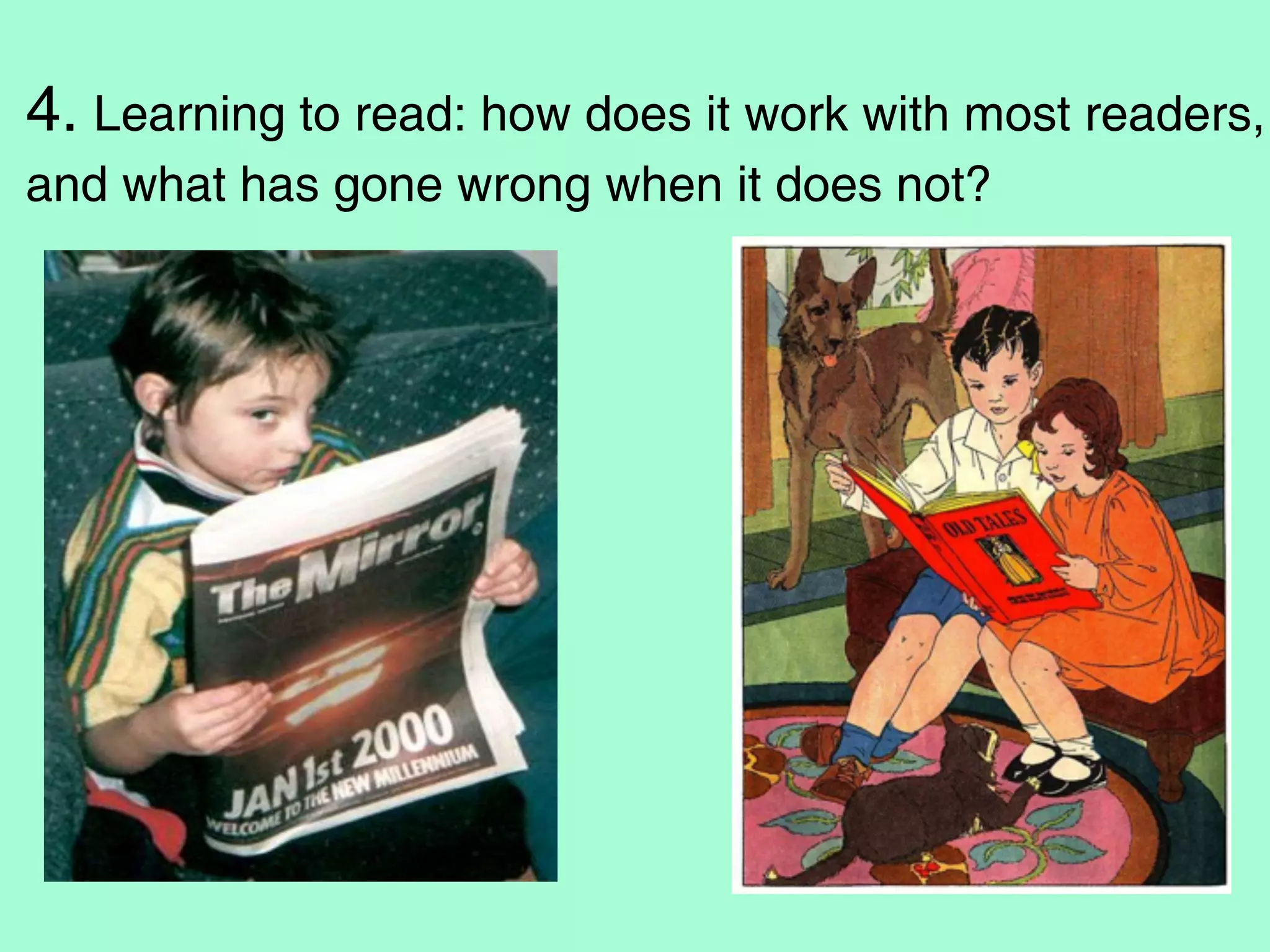
4. Learning to read: how does it work with most readers,
and what has gone wrong when it does not?
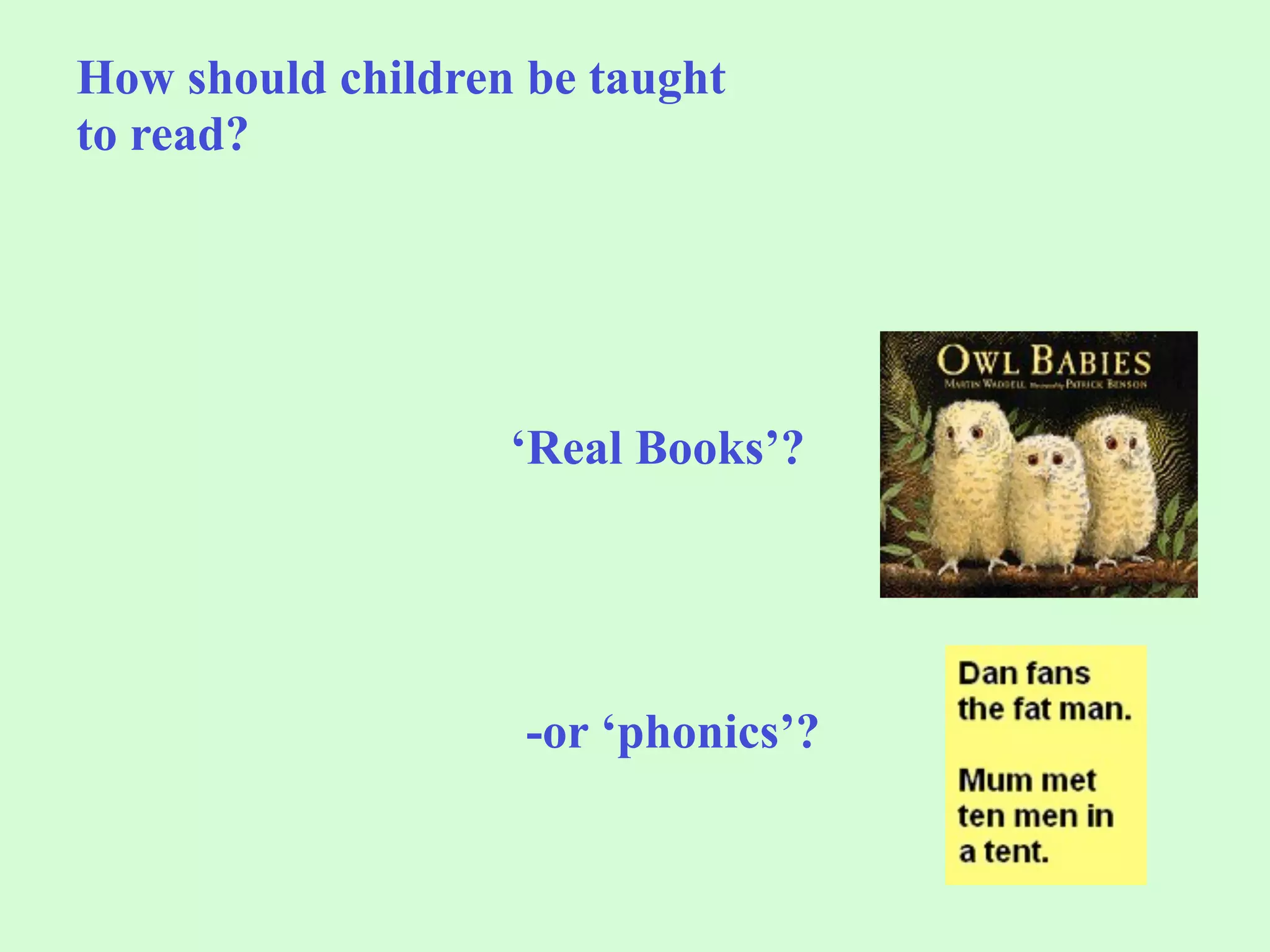
How should children be taught
to read?


                   ‘Real Books’?


                    -or ‘phonics’?
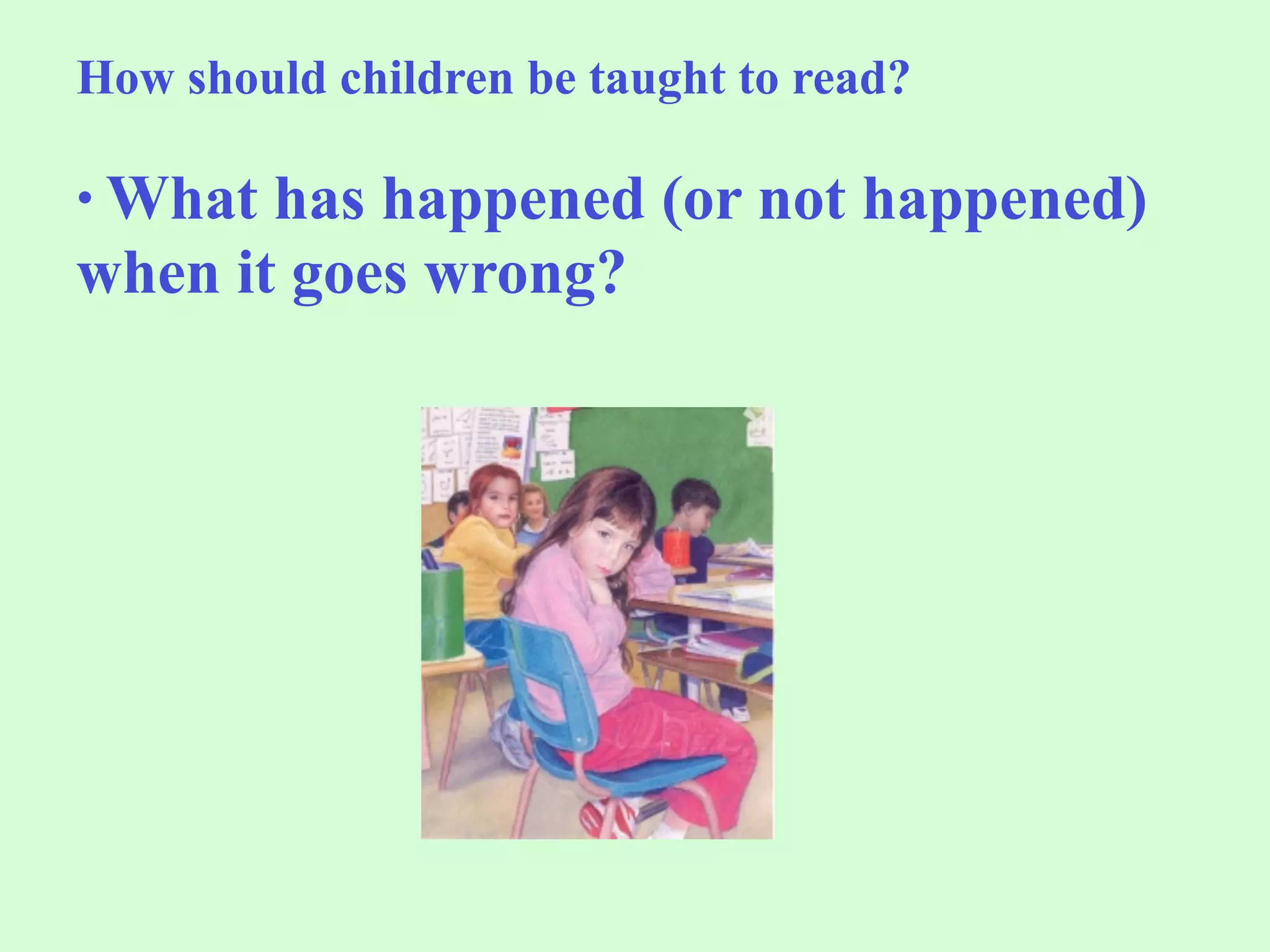
How should children be taught to read?

• What has happened (or not happened)
when it goes wrong?
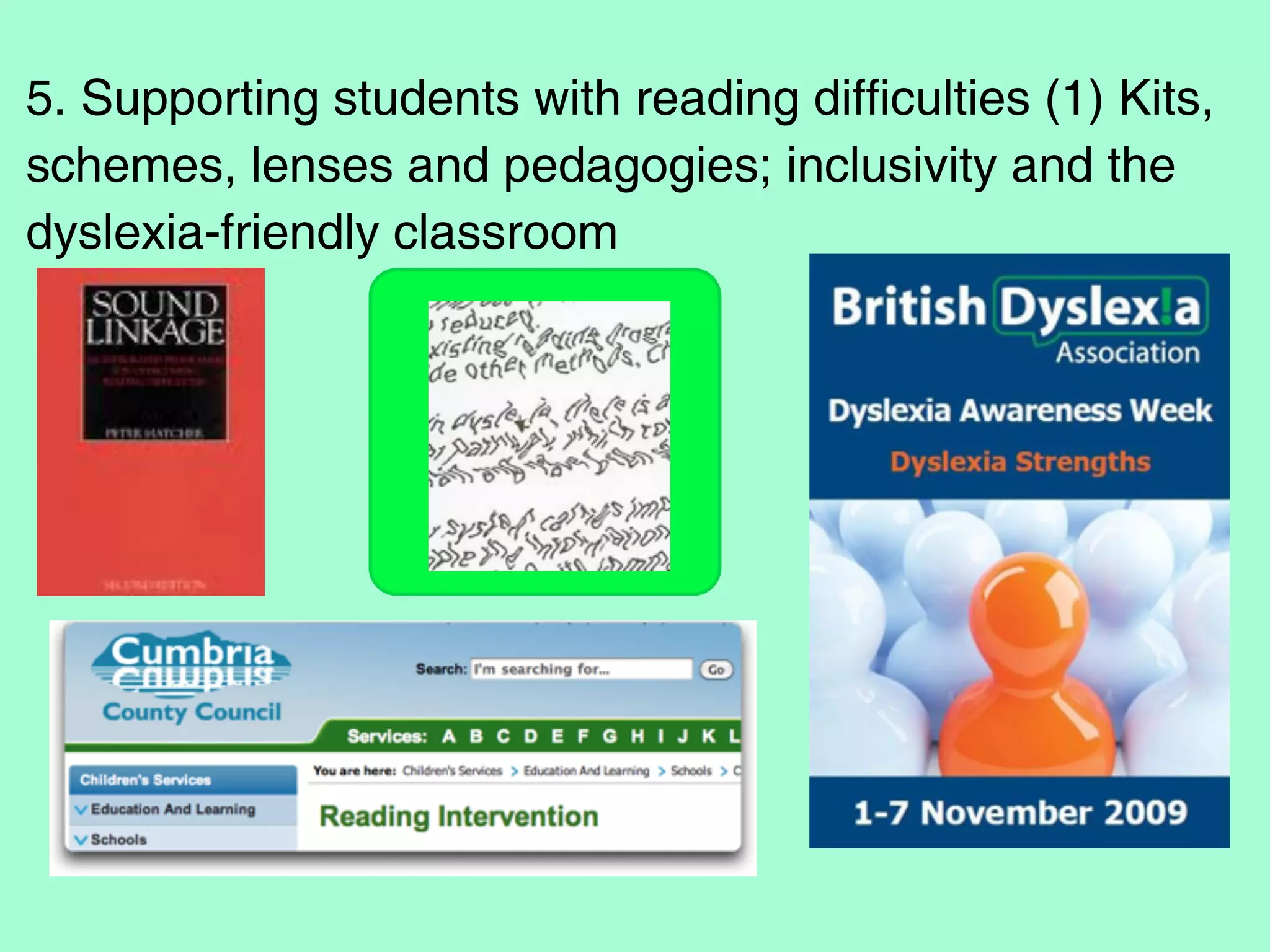
5. Supporting students with reading difficulties (1) Kits,
schemes, lenses and pedagogies; inclusivity and the
dyslexia-friendly classroom
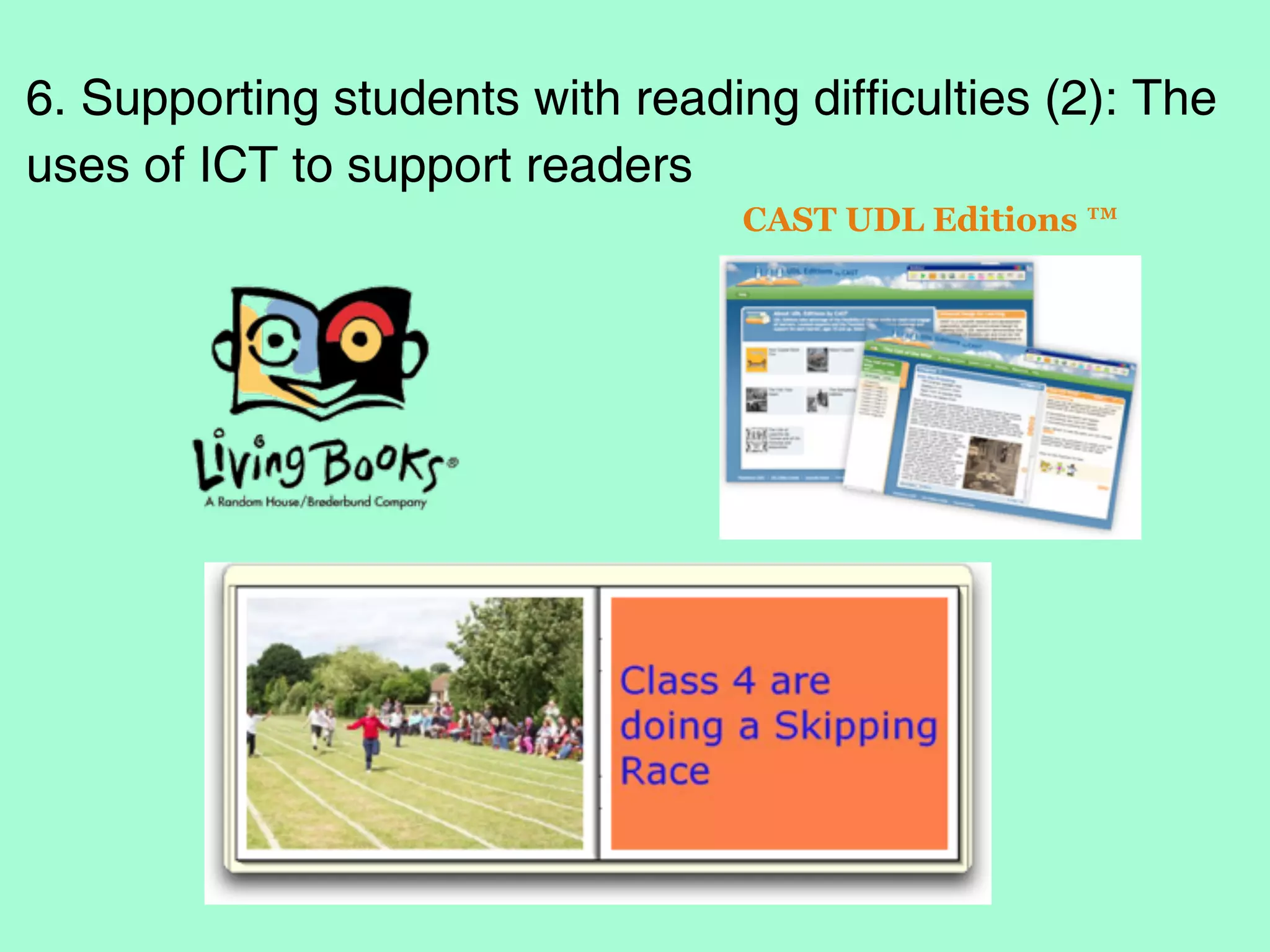
6. Supporting students with reading difficulties (2): The
uses of ICT to support readers
                                  CAST UDL Editions ™
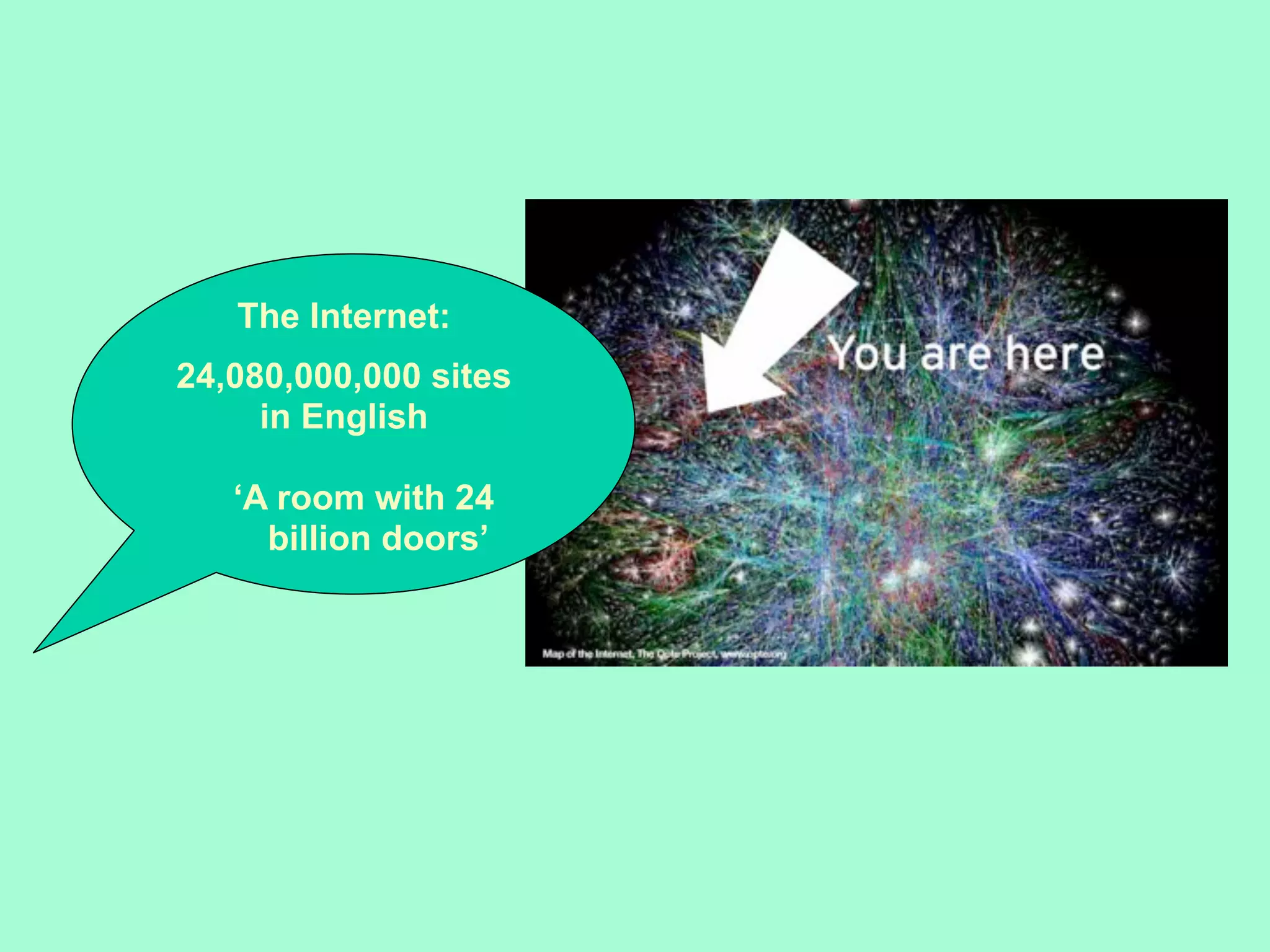
The Internet:
24,080,000,000 sites
     in English

   ‘A room with 24
     billion doors’
7. Is dyslexia a myth?
  Watch the video; evaluate the arguments


                1.Is dyslexia a myth? Watch the video; evaluate the arguments


             THE DYSLEXIA MYTH >
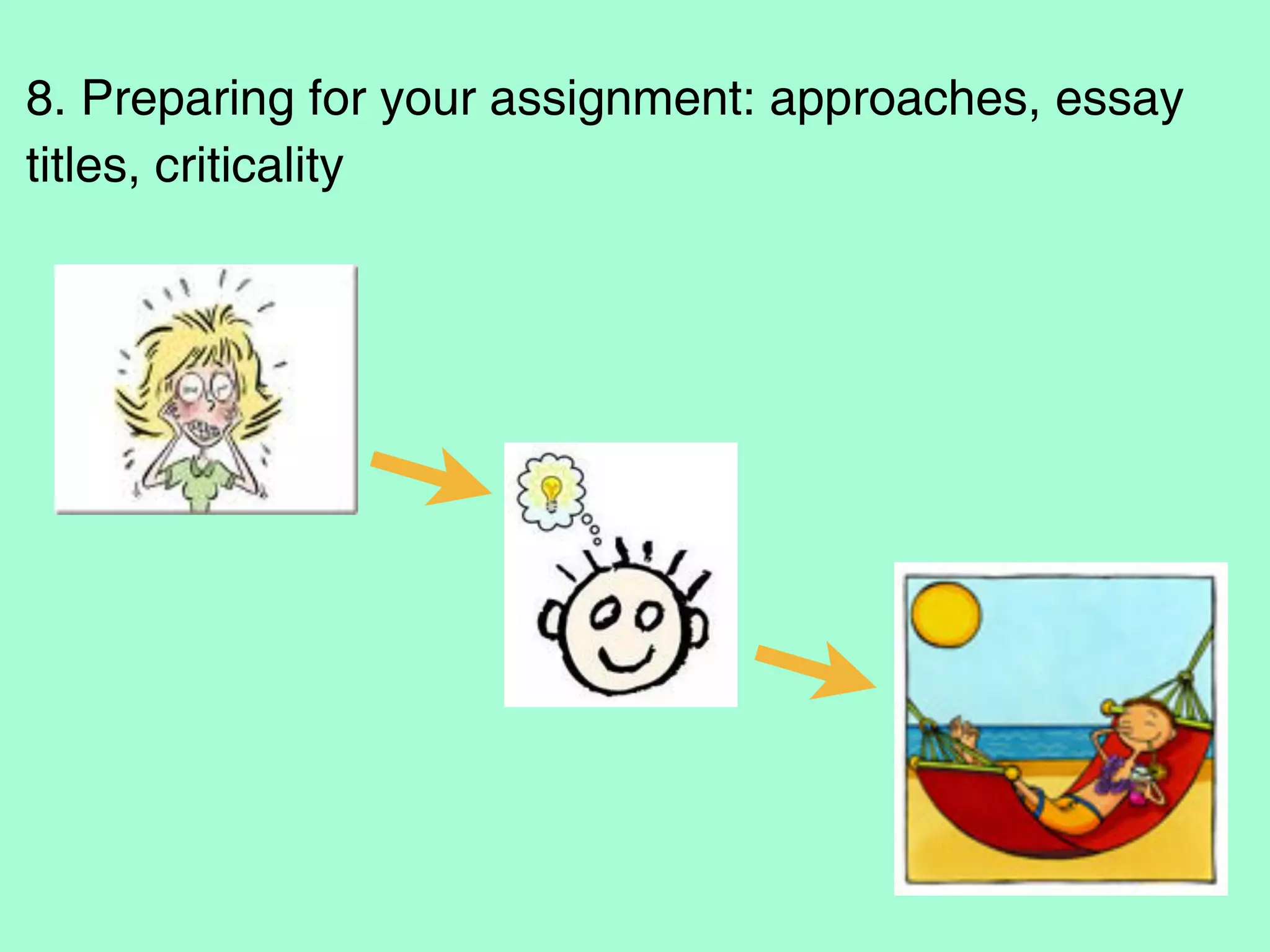
8. Preparing for your assignment: approaches, essay
titles, criticality
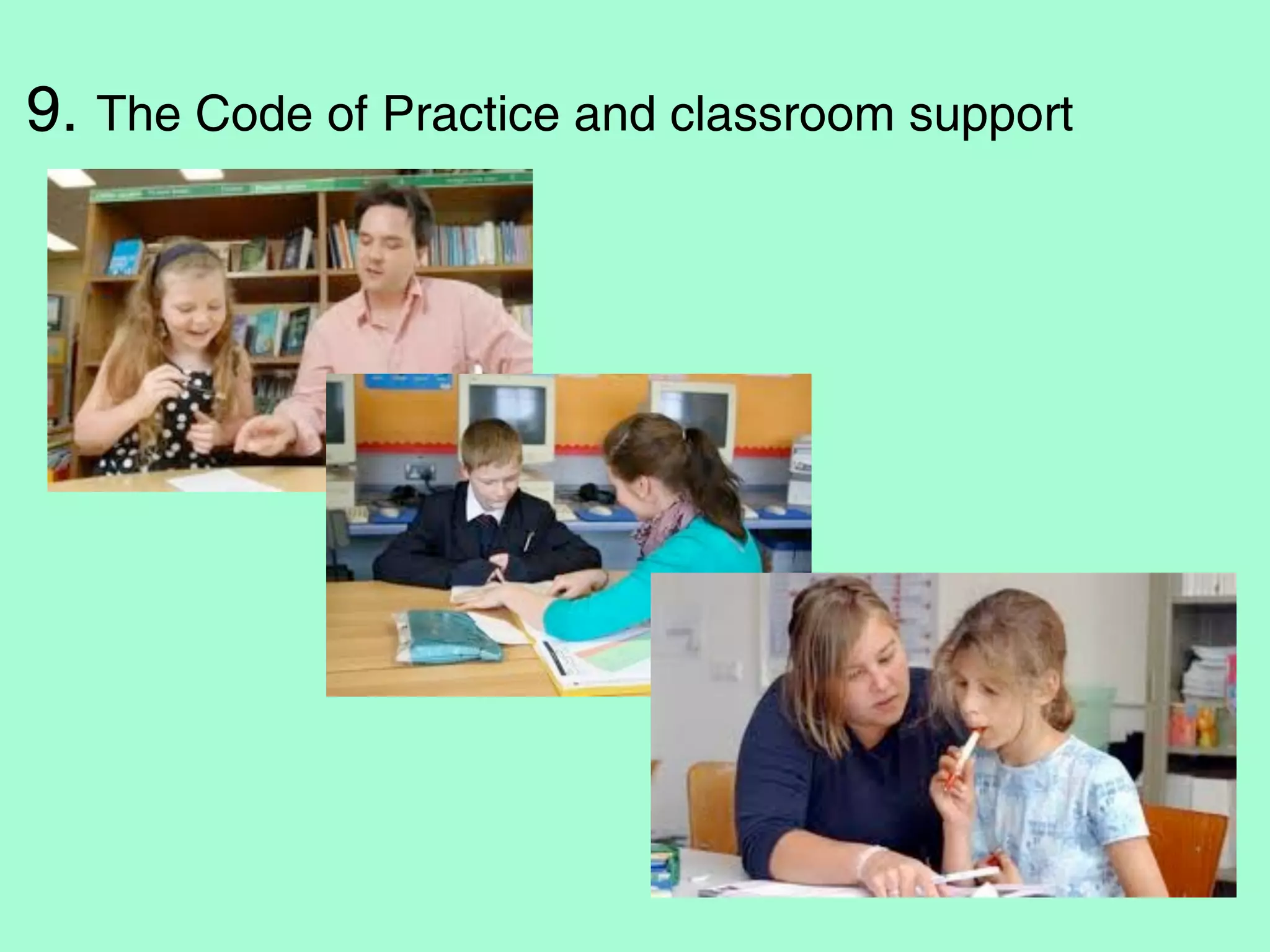
9. The Code of Practice and classroom support
10. What are the social and emotional effects of being
dyslexic?   Where do parents fit in? Module review
Definitions of dyslexia:
1. On a Post-It note, write your own answer
to the question ‘What is dyslexia?’
Definitions of dyslexia:
1. On a Post-It note, write your own answer
to the question ‘What is dyslexia?’
2. Look at the definitions of the others on
your table; try to spot similarities and
differences.
Definitions of dyslexia:
1. On a Post-It note, write your own answer
to the question ‘What is dyslexia?’
2. Look at the definitions of the others on
your table; try to spot similarities and
differences.
3. Decide as a group how you might classify
the definitions on your table; make a list of
3-5 classification categories.
Definitions of dyslexia:
1. On a Post-It note, write your own answer
to the question ‘What is dyslexia?’
2. Look at the definitions of the others on
your table; try to spot similarities and
differences.
3. Decide as a group how you might classify
the definitions on your table; make a list of
3-5 classification categories.
4. Let’s compare notes and see what we
come up with...
Definition categories for dyslexia:

1.
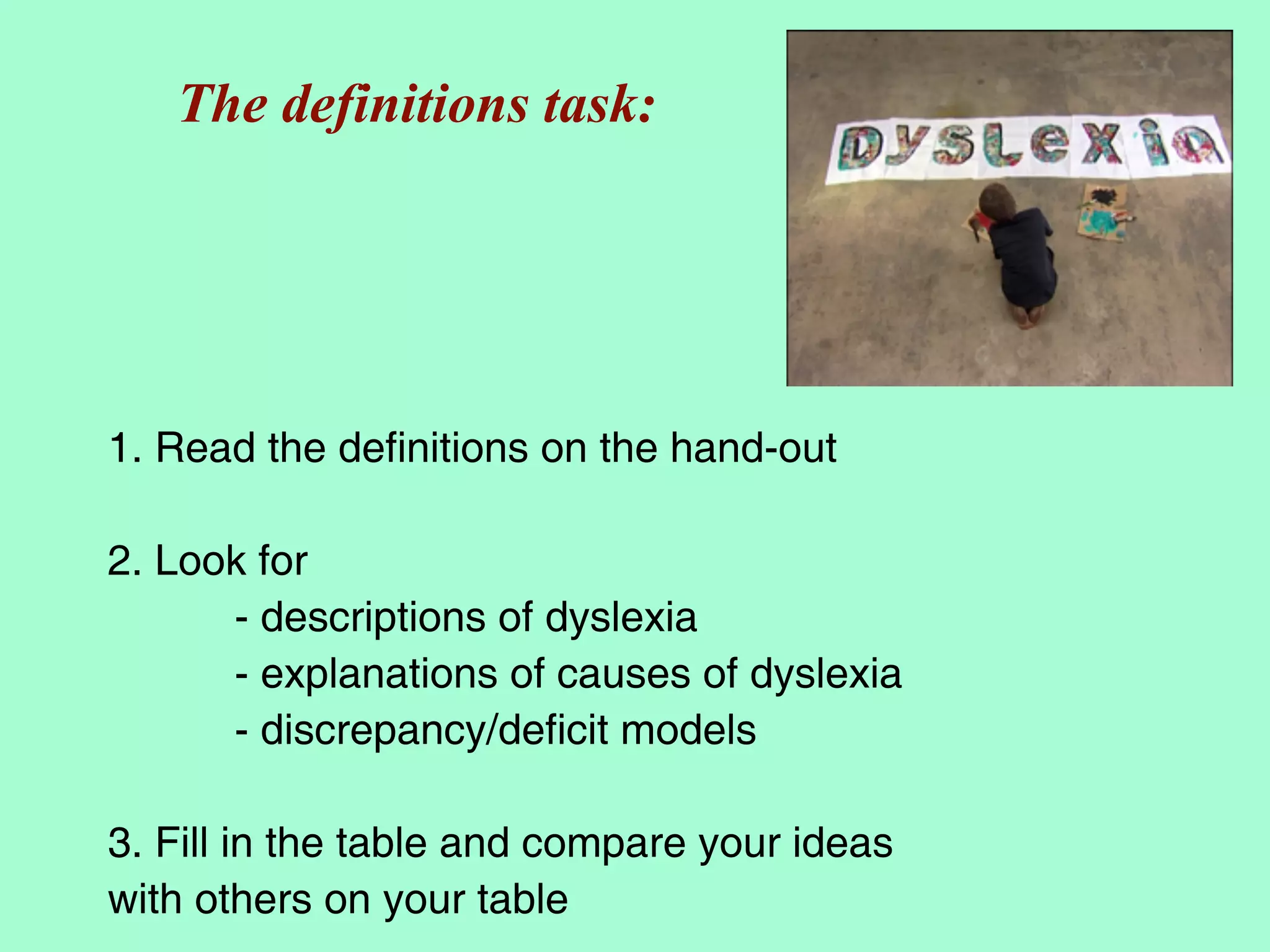
The definitions task:


1. Read the definitions on the hand-out

2. Look for
      - descriptions of dyslexia
      - explanations of causes of dyslexia
      - discrepancy/deficit models

3. Fill in the table and compare your ideas
with others on your table
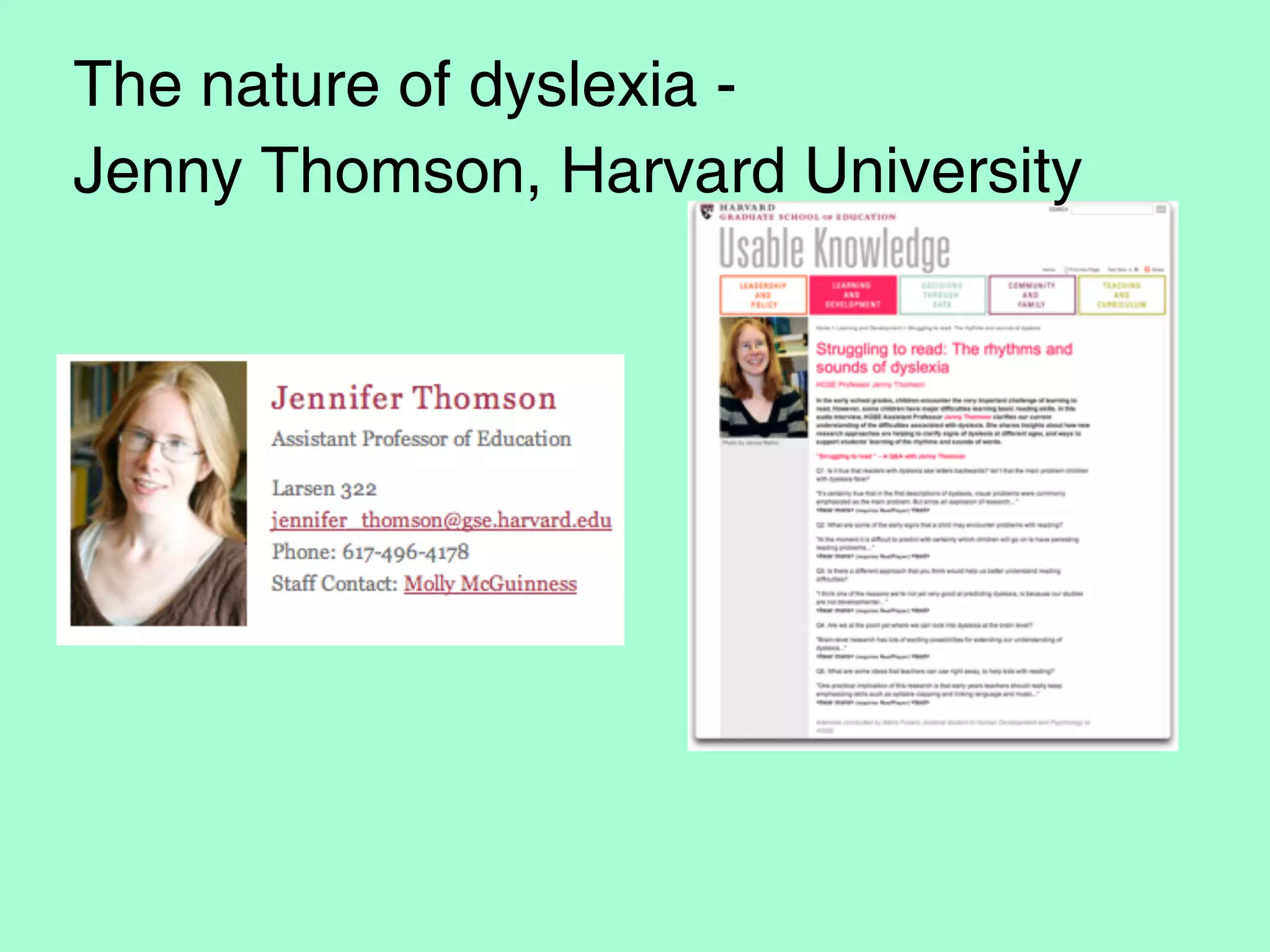
The nature of dyslexia -
Jenny Thomson, Harvard University
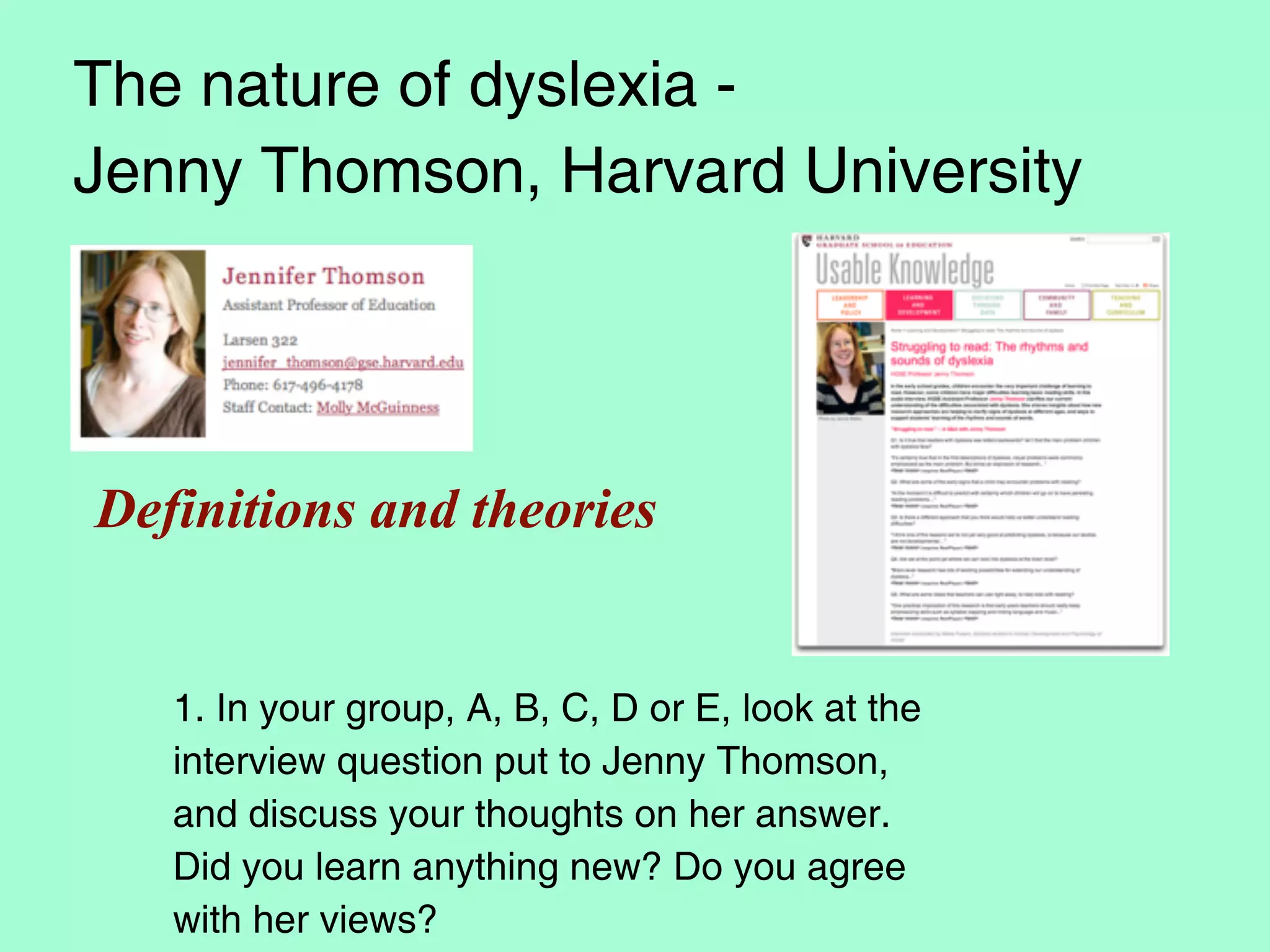
The nature of dyslexia -
Jenny Thomson, Harvard University


Definitions and theories


   1. In your group, A, B, C, D or E, look at the
   interview question put to Jenny Thomson,
   and discuss your thoughts on her answer.
   Did you learn anything new? Do you agree
   with her views?
And finally ...


Stanovich!!!

1. Your task before Session 3 tomorrow is to
read the two articles, and mark or highlight in
different colours, if you can:

   - key ideas
   - things you agree with
   - anything you disagree with
   - words or sections you don’t understand

MA dyslexia introduction

  • 1.
    Understanding & SupportingStudents with Reading Difficulties/Dyslexia Module XXD017 Introduction to the Dyslexia module; definitions and descriptions Colin Harrison and Jackie Dearden School of Education colin.harrison@nottingham.ac.uk jackie.dearden@nottingham.ac.uk
  • 2.
    Introduce yourself: 1. Fillin the personal information sheet 2. Then introduce yourself to the others on your table 3. Try to be able to say and spell the names of everyone on your table
  • 3.
    The ten units: 1.The nature of dyslexia; definitions and diagnosis 2. Assessment and dyslexia 3. The reading process: how do fluent readers read, and what models of the reading process are useful? 4. Learning to read: how does it work with most readers, and what has gone wrong when it does not? 5.Supporting students with reading difficulties (1) Kits, schemes, lenses and pedagogies; inclusivity and the dyslexia-friendly classroom 6. Supporting students with reading difficulties (2) The uses of ICT to support readers 7.Is dyslexia a myth? Watch the video; evaluate the arguments 8. Developing criticality, assignment planning; essay titles 9. Assessing learning opportunities for the individual 10. Social and emotional issues/ Establishing a dyslexia-friendly classroom and school + course review
  • 4.
    1. The natureof dyslexia http://www.teachernet.gov.uk/_doc/3724/SENCodeofPractice.pdf
  • 5.
    1. The natureof dyslexia http://www.education.gov.uk/schools/pupilsupport/sen/b0075291/ sen-and-disability-green-paper-executive-summary/
  • 6.
    2. Assessment anddyslexia: tests, profiles
  • 7.
    3. The readingprocess: how do fluent readers read, and what models of the reading process are useful?
  • 8.
    The reading process: The‘Searchlights Model’ The ‘Simple View’: R = D x LC
  • 9.
    4. Learning toread: how does it work with most readers, and what has gone wrong when it does not?
  • 10.
    How should childrenbe taught to read? ‘Real Books’? -or ‘phonics’?
  • 11.
    How should childrenbe taught to read? • What has happened (or not happened) when it goes wrong?
  • 12.
    5. Supporting studentswith reading difficulties (1) Kits, schemes, lenses and pedagogies; inclusivity and the dyslexia-friendly classroom
  • 13.
    6. Supporting studentswith reading difficulties (2): The uses of ICT to support readers CAST UDL Editions ™
  • 14.
    The Internet: 24,080,000,000 sites in English ‘A room with 24 billion doors’
  • 15.
    7. Is dyslexiaa myth? Watch the video; evaluate the arguments 1.Is dyslexia a myth? Watch the video; evaluate the arguments THE DYSLEXIA MYTH >
  • 16.
    8. Preparing foryour assignment: approaches, essay titles, criticality
  • 17.
    9. The Codeof Practice and classroom support
  • 18.
    10. What arethe social and emotional effects of being dyslexic? Where do parents fit in? Module review
  • 19.
    Definitions of dyslexia: 1.On a Post-It note, write your own answer to the question ‘What is dyslexia?’
  • 20.
    Definitions of dyslexia: 1.On a Post-It note, write your own answer to the question ‘What is dyslexia?’ 2. Look at the definitions of the others on your table; try to spot similarities and differences.
  • 21.
    Definitions of dyslexia: 1.On a Post-It note, write your own answer to the question ‘What is dyslexia?’ 2. Look at the definitions of the others on your table; try to spot similarities and differences. 3. Decide as a group how you might classify the definitions on your table; make a list of 3-5 classification categories.
  • 22.
    Definitions of dyslexia: 1.On a Post-It note, write your own answer to the question ‘What is dyslexia?’ 2. Look at the definitions of the others on your table; try to spot similarities and differences. 3. Decide as a group how you might classify the definitions on your table; make a list of 3-5 classification categories. 4. Let’s compare notes and see what we come up with...
  • 23.
  • 24.
    The definitions task: 1.Read the definitions on the hand-out 2. Look for - descriptions of dyslexia - explanations of causes of dyslexia - discrepancy/deficit models 3. Fill in the table and compare your ideas with others on your table
  • 25.
    The nature ofdyslexia - Jenny Thomson, Harvard University
  • 26.
    The nature ofdyslexia - Jenny Thomson, Harvard University Definitions and theories 1. In your group, A, B, C, D or E, look at the interview question put to Jenny Thomson, and discuss your thoughts on her answer. Did you learn anything new? Do you agree with her views?
  • 27.
    And finally ... Stanovich!!! 1.Your task before Session 3 tomorrow is to read the two articles, and mark or highlight in different colours, if you can: - key ideas - things you agree with - anything you disagree with - words or sections you don’t understand