INTRODUCTION
A learning difficultyis a condition that can cause
an individual to experience problems in a
traditional classroom learning context. It may
interfere with literacy skills development and
math/maths and can also affect memory, ability
to focus and organizational skills. A child or adult
with a learning difficulty may require additional
time to complete assignments at school and can
often benefit from strategy instruction and
classroom accommodations, such as material
4.
Learning difficulties aresometimes
referred to as learning disabilities. You
may also encounter the terms learning
differences or specific learning differences.
The differences between these labels can
seem subtle but may have implications for
how an individual with a learning difficulty
views him or herself. The word disability
implies a person is less able than his or her
peers. It can also suggest they are in a
permanent state of disadvantage and
5.
5 TYPES OFLEARNING DIFFICULTIES
This are the 5 common Learning
Difficulties:
1.Dyslexia
2.Attention Difficulties
3.Dysgraphia
4.Dyscalculia
5.Dyspraxia
6.
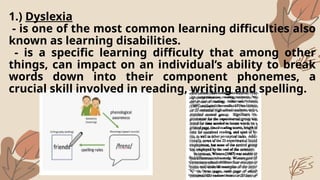
1.) Dyslexia
- isone of the most common learning difficulties also
known as learning disabilities.
- is a specific learning difficulty that among other
things, can impact on an individual’s ability to break
words down into their component phonemes, a
crucial skill involved in reading, writing and spelling.
7.
6 TYPES OF
DYSLEXIA
1.Phonological Dyslexia - People with
dyslexia have no trouble producing and
processing the sounds they need to speak
their native language. The difficulty comes
with identifying the individual sounds that
make up a word.
2. Surface Dyslexia - which can cause them to
take longer to process language when they
move beyond the decoding stage. Not all words
are spelled as they sound in English and
sometimes we meet a word that gives us no
8.
3. Visual Dyslexia- Symptoms often include trouble reading and
remembering what has been seen on a page. Visual Dyslexia
impacts on visual processing, meaning the brain doesn’t receive
the full picture of what the eyes are seeing. This can have severe
implications for learning to form letters and also mastering
spelling, a process in which remembering the correct letter
sequences in words is key.
4. Primary Dyslexia - The “primary” label refers to dyslexia when it
is a result of a genetically inherited condition. This means if a
child has a parent with dyslexia, they are more likely to have the
learning difficulty themselves.
•Primary Dyslexia can cause difficulties processing sounds, letters
and numbers, which negatively impacts on a child’s abilities in
spelling, reading and math. Dyslexia not only runs in families but
tends to be seen more often in males, particularly those who are
left-handed.
9.
5. Secondary/Developmental Dyslexia- Due to
infections, and sometimes poor nutrition in the womb,
some babies experience brain development issues
which can cause neurological impairment and result in
dyslexia.
•Secondary or Developmental has been shown to
respond best to treatment, including targeted phonics
work through computer programmer.
6. Trauma Dyslexia also referred to as Acquired Dyslexia
- When an adult or child has a brain injury from trauma
or disease, they can sometimes develop difficulties with
language processing, which result in dyslexia.
10.
Causes:
-Dyslexia tends torun in families.
-It appears to be linked to certain genes that
affect how the brain processes reading and
language, as well as risk factors in the
environment.
Risk factors
Dyslexia risk factors include:
• A family history of dyslexia or other learning disabilities
• Premature birth or low birth weight
•Exposure during pregnancy to nicotine, drugs, alcohol or infection
that may alter brain development in the fetus
• Individual differences in the parts of the brain that enable reading
•Children who have dyslexia are at increased risk of having attention-
deficit/hyperactivity disorder (ADHD), and vice versa. ADHD can cause
difficulty sustaining attention as well as hyperactivity and impulsive
behavior, which can make dyslexia harder to treat.
11.
5 STRATEGIES YOUCAN APPLY IN YOUR
ROOM:
1. Multisensory Learning
Multisensory activities help dyslexic children
absorb and process information in a
retainable manner and involve using senses
like touch and movement alongside sight and
hearing.
Examples:
Writing words and sentences with tactile
materials,e.g. glitter glue, sand, pasta, LEGO,
12.
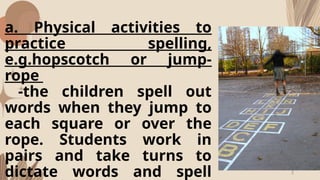
a. Physical activitiesto
practice spelling,
e.g.hopscotch or jump-
rope
-the children spell out
words when they jump to
each square or over the
rope. Students work in
pairs and take turns to
dictate words and spell
13.
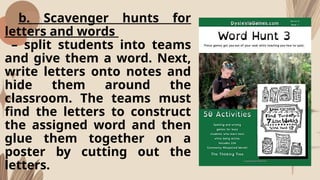
b. Scavenger huntsfor
letters and words
– split students into teams
and give them a word. Next,
write letters onto notes and
hide them around the
classroom. The teams must
find the letters to construct
the assigned word and then
glue them together on a
poster by cutting out the
letters.
14.
2. Assistive TechnologyAnd
Tools
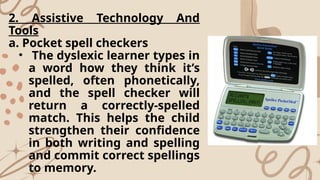
a. Pocket spell checkers
• The dyslexic learner types in
a word how they think it’s
spelled, often phonetically,
and the spell checker will
return a correctly-spelled
match. This helps the child
strengthen their confidence
in both writing and spelling
and commit correct spellings
to memory.
15.
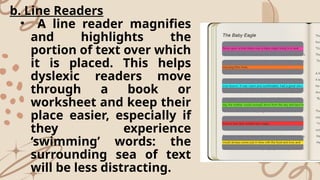
b. Line Readers
•A line reader magnifies
and highlights the
portion of text over which
it is placed. This helps
dyslexic readers move
through a book or
worksheet and keep their
place easier, especially if
they experience
‘swimming’ words: the
surrounding sea of text
will be less distracting.
16.
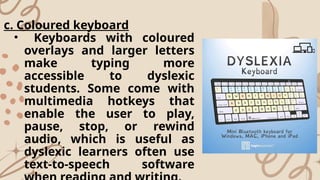
c. Coloured keyboard
•Keyboards with coloured
overlays and larger letters
make typing more
accessible to dyslexic
students. Some come with
multimedia hotkeys that
enable the user to play,
pause, stop, or rewind
audio, which is useful as
dyslexic learners often use
text-to-speech software
17.
A. USE ACLOZE PROCEDURE.
Give students a worksheet with missing key words so
they can fill in the blanks as they listen.
3. HELPFUL ARRANGEMENTS
B. GIVE THEM PLENTY OF TIME TO COMPLETE HOMEWORK.
Assign homework on Fridays so students have the
weekend to complete it.
C. MARK BASED ON EFFORT AND IDEAS
Focus on creativity and understanding rather than just
spelling and grammar.
18.
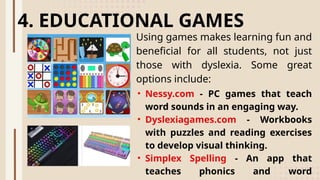
Using games makeslearning fun and
beneficial for all students, not just
those with dyslexia. Some great
options include:
4. EDUCATIONAL GAMES
• Nessy.com - PC games that teach
word sounds in an engaging way.
• Dyslexiagames.com - Workbooks
with puzzles and reading exercises
to develop visual thinking.
• Simplex Spelling - An app that
teaches phonics and word
19.
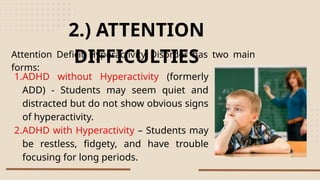
Attention Deficit HyperactivityDisorder has two main
forms:
2.) ATTENTION
DIFFICULTIES
1.ADHD without Hyperactivity (formerly
ADD) - Students may seem quiet and
distracted but do not show obvious signs
of hyperactivity.
2.ADHD with Hyperactivity – Students may
be restless, fidgety, and have trouble
focusing for long periods.
20.
14 STRATEGIES FORMANAGING ATTENTION
PROBLEMS:
1.Take the Mystery Away
2.Understand Consistent
Inconsistency
3.Explore the Option of
Medication
4.Vary Instructional
Strategies
5.Use Signals
6.Leverage Interests
9.Use Behavior Modification
and Self-Assessment
10. Discourage Frenetic
Work Patterns
11.Get Organized
12.Use Daily Planners
13.Set Up a Home Office
14.Allow Time to Wind Down
21.
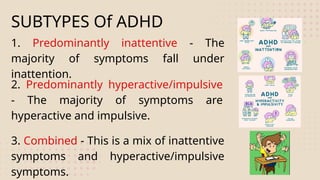
SUBTYPES Of ADHD
1.Predominantly inattentive - The
majority of symptoms fall under
inattention.
2. Predominantly hyperactive/impulsive
- The majority of symptoms are
hyperactive and impulsive.
3. Combined - This is a mix of inattentive
symptoms and hyperactive/impulsive
symptoms.
22.
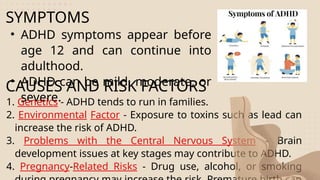
SYMPTOMS
• ADHD symptomsappear before
age 12 and can continue into
adulthood.
• ADHD can be mild, moderate, or
severe.
CAUSES AND RISK FACTORS
1. Genetics - ADHD tends to run in families.
2. Environmental Factor - Exposure to toxins such as lead can
increase the risk of ADHD.
3. Problems with the Central Nervous System - Brain
development issues at key stages may contribute to ADHD.
4. Pregnancy-Related Risks - Drug use, alcohol, or smoking
23.
3.) Dysgraphia
• Childrenwho struggle with dysgraphia have a hard time
with writing and may produce text that is illegible.
• Writing can be labored, taking a long time to complete and
causing frustration and stress.
• Staying in the margins, using punctuation and choosing
between capital and lowercase letters may also be hard.
9 Tips for Students:
1.Stretch out your hands 6.Make audio-recordings
2.Learn to touch-type 7. Recite word spelling out loud
3.Use cursive vs. print 8.Brainstorm ideas before
writing
24.
Some common characteristicsof dysgraphia
include:
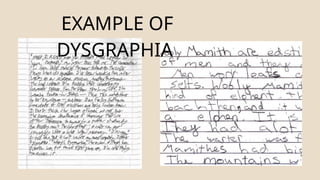
• Incorrect spelling and capitalization
• Mix of cursive and print letters
• Inappropriate sizing and spacing of letters
• Difficulty copying words
• Slow or labored writing
• Difficulty visualizing words before writing them
• Unusual body or hand position when writing
• Tight hold on pen or pencil resulting in hand
cramps
• Watching your hand while you write
• Saying words aloud while writing
•
4.) Dyscalculia
*(from Greek:dus- “ill”, kalos “beauty”
*“MATH ANCIETY”
*Dyscalculia has to do with processing numbers.
*They may not know how to approach a math/maths
problem.
*Even counting can be a struggle and it is often
recommended that individuals with dyscalculia be allowed
to use a calculator to support their learning.
*When dyslexia and dyscalculia are present together,
reading word problems is made more difficult, and number
reversals may be frequent.
*Dysgraphia and dyscalculia together mean a child often
finds showing math/maths work in long form particularly
difficult to complete.
27.
There Are 6Different Classification Symptoms Of Dyscalculia
According to Kosc:
1.Verbal dyscalculia – naming specific amounts, e.g. ‘three
oranges’. Later research calls it a lack of number sense, or
difficulty in understanding quantity.
2.Practognostic dyscalculia – manipulating objects
mathematically, e.g. making comparisons to determine which
is smaller or larger, less or more etc.
3.Ideognostical dyscalculia – understanding mathematical and
arithmetic concepts and relationships.
4.Lexical dyscalculia – reading mathematical symbols, such as
operational signs (+, -, <, > etc) and numbers.
5.Graphical dyscalculia – writing mathematical symbols such as
operational signs (+, -, <, > etc) and numbers.
6.Operational dyscalculia – performing arithmetic and
mathematical calculations.
28.
5.) Dyspraxia
• Dyspraxiais a motor skills difficulty that can also impact on academic
success.
• That’s because it affects the planning and coordination of muscles,
including those of the hand.
• As gripping the pen or pencil in written language production is painful,
writing may contain more spelling errors and less text as a result.
• People with dyspraxia may also walk with a funny gait, have trouble
using a paintbrush in art class, experience difficulties playing a musical
instrument, and/or performing coordinated movements in sports.
• They can be clumsy and might also struggle with organisation and
tasks that involve planning.
Some of the general symptoms of dyspraxia include:
• Poor balance •Differences in speech
• Poor posture • Perception problems
• Fatigue •Poor hand-eye coordination
• Clumsiness
29.
Causes of dyspraxia
Scientistsdo not know what causes dyspraxia. Experts believe the
person’s nerve cells that control muscles (motor neurons) are not
developing correctly. If motor neurons cannot form proper
connections, for whatever reason, the brain will take much longer to
process data.
Some Tips On How Teacher Can Help To A Child With Dyspraxia:
1.Pay attention to writing utensils and paper.
2. Consider alternatives to activities requiring handwriting.
3. Teach dyspraxic children touch-typing.
4. Adjust seating plans.
5. Provide breaks in the schedule.
6. Give plenty of extra time.
7. Emphasize directions in step-by-step form.
8. Provide written, visual and recorded support.
9. Keep a list of classroom rules and role-play expected behaviour.
10. Help with tasks that require fine motor skills.