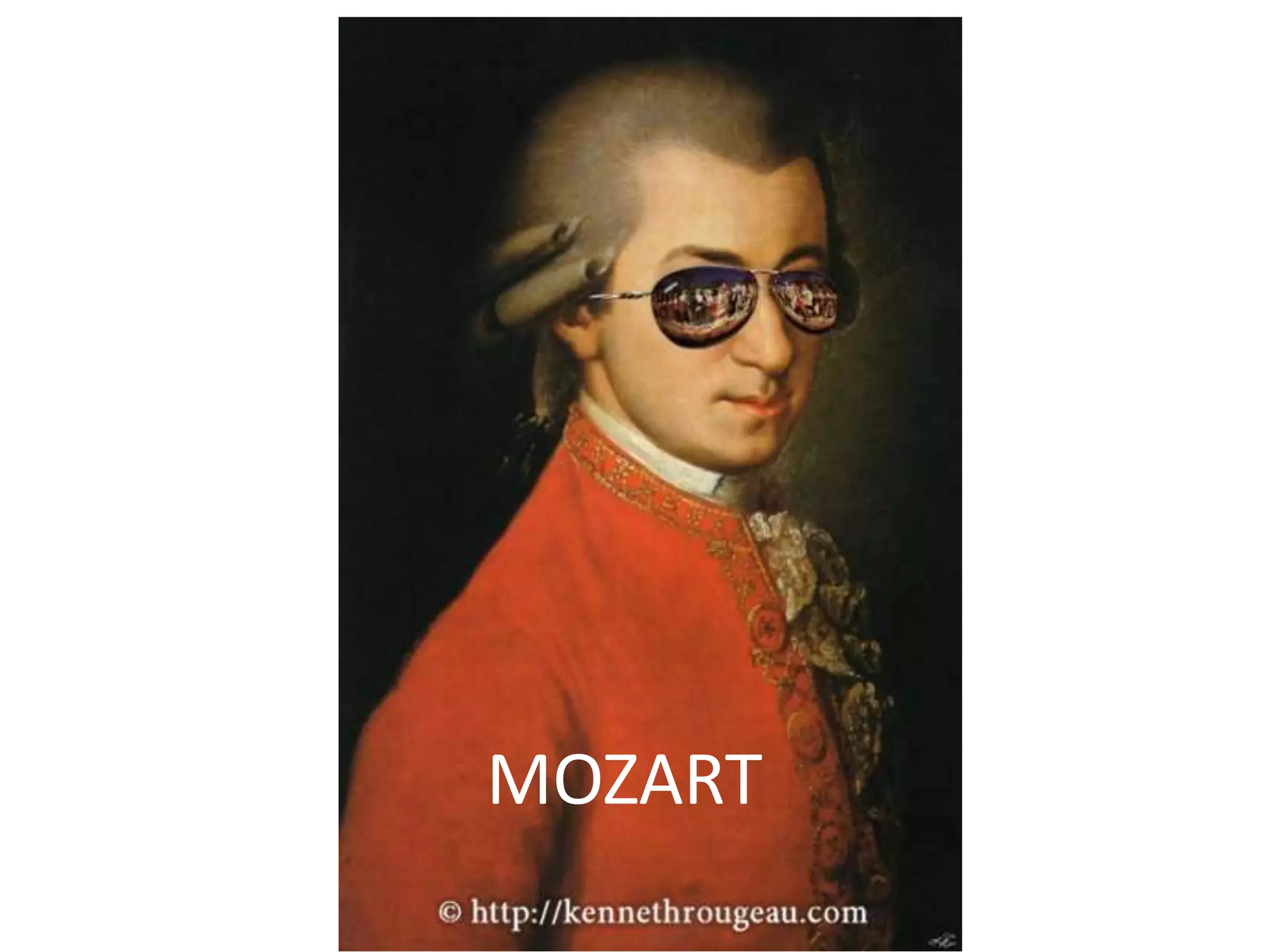
MOZART
Leonardo Da Vinci
THOMAS EDISON
ALEXANDER GRAHAM BELL
NEWTON
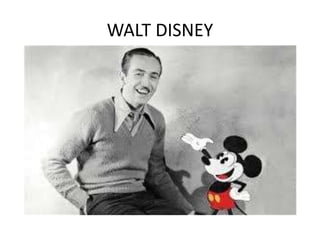
WALT DISNEY
TOM CRUISE
ALBERT EINSTEIN
BILL GATES
LEARNING DISABILITIES
WHAT IS A LEARNING DISABILITY?
1) A learning disability is any of a number of
conditions that make the process of learning
difficult because of the way the brain
processes information.
2) A disorder found in children of normal
intelligence who have difficulties in learning
specific skills.
3) An extreme difficulty in performing a specific
mental skill such as reading or doing
mathematical problems. It is inconsistent with
the person's overall intelligence and
sometimes linked to perceptual or memory
problems.
4) A disorder in basic psychological processes
involved in understanding or using language,
spoken or written, that may manifest itself in
an imperfect ability to listen, think, speak,
read, write, spell or use mathematical
calculations.
5) A variety of disorders, including hyperactivity,
dyslexia, and hearing problems, that can
interfere with a person's ability to learn
6) A disorder that hinders people's ability to
either interpret what they see or what they
hear . These limitations are characterized by
difficulty in reading, writing, and arithmetic.
Causes of Specific
Learning Disabilities
• Physiological:
– Brain injury – may occur
prenatally if exposed to toxins,
during birth if deprived of oxygen,
or postnatally from an accident or
illness.
– Heredity – if one or both parents
have a learning disability, the
chance of the child having one is
30-50%.
– Chemical imbalance –
biochemical disorder in the brain.
Causes (cont.)
Curriculum and Environmental
Contributors:
– Poor nutrition
– Adverse emotional climate
– Toxins in the environment - lead-
based paint, cigarette smoke
– Too little stimulation
– Lack of educational materials
– English as a second language
– Children who live in poverty
Causes (cont)
– Lack of medical care
– Low parent education and less modeling
– Few early learning experiences
In most cases, a single cause is not known,
and it is very unlikely that a primary cause is
ever identified.
However, a combination of one or more of
these causes are most often considered. It is
not uncommon for SLD to co-occur with
social, emotional, or behavior problems.
TYPES
• Motor difficulties (Dyspraxia)
• Math difficulties (Dyscalculia)
• Language
difficulties(Aphasia/Dysphasia)
• Reading difficulties (Dyslexia)
• Writing difficulties (Dysgraphia)
• Auditory and visual processing
difficulties
Dyslexia
A language-based learning disability
• Involves a cluster of symptoms resulting in difficulty with
specific language skills, particularly reading.
• The core difficulty is with word recognition and reading
fluency, spelling, and writing.
• Dyslexia is diagnosed in people of all levels of intelligence.
• There are no known causes of dyslexia.
• Most people with dyslexia need help from a teacher, tutor,
or therapist specially trained in using a multisensory,
structured language approach.
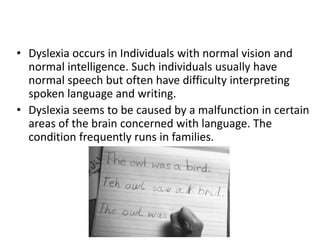
• Dyslexia occurs in Individuals with normal vision and
normal intelligence. Such individuals usually have
normal speech but often have difficulty interpreting
spoken language and writing.
• Dyslexia seems to be caused by a malfunction in certain
areas of the brain concerned with language. The
condition frequently runs in families.
Signs and Symptoms of Dyslexia
• Dyslexia can be difficult to recognize, but
some early clues may indicate a problem.
• problem with new words,
• deb
• difficulty rhyming
• Problems linking letters with sounds
• Writing words backwards
• Problems following directions with many steps
Dyscalculia
• The word "dyscalculia" means difficulty performing
math calculations.
• In other words, it just means "math difficulty". And
specifically, it means a learning disability which
affects math.
• Sometimes confusion arises when we start dealing
with the term "dyscalculia" as it relates to "special
education services".
• When a student's math difficulties are severe enough
to meet this criteria, special education services are
indicated. On the other hand, "dyscalculia" has no
clearly defined criteria.
Dyscalculia
• Good at speaking, reading, and writing, but slow to
develop counting and math problem-solving skills
• Good memory for printed words, but difficulty reading
numbers, or recalling numbers in sequence
• Good with general math concepts, but frustrated when
specific computation and organization skills need to be
used
• Trouble with the concept of time-chronically late,
difficulty remembering schedules, trouble with
approximating how long something will take
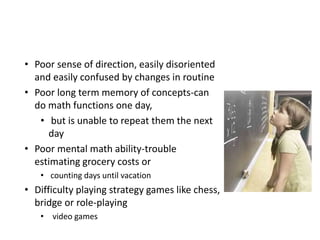
• Poor sense of direction, easily disoriented
and easily confused by changes in routine
• Poor long term memory of concepts-can
do math functions one day,
• but is unable to repeat them the next
day
• Poor mental math ability-trouble
estimating grocery costs or
• counting days until vacation
• Difficulty playing strategy games like chess,
bridge or role-playing
• video games
Dysgraphia
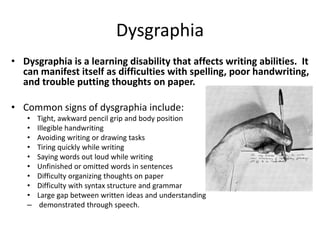
• Dysgraphia is a learning disability that affects writing abilities. It
can manifest itself as difficulties with spelling, poor handwriting,
and trouble putting thoughts on paper.
• Common signs of dysgraphia include:
• Tight, awkward pencil grip and body position
• Illegible handwriting
• Avoiding writing or drawing tasks
• Tiring quickly while writing
• Saying words out loud while writing
• Unfinished or omitted words in sentences
• Difficulty organizing thoughts on paper
• Difficulty with syntax structure and grammar
• Large gap between written ideas and understanding
– demonstrated through speech.
Dyspraxia
• A motor coordination disability (also known as
Sensory Integration Disorder).
• Adults with dyspraxia may have difficulty carrying
out tasks such as driving, cooking, and household
chores or grooming.
• Children with dyspraxia may be late in reaching
developmental milestones, such as rolling over,
sitting, standing and walking. They may
frequently fall over, and when older may avoid PE
and swimming lessons at school or any other
sporting activity.
Aphasia
• A language disability (the student has
difficulty understanding spoken language).
• inability to comprehend language
• inability to pronounce, not due to muscle
paralysis or weakness
• inability to speak spontaneously
• inability to form words
• inability to name objects
DYSPHASIA
• A language disability (the student has difficulty
with reading comprehension).
• Difficulty remembering words
• Difficulty naming objects and/or people
• Difficulty speaking in complete and/or
meaningful sentences
• Difficulty speaking in any fashion
• Difficulty reading or writing
• Difficulty expressing thoughts and feelings
• Difficulty understanding spoken language
Central Auditory Processing Disorder
A sensory disability
related to processing
sounds.
• have trouble paying attention to and remembering information
presented orally, and may cope better with visually acquired
information
• have problems carrying out multi-step directions given orally;
need to hear only one direction at a time
• have poor listening skills
• need more time to process information
• have low academic performance
• have behavior problems
• have language difficulties (e.g., they confuse syllable sequences
and have problems developing vocabulary and understanding
language)
• have difficulty with reading, comprehension, spelling, and
vocabulary
Sign and symptoms of Central Auditory
Processing Disorder
Visual Processing Disorder
A sensory disability
related to processing
images.
Some symptoms of Visual Processing
Disorder
• Mixing up letters (i.e. ‘d’ and ‘b’)
• Mixing up words by changing letters around (i.e.
‘saw’ and ‘was’)
• After reads a story they cannot always tell the
detail what the story was about.
• Skipping words, letters or paragraphs when
reading.
• Learner would get headaches during and after
reading.
Non-Verbal Learning Disorder
A visual-spatial
disability related to
body control.
Sign and symptoms of Non-Verbal
Learning Disorder
• delay in understanding or using spoken language;
• difficulty understanding simple instructions;
• lengthy pauses before naming objects and colors;
• limited awareness or interest in books;
• difficulty coloring or drawing;
• short attention span (won't sit through one storybook).
• difficulty understanding and following instructions;
• trouble remembering what someone just told them;
• lacking motor coordination when walking, playing sports,
holding a pencil or trying to tie a shoelace;
• frequently losing or misplacing homework, schoolbooks or
other items;
• unable to understand the concept of time (confused by the
difference between “yesterday,” “today,” and “tomorrow.”
Attention Deficit Hyperactivity
Disorder (ADHD)
• Observe child for “ATENTION” features
• Annoying
• Temperamental
• Energetic
• Noisy
• Task incompletion
• Inattentive
• Oppositional
• Negativism
ADHD cont.
• average onset 3 yr old
• identification upon school entry
• rule out developmental delay, genetic
syndromes,encephalopathies or toxins (alcohol, lead)
• risk of substance abuse, particularly cannabis and
cocaine, depression, anxiety, academic failure,
poor social skills, risk of comorbid CD and/or ODD, risk of
adult ASPD
• associated with family history of ADHD, difficult
temperamental characteristics
Clinical Picture as a Whole.
• Difficulty learning new skills, relying on memorization
• Trouble learning about time
• Difficulty remembering facts
• Confusing basic words (dog, cat, run)
• Poor coordination, 'accident prone', unaware of physical surroundings
• Having a hard time learning the connection between letters and sounds
• (Phonetics)
• Spelling and reading errors such as substitutions (house/home), letter
• reversals (b/d), inversions (m/w) and transpositions (felt/left)
• Problems with planning
• Impulsive behavior
• Transposes number sequences and confuses arithmetic signs
• The occupational therapy evaluation is an important
component of the multidisciplinary assessment process.
The purpose of this evaluation is to identify the areas of
strengths and weakness of individuals with learning
disabilities in performing various activities and occupations
and analyzing the tasks these individuals need to perform.
• The process of evaluation starts with an interview with the
person and /or his/her family in order to gather information
about the person’s occupational history, wishes and needs,
routines and habits, areas of interest and values.
• This information helps identify the individual’s strengths,
weaknesses and list of priorities regarding the person’s
various activities.
• The occupational therapist then chooses a
standardized assessment tool to assess the underlying
causes of the individual’s difficulties and the various
demands of the environment in which he/she
functions.
• The source of the difficulties may lie in various deficits
in sensory, motor, cognitive functions, as well as
other areas.
• The process is completed by integrating the findings of
the interview, observations and standardized
assessments to form a comprehensive picture of the
individual's capacities, the source of his/her difficulties
and the manner in which the person copes with the
environmental demands.
DIAGNOSIS OF LEARNING DISABILITIES
Diagnosis of learning disabilities is highly sophisticated and nobody other
than well-trained personnel can diagnose it
• History
• Clinical picture
• Assessments in reading, including word recognition,
fluency, and comprehension; mathematics, including
computation and problem solving; and written
expression, including handwriting, spelling and
composition.
Management
• Learning: Evaluating and improving the
individual's ability to cope with the demands
of different academic settings through
efficient information processing, improving
organizational abilities, developing strategies,
improving writing skills, and so forth.
• Play and leisure: The evaluation of play skills
and leisure patterns, the cultivation and
development of leisure opportunities,
fostering internal control and satisfaction from
play and leisure activities (e.g., guidance
regarding adapting activities/clubs to suit the
needs and strengths of the individual)
• Cognitive skills: Training and improvement of
attention, perceptual and memory processes,
information processing as well as training and
improvement of ability to classify and
generalize.
• Development of specific skills necessary for learning:
These include the development and improvement of
writing skills – developing the ability to write within a
reasonable amount of time without investing
unnecessary energy, such that the written document is
legible and comprehensible. Writing skills are needed
for writing tasks that include copying, dictation,
preparing homework, and the like. Intervention
includes direct intervention as well as
recommendations for adaptation to the school’s
requirements and of various accessories (e.g., type of
pencil, notebook, laptop computer and accompanying
accessories), as well as teaching keyboarding skills.

3.learning disabilities

  • 1.
  • 2.
  • 3.
  • 4.
  • 5.
  • 6.
  • 7.
  • 8.
  • 9.
  • 10.
  • 11.
    WHAT IS ALEARNING DISABILITY? 1) A learning disability is any of a number of conditions that make the process of learning difficult because of the way the brain processes information. 2) A disorder found in children of normal intelligence who have difficulties in learning specific skills.
  • 12.
    3) An extremedifficulty in performing a specific mental skill such as reading or doing mathematical problems. It is inconsistent with the person's overall intelligence and sometimes linked to perceptual or memory problems. 4) A disorder in basic psychological processes involved in understanding or using language, spoken or written, that may manifest itself in an imperfect ability to listen, think, speak, read, write, spell or use mathematical calculations.
  • 13.
    5) A varietyof disorders, including hyperactivity, dyslexia, and hearing problems, that can interfere with a person's ability to learn 6) A disorder that hinders people's ability to either interpret what they see or what they hear . These limitations are characterized by difficulty in reading, writing, and arithmetic.
  • 14.
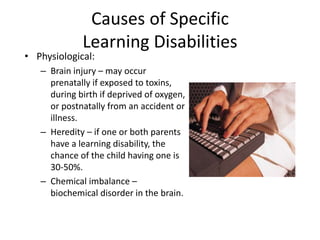
    Causes of Specific LearningDisabilities • Physiological: – Brain injury – may occur prenatally if exposed to toxins, during birth if deprived of oxygen, or postnatally from an accident or illness. – Heredity – if one or both parents have a learning disability, the chance of the child having one is 30-50%. – Chemical imbalance – biochemical disorder in the brain.
  • 15.
    Causes (cont.) Curriculum andEnvironmental Contributors: – Poor nutrition – Adverse emotional climate – Toxins in the environment - lead- based paint, cigarette smoke – Too little stimulation – Lack of educational materials – English as a second language – Children who live in poverty
  • 16.
    Causes (cont) – Lackof medical care – Low parent education and less modeling – Few early learning experiences In most cases, a single cause is not known, and it is very unlikely that a primary cause is ever identified. However, a combination of one or more of these causes are most often considered. It is not uncommon for SLD to co-occur with social, emotional, or behavior problems.
  • 17.
    TYPES • Motor difficulties(Dyspraxia) • Math difficulties (Dyscalculia) • Language difficulties(Aphasia/Dysphasia) • Reading difficulties (Dyslexia) • Writing difficulties (Dysgraphia) • Auditory and visual processing difficulties
  • 18.
    Dyslexia A language-based learningdisability • Involves a cluster of symptoms resulting in difficulty with specific language skills, particularly reading. • The core difficulty is with word recognition and reading fluency, spelling, and writing. • Dyslexia is diagnosed in people of all levels of intelligence. • There are no known causes of dyslexia. • Most people with dyslexia need help from a teacher, tutor, or therapist specially trained in using a multisensory, structured language approach.
  • 19.
    • Dyslexia occursin Individuals with normal vision and normal intelligence. Such individuals usually have normal speech but often have difficulty interpreting spoken language and writing. • Dyslexia seems to be caused by a malfunction in certain areas of the brain concerned with language. The condition frequently runs in families.
  • 20.
    Signs and Symptomsof Dyslexia • Dyslexia can be difficult to recognize, but some early clues may indicate a problem. • problem with new words, • deb • difficulty rhyming • Problems linking letters with sounds • Writing words backwards • Problems following directions with many steps
  • 22.
    Dyscalculia • The word"dyscalculia" means difficulty performing math calculations. • In other words, it just means "math difficulty". And specifically, it means a learning disability which affects math. • Sometimes confusion arises when we start dealing with the term "dyscalculia" as it relates to "special education services". • When a student's math difficulties are severe enough to meet this criteria, special education services are indicated. On the other hand, "dyscalculia" has no clearly defined criteria.
  • 23.
    Dyscalculia • Good atspeaking, reading, and writing, but slow to develop counting and math problem-solving skills • Good memory for printed words, but difficulty reading numbers, or recalling numbers in sequence • Good with general math concepts, but frustrated when specific computation and organization skills need to be used • Trouble with the concept of time-chronically late, difficulty remembering schedules, trouble with approximating how long something will take
  • 24.
    • Poor senseof direction, easily disoriented and easily confused by changes in routine • Poor long term memory of concepts-can do math functions one day, • but is unable to repeat them the next day • Poor mental math ability-trouble estimating grocery costs or • counting days until vacation • Difficulty playing strategy games like chess, bridge or role-playing • video games
  • 25.
    Dysgraphia • Dysgraphia isa learning disability that affects writing abilities. It can manifest itself as difficulties with spelling, poor handwriting, and trouble putting thoughts on paper. • Common signs of dysgraphia include: • Tight, awkward pencil grip and body position • Illegible handwriting • Avoiding writing or drawing tasks • Tiring quickly while writing • Saying words out loud while writing • Unfinished or omitted words in sentences • Difficulty organizing thoughts on paper • Difficulty with syntax structure and grammar • Large gap between written ideas and understanding – demonstrated through speech.
  • 26.
    Dyspraxia • A motorcoordination disability (also known as Sensory Integration Disorder). • Adults with dyspraxia may have difficulty carrying out tasks such as driving, cooking, and household chores or grooming. • Children with dyspraxia may be late in reaching developmental milestones, such as rolling over, sitting, standing and walking. They may frequently fall over, and when older may avoid PE and swimming lessons at school or any other sporting activity.
  • 27.
    Aphasia • A languagedisability (the student has difficulty understanding spoken language). • inability to comprehend language • inability to pronounce, not due to muscle paralysis or weakness • inability to speak spontaneously • inability to form words • inability to name objects
  • 28.
    DYSPHASIA • A languagedisability (the student has difficulty with reading comprehension). • Difficulty remembering words • Difficulty naming objects and/or people • Difficulty speaking in complete and/or meaningful sentences • Difficulty speaking in any fashion • Difficulty reading or writing • Difficulty expressing thoughts and feelings • Difficulty understanding spoken language
  • 29.
    Central Auditory ProcessingDisorder A sensory disability related to processing sounds.
  • 30.
    • have troublepaying attention to and remembering information presented orally, and may cope better with visually acquired information • have problems carrying out multi-step directions given orally; need to hear only one direction at a time • have poor listening skills • need more time to process information • have low academic performance • have behavior problems • have language difficulties (e.g., they confuse syllable sequences and have problems developing vocabulary and understanding language) • have difficulty with reading, comprehension, spelling, and vocabulary Sign and symptoms of Central Auditory Processing Disorder
  • 31.
    Visual Processing Disorder Asensory disability related to processing images.
  • 32.
    Some symptoms ofVisual Processing Disorder • Mixing up letters (i.e. ‘d’ and ‘b’) • Mixing up words by changing letters around (i.e. ‘saw’ and ‘was’) • After reads a story they cannot always tell the detail what the story was about. • Skipping words, letters or paragraphs when reading. • Learner would get headaches during and after reading.
  • 33.
    Non-Verbal Learning Disorder Avisual-spatial disability related to body control.
  • 34.
    Sign and symptomsof Non-Verbal Learning Disorder • delay in understanding or using spoken language; • difficulty understanding simple instructions; • lengthy pauses before naming objects and colors; • limited awareness or interest in books; • difficulty coloring or drawing; • short attention span (won't sit through one storybook). • difficulty understanding and following instructions; • trouble remembering what someone just told them; • lacking motor coordination when walking, playing sports, holding a pencil or trying to tie a shoelace; • frequently losing or misplacing homework, schoolbooks or other items; • unable to understand the concept of time (confused by the difference between “yesterday,” “today,” and “tomorrow.”
  • 35.
    Attention Deficit Hyperactivity Disorder(ADHD) • Observe child for “ATENTION” features • Annoying • Temperamental • Energetic • Noisy • Task incompletion • Inattentive • Oppositional • Negativism
  • 36.
    ADHD cont. • averageonset 3 yr old • identification upon school entry • rule out developmental delay, genetic syndromes,encephalopathies or toxins (alcohol, lead) • risk of substance abuse, particularly cannabis and cocaine, depression, anxiety, academic failure, poor social skills, risk of comorbid CD and/or ODD, risk of adult ASPD • associated with family history of ADHD, difficult temperamental characteristics
  • 37.
    Clinical Picture asa Whole. • Difficulty learning new skills, relying on memorization • Trouble learning about time • Difficulty remembering facts • Confusing basic words (dog, cat, run) • Poor coordination, 'accident prone', unaware of physical surroundings • Having a hard time learning the connection between letters and sounds • (Phonetics) • Spelling and reading errors such as substitutions (house/home), letter • reversals (b/d), inversions (m/w) and transpositions (felt/left) • Problems with planning • Impulsive behavior • Transposes number sequences and confuses arithmetic signs
  • 38.
    • The occupationaltherapy evaluation is an important component of the multidisciplinary assessment process. The purpose of this evaluation is to identify the areas of strengths and weakness of individuals with learning disabilities in performing various activities and occupations and analyzing the tasks these individuals need to perform. • The process of evaluation starts with an interview with the person and /or his/her family in order to gather information about the person’s occupational history, wishes and needs, routines and habits, areas of interest and values. • This information helps identify the individual’s strengths, weaknesses and list of priorities regarding the person’s various activities.
  • 39.
    • The occupationaltherapist then chooses a standardized assessment tool to assess the underlying causes of the individual’s difficulties and the various demands of the environment in which he/she functions. • The source of the difficulties may lie in various deficits in sensory, motor, cognitive functions, as well as other areas. • The process is completed by integrating the findings of the interview, observations and standardized assessments to form a comprehensive picture of the individual's capacities, the source of his/her difficulties and the manner in which the person copes with the environmental demands.
  • 40.
    DIAGNOSIS OF LEARNINGDISABILITIES Diagnosis of learning disabilities is highly sophisticated and nobody other than well-trained personnel can diagnose it • History • Clinical picture • Assessments in reading, including word recognition, fluency, and comprehension; mathematics, including computation and problem solving; and written expression, including handwriting, spelling and composition.
  • 41.
    Management • Learning: Evaluatingand improving the individual's ability to cope with the demands of different academic settings through efficient information processing, improving organizational abilities, developing strategies, improving writing skills, and so forth.
  • 42.
    • Play andleisure: The evaluation of play skills and leisure patterns, the cultivation and development of leisure opportunities, fostering internal control and satisfaction from play and leisure activities (e.g., guidance regarding adapting activities/clubs to suit the needs and strengths of the individual)
  • 43.
    • Cognitive skills:Training and improvement of attention, perceptual and memory processes, information processing as well as training and improvement of ability to classify and generalize.
  • 44.
    • Development ofspecific skills necessary for learning: These include the development and improvement of writing skills – developing the ability to write within a reasonable amount of time without investing unnecessary energy, such that the written document is legible and comprehensible. Writing skills are needed for writing tasks that include copying, dictation, preparing homework, and the like. Intervention includes direct intervention as well as recommendations for adaptation to the school’s requirements and of various accessories (e.g., type of pencil, notebook, laptop computer and accompanying accessories), as well as teaching keyboarding skills.

Editor's Notes

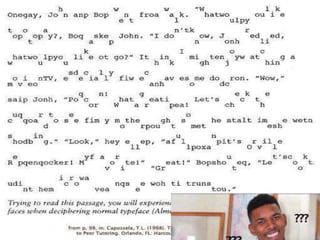
  • #22 BOB SUGGESTED TO DO WHAT? WHAT WERE THEY LOOKING IN FOR IN THE CUPBOARD HOW DID THEY COOK IT? COULD YOU UNDERSTAND WHAT WAS GOING ON?