Learning Object Repositories:  a learner centered perspective Julià Minguillón Universitat Oberta de Catalunya EdReNe – 4 th  Strategic Seminar, March 24th - March 26th 2010, Barcelona, Spain
Table of contents Learning Objects and Repositories LOR for Statistical resources Virtual Learning Environments Idealizing a LOR Our reality: DSpace Improving learner’s experience Open issues J. Minguillón   EdReNe – 4th Strategic Seminar, March 24th - March 26th 2010, Barcelona, Spain
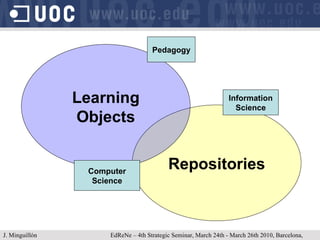
J. Minguillón   EdReNe – 4th Strategic Seminar, March 24th - March 26th 2010, Barcelona, Spain Repositories Learning Objects Computer Science Pedagogy Information Science
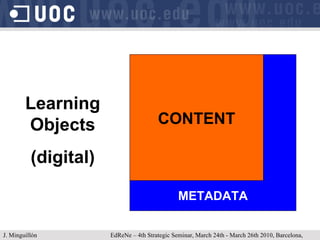
J. Minguillón   EdReNe – 4th Strategic Seminar, March 24th - March 26th 2010, Barcelona, Spain METADATA CONTENT Learning Objects (digital)
Learning Objects Main goals : Help learners to acquire and develop a competence, skill, ability, … Help teachers (and learners) to create new LOs Desired characteristics: Small to medium granularity Described according to educational purposes High level of connections between LOs J. Minguillón   EdReNe – 4th Strategic Seminar, March 24th - March 26th 2010, Barcelona, Spain
Learning Objects LOs are  diverse : Courses SCORM, LD, HTML, … Exercises PDF, QTI, … Examples PDF, PPT, ODP, … Multimedia elements JPEG, MP3, MOV, … Simulations Applets, Flash Source code C, Java, … Data XLS, SPSS, … Equations LaTeX, MathML, … Other CML, XML, … J. Minguillón   EdReNe – 4th Strategic Seminar, March 24th - March 26th 2010, Barcelona, Spain
Learning Object Metadata Proposed metadata scheme: IEEE LOM 9 categories including  Technical ,  Educational ,  Relation  and  Classification No required fields but plenty of them (> 70) Can be “reduced” to unqualified Dublin Core But, what the  □ □ □ □  is “ 5.4 Semantic density ”? Who will fill out over 70 fields? What is the title of an exercise? J. Minguillón   EdReNe – 4th Strategic Seminar, March 24th - March 26th 2010, Barcelona, Spain
Describing LOs Only fill out fields that: …can be automatically filled …are needed for preservation purposes …will be used for retrieving ( i.e.  author?) Establish two or three levels of metadata: Minimum, mandatory fields Desirable Complete J. Minguillón   EdReNe – 4th Strategic Seminar, March 24th - March 26th 2010, Barcelona, Spain Progressive
Repositories Two main goals: Ensure  preservation  (keep the mummy) Promote  reutilization   (show the mummy) These goals are somehow contradictory! (even if the mummy is digital) Institutional  top-down  position prevails J. Minguillón   EdReNe – 4th Strategic Seminar, March 24th - March 26th 2010, Barcelona, Spain
Traditional perspective Library centered: Books, journals, works, … (mostly textual) Everything has a unique title Everything has one or more authors Everything has a creation date Everything has a source Almost everything is a PDF file Main goal : easily finding a resource by using a minimum set of common descriptors J. Minguillón   EdReNe – 4th Strategic Seminar, March 24th - March 26th 2010, Barcelona, Spain
Repositories Several possibilities: General purpose Thematic Top-down Bottom-up Institution driven Community driven Content Links to content No discussion:  open access J. Minguillón   EdReNe – 4th Strategic Seminar, March 24th - March 26th 2010, Barcelona, Spain
Case of study: LOR on Statistics Why Statistics? Basic competences for the Information Society Compulsory course for several degrees Thousands of students each semester ( ≈ 4000) Large collection of heterogeneous resources Known problems: “ There are too many resources ” “ I don’t know how to start ” “ I can’t link concepts and tools ” J. Minguillón   EdReNe – 4th Strategic Seminar, March 24th - March 26th 2010, Barcelona, Spain
Our proposal From a  teaching  perspective: Build a thematic open LOR on Statistics Bottom-up approach (teachers) Integrate the LOR into the learning process Engage learners into using the LOR From a  research  perspective: Learning by doing Create better user interfaces for LORs Analyze user behavior J. Minguillón   EdReNe – 4th Strategic Seminar, March 24th - March 26th 2010, Barcelona, Spain
Key factors for LOR success Three dimensions (McNaught, 2006): Resources: what? Actions: how? Users : who? Why? (Margaryan and Littlejohn, 2008) User Centered Design methodology J. Minguillón   EdReNe – 4th Strategic Seminar, March 24th - March 26th 2010, Barcelona, Spain
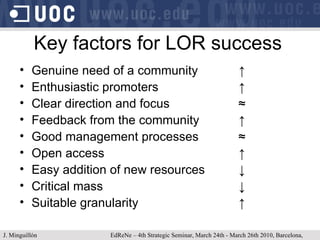
Key factors for LOR success Genuine need of a community Enthusiastic promoters Clear direction and focus Feedback from the community Good management processes Open access Easy addition of new resources Critical mass Suitable granularity J. Minguillón   EdReNe – 4th Strategic Seminar, March 24th - March 26th 2010, Barcelona, Spain ↑ ↑ ≈ ↑ ≈ ↑ ↓ ↓ ↑
Adopting E-Learning Three dimensions (Bates, 2005): Methodological Technological Organizational Not completely orthogonal:   interconnected LORs are basic infrastructure of VLEs J. Minguillón   EdReNe – 4th Strategic Seminar, March 24th - March 26th 2010, Barcelona, Spain
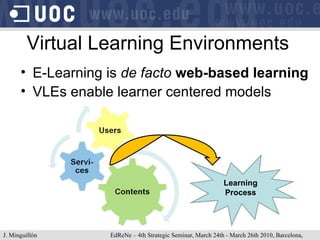
Virtual Learning Environments E-Learning is  de facto   web-based learning VLEs enable learner centered models Learning Process J. Minguillón   EdReNe – 4th Strategic Seminar, March 24th - March 26th 2010, Barcelona, Spain
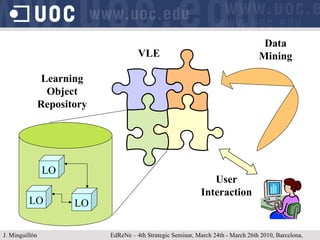
LO LO LO Learning Object Repository VLE User Interaction Data Mining J. Minguillón   EdReNe – 4th Strategic Seminar, March 24th - March 26th 2010, Barcelona, Spain
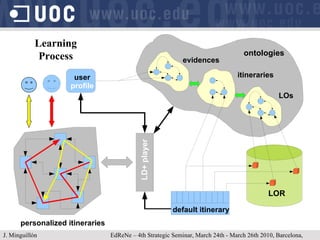
Learning Process J. Minguillón   EdReNe – 4th Strategic Seminar, March 24th - March 26th 2010, Barcelona, Spain LD+ player user profile default itinerary LOR ontologies personalized itineraries LOs itineraries evidences
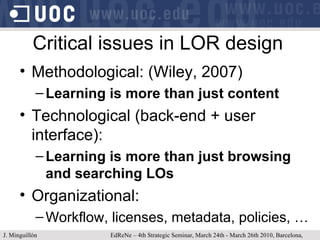
Critical issues in LOR design Methodological: (Wiley, 2007) Learning is more than just content Technological (back-end + user interface): Learning is more than just browsing and searching LOs Organizational: Workflow, licenses, metadata, policies, … J. Minguillón   EdReNe – 4th Strategic Seminar, March 24th - March 26th 2010, Barcelona, Spain
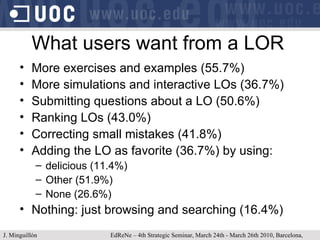
What users want from a LOR More exercises and examples (55.7%) More simulations and interactive LOs (36.7%) Submitting questions about a LO (50.6%) Ranking LOs (43.0%) Correcting small mistakes (41.8%) Adding the LO as favorite (36.7%) by using: delicious (11.4%) Other (51.9%) None (26.6%) Nothing: just browsing and searching (16.4%) J. Minguillón   EdReNe – 4th Strategic Seminar, March 24th - March 26th 2010, Barcelona, Spain
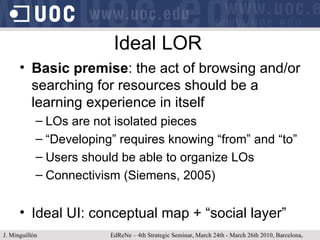
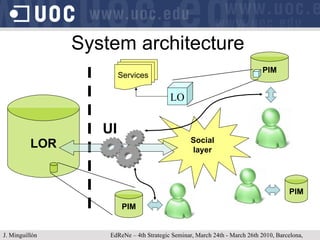
Ideal LOR Basic premise : the act of browsing and/or searching for resources should be a learning experience in itself LOs are not isolated pieces “Developing” requires knowing “from” and “to” Users should be able to organize LOs Connectivism (Siemens, 2005) Ideal UI: conceptual map + “social layer” J. Minguillón   EdReNe – 4th Strategic Seminar, March 24th - March 26th 2010, Barcelona, Spain
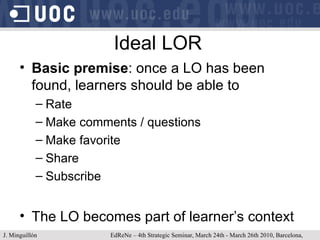
Ideal LOR Basic premise : once a LO has been found, learners should be able to Rate Make comments / questions Make favorite Share Subscribe The LO becomes part of learner’s context J. Minguillón   EdReNe – 4th Strategic Seminar, March 24th - March 26th 2010, Barcelona, Spain
System architecture Social layer PIM LOR PIM PIM UI J. Minguillón   EdReNe – 4th Strategic Seminar, March 24th - March 26th 2010, Barcelona, Spain LO Services
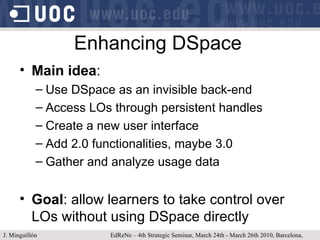
Enhancing DSpace Main idea :  Use DSpace as an invisible back-end Access LOs through persistent handles Create a new user interface Add 2.0 functionalities, maybe 3.0 Gather and analyze usage data Goal : allow learners to take control over LOs without using DSpace directly J. Minguillón   EdReNe – 4th Strategic Seminar, March 24th - March 26th 2010, Barcelona, Spain
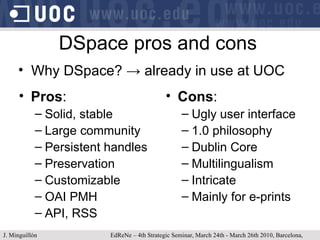
DSpace pros and cons Pros : Solid, stable Large community Persistent handles Preservation Customizable OAI PMH API, RSS Cons : Ugly user interface 1.0 philosophy Dublin Core Multilingualism Intricate Mainly for e-prints Why DSpace?  -> already in use at UOC J. Minguillón   EdReNe – 4th Strategic Seminar, March 24th - March 26th 2010, Barcelona, Spain
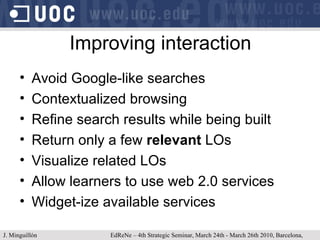
Improving interaction Avoid Google-like searches Contextualized browsing Refine search results while being built Return only a few  relevant  LOs Visualize related LOs Allow learners to use web 2.0 services Widget-ize available services  J. Minguillón   EdReNe – 4th Strategic Seminar, March 24th - March 26th 2010, Barcelona, Spain
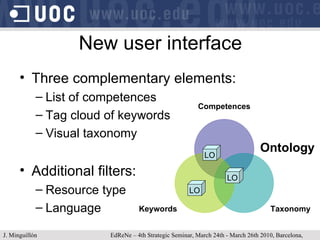
Three complementary elements: List of competences Tag cloud of keywords Visual taxonomy Additional filters: Resource type Language New user interface Ontology LO J. Minguillón   EdReNe – 4th Strategic Seminar, March 24th - March 26th 2010, Barcelona, Spain Competences Taxonomy Keywords LO LO
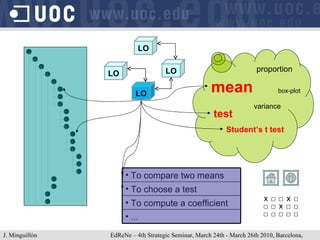
mean variance proportion LO LO LO Student’s t test box-plot LO test J. Minguillón   EdReNe – 4th Strategic Seminar, March 24th - March 26th 2010, Barcelona, Spain x □ □ □ □ x x □ □ □ □ □ □ □ □ ... To compute a coefficient To choose a test To compare two means
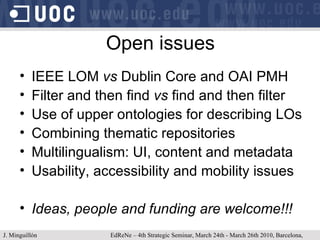
Open issues IEEE LOM  vs  Dublin Core and OAI PMH Filter and then find  vs  find and then filter Use of upper ontologies for describing LOs Combining thematic repositories Multilingualism: UI, content and metadata Usability, accessibility and mobility issues Ideas, people and funding are welcome!!! J. Minguillón   EdReNe – 4th Strategic Seminar, March 24th - March 26th 2010, Barcelona, Spain
References and bibliography Bates, A.W. (2005). Technology, E-learning and Distance Education, Routledge. Margaryan, A. and Littlejohn, A. (2008). Repositories and communities at cross-purposes: issues in sharing and reuse of digital learning resources. Journal of Computer Assisted Learning, 24, 333-347. McNaught, C. (2006). Are Learning Repositories Likely To Become Mainstream In Education? In: Proceedings of the 2nd International Conference on Web Information Systems and Technologies, Setubal, Portugal, 11-13 April, IS9-IS17. Siemens, G. (2005). Connectivism: A learning theory for the digital age. International Journal of Instructional Technology and Distance Learning. 2(1), 3–10. Wiley, D. (2007). Content is infrastructure. Terra incognita. Available at http://blog.worldcampus.psu.edu/index.php/2007/10/03/content-is-infrastructure/  McGreal, R. (2004). Learning Objects: A Practical definition. International Journal of Instructional Technology and Distance Learning, 1(9). Monge, S.; Ovelar, R.; Azpeitia, I. (2008). “Repository 2.0: Social Dynamics to Support Community Building in Learning Object Repositories“. Interdisciplinary Journal of E-Learning and Learning Objects (formerly IJKLO), 4.  Thomas, A. and Rothery, A. (2005). Online repositories for learning materials: the user perspective. Ariadne, 45. Available at: http://www.ariadne.ac.uk/issue45/thomas-rothery/  J. Minguillón   EdReNe – 4th Strategic Seminar, March 24th - March 26th 2010, Barcelona, Spain
Thank you! Contact information: Julià Minguillón [email_address] CC-BY-NC-SA http://www.slideshare.net/jminguillona J. Minguillón   EdReNe – 4th Strategic Seminar, March 24th - March 26th 2010, Barcelona, Spain

Learning Object Repositories: a learner centered perspective

  • 1.
    Learning Object Repositories: a learner centered perspective Julià Minguillón Universitat Oberta de Catalunya EdReNe – 4 th Strategic Seminar, March 24th - March 26th 2010, Barcelona, Spain
  • 2.
    Table of contentsLearning Objects and Repositories LOR for Statistical resources Virtual Learning Environments Idealizing a LOR Our reality: DSpace Improving learner’s experience Open issues J. Minguillón EdReNe – 4th Strategic Seminar, March 24th - March 26th 2010, Barcelona, Spain
  • 3.
    J. Minguillón EdReNe – 4th Strategic Seminar, March 24th - March 26th 2010, Barcelona, Spain Repositories Learning Objects Computer Science Pedagogy Information Science
  • 4.
    J. Minguillón EdReNe – 4th Strategic Seminar, March 24th - March 26th 2010, Barcelona, Spain METADATA CONTENT Learning Objects (digital)
  • 5.
    Learning Objects Maingoals : Help learners to acquire and develop a competence, skill, ability, … Help teachers (and learners) to create new LOs Desired characteristics: Small to medium granularity Described according to educational purposes High level of connections between LOs J. Minguillón EdReNe – 4th Strategic Seminar, March 24th - March 26th 2010, Barcelona, Spain
  • 6.
    Learning Objects LOsare diverse : Courses SCORM, LD, HTML, … Exercises PDF, QTI, … Examples PDF, PPT, ODP, … Multimedia elements JPEG, MP3, MOV, … Simulations Applets, Flash Source code C, Java, … Data XLS, SPSS, … Equations LaTeX, MathML, … Other CML, XML, … J. Minguillón EdReNe – 4th Strategic Seminar, March 24th - March 26th 2010, Barcelona, Spain
  • 7.
    Learning Object MetadataProposed metadata scheme: IEEE LOM 9 categories including Technical , Educational , Relation and Classification No required fields but plenty of them (> 70) Can be “reduced” to unqualified Dublin Core But, what the □ □ □ □ is “ 5.4 Semantic density ”? Who will fill out over 70 fields? What is the title of an exercise? J. Minguillón EdReNe – 4th Strategic Seminar, March 24th - March 26th 2010, Barcelona, Spain
  • 8.
    Describing LOs Onlyfill out fields that: …can be automatically filled …are needed for preservation purposes …will be used for retrieving ( i.e. author?) Establish two or three levels of metadata: Minimum, mandatory fields Desirable Complete J. Minguillón EdReNe – 4th Strategic Seminar, March 24th - March 26th 2010, Barcelona, Spain Progressive
  • 9.
    Repositories Two maingoals: Ensure preservation (keep the mummy) Promote reutilization (show the mummy) These goals are somehow contradictory! (even if the mummy is digital) Institutional top-down position prevails J. Minguillón EdReNe – 4th Strategic Seminar, March 24th - March 26th 2010, Barcelona, Spain
  • 10.
    Traditional perspective Librarycentered: Books, journals, works, … (mostly textual) Everything has a unique title Everything has one or more authors Everything has a creation date Everything has a source Almost everything is a PDF file Main goal : easily finding a resource by using a minimum set of common descriptors J. Minguillón EdReNe – 4th Strategic Seminar, March 24th - March 26th 2010, Barcelona, Spain
  • 11.
    Repositories Several possibilities:General purpose Thematic Top-down Bottom-up Institution driven Community driven Content Links to content No discussion: open access J. Minguillón EdReNe – 4th Strategic Seminar, March 24th - March 26th 2010, Barcelona, Spain
  • 12.
    Case of study:LOR on Statistics Why Statistics? Basic competences for the Information Society Compulsory course for several degrees Thousands of students each semester ( ≈ 4000) Large collection of heterogeneous resources Known problems: “ There are too many resources ” “ I don’t know how to start ” “ I can’t link concepts and tools ” J. Minguillón EdReNe – 4th Strategic Seminar, March 24th - March 26th 2010, Barcelona, Spain
  • 13.
    Our proposal Froma teaching perspective: Build a thematic open LOR on Statistics Bottom-up approach (teachers) Integrate the LOR into the learning process Engage learners into using the LOR From a research perspective: Learning by doing Create better user interfaces for LORs Analyze user behavior J. Minguillón EdReNe – 4th Strategic Seminar, March 24th - March 26th 2010, Barcelona, Spain
  • 14.
    Key factors forLOR success Three dimensions (McNaught, 2006): Resources: what? Actions: how? Users : who? Why? (Margaryan and Littlejohn, 2008) User Centered Design methodology J. Minguillón EdReNe – 4th Strategic Seminar, March 24th - March 26th 2010, Barcelona, Spain
  • 15.
    Key factors forLOR success Genuine need of a community Enthusiastic promoters Clear direction and focus Feedback from the community Good management processes Open access Easy addition of new resources Critical mass Suitable granularity J. Minguillón EdReNe – 4th Strategic Seminar, March 24th - March 26th 2010, Barcelona, Spain ↑ ↑ ≈ ↑ ≈ ↑ ↓ ↓ ↑
  • 16.
    Adopting E-Learning Threedimensions (Bates, 2005): Methodological Technological Organizational Not completely orthogonal: interconnected LORs are basic infrastructure of VLEs J. Minguillón EdReNe – 4th Strategic Seminar, March 24th - March 26th 2010, Barcelona, Spain
  • 17.
    Virtual Learning EnvironmentsE-Learning is de facto web-based learning VLEs enable learner centered models Learning Process J. Minguillón EdReNe – 4th Strategic Seminar, March 24th - March 26th 2010, Barcelona, Spain
  • 18.
    LO LO LOLearning Object Repository VLE User Interaction Data Mining J. Minguillón EdReNe – 4th Strategic Seminar, March 24th - March 26th 2010, Barcelona, Spain
  • 19.
    Learning Process J.Minguillón EdReNe – 4th Strategic Seminar, March 24th - March 26th 2010, Barcelona, Spain LD+ player user profile default itinerary LOR ontologies personalized itineraries LOs itineraries evidences
  • 20.
    Critical issues inLOR design Methodological: (Wiley, 2007) Learning is more than just content Technological (back-end + user interface): Learning is more than just browsing and searching LOs Organizational: Workflow, licenses, metadata, policies, … J. Minguillón EdReNe – 4th Strategic Seminar, March 24th - March 26th 2010, Barcelona, Spain
  • 21.
    What users wantfrom a LOR More exercises and examples (55.7%) More simulations and interactive LOs (36.7%) Submitting questions about a LO (50.6%) Ranking LOs (43.0%) Correcting small mistakes (41.8%) Adding the LO as favorite (36.7%) by using: delicious (11.4%) Other (51.9%) None (26.6%) Nothing: just browsing and searching (16.4%) J. Minguillón EdReNe – 4th Strategic Seminar, March 24th - March 26th 2010, Barcelona, Spain
  • 22.
    Ideal LOR Basicpremise : the act of browsing and/or searching for resources should be a learning experience in itself LOs are not isolated pieces “Developing” requires knowing “from” and “to” Users should be able to organize LOs Connectivism (Siemens, 2005) Ideal UI: conceptual map + “social layer” J. Minguillón EdReNe – 4th Strategic Seminar, March 24th - March 26th 2010, Barcelona, Spain
  • 23.
    Ideal LOR Basicpremise : once a LO has been found, learners should be able to Rate Make comments / questions Make favorite Share Subscribe The LO becomes part of learner’s context J. Minguillón EdReNe – 4th Strategic Seminar, March 24th - March 26th 2010, Barcelona, Spain
  • 24.
    System architecture Sociallayer PIM LOR PIM PIM UI J. Minguillón EdReNe – 4th Strategic Seminar, March 24th - March 26th 2010, Barcelona, Spain LO Services
  • 25.
    Enhancing DSpace Mainidea : Use DSpace as an invisible back-end Access LOs through persistent handles Create a new user interface Add 2.0 functionalities, maybe 3.0 Gather and analyze usage data Goal : allow learners to take control over LOs without using DSpace directly J. Minguillón EdReNe – 4th Strategic Seminar, March 24th - March 26th 2010, Barcelona, Spain
  • 26.
    DSpace pros andcons Pros : Solid, stable Large community Persistent handles Preservation Customizable OAI PMH API, RSS Cons : Ugly user interface 1.0 philosophy Dublin Core Multilingualism Intricate Mainly for e-prints Why DSpace? -> already in use at UOC J. Minguillón EdReNe – 4th Strategic Seminar, March 24th - March 26th 2010, Barcelona, Spain
  • 27.
    Improving interaction AvoidGoogle-like searches Contextualized browsing Refine search results while being built Return only a few relevant LOs Visualize related LOs Allow learners to use web 2.0 services Widget-ize available services J. Minguillón EdReNe – 4th Strategic Seminar, March 24th - March 26th 2010, Barcelona, Spain
  • 28.
    Three complementary elements:List of competences Tag cloud of keywords Visual taxonomy Additional filters: Resource type Language New user interface Ontology LO J. Minguillón EdReNe – 4th Strategic Seminar, March 24th - March 26th 2010, Barcelona, Spain Competences Taxonomy Keywords LO LO
  • 29.
    mean variance proportionLO LO LO Student’s t test box-plot LO test J. Minguillón EdReNe – 4th Strategic Seminar, March 24th - March 26th 2010, Barcelona, Spain x □ □ □ □ x x □ □ □ □ □ □ □ □ ... To compute a coefficient To choose a test To compare two means
  • 30.
    Open issues IEEELOM vs Dublin Core and OAI PMH Filter and then find vs find and then filter Use of upper ontologies for describing LOs Combining thematic repositories Multilingualism: UI, content and metadata Usability, accessibility and mobility issues Ideas, people and funding are welcome!!! J. Minguillón EdReNe – 4th Strategic Seminar, March 24th - March 26th 2010, Barcelona, Spain
  • 31.
    References and bibliographyBates, A.W. (2005). Technology, E-learning and Distance Education, Routledge. Margaryan, A. and Littlejohn, A. (2008). Repositories and communities at cross-purposes: issues in sharing and reuse of digital learning resources. Journal of Computer Assisted Learning, 24, 333-347. McNaught, C. (2006). Are Learning Repositories Likely To Become Mainstream In Education? In: Proceedings of the 2nd International Conference on Web Information Systems and Technologies, Setubal, Portugal, 11-13 April, IS9-IS17. Siemens, G. (2005). Connectivism: A learning theory for the digital age. International Journal of Instructional Technology and Distance Learning. 2(1), 3–10. Wiley, D. (2007). Content is infrastructure. Terra incognita. Available at http://blog.worldcampus.psu.edu/index.php/2007/10/03/content-is-infrastructure/ McGreal, R. (2004). Learning Objects: A Practical definition. International Journal of Instructional Technology and Distance Learning, 1(9). Monge, S.; Ovelar, R.; Azpeitia, I. (2008). “Repository 2.0: Social Dynamics to Support Community Building in Learning Object Repositories“. Interdisciplinary Journal of E-Learning and Learning Objects (formerly IJKLO), 4. Thomas, A. and Rothery, A. (2005). Online repositories for learning materials: the user perspective. Ariadne, 45. Available at: http://www.ariadne.ac.uk/issue45/thomas-rothery/ J. Minguillón EdReNe – 4th Strategic Seminar, March 24th - March 26th 2010, Barcelona, Spain
  • 32.
    Thank you! Contactinformation: Julià Minguillón [email_address] CC-BY-NC-SA http://www.slideshare.net/jminguillona J. Minguillón EdReNe – 4th Strategic Seminar, March 24th - March 26th 2010, Barcelona, Spain