ONLINE
ASSIGNMENT
Submitted to, Submitted by,
Ms.Lesha.M.S Shilpa Biju
Lecturer in Charge Natural Science
Circle Learning
INTRODUCTION
Educationprepares the future generationsto play their
respective roles in the society and teachers play a pivotalrole
in this process.
The revision and developmentof curriculum
together with modern instructionalstrategies implies an
intensionto ensure a progressive change in education.The
motivationfor this change has not only been pedagogic but
social and politicalas well.
In the modern instructionalstrategy the
curriculum can be considered as unificationof aims, subject
matter and controls of learning. One among the modern
instructionalstrategy is circle learning model.
The use of circle as both the organizational
structure and descriptive metaphorfor a meeting of equalsis
like to have been a part of our history for as long as five has.
The learningcircle is a mechanism for organizing and
honouringthe collective wisdom of the group and is present
in many indigenouscultures. The term Learning Circle has
been used to describe group efforts with clear links to social
change.
Over time and across countries, civic
organizations, neighbourhood communities,trade unions,
churches and social justice groups have used the idea of
learning circles to empower their members to make choices
and take action. The web can help locate the many ways both
present that groups have used the term study circles or
learning circles as a form of adult education.For example,
educators for community engagement, find that learning
circles-with their principles of equal participation,reciprocity
and honouring of collective wisdom-embody the democratic
principles of effective service learning partnerships. They use
learning circles, rather than more traditionalforms of group
meetings, to structure their annualconferences. Primary
teachers use a form of learning circles when they gather the
students at the rug for circle time. Among the goals of this
activity are helping students to developthe trust and respect
for diversity of experience, and fostering both listening and
speaking skills among peers.
 A learning circle is a highly interactive , participatory
structure for organizing group work. The goal is to build ,
share, and express knowledge through a process of
open dialogues and deep reflection around issues or
problems with a focus on a shared outcome.
 A learning circle is not a community practice or a
professional learning but it can be a strategy used by
either.
 Online learningcircles are teams of distance learners
who use technology to acquire a deeper understanding
of areas of shared interest. The structure balances
individualownership with collective responsibilityto
provide a setting which helpseveryone achieve their
learning objectives
 The circle is managed by distributed leadershipand
suggests that each participantto be engaged in leading
one of the group projects.
 They can be used to in a wide range of formal and
informal contexts.
 Other examples of globallearning circles used to
connect in learners in different locationat all levels of
school from primary to graduate level work
 Other examples include the use of learning professional
developmentin evaluationandaction research.
 The learningcircle is a structure for collaborativework
that shares features with other community-based
learning groups,but also differs in specific ways.
 Most importantly, it is a task based learning community
in context to a practice based or knowledge based
learning community.
 Instead of one shared group tasks, learning circle focus
on smaller interacting group task, each lead by one of
the circle participant
 Effective learning circle work involvebuildinga level of
trust and developing shared norms of trust, openness
and reciprocity
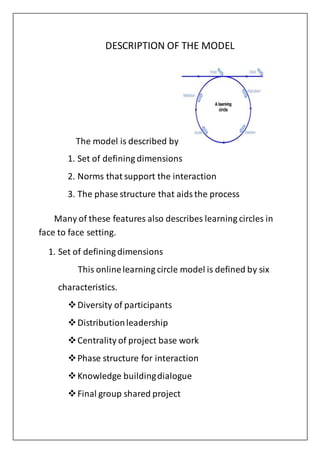
DESCRIPTION OF THE MODEL
The model is described by
1. Set of defining dimensions
2. Norms that support the interaction
3. The phase structure that aidsthe process
Many of these features also describes learning circles in
face to face setting.
1. Set of defining dimensions
This onlinelearning circle model is defined by six
characteristics.
Diversity of participants
Distributionleadership
Centrality of project base work
Phase structure for interaction
Knowledge buildingdialogue
Final group shared project
2. Norms that support the interaction
Norms are implicit that develop among group of
people which guide behaviour.In setting up learning
circles, the facilitatorneeds to think about ways to
develop these norms. Talkingabout norms is one of
making them explicit but one of the most effective way
of setting norms is through modeling them. Where
circumstances allow, the first meeting of the circle
should be in person. It is much easier to developsuch
practices and habitswhen there is shared experiences in
a face to face setting. However , the best use of this
time might be to engage in activities that surfaces some
of the issues that result in norm setting by the group.
 Trust
 Respect
 Open and flexible approachto thinking
 Individual responsibility
 Group reciprocity
3. The phase structure that aidsthe process
 Learning circles have a beginning, a set of steps
and an end, which distinguishes them from
other forms of community development.
 The first phase begins with the organizationof
the circle
 Circle size is determined by balancingthe need
for diversity of perspectives with oppurtunities
for interaction
 The circle openswith activities to build trust
and cohesion, moves to framing the projects is
followed by shared work on the projects and
then exhibitionsor sharing of completed work
leadsto the end of the circle
 At the end of a learning circle, the participants
often join a new circle if they choose to
continue and thus repeat the above cycle.
 The timelineand headlinesare an important
part of the learning circle experience
 Diversity of the participantsis such an
important part of the learning structure
A)Opening the circle
B) Defining the set of projects
C) Working in the project
D)Sharing outcomes
E) Closing of the circle
A)Opening the circle:
o It is concerned with setting the
culture and establishingthe practice
for learning circle interactions.
o Putting people in the room and
simply giving them time to talk, or
connecting them on a networks with
space for chat does not make them a
well functioning group ,much less a
community
o It is important to understand the
differences
o The goal in arranging people in
learning is to maximize diversity and
then use that diversity as a resource
o However for diversity to be a
resource , there needs to be a high
level of trust and respect.
o Activities described in this phases
work to ensure the developmentof
trust and respect
o Buildingcommunity : a central goal
of the first meeting is to create trust
and respect that underlies group
work and knowledge building
o Collaborative learning: Identify is a
closely tied to learning . Who we are
is shaped by who we associate with.
Each person makes a contributionto
the group identity. The group identity
will shape and forms and process of
learning
o Setting expectations: Dependingon
what happenedduring the getting
ready phase and the participants
experience with learningcircles, the
first meeting is also a time set
expectations
o Comfort with technology:Finallythe
opening session is a test run to make
sure that everyone can use the
software that will be used for
meetings and projects
B) Planning the projects
o Designing the project is the most
important phase of learning circles
and for sometime difficult to
understand. The reason is that we
are used to having defined projects
and clear project leaders. One of the
important dimensionsof learning
circles is distributed leadership
C) Sharing the outcomes
o Circle participantsorganize the
informationthey exchange for their
project into a part of the circle
presentation
D) Closing the circle
o The closing date of the learning circle
should be listed in the timeline
o Circle members may be needed to
be reminded of the timetableand
the ending date
o It is nice to planfor the end so that
circle partners have a chance to say
goodbye as the work is completed
CONCLUSION
These different forms of learning circles wisdom circles, circle
time, study circles and qualitycircles are all structures for
face to face dialogues.But learningcircles can also take place
over a networks in an onlineor virtualsetting. Thisspecific
use of the idea of learning circles refers to an onlinestructure
for linkingparticipantsfrom different countries to work
together using their diversity as a resource to achieve deeper
understandingsand henceforth it is an effective model as far
as teaching learning process is considered.
REFERENCE
1. David and Roger Johnson,EdytheJohnson
The new Circles of Learning
ASCD
2. MichelleCollay
Learning Circles
Corwin Press

Online assignment-Circle Learning

  • 1.
    ONLINE ASSIGNMENT Submitted to, Submittedby, Ms.Lesha.M.S Shilpa Biju Lecturer in Charge Natural Science
  • 2.
  • 3.
    INTRODUCTION Educationprepares the futuregenerationsto play their respective roles in the society and teachers play a pivotalrole in this process. The revision and developmentof curriculum together with modern instructionalstrategies implies an intensionto ensure a progressive change in education.The motivationfor this change has not only been pedagogic but social and politicalas well. In the modern instructionalstrategy the curriculum can be considered as unificationof aims, subject matter and controls of learning. One among the modern instructionalstrategy is circle learning model. The use of circle as both the organizational structure and descriptive metaphorfor a meeting of equalsis like to have been a part of our history for as long as five has. The learningcircle is a mechanism for organizing and honouringthe collective wisdom of the group and is present in many indigenouscultures. The term Learning Circle has been used to describe group efforts with clear links to social change. Over time and across countries, civic organizations, neighbourhood communities,trade unions,
  • 4.
    churches and socialjustice groups have used the idea of learning circles to empower their members to make choices and take action. The web can help locate the many ways both present that groups have used the term study circles or learning circles as a form of adult education.For example, educators for community engagement, find that learning circles-with their principles of equal participation,reciprocity and honouring of collective wisdom-embody the democratic principles of effective service learning partnerships. They use learning circles, rather than more traditionalforms of group meetings, to structure their annualconferences. Primary teachers use a form of learning circles when they gather the students at the rug for circle time. Among the goals of this activity are helping students to developthe trust and respect for diversity of experience, and fostering both listening and speaking skills among peers.  A learning circle is a highly interactive , participatory structure for organizing group work. The goal is to build , share, and express knowledge through a process of open dialogues and deep reflection around issues or problems with a focus on a shared outcome.  A learning circle is not a community practice or a professional learning but it can be a strategy used by either.  Online learningcircles are teams of distance learners who use technology to acquire a deeper understanding of areas of shared interest. The structure balances
  • 5.
    individualownership with collectiveresponsibilityto provide a setting which helpseveryone achieve their learning objectives  The circle is managed by distributed leadershipand suggests that each participantto be engaged in leading one of the group projects.  They can be used to in a wide range of formal and informal contexts.  Other examples of globallearning circles used to connect in learners in different locationat all levels of school from primary to graduate level work  Other examples include the use of learning professional developmentin evaluationandaction research.  The learningcircle is a structure for collaborativework that shares features with other community-based learning groups,but also differs in specific ways.  Most importantly, it is a task based learning community in context to a practice based or knowledge based learning community.  Instead of one shared group tasks, learning circle focus on smaller interacting group task, each lead by one of the circle participant  Effective learning circle work involvebuildinga level of trust and developing shared norms of trust, openness and reciprocity
  • 8.
    DESCRIPTION OF THEMODEL The model is described by 1. Set of defining dimensions 2. Norms that support the interaction 3. The phase structure that aidsthe process Many of these features also describes learning circles in face to face setting. 1. Set of defining dimensions This onlinelearning circle model is defined by six characteristics. Diversity of participants Distributionleadership Centrality of project base work Phase structure for interaction Knowledge buildingdialogue Final group shared project
  • 9.
    2. Norms thatsupport the interaction Norms are implicit that develop among group of people which guide behaviour.In setting up learning circles, the facilitatorneeds to think about ways to develop these norms. Talkingabout norms is one of making them explicit but one of the most effective way of setting norms is through modeling them. Where circumstances allow, the first meeting of the circle should be in person. It is much easier to developsuch practices and habitswhen there is shared experiences in a face to face setting. However , the best use of this time might be to engage in activities that surfaces some of the issues that result in norm setting by the group.  Trust  Respect  Open and flexible approachto thinking  Individual responsibility  Group reciprocity
  • 10.
    3. The phasestructure that aidsthe process  Learning circles have a beginning, a set of steps and an end, which distinguishes them from other forms of community development.  The first phase begins with the organizationof the circle  Circle size is determined by balancingthe need for diversity of perspectives with oppurtunities for interaction
  • 11.
     The circleopenswith activities to build trust and cohesion, moves to framing the projects is followed by shared work on the projects and then exhibitionsor sharing of completed work leadsto the end of the circle  At the end of a learning circle, the participants often join a new circle if they choose to continue and thus repeat the above cycle.  The timelineand headlinesare an important part of the learning circle experience  Diversity of the participantsis such an important part of the learning structure A)Opening the circle B) Defining the set of projects C) Working in the project D)Sharing outcomes E) Closing of the circle
  • 12.
    A)Opening the circle: oIt is concerned with setting the culture and establishingthe practice for learning circle interactions. o Putting people in the room and simply giving them time to talk, or connecting them on a networks with space for chat does not make them a well functioning group ,much less a community o It is important to understand the differences o The goal in arranging people in learning is to maximize diversity and then use that diversity as a resource o However for diversity to be a resource , there needs to be a high level of trust and respect. o Activities described in this phases work to ensure the developmentof trust and respect
  • 13.
    o Buildingcommunity :a central goal of the first meeting is to create trust and respect that underlies group work and knowledge building o Collaborative learning: Identify is a closely tied to learning . Who we are is shaped by who we associate with. Each person makes a contributionto the group identity. The group identity will shape and forms and process of learning o Setting expectations: Dependingon what happenedduring the getting ready phase and the participants experience with learningcircles, the first meeting is also a time set expectations o Comfort with technology:Finallythe opening session is a test run to make sure that everyone can use the
  • 14.
    software that willbe used for meetings and projects B) Planning the projects o Designing the project is the most important phase of learning circles and for sometime difficult to understand. The reason is that we are used to having defined projects and clear project leaders. One of the important dimensionsof learning circles is distributed leadership C) Sharing the outcomes o Circle participantsorganize the informationthey exchange for their project into a part of the circle presentation D) Closing the circle o The closing date of the learning circle should be listed in the timeline
  • 15.
    o Circle membersmay be needed to be reminded of the timetableand the ending date o It is nice to planfor the end so that circle partners have a chance to say goodbye as the work is completed
  • 16.
    CONCLUSION These different formsof learning circles wisdom circles, circle time, study circles and qualitycircles are all structures for face to face dialogues.But learningcircles can also take place over a networks in an onlineor virtualsetting. Thisspecific use of the idea of learning circles refers to an onlinestructure for linkingparticipantsfrom different countries to work together using their diversity as a resource to achieve deeper understandingsand henceforth it is an effective model as far as teaching learning process is considered.
  • 17.
    REFERENCE 1. David andRoger Johnson,EdytheJohnson The new Circles of Learning ASCD 2. MichelleCollay Learning Circles Corwin Press