Joined up learning:
          students’ use of the VLE, and
                      what it can tell us
                                          Dr Claire McAvinia
             Centre for Teaching and Learning, NUI Maynooth
CONUL ACIL Annual Information Literacy Seminar, 14 June 2012
A map for today
   What is a Learning Technologist?
   What do we have in common with you?
   What can the VLE experience tell us
    about some of the challenges we face?
   How might we support students in new
    ways in the future?
   Questions and discussion
What have Learning Technologists got in
common with Library people?

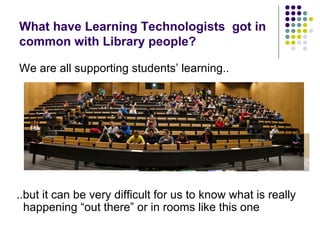
We are all supporting students’ learning..


..but it can be very difficult for us to know what is really
  happening “out there” or in rooms like this one
Challenges we face
   How do we know what effects new
    technologies may be having?
   How do we know what supports to put in
    place for students?
   And how do we know what effects our
    supports are having?
   What should we do next?
   What do other people think we should be
    doing?
Addressing these challenges:
the VLE as a lens
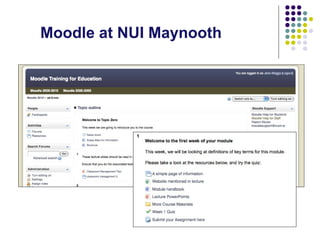
Moodle at NUI Maynooth
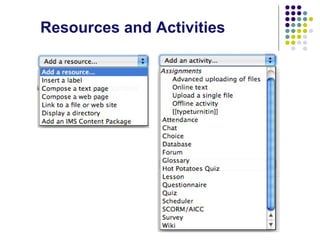
Resources and Activities
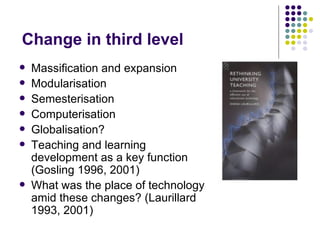
Change in third level
   Massification and expansion
   Modularisation
   Semesterisation
   Computerisation
   Globalisation?
   Teaching and learning
    development as a key function
    (Gosling 1996, 2001)
   What was the place of technology
    amid these changes? (Laurillard
    1993, 2001)
VLE as a means of embarking on
e-learning?

   Notes of our decision to adopt Moodle:
    The Committee believes that the mainstreaming of e-learning in a strategically
       aligned manner will enable us to
        enhance the learning experience for students through a consistently
          student-centred approach
        support the quality agenda of higher education

        enhance the research capacity of the institution

        increase student numbers and market globally

        upskill for the knowledge economy

        enhance access to higher education

        provide progression routes and learner mobility

        emphasise the importance of learning communities

        operationalise the public policy imperatives of lifelong learning.
          (Committee, 2005a, p. 1, my emphasis)
So - what did people use it for?

…fast forward to the end of the noughties…
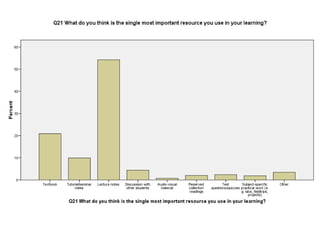
What were students doing?
   Many case studies reporting positive outcomes
    where activities used in the VLE:
       But often in funded projects with discrete groups
   Wider studies of students’ use of VLEs and
    other technologies were undertaken:
       Conole (2008); Conole, de Laat, Dillon & Darby
        (2008); Jones & Lea (2008) in UK
       Cosgrave et al (2008, 2009, 2011) in Ireland
       Ongoing research originating in NAIRTL, now
        supported by ILTA
       Over 15,000 responses (2012)
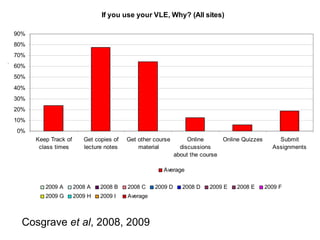
If you use your VLE, Why? (All sites)

 90%
 80%                                  If you use your VLE, Why?
 70%
100%
  60%
 90%
  50%
 80%
  40%
 70%
60%
 30%
50%
 20%
40%
 10%
30%
  0%
20%
10%      Keep Track of      Get copies of     Get other course       Online        Online Quizzes      Submit
 0%       class times       lecture notes         material        discussions                        Assignments
        Keep Track of     Get copies of    Get other course     about the course
                                                                 Online       Online Quizzes      Submit
         class times      lecture notes        material       discussions                       Assignments
                                                            Average course
                                                            about the

             2009 A      2008 A   2008 B      2008 C    2009 D    2008 D    2009 E    2008 E    2009 F
             2009 G      2009 H   2009 I      Average


      Cosgrave et al, 2008, 2009
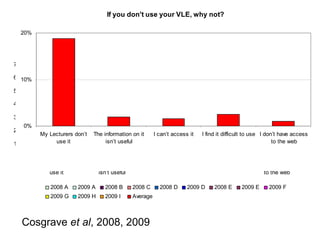
If you don't use your VLE, why not?

 20%

                                  If you don't use your VLE, why not?

70%

60%
  10%

50%

40%

30%


If not, why not?
   0%
20%
          My Lecturers don’t   The information on it      I can’t access it      I find it difficult to use I don’t have access
10%            use it               isn’t useful                                                                 to the web

0%
        My Lecturers don’t   The information on it     I can’t access it      I find it difficult to use I don’t have access
             use it               isn’t useful                                                                to the web

              2008 A     2009 A     2008 B      2008 C      2008 D         2009 D     2008 E      2009 E      2009 F
              2009 G     2009 H     2009 I      Average


  Cosgrave et al, 2008, 2009
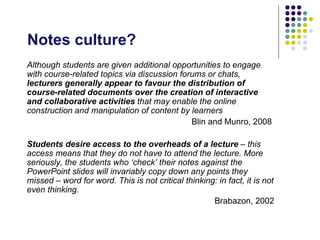
Notes culture?
Although students are given additional opportunities to engage
with course-related topics via discussion forums or chats,
lecturers generally appear to favour the distribution of
course-related documents over the creation of interactive
and collaborative activities that may enable the online
construction and manipulation of content by learners
                                             Blin and Munro, 2008

Students desire access to the overheads of a lecture – this
access means that they do not have to attend the lecture. More
seriously, the students who ‘check’ their notes against the
PowerPoint slides will invariably copy down any points they
missed – word for word. This is not critical thinking: in fact, it is not
even thinking.
                                                     Brabazon, 2002
Researchers disappointed

Certainly, as it is currently being used on campus, eLearning
is not delivering the wide benefits to education which were
expected: the anticipated sweeping impact of the new
technologies on restructuring the learning and teaching
practices at universities (and with it their high-profit
prospects) has not materialised.

                           Donnelly & O'Rourke, 2007, p. 38
Characterising VLE use by 2008
   Things we knew were happening:
      VLE usage pervasive amongst students
      At NUIM: Moodle reported as being easy to use, reliable

   Things we thought were happening:
      Student use dependent on lecturer use
      Notes culture persists - from Leaving Cert, or…?
      Limited use of interactive features
      Some students needing more help
   Could this be investigated further?
   What would we find out about the impacts of new
    technologies?
   What could we find out about supporting students better?
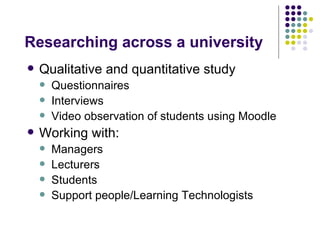
Researching across a university
   Qualitative and quantitative study
       Questionnaires
       Interviews
       Video observation of students using Moodle
   Working with:
       Managers
       Lecturers
       Students
       Support people/Learning Technologists
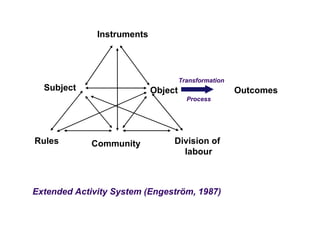
Instruments


                                     Transformation
  Subject                   Object                    Outcomes
                                       Process


Rules        Community           Division of
                                   labour


Extended Activity System (Engeström, 1987)
Students
   Object 1: Keep up to date.

   Object 2: Undertake and complete
    coursework.
Overview of survey findings
with students
   60 responses
   Group was self-selecting:
       Majority female, first year undergraduates
       Most were born after 1983
   Estimated that they spent up to 15 hours a week online
       Figures corresponded with those for Lecturers
   Nearly all were using social networking sites
       Some Lecturers were too!
   Most thought the web was “useful” or “very useful” for their
    studies
   They were wary of some content and resources and did not
    like paying for things
       Lecturers shared these concerns
Overview of survey findings
with students
   Use of the VLE:
       Often reading from screen, printing selectively
       Lengthy documents printed
       Experiences not consistent across subjects
       VLE supported administrative aspects of the
        course making tools, procedures visible (Kuutti,
        1996)
       VLE helped them to manage their studies
       There was some support available from the
        “community” via Forums
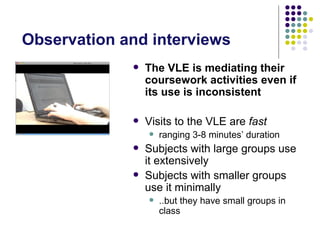
Observation and interviews
                The VLE is mediating their
                 coursework activities even if
                 its use is inconsistent

                Visits to the VLE are fast
                    ranging 3-8 minutes’ duration
                Subjects with large groups use
                 it extensively
                Subjects with smaller groups
                 use it minimally
                    ..but they have small groups in
                     class
Students
   No direct statement that more technology
    should be used in class or in their courses.
   High tolerance for inconsistent use of the
    VLE:
       No desire to lead or drive the use of technology -
        consumerist approach!
       Lecturer-dependent
       Supporter-dependent?
   Not displaying the assumed behaviour of the
    digital native
What can we do next?

   Not only continue providing formal inductions for
    students:
       Orientation Week
       LIST with Library at NUI Maynooth
       Departmental requests for training
   But also:
       Providing student-led support (pilot project)
       Developing other forms of agile, amorphous support?
       Continuing to research with students and staff
       Challenging the notion of digital natives
Evolution or Revolution?


The image of primary school children using computer in 1980 is
copyright protected, but available from the Science in Society
Picture Gallery at http://www.scienceandsociety.co.uk/, at
http://www.scienceandsociety.co.uk/results.asp?image=10464130&itemw=4
Comments and questions…
Thank you!

claire.mcavinia@nuim.ie

Joined Up Learning: Students' use of the VLE and what it can tell us

  • 1.
    Joined up learning: students’ use of the VLE, and what it can tell us Dr Claire McAvinia Centre for Teaching and Learning, NUI Maynooth CONUL ACIL Annual Information Literacy Seminar, 14 June 2012
  • 2.
    A map fortoday  What is a Learning Technologist?  What do we have in common with you?  What can the VLE experience tell us about some of the challenges we face?  How might we support students in new ways in the future?  Questions and discussion
  • 3.
    What have LearningTechnologists got in common with Library people? We are all supporting students’ learning.. ..but it can be very difficult for us to know what is really happening “out there” or in rooms like this one
  • 4.
    Challenges we face  How do we know what effects new technologies may be having?  How do we know what supports to put in place for students?  And how do we know what effects our supports are having?  What should we do next?  What do other people think we should be doing?
  • 5.
  • 6.
    Moodle at NUIMaynooth
  • 7.
  • 8.
    Change in thirdlevel  Massification and expansion  Modularisation  Semesterisation  Computerisation  Globalisation?  Teaching and learning development as a key function (Gosling 1996, 2001)  What was the place of technology amid these changes? (Laurillard 1993, 2001)
  • 9.
    VLE as ameans of embarking on e-learning?  Notes of our decision to adopt Moodle: The Committee believes that the mainstreaming of e-learning in a strategically aligned manner will enable us to  enhance the learning experience for students through a consistently student-centred approach  support the quality agenda of higher education  enhance the research capacity of the institution  increase student numbers and market globally  upskill for the knowledge economy  enhance access to higher education  provide progression routes and learner mobility  emphasise the importance of learning communities  operationalise the public policy imperatives of lifelong learning. (Committee, 2005a, p. 1, my emphasis)
  • 10.
    So - whatdid people use it for? …fast forward to the end of the noughties…
  • 11.
    What were studentsdoing?  Many case studies reporting positive outcomes where activities used in the VLE:  But often in funded projects with discrete groups  Wider studies of students’ use of VLEs and other technologies were undertaken:  Conole (2008); Conole, de Laat, Dillon & Darby (2008); Jones & Lea (2008) in UK  Cosgrave et al (2008, 2009, 2011) in Ireland  Ongoing research originating in NAIRTL, now supported by ILTA  Over 15,000 responses (2012)
  • 12.
    If you useyour VLE, Why? (All sites) 90% 80% If you use your VLE, Why? 70% 100% 60% 90% 50% 80% 40% 70% 60% 30% 50% 20% 40% 10% 30% 0% 20% 10% Keep Track of Get copies of Get other course Online Online Quizzes Submit 0% class times lecture notes material discussions Assignments Keep Track of Get copies of Get other course about the course Online Online Quizzes Submit class times lecture notes material discussions Assignments Average course about the 2009 A 2008 A 2008 B 2008 C 2009 D 2008 D 2009 E 2008 E 2009 F 2009 G 2009 H 2009 I Average Cosgrave et al, 2008, 2009
  • 13.
    If you don'tuse your VLE, why not? 20% If you don't use your VLE, why not? 70% 60% 10% 50% 40% 30% If not, why not? 0% 20% My Lecturers don’t The information on it I can’t access it I find it difficult to use I don’t have access 10% use it isn’t useful to the web 0% My Lecturers don’t The information on it I can’t access it I find it difficult to use I don’t have access use it isn’t useful to the web 2008 A 2009 A 2008 B 2008 C 2008 D 2009 D 2008 E 2009 E 2009 F 2009 G 2009 H 2009 I Average Cosgrave et al, 2008, 2009
  • 15.
    Notes culture? Although studentsare given additional opportunities to engage with course-related topics via discussion forums or chats, lecturers generally appear to favour the distribution of course-related documents over the creation of interactive and collaborative activities that may enable the online construction and manipulation of content by learners Blin and Munro, 2008 Students desire access to the overheads of a lecture – this access means that they do not have to attend the lecture. More seriously, the students who ‘check’ their notes against the PowerPoint slides will invariably copy down any points they missed – word for word. This is not critical thinking: in fact, it is not even thinking. Brabazon, 2002
  • 16.
    Researchers disappointed Certainly, asit is currently being used on campus, eLearning is not delivering the wide benefits to education which were expected: the anticipated sweeping impact of the new technologies on restructuring the learning and teaching practices at universities (and with it their high-profit prospects) has not materialised. Donnelly & O'Rourke, 2007, p. 38
  • 17.
    Characterising VLE useby 2008  Things we knew were happening:  VLE usage pervasive amongst students  At NUIM: Moodle reported as being easy to use, reliable  Things we thought were happening:  Student use dependent on lecturer use  Notes culture persists - from Leaving Cert, or…?  Limited use of interactive features  Some students needing more help  Could this be investigated further?  What would we find out about the impacts of new technologies?  What could we find out about supporting students better?
  • 18.
    Researching across auniversity  Qualitative and quantitative study  Questionnaires  Interviews  Video observation of students using Moodle  Working with:  Managers  Lecturers  Students  Support people/Learning Technologists
  • 19.
    Instruments Transformation Subject Object Outcomes Process Rules Community Division of labour Extended Activity System (Engeström, 1987)
  • 20.
    Students  Object 1: Keep up to date.  Object 2: Undertake and complete coursework.
  • 21.
    Overview of surveyfindings with students  60 responses  Group was self-selecting:  Majority female, first year undergraduates  Most were born after 1983  Estimated that they spent up to 15 hours a week online  Figures corresponded with those for Lecturers  Nearly all were using social networking sites  Some Lecturers were too!  Most thought the web was “useful” or “very useful” for their studies  They were wary of some content and resources and did not like paying for things  Lecturers shared these concerns
  • 22.
    Overview of surveyfindings with students  Use of the VLE:  Often reading from screen, printing selectively  Lengthy documents printed  Experiences not consistent across subjects  VLE supported administrative aspects of the course making tools, procedures visible (Kuutti, 1996)  VLE helped them to manage their studies  There was some support available from the “community” via Forums
  • 23.
    Observation and interviews  The VLE is mediating their coursework activities even if its use is inconsistent  Visits to the VLE are fast  ranging 3-8 minutes’ duration  Subjects with large groups use it extensively  Subjects with smaller groups use it minimally  ..but they have small groups in class
  • 24.
    Students  No direct statement that more technology should be used in class or in their courses.  High tolerance for inconsistent use of the VLE:  No desire to lead or drive the use of technology - consumerist approach!  Lecturer-dependent  Supporter-dependent?  Not displaying the assumed behaviour of the digital native
  • 25.
    What can wedo next?  Not only continue providing formal inductions for students:  Orientation Week  LIST with Library at NUI Maynooth  Departmental requests for training  But also:  Providing student-led support (pilot project)  Developing other forms of agile, amorphous support?  Continuing to research with students and staff  Challenging the notion of digital natives
  • 26.
    Evolution or Revolution? Theimage of primary school children using computer in 1980 is copyright protected, but available from the Science in Society Picture Gallery at http://www.scienceandsociety.co.uk/, at http://www.scienceandsociety.co.uk/results.asp?image=10464130&itemw=4
  • 27.
  • 28.

Editor's Notes

  • #20 Engestrom’s Extended Activity System accommodates the social context for an activity. We still have the fundamental idea of a person with a goal, and the activity being mediated by some tools or instruments, but we also have the notion of Rules - in other words, laws, conventions or tacit conditions which also mediate the activity, we have a Community which is the people surrounding the individual Subject, and we have Division of Labour - how the activity is shared amongst more than one person. Engestrom is also suggesting interactions between all of these nodes, and the arrows are to indicate this. So, while we can map the activity according to this framework, we also have to think about how all of these elements interact with each other, and how that is going to affect the outcome. Again, the Object is shown to be separate to the Outcome which is an important distinction.
  • #21 1.