Submitted by
Athira. m
Physical science
The Classroom Environment is home
away from home for both the teacher and
student. This warm, safe, and caring
environment allows students to “influence
the nature of the activities they undertake,
engage seriously in their study, regulate their
behavior, and know of the explicit criteria
and high expectations of what they are to
achieve”.
Classroom environment encompasses
a broad range of educational concepts. The
main factors of classroom environment are
The Physical Environment
Classroom climate
Psychological environment
The Physical Environment
The Physical Environment aspects are
Class composition
Class size
Classroom management
The physical environment of the
classroom is talking about the way a
classroom is set up.
Class composition examine classroom
grouping methods, including ability, grouping of
students and cooperative learning groups.
Classrooms with highly cooperative groups appear
to have students with more positive perceptions of
fairness in grading, stronger class cohesion, and
higher degree of social support, as well as higher
achievement scores.
Class Composition
Class Size
An educational tool that can be used to
describe the average number of students per class
in a school.
Important factors about reduced class size are…
Smaller classes can boost student academic achievement.
Smaller classes result in increased teacher-students contact.
Students in smaller classes show more appreciation for one
another and more desire to participle in classroom activities.
Smaller classes results in high teacher morale and reduced
stress.
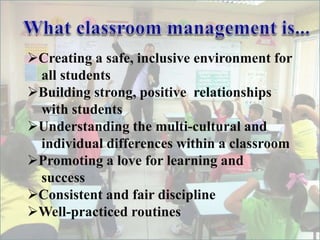
Creating a safe, inclusive environment for
all students
Building strong, positive relationships
with students
Understanding the multi-cultural and
individual differences within a classroom
Promoting a love for learning and
success
Consistent and fair discipline
Well-practiced routines
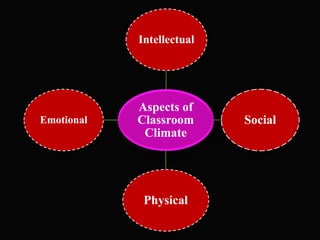
Classroom climate is the intellectual,
emotional, and physical environment
where students can learn as a by-
product of the social interactions
between and among teachers and
students. Classroom climate plays a
major role in shaping the quality of
school life and learning.
Aspects of
Classroom
Climate
Intellectual
Social
Physical
Emotional
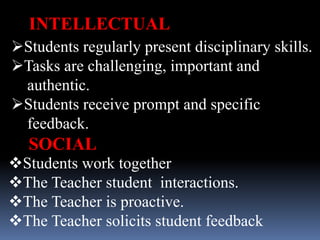
Students regularly present disciplinary skills.
Tasks are challenging, important and
authentic.
Students receive prompt and specific
feedback.
INTELLECTUAL
Students work together
The Teacher student interactions.
The Teacher is proactive.
The Teacher solicits student feedback
SOCIAL
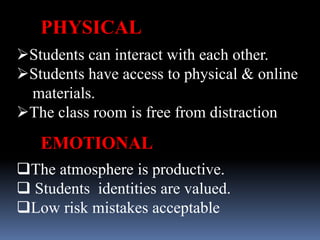
Students can interact with each other.
Students have access to physical & online
materials.
The class room is free from distraction
PHYSICAL
EMOTIONAL
The atmosphere is productive.
 Students identities are valued.
Low risk mistakes acceptable
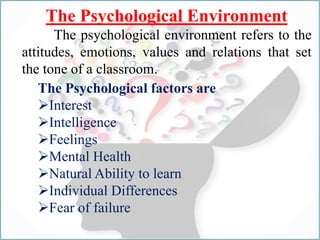
The Psychological Environment
The psychological environment refers to the
attitudes, emotions, values and relations that set
the tone of a classroom.
The Psychological factors are
Interest
Intelligence
Feelings
Mental Health
Natural Ability to learn
Individual Differences
Fear of failure
Interest
Interest refers to the feeling of wanting
to know or learn about something.
Intelligence
Intelligence is a natural capacity and ability
which helps the man to understand and
solve the problems according to the situation.
Feelings
Love, fear and anger are supposed to be
the basic feelings. Feeling is a power
which leads a person to its successful
destination.
Mental Health
A person’s condition with regard to their
psychological and emotional well-being.
Natural Ability to learn
Some learners have natural ability to
learn the things quickly and some are
slow learners. Teachers have to trace out
the natural abilities of the students to
make them a complete personality.
Individual Differences
Learners have different strategies,
approaches, and capabilities for learning
that are a function of prior experience
and heredity.
Fear of Failure
It is a psychological problem and when a
learner think of being fail this feeling
affects his learning. So teachers should
always motivate and encourage the
students and get them out of this fear to
improve their learning.
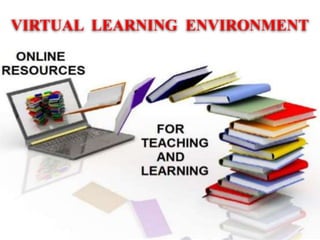
VIRTUAL LEARNING ENVIRONMENT
 A set of teaching and learning tools designed to
enhance a student's learning experience by
including computers and Internet in the learning
process.
 They can be accessed both on and off- campus,
meaning that they can support students learning
outside the lecture hall 24 hours a day, seven
days a week
VIRTUAL LEARNING ENVIRONMENT (VLE)
DEFINITION:
Virtual learning environment or learning
platform is an e-learning education system
based on the web that models conventional in-
person education by providing equivalent
virtual access to classes, class content, tests,
homework, grades, assessments and other
resources such as academic or museum links.
Classroom environment continues to
evolve with the development of online
courses and increased use of technology in
learning situations. Classrooms are now
networked, expanding the environment
beyond physical walls, enabling students to
interact via email, video conferencing, and
blogs. The addition of technology to the
classroom has changed the environment.
CONCLUSION
Changing concept of classroom environment

Changing concept of classroom environment

  • 2.
  • 3.
    The Classroom Environmentis home away from home for both the teacher and student. This warm, safe, and caring environment allows students to “influence the nature of the activities they undertake, engage seriously in their study, regulate their behavior, and know of the explicit criteria and high expectations of what they are to achieve”.
  • 4.
    Classroom environment encompasses abroad range of educational concepts. The main factors of classroom environment are The Physical Environment Classroom climate Psychological environment
  • 5.
    The Physical Environment ThePhysical Environment aspects are Class composition Class size Classroom management The physical environment of the classroom is talking about the way a classroom is set up.
  • 6.
    Class composition examineclassroom grouping methods, including ability, grouping of students and cooperative learning groups. Classrooms with highly cooperative groups appear to have students with more positive perceptions of fairness in grading, stronger class cohesion, and higher degree of social support, as well as higher achievement scores. Class Composition
  • 7.
    Class Size An educationaltool that can be used to describe the average number of students per class in a school. Important factors about reduced class size are… Smaller classes can boost student academic achievement. Smaller classes result in increased teacher-students contact. Students in smaller classes show more appreciation for one another and more desire to participle in classroom activities. Smaller classes results in high teacher morale and reduced stress.
  • 8.
    Creating a safe,inclusive environment for all students Building strong, positive relationships with students Understanding the multi-cultural and individual differences within a classroom Promoting a love for learning and success Consistent and fair discipline Well-practiced routines
  • 9.
    Classroom climate isthe intellectual, emotional, and physical environment where students can learn as a by- product of the social interactions between and among teachers and students. Classroom climate plays a major role in shaping the quality of school life and learning.
  • 10.
  • 11.
    Students regularly presentdisciplinary skills. Tasks are challenging, important and authentic. Students receive prompt and specific feedback. INTELLECTUAL Students work together The Teacher student interactions. The Teacher is proactive. The Teacher solicits student feedback SOCIAL
  • 12.
    Students can interactwith each other. Students have access to physical & online materials. The class room is free from distraction PHYSICAL EMOTIONAL The atmosphere is productive.  Students identities are valued. Low risk mistakes acceptable
  • 13.
    The Psychological Environment Thepsychological environment refers to the attitudes, emotions, values and relations that set the tone of a classroom. The Psychological factors are Interest Intelligence Feelings Mental Health Natural Ability to learn Individual Differences Fear of failure
  • 14.
    Interest Interest refers tothe feeling of wanting to know or learn about something. Intelligence Intelligence is a natural capacity and ability which helps the man to understand and solve the problems according to the situation.
  • 15.
    Feelings Love, fear andanger are supposed to be the basic feelings. Feeling is a power which leads a person to its successful destination. Mental Health A person’s condition with regard to their psychological and emotional well-being.
  • 16.
    Natural Ability tolearn Some learners have natural ability to learn the things quickly and some are slow learners. Teachers have to trace out the natural abilities of the students to make them a complete personality. Individual Differences Learners have different strategies, approaches, and capabilities for learning that are a function of prior experience and heredity.
  • 17.
    Fear of Failure Itis a psychological problem and when a learner think of being fail this feeling affects his learning. So teachers should always motivate and encourage the students and get them out of this fear to improve their learning.
  • 18.
  • 19.
     A setof teaching and learning tools designed to enhance a student's learning experience by including computers and Internet in the learning process.  They can be accessed both on and off- campus, meaning that they can support students learning outside the lecture hall 24 hours a day, seven days a week VIRTUAL LEARNING ENVIRONMENT (VLE)
  • 20.
    DEFINITION: Virtual learning environmentor learning platform is an e-learning education system based on the web that models conventional in- person education by providing equivalent virtual access to classes, class content, tests, homework, grades, assessments and other resources such as academic or museum links.
  • 21.
    Classroom environment continuesto evolve with the development of online courses and increased use of technology in learning situations. Classrooms are now networked, expanding the environment beyond physical walls, enabling students to interact via email, video conferencing, and blogs. The addition of technology to the classroom has changed the environment. CONCLUSION