

PEDAGOGY OF PHYSICAL
SCIENCE
M.SYEDALI FATHIMA,
I YEAR B.Ed PHYSICAL S
VOC COLLEGE OF EDUC
THOOTHUKUDI
NEED AND SIGNIFICANCE & VALUES OF
TEACHING PHYSICAL SCIENCE
INTRODUCTION
• Physical Science is the concerted human effort to understand, or to understand better,
the history of the natural world and how the natural world works with observable
physical evidence as the basis of that understanding. It is done through observation of
natural phenomena, and or through experimentation that tries to stimulate natural
processes under controlled conditions.
• Just a few hundred years after Thales, the Greek philosopher Aristotle made a very
important contribution to science. Prior to Aristotle, other philosophers believed that
they could find the truth about the natural world by inward reflection—in other words,
just by thinking about it. Aristotle, in contrast,thought that truth about the natural world
could come only from observations of nature and inductive reasoning. He argued that
knowledge of nature must be based on evidence and logic. This idea is called
empiricism, and it is the Basis of Science Today.
WHAT IS PHYSICAL SCIENCE?
1. Physical science is a branch of natural science that studies
non-living system, in contrast to life science.
2. The Main purpose of teaching Physical science in
secondary to grasp systematically the basic knowledge of
knowledge of physical science needed for the further study
further study of modern science and technology
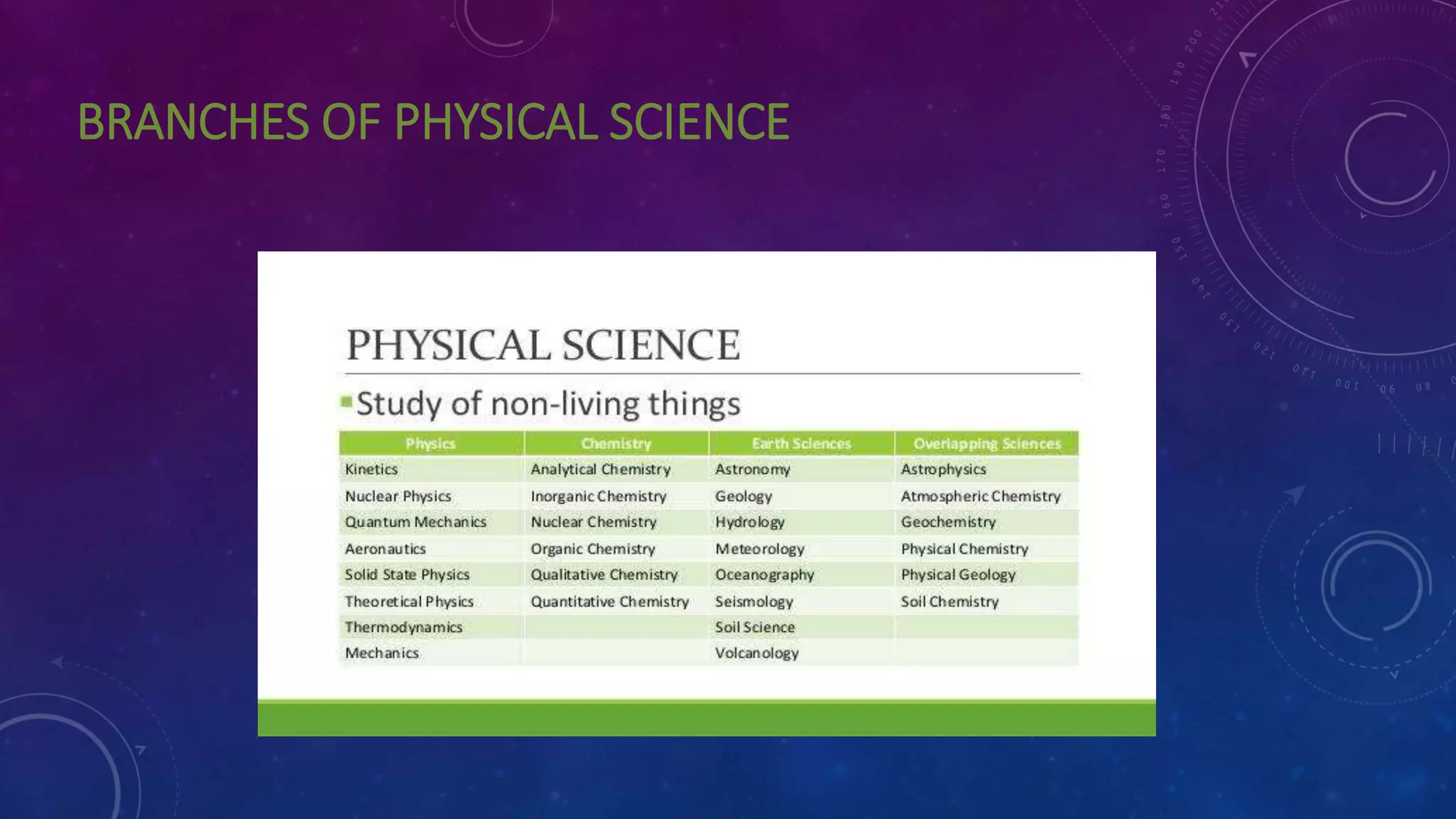
BRANCHES OF PHYSICAL SCIENCE
SCOPE OF PHYSICAL SCIENCE
• Anything that is outside the boundaries of senses of
human being is outside the limits of science.In other
words, the scope of physical science includes everything
within the realm of the sense of human beings.
• Physical Science deals with the natural word, thr realm of
nature, matter and energy.
• Physical Science is not limited to only what is
observable.
AIMS OF TEACHING PHYSICAL SCIENCE
1. To know about the facts and Principles of science and its
applications, consistent with the stage of cognitive
development.
2. To develop a historical and developmental prospective of
science.
3. To nurture the natural curiosity, aesthetic sense and
creativity in science and technology.
4. To cultivate scientific temper, Objectivity and critical
thinking.
NEED AND SIGNIFICANCE OF TEACHING
PHYSICAL SCIENCE
• Science is one of the human activities that man has created to gratify
certain human needs and desires.
The search of truth became the dominant motive in the prosecution o
f science . The
teachingof science imparts training in the scientific method and devel
ops scientific attitude which are very
valuable and at the same time are transferable to other situations in lif
e.
• Therapid advancement of science and technology and increasing nee
d for scientist and technologies have made it all the moreimportant t
o provide for science based education in the schools
Science has now become acompulsory subject in the school curriculu
m because of its multifarious value to the individuals aswell as the soci
ety.
PHYSICS AS A SCIENCE
• Physics, in every day terms, is the science of matter
and its motion; the science that deals with concepta
such as Force, energy mass, and Charge For
Example. More accurately, it is the general analysis of
nature, conducted in order to understand how the
world around us behaves.
• In One form or another, physics is one of the oldest
academic disciplines, and possibly the oldest through
its modern subfield of astronomy.
• Sometimes synonymous with philosophy,chemistry and even
certain branches of mathematics and biology during the last t
wo millennia, physics emerged as a modern science in the
16th century and is now generally distinct from these
other disciplines;although the boundaries between physics an
d all these other subjects still remain difficult to define.
• Today , Physics is a broad and highly developed subject that
is for practical reasons split into several general subfields. In
addition to this, it can also be divided into two conceptually
different branches: Theoretical and experimental physics; the
former dealing with the development of new theories and the
latter dealing with the experimental testing of these new, or
existing, theories.
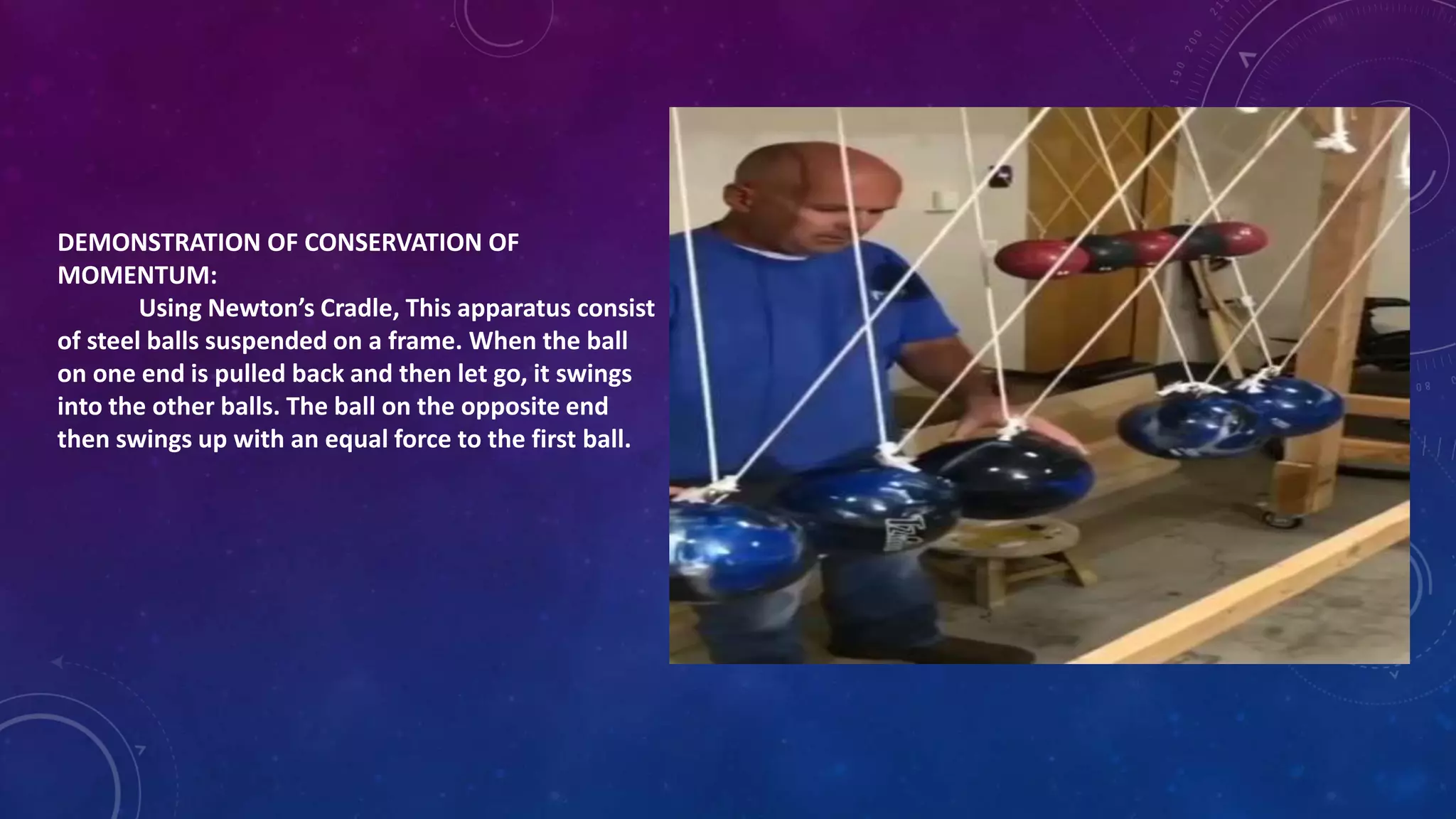
DEMONSTRATION OF CONSERVATION OF
MOMENTUM:
Using Newton’s Cradle, This apparatus consist
of steel balls suspended on a frame. When the ball
on one end is pulled back and then let go, it swings
into the other balls. The ball on the opposite end
then swings up with an equal force to the first ball.
CHEMISTRY AS A SCIENCE
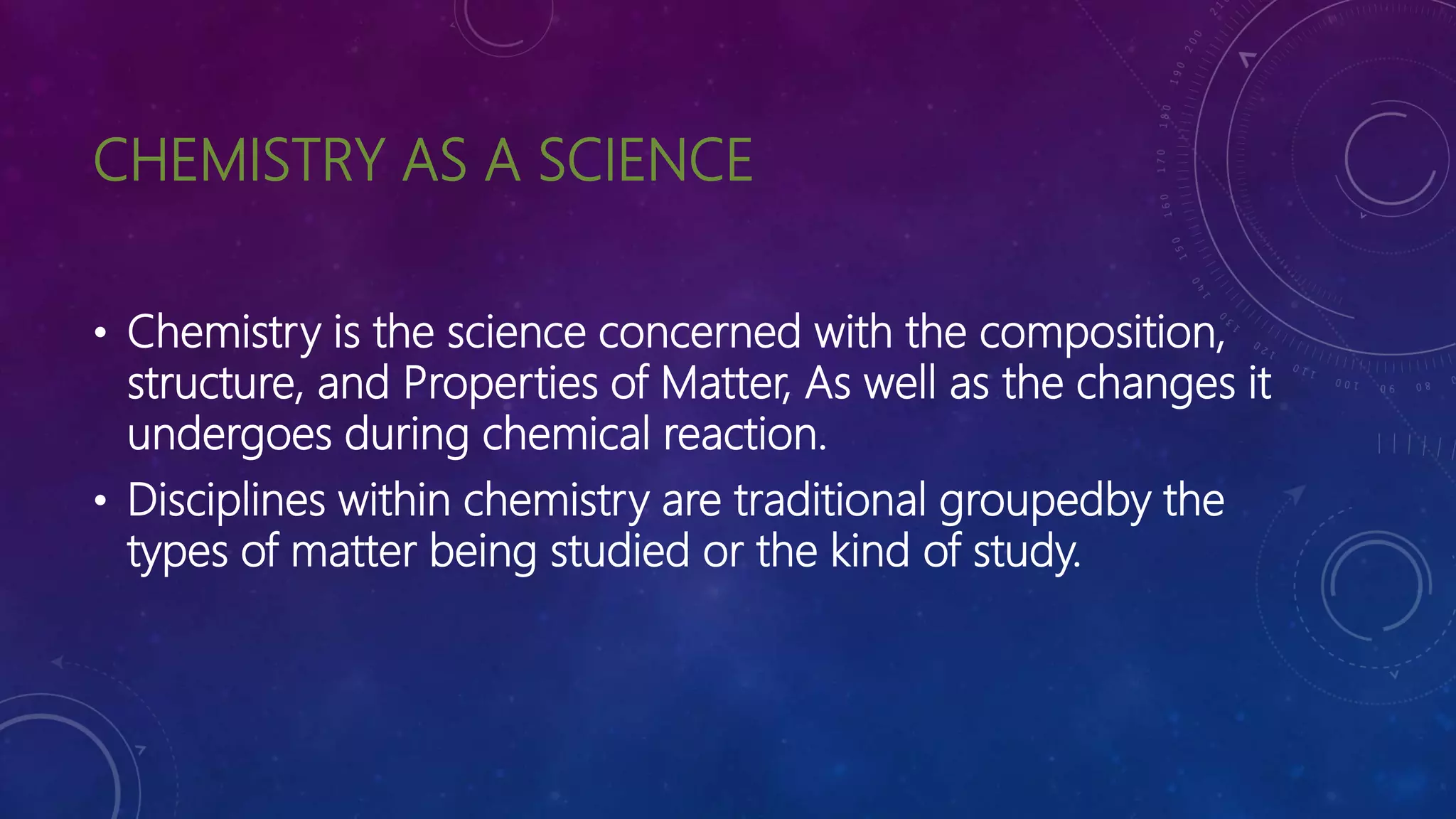
• Chemistry is the science concerned with the composition,
structure, and Properties of Matter, As well as the changes it
undergoes during chemical reaction.
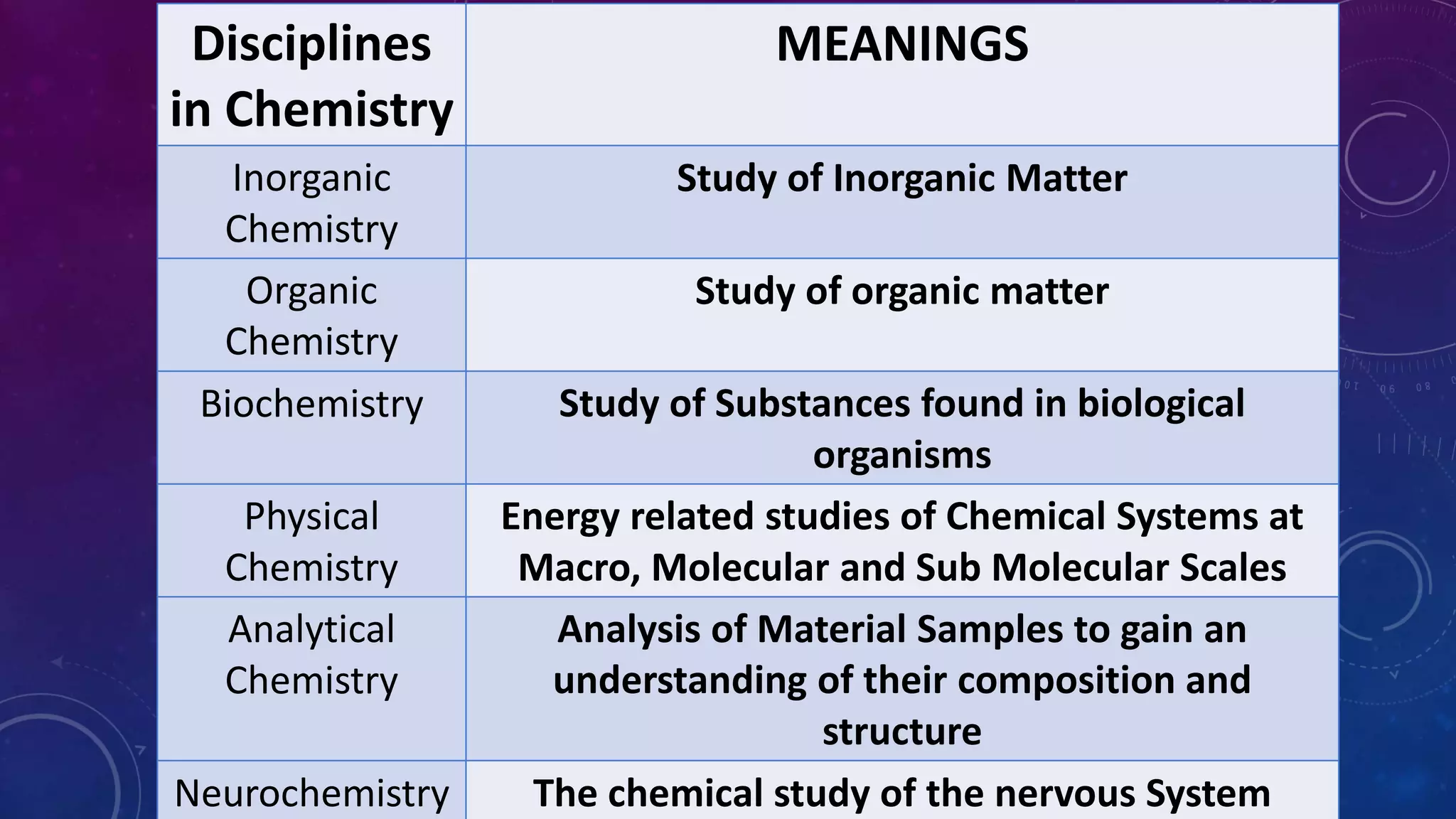
• Disciplines within chemistry are traditional groupedby the
types of matter being studied or the kind of study.
Disciplines
in Chemistry
MEANINGS
Inorganic
Chemistry
Study of Inorganic Matter
Organic
Chemistry
Study of organic matter
Biochemistry Study of Substances found in biological
organisms
Physical
Chemistry
Energy related studies of Chemical Systems at
Macro, Molecular and Sub Molecular Scales
Analytical
Chemistry
Analysis of Material Samples to gain an
understanding of their composition and
structure
Neurochemistry The chemical study of the nervous System
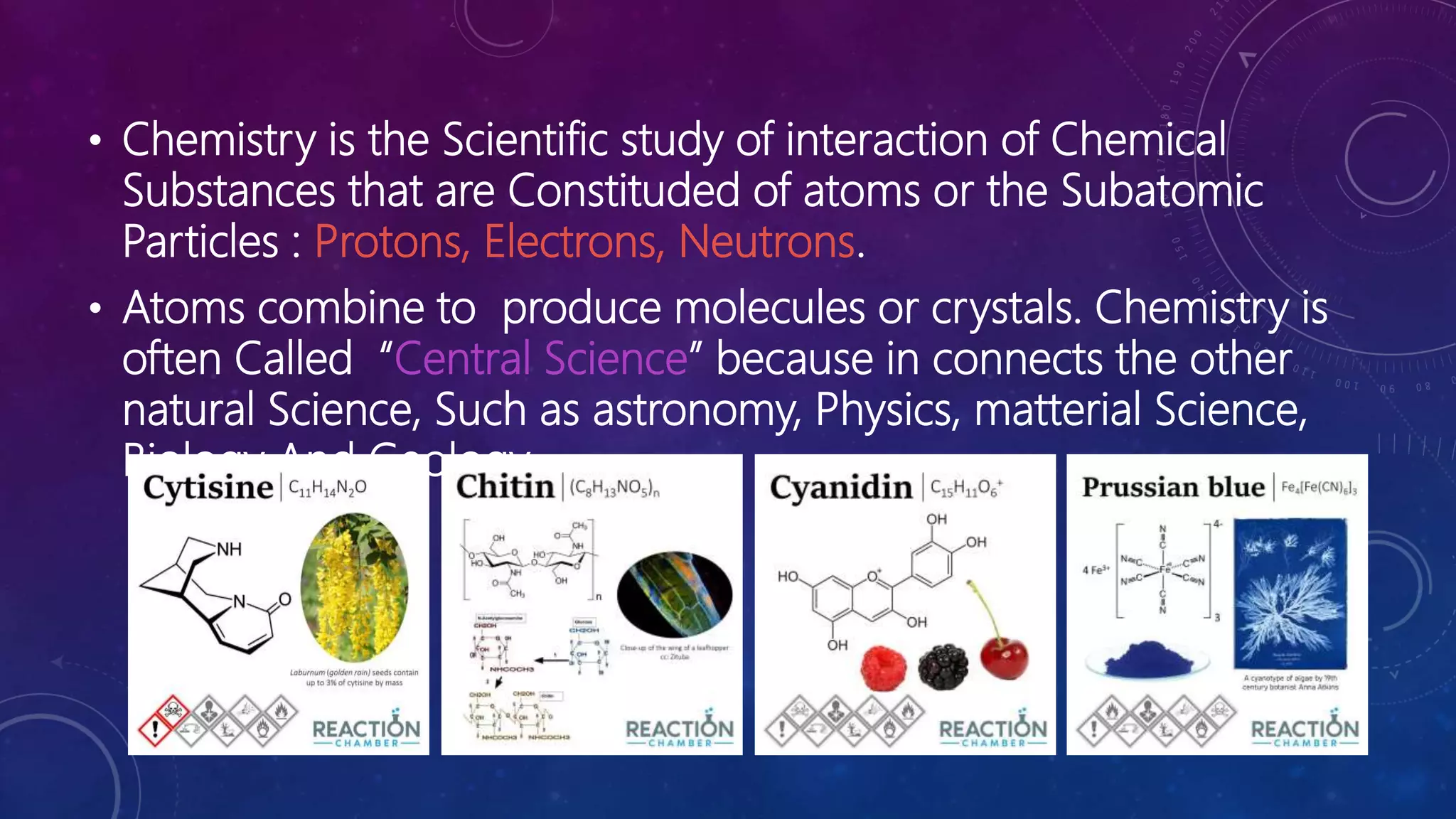
• Chemistry is the Scientific study of interaction of Chemical
Substances that are Constituded of atoms or the Subatomic
Particles : Protons, Electrons, Neutrons.
• Atoms combine to produce molecules or crystals. Chemistry is
often Called “Central Science” because in connects the other
natural Science, Such as astronomy, Physics, matterial Science,
Biology And Geology.
Watch a Copper Wire undergo a
redox/ Displacement with a silver
nitrate Solution
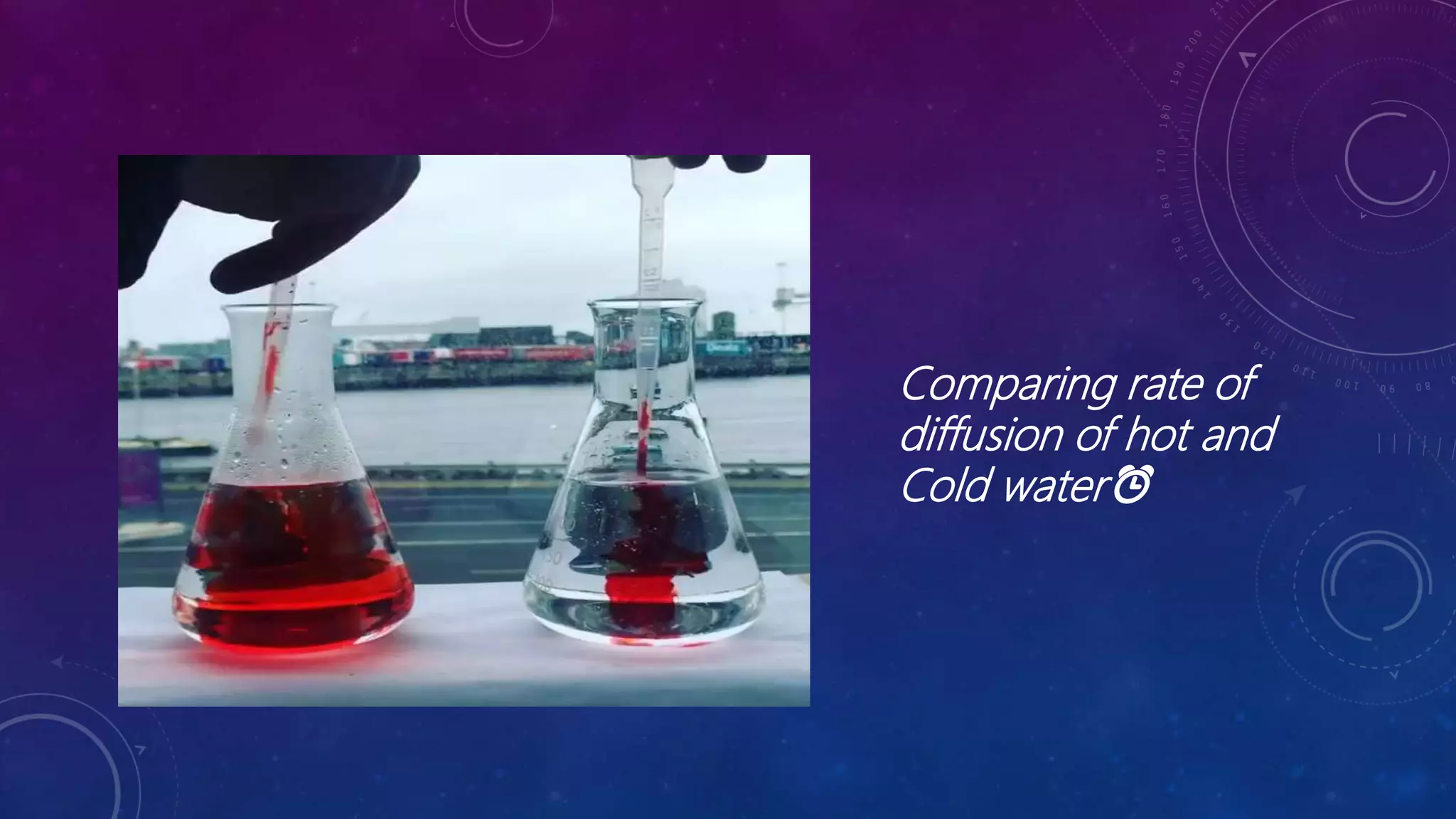
Comparing rate of
diffusion of hot and
Cold water⏰
VALUES OF TEACHING PHYSICAL SCIENCE
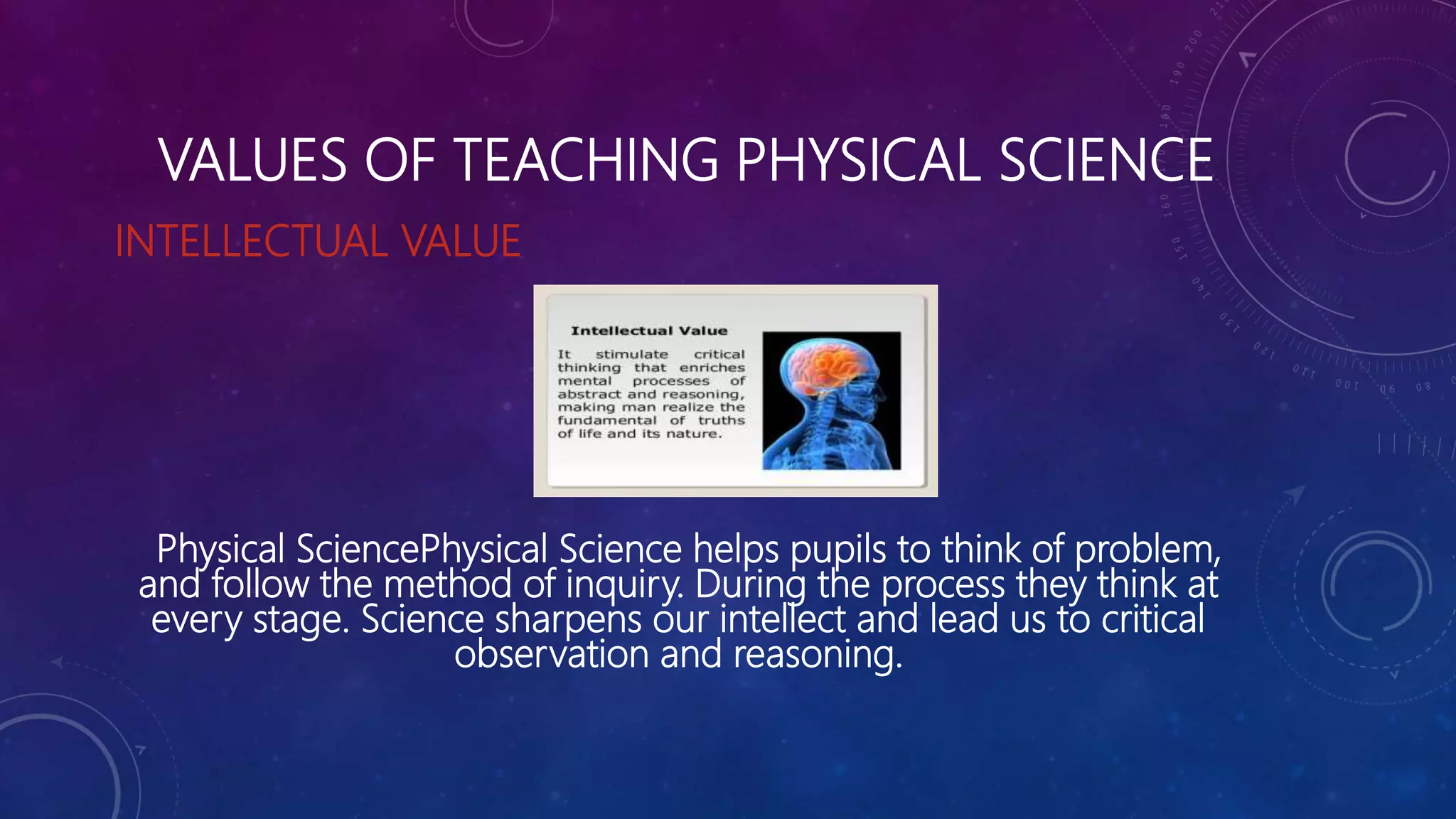
INTELLECTUAL VALUE
Physical SciencePhysical Science helps pupils to think of problem,
and follow the method of inquiry. During the process they think at
every stage. Science sharpens our intellect and lead us to critical
observation and reasoning.
UTILITARIAN VALUE
• We are living in an age of science and technology. Physical
Science has entered in our life and daily activities.
• All our activities are controlled and fashioned by it. There is a
vast storehouse of natural power such as wind, waterfall, heat of
the sun, etc. which science shows how it is useful for us.
• Science has revealed from nature almost all the hidden
treasures. It restores eyes to the blind, hearing to the deaf, legs
to the lame, even life to the dead. So it is very essential to have
some elementary knowledge of science for becoming a full
member in the society.
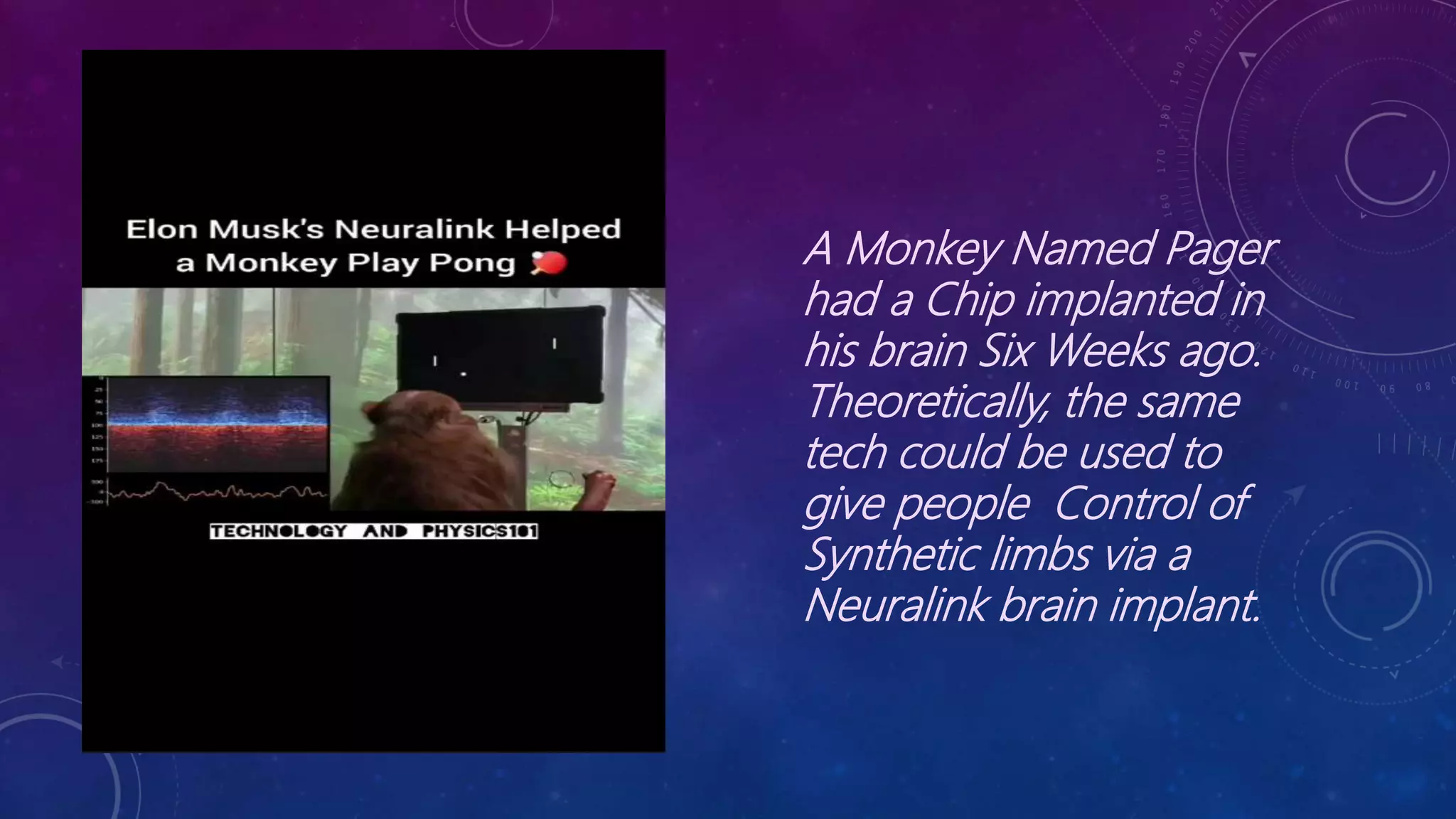
A Monkey Named Pager
had a Chip implanted in
his brain Six Weeks ago.
Theoretically, the same
tech could be used to
give people Control of
Synthetic limbs via a
Neuralink brain implant.
Vocational Value
• Knowledge of science forms the basis for many vocational
studies like medicine,
• engineering, agriculture or any other profession. Further the
study of science forms the basis for
• many hobbies like bee keeping, radio servicing,
photography, etc.
Moral Value
• Science has more moral value. It is the search for truth in a
faithful manner. When a
• scientific theory has religious and philosophic or any other
kind of human interest, it no longer
• remains disintegrated passion for the truth. It teaches the
pupil to be intellectually honest and truthful.
Cultural Value
• Science has aided the growth of consciousness by
making us more aware of the universe we live in.
Through the practical application of scientific discovery
our civilization is undergoing constant change which in
turn brings about situations that threatens the well-
being of the future generations. Scientists take an active
part in the vital issues of the country so as to bring
about consideration and integration of scientific
development and our cultural heritage.
• Aesthetic sense is the most important
consideration with all scientific men for it
meets one of the deepest needs of human
nature which manifests itself as the desire for
beauty.
• To a man of science, practical application is
just a by-product of his autonomous activity.
• The search for universal laws and
comprehensive theories undoubtedly the
manifestation of the aesthetic motive is very
apparent and the satisfaction they get from it
seems to be indistinguishable from those of
an artist.
CONCLUSION
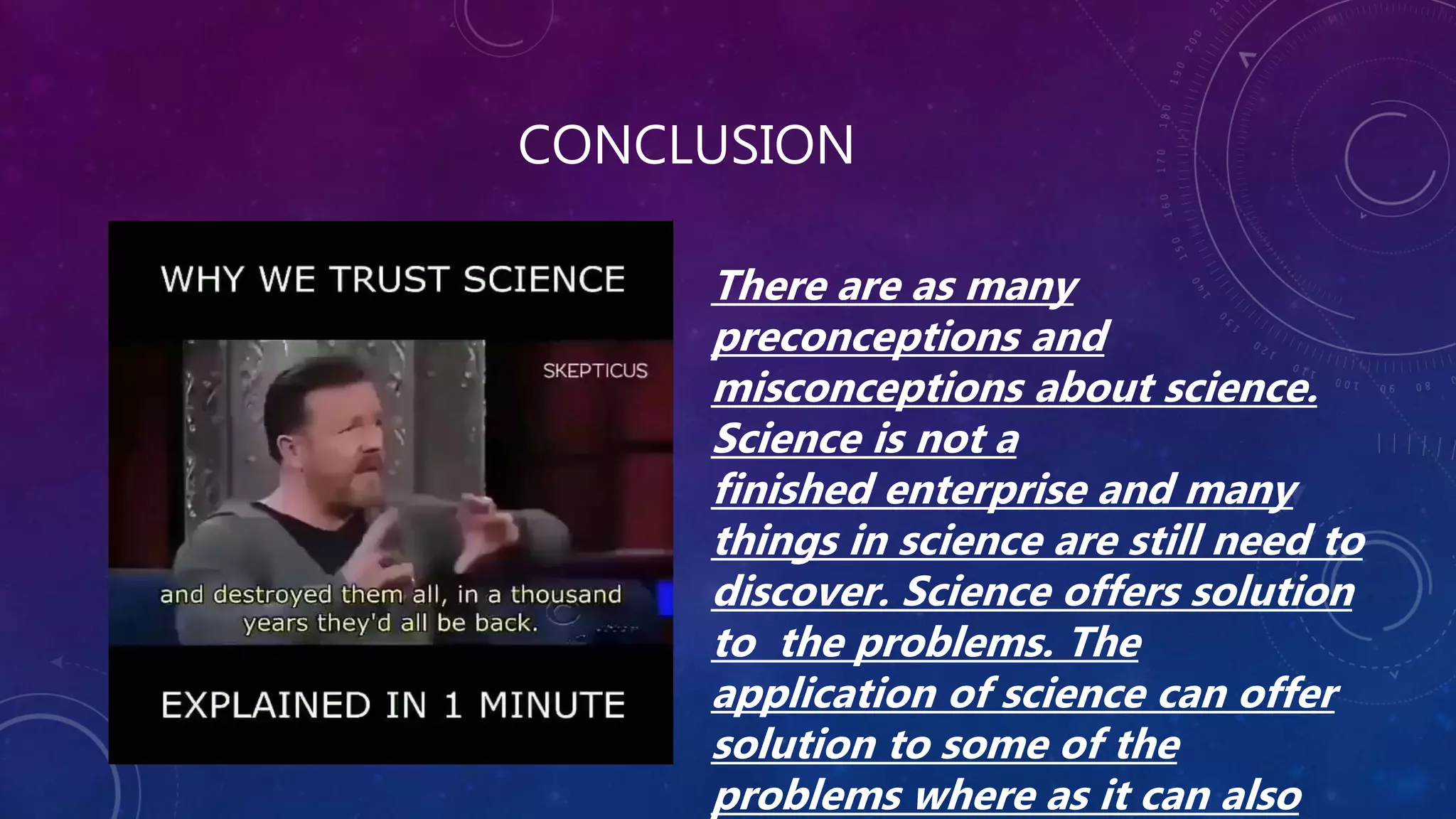
There are as many
preconceptions and
misconceptions about science.
Science is not a
finished enterprise and many
things in science are still need to
discover. Science offers solution
to the problems. The
application of science can offer
solution to some of the
problems where as it can also

PEDAGOGY OF TEACHING PHYSICAL SCIENCE

  • 1.
    PEDAGOGY OF PHYSICAL SCIENCE M.SYEDALIFATHIMA, I YEAR B.Ed PHYSICAL S VOC COLLEGE OF EDUC THOOTHUKUDI NEED AND SIGNIFICANCE & VALUES OF TEACHING PHYSICAL SCIENCE
  • 2.
  • 3.
    • Physical Scienceis the concerted human effort to understand, or to understand better, the history of the natural world and how the natural world works with observable physical evidence as the basis of that understanding. It is done through observation of natural phenomena, and or through experimentation that tries to stimulate natural processes under controlled conditions. • Just a few hundred years after Thales, the Greek philosopher Aristotle made a very important contribution to science. Prior to Aristotle, other philosophers believed that they could find the truth about the natural world by inward reflection—in other words, just by thinking about it. Aristotle, in contrast,thought that truth about the natural world could come only from observations of nature and inductive reasoning. He argued that knowledge of nature must be based on evidence and logic. This idea is called empiricism, and it is the Basis of Science Today.
  • 4.
    WHAT IS PHYSICALSCIENCE? 1. Physical science is a branch of natural science that studies non-living system, in contrast to life science. 2. The Main purpose of teaching Physical science in secondary to grasp systematically the basic knowledge of knowledge of physical science needed for the further study further study of modern science and technology
  • 5.
  • 6.
    SCOPE OF PHYSICALSCIENCE • Anything that is outside the boundaries of senses of human being is outside the limits of science.In other words, the scope of physical science includes everything within the realm of the sense of human beings. • Physical Science deals with the natural word, thr realm of nature, matter and energy. • Physical Science is not limited to only what is observable.
  • 7.
    AIMS OF TEACHINGPHYSICAL SCIENCE 1. To know about the facts and Principles of science and its applications, consistent with the stage of cognitive development. 2. To develop a historical and developmental prospective of science. 3. To nurture the natural curiosity, aesthetic sense and creativity in science and technology. 4. To cultivate scientific temper, Objectivity and critical thinking.
  • 8.
    NEED AND SIGNIFICANCEOF TEACHING PHYSICAL SCIENCE • Science is one of the human activities that man has created to gratify certain human needs and desires. The search of truth became the dominant motive in the prosecution o f science . The teachingof science imparts training in the scientific method and devel ops scientific attitude which are very valuable and at the same time are transferable to other situations in lif e. • Therapid advancement of science and technology and increasing nee d for scientist and technologies have made it all the moreimportant t o provide for science based education in the schools Science has now become acompulsory subject in the school curriculu m because of its multifarious value to the individuals aswell as the soci ety.
  • 9.
    PHYSICS AS ASCIENCE • Physics, in every day terms, is the science of matter and its motion; the science that deals with concepta such as Force, energy mass, and Charge For Example. More accurately, it is the general analysis of nature, conducted in order to understand how the world around us behaves. • In One form or another, physics is one of the oldest academic disciplines, and possibly the oldest through its modern subfield of astronomy.
  • 12.
    • Sometimes synonymouswith philosophy,chemistry and even certain branches of mathematics and biology during the last t wo millennia, physics emerged as a modern science in the 16th century and is now generally distinct from these other disciplines;although the boundaries between physics an d all these other subjects still remain difficult to define. • Today , Physics is a broad and highly developed subject that is for practical reasons split into several general subfields. In addition to this, it can also be divided into two conceptually different branches: Theoretical and experimental physics; the former dealing with the development of new theories and the latter dealing with the experimental testing of these new, or existing, theories.
  • 13.
    DEMONSTRATION OF CONSERVATIONOF MOMENTUM: Using Newton’s Cradle, This apparatus consist of steel balls suspended on a frame. When the ball on one end is pulled back and then let go, it swings into the other balls. The ball on the opposite end then swings up with an equal force to the first ball.
  • 14.
    CHEMISTRY AS ASCIENCE • Chemistry is the science concerned with the composition, structure, and Properties of Matter, As well as the changes it undergoes during chemical reaction. • Disciplines within chemistry are traditional groupedby the types of matter being studied or the kind of study.
  • 15.
    Disciplines in Chemistry MEANINGS Inorganic Chemistry Study ofInorganic Matter Organic Chemistry Study of organic matter Biochemistry Study of Substances found in biological organisms Physical Chemistry Energy related studies of Chemical Systems at Macro, Molecular and Sub Molecular Scales Analytical Chemistry Analysis of Material Samples to gain an understanding of their composition and structure Neurochemistry The chemical study of the nervous System
  • 16.
    • Chemistry isthe Scientific study of interaction of Chemical Substances that are Constituded of atoms or the Subatomic Particles : Protons, Electrons, Neutrons. • Atoms combine to produce molecules or crystals. Chemistry is often Called “Central Science” because in connects the other natural Science, Such as astronomy, Physics, matterial Science, Biology And Geology.
  • 18.
    Watch a CopperWire undergo a redox/ Displacement with a silver nitrate Solution
  • 19.
    Comparing rate of diffusionof hot and Cold water⏰
  • 20.
    VALUES OF TEACHINGPHYSICAL SCIENCE INTELLECTUAL VALUE Physical SciencePhysical Science helps pupils to think of problem, and follow the method of inquiry. During the process they think at every stage. Science sharpens our intellect and lead us to critical observation and reasoning.
  • 21.
    UTILITARIAN VALUE • Weare living in an age of science and technology. Physical Science has entered in our life and daily activities. • All our activities are controlled and fashioned by it. There is a vast storehouse of natural power such as wind, waterfall, heat of the sun, etc. which science shows how it is useful for us. • Science has revealed from nature almost all the hidden treasures. It restores eyes to the blind, hearing to the deaf, legs to the lame, even life to the dead. So it is very essential to have some elementary knowledge of science for becoming a full member in the society.
  • 22.
    A Monkey NamedPager had a Chip implanted in his brain Six Weeks ago. Theoretically, the same tech could be used to give people Control of Synthetic limbs via a Neuralink brain implant.
  • 23.
    Vocational Value • Knowledgeof science forms the basis for many vocational studies like medicine, • engineering, agriculture or any other profession. Further the study of science forms the basis for • many hobbies like bee keeping, radio servicing, photography, etc. Moral Value • Science has more moral value. It is the search for truth in a faithful manner. When a • scientific theory has religious and philosophic or any other kind of human interest, it no longer • remains disintegrated passion for the truth. It teaches the pupil to be intellectually honest and truthful.
  • 24.
    Cultural Value • Sciencehas aided the growth of consciousness by making us more aware of the universe we live in. Through the practical application of scientific discovery our civilization is undergoing constant change which in turn brings about situations that threatens the well- being of the future generations. Scientists take an active part in the vital issues of the country so as to bring about consideration and integration of scientific development and our cultural heritage.
  • 25.
    • Aesthetic senseis the most important consideration with all scientific men for it meets one of the deepest needs of human nature which manifests itself as the desire for beauty. • To a man of science, practical application is just a by-product of his autonomous activity. • The search for universal laws and comprehensive theories undoubtedly the manifestation of the aesthetic motive is very apparent and the satisfaction they get from it seems to be indistinguishable from those of an artist.
  • 26.
    CONCLUSION There are asmany preconceptions and misconceptions about science. Science is not a finished enterprise and many things in science are still need to discover. Science offers solution to the problems. The application of science can offer solution to some of the problems where as it can also

Editor's Notes

  • #14 DEMONSTRATION OF CONSERVATION OF MOMENTUM: Using Newton’s Cradle, This apparatus consist of steel balls suspended on a frame. When the ball on one end is pulled back and then let go, it swings into the other balls. The ball on the opposite end then swings up with an equal force to the first ball.