Learner-centered learning
   object repositories:
 personalization and
  interaction issues
        Julià Minguillón
Universitat Oberta de Catalunya


               ECEL 2009, 8th European Conference on eLearning, Bari, Italy
Table of contents
      •    E-Learning is / is not …
      •    Virtual Learning Environments
      •    Learning Object Repositories
      •    Case of study: Statistics
      •    Improving interaction
      •    Introducing personalization
      •    Current project status
      •    Summary
J. Minguillón                 ECEL 2009, 8th European Conference on eLearning, Bari, Italy
E-Learning is not…
      •    …e + learning
      •    …reproducing traditional learning
      •    …leaving learners alone with technology
      •    …technology replacing teachers
      •    …delivering content through LCMS
      •    …a collection of tools / services
      •    …mail, chat or blog
      •    …self-learning
J. Minguillón                ECEL 2009, 8th European Conference on eLearning, Bari, Italy
E-Learning should be…
      •    …promoting communication
      •    …enabling deeper reflection
      •    …technology supporting users
      •    …personalized and adaptive
      •    …interactive and engaging
      •    …overcoming time / space barriers

      • Learning anytime and anywhere!
J. Minguillón                 ECEL 2009, 8th European Conference on eLearning, Bari, Italy
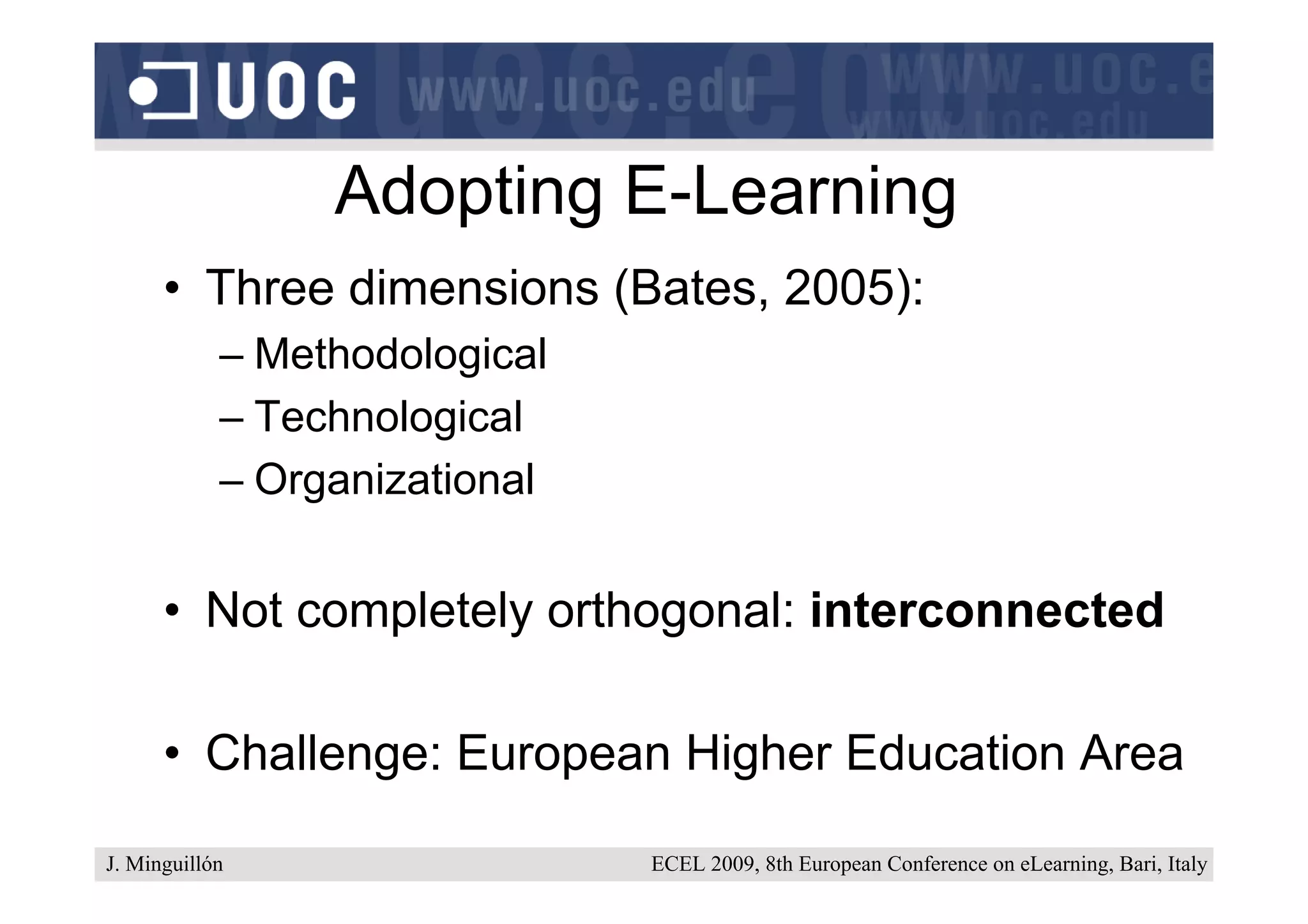
Adopting E-Learning
      • Three dimensions (Bates, 2005):
            – Methodological
            – Technological
            – Organizational


      • Not completely orthogonal: interconnected

      • Challenge: European Higher Education Area

J. Minguillón                  ECEL 2009, 8th European Conference on eLearning, Bari, Italy
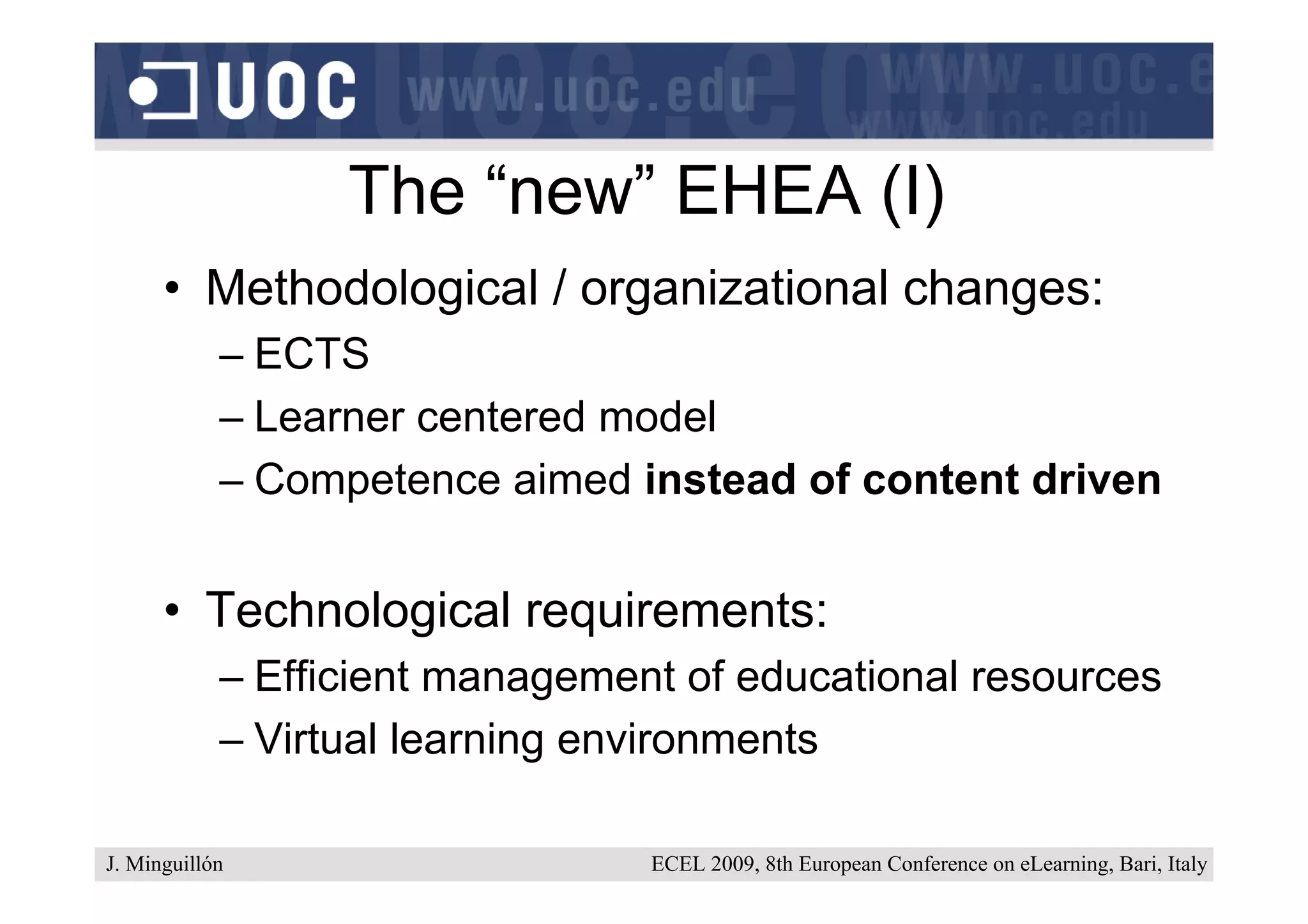
The “new” EHEA (I)
      • Methodological / organizational changes:
            – ECTS
            – Learner centered model
            – Competence aimed instead of content driven


      • Technological requirements:
            – Efficient management of educational resources
            – Virtual learning environments

J. Minguillón                    ECEL 2009, 8th European Conference on eLearning, Bari, Italy
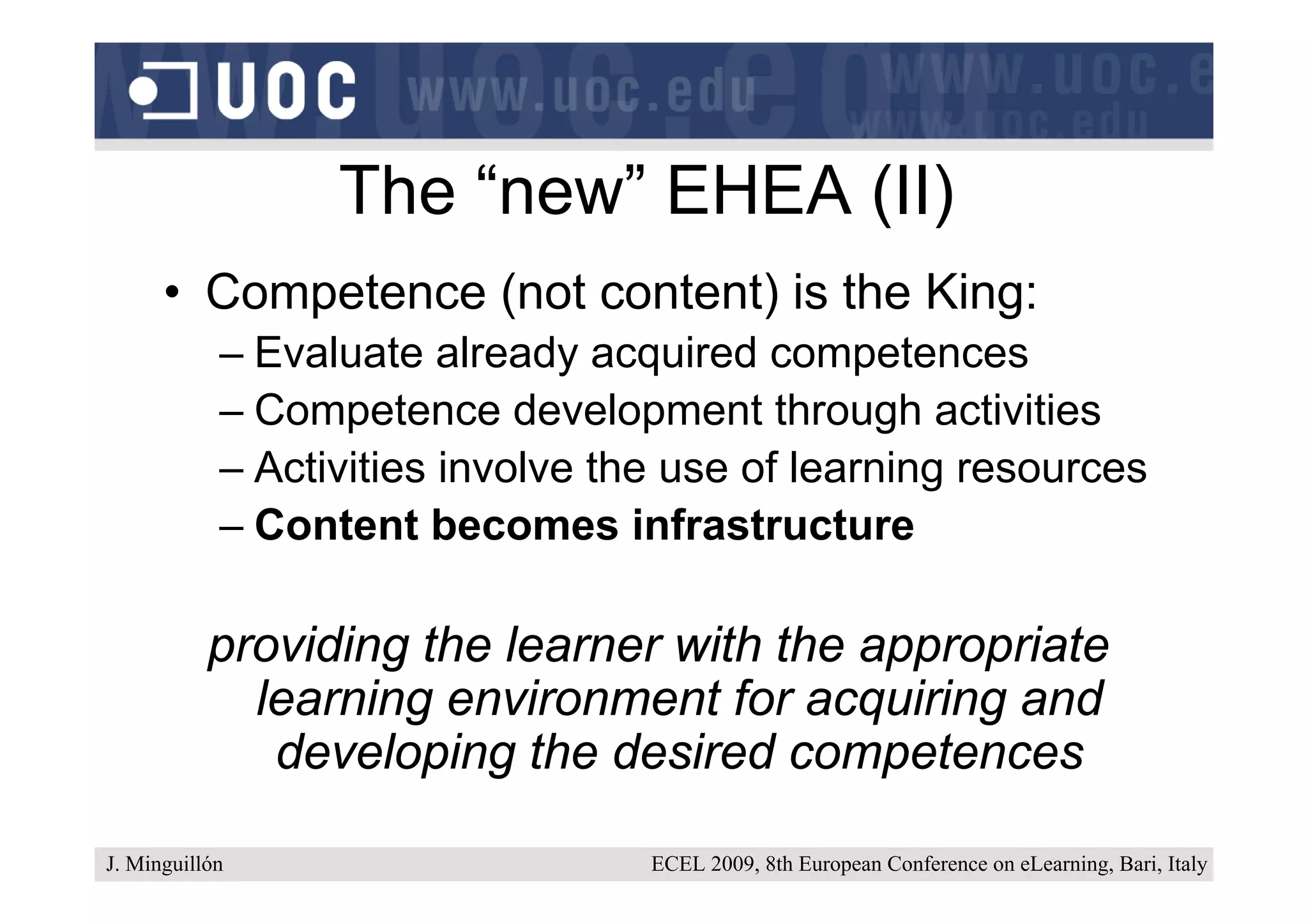
The “new” EHEA (II)
      • Competence (not content) is the King:
            – Evaluate already acquired competences
            – Competence development through activities
            – Activities involve the use of learning resources
            – Content becomes infrastructure

           providing the learner with the appropriate
             learning environment for acquiring and
              developing the desired competences

J. Minguillón                      ECEL 2009, 8th European Conference on eLearning, Bari, Italy
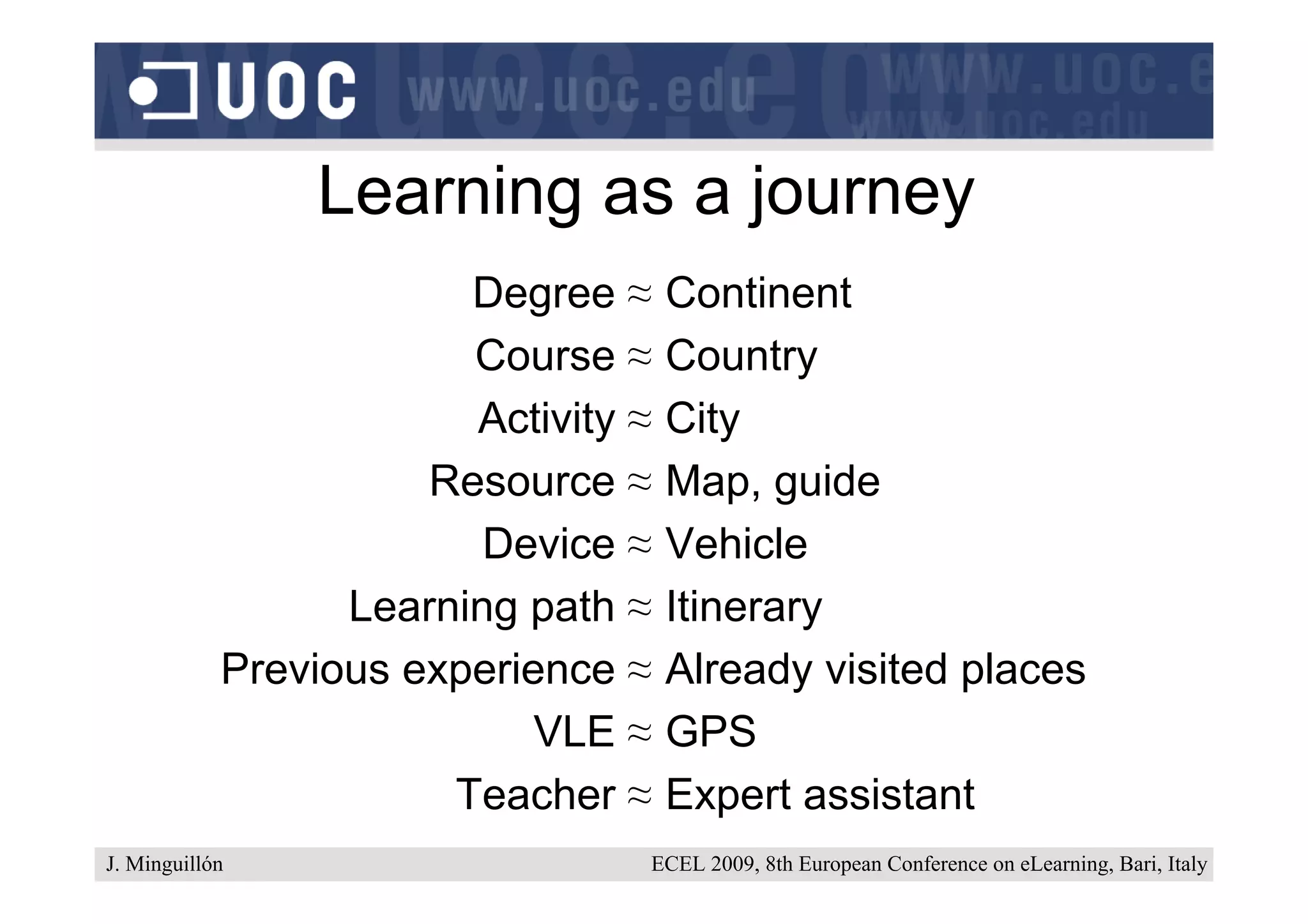
Learning as a journey
                        Degree ≈     Continent
                        Course ≈     Country
                        Activity ≈   City
                      Resource ≈     Map, guide
                         Device ≈    Vehicle
                  Learning path ≈    Itinerary
            Previous experience ≈    Already visited places
                            VLE ≈    GPS
                       Teacher ≈     Expert assistant
J. Minguillón                    ECEL 2009, 8th European Conference on eLearning, Bari, Italy
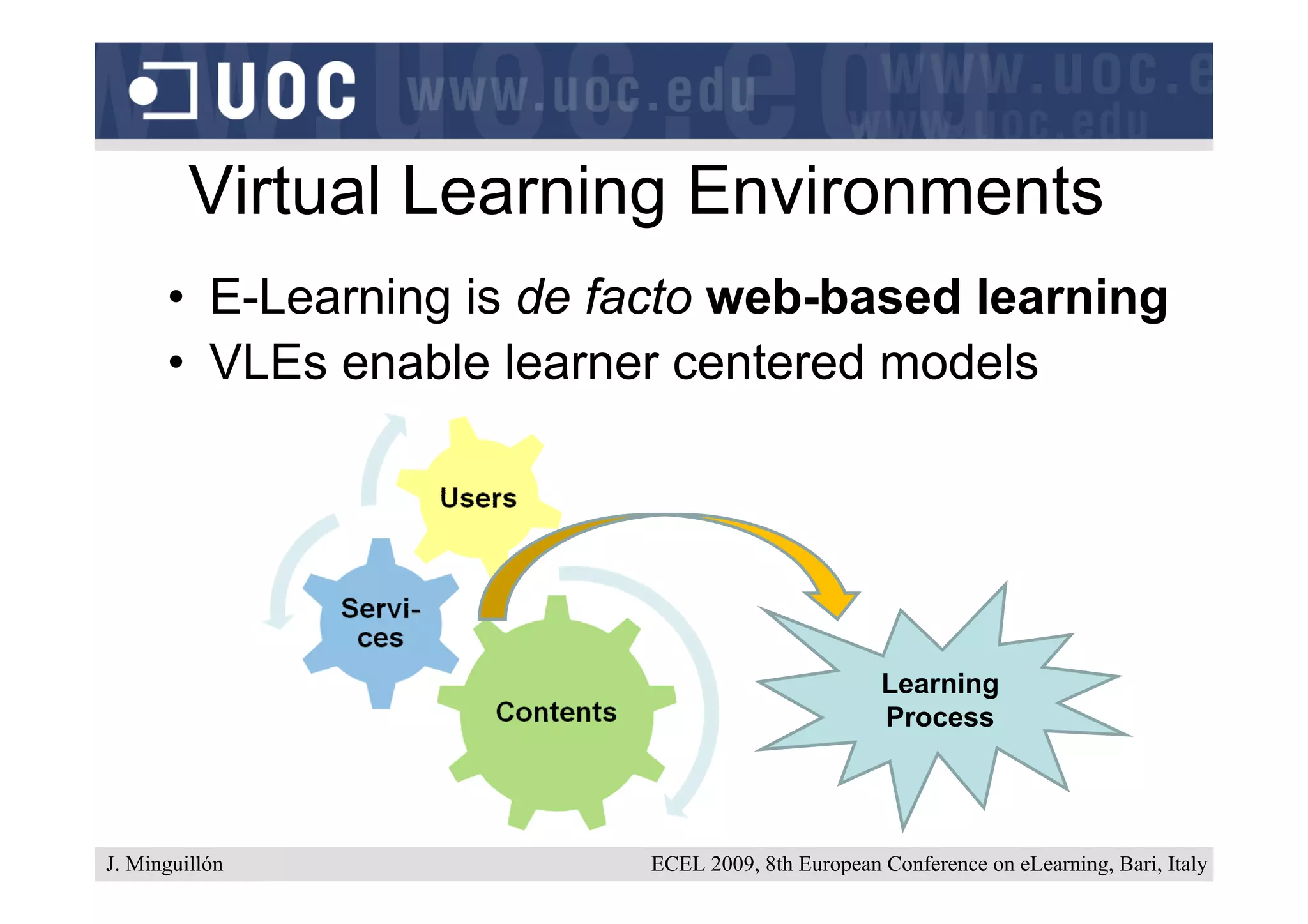
Virtual Learning Environments
      • E-Learning is de facto web-based learning
      • VLEs enable learner centered models


                                                  Learning
                                                  Process


J. Minguillón             ECEL 2009, 8th European Conference on eLearning, Bari, Italy
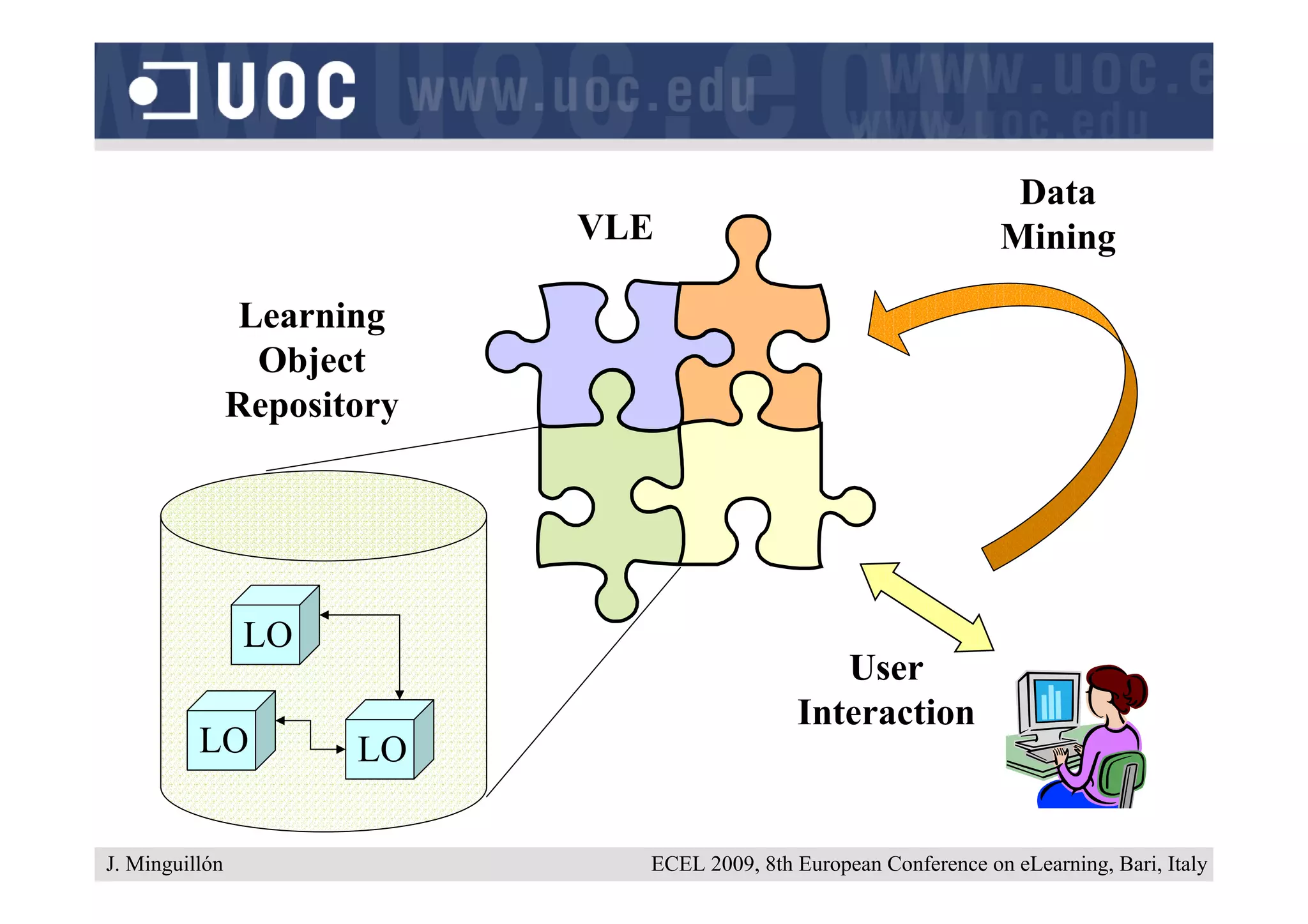
Data
                             VLE                                    Mining

                Learning
                 Object
                Repository


                 LO
                                                 User
                                              Interaction
          LO           LO

J. Minguillón                  ECEL 2009, 8th European Conference on eLearning, Bari, Italy
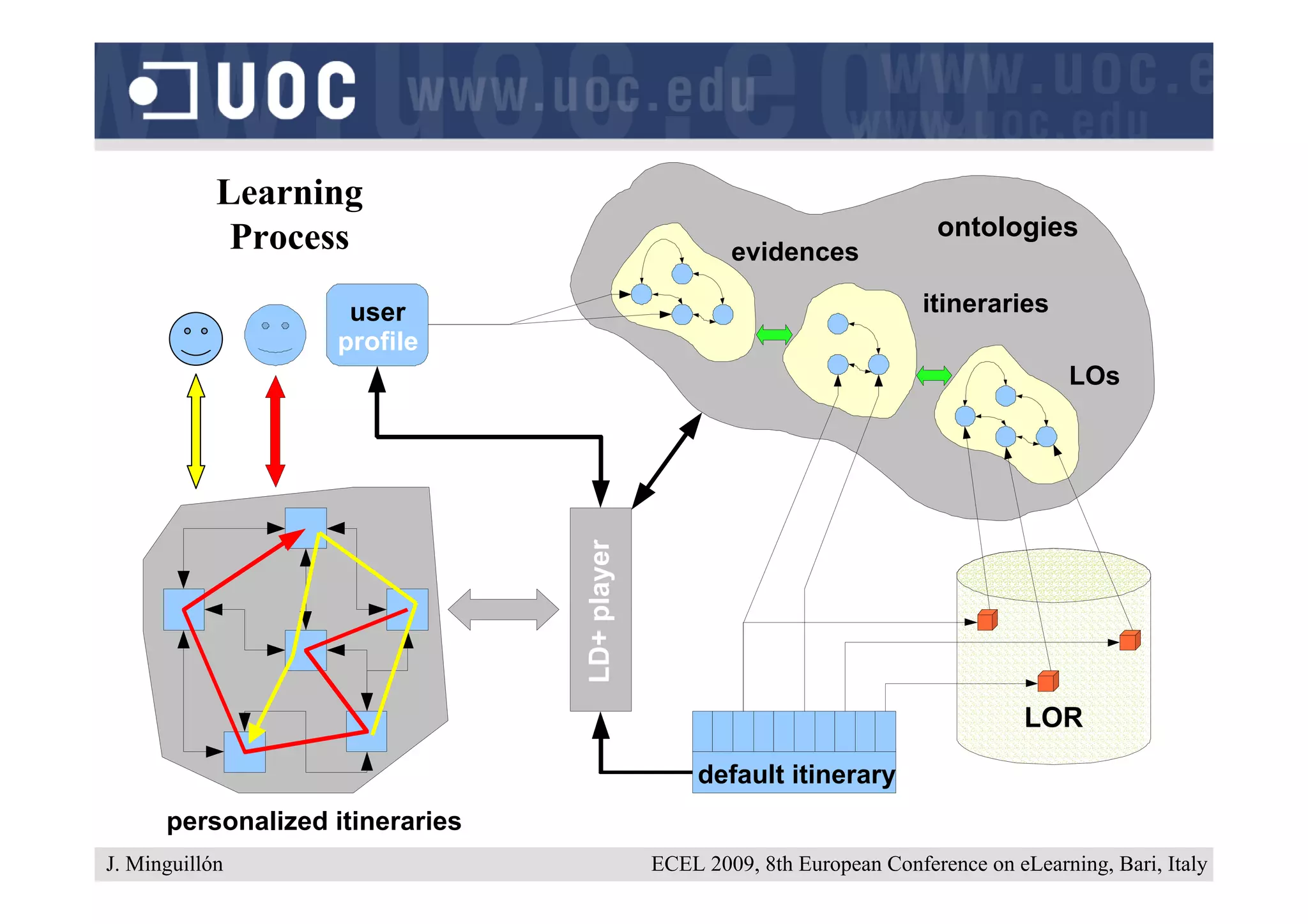
Learning
             Process                                                        ontologies
                                                      evidences

                    user                                                   itineraries
                   profile
                                                                                           LOs


                                 LD+ player


                                                                                      LOR

                                                   default itinerary
      personalized itineraries
J. Minguillón                                 ECEL 2009, 8th European Conference on eLearning, Bari, Italy
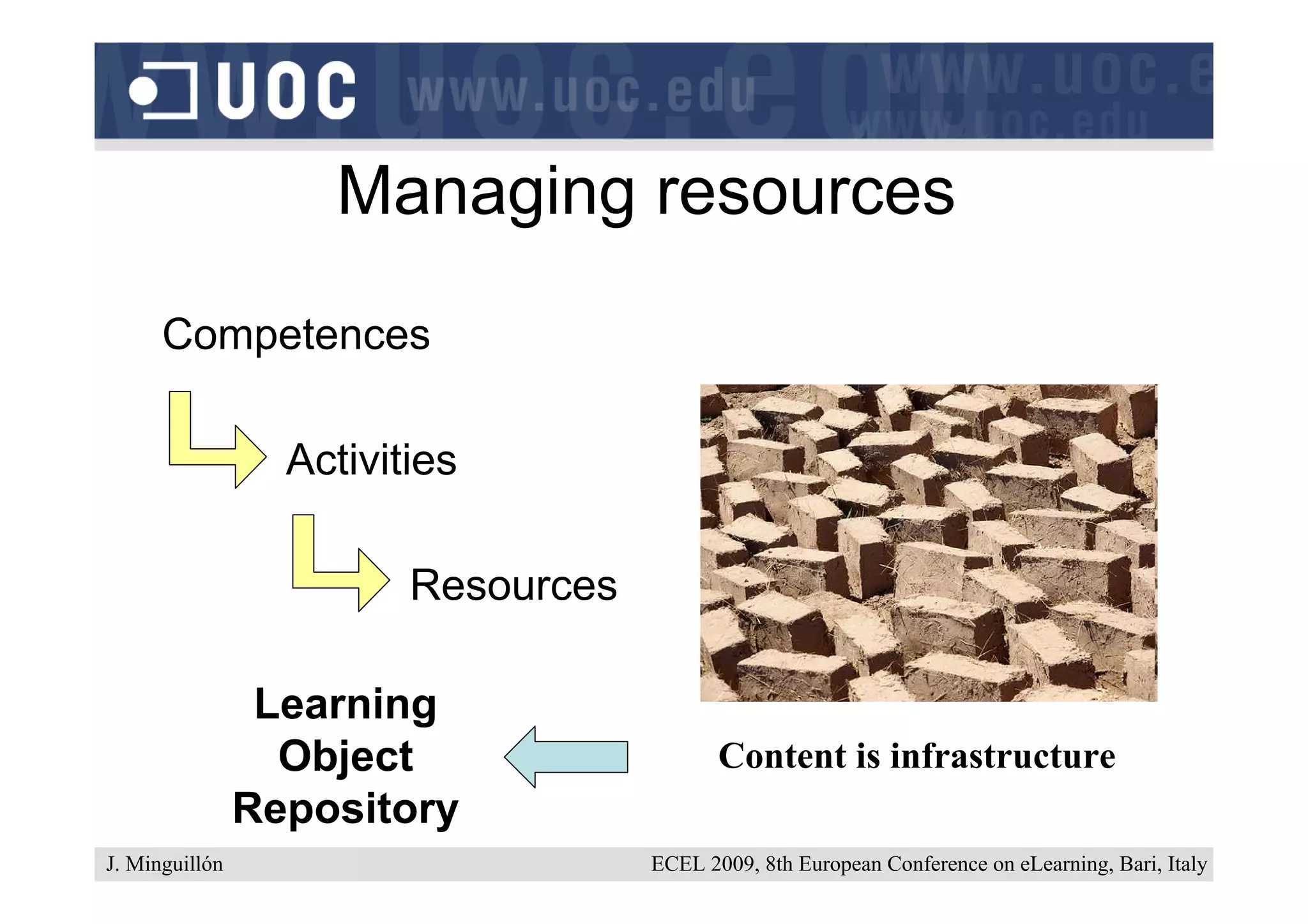
Managing resources
      Competences

                  Activities

                         Resources

                 Learning
                  Object                    Content is infrastructure
                Repository
J. Minguillón                        ECEL 2009, 8th European Conference on eLearning, Bari, Italy
Learning Object Repositories
      • Two main goals:
            – Ensure preservation
            – Promote reutilization

      • Other goals:
            – Dissemination → positioning    (institutional)
            – Personal information management       (users)

      • These goals are somehow contradictory!
J. Minguillón                    ECEL 2009, 8th European Conference on eLearning, Bari, Italy
Key factors for LOR success (I)
      • Three dimensions (McNaught, 2006):
            – Resources: what?
            – Actions: how?
            – Users: who?

      • LOR design should include them all

      • Top-down vs bottom-up approaches

J. Minguillón                    ECEL 2009, 8th European Conference on eLearning, Bari, Italy
Key factors for LOR success (II)
      •    Genuine need of a community
      •    Enthusiastic promoters
      •    Clear direction and focus
      •    Feedback from the community
      •    Good management processes
      •    Open access
      •    Easy addition of new resources
      •    Critical mass
      •    Suitable granularity

J. Minguillón                    ECEL 2009, 8th European Conference on eLearning, Bari, Italy
Critical issues of LOR design
      • Methodological:
            – Learning is more than just content
      • Technological (back-end + user interface):
            – Learning is more than just accessing LOs
      • Organizational:
            – Workflow
            – Licenses
            – Metadata
            – Policies
J. Minguillón                   ECEL 2009, 8th European Conference on eLearning, Bari, Italy
Traditional repositories
     • Library centered:
           – Books, journals, works, …                    (mostly textual)
                •   Everything has a unique title
                •   Everything has one or more authors
                •   Everything has a creation date
                •   Almost everything is a PDF file


     • Main goal: easily finding a resource by
       using a minimum set of common descriptors

J. Minguillón                           ECEL 2009, 8th European Conference on eLearning, Bari, Italy
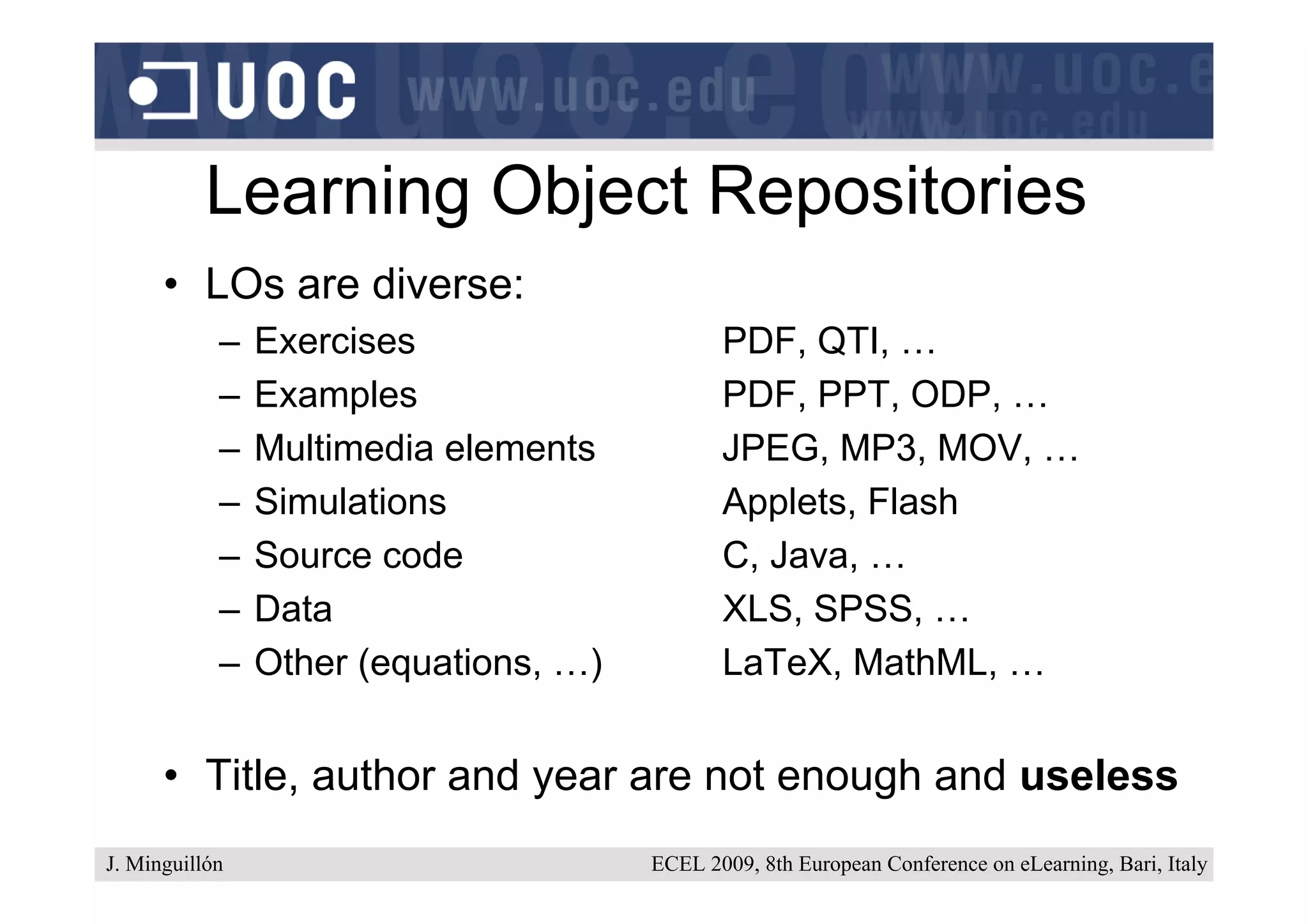
Learning Object Repositories
      • LOs are diverse:
            –   Exercises                     PDF, QTI, …
            –   Examples                      PDF, PPT, ODP, …
            –   Multimedia elements           JPEG, MP3, MOV, …
            –   Simulations                   Applets, Flash
            –   Source code                   C, Java, …
            –   Data                          XLS, SPSS, …
            –   Other (equations, …)          LaTeX, MathML, …


      • Title, author and year are not enough and useless
J. Minguillón                          ECEL 2009, 8th European Conference on eLearning, Bari, Italy
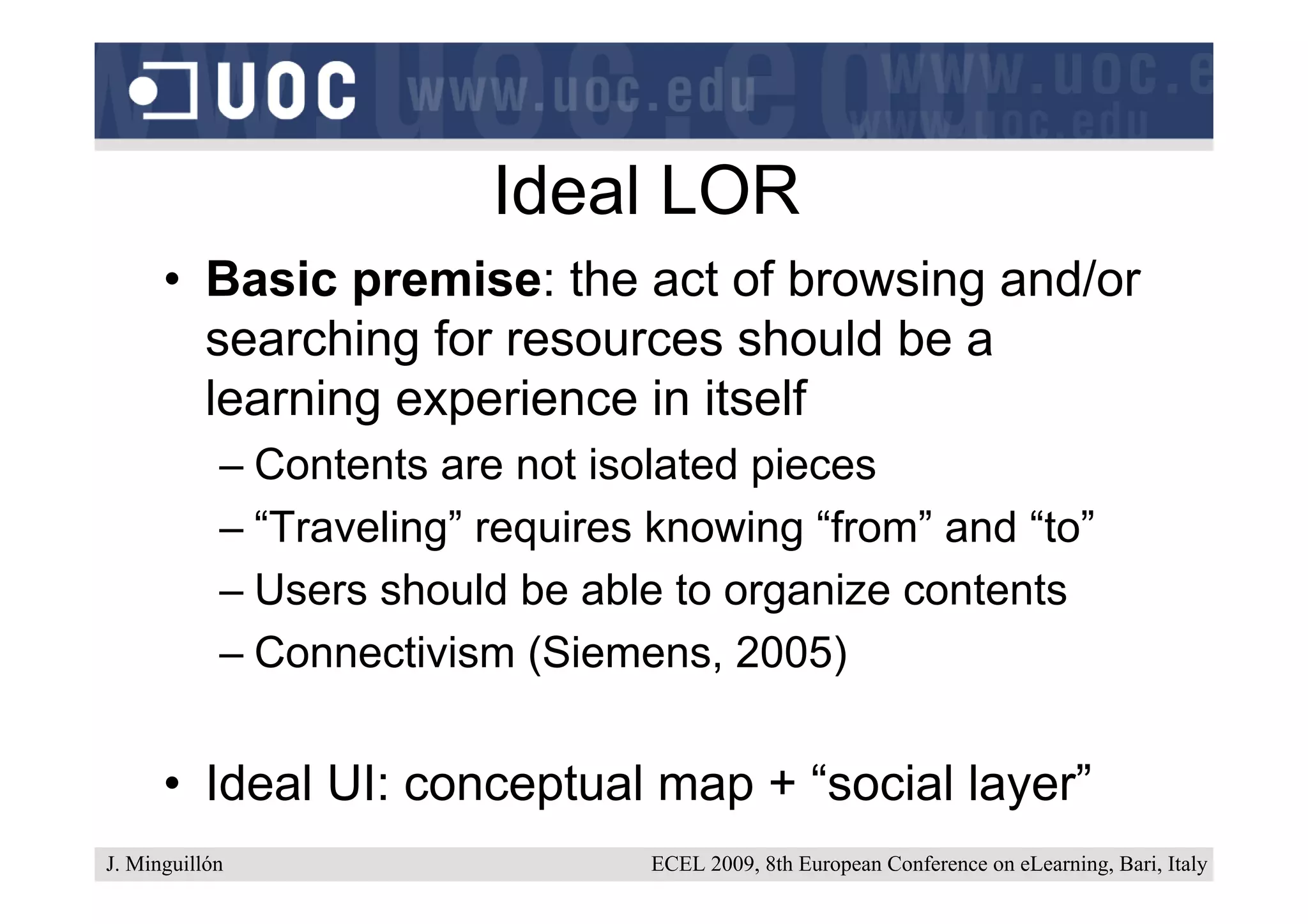
Ideal LOR
      • Basic premise: the act of browsing and/or
        searching for resources should be a
        learning experience in itself
            – Contents are not isolated pieces
            – “Traveling” requires knowing “from” and “to”
            – Users should be able to organize contents
            – Connectivism (Siemens, 2005)


      • Ideal UI: conceptual map + “social layer”
J. Minguillón                     ECEL 2009, 8th European Conference on eLearning, Bari, Italy
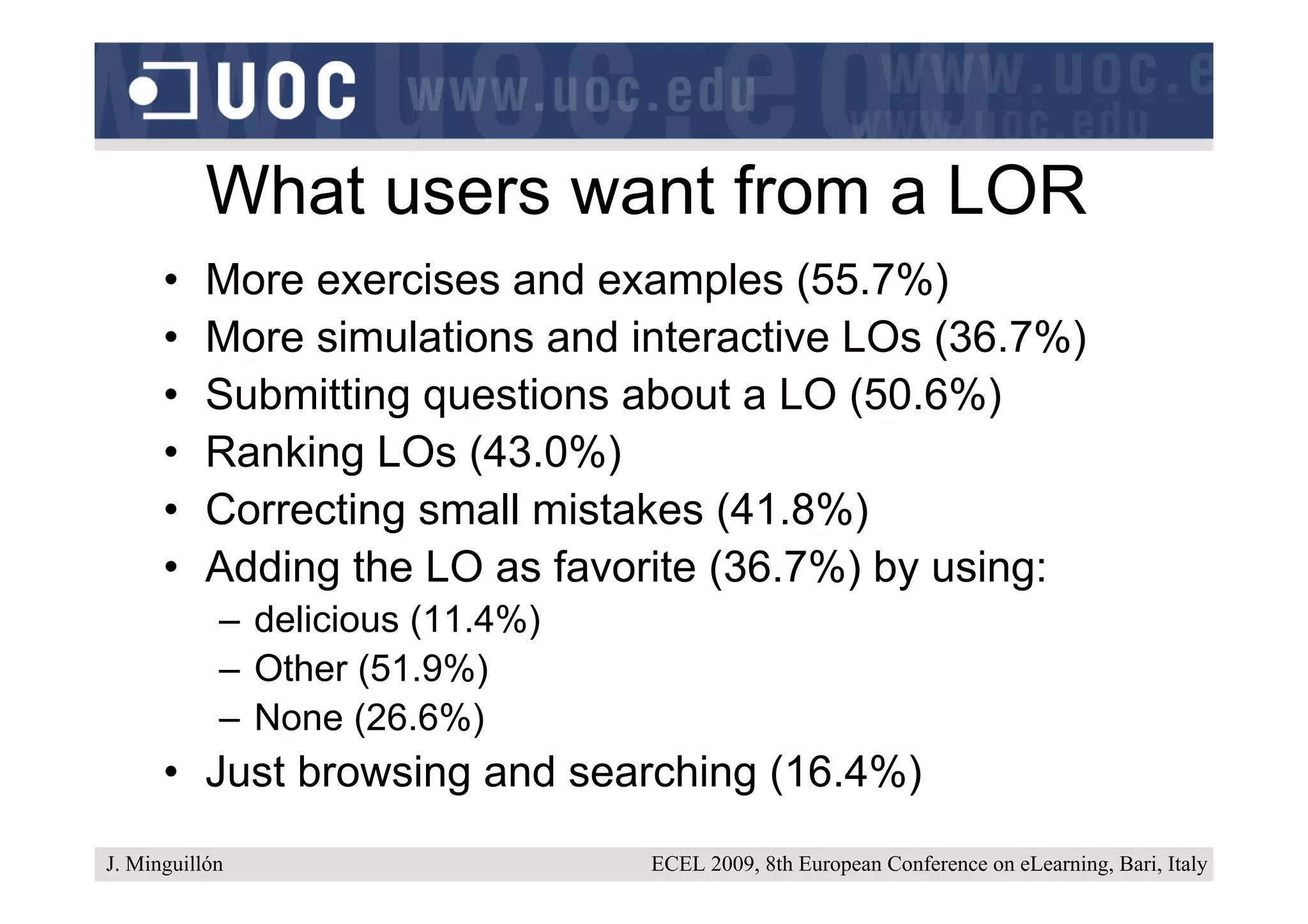
What users want from a LOR
      •    More exercises and examples (55.7%)
      •    More simulations and interactive LOs (36.7%)
      •    Submitting questions about a LO (50.6%)
      •    Ranking LOs (43.0%)
      •    Correcting small mistakes (41.8%)
      •    Adding the LO as favorite (36.7%) by using:
            – delicious (11.4%)
            – Other (51.9%)
            – None (26.6%)
      • Just browsing and searching (16.4%)
J. Minguillón                     ECEL 2009, 8th European Conference on eLearning, Bari, Italy
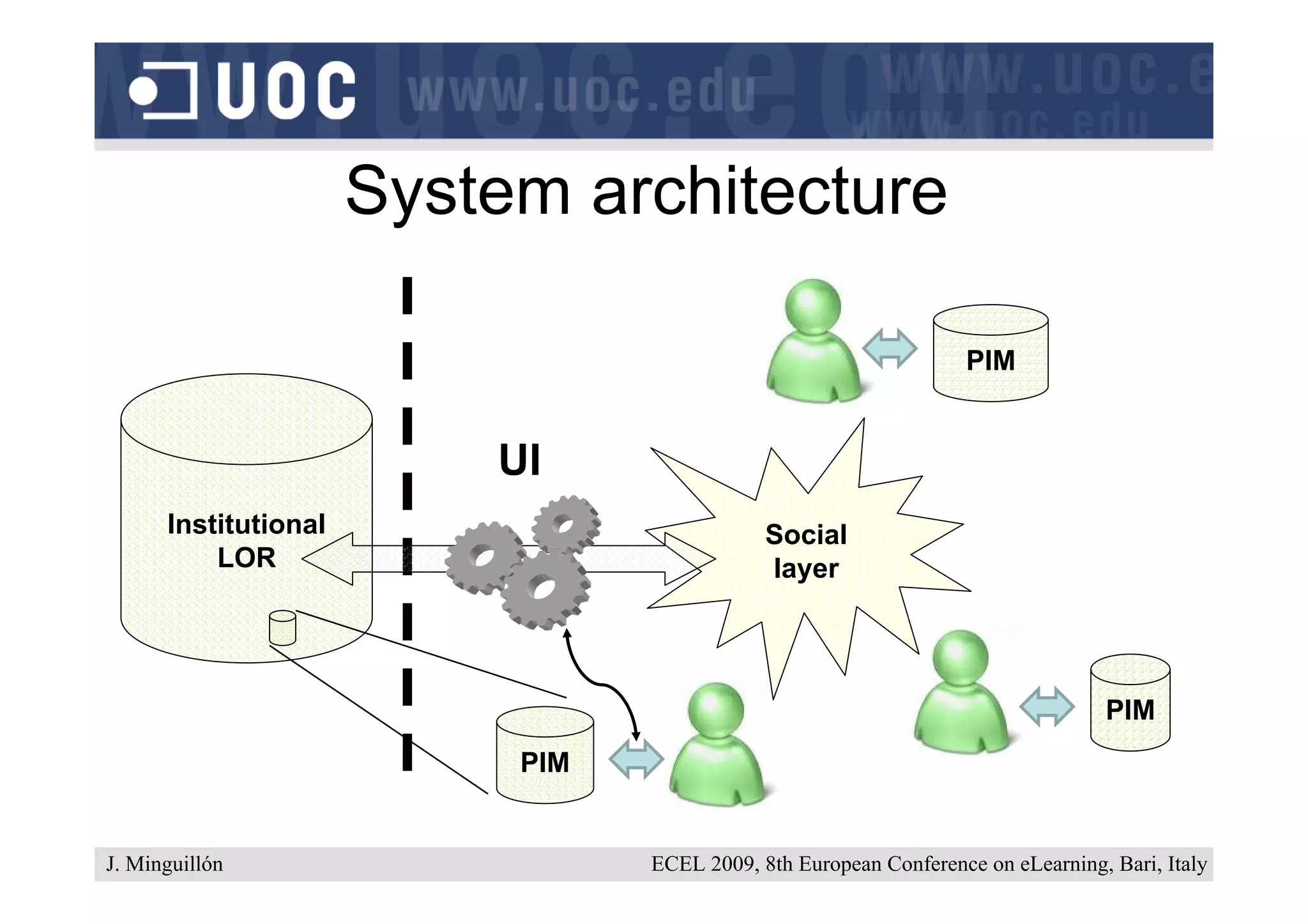
System architecture

                                                                  PIM


                          UI
      Institutional                          Social
          LOR                                layer


                                                                                  PIM
                           PIM


J. Minguillón                    ECEL 2009, 8th European Conference on eLearning, Bari, Italy
DSpace pros and cons
      • Why DSpace? → already in use at UOC
      • Pros:                        • Cons:
            – Solid, stable                – Ugly user interface
            – Large community              – 1.0 philosophy
            – Persistent handles           – Dublin Core
            – Preservation                 – Multilingualism
            – Customizable                 – Intricate
            – OAI PMH                      – Mainly for e-prints

J. Minguillón                      ECEL 2009, 8th European Conference on eLearning, Bari, Italy
Enhancing DSpace
      • Main idea:
            – Use DSpace as an invisible back-end
            – Access LOs through persistent handles
            – Create a new user interface
            – Add 2.0 functionalities
            – Gather usage data


      • Goal: allow learners to take control over LOs
        without using DSpace directly
J. Minguillón                    ECEL 2009, 8th European Conference on eLearning, Bari, Italy
Case of study: LOR on Statistics
      • Why Statistics?
            – Basic competences for the Information Society
            – Compulsory course for several degrees
            – Thousands of students each semester (≈ 4000)
            – Large collection of heterogeneous resources
      • Known problems:
            – “There are too many resources”
            – “I don’t know how to start”
            – “I can’t link concepts and tools”
J. Minguillón                      ECEL 2009, 8th European Conference on eLearning, Bari, Italy
Improving interaction
      •    Avoid Google-like searches
      •    Contextualized browsing
      •    Refine search results while being built
      •    Return only a few relevant LOs
      •    Visualize related LOs
      •    Allow learners to use web 2.0 services
      •    Widget-ize available services

J. Minguillón                  ECEL 2009, 8th European Conference on eLearning, Bari, Italy
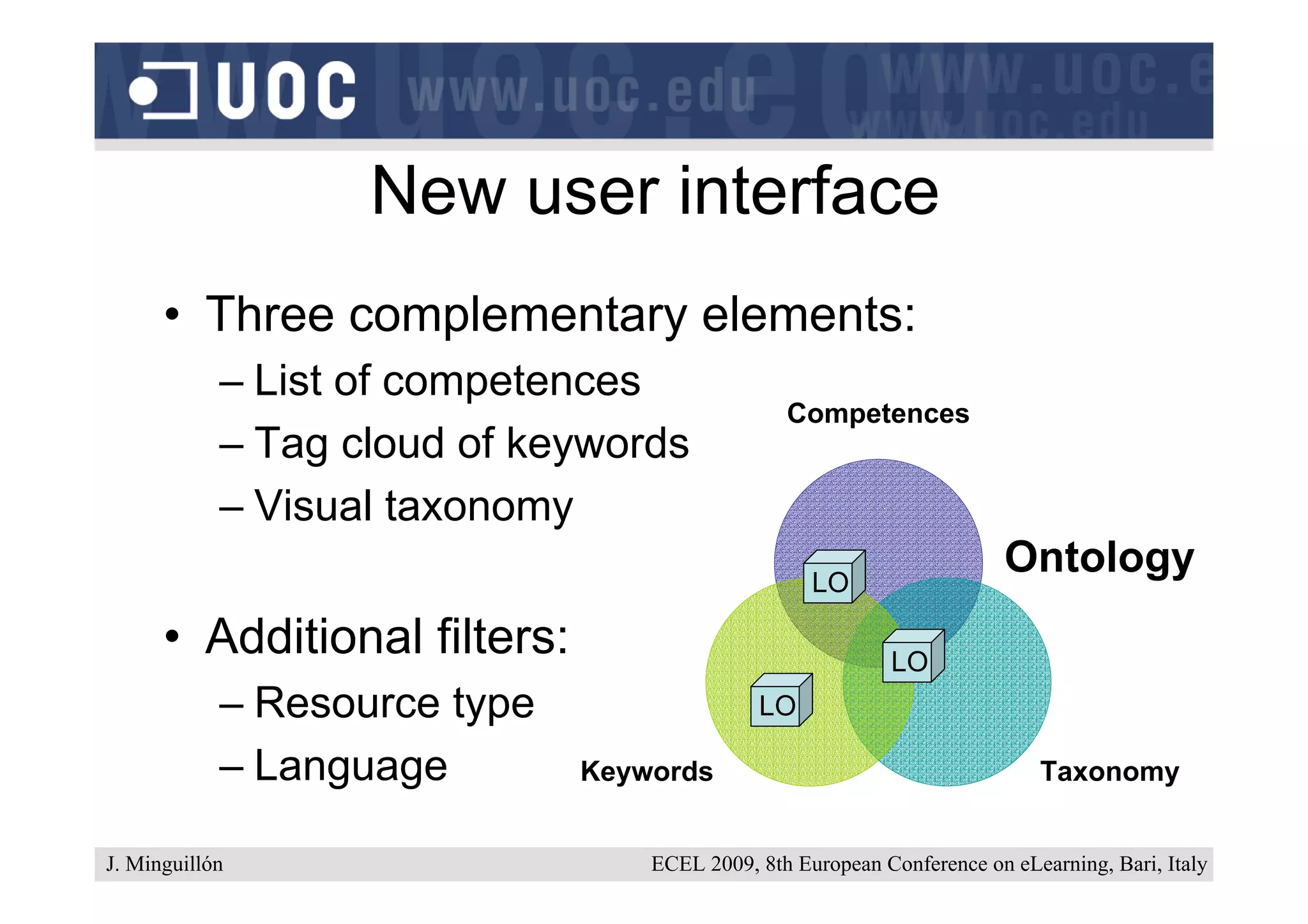
New user interface
      • Three complementary elements:
            – List of competences
                                                Competences
            – Tag cloud of keywords
            – Visual taxonomy
                                                   LO
                                                                        Ontology
      • Additional filters:                                LO
            – Resource type                  LO

            – Language        Keywords                                     Taxonomy


J. Minguillón                     ECEL 2009, 8th European Conference on eLearning, Bari, Italy
Introducing personalization
      • Don’t constrain, always recommend
      • Tag cloud parameters:
            – Which keywords
            – Sorting
            – Color
            – Size
      • Context-aware (right-button pop-up)
      • Web 2.0 services: delicious, annorate, …
J. Minguillón                  ECEL 2009, 8th European Conference on eLearning, Bari, Italy
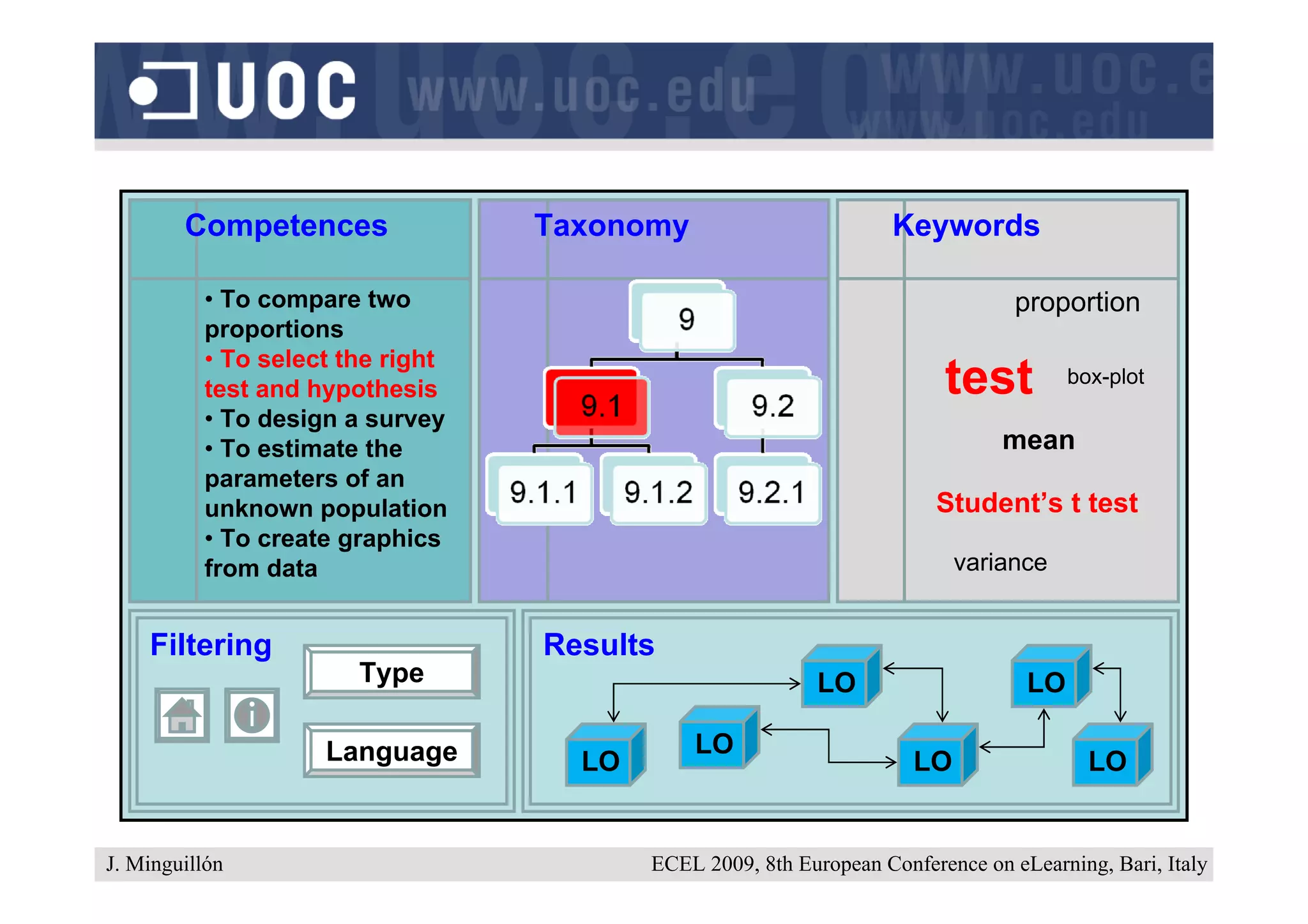
Competences               Taxonomy                        Keywords

          • To compare two                                                      proportion
          proportions
          • To select the right
          test and hypothesis                                           test          box-plot
          • To design a survey
          • To estimate the                                                   mean
          parameters of an
          unknown population                                           Student’s t test
          • To create graphics
          from data                                                       variance


    Filtering                     Results
                       Type                               LO                     LO

                    Language                 LO
                                    LO                               LO                 LO


J. Minguillón                            ECEL 2009, 8th European Conference on eLearning, Bari, Italy
Current project status (I)
      •    DSpace repository online http://oer.uoc.edu
      •    200 resources (500 soon, >1000 expected)
      •    Pilot course with 400 students (CS degree)
      •    List of specific competences for Statistics
      •    Visual taxonomy created with prefuse
      •    Tag cloud created with tagcrowd
      •    First stages of user-centered design

J. Minguillón                 ECEL 2009, 8th European Conference on eLearning, Bari, Italy
Current project status (II)
      • But:
            – Different technologies (Java, PHP, HTML, …)
            – Complex process for adding resources
            – Our learners (and teachers) are not so “2.0”
            – Engaging activities must be designed
            – Accessibility issues


      • Ideas, money and students are welcomed!!!
J. Minguillón                    ECEL 2009, 8th European Conference on eLearning, Bari, Italy
Summary
      •    LOs cannot be isolated pieces
      •    Learners need to contextualize LOs
      •    Learners need to “adopt” LOs
      •    LORs cannot be just lists of LOs
      •    LORs = back-end + front-end
      •    DSpace as back-end: the “pyramid”
      •    UI as front-end: the (personal) “museum”

J. Minguillón                 ECEL 2009, 8th European Conference on eLearning, Bari, Italy
Thank you!

      • Contact information:

                                     Julià Minguillón
                               jminguillona@uoc.edu


J. Minguillón                  ECEL 2009, 8th European Conference on eLearning, Bari, Italy

ECEL 2009 Keynote J. Minguillón

  • 1.
    Learner-centered learning object repositories: personalization and interaction issues Julià Minguillón Universitat Oberta de Catalunya ECEL 2009, 8th European Conference on eLearning, Bari, Italy
  • 2.
    Table of contents • E-Learning is / is not … • Virtual Learning Environments • Learning Object Repositories • Case of study: Statistics • Improving interaction • Introducing personalization • Current project status • Summary J. Minguillón ECEL 2009, 8th European Conference on eLearning, Bari, Italy
  • 3.
    E-Learning is not… • …e + learning • …reproducing traditional learning • …leaving learners alone with technology • …technology replacing teachers • …delivering content through LCMS • …a collection of tools / services • …mail, chat or blog • …self-learning J. Minguillón ECEL 2009, 8th European Conference on eLearning, Bari, Italy
  • 4.
    E-Learning should be… • …promoting communication • …enabling deeper reflection • …technology supporting users • …personalized and adaptive • …interactive and engaging • …overcoming time / space barriers • Learning anytime and anywhere! J. Minguillón ECEL 2009, 8th European Conference on eLearning, Bari, Italy
  • 5.
    Adopting E-Learning • Three dimensions (Bates, 2005): – Methodological – Technological – Organizational • Not completely orthogonal: interconnected • Challenge: European Higher Education Area J. Minguillón ECEL 2009, 8th European Conference on eLearning, Bari, Italy
  • 6.
    The “new” EHEA(I) • Methodological / organizational changes: – ECTS – Learner centered model – Competence aimed instead of content driven • Technological requirements: – Efficient management of educational resources – Virtual learning environments J. Minguillón ECEL 2009, 8th European Conference on eLearning, Bari, Italy
  • 7.
    The “new” EHEA(II) • Competence (not content) is the King: – Evaluate already acquired competences – Competence development through activities – Activities involve the use of learning resources – Content becomes infrastructure providing the learner with the appropriate learning environment for acquiring and developing the desired competences J. Minguillón ECEL 2009, 8th European Conference on eLearning, Bari, Italy
  • 8.
    Learning as ajourney Degree ≈ Continent Course ≈ Country Activity ≈ City Resource ≈ Map, guide Device ≈ Vehicle Learning path ≈ Itinerary Previous experience ≈ Already visited places VLE ≈ GPS Teacher ≈ Expert assistant J. Minguillón ECEL 2009, 8th European Conference on eLearning, Bari, Italy
  • 9.
    Virtual Learning Environments • E-Learning is de facto web-based learning • VLEs enable learner centered models Learning Process J. Minguillón ECEL 2009, 8th European Conference on eLearning, Bari, Italy
  • 10.
    Data VLE Mining Learning Object Repository LO User Interaction LO LO J. Minguillón ECEL 2009, 8th European Conference on eLearning, Bari, Italy
  • 11.
    Learning Process ontologies evidences user itineraries profile LOs LD+ player LOR default itinerary personalized itineraries J. Minguillón ECEL 2009, 8th European Conference on eLearning, Bari, Italy
  • 12.
    Managing resources Competences Activities Resources Learning Object Content is infrastructure Repository J. Minguillón ECEL 2009, 8th European Conference on eLearning, Bari, Italy
  • 13.
    Learning Object Repositories • Two main goals: – Ensure preservation – Promote reutilization • Other goals: – Dissemination → positioning (institutional) – Personal information management (users) • These goals are somehow contradictory! J. Minguillón ECEL 2009, 8th European Conference on eLearning, Bari, Italy
  • 14.
    Key factors forLOR success (I) • Three dimensions (McNaught, 2006): – Resources: what? – Actions: how? – Users: who? • LOR design should include them all • Top-down vs bottom-up approaches J. Minguillón ECEL 2009, 8th European Conference on eLearning, Bari, Italy
  • 15.
    Key factors forLOR success (II) • Genuine need of a community • Enthusiastic promoters • Clear direction and focus • Feedback from the community • Good management processes • Open access • Easy addition of new resources • Critical mass • Suitable granularity J. Minguillón ECEL 2009, 8th European Conference on eLearning, Bari, Italy
  • 16.
    Critical issues ofLOR design • Methodological: – Learning is more than just content • Technological (back-end + user interface): – Learning is more than just accessing LOs • Organizational: – Workflow – Licenses – Metadata – Policies J. Minguillón ECEL 2009, 8th European Conference on eLearning, Bari, Italy
  • 17.
    Traditional repositories • Library centered: – Books, journals, works, … (mostly textual) • Everything has a unique title • Everything has one or more authors • Everything has a creation date • Almost everything is a PDF file • Main goal: easily finding a resource by using a minimum set of common descriptors J. Minguillón ECEL 2009, 8th European Conference on eLearning, Bari, Italy
  • 18.
    Learning Object Repositories • LOs are diverse: – Exercises PDF, QTI, … – Examples PDF, PPT, ODP, … – Multimedia elements JPEG, MP3, MOV, … – Simulations Applets, Flash – Source code C, Java, … – Data XLS, SPSS, … – Other (equations, …) LaTeX, MathML, … • Title, author and year are not enough and useless J. Minguillón ECEL 2009, 8th European Conference on eLearning, Bari, Italy
  • 19.
    Ideal LOR • Basic premise: the act of browsing and/or searching for resources should be a learning experience in itself – Contents are not isolated pieces – “Traveling” requires knowing “from” and “to” – Users should be able to organize contents – Connectivism (Siemens, 2005) • Ideal UI: conceptual map + “social layer” J. Minguillón ECEL 2009, 8th European Conference on eLearning, Bari, Italy
  • 20.
    What users wantfrom a LOR • More exercises and examples (55.7%) • More simulations and interactive LOs (36.7%) • Submitting questions about a LO (50.6%) • Ranking LOs (43.0%) • Correcting small mistakes (41.8%) • Adding the LO as favorite (36.7%) by using: – delicious (11.4%) – Other (51.9%) – None (26.6%) • Just browsing and searching (16.4%) J. Minguillón ECEL 2009, 8th European Conference on eLearning, Bari, Italy
  • 21.
    System architecture PIM UI Institutional Social LOR layer PIM PIM J. Minguillón ECEL 2009, 8th European Conference on eLearning, Bari, Italy
  • 22.
    DSpace pros andcons • Why DSpace? → already in use at UOC • Pros: • Cons: – Solid, stable – Ugly user interface – Large community – 1.0 philosophy – Persistent handles – Dublin Core – Preservation – Multilingualism – Customizable – Intricate – OAI PMH – Mainly for e-prints J. Minguillón ECEL 2009, 8th European Conference on eLearning, Bari, Italy
  • 23.
    Enhancing DSpace • Main idea: – Use DSpace as an invisible back-end – Access LOs through persistent handles – Create a new user interface – Add 2.0 functionalities – Gather usage data • Goal: allow learners to take control over LOs without using DSpace directly J. Minguillón ECEL 2009, 8th European Conference on eLearning, Bari, Italy
  • 24.
    Case of study:LOR on Statistics • Why Statistics? – Basic competences for the Information Society – Compulsory course for several degrees – Thousands of students each semester (≈ 4000) – Large collection of heterogeneous resources • Known problems: – “There are too many resources” – “I don’t know how to start” – “I can’t link concepts and tools” J. Minguillón ECEL 2009, 8th European Conference on eLearning, Bari, Italy
  • 25.
    Improving interaction • Avoid Google-like searches • Contextualized browsing • Refine search results while being built • Return only a few relevant LOs • Visualize related LOs • Allow learners to use web 2.0 services • Widget-ize available services J. Minguillón ECEL 2009, 8th European Conference on eLearning, Bari, Italy
  • 26.
    New user interface • Three complementary elements: – List of competences Competences – Tag cloud of keywords – Visual taxonomy LO Ontology • Additional filters: LO – Resource type LO – Language Keywords Taxonomy J. Minguillón ECEL 2009, 8th European Conference on eLearning, Bari, Italy
  • 27.
    Introducing personalization • Don’t constrain, always recommend • Tag cloud parameters: – Which keywords – Sorting – Color – Size • Context-aware (right-button pop-up) • Web 2.0 services: delicious, annorate, … J. Minguillón ECEL 2009, 8th European Conference on eLearning, Bari, Italy
  • 28.
    Competences Taxonomy Keywords • To compare two proportion proportions • To select the right test and hypothesis test box-plot • To design a survey • To estimate the mean parameters of an unknown population Student’s t test • To create graphics from data variance Filtering Results Type LO LO Language LO LO LO LO J. Minguillón ECEL 2009, 8th European Conference on eLearning, Bari, Italy
  • 29.
    Current project status(I) • DSpace repository online http://oer.uoc.edu • 200 resources (500 soon, >1000 expected) • Pilot course with 400 students (CS degree) • List of specific competences for Statistics • Visual taxonomy created with prefuse • Tag cloud created with tagcrowd • First stages of user-centered design J. Minguillón ECEL 2009, 8th European Conference on eLearning, Bari, Italy
  • 30.
    Current project status(II) • But: – Different technologies (Java, PHP, HTML, …) – Complex process for adding resources – Our learners (and teachers) are not so “2.0” – Engaging activities must be designed – Accessibility issues • Ideas, money and students are welcomed!!! J. Minguillón ECEL 2009, 8th European Conference on eLearning, Bari, Italy
  • 31.
    Summary • LOs cannot be isolated pieces • Learners need to contextualize LOs • Learners need to “adopt” LOs • LORs cannot be just lists of LOs • LORs = back-end + front-end • DSpace as back-end: the “pyramid” • UI as front-end: the (personal) “museum” J. Minguillón ECEL 2009, 8th European Conference on eLearning, Bari, Italy
  • 32.
    Thank you! • Contact information: Julià Minguillón jminguillona@uoc.edu J. Minguillón ECEL 2009, 8th European Conference on eLearning, Bari, Italy