Analyzing OpenCourseWare usage by means of social tagging   Julià Minguillón 1,2 , Jordi Conesa 2 1 UOC UNESCO Chair in e-Learning 2 Universitat Oberta de Catalunya Barcelona, Spain CAL 2011, 13-15 April, Manchester, UK
Table of contents Open Educational Resources Social tagging Exploratory analysis Preliminary results Discussion Conclusions Future research CAL 2011, 13-15 April, Manchester, UK
Open Educational Resources Everybody is creating and publishing OERs Available through repositories, websites, … MERLOT, … OpenCourseWare But… Poor metadata descriptions, flat structure Wide degree of granularity Who is (re)using them? CAL 2011, 13-15 April, Manchester, UK
Searching at OCW Limited possibilities: Filter by keyword Language Source (OCW site) No shared taxonomies between OCW sites Goal : improve users’ support when browsing and searching for OERs CAL 2011, 13-15 April, Manchester, UK
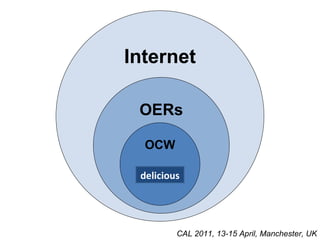
Internet OERs OCW CAL 2011, 13-15 April, Manchester, UK delicious
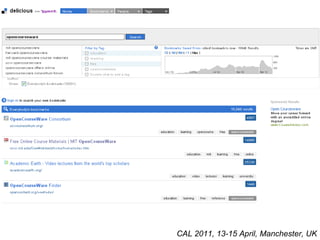
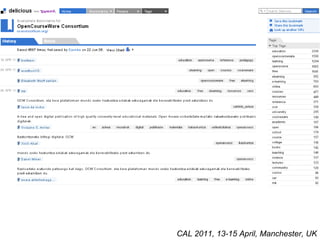
Social tagging Web 2.0 service (a.k.a. social bookmarking) Organize, describe and share URLs Triplets: URL, user, {tags} Delicious: Largest service of its kind Sustainability: Yahoo wants to close/sell delicious Simple poll: how many of you use delicious? CAL 2011, 13-15 April, Manchester, UK
CAL 2011, 13-15 April, Manchester, UK
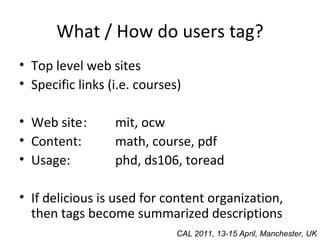
What / How do users tag? Top level web sites Specific links (i.e. courses) Web site : mit, ocw Content: math, course, pdf Usage: phd, ds106, toread If delicious is used for content organization, then tags become summarized descriptions CAL 2011, 13-15 April, Manchester, UK
Basic idea What if we obtain “all” tags from “all” users sharing “all” the URLs for a given concept? Tags could reveal a hidden semantic structure used for organizing and describing content What does “OCW” mean for OCW users? CAL 2011, 13-15 April, Manchester, UK
Methodology Retrieve “all” triplets for a given search term (opencourseware + ocw) Do some data cleansing Select the most important triplets Build a binary data set (N x T): URL X tagged by user Y with tags T 1 ,…,T T Perform some exploratory data analysis Interpret results CAL 2011, 13-15 April, Manchester, UK
Retrieving data from delicious scripting + wget + HTML parsing Problem: IP throttling Slow, “risky”, tricky process Search term: “opencourseware+OR+ocw” Before data cleansing and selection: 2479 URLs 50 pages of users’ tags per URL 3 GB of information CAL 2011, 13-15 April, Manchester, UK
Data cleansing Plurals, capital letters Misspelling: course, coruse Multilingualism: curso, curs, kurs, … Equivalent tags: math = mathematics Abbreviations: cs = compsci = computer science Compound terms: web + 2.0 = web20 Spammers URLs with no tags CAL 2011, 13-15 April, Manchester, UK
Triplet selection Remove those users tagging less than M resources (spammers, occasional users) Remove those URLs tagged by less than N users (spammers, broken URLs) Keep only a fraction of tags (P) which are the most used (Pareto-like)  M=5-10, N=5-10, P=80%-90% CAL 2011, 13-15 April, Manchester, UK
Resulting data sets 389866 triplets (N):  Before: 1456 URLs, 26753 users, 21384 tags After:  1297 URLs, 24981 users, 434 tags  (T) Course subset: course URLs at MIT OCW 17024 triplets 351 URLs, 5689 users, 362 tags  ( 120  if P=80%) Data set – subset (Non-course): 946 URLs, 12290 users, 412 tags  ( 116  if P=80%) CAL 2011, 13-15 April, Manchester, UK
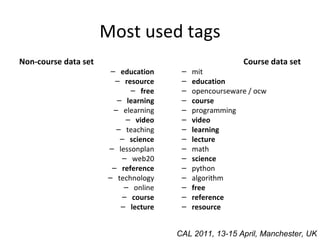
Most used tags Non-course data set education resource free learning elearning video teaching science lessonplan web20 reference technology online course lecture Course data set mit education opencourseware / ocw course programming video learning lecture math science python algorithm free reference resource CAL 2011, 13-15 April, Manchester, UK
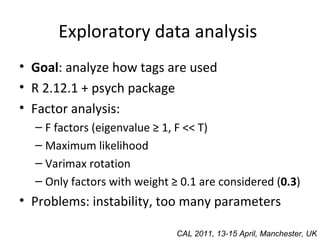
Exploratory data analysis  Goal : analyze how tags are used R 2.12.1 + psych package Factor analysis: F factors (eigenvalue ≥ 1, F << T) Maximum likelihood Varimax rotation Only factors with weight ≥ 0.1 are considered ( 0.3 ) Problems: instability, too many parameters CAL 2011, 13-15 April, Manchester, UK
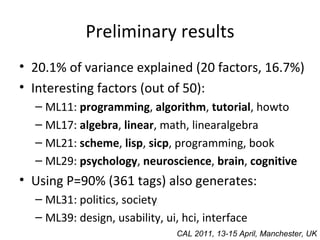
Preliminary results 20.1% of variance explained (20 factors, 16.7%) Interesting factors (out of 50): ML11:  programming ,  algorithm ,  tutorial , howto ML17:  algebra ,  linear , math, linearalgebra ML21:  scheme ,  lisp ,  sicp , programming, book ML29:  psychology ,  neuroscience ,  brain ,  cognitive Using P=90% (361 tags) also generates: ML31: politics, society ML39: design, usability, ui, hci, interface CAL 2011, 13-15 April, Manchester, UK
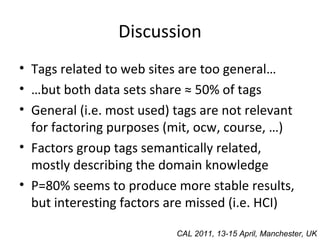
Discussion Tags related to web sites are too general… … but both data sets share ≈ 50% of tags  General (i.e. most used) tags are not relevant for factoring purposes (mit, ocw, course, …) Factors group tags semantically related, mostly describing the domain knowledge P=80% seems to produce more stable results, but interesting factors are missed (i.e. HCI) CAL 2011, 13-15 April, Manchester, UK
Conclusions OCW could take advantage of “advanced” users tagging its courses Non “tech” domains are underrepresented Data cleansing is critical Proposal: describe domain (keywords), type of resource (book, course) and format (pdf, video) Some parameters need fine-tuning  More experimentation is needed! CAL 2011, 13-15 April, Manchester, UK
Future research Automate and improve data cleansing Use of Wordnet / DBpedia / ontologies Non-Negative Matrix Factorization + clustering Build recommendation systems: Tags / Related resources Build reputation schemes: Most expert users Pilot at  http://ocw.uoc.edu CAL 2011, 13-15 April, Manchester, UK
Thank you! Julià Minguillón [email_address] CAL 2011, 13-15 April, Manchester, UK

Analyzing OpenCourseWare usage by means of social tagging

  • 1.
    Analyzing OpenCourseWare usageby means of social tagging Julià Minguillón 1,2 , Jordi Conesa 2 1 UOC UNESCO Chair in e-Learning 2 Universitat Oberta de Catalunya Barcelona, Spain CAL 2011, 13-15 April, Manchester, UK
  • 2.
    Table of contentsOpen Educational Resources Social tagging Exploratory analysis Preliminary results Discussion Conclusions Future research CAL 2011, 13-15 April, Manchester, UK
  • 3.
    Open Educational ResourcesEverybody is creating and publishing OERs Available through repositories, websites, … MERLOT, … OpenCourseWare But… Poor metadata descriptions, flat structure Wide degree of granularity Who is (re)using them? CAL 2011, 13-15 April, Manchester, UK
  • 4.
    Searching at OCWLimited possibilities: Filter by keyword Language Source (OCW site) No shared taxonomies between OCW sites Goal : improve users’ support when browsing and searching for OERs CAL 2011, 13-15 April, Manchester, UK
  • 5.
    Internet OERs OCWCAL 2011, 13-15 April, Manchester, UK delicious
  • 6.
    Social tagging Web2.0 service (a.k.a. social bookmarking) Organize, describe and share URLs Triplets: URL, user, {tags} Delicious: Largest service of its kind Sustainability: Yahoo wants to close/sell delicious Simple poll: how many of you use delicious? CAL 2011, 13-15 April, Manchester, UK
  • 7.
    CAL 2011, 13-15April, Manchester, UK
  • 8.
    CAL 2011, 13-15April, Manchester, UK
  • 9.
    What / Howdo users tag? Top level web sites Specific links (i.e. courses) Web site : mit, ocw Content: math, course, pdf Usage: phd, ds106, toread If delicious is used for content organization, then tags become summarized descriptions CAL 2011, 13-15 April, Manchester, UK
  • 10.
    Basic idea Whatif we obtain “all” tags from “all” users sharing “all” the URLs for a given concept? Tags could reveal a hidden semantic structure used for organizing and describing content What does “OCW” mean for OCW users? CAL 2011, 13-15 April, Manchester, UK
  • 11.
    Methodology Retrieve “all”triplets for a given search term (opencourseware + ocw) Do some data cleansing Select the most important triplets Build a binary data set (N x T): URL X tagged by user Y with tags T 1 ,…,T T Perform some exploratory data analysis Interpret results CAL 2011, 13-15 April, Manchester, UK
  • 12.
    Retrieving data fromdelicious scripting + wget + HTML parsing Problem: IP throttling Slow, “risky”, tricky process Search term: “opencourseware+OR+ocw” Before data cleansing and selection: 2479 URLs 50 pages of users’ tags per URL 3 GB of information CAL 2011, 13-15 April, Manchester, UK
  • 13.
    Data cleansing Plurals,capital letters Misspelling: course, coruse Multilingualism: curso, curs, kurs, … Equivalent tags: math = mathematics Abbreviations: cs = compsci = computer science Compound terms: web + 2.0 = web20 Spammers URLs with no tags CAL 2011, 13-15 April, Manchester, UK
  • 14.
    Triplet selection Removethose users tagging less than M resources (spammers, occasional users) Remove those URLs tagged by less than N users (spammers, broken URLs) Keep only a fraction of tags (P) which are the most used (Pareto-like) M=5-10, N=5-10, P=80%-90% CAL 2011, 13-15 April, Manchester, UK
  • 15.
    Resulting data sets389866 triplets (N): Before: 1456 URLs, 26753 users, 21384 tags After: 1297 URLs, 24981 users, 434 tags (T) Course subset: course URLs at MIT OCW 17024 triplets 351 URLs, 5689 users, 362 tags ( 120 if P=80%) Data set – subset (Non-course): 946 URLs, 12290 users, 412 tags ( 116 if P=80%) CAL 2011, 13-15 April, Manchester, UK
  • 16.
    Most used tagsNon-course data set education resource free learning elearning video teaching science lessonplan web20 reference technology online course lecture Course data set mit education opencourseware / ocw course programming video learning lecture math science python algorithm free reference resource CAL 2011, 13-15 April, Manchester, UK
  • 17.
    Exploratory data analysis Goal : analyze how tags are used R 2.12.1 + psych package Factor analysis: F factors (eigenvalue ≥ 1, F << T) Maximum likelihood Varimax rotation Only factors with weight ≥ 0.1 are considered ( 0.3 ) Problems: instability, too many parameters CAL 2011, 13-15 April, Manchester, UK
  • 18.
    Preliminary results 20.1%of variance explained (20 factors, 16.7%) Interesting factors (out of 50): ML11: programming , algorithm , tutorial , howto ML17: algebra , linear , math, linearalgebra ML21: scheme , lisp , sicp , programming, book ML29: psychology , neuroscience , brain , cognitive Using P=90% (361 tags) also generates: ML31: politics, society ML39: design, usability, ui, hci, interface CAL 2011, 13-15 April, Manchester, UK
  • 19.
    Discussion Tags relatedto web sites are too general… … but both data sets share ≈ 50% of tags General (i.e. most used) tags are not relevant for factoring purposes (mit, ocw, course, …) Factors group tags semantically related, mostly describing the domain knowledge P=80% seems to produce more stable results, but interesting factors are missed (i.e. HCI) CAL 2011, 13-15 April, Manchester, UK
  • 20.
    Conclusions OCW couldtake advantage of “advanced” users tagging its courses Non “tech” domains are underrepresented Data cleansing is critical Proposal: describe domain (keywords), type of resource (book, course) and format (pdf, video) Some parameters need fine-tuning More experimentation is needed! CAL 2011, 13-15 April, Manchester, UK
  • 21.
    Future research Automateand improve data cleansing Use of Wordnet / DBpedia / ontologies Non-Negative Matrix Factorization + clustering Build recommendation systems: Tags / Related resources Build reputation schemes: Most expert users Pilot at http://ocw.uoc.edu CAL 2011, 13-15 April, Manchester, UK
  • 22.
    Thank you! JuliàMinguillón [email_address] CAL 2011, 13-15 April, Manchester, UK