E-learning
and OER
primer for libraries
Vrije Universiteit Brussel
Prof. dr. Frederik Questier
Workshop for Lib@web 2015
VLIR International Training Program
November 2015 @ University of Antwerp
Management of Electronic Information and Digital Libraries
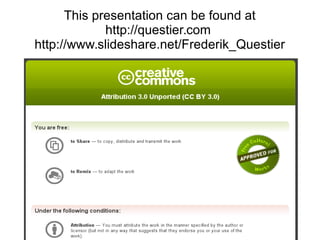
This presentation can be found at
http://questier.com
http://www.slideshare.net/Frederik_Questier
During this workshop:
reflect about
➢ How can e-learning and OER be useful for
libraries?
➢ How can libraries help their organisation or
members with e-learning and OER needs?
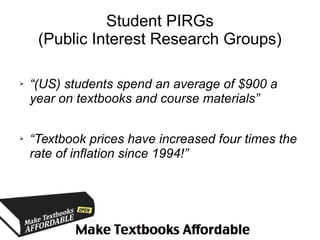
Student PIRGs
(Public Interest Research Groups)
➢ “(US) students spend an average of $900 a
year on textbooks and course materials”
➢ “Textbook prices have increased four times the

rate of inflation since 1994!”
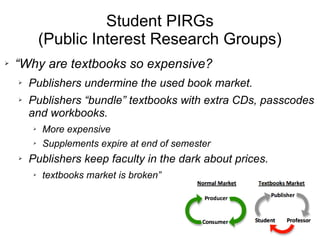
Student PIRGs
(Public Interest Research Groups)
➢ “Why are textbooks so expensive?
➢ Publishers undermine the used book market.
➢ Publishers “bundle” textbooks with extra CDs, passcodes
and workbooks.
➢ More expensive
➢ Supplements expire at end of semester
➢ Publishers keep faculty in the dark about prices.
➢ textbooks market is broken”
8
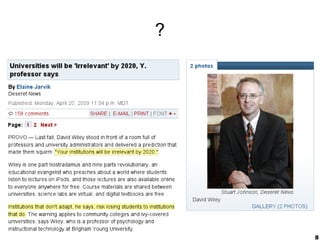
?
9
?
10
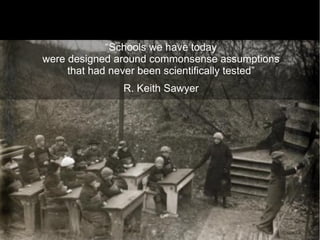
“Schools we have today
were designed around commonsense assumptions
that had never been scientifically tested”
R. Keith Sawyer
11
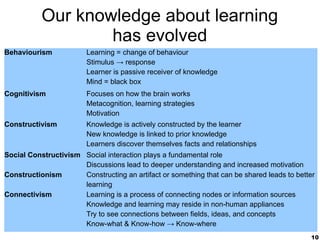
Our knowledge about learning
has evolved
Behaviourism Learning = change of behaviour
Stimulus → response
Learner is passive receiver of knowledge
Mind = black box
Cognitivism Focuses on how the brain works
Metacognition, learning strategies
Motivation
Constructivism Knowledge is actively constructed by the learner
New knowledge is linked to prior knowledge
Learners discover themselves facts and relationships
Social Constructivism Social interaction plays a fundamental role
Discussions lead to deeper understanding and increased motivation
Constructionism Constructing an artifact or something that can be shared leads to better
learning
Connectivism Learning is a process of connecting nodes or information sources
Knowledge and learning may reside in non-human appliances
Try to see connections between fields, ideas, and concepts
Know-what & Know-how → Know-where
12
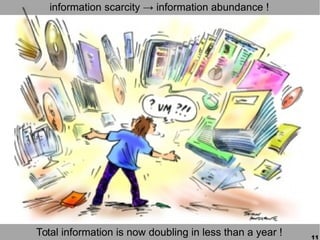
information scarcity → information abundance !
Total information is now doubling in less than a year !
13
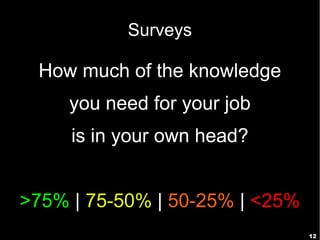
Surveys
How much of the knowledge
you need for your job
is in your own head?
>75% | 75-50% | 50-25% | <25%
14
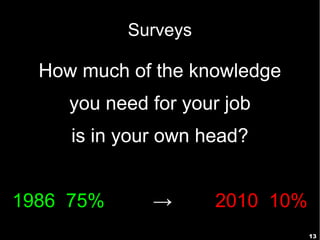
Surveys
How much of the knowledge
you need for your job
is in your own head?
1986 75% → 2010 10%
15
The longer one studies,
the more one comes to realize
how much one does not know
16
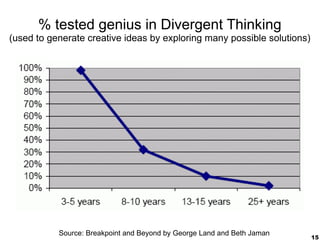
% tested genius in Divergent Thinking
(used to generate creative ideas by exploring many possible solutions)
Source: Breakpoint and Beyond by George Land and Beth Jaman
17
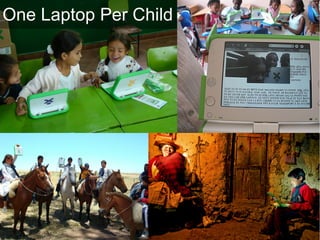
One Laptop Per Child
18
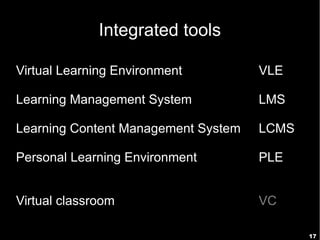
Virtual Learning Environment VLE
Learning Management System LMS
Learning Content Management System LCMS
Personal Learning Environment PLE
Virtual classroom VC
Integrated tools
19
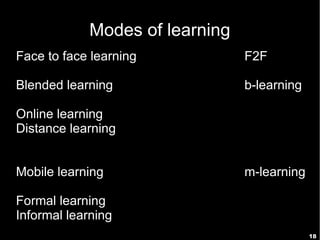
Face to face learning F2F
Blended learning b-learning
Online learning e-learning
Distance learning
Mobile learning m-learning
Formal learning
Informal learning
Modes of learning
20
21
22
23
24
25
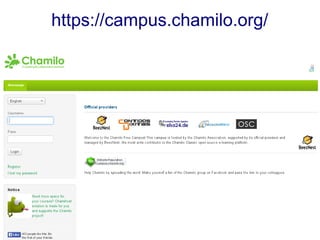
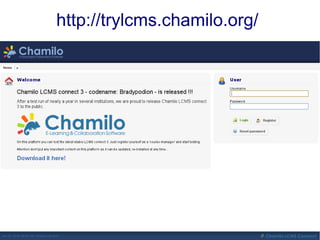
https://campus.chamilo.org/
26
http://demo.lcmsconnect.org
27
28
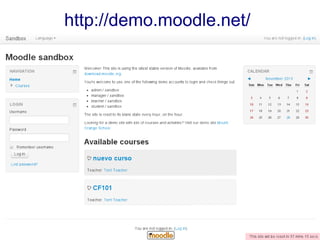
http://demo.moodle.net/
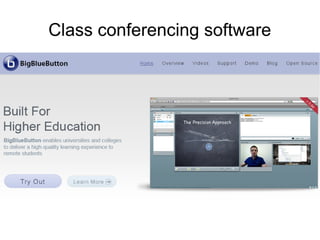
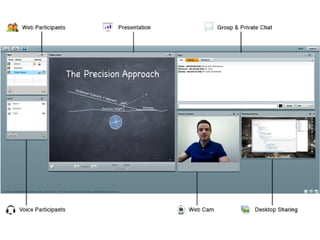
Class conferencing software
31
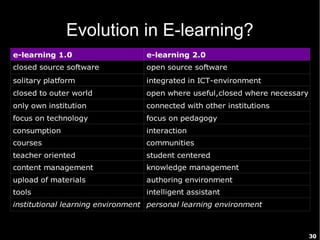
Evolution in E-learning?
e-learning 1.0 e-learning 2.0
open source software
content management
tools
personal learning environment
closed source software
solitary platform integrated in ICT-environment
closed to outer world open where useful,closed where necessary
only own institution connected with other institutions
focus on technology focus on pedagogy
consumption interaction
courses communities
teacher oriented student centered
knowledge management
upload of materials authoring environment
intelligent assistant
institutional learning environment
33
34
35
Open educational resources
(OER)
digitised materials
offered freely and openly
for educators, students and self-learners
to use and reuse
for teaching, learning and research
Believing that OER can
widen access to quality education,
particularly when shared by many countries
and higher education institutions,
UNESCO champions OER
as a means of promoting access, equity and quality
in the spirit of the Universal Declaration of Human Rights.
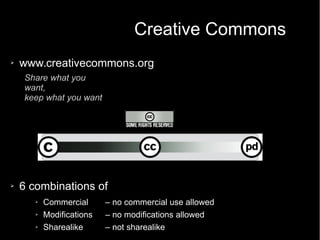
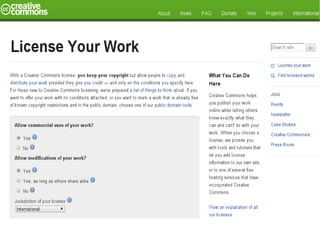
Creative Commons
➢ www.creativecommons.org
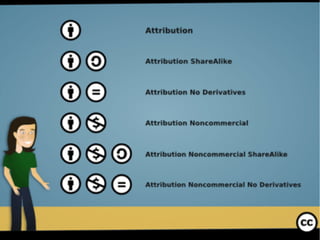
➢ 6 combinations of
➢ Commercial – no commercial use allowed
➢ Modifications – no modifications allowed
➢ Sharealike – not sharealike
Share what you
want,
keep what you want
44
45
46
47
48
49
50
51
52
53
54
55
56
57
58
59
60
61
62
63
66
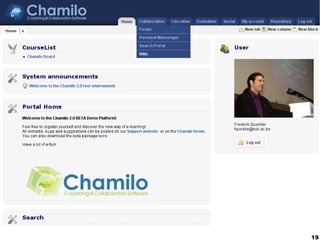
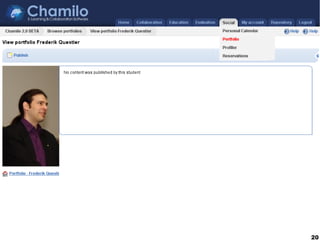
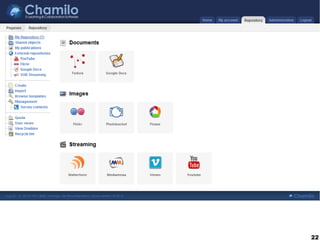
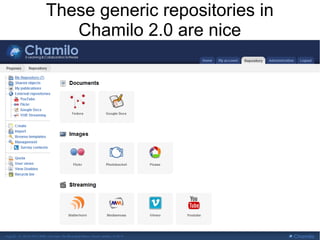
These generic repositories in
Chamilo 2.0 are nice
67
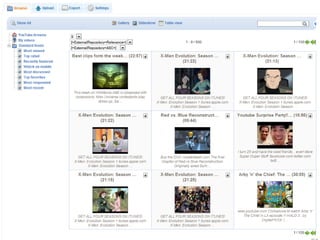
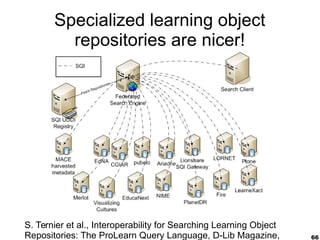
Specialized learning object
repositories are nicer!
S. Ternier et al., Interoperability for Searching Learning Object
Repositories: The ProLearn Query Language, D-Lib Magazine,
68
Let's avoid the
empty box
feeling!
69
Content is King ?
70
How can we
make the best
of our content?
71
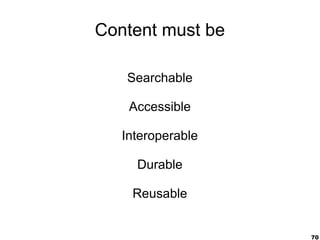
Content must be
Searchable
Accessible
Interoperable
Durable
Reusable
72
How?
73
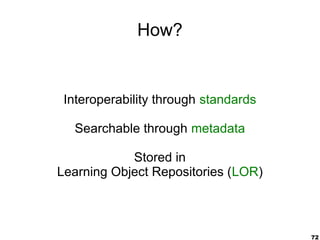
How?
Interoperability through standards
Searchable through metadata
Stored in
Learning Object Repositories (LOR)
74
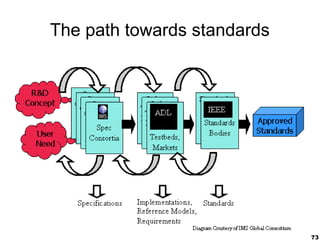
The path towards standards
75
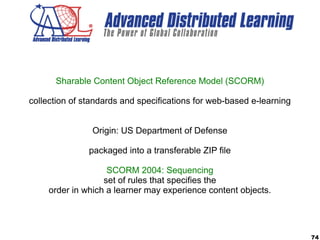
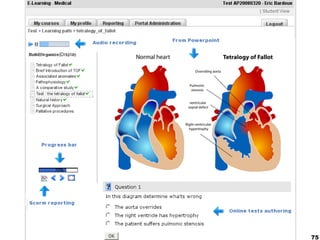
SCORM
Sharable Content Object Reference Model (SCORM)
collection of standards and specifications for web-based e-learning
Origin: US Department of Defense
packaged into a transferable ZIP file
SCORM 2004: Sequencing
set of rules that specifies the
order in which a learner may experience content objects.
76
77
AICC
Aviation Industry
Computer-Based Training Committee
78
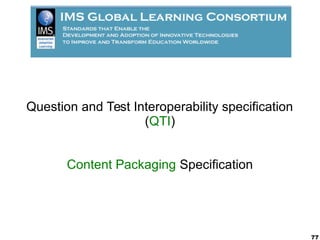
IMS Global Learning Consortium
Question and Test Interoperability specification
(QTI)
Content Packaging Specification
79
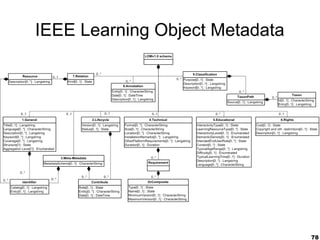
IEEE Learning Object Metadata
80
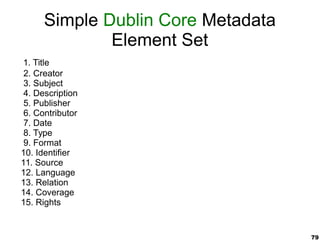
Simple Dublin Core Metadata
Element Set
1. Title
2. Creator
3. Subject
4. Description
5. Publisher
6. Contributor
7. Date
8. Type
9. Format
10. Identifier
11. Source
12. Language
13. Relation
14. Coverage
15. Rights
81
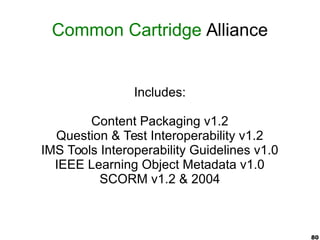
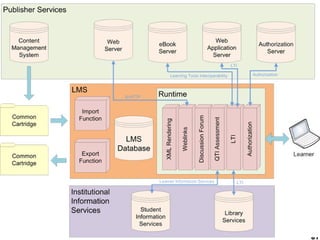
Common Cartridge Alliance
Includes:
Content Packaging v1.2
Question & Test Interoperability v1.2
IMS Tools Interoperability Guidelines v1.0
IEEE Learning Object Metadata v1.0
SCORM v1.2 & 2004
82
83
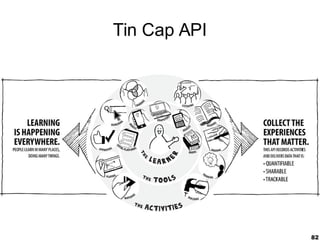
Tin Cap API
84
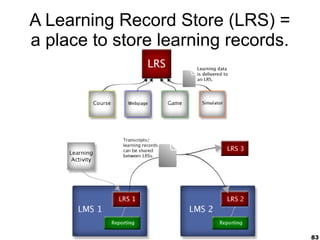
A Learning Record Store (LRS) =
a place to store learning records.
86
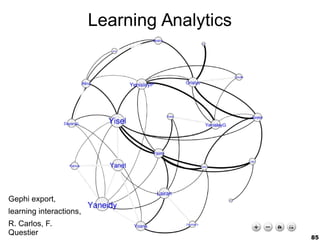
Learning Analytics
Gephi export,
learning interactions,
R. Carlos, F.
Questier
87
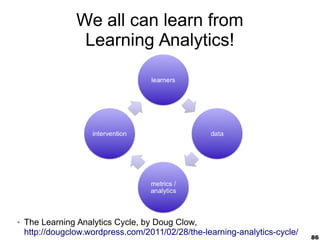
We all can learn from
Learning Analytics!
➢ The Learning Analytics Cycle, by Doug Clow,
http://dougclow.wordpress.com/2011/02/28/the-learning-analytics-cycle/
Is this ICT supported
learning paradigm shift
possible without
teacher learning/training?
89
Research studies show that
how much and how effectively
teachers integrate ICT
in their teaching process
depends mainly on their educational vision
(not age, gender, ...)
OER Barriers?
➢ Barriers for usage
➢ Lack of awareness
➢ Bandwith in developing countries
➢ Not enough OER yet
➢ Bandwith
➢ Hard to localize
➢ Barriers for production
➢ Teachers attitude
➢ Skills
➢ Copyright
➢ Limitations of LMS? (licenses, access control)
➢ Funding
➢ Institutional policy
91
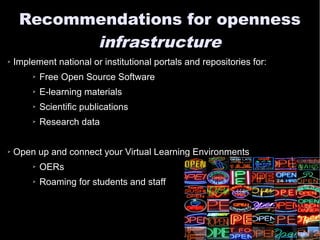
Recommendations for opennessRecommendations for openness
infrastructureinfrastructure
➢
Implement national or institutional portals and repositories for:Implement national or institutional portals and repositories for:
➢
Free Open Source SoftwareFree Open Source Software
➢
E-learning materialsE-learning materials
➢
Scientific publicationsScientific publications
➢
Research dataResearch data
➢
Open up and connect your Virtual Learning EnvironmentsOpen up and connect your Virtual Learning Environments
➢
OERsOERs
➢
Roaming for students and staffRoaming for students and staff
92
Exercise
What can libraries do
related to e-learning & OER?
93
One extra idea:
Integrate library and
virtual learning environment
OpenURL
94
DARE
TO SHARE
Questions? Thanks!
Questier.com
Frederik AT Questier.com
www.linkedin.com/in/fquestie
www.diigo.com/user/frederikquestier
www.slideshare.net/Frederik_Questier
This presentation was made
with 100% Free Software
No animals were harmed
@fquestie – http://questier.com
Copyright acknowledgements
➢ Question! CC-by by Stefan Baudy
➢ http://cogdogblog.com/2012/07/17/mooc-hysertia/
➢ http://www.onlinecollege.org/2012/08/21/25-tips-make-most-mooc/
➢ GNU Head Joseph W. Reiss Free Art License or the GNU GPLv2
➢ Share matches CC-by-nc-nd by Josh Harper
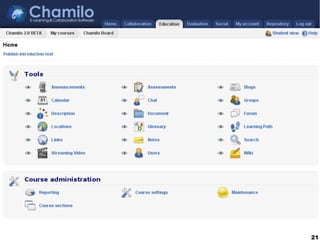
➢ Screenshot http://www.chamilo.org/
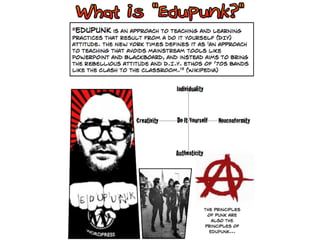
➢ Edupunk: http://blogs.pstcc.edu/drbrown/files/2009/11/Picture-4.png
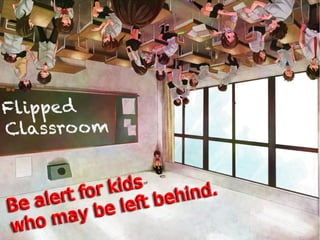
➢ Flipped-Classroom-CC-BY-NC-SA-2-by-ransomtech
➢ OPEN, CC-by-nc-sa by Tom Magliery
➢ Empty box, CC by-nc-nd by Mike Bitzenhofer
➢ Share matches CC by-nc-nd by Josh Harper

E-learning and Open Educational Resources - primer for libraries

  • 1.
    E-learning and OER primer forlibraries Vrije Universiteit Brussel Prof. dr. Frederik Questier Workshop for Lib@web 2015 VLIR International Training Program November 2015 @ University of Antwerp Management of Electronic Information and Digital Libraries
  • 3.
    This presentation canbe found at http://questier.com http://www.slideshare.net/Frederik_Questier
  • 4.
    During this workshop: reflectabout ➢ How can e-learning and OER be useful for libraries? ➢ How can libraries help their organisation or members with e-learning and OER needs?
  • 5.
    Student PIRGs (Public InterestResearch Groups) ➢ “(US) students spend an average of $900 a year on textbooks and course materials” ➢ “Textbook prices have increased four times the rate of inflation since 1994!”
  • 6.
    Student PIRGs (Public InterestResearch Groups) ➢ “Why are textbooks so expensive? ➢ Publishers undermine the used book market. ➢ Publishers “bundle” textbooks with extra CDs, passcodes and workbooks. ➢ More expensive ➢ Supplements expire at end of semester ➢ Publishers keep faculty in the dark about prices. ➢ textbooks market is broken”
  • 8.
  • 9.
  • 10.
    10 “Schools we havetoday were designed around commonsense assumptions that had never been scientifically tested” R. Keith Sawyer
  • 11.
    11 Our knowledge aboutlearning has evolved Behaviourism Learning = change of behaviour Stimulus → response Learner is passive receiver of knowledge Mind = black box Cognitivism Focuses on how the brain works Metacognition, learning strategies Motivation Constructivism Knowledge is actively constructed by the learner New knowledge is linked to prior knowledge Learners discover themselves facts and relationships Social Constructivism Social interaction plays a fundamental role Discussions lead to deeper understanding and increased motivation Constructionism Constructing an artifact or something that can be shared leads to better learning Connectivism Learning is a process of connecting nodes or information sources Knowledge and learning may reside in non-human appliances Try to see connections between fields, ideas, and concepts Know-what & Know-how → Know-where
  • 12.
    12 information scarcity →information abundance ! Total information is now doubling in less than a year !
  • 13.
    13 Surveys How much ofthe knowledge you need for your job is in your own head? >75% | 75-50% | 50-25% | <25%
  • 14.
    14 Surveys How much ofthe knowledge you need for your job is in your own head? 1986 75% → 2010 10%
  • 15.
    15 The longer onestudies, the more one comes to realize how much one does not know
  • 16.
    16 % tested geniusin Divergent Thinking (used to generate creative ideas by exploring many possible solutions) Source: Breakpoint and Beyond by George Land and Beth Jaman
  • 17.
  • 18.
    18 Virtual Learning EnvironmentVLE Learning Management System LMS Learning Content Management System LCMS Personal Learning Environment PLE Virtual classroom VC Integrated tools
  • 19.
    19 Face to facelearning F2F Blended learning b-learning Online learning e-learning Distance learning Mobile learning m-learning Formal learning Informal learning Modes of learning
  • 20.
  • 21.
  • 22.
  • 23.
  • 24.
  • 25.
  • 26.
  • 27.
  • 28.
  • 29.
  • 31.
    31 Evolution in E-learning? e-learning1.0 e-learning 2.0 open source software content management tools personal learning environment closed source software solitary platform integrated in ICT-environment closed to outer world open where useful,closed where necessary only own institution connected with other institutions focus on technology focus on pedagogy consumption interaction courses communities teacher oriented student centered knowledge management upload of materials authoring environment intelligent assistant institutional learning environment
  • 33.
  • 34.
  • 35.
  • 38.
    Open educational resources (OER) digitisedmaterials offered freely and openly for educators, students and self-learners to use and reuse for teaching, learning and research
  • 39.
    Believing that OERcan widen access to quality education, particularly when shared by many countries and higher education institutions, UNESCO champions OER as a means of promoting access, equity and quality in the spirit of the Universal Declaration of Human Rights.
  • 40.
    Creative Commons ➢ www.creativecommons.org ➢6 combinations of ➢ Commercial – no commercial use allowed ➢ Modifications – no modifications allowed ➢ Sharealike – not sharealike Share what you want, keep what you want
  • 44.
  • 45.
  • 46.
  • 47.
  • 48.
  • 49.
  • 50.
  • 51.
  • 52.
  • 53.
  • 54.
  • 55.
  • 56.
  • 57.
  • 58.
  • 59.
  • 60.
  • 61.
  • 62.
  • 63.
  • 66.
    66 These generic repositoriesin Chamilo 2.0 are nice
  • 67.
    67 Specialized learning object repositoriesare nicer! S. Ternier et al., Interoperability for Searching Learning Object Repositories: The ProLearn Query Language, D-Lib Magazine,
  • 68.
  • 69.
  • 70.
    70 How can we makethe best of our content?
  • 71.
  • 72.
  • 73.
    73 How? Interoperability through standards Searchablethrough metadata Stored in Learning Object Repositories (LOR)
  • 74.
  • 75.
    75 SCORM Sharable Content ObjectReference Model (SCORM) collection of standards and specifications for web-based e-learning Origin: US Department of Defense packaged into a transferable ZIP file SCORM 2004: Sequencing set of rules that specifies the order in which a learner may experience content objects.
  • 76.
  • 77.
  • 78.
    78 IMS Global LearningConsortium Question and Test Interoperability specification (QTI) Content Packaging Specification
  • 79.
  • 80.
    80 Simple Dublin CoreMetadata Element Set 1. Title 2. Creator 3. Subject 4. Description 5. Publisher 6. Contributor 7. Date 8. Type 9. Format 10. Identifier 11. Source 12. Language 13. Relation 14. Coverage 15. Rights
  • 81.
    81 Common Cartridge Alliance Includes: ContentPackaging v1.2 Question & Test Interoperability v1.2 IMS Tools Interoperability Guidelines v1.0 IEEE Learning Object Metadata v1.0 SCORM v1.2 & 2004
  • 82.
  • 83.
  • 84.
    84 A Learning RecordStore (LRS) = a place to store learning records.
  • 86.
    86 Learning Analytics Gephi export, learninginteractions, R. Carlos, F. Questier
  • 87.
    87 We all canlearn from Learning Analytics! ➢ The Learning Analytics Cycle, by Doug Clow, http://dougclow.wordpress.com/2011/02/28/the-learning-analytics-cycle/
  • 88.
    Is this ICTsupported learning paradigm shift possible without teacher learning/training?
  • 89.
    89 Research studies showthat how much and how effectively teachers integrate ICT in their teaching process depends mainly on their educational vision (not age, gender, ...)
  • 90.
    OER Barriers? ➢ Barriersfor usage ➢ Lack of awareness ➢ Bandwith in developing countries ➢ Not enough OER yet ➢ Bandwith ➢ Hard to localize ➢ Barriers for production ➢ Teachers attitude ➢ Skills ➢ Copyright ➢ Limitations of LMS? (licenses, access control) ➢ Funding ➢ Institutional policy
  • 91.
    91 Recommendations for opennessRecommendationsfor openness infrastructureinfrastructure ➢ Implement national or institutional portals and repositories for:Implement national or institutional portals and repositories for: ➢ Free Open Source SoftwareFree Open Source Software ➢ E-learning materialsE-learning materials ➢ Scientific publicationsScientific publications ➢ Research dataResearch data ➢ Open up and connect your Virtual Learning EnvironmentsOpen up and connect your Virtual Learning Environments ➢ OERsOERs ➢ Roaming for students and staffRoaming for students and staff
  • 92.
    92 Exercise What can librariesdo related to e-learning & OER?
  • 93.
    93 One extra idea: Integratelibrary and virtual learning environment OpenURL
  • 94.
  • 95.
    Questions? Thanks! Questier.com Frederik ATQuestier.com www.linkedin.com/in/fquestie www.diigo.com/user/frederikquestier www.slideshare.net/Frederik_Questier
  • 96.
    This presentation wasmade with 100% Free Software No animals were harmed @fquestie – http://questier.com
  • 97.
    Copyright acknowledgements ➢ Question!CC-by by Stefan Baudy ➢ http://cogdogblog.com/2012/07/17/mooc-hysertia/ ➢ http://www.onlinecollege.org/2012/08/21/25-tips-make-most-mooc/ ➢ GNU Head Joseph W. Reiss Free Art License or the GNU GPLv2 ➢ Share matches CC-by-nc-nd by Josh Harper ➢ Screenshot http://www.chamilo.org/ ➢ Edupunk: http://blogs.pstcc.edu/drbrown/files/2009/11/Picture-4.png ➢ Flipped-Classroom-CC-BY-NC-SA-2-by-ransomtech ➢ OPEN, CC-by-nc-sa by Tom Magliery ➢ Empty box, CC by-nc-nd by Mike Bitzenhofer ➢ Share matches CC by-nc-nd by Josh Harper