Relationships between
   users, resources and
services in learning object
       repositories
  Jordi Conesa, Julia Minguillón, and M. Elena Rodríguez
             Universitat Oberta de Catalunya


                                               MTSR 2012, Cádiz, Spain
Scenario (I)
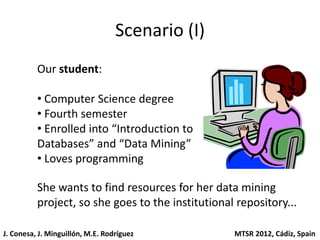
          Our student:

          • Computer Science degree
          • Fourth semester
          • Enrolled into “Introduction to
          Databases” and “Data Mining”
          • Loves programming

          She wants to find resources for her data mining
          project, so she goes to the institutional repository...

J. Conesa, J. Minguillón, M.E. Rodríguez           MTSR 2012, Cádiz, Spain
Scenario (II)
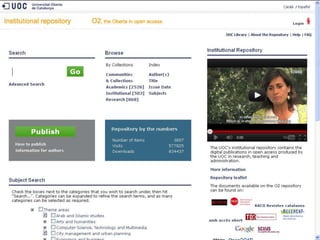
          The institutional repository:

          • Created by (and for) librarians
          • Stores documents
          • Basic services:
              • Upload (restricted)
              • Browse / Search
              • Download
          • Recent submissions
          Will our student find what she is looking for?
J. Conesa, J. Minguillón, M.E. Rodríguez          MTSR 2012, Cádiz, Spain
It’s not just searching and browsing
    • How are documents organized?
    • How have they been described?

       The institutional repository cannot be a mere
        digital shelf where to deposit documents in a
                  simple hierarchical structure

                    We need context and relations

J. Conesa, J. Minguillón, M.E. Rodríguez      MTSR 2012, Cádiz, Spain
Project framework
    • Mining, data Analysis and Visualization based
      on Social models in E-Learning (MAVSEL)
    • 3 year UAH / UOC project

            The learning process is the result of learners
          interacting with resources, services and other
          learners; we can analyze such interaction and
                  improve the learning scenario (i.e. the
                                institutional repository)

J. Conesa, J. Minguillón, M.E. Rodríguez     MTSR 2012, Cádiz, Spain
Current situation (I)
    • The institutional repository does not “know”
      its users (except permissions for uploading):
         – No context for browsing or searching →
         – No guidance → structure becomes a maze
         – No recommendations (only recent submissions)
    • Stores documents: title, author, date, keywords
    • Documents are unrelated to each other
                      “Invisible”

J. Conesa, J. Minguillón, M.E. Rodríguez     MTSR 2012, Cádiz, Spain
Current situation (II)
    • Interviews + survey to students and teachers
    • Most students (87.5%) are unfamiliar with the
      institutional repository; most teachers (67.4%)
      too; they do not use it except if “forced”

                      “it’s not easy to find things”
                  “unrelated to the learning process”
              “resource description needs to be improved”
             “what / where is the institutional repository?”

J. Conesa, J. Minguillón, M.E. Rodríguez          MTSR 2012, Cádiz, Spain
Our proposal (I)
        Main goal: make teachers and students take
          control over the institutional repository

    •   From documents to resources
    •   Contextualized searching
    •   Improved browsing → navigation
    •   Additional services → social layer


J. Conesa, J. Minguillón, M.E. Rodríguez       MTSR 2012, Cádiz, Spain
Our proposal (II)
    • Improve resource descriptions:
         – Domain (i.e. statistics, programming, …)
         – Current / potential use (courses, degrees)
         – Type / level / intended use
    • Establish relationships between elements
    • Additional services:
         – Resource rating, favorites, tagging, sharing
    • Analyze paradata for recommendation purposes

J. Conesa, J. Minguillón, M.E. Rodríguez         MTSR 2012, Cádiz, Spain
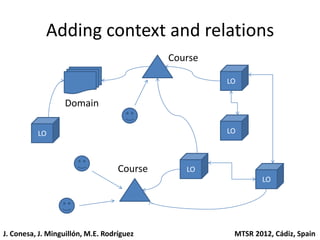
Adding context and relations
                                            Course

                                                     LO

                  Domain

          LO                                         LO


                                   Course      LO
                                                             LO


J. Conesa, J. Minguillón, M.E. Rodríguez              MTSR 2012, Cádiz, Spain
Relationships
    • Between resources:
         – Dublin Core: references, requires, is version of
         – Explicit: exemplifies, deepens, summarizes
         – Computed: isCloseTo
    • Between users:
         – Computed: isCloseTo
    • Between users and resources
    • New levels: course, domain

J. Conesa, J. Minguillón, M.E. Rodríguez          MTSR 2012, Cádiz, Spain
Extending Dublin Core
    • Used for describing content, not context
    • Currently now:
         – dc:subject
         – dc:type
         – dc:format
         – dc:relation
    • “Flat” representation of an ontology
    • OAI-PMH needs to be considered

J. Conesa, J. Minguillón, M.E. Rodríguez   MTSR 2012, Cádiz, Spain
Establishing a metric
    • Resources:
         – Reputation scheme FR(Ri)
         – Distance dR(Ri,Rj)
    • Users:
         – Reputation scheme FU(Ui)
         – Distance dU(Ui,Uj)
    • Users and Resources:
         – Distance dU,R(Ui,Rj)

J. Conesa, J. Minguillón, M.E. Rodríguez   MTSR 2012, Cádiz, Spain
Analyzing paradata
    • Resources:
         – Number of times accessed, downloaded
         – Rankings, number of favorites
         – Tags
    • Users:
         – Number of resources
           downloaded, rated, favorited, tagged
         – Navigational patterns


J. Conesa, J. Minguillón, M.E. Rodríguez          MTSR 2012, Cádiz, Spain
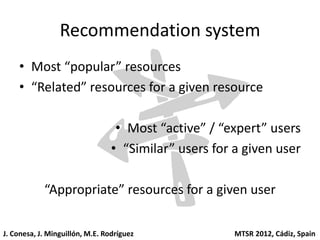
Recommendation system
    • Most “popular” resources
    • “Related” resources for a given resource

                                  • Most “active” / “expert” users
                                 • “Similar” users for a given user

            “Appropriate” resources for a given user

J. Conesa, J. Minguillón, M.E. Rodríguez               MTSR 2012, Cádiz, Spain
Conclusions and                future work
    • The institutional repository is underused
    • Resources are isolated → no discovery
    • We want learners to take a more active role
    • Describe resources according to learners’ needs
      and particularities (i.e. context)
    • Implementation of the service layer
    • Design of the reputation scheme
    • Pilot test during Spring 2013 → MTSR 2013!!!
J. Conesa, J. Minguillón, M.E. Rodríguez          MTSR 2012, Cádiz, Spain
Thank you!!!
MAVSEL project:
              http://personal.uoc.edu/MAVSEL
Contact:
                              Julià Minguillón
                  jminguillona[at]uoc[dot]edu
                       Twitter/@jminguillona
           CC-BY-NC-ND

Relationships between users, resources and services in learning object repositories

  • 1.
    Relationships between users, resources and services in learning object repositories Jordi Conesa, Julia Minguillón, and M. Elena Rodríguez Universitat Oberta de Catalunya MTSR 2012, Cádiz, Spain
  • 2.
    Scenario (I) Our student: • Computer Science degree • Fourth semester • Enrolled into “Introduction to Databases” and “Data Mining” • Loves programming She wants to find resources for her data mining project, so she goes to the institutional repository... J. Conesa, J. Minguillón, M.E. Rodríguez MTSR 2012, Cádiz, Spain
  • 3.
    Scenario (II) The institutional repository: • Created by (and for) librarians • Stores documents • Basic services: • Upload (restricted) • Browse / Search • Download • Recent submissions Will our student find what she is looking for? J. Conesa, J. Minguillón, M.E. Rodríguez MTSR 2012, Cádiz, Spain
  • 5.
    It’s not justsearching and browsing • How are documents organized? • How have they been described? The institutional repository cannot be a mere digital shelf where to deposit documents in a simple hierarchical structure We need context and relations J. Conesa, J. Minguillón, M.E. Rodríguez MTSR 2012, Cádiz, Spain
  • 6.
    Project framework • Mining, data Analysis and Visualization based on Social models in E-Learning (MAVSEL) • 3 year UAH / UOC project The learning process is the result of learners interacting with resources, services and other learners; we can analyze such interaction and improve the learning scenario (i.e. the institutional repository) J. Conesa, J. Minguillón, M.E. Rodríguez MTSR 2012, Cádiz, Spain
  • 7.
    Current situation (I) • The institutional repository does not “know” its users (except permissions for uploading): – No context for browsing or searching → – No guidance → structure becomes a maze – No recommendations (only recent submissions) • Stores documents: title, author, date, keywords • Documents are unrelated to each other “Invisible” J. Conesa, J. Minguillón, M.E. Rodríguez MTSR 2012, Cádiz, Spain
  • 8.
    Current situation (II) • Interviews + survey to students and teachers • Most students (87.5%) are unfamiliar with the institutional repository; most teachers (67.4%) too; they do not use it except if “forced” “it’s not easy to find things” “unrelated to the learning process” “resource description needs to be improved” “what / where is the institutional repository?” J. Conesa, J. Minguillón, M.E. Rodríguez MTSR 2012, Cádiz, Spain
  • 9.
    Our proposal (I) Main goal: make teachers and students take control over the institutional repository • From documents to resources • Contextualized searching • Improved browsing → navigation • Additional services → social layer J. Conesa, J. Minguillón, M.E. Rodríguez MTSR 2012, Cádiz, Spain
  • 10.
    Our proposal (II) • Improve resource descriptions: – Domain (i.e. statistics, programming, …) – Current / potential use (courses, degrees) – Type / level / intended use • Establish relationships between elements • Additional services: – Resource rating, favorites, tagging, sharing • Analyze paradata for recommendation purposes J. Conesa, J. Minguillón, M.E. Rodríguez MTSR 2012, Cádiz, Spain
  • 11.
    Adding context andrelations Course LO Domain LO LO Course LO LO J. Conesa, J. Minguillón, M.E. Rodríguez MTSR 2012, Cádiz, Spain
  • 12.
    Relationships • Between resources: – Dublin Core: references, requires, is version of – Explicit: exemplifies, deepens, summarizes – Computed: isCloseTo • Between users: – Computed: isCloseTo • Between users and resources • New levels: course, domain J. Conesa, J. Minguillón, M.E. Rodríguez MTSR 2012, Cádiz, Spain
  • 13.
    Extending Dublin Core • Used for describing content, not context • Currently now: – dc:subject – dc:type – dc:format – dc:relation • “Flat” representation of an ontology • OAI-PMH needs to be considered J. Conesa, J. Minguillón, M.E. Rodríguez MTSR 2012, Cádiz, Spain
  • 14.
    Establishing a metric • Resources: – Reputation scheme FR(Ri) – Distance dR(Ri,Rj) • Users: – Reputation scheme FU(Ui) – Distance dU(Ui,Uj) • Users and Resources: – Distance dU,R(Ui,Rj) J. Conesa, J. Minguillón, M.E. Rodríguez MTSR 2012, Cádiz, Spain
  • 15.
    Analyzing paradata • Resources: – Number of times accessed, downloaded – Rankings, number of favorites – Tags • Users: – Number of resources downloaded, rated, favorited, tagged – Navigational patterns J. Conesa, J. Minguillón, M.E. Rodríguez MTSR 2012, Cádiz, Spain
  • 16.
    Recommendation system • Most “popular” resources • “Related” resources for a given resource • Most “active” / “expert” users • “Similar” users for a given user “Appropriate” resources for a given user J. Conesa, J. Minguillón, M.E. Rodríguez MTSR 2012, Cádiz, Spain
  • 17.
    Conclusions and future work • The institutional repository is underused • Resources are isolated → no discovery • We want learners to take a more active role • Describe resources according to learners’ needs and particularities (i.e. context) • Implementation of the service layer • Design of the reputation scheme • Pilot test during Spring 2013 → MTSR 2013!!! J. Conesa, J. Minguillón, M.E. Rodríguez MTSR 2012, Cádiz, Spain
  • 18.
    Thank you!!! MAVSEL project: http://personal.uoc.edu/MAVSEL Contact: Julià Minguillón jminguillona[at]uoc[dot]edu Twitter/@jminguillona CC-BY-NC-ND