National 
Teaching 
Fellow 2012 EDEN fellow 2013 Ascilite fellow 2012 
Disruptive learning – towards PLE+? 
Gráinne Conole, University of Leicester 
27th August 2014 
5th International PLE conference, Kuala Lumpur 
UNITAR International University
Outline 
• Disruptive innovation 
• Emergent technologies 
• Disruptive learning 
innovations 
– The flipped classroom 
– Mobile learning 
– Open learning 
• Facilitating learning 
– From VLEs to PLEs to PLE+ 
– Characteristics of a PLE+ 
• The 7Cs of Learning Design
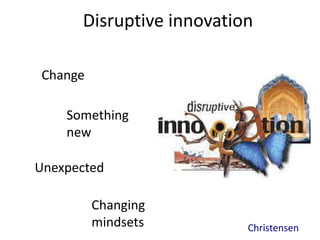
Disruptive innovation 
Change 
Something 
new 
Unexpected 
Christensen 
Changing 
mindsets
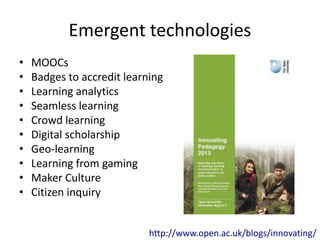
Emergent technologies 
• MOOCs 
• Badges to accredit learning 
• Learning analytics 
• Seamless learning 
• Crowd learning 
• Digital scholarship 
• Geo-learning 
• Learning from gaming 
• Maker Culture 
• Citizen inquiry 
http://www.open.ac.uk/blogs/innovating/
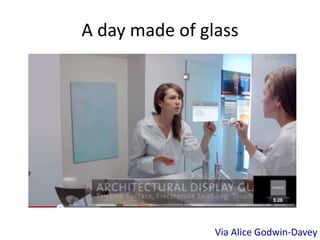
A day made of glass 
Via Alice Godwin-Davey
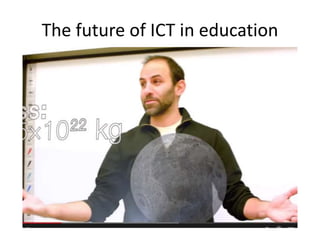
The future of ICT in education
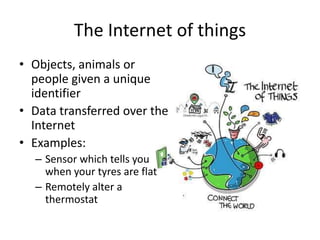
The Internet of things 
• Objects, animals or 
people given a unique 
identifier 
• Data transferred over the 
Internet 
• Examples: 
– Sensor which tells you 
when your tyres are flat 
– Remotely alter a 
thermostat
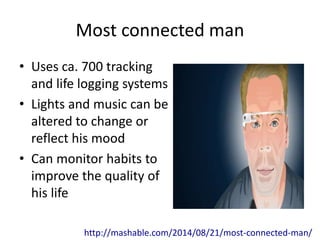
Most connected man 
• Uses ca. 700 tracking 
and life logging systems 
• Lights and music can be 
altered to change or 
reflect his mood 
• Can monitor habits to 
improve the quality of 
his life 
http://mashable.com/2014/08/21/most-connected-man/
Discussion point 
• What (if 
anything) is 
innovative 
and/or 
disruptive about 
these? 
• How might they 
be used in a 
learning 
context?
Discussion 
Innovative or disruptive Use in a learning context
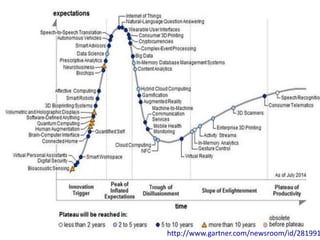
http://www.gartner.com/newsroom/id/2819918
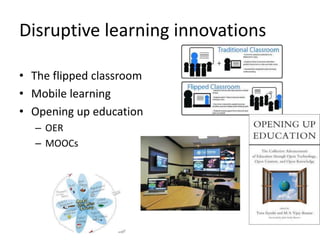
Disruptive learning innovations 
• The flipped classroom 
• Mobile learning 
• Opening up education 
– OER 
– MOOCs
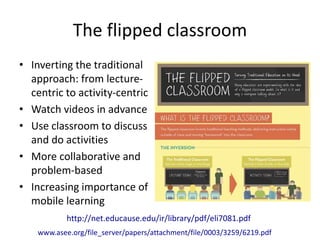
The flipped classroom 
• Inverting the traditional 
approach: from lecture-centric 
to activity-centric 
• Watch videos in advance 
• Use classroom to discuss 
and do activities 
• More collaborative and 
problem-based 
• Increasing importance of 
mobile learning 
http://net.educause.edu/ir/library/pdf/eli7081.pdf 
www.asee.org/file_server/papers/attachment/file/0003/3259/6219.pdf
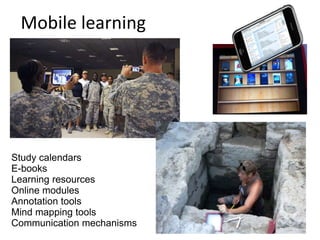
Mobile learning 
Study calendars 
E-books 
Learning resources 
Online modules 
Annotation tools 
Mind mapping tools 
Communication mechanisms
From E-Learning to M-Learning 
• More than just mobile e-learning 
– Anytime, anywhere for the learner (efficiency) 
– Enables learning in special location (i.e. fieldwork) 
• New affordances of mobile 
– Small and compact 
– Personal 
– Capturing sound, video, image 
– New tech i.e. augmented reality 
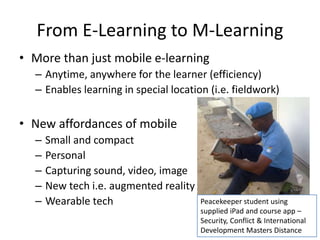
– Wearable tech Peacekeeper student using 
supplied iPad and course app – 
Security, Conflict & International 
Development Masters Distance
Other Leicester examples 
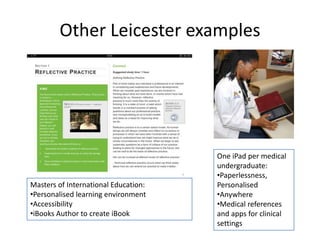
One iPad per medical 
undergraduate: 
•Paperlessness, 
Personalised 
•Anywhere 
•Medical references 
and apps for clinical 
settings 
Masters of International Education: 
•Personalised learning environment 
•Accessibility 
•iBooks Author to create iBook
Flexibility and mobility 
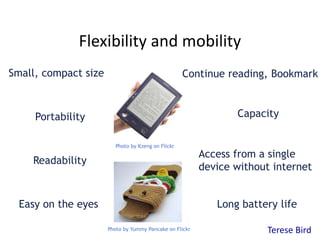
Small, compact size 
Continue reading, Bookmark 
Portability Capacity 
Readability 
Easy on the eyes 
Access from a single 
device without internet 
Long battery life 
Photo by Kzeng on Flickr 
Photo by Yummy Pancake on Flickr Terese Bird
Open learning 
• Over ten years of the Open Educational Resource 
(OER) movement 
• Hundreds of OER repositories worldwide 
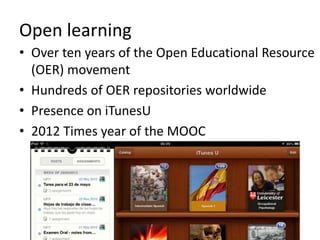
• Presence on iTunesU 
• 2012 Times year of the MOOC
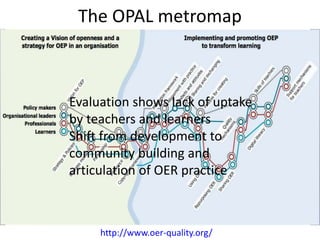
The OPAL metromap 
Evaluation shows lack of uptake 
by teachers and learners 
Shift from development to 
community building and 
articulation of OER practice 
http://www.oer-quality.org/
POERUP outputs 
• An inventory of more than 300 OER initiatives 
http://poerup.referata.com/wiki/Countries_with_OER_initiatives 
• 11 country reports and 13 mini-reports 
http://poerup.referata.com/wiki/Countries 
• 7 in-depth case studies 
• 3 EU-wide policy papers
The emergence of MOOCs 
• CCK08 
– Connectivist MOOC (cMOOC) 
– Siemens, Downes and Cormier 
– Evaluation (Fini, 2009)http://www.irrodl.org/index.php/irrodl/article/view/643/1402 
• Emergence of large-scale xMOOCs 
• Recent developments 
– UK-based FutureLearn 
– Launch of Massey on Open2Study 
• List of MOOCs 
– http://www.mooc-list.com/ 
• EFQUEL series of blogs 
– http://mooc.efquel.org/ 
• ICDE list of MOOC reports 
– http://tinyurl.com/gconole-MOOC 
• MOOC research reports 
– http://www.moocresearch.com/reports 
• MOOCs for development 
– http://www.moocs4d.org/media.html
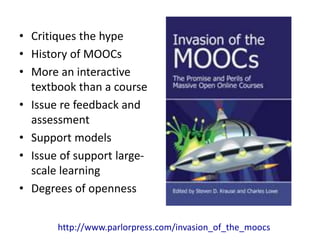
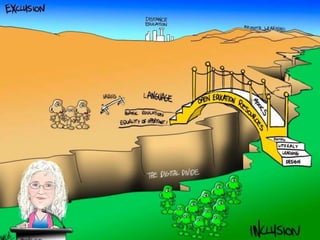
• Critiques the hype 
• History of MOOCs 
• More an interactive 
textbook than a course 
• Issue re feedback and 
assessment 
• Support models 
• Issue of support large-scale 
learning 
• Degrees of openness 
http://www.parlorpress.com/invasion_of_the_moocs
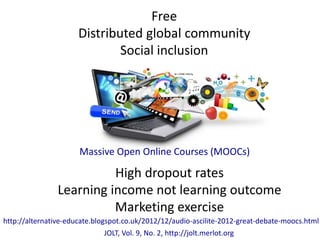
Free 
Distributed global community 
Social inclusion 
Massive Open Online Courses (MOOCs) 
High dropout rates 
Learning income not learning outcome 
Marketing exercise 
http://alternative-educate.blogspot.co.uk/2012/12/audio-ascilite-2012-great-debate-moocs.html 
JOLT, Vol. 9, No. 2, http://jolt.merlot.org
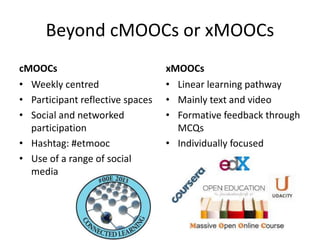
Beyond cMOOCs or xMOOCs 
cMOOCs 
• Weekly centred 
• Participant reflective spaces 
• Social and networked 
participation 
• Hashtag: #etmooc 
• Use of a range of social 
media 
xMOOCs 
• Linear learning pathway 
• Mainly text and video 
• Formative feedback through 
MCQs 
• Individually focused
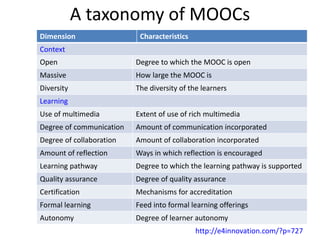
A taxonomy of MOOCs 
Dimension Characteristics 
Context 
Open Degree to which the MOOC is open 
Massive How large the MOOC is 
Diversity The diversity of the learners 
Learning 
Use of multimedia Extent of use of rich multimedia 
Degree of communication Amount of communication incorporated 
Degree of collaboration Amount of collaboration incorporated 
Amount of reflection Ways in which reflection is encouraged 
Learning pathway Degree to which the learning pathway is supported 
Quality assurance Degree of quality assurance 
Certification Mechanisms for accreditation 
Formal learning Feed into formal learning offerings 
Autonomy Degree of learner autonomy 
http://e4innovation.com/?p=727
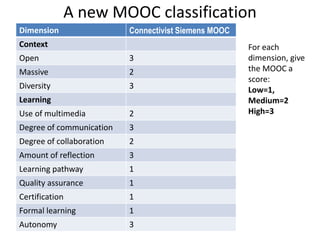
A new MOOC classification 
Dimension Connectivist Siemens MOOC 
Context 
Open 3 
Massive 2 
Diversity 3 
Learning 
Use of multimedia 2 
Degree of communication 3 
Degree of collaboration 2 
Amount of reflection 3 
Learning pathway 1 
Quality assurance 1 
Certification 1 
Formal learning 1 
Autonomy 3 
For each 
dimension, give 
the MOOC a 
score: 
Low=1, 
Medium=2 
High=3
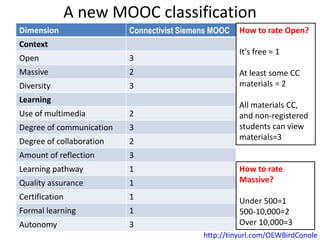
A new MOOC classification 
Dimension Connectivist Siemens MOOC 
Context 
Open 3 
Massive 2 
Diversity 3 
Learning 
Use of multimedia 2 
Degree of communication 3 
Degree of collaboration 2 
Amount of reflection 3 
Learning pathway 1 
Quality assurance 1 
Certification 1 
Formal learning 1 
Autonomy 3 
How to rate Open? 
It’s free = 1 
At least some CC 
materials = 2 
All materials CC, 
and non-registered 
students can view 
materials=3 
How to rate 
Massive? 
Under 500=1 
500-10,000=2 
Over 10,000=3 
http://tinyurl.com/OEWBirdConole
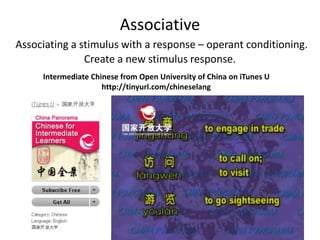
Associative 
Associating a stimulus with a response – operant conditioning. 
Create a new stimulus response. 
Intermediate Chinese from Open University of China on iTunes U 
http://tinyurl.com/chineselang
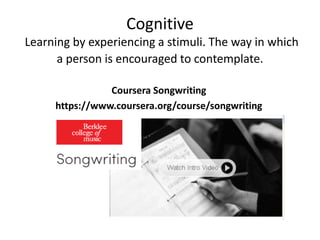
Cognitive 
Learning by experiencing a stimuli. The way in which 
a person is encouraged to contemplate. 
Coursera Songwriting 
https://www.coursera.org/course/songwriting
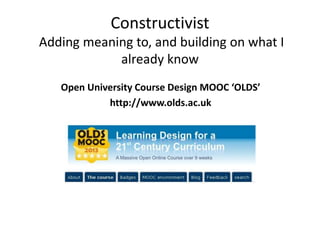
Constructivist 
Adding meaning to, and building on what I 
already know 
Open University Course Design MOOC ‘OLDS’ 
http://www.olds.ac.uk
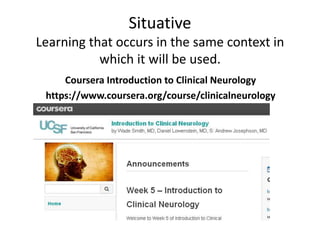
Situative 
Learning that occurs in the same context in 
which it will be used. 
Coursera Introduction to Clinical Neurology 
https://www.coursera.org/course/clinicalneurology
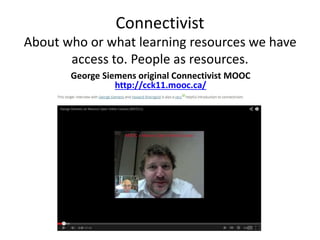
Connectivist 
About who or what learning resources we have 
access to. People as resources. 
George Siemens original Connectivist MOOC 
http://cck11.mooc.ca/
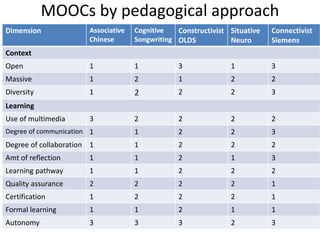
MOOCs by pedagogical approach 
Dimension Associative 
Chinese 
Cognitive 
Songwriting 
Constructivist 
OLDS 
Situative 
Neuro 
Connectivist 
Siemens 
Context 
Open 1 1 3 1 3 
Massive 1 2 1 2 2 
Diversity 1 2 2 2 3 
Learning 
Use of multimedia 3 2 2 2 2 
Degree of communication 1 1 2 2 3 
Degree of collaboration 1 1 2 2 2 
Amt of reflection 1 1 2 1 3 
Learning pathway 1 1 2 2 2 
Quality assurance 2 2 2 2 1 
Certification 1 2 2 2 1 
Formal learning 1 1 2 1 1 
Autonomy 3 3 3 2 3
Related projects 
http://wp.europeanmoocs.eu/ 
http://wikieducator.org/Emundus 
http://vmpass.eu/
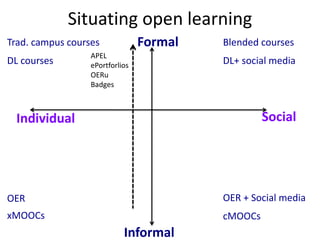
Situating open learning 
Formal 
Individual Social 
Informal 
Blended courses 
DL+ social media 
Trad. campus courses 
DL courses 
OER 
xMOOCs 
OER + Social media 
cMOOCs 
APEL 
ePortforlios 
OERu 
Badges
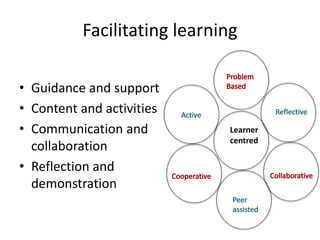
Facilitating learning 
• Guidance and support 
• Content and activities 
• Communication and 
collaboration 
• Reflection and 
demonstration 
Learner 
centred
https://tinyurl.com/hotelproject
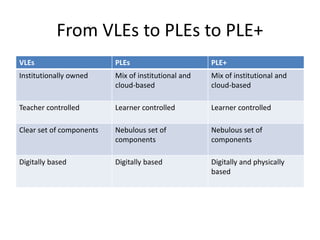
From VLEs to PLEs to PLE+ 
VLEs PLEs PLE+ 
Institutionally owned Mix of institutional and 
cloud-based 
Mix of institutional and 
cloud-based 
Teacher controlled Learner controlled Learner controlled 
Clear set of components Nebulous set of 
components 
Nebulous set of 
components 
Digitally based Digitally based Digitally and physically 
based
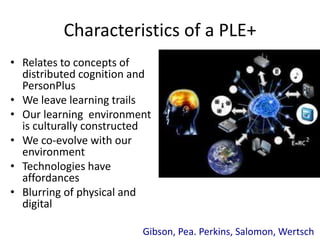
Characteristics of a PLE+ 
• Relates to concepts of 
distributed cognition and 
PersonPlus 
• We leave learning trails 
• Our learning environment 
is culturally constructed 
• We co-evolve with our 
environment 
• Technologies have 
affordances 
• Blurring of physical and 
digital 
Gibson, Pea. Perkins, Salomon, Wertsch
Learning Design 
• To provide guidance and 
support to enable 
practitioners make 
design decisions that are 
pedagogically informed 
and make appropriate 
use of technologies 
• Can also by learners to 
create their PLE+
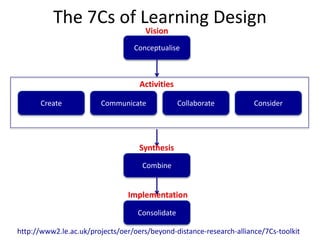
The 7Cs of Learning Design 
Vision 
Conceptualise 
Activities 
Create Communicate Collaborate Consider 
Synthesis 
Combine 
Implementation 
Consolidate 
http://www2.le.ac.uk/projects/oer/oers/beyond-distance-research-alliance/7Cs-toolkit
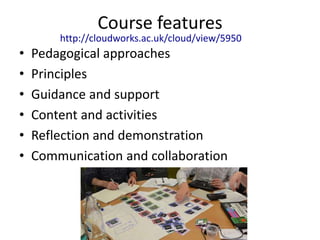
Course features 
http://cloudworks.ac.uk/cloud/view/5950 
• Pedagogical approaches 
• Principles 
• Guidance and support 
• Content and activities 
• Reflection and demonstration 
• Communication and collaboration
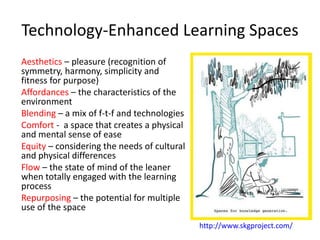
Technology-Enhanced Learning Spaces 
Aesthetics – pleasure (recognition of 
symmetry, harmony, simplicity and 
fitness for purpose) 
Affordances – the characteristics of the 
environment 
Blending – a mix of f-t-f and technologies 
Comfort - a space that creates a physical 
and mental sense of ease 
Equity – considering the needs of cultural 
and physical differences 
Flow – the state of mind of the leaner 
when totally engaged with the learning 
process 
Repurposing – the potential for multiple 
use of the space 
http://www.skgproject.com/
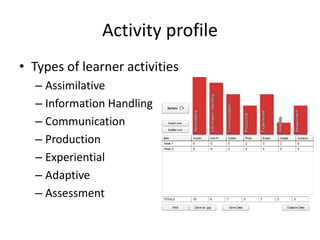
Activity profile 
• Types of learner activities 
– Assimilative 
– Information Handling 
– Communication 
– Production 
– Experiential 
– Adaptive 
– Assessment
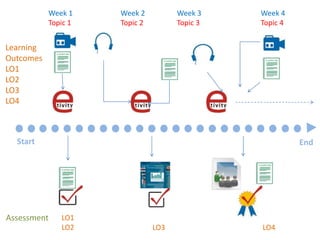
Learning 
Outcomes 
LO1 
LO2 
LO3 
LO4 
Week 1 
Topic 1 
Week 2 
Topic 2 
Week 3 
Topic 3 
Week 4 
Topic 4 
Start End 
Assessment LO1 
LO2 LO3 LO4
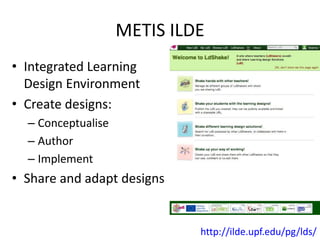
METIS ILDE 
• Integrated Learning 
Design Environment 
• Create designs: 
– Conceptualise 
– Author 
– Implement 
• Share and adapt designs 
http://ilde.upf.edu/pg/lds/
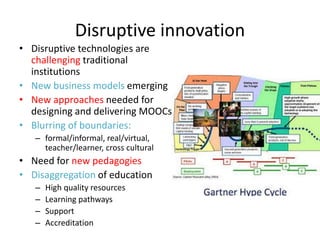
Disruptive innovation 
• Disruptive technologies are 
challenging traditional 
institutions 
• New business models emerging 
• New approaches needed for 
designing and delivering MOOCs 
• Blurring of boundaries: 
– formal/informal, real/virtual, 
teacher/learner, cross cultural 
• Need for new pedagogies 
• Disaggregation of education 
– High quality resources 
– Learning pathways 
– Support 
– Accreditation
http://www.le.ac.uk/ili 
http://www.slideshare.net/GrainneConole 
grainne.conole@le.ac.uk 
http://e4innovation.com 
@gconole

Conole ple kl_final

  • 1.
    National Teaching Fellow2012 EDEN fellow 2013 Ascilite fellow 2012 Disruptive learning – towards PLE+? Gráinne Conole, University of Leicester 27th August 2014 5th International PLE conference, Kuala Lumpur UNITAR International University
  • 3.
    Outline • Disruptiveinnovation • Emergent technologies • Disruptive learning innovations – The flipped classroom – Mobile learning – Open learning • Facilitating learning – From VLEs to PLEs to PLE+ – Characteristics of a PLE+ • The 7Cs of Learning Design
  • 5.
    Disruptive innovation Change Something new Unexpected Christensen Changing mindsets
  • 6.
    Emergent technologies •MOOCs • Badges to accredit learning • Learning analytics • Seamless learning • Crowd learning • Digital scholarship • Geo-learning • Learning from gaming • Maker Culture • Citizen inquiry http://www.open.ac.uk/blogs/innovating/
  • 7.
    A day madeof glass Via Alice Godwin-Davey
  • 8.
    The future ofICT in education
  • 9.
    The Internet ofthings • Objects, animals or people given a unique identifier • Data transferred over the Internet • Examples: – Sensor which tells you when your tyres are flat – Remotely alter a thermostat
  • 10.
    Most connected man • Uses ca. 700 tracking and life logging systems • Lights and music can be altered to change or reflect his mood • Can monitor habits to improve the quality of his life http://mashable.com/2014/08/21/most-connected-man/
  • 11.
    Discussion point •What (if anything) is innovative and/or disruptive about these? • How might they be used in a learning context?
  • 12.
    Discussion Innovative ordisruptive Use in a learning context
  • 13.
  • 14.
    Disruptive learning innovations • The flipped classroom • Mobile learning • Opening up education – OER – MOOCs
  • 15.
    The flipped classroom • Inverting the traditional approach: from lecture-centric to activity-centric • Watch videos in advance • Use classroom to discuss and do activities • More collaborative and problem-based • Increasing importance of mobile learning http://net.educause.edu/ir/library/pdf/eli7081.pdf www.asee.org/file_server/papers/attachment/file/0003/3259/6219.pdf
  • 16.
    Mobile learning Studycalendars E-books Learning resources Online modules Annotation tools Mind mapping tools Communication mechanisms
  • 17.
    From E-Learning toM-Learning • More than just mobile e-learning – Anytime, anywhere for the learner (efficiency) – Enables learning in special location (i.e. fieldwork) • New affordances of mobile – Small and compact – Personal – Capturing sound, video, image – New tech i.e. augmented reality – Wearable tech Peacekeeper student using supplied iPad and course app – Security, Conflict & International Development Masters Distance
  • 18.
    Other Leicester examples One iPad per medical undergraduate: •Paperlessness, Personalised •Anywhere •Medical references and apps for clinical settings Masters of International Education: •Personalised learning environment •Accessibility •iBooks Author to create iBook
  • 19.
    Flexibility and mobility Small, compact size Continue reading, Bookmark Portability Capacity Readability Easy on the eyes Access from a single device without internet Long battery life Photo by Kzeng on Flickr Photo by Yummy Pancake on Flickr Terese Bird
  • 20.
    Open learning •Over ten years of the Open Educational Resource (OER) movement • Hundreds of OER repositories worldwide • Presence on iTunesU • 2012 Times year of the MOOC
  • 21.
    The OPAL metromap Evaluation shows lack of uptake by teachers and learners Shift from development to community building and articulation of OER practice http://www.oer-quality.org/
  • 22.
    POERUP outputs •An inventory of more than 300 OER initiatives http://poerup.referata.com/wiki/Countries_with_OER_initiatives • 11 country reports and 13 mini-reports http://poerup.referata.com/wiki/Countries • 7 in-depth case studies • 3 EU-wide policy papers
  • 23.
    The emergence ofMOOCs • CCK08 – Connectivist MOOC (cMOOC) – Siemens, Downes and Cormier – Evaluation (Fini, 2009)http://www.irrodl.org/index.php/irrodl/article/view/643/1402 • Emergence of large-scale xMOOCs • Recent developments – UK-based FutureLearn – Launch of Massey on Open2Study • List of MOOCs – http://www.mooc-list.com/ • EFQUEL series of blogs – http://mooc.efquel.org/ • ICDE list of MOOC reports – http://tinyurl.com/gconole-MOOC • MOOC research reports – http://www.moocresearch.com/reports • MOOCs for development – http://www.moocs4d.org/media.html
  • 24.
    • Critiques thehype • History of MOOCs • More an interactive textbook than a course • Issue re feedback and assessment • Support models • Issue of support large-scale learning • Degrees of openness http://www.parlorpress.com/invasion_of_the_moocs
  • 26.
    Free Distributed globalcommunity Social inclusion Massive Open Online Courses (MOOCs) High dropout rates Learning income not learning outcome Marketing exercise http://alternative-educate.blogspot.co.uk/2012/12/audio-ascilite-2012-great-debate-moocs.html JOLT, Vol. 9, No. 2, http://jolt.merlot.org
  • 27.
    Beyond cMOOCs orxMOOCs cMOOCs • Weekly centred • Participant reflective spaces • Social and networked participation • Hashtag: #etmooc • Use of a range of social media xMOOCs • Linear learning pathway • Mainly text and video • Formative feedback through MCQs • Individually focused
  • 28.
    A taxonomy ofMOOCs Dimension Characteristics Context Open Degree to which the MOOC is open Massive How large the MOOC is Diversity The diversity of the learners Learning Use of multimedia Extent of use of rich multimedia Degree of communication Amount of communication incorporated Degree of collaboration Amount of collaboration incorporated Amount of reflection Ways in which reflection is encouraged Learning pathway Degree to which the learning pathway is supported Quality assurance Degree of quality assurance Certification Mechanisms for accreditation Formal learning Feed into formal learning offerings Autonomy Degree of learner autonomy http://e4innovation.com/?p=727
  • 29.
    A new MOOCclassification Dimension Connectivist Siemens MOOC Context Open 3 Massive 2 Diversity 3 Learning Use of multimedia 2 Degree of communication 3 Degree of collaboration 2 Amount of reflection 3 Learning pathway 1 Quality assurance 1 Certification 1 Formal learning 1 Autonomy 3 For each dimension, give the MOOC a score: Low=1, Medium=2 High=3
  • 30.
    A new MOOCclassification Dimension Connectivist Siemens MOOC Context Open 3 Massive 2 Diversity 3 Learning Use of multimedia 2 Degree of communication 3 Degree of collaboration 2 Amount of reflection 3 Learning pathway 1 Quality assurance 1 Certification 1 Formal learning 1 Autonomy 3 How to rate Open? It’s free = 1 At least some CC materials = 2 All materials CC, and non-registered students can view materials=3 How to rate Massive? Under 500=1 500-10,000=2 Over 10,000=3 http://tinyurl.com/OEWBirdConole
  • 31.
    Associative Associating astimulus with a response – operant conditioning. Create a new stimulus response. Intermediate Chinese from Open University of China on iTunes U http://tinyurl.com/chineselang
  • 32.
    Cognitive Learning byexperiencing a stimuli. The way in which a person is encouraged to contemplate. Coursera Songwriting https://www.coursera.org/course/songwriting
  • 33.
    Constructivist Adding meaningto, and building on what I already know Open University Course Design MOOC ‘OLDS’ http://www.olds.ac.uk
  • 34.
    Situative Learning thatoccurs in the same context in which it will be used. Coursera Introduction to Clinical Neurology https://www.coursera.org/course/clinicalneurology
  • 35.
    Connectivist About whoor what learning resources we have access to. People as resources. George Siemens original Connectivist MOOC http://cck11.mooc.ca/
  • 36.
    MOOCs by pedagogicalapproach Dimension Associative Chinese Cognitive Songwriting Constructivist OLDS Situative Neuro Connectivist Siemens Context Open 1 1 3 1 3 Massive 1 2 1 2 2 Diversity 1 2 2 2 3 Learning Use of multimedia 3 2 2 2 2 Degree of communication 1 1 2 2 3 Degree of collaboration 1 1 2 2 2 Amt of reflection 1 1 2 1 3 Learning pathway 1 1 2 2 2 Quality assurance 2 2 2 2 1 Certification 1 2 2 2 1 Formal learning 1 1 2 1 1 Autonomy 3 3 3 2 3
  • 37.
    Related projects http://wp.europeanmoocs.eu/ http://wikieducator.org/Emundus http://vmpass.eu/
  • 38.
    Situating open learning Formal Individual Social Informal Blended courses DL+ social media Trad. campus courses DL courses OER xMOOCs OER + Social media cMOOCs APEL ePortforlios OERu Badges
  • 39.
    Facilitating learning •Guidance and support • Content and activities • Communication and collaboration • Reflection and demonstration Learner centred
  • 40.
  • 41.
    From VLEs toPLEs to PLE+ VLEs PLEs PLE+ Institutionally owned Mix of institutional and cloud-based Mix of institutional and cloud-based Teacher controlled Learner controlled Learner controlled Clear set of components Nebulous set of components Nebulous set of components Digitally based Digitally based Digitally and physically based
  • 42.
    Characteristics of aPLE+ • Relates to concepts of distributed cognition and PersonPlus • We leave learning trails • Our learning environment is culturally constructed • We co-evolve with our environment • Technologies have affordances • Blurring of physical and digital Gibson, Pea. Perkins, Salomon, Wertsch
  • 43.
    Learning Design •To provide guidance and support to enable practitioners make design decisions that are pedagogically informed and make appropriate use of technologies • Can also by learners to create their PLE+
  • 44.
    The 7Cs ofLearning Design Vision Conceptualise Activities Create Communicate Collaborate Consider Synthesis Combine Implementation Consolidate http://www2.le.ac.uk/projects/oer/oers/beyond-distance-research-alliance/7Cs-toolkit
  • 45.
    Course features http://cloudworks.ac.uk/cloud/view/5950 • Pedagogical approaches • Principles • Guidance and support • Content and activities • Reflection and demonstration • Communication and collaboration
  • 46.
    Technology-Enhanced Learning Spaces Aesthetics – pleasure (recognition of symmetry, harmony, simplicity and fitness for purpose) Affordances – the characteristics of the environment Blending – a mix of f-t-f and technologies Comfort - a space that creates a physical and mental sense of ease Equity – considering the needs of cultural and physical differences Flow – the state of mind of the leaner when totally engaged with the learning process Repurposing – the potential for multiple use of the space http://www.skgproject.com/
  • 47.
    Activity profile •Types of learner activities – Assimilative – Information Handling – Communication – Production – Experiential – Adaptive – Assessment
  • 48.
    Learning Outcomes LO1 LO2 LO3 LO4 Week 1 Topic 1 Week 2 Topic 2 Week 3 Topic 3 Week 4 Topic 4 Start End Assessment LO1 LO2 LO3 LO4
  • 49.
    METIS ILDE •Integrated Learning Design Environment • Create designs: – Conceptualise – Author – Implement • Share and adapt designs http://ilde.upf.edu/pg/lds/
  • 50.
    Disruptive innovation •Disruptive technologies are challenging traditional institutions • New business models emerging • New approaches needed for designing and delivering MOOCs • Blurring of boundaries: – formal/informal, real/virtual, teacher/learner, cross cultural • Need for new pedagogies • Disaggregation of education – High quality resources – Learning pathways – Support – Accreditation
  • 51.

Editor's Notes