Damped Oscillation
Recall: Oscillation is “one complete back-and-forth motion”
Damped oscillations are oscillations with 𝐹𝐷 (drag force) acting on the system
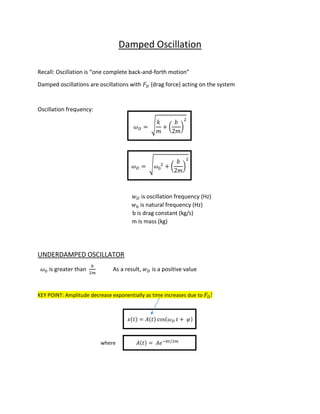
Oscillation frequency:
𝜔 𝐷 = √
𝑘
𝑚
+ (
𝑏
2𝑚
)
2
𝜔 𝐷 = √ 𝜔0
2
+ (
𝑏
2𝑚
)
2
𝑤 𝐷 is oscillation frequency (Hz)
𝑤0 is natural frequency (Hz)
b is drag constant (kg/s)
m is mass (kg)
UNDERDAMPED OSCILLATOR
𝜔0 is greater than
𝑏
2𝑚
As a result, 𝑤 𝐷 is a positive value
KEY POINT: Amplitude decrease exponentially as time increases due to 𝐹𝐷!
𝑥(𝑡) = 𝐴(𝑡) cos(𝜔 𝐷 𝑡 + 𝜑)
where 𝐴(𝑡) = 𝐴𝑒−𝑏𝑡/2𝑚
𝑥(𝑡) = 𝐴𝑒−𝑏𝑡/2𝑚
cos(𝜔 𝐷 𝑡 + 𝜑)
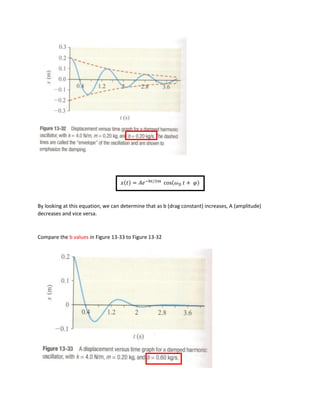
By looking at this equation, we can determine that as b (drag constant) increases, A (amplitude)
decreases and vice versa.
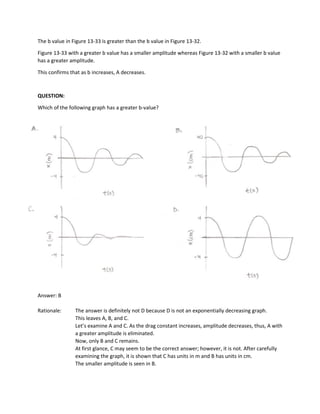
Compare the b values in Figure 13-33 to Figure 13-32
The b value in Figure 13-33 is greater than the b value in Figure 13-32.
Figure 13-33 with a greater b value has a smaller amplitude whereas Figure 13-32 with a smaller b value
has a greater amplitude.
This confirms that as b increases, A decreases.
QUESTION:
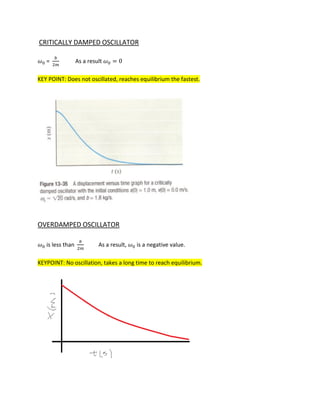
Which of the following graph has a greater b-value?
Answer: B
Rationale: The answer is definitely not D because D is not an exponentially decreasing graph.
This leaves A, B, and C.
Let’s examine A and C. As the drag constant increases, amplitude decreases, thus, A with
a greater amplitude is eliminated.
Now, only B and C remains.
At first glance, C may seem to be the correct answer; however, it is not. After carefully
examining the graph, it is shown that C has units in m and B has units in cm.
The smaller amplitude is seen in B.
CRITICALLY DAMPED OSCILLATOR
𝜔0 =
𝑏
2𝑚
As a result 𝜔0 = 0
KEY POINT: Does not oscillated, reaches equilibrium the fastest.
OVERDAMPED OSCILLATOR
𝜔0 is less than
𝑏
2𝑚
As a result, 𝜔0 is a negative value.
KEYPOINT: No oscillation, takes a long time to reach equilibrium.
Citation
Hawkes et al., (2015). Physics for Scientists and Engineers: An Interactive Approach. Toronto: Nelson
Education Ltd.

Learning object 2 (parly tan)

  • 1.
    Damped Oscillation Recall: Oscillationis “one complete back-and-forth motion” Damped oscillations are oscillations with 𝐹𝐷 (drag force) acting on the system Oscillation frequency: 𝜔 𝐷 = √ 𝑘 𝑚 + ( 𝑏 2𝑚 ) 2 𝜔 𝐷 = √ 𝜔0 2 + ( 𝑏 2𝑚 ) 2 𝑤 𝐷 is oscillation frequency (Hz) 𝑤0 is natural frequency (Hz) b is drag constant (kg/s) m is mass (kg) UNDERDAMPED OSCILLATOR 𝜔0 is greater than 𝑏 2𝑚 As a result, 𝑤 𝐷 is a positive value KEY POINT: Amplitude decrease exponentially as time increases due to 𝐹𝐷! 𝑥(𝑡) = 𝐴(𝑡) cos(𝜔 𝐷 𝑡 + 𝜑) where 𝐴(𝑡) = 𝐴𝑒−𝑏𝑡/2𝑚
  • 2.
    𝑥(𝑡) = 𝐴𝑒−𝑏𝑡/2𝑚 cos(𝜔𝐷 𝑡 + 𝜑) By looking at this equation, we can determine that as b (drag constant) increases, A (amplitude) decreases and vice versa. Compare the b values in Figure 13-33 to Figure 13-32
  • 3.
    The b valuein Figure 13-33 is greater than the b value in Figure 13-32. Figure 13-33 with a greater b value has a smaller amplitude whereas Figure 13-32 with a smaller b value has a greater amplitude. This confirms that as b increases, A decreases. QUESTION: Which of the following graph has a greater b-value? Answer: B Rationale: The answer is definitely not D because D is not an exponentially decreasing graph. This leaves A, B, and C. Let’s examine A and C. As the drag constant increases, amplitude decreases, thus, A with a greater amplitude is eliminated. Now, only B and C remains. At first glance, C may seem to be the correct answer; however, it is not. After carefully examining the graph, it is shown that C has units in m and B has units in cm. The smaller amplitude is seen in B.
  • 4.
    CRITICALLY DAMPED OSCILLATOR 𝜔0= 𝑏 2𝑚 As a result 𝜔0 = 0 KEY POINT: Does not oscillated, reaches equilibrium the fastest. OVERDAMPED OSCILLATOR 𝜔0 is less than 𝑏 2𝑚 As a result, 𝜔0 is a negative value. KEYPOINT: No oscillation, takes a long time to reach equilibrium.
  • 5.
    Citation Hawkes et al.,(2015). Physics for Scientists and Engineers: An Interactive Approach. Toronto: Nelson Education Ltd.