Lecture 7: Topicsto be Covered
1. Damped Harmonic Motion
2. Equation of Damped Harmonic Motion
3.
Up to thispoint we have assumed that no frictional forces act on the oscillator. If this
assumption held strictly, a pendulum or a mass on a spring would oscillate indefinitely
with a constant mechanical energy (that is, with no loss in the amplitude of the
oscillation).
Damped Harmonic Motion
This loss in amplitude is called damping and the motion is called damped harmonic
motion. There are many causes of damping, including friction, air resistance, and
internal forces.
Since we observe a loss in amplitude for real oscillators, we know that this assumption is
not strictly true, although it may be a good approximation for some oscillators.
4.
Damped Harmonic Motion
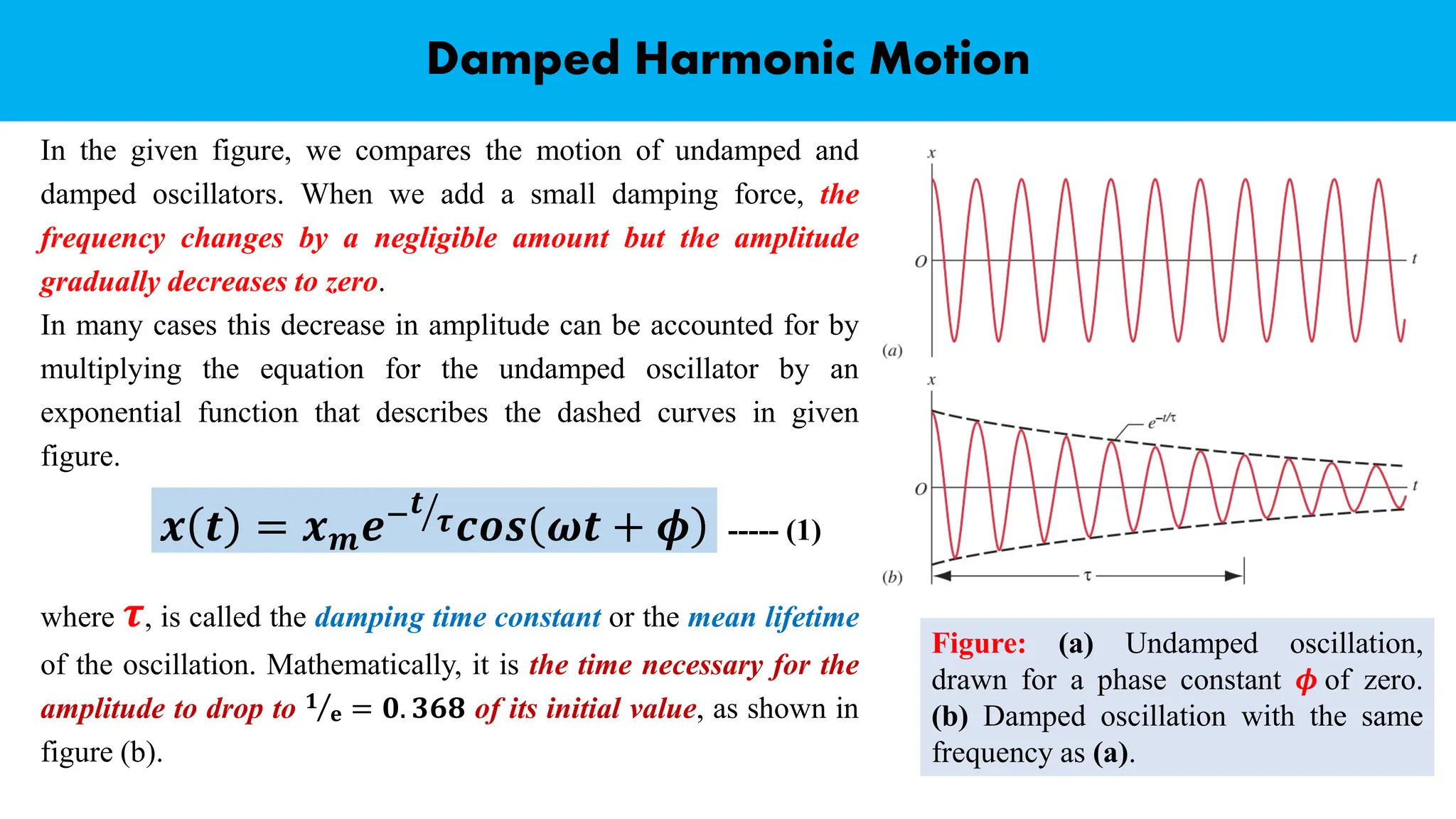
Inthe given figure, we compares the motion of undamped and
damped oscillators. When we add a small damping force, the
frequency changes by a negligible amount but the amplitude
gradually decreases to zero.
In many cases this decrease in amplitude can be accounted for by
multiplying the equation for the undamped oscillator by an
exponential function that describes the dashed curves in given
figure.
where 𝝉, is called the damping time constant or the mean lifetime
of the oscillation. Mathematically, it is the time necessary for the
amplitude to drop to Τ
𝟏
𝐞 = 𝟎. 𝟑𝟔𝟖 of its initial value, as shown in
figure (b).
𝒙 𝒕 = 𝒙𝒎𝒆− ൗ
𝒕
𝝉𝒄𝒐𝒔 𝝎𝒕 + 𝝓 ----- (1)
Figure: (a) Undamped oscillation,
drawn for a phase constant 𝝓 of zero.
(b) Damped oscillation with the same
frequency as (a).
5.
Damped Harmonic Motion
Tosolve the equation of motion of this system, we have
𝑭𝒙 = 𝒎𝒂 = −𝒌𝒙 − 𝒃𝒗
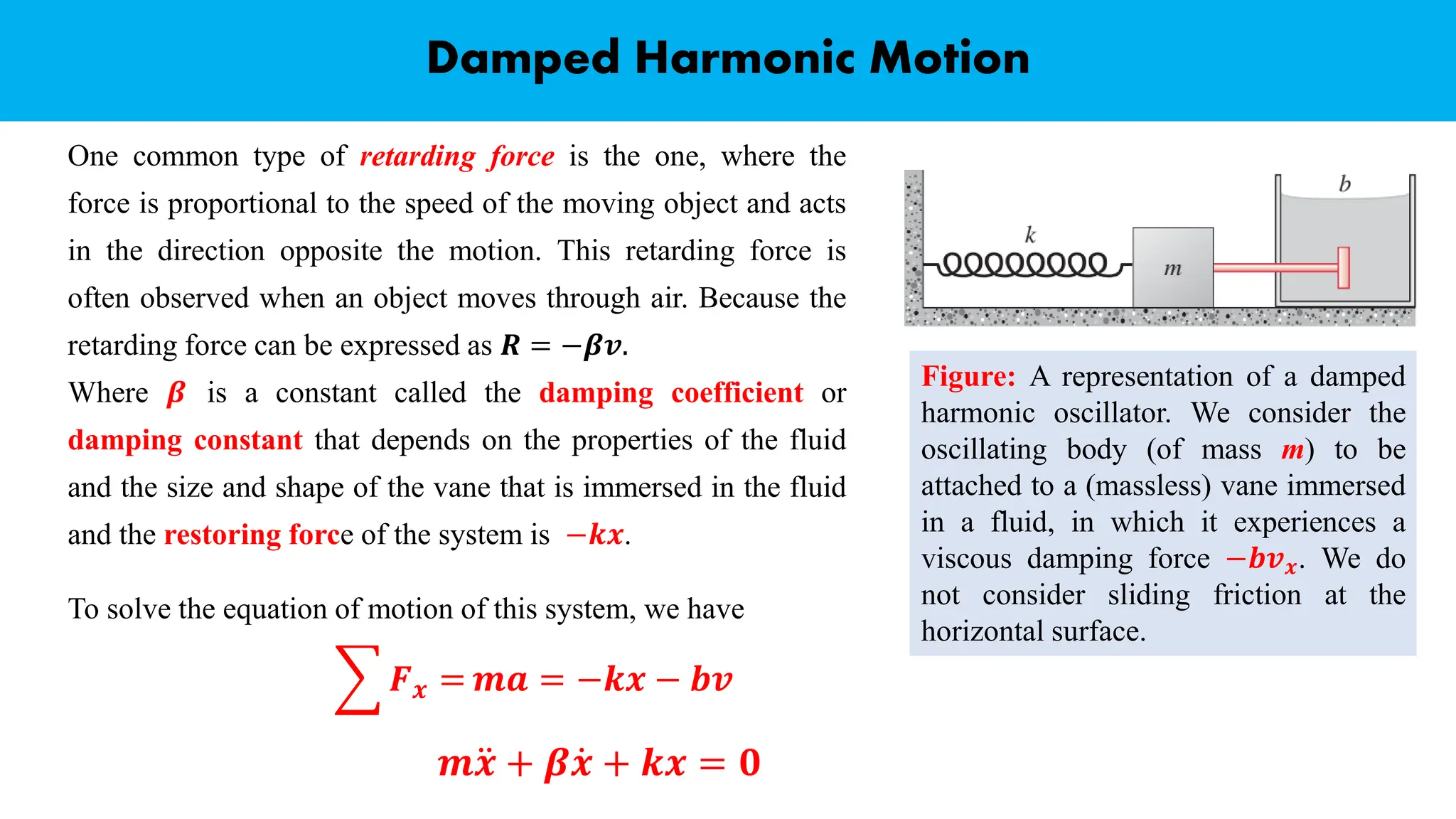
Figure: A representation of a damped
harmonic oscillator. We consider the
oscillating body (of mass m) to be
attached to a (massless) vane immersed
in a fluid, in which it experiences a
viscous damping force −𝒃𝒗𝒙. We do
not consider sliding friction at the
horizontal surface.
One common type of retarding force is the one, where the
force is proportional to the speed of the moving object and acts
in the direction opposite the motion. This retarding force is
often observed when an object moves through air. Because the
retarding force can be expressed as 𝑹 = −𝜷𝒗.
Where 𝜷 is a constant called the damping coefficient or
damping constant that depends on the properties of the fluid
and the size and shape of the vane that is immersed in the fluid
and the restoring force of the system is −𝒌𝒙.
𝒎 ሷ
𝒙 + 𝜷 ሶ
𝒙 + 𝒌𝒙 = 𝟎
Solution of DampedHarmonic Oscillator Equation
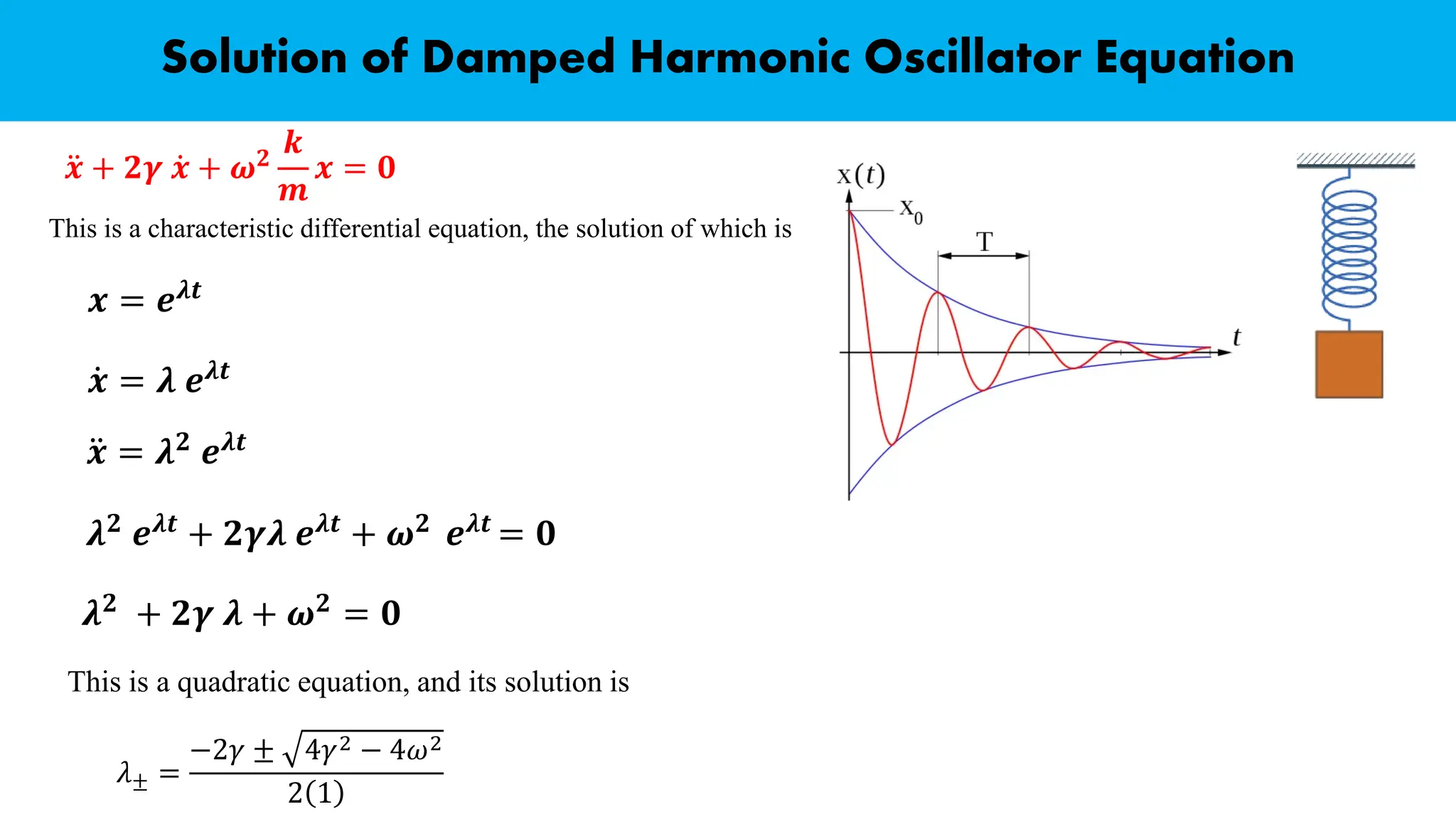
This is a characteristic differential equation, the solution of which is
ሷ
𝒙 + 𝟐𝜸 ሶ
𝒙 + 𝝎𝟐
𝒌
𝒎
𝒙 = 𝟎
𝒙 = 𝒆𝝀𝒕
ሶ
𝒙 = 𝝀 𝒆𝝀𝒕
ሷ
𝒙 = 𝝀𝟐
𝒆𝝀𝒕
𝝀𝟐 𝒆𝝀𝒕 + 𝟐𝜸𝝀 𝒆𝝀𝒕 + 𝝎𝟐 𝒆𝝀𝒕 = 𝟎
𝝀𝟐 + 𝟐𝜸 𝝀 + 𝝎𝟐 = 𝟎
This is a quadratic equation, and its solution is
𝜆± =
−2𝛾 ± 4𝛾2 − 4𝜔2
2 1
8.
Solution of DampedHarmonic Oscillator Equation
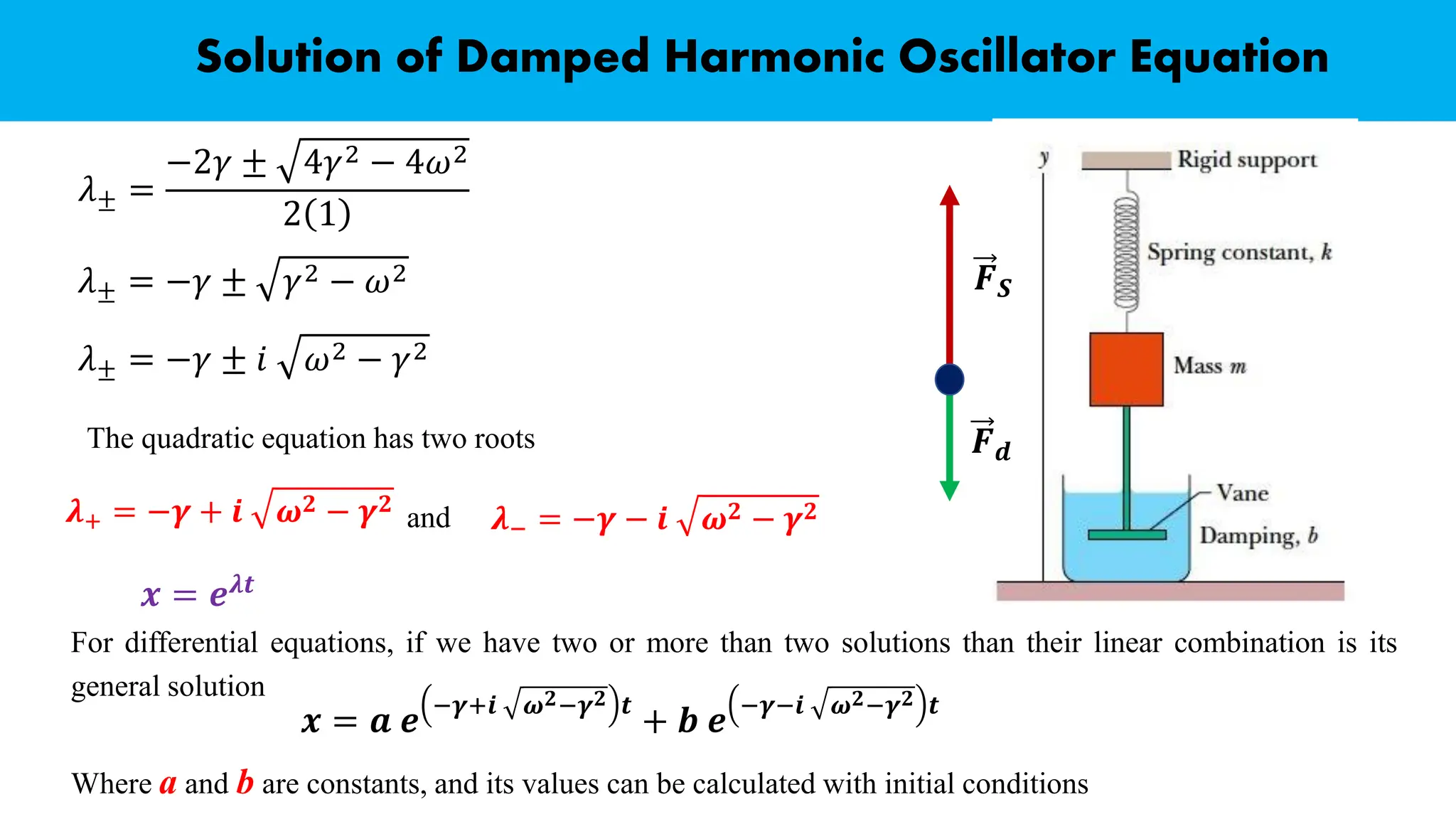
The quadratic equation has two roots
𝜆± =
−2𝛾 ± 4𝛾2 − 4𝜔2
2 1
𝜆± = −𝛾 ± 𝛾2 − 𝜔2
𝜆± = −𝛾 ± 𝑖 𝜔2 − 𝛾2
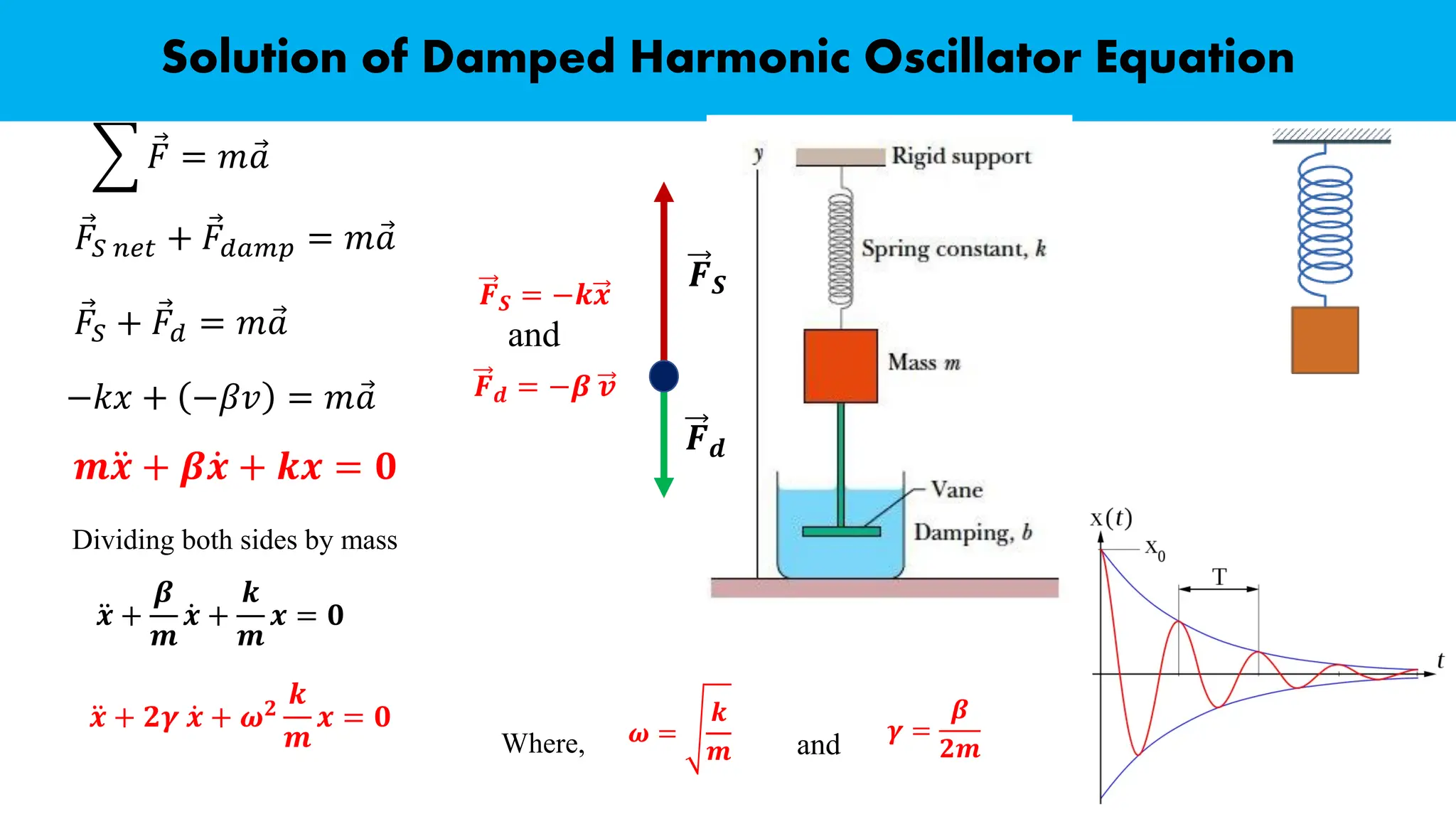
𝑭𝒅
𝑭𝑺
𝝀+ = −𝜸 + 𝒊 𝝎𝟐 − 𝜸𝟐
𝝀− = −𝜸 − 𝒊 𝝎𝟐 − 𝜸𝟐
and
For differential equations, if we have two or more than two solutions than their linear combination is its
general solution
𝒙 = 𝒆𝝀𝒕
𝒙 = 𝒂 𝒆
−𝜸+𝒊 𝝎𝟐−𝜸𝟐 𝒕
+ 𝒃 𝒆
−𝜸−𝒊 𝝎𝟐−𝜸𝟐 𝒕
Where a and b are constants, and its values can be calculated with initial conditions
9.
Solution of DampedHarmonic Oscillator Equation
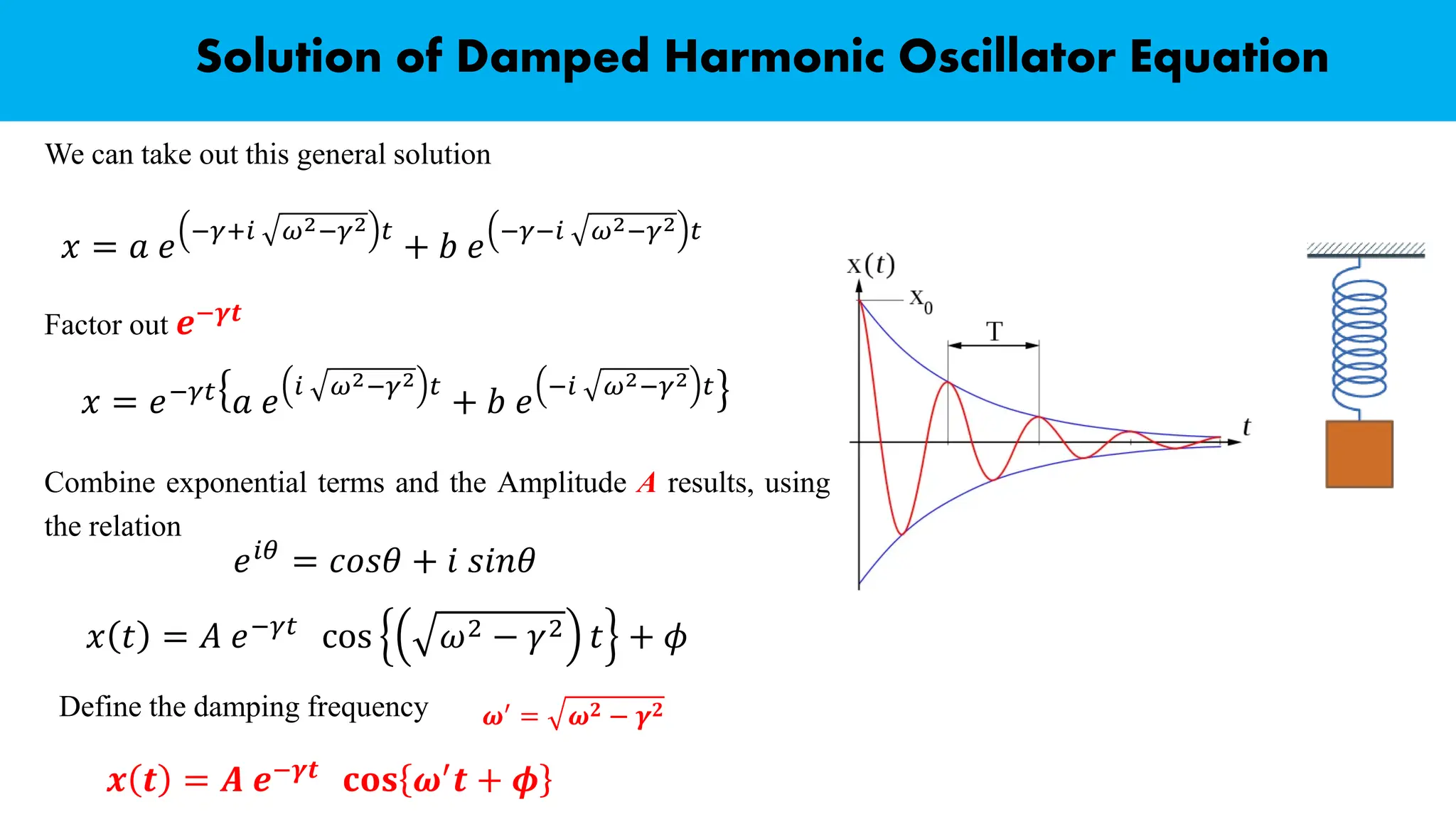
We can take out this general solution
𝑥 = 𝑎 𝑒
−𝛾+𝑖 𝜔2−𝛾2 𝑡
+ 𝑏 𝑒
−𝛾−𝑖 𝜔2−𝛾2 𝑡
Define the damping frequency
Factor out 𝒆−𝜸𝒕
𝑥 = 𝑒−𝛾𝑡
𝑎 𝑒
𝑖 𝜔2−𝛾2 𝑡
+ 𝑏 𝑒
−𝑖 𝜔2−𝛾2 𝑡
Combine exponential terms and the Amplitude A results, using
the relation
𝑒𝑖𝜃 = 𝑐𝑜𝑠𝜃 + 𝑖 𝑠𝑖𝑛𝜃
𝑥 𝑡 = 𝐴 𝑒−𝛾𝑡 cos 𝜔2 − 𝛾2 𝑡 + 𝜙
𝝎′
= 𝝎𝟐 − 𝜸𝟐
𝒙 𝒕 = 𝑨 𝒆−𝜸𝒕
𝐜𝐨𝐬 𝝎′
𝒕 + 𝝓
10.
Damped Harmonic Motion
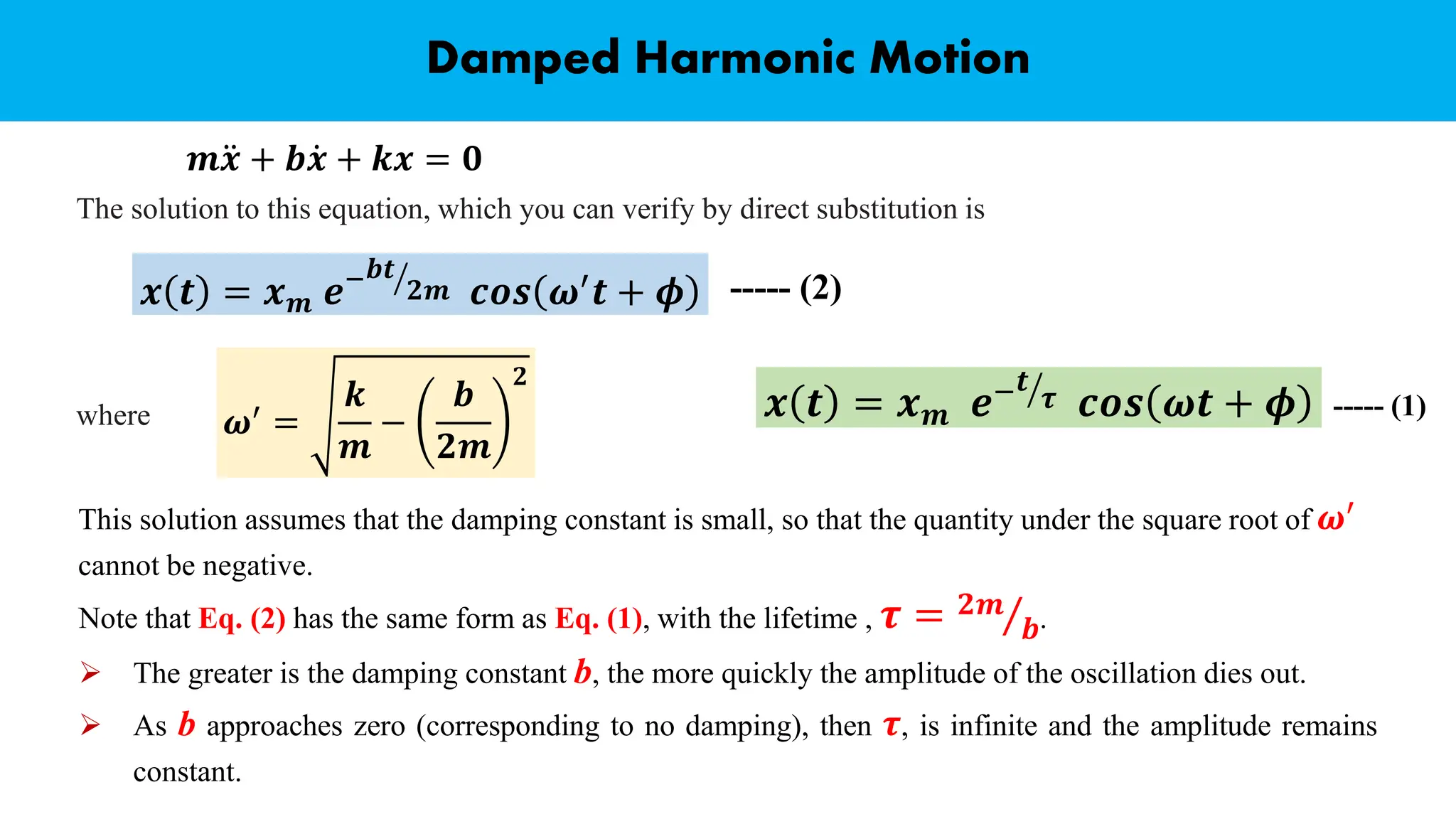
Thesolution to this equation, which you can verify by direct substitution is
𝒎 ሷ
𝒙 + 𝒃 ሶ
𝒙 + 𝒌𝒙 = 𝟎
𝒙 𝒕 = 𝒙𝒎 𝒆− ൗ
𝒃𝒕
𝟐𝒎 𝒄𝒐𝒔 𝝎′
𝒕 + 𝝓
where 𝝎′ =
𝒌
𝒎
−
𝒃
𝟐𝒎
𝟐
This solution assumes that the damping constant is small, so that the quantity under the square root of 𝝎′
cannot be negative.
----- (2)
𝒙 𝒕 = 𝒙𝒎 𝒆− ൗ
𝒕
𝝉 𝒄𝒐𝒔 𝝎𝒕 + 𝝓 ----- (1)
Note that Eq. (2) has the same form as Eq. (1), with the lifetime , 𝝉 = Τ
𝟐𝒎
𝒃.
➢ The greater is the damping constant b, the more quickly the amplitude of the oscillation dies out.
➢ As b approaches zero (corresponding to no damping), then 𝝉, is infinite and the amplitude remains
constant.
11.
When damping ispresent, the oscillation frequency is smaller (the period is larger). That is, damping slows
down the motion, as we might expect.
If 𝒃 = 𝟎 (no damping, then 𝝎′ =
𝒌
𝒎
, which is simply the angular frequency 𝝎𝒐 of the undamped motion.
Damped Harmonic Motion
When damping is present, 𝝎′ is slightly less than 𝝎𝒐, but in most cases of interest, the damping is sufficiently
weak that 𝝎′
≈ 𝝎𝒐.
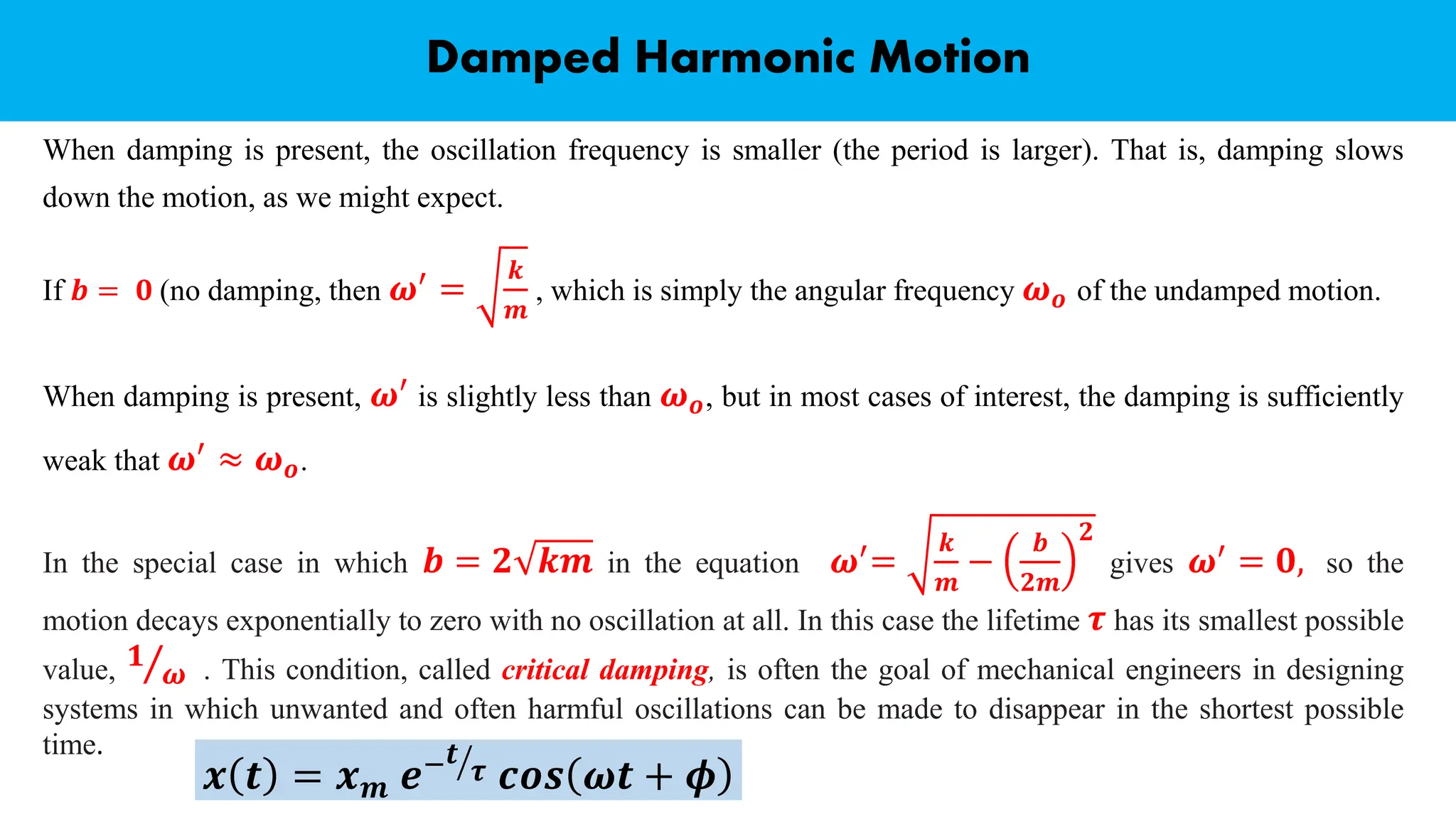
In the special case in which 𝒃 = 𝟐 𝒌𝒎 in the equation 𝝎′=
𝒌
𝒎
−
𝒃
𝟐𝒎
𝟐
gives 𝝎′ = 𝟎, so the
motion decays exponentially to zero with no oscillation at all. In this case the lifetime 𝝉 has its smallest possible
value, Τ
𝟏
𝝎 . This condition, called critical damping, is often the goal of mechanical engineers in designing
systems in which unwanted and often harmful oscillations can be made to disappear in the shortest possible
time.
𝒙 𝒕 = 𝒙𝒎 𝒆− ൗ
𝒕
𝝉 𝒄𝒐𝒔 𝝎𝒕 + 𝝓
12.
Damped Harmonic Motion
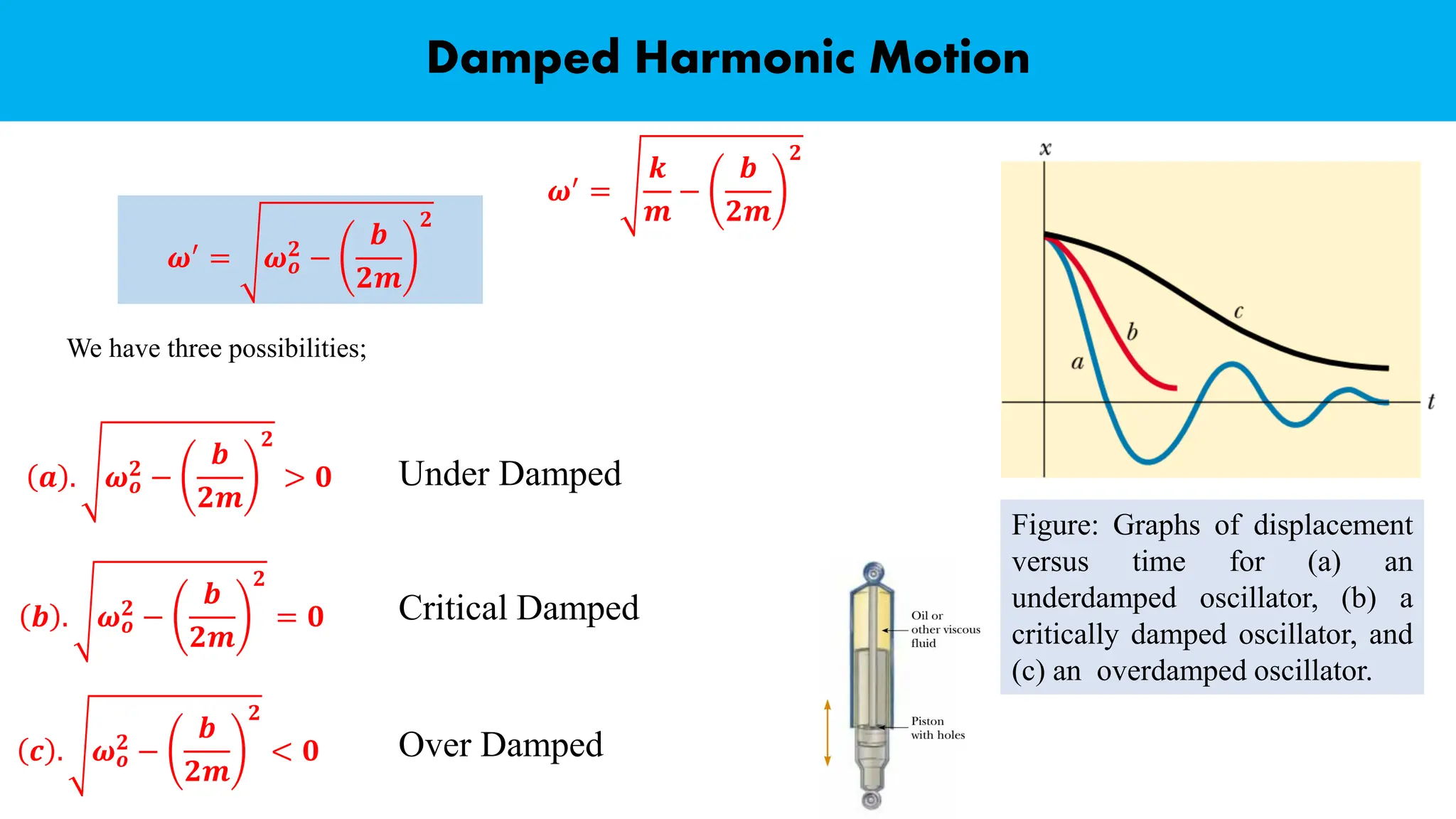
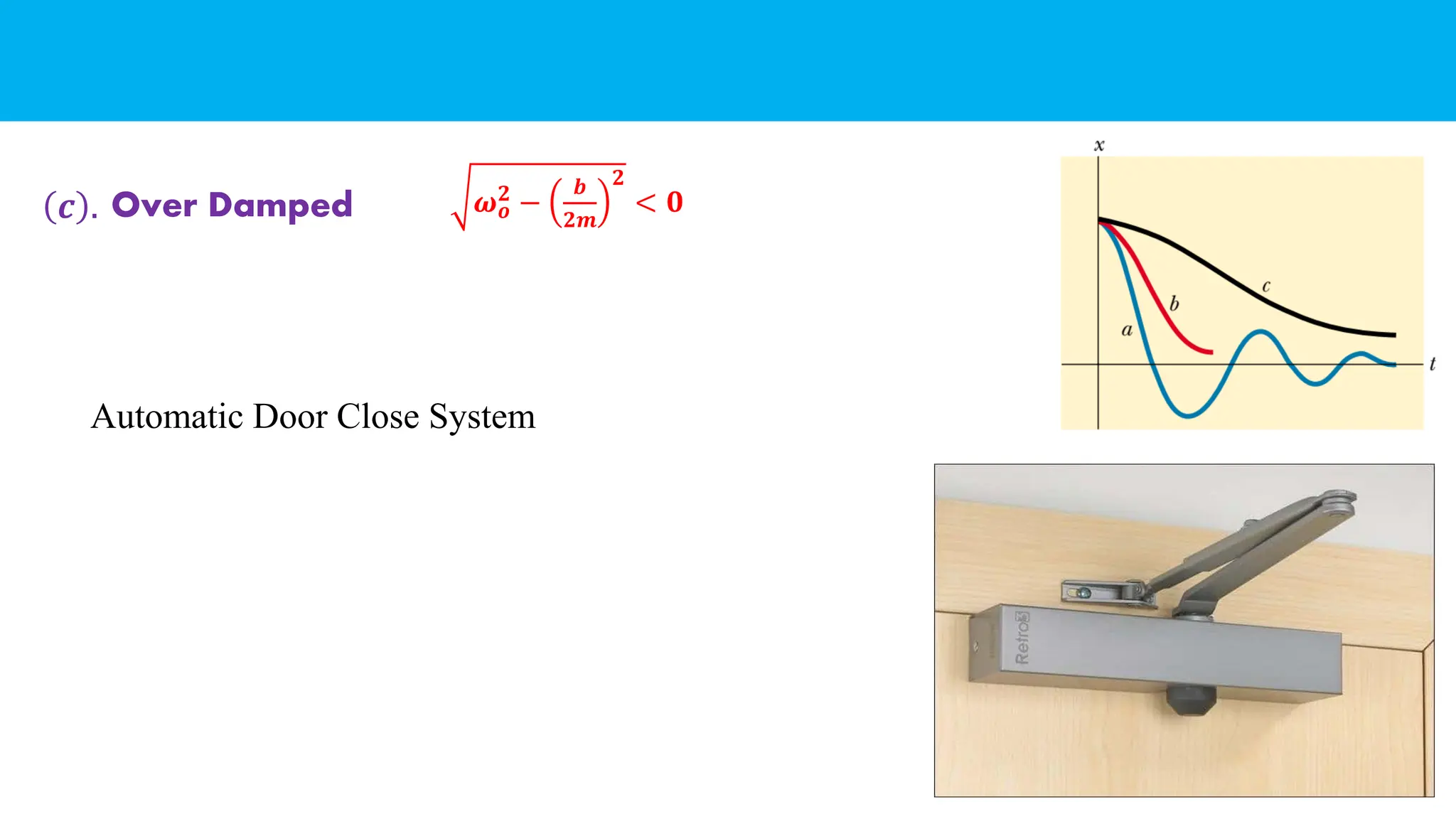
Figure:Graphs of displacement
versus time for (a) an
underdamped oscillator, (b) a
critically damped oscillator, and
(c) an overdamped oscillator.
𝝎′
=
𝒌
𝒎
−
𝒃
𝟐𝒎
𝟐
𝝎′ = 𝝎𝒐
𝟐 −
𝒃
𝟐𝒎
𝟐
We have three possibilities;
𝒄 . 𝝎𝒐
𝟐 −
𝒃
𝟐𝒎
𝟐
< 𝟎
𝒂 . 𝝎𝒐
𝟐 −
𝒃
𝟐𝒎
𝟐
> 𝟎
𝒃 . 𝝎𝒐
𝟐
−
𝒃
𝟐𝒎
𝟐
= 𝟎 Critical Damped
Over Damped
Under Damped
13.
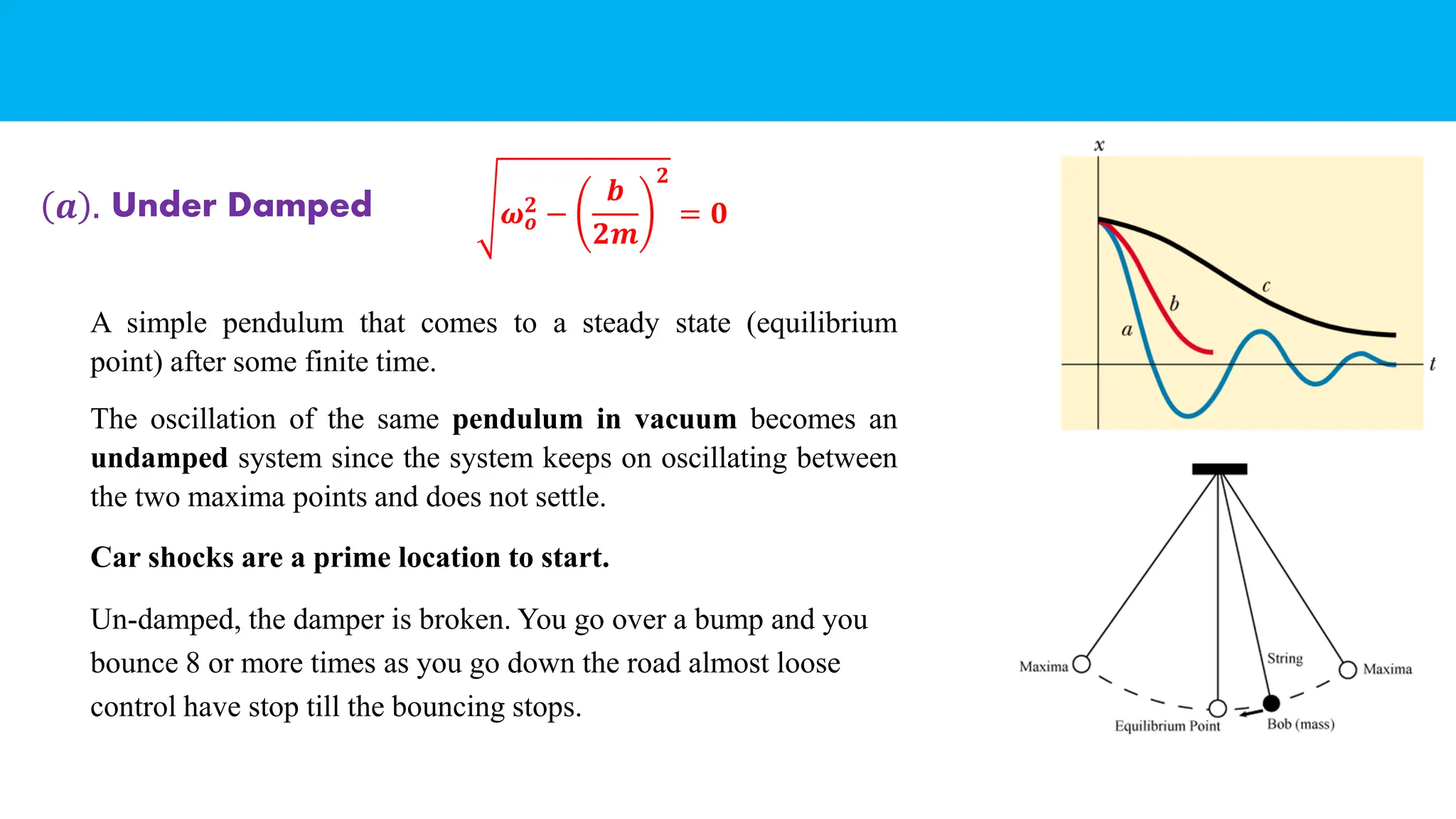
A simple pendulumthat comes to a steady state (equilibrium
point) after some finite time.
The oscillation of the same pendulum in vacuum becomes an
undamped system since the system keeps on oscillating between
the two maxima points and does not settle.
Car shocks are a prime location to start.
Un-damped, the damper is broken. You go over a bump and you
bounce 8 or more times as you go down the road almost loose
control have stop till the bouncing stops.
𝝎𝒐
𝟐
−
𝒃
𝟐𝒎
𝟐
= 𝟎
Under Damped
𝒂 .
14.
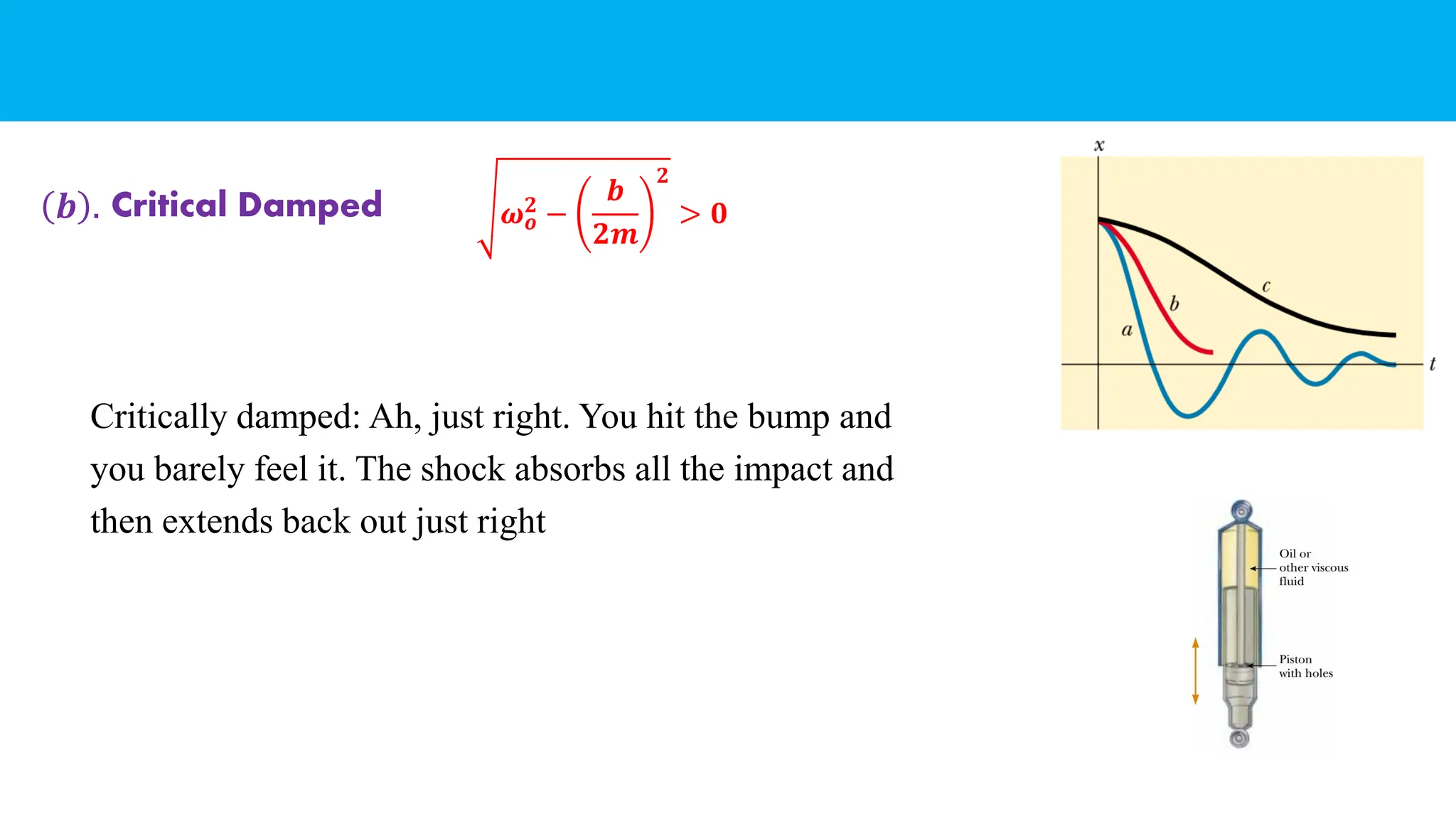
Critically damped: Ah,just right. You hit the bump and
you barely feel it. The shock absorbs all the impact and
then extends back out just right
𝝎𝒐
𝟐
−
𝒃
𝟐𝒎
𝟐
> 𝟎
Critical Damped
𝒃 .