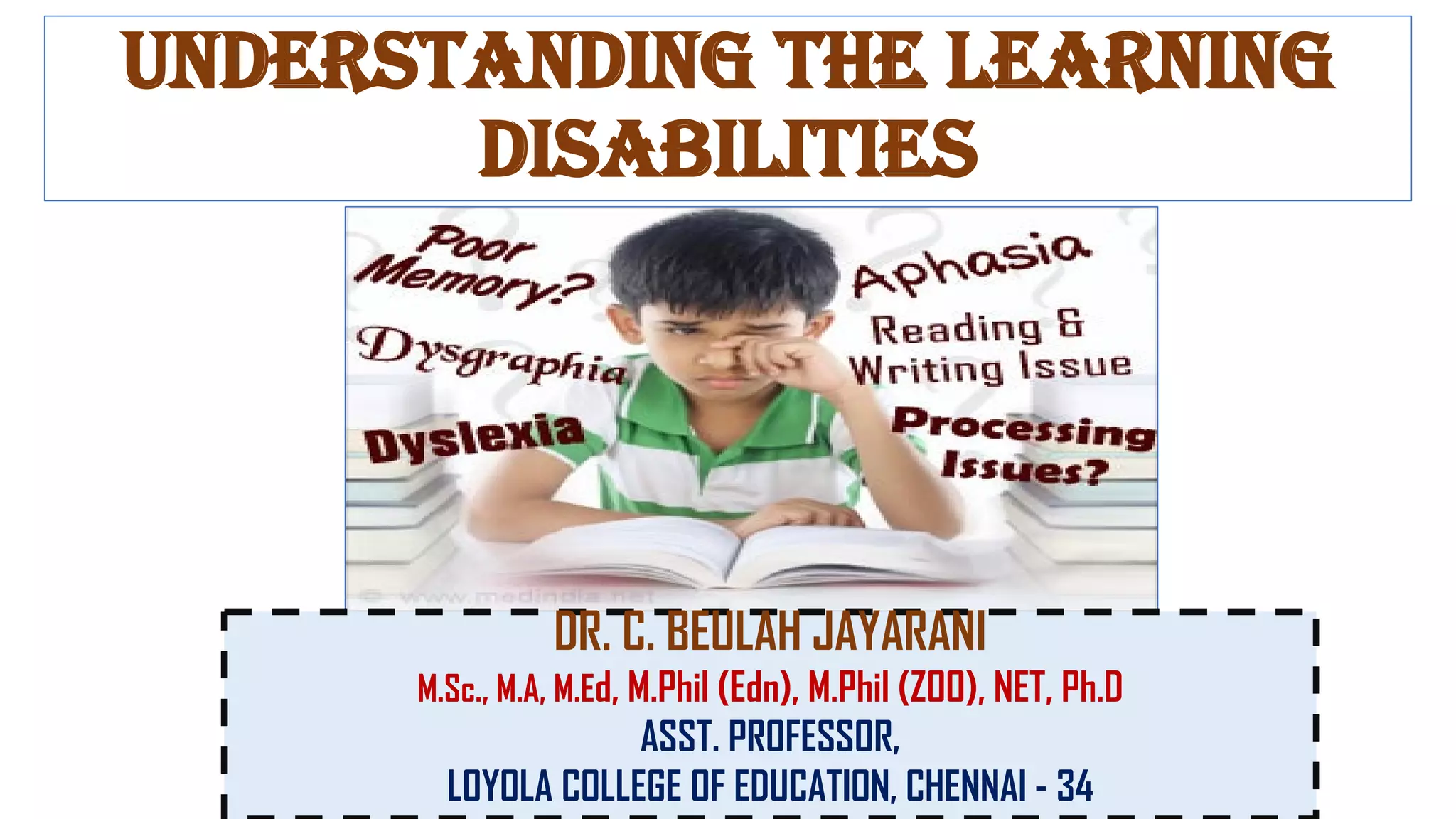
Understanding the learning
disabilities
DR. C. BEULAH JAYARANI
M.Sc., M.A, M.Ed, M.Phil (Edn), M.Phil (ZOO), NET, Ph.D
ASST. PROFESSOR,
LOYOLA COLLEGE OF EDUCATION, CHENNAI - 34
Unit II Understanding the learning disabilities
Meaning and definition of learning disabilities - Kinds of learning disabilities:
dyslexia, dyscalculia, dysgraphia, dyspraxia - Approaches to identifying children
with disabilities: Cognitive approach, sensory approach, disability-based approach,
society-based approach - Role of teachers in managing students with learning
disabilities.(Suggested instructional approaches and methods:
i) Invited talk by expert(s) /talk by teacher(s) on the different learning kinds of
disabilities.
ii) Student seminar on the importance and means of identifying the
learning disabilities of students.)
14-04-2022 Dr. C. BEULAH JAYARANI 2
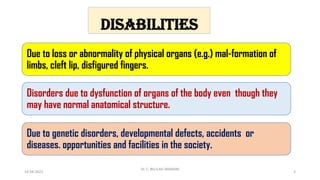
Disabilities
Due to loss or abnormality of physical organs (e.g.) mal-formation of
limbs, cleft lip, disfigured fingers.
Disorders due to dysfunction of organs of the body even though they
may have normal anatomical structure.
Due to genetic disorders, developmental defects, accidents or
diseases. opportunities and facilities in the society.
Dr. C. BEULAH JAYARANI
14-04-2022 3
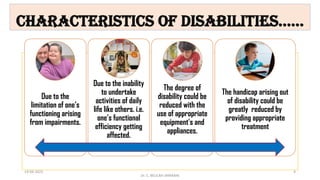
Characteristics of Disabilities……
Due to the
limitation of one’s
functioning arising
from impairments.
Due to the inability
to undertake
activities of daily
life like others. i.e.
one’s functional
efficiency getting
affected.
The degree of
disability could be
reduced with the
use of appropriate
equipment's and
appliances.
The handicap arising out
of disability could be
greatly reduced by
providing appropriate
treatment
Dr. C. BEULAH JAYARANI
14-04-2022 4
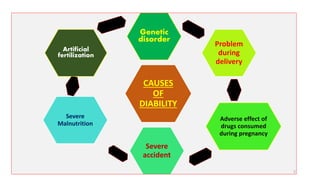
CAUSES
OF
DIABILITY
Genetic
disorder
Problem
during
delivery
Adverse effect of
drugs consumed
during pregnancy
Severe
accident
Severe
Malnutrition
Artificial
fertilization
5
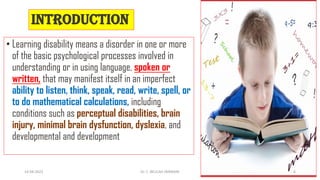
INTRODUCTION
• Learning disability means a disorder in one or more
of the basic psychological processes involved in
understanding or in using language, spoken or
written, that may manifest itself in an imperfect
ability to listen, think, speak, read, write, spell, or
to do mathematical calculations, including
conditions such as perceptual disabilities, brain
injury, minimal brain dysfunction, dyslexia, and
developmental and development
14-04-2022 Dr. C. BEULAH JAYARANI 6
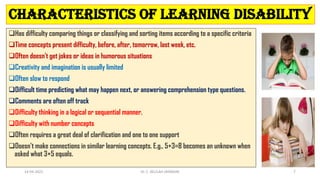
Characteristics of Learning Disability
Has difficulty comparing things or classifying and sorting items according to a specific criteria
Time concepts present difficulty, before, after, tomorrow, last week, etc.
Often doesn't get jokes or ideas in humorous situations
Creativity and imagination is usually limited
Often slow to respond
Difficult time predicting what may happen next, or answering comprehension type questions.
Comments are often off track
Difficulty thinking in a logical or sequential manner.
Difficulty with number concepts
Often requires a great deal of clarification and one to one support
Doesn't make connections in similar learning concepts. E.g., 5+3=8 becomes an unknown when
asked what 3+5 equals.
14-04-2022 Dr. C. BEULAH JAYARANI 7
Some Types of Learning Disabilities
Some types of learning disabilities are more specifically defined by education-based labels such as
reading, writing, language, and math. They are..
Dyslexia: A reading disability (the student has trouble reading written words fluently, out loud).
Dysgraphia: A writing disability (the student has difficulty with forming letters and legibility).
Dyscalculia: A math disability (the student struggles with math problems and concepts).
Dyspraxia: A motor coordination disability (also known as Sensory Integration Disorder).
Dysphasia: A language disability (the student has difficulty with reading comprehension).
Aphasia: A language disability (the student has difficulty understanding spoken language).
Central Auditory Processing Disorder: A sensory disability related to processing sounds.
Visual Processing Disorder: A sensory disability related to processing images.
14-04-2022 Dr. C. BEULAH JAYARANI 8
Sign and symptoms of Dyslexia
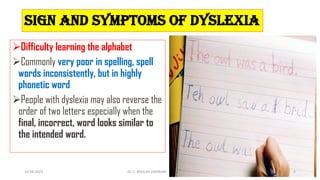
Difficulty learning the alphabet
Commonly very poor in spelling, spell
words inconsistently, but in highly
phonetic word
People with dyslexia may also reverse the
order of two letters especially when the
final, incorrect, word looks similar to
the intended word.
14-04-2022 Dr. C. BEULAH JAYARANI 9
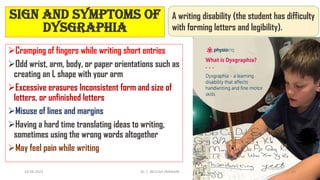
Cramping of fingers while writing short entries
Odd wrist, arm, body, or paper orientations such as
creating an L shape with your arm
Excessive erasures Inconsistent form and size of
letters, or unfinished letters
Misuse of lines and margins
Having a hard time translating ideas to writing,
sometimes using the wrong words altogether
May feel pain while writing
Sign and symptoms of
Dysgraphia
A writing disability (the student has difficulty
with forming letters and legibility).
14-04-2022 Dr. C. BEULAH JAYARANI 10
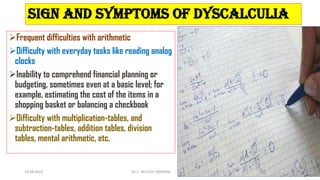
Frequent difficulties with arithmetic
Difficulty with everyday tasks like reading analog
clocks
Inability to comprehend financial planning or
budgeting, sometimes even at a basic level; for
example, estimating the cost of the items in a
shopping basket or balancing a checkbook
Difficulty with multiplication-tables, and
subtraction-tables, addition tables, division
tables, mental arithmetic, etc.
Sign and symptoms of Dyscalculia
14-04-2022 Dr. C. BEULAH JAYARANI 11
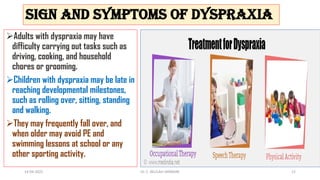
Sign and symptoms of Dyspraxia
Adults with dyspraxia may have
difficulty carrying out tasks such as
driving, cooking, and household
chores or grooming.
Children with dyspraxia may be late in
reaching developmental milestones,
such as rolling over, sitting, standing
and walking.
They may frequently fall over, and
when older may avoid PE and
swimming lessons at school or any
other sporting activity.
14-04-2022 Dr. C. BEULAH JAYARANI 12
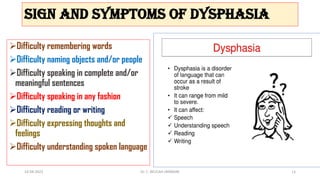
Difficulty remembering words
Difficulty naming objects and/or people
Difficulty speaking in complete and/or
meaningful sentences
Difficulty speaking in any fashion
Difficulty reading or writing
Difficulty expressing thoughts and
feelings
Difficulty understanding spoken language
Sign and symptoms of Dysphasia
14-04-2022 Dr. C. BEULAH JAYARANI 13
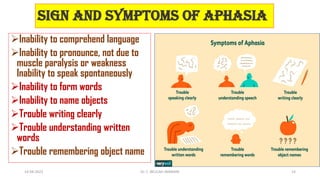
Sign and symptoms of Aphasia
Inability to comprehend language
Inability to pronounce, not due to
muscle paralysis or weakness
Inability to speak spontaneously
Inability to form words
Inability to name objects
Trouble writing clearly
Trouble understanding written
words
Trouble remembering object name
14-04-2022 Dr. C. BEULAH JAYARANI 14
Sign and symptoms of Central Auditory
Processing Disorder
Have trouble paying attention to and remembering information
presented orally, and may cope better with visually acquired
information
Have problems carrying out multi-step directions given orally; need to
hear only one direction at a time
Have poor listening skills
Need more time to process information
Have low academic performance
Have behavior problems
Have language difficulties (e.g., they confuse syllable sequences and
have problems developing vocabulary and understanding language)
Have difficulty with reading, comprehension, spelling, and
vocabulary
14-04-2022 Dr. C. BEULAH JAYARANI
15
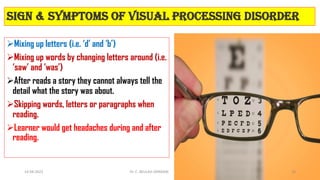
Sign & symptoms of Visual Processing Disorder
Mixing up letters (i.e. ‘d’ and ‘b’)
Mixing up words by changing letters around (i.e.
‘saw’ and ‘was’)
After reads a story they cannot always tell the
detail what the story was about.
Skipping words, letters or paragraphs when
reading.
Learner would get headaches during and after
reading.
14-04-2022 Dr. C. BEULAH JAYARANI 16
some more causes of learning disability
1. Heredity: Learning disabilities often run in the family. Children with learning
disabilities are likely to have parents or other relatives with similar
difficulties.
2. Problems during pregnancy and birth: Learning disabilities can result
from anomalies in the developing brain, illness or injury, fetal exposure to
alcohol or drugs, low birth weight, oxygen deprivation, or by premature or
prolonged labor.
3. Accidents after birth: Learning disabilities can also be caused by head
injuries, malnutrition, or by toxic exposure (such as heavy metals or
pesticides).
4. Brain Damage or Dysfunction: Some professionals believe that all
children with learning disabilities suffer from some type of brain injury or
dysfunction of the central nervous system.
14-04-2022 Dr. C. BEULAH JAYARANI 17
Contd.,
5. Biochemical Imbalance: It was once theorized that biochemical
disturbances within a child’s body caused learning disabilities. For example,
Feingold (1975, 1976) claimed that artificial colorings and flavorings in many
of the foods children eat can cause learning disability.
6. Environmental Factors: Although very difficult to document as primary
causes of learning disabilities, environmental factors—particularly
impoverished living conditions early in a child’s life and poor instruction—
probably contribute to the achievement deficits experienced by many
children in this special education category. The tendency for learning
disabilities to run in families suggests a correlation between
environmental influences on children’s early development and
subsequent achievement in school. Evidence for this relationship can
be found in longitudinal research such as that conducted by Hart and
Risley (1995), who found that infants and toddlers who received infrequent
communication exchanges with their parents were more likely to show
deficits in vocabulary, language use, and intellectual development before
entering school.
14-04-2022 Dr. C. BEULAH JAYARANI
18
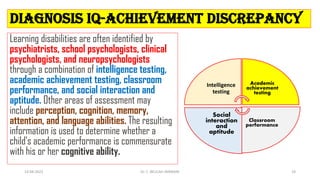
Diagnosis IQ-Achievement Discrepancy
Learning disabilities are often identified by
psychiatrists, school psychologists, clinical
psychologists, and neuropsychologists
through a combination of intelligence testing,
academic achievement testing, classroom
performance, and social interaction and
aptitude. Other areas of assessment may
include perception, cognition, memory,
attention, and language abilities. The resulting
information is used to determine whether a
child's academic performance is commensurate
with his or her cognitive ability.
Intelligence
testing
Academic
achievement
testing
Classroom
performance
Social
interaction
and
aptitude
14-04-2022 Dr. C. BEULAH JAYARANI 19
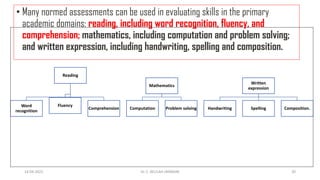
• Many normed assessments can be used in evaluating skills in the primary
academic domains: reading, including word recognition, fluency, and
comprehension; mathematics, including computation and problem solving;
and written expression, including handwriting, spelling and composition.
Reading
Word
recognition
Fluency
Comprehension
Mathematics
Computation Problem solving
Written
expression
Handwriting Spelling Composition.
14-04-2022 Dr. C. BEULAH JAYARANI 20
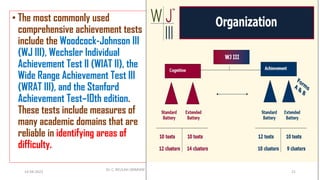
• The most commonly used
comprehensive achievement tests
include the Woodcock-Johnson III
(WJ III), Wechsler Individual
Achievement Test II (WIAT II), the
Wide Range Achievement Test III
(WRAT III), and the Stanford
Achievement Test–10th edition.
These tests include measures of
many academic domains that are
reliable in identifying areas of
difficulty.
14-04-2022
Dr. C. BEULAH JAYARANI
21
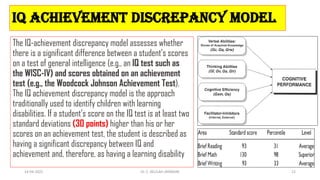
IQ achievement discrepancy model
The IQ-achievement discrepancy model assesses whether
there is a significant difference between a student’s scores
on a test of general intelligence (e.g., an IQ test such as
the WISC-IV) and scores obtained on an achievement
test (e.g., the Woodcock Johnson Achievement Test).
The IQ achievement discrepancy model is the approach
traditionally used to identify children with learning
disabilities. If a student’s score on the IQ test is at least two
standard deviations (30 points) higher than his or her
scores on an achievement test, the student is described as
having a significant discrepancy between IQ and
achievement and, therefore, as having a learning disability
14-04-2022 Dr. C. BEULAH JAYARANI 22
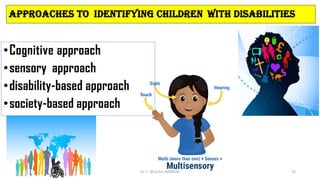
Approaches to identifying children with disabilities
•Cognitive approach
•sensory approach
•disability-based approach
•society-based approach
Dr. C. BEULAH JAYARANI 23
COGNITIVE APPROACH
• This approach advocates that children with disabilities
could be easily identified by observed the limitations in
individual’s cognitive abilities like receiving
information from his environment processing,
interpreting and reacting to it.
• According to it, using intelligence tests one’s IQ could
be calculated to judge whether he or she is
intellectually disabled.
• Intelligence tests are differently categorized as verbal
tests, non-verbal tests and performance tests.
Performance tests of intelligence will be highly
useful to judge the children’s individual intelligence
ability.
14-04-2022 Dr. C. BEULAH JAYARANI
24
SENSORY APPROACH
• This approach advocates that children with disabilities
could be easily identified by measuring their sensory
abilities (visual acuity, hearing ability and speaking ability)
• After identifying disabled, measures to improve the
degree of handicap like
Providing special training
Making available appropriate facilities & opportunities
for them to actively participate in social activities
• To find the “ways and means of improving”-
The levels of visual disability
The level of hearing disability
The level of speech disability
14-04-2022 Dr. C. BEULAH JAYARANI 25
DISABILITY BASED APPROACH
• Instead of judging the handicap of an individual through mental
disability or sensory disabilities, his/her disabilities in carrying out
the day of day activities of life as well as playing effectively his/her
social roles like others in the society could be used as criteria for
identifying the handicap of a person.
• This approach insists on finding the areas in which one exhibits
disability, in order to identify him/her as a handicapped.
• -i.e. all kinds of disabilities
Visual, hearing impairment, speech disorders, motor
disabilities, Autism, cerebral palsy
Mental disorders, delinquency, Multiple disabilities etc.,
14-04-2022 Dr. C. BEULAH JAYARANI 26
SOCIETY BASED APPROACH
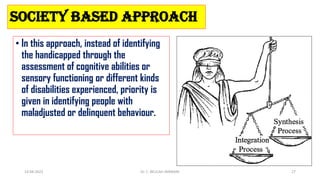
• In this approach, instead of identifying
the handicapped through the
assessment of cognitive abilities or
sensory functioning or different kinds
of disabilities experienced, priority is
given in identifying people with
maladjusted or delinquent behaviour.
14-04-2022 Dr. C. BEULAH JAYARANI 27
ROLE OF TEACHERS IN MANAGING STUDENTS
WITH LEARNING DISABILITIES
•THERAPEUTIC MEASURES
14-04-2022 Dr. C. BEULAH JAYARANI 28
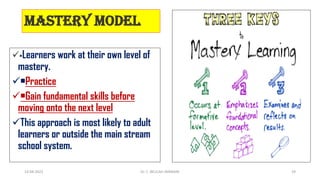
Mastery model
•Learners work at their own level of
mastery.
•Practice
•Gain fundamental skills before
moving onto the next level
This approach is most likely to adult
learners or outside the main stream
school system.
14-04-2022 Dr. C. BEULAH JAYARANI 29
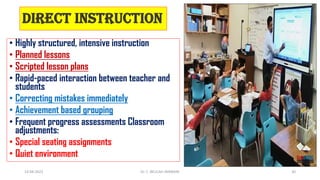
Direct Instruction
• Highly structured, intensive instruction
• Planned lessons
• Scripted lesson plans
• Rapid-paced interaction between teacher and
students
• Correcting mistakes immediately
• Achievement based grouping
• Frequent progress assessments Classroom
adjustments:
• Special seating assignments
• Quiet environment
14-04-2022 Dr. C. BEULAH JAYARANI 30
Special equipment
• Word processors with spell checkers and
dictionaries
• Text-to-speech and speech-to-test
programmes
• Talking calculators
• Books on tape
• Computer-based activities
14-04-2022 Dr. C. BEULAH JAYARANI 31
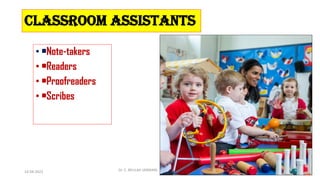
Classroom assistants
• •Note-takers
• •Readers
• •Proofreaders
• •Scribes
14-04-2022 Dr. C. BEULAH JAYARANI 32
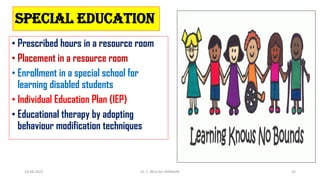
Special Education
• Prescribed hours in a resource room
• Placement in a resource room
• Enrollment in a special school for
learning disabled students
• Individual Education Plan (IEP)
• Educational therapy by adopting
behaviour modification techniques
14-04-2022 Dr. C. BEULAH JAYARANI 33
references
14-04-2022 Dr. C. BEULAH JAYARANI 34
“Inclusive Education”
• TNTEU – Study Material
• Ram Publications
• Sri Krishna Publications
• Samyukdha Publications
• Google Images

LEARNING DISABILITY.pdf

  • 1.
    Understanding the learning disabilities DR.C. BEULAH JAYARANI M.Sc., M.A, M.Ed, M.Phil (Edn), M.Phil (ZOO), NET, Ph.D ASST. PROFESSOR, LOYOLA COLLEGE OF EDUCATION, CHENNAI - 34
  • 2.
    Unit II Understandingthe learning disabilities Meaning and definition of learning disabilities - Kinds of learning disabilities: dyslexia, dyscalculia, dysgraphia, dyspraxia - Approaches to identifying children with disabilities: Cognitive approach, sensory approach, disability-based approach, society-based approach - Role of teachers in managing students with learning disabilities.(Suggested instructional approaches and methods: i) Invited talk by expert(s) /talk by teacher(s) on the different learning kinds of disabilities. ii) Student seminar on the importance and means of identifying the learning disabilities of students.) 14-04-2022 Dr. C. BEULAH JAYARANI 2
  • 3.
    Disabilities Due to lossor abnormality of physical organs (e.g.) mal-formation of limbs, cleft lip, disfigured fingers. Disorders due to dysfunction of organs of the body even though they may have normal anatomical structure. Due to genetic disorders, developmental defects, accidents or diseases. opportunities and facilities in the society. Dr. C. BEULAH JAYARANI 14-04-2022 3
  • 4.
    Characteristics of Disabilities…… Dueto the limitation of one’s functioning arising from impairments. Due to the inability to undertake activities of daily life like others. i.e. one’s functional efficiency getting affected. The degree of disability could be reduced with the use of appropriate equipment's and appliances. The handicap arising out of disability could be greatly reduced by providing appropriate treatment Dr. C. BEULAH JAYARANI 14-04-2022 4
  • 5.
    CAUSES OF DIABILITY Genetic disorder Problem during delivery Adverse effect of drugsconsumed during pregnancy Severe accident Severe Malnutrition Artificial fertilization 5
  • 6.
    INTRODUCTION • Learning disabilitymeans a disorder in one or more of the basic psychological processes involved in understanding or in using language, spoken or written, that may manifest itself in an imperfect ability to listen, think, speak, read, write, spell, or to do mathematical calculations, including conditions such as perceptual disabilities, brain injury, minimal brain dysfunction, dyslexia, and developmental and development 14-04-2022 Dr. C. BEULAH JAYARANI 6
  • 7.
    Characteristics of LearningDisability Has difficulty comparing things or classifying and sorting items according to a specific criteria Time concepts present difficulty, before, after, tomorrow, last week, etc. Often doesn't get jokes or ideas in humorous situations Creativity and imagination is usually limited Often slow to respond Difficult time predicting what may happen next, or answering comprehension type questions. Comments are often off track Difficulty thinking in a logical or sequential manner. Difficulty with number concepts Often requires a great deal of clarification and one to one support Doesn't make connections in similar learning concepts. E.g., 5+3=8 becomes an unknown when asked what 3+5 equals. 14-04-2022 Dr. C. BEULAH JAYARANI 7
  • 8.
    Some Types ofLearning Disabilities Some types of learning disabilities are more specifically defined by education-based labels such as reading, writing, language, and math. They are.. Dyslexia: A reading disability (the student has trouble reading written words fluently, out loud). Dysgraphia: A writing disability (the student has difficulty with forming letters and legibility). Dyscalculia: A math disability (the student struggles with math problems and concepts). Dyspraxia: A motor coordination disability (also known as Sensory Integration Disorder). Dysphasia: A language disability (the student has difficulty with reading comprehension). Aphasia: A language disability (the student has difficulty understanding spoken language). Central Auditory Processing Disorder: A sensory disability related to processing sounds. Visual Processing Disorder: A sensory disability related to processing images. 14-04-2022 Dr. C. BEULAH JAYARANI 8
  • 9.
    Sign and symptomsof Dyslexia Difficulty learning the alphabet Commonly very poor in spelling, spell words inconsistently, but in highly phonetic word People with dyslexia may also reverse the order of two letters especially when the final, incorrect, word looks similar to the intended word. 14-04-2022 Dr. C. BEULAH JAYARANI 9
  • 10.
    Cramping of fingerswhile writing short entries Odd wrist, arm, body, or paper orientations such as creating an L shape with your arm Excessive erasures Inconsistent form and size of letters, or unfinished letters Misuse of lines and margins Having a hard time translating ideas to writing, sometimes using the wrong words altogether May feel pain while writing Sign and symptoms of Dysgraphia A writing disability (the student has difficulty with forming letters and legibility). 14-04-2022 Dr. C. BEULAH JAYARANI 10
  • 11.
    Frequent difficulties witharithmetic Difficulty with everyday tasks like reading analog clocks Inability to comprehend financial planning or budgeting, sometimes even at a basic level; for example, estimating the cost of the items in a shopping basket or balancing a checkbook Difficulty with multiplication-tables, and subtraction-tables, addition tables, division tables, mental arithmetic, etc. Sign and symptoms of Dyscalculia 14-04-2022 Dr. C. BEULAH JAYARANI 11
  • 12.
    Sign and symptomsof Dyspraxia Adults with dyspraxia may have difficulty carrying out tasks such as driving, cooking, and household chores or grooming. Children with dyspraxia may be late in reaching developmental milestones, such as rolling over, sitting, standing and walking. They may frequently fall over, and when older may avoid PE and swimming lessons at school or any other sporting activity. 14-04-2022 Dr. C. BEULAH JAYARANI 12
  • 13.
    Difficulty remembering words Difficultynaming objects and/or people Difficulty speaking in complete and/or meaningful sentences Difficulty speaking in any fashion Difficulty reading or writing Difficulty expressing thoughts and feelings Difficulty understanding spoken language Sign and symptoms of Dysphasia 14-04-2022 Dr. C. BEULAH JAYARANI 13
  • 14.
    Sign and symptomsof Aphasia Inability to comprehend language Inability to pronounce, not due to muscle paralysis or weakness Inability to speak spontaneously Inability to form words Inability to name objects Trouble writing clearly Trouble understanding written words Trouble remembering object name 14-04-2022 Dr. C. BEULAH JAYARANI 14
  • 15.
    Sign and symptomsof Central Auditory Processing Disorder Have trouble paying attention to and remembering information presented orally, and may cope better with visually acquired information Have problems carrying out multi-step directions given orally; need to hear only one direction at a time Have poor listening skills Need more time to process information Have low academic performance Have behavior problems Have language difficulties (e.g., they confuse syllable sequences and have problems developing vocabulary and understanding language) Have difficulty with reading, comprehension, spelling, and vocabulary 14-04-2022 Dr. C. BEULAH JAYARANI 15
  • 16.
    Sign & symptomsof Visual Processing Disorder Mixing up letters (i.e. ‘d’ and ‘b’) Mixing up words by changing letters around (i.e. ‘saw’ and ‘was’) After reads a story they cannot always tell the detail what the story was about. Skipping words, letters or paragraphs when reading. Learner would get headaches during and after reading. 14-04-2022 Dr. C. BEULAH JAYARANI 16
  • 17.
    some more causesof learning disability 1. Heredity: Learning disabilities often run in the family. Children with learning disabilities are likely to have parents or other relatives with similar difficulties. 2. Problems during pregnancy and birth: Learning disabilities can result from anomalies in the developing brain, illness or injury, fetal exposure to alcohol or drugs, low birth weight, oxygen deprivation, or by premature or prolonged labor. 3. Accidents after birth: Learning disabilities can also be caused by head injuries, malnutrition, or by toxic exposure (such as heavy metals or pesticides). 4. Brain Damage or Dysfunction: Some professionals believe that all children with learning disabilities suffer from some type of brain injury or dysfunction of the central nervous system. 14-04-2022 Dr. C. BEULAH JAYARANI 17
  • 18.
    Contd., 5. Biochemical Imbalance:It was once theorized that biochemical disturbances within a child’s body caused learning disabilities. For example, Feingold (1975, 1976) claimed that artificial colorings and flavorings in many of the foods children eat can cause learning disability. 6. Environmental Factors: Although very difficult to document as primary causes of learning disabilities, environmental factors—particularly impoverished living conditions early in a child’s life and poor instruction— probably contribute to the achievement deficits experienced by many children in this special education category. The tendency for learning disabilities to run in families suggests a correlation between environmental influences on children’s early development and subsequent achievement in school. Evidence for this relationship can be found in longitudinal research such as that conducted by Hart and Risley (1995), who found that infants and toddlers who received infrequent communication exchanges with their parents were more likely to show deficits in vocabulary, language use, and intellectual development before entering school. 14-04-2022 Dr. C. BEULAH JAYARANI 18
  • 19.
    Diagnosis IQ-Achievement Discrepancy Learningdisabilities are often identified by psychiatrists, school psychologists, clinical psychologists, and neuropsychologists through a combination of intelligence testing, academic achievement testing, classroom performance, and social interaction and aptitude. Other areas of assessment may include perception, cognition, memory, attention, and language abilities. The resulting information is used to determine whether a child's academic performance is commensurate with his or her cognitive ability. Intelligence testing Academic achievement testing Classroom performance Social interaction and aptitude 14-04-2022 Dr. C. BEULAH JAYARANI 19
  • 20.
    • Many normedassessments can be used in evaluating skills in the primary academic domains: reading, including word recognition, fluency, and comprehension; mathematics, including computation and problem solving; and written expression, including handwriting, spelling and composition. Reading Word recognition Fluency Comprehension Mathematics Computation Problem solving Written expression Handwriting Spelling Composition. 14-04-2022 Dr. C. BEULAH JAYARANI 20
  • 21.
    • The mostcommonly used comprehensive achievement tests include the Woodcock-Johnson III (WJ III), Wechsler Individual Achievement Test II (WIAT II), the Wide Range Achievement Test III (WRAT III), and the Stanford Achievement Test–10th edition. These tests include measures of many academic domains that are reliable in identifying areas of difficulty. 14-04-2022 Dr. C. BEULAH JAYARANI 21
  • 22.
    IQ achievement discrepancymodel The IQ-achievement discrepancy model assesses whether there is a significant difference between a student’s scores on a test of general intelligence (e.g., an IQ test such as the WISC-IV) and scores obtained on an achievement test (e.g., the Woodcock Johnson Achievement Test). The IQ achievement discrepancy model is the approach traditionally used to identify children with learning disabilities. If a student’s score on the IQ test is at least two standard deviations (30 points) higher than his or her scores on an achievement test, the student is described as having a significant discrepancy between IQ and achievement and, therefore, as having a learning disability 14-04-2022 Dr. C. BEULAH JAYARANI 22
  • 23.
    Approaches to identifyingchildren with disabilities •Cognitive approach •sensory approach •disability-based approach •society-based approach Dr. C. BEULAH JAYARANI 23
  • 24.
    COGNITIVE APPROACH • Thisapproach advocates that children with disabilities could be easily identified by observed the limitations in individual’s cognitive abilities like receiving information from his environment processing, interpreting and reacting to it. • According to it, using intelligence tests one’s IQ could be calculated to judge whether he or she is intellectually disabled. • Intelligence tests are differently categorized as verbal tests, non-verbal tests and performance tests. Performance tests of intelligence will be highly useful to judge the children’s individual intelligence ability. 14-04-2022 Dr. C. BEULAH JAYARANI 24
  • 25.
    SENSORY APPROACH • Thisapproach advocates that children with disabilities could be easily identified by measuring their sensory abilities (visual acuity, hearing ability and speaking ability) • After identifying disabled, measures to improve the degree of handicap like Providing special training Making available appropriate facilities & opportunities for them to actively participate in social activities • To find the “ways and means of improving”- The levels of visual disability The level of hearing disability The level of speech disability 14-04-2022 Dr. C. BEULAH JAYARANI 25
  • 26.
    DISABILITY BASED APPROACH •Instead of judging the handicap of an individual through mental disability or sensory disabilities, his/her disabilities in carrying out the day of day activities of life as well as playing effectively his/her social roles like others in the society could be used as criteria for identifying the handicap of a person. • This approach insists on finding the areas in which one exhibits disability, in order to identify him/her as a handicapped. • -i.e. all kinds of disabilities Visual, hearing impairment, speech disorders, motor disabilities, Autism, cerebral palsy Mental disorders, delinquency, Multiple disabilities etc., 14-04-2022 Dr. C. BEULAH JAYARANI 26
  • 27.
    SOCIETY BASED APPROACH •In this approach, instead of identifying the handicapped through the assessment of cognitive abilities or sensory functioning or different kinds of disabilities experienced, priority is given in identifying people with maladjusted or delinquent behaviour. 14-04-2022 Dr. C. BEULAH JAYARANI 27
  • 28.
    ROLE OF TEACHERSIN MANAGING STUDENTS WITH LEARNING DISABILITIES •THERAPEUTIC MEASURES 14-04-2022 Dr. C. BEULAH JAYARANI 28
  • 29.
    Mastery model •Learners workat their own level of mastery. •Practice •Gain fundamental skills before moving onto the next level This approach is most likely to adult learners or outside the main stream school system. 14-04-2022 Dr. C. BEULAH JAYARANI 29
  • 30.
    Direct Instruction • Highlystructured, intensive instruction • Planned lessons • Scripted lesson plans • Rapid-paced interaction between teacher and students • Correcting mistakes immediately • Achievement based grouping • Frequent progress assessments Classroom adjustments: • Special seating assignments • Quiet environment 14-04-2022 Dr. C. BEULAH JAYARANI 30
  • 31.
    Special equipment • Wordprocessors with spell checkers and dictionaries • Text-to-speech and speech-to-test programmes • Talking calculators • Books on tape • Computer-based activities 14-04-2022 Dr. C. BEULAH JAYARANI 31
  • 32.
    Classroom assistants • •Note-takers ••Readers • •Proofreaders • •Scribes 14-04-2022 Dr. C. BEULAH JAYARANI 32
  • 33.
    Special Education • Prescribedhours in a resource room • Placement in a resource room • Enrollment in a special school for learning disabled students • Individual Education Plan (IEP) • Educational therapy by adopting behaviour modification techniques 14-04-2022 Dr. C. BEULAH JAYARANI 33
  • 34.
    references 14-04-2022 Dr. C.BEULAH JAYARANI 34 “Inclusive Education” • TNTEU – Study Material • Ram Publications • Sri Krishna Publications • Samyukdha Publications • Google Images