Achievement Test and Blueprint
construction
Dr. Sankaranarayanan Paleeri
Asst. Professor
NSS Training College, Ottapalam, Kerala
(Copyright (Patent for concept) holder in PDB
Blueprint for test construction)
Ph 9946681761
paleeri@gmail.com
Double Click on video file
What is an achievement test?
• An achievement test is a test that measures the
achievement -of knowledge- of an individual after
a prescribed period of learning or training.
• Achievement test measures what a learner
learned in a prescribed content or concept that
taught in a formal classroom/teaching learning
situation for a prescribed period.
• Achievement test is a formal method of
evaluation.
Some Characteristics
• It can be a standardized test or teacher made
test.
• Developed to measure skills and learned
knowledge of the learners
• Conducting after a planned instruction
• Test determines the level of instruction and
learning for which the learner is prepared.
• High score in achievement test indicates
mastery on learned content.
A test can be
• Paper pencil test or written test
• Oral test
• Perormance test
• Most popular is written test
By method , the achievement test
can be-
• Speed test: To be completed with in a
given time
• Power test: No time restriction
• Objective type
• Subjective type
• Formative
• Summative
A standardized Achievement test
constructed with certain norms
• Finalized after try out
• Items in test will be analysed on quality
• Difficulty level will be maintained
• Validity and reliability of the test items will be
maintained
General Approach or Steps to Construct a
Teacher Made Achievement Test
• Planning the test
• -design
• - preparation of blueprint
• Item writing
• Item editing
• Preparing the final test
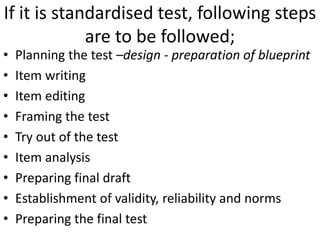
If it is standardised test, following steps
are to be followed;
• Planning the test –design - preparation of blueprint
• Item writing
• Item editing
• Framing the test
• Try out of the test
• Item analysis
• Preparing final draft
• Establishment of validity, reliability and norms
• Preparing the final test
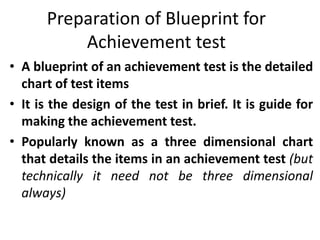
Preparation of Blueprint for
Achievement test
• A blueprint of an achievement test is the detailed
chart of test items
• It is the design of the test in brief. It is guide for
making the achievement test.
• Popularly known as a three dimensional chart
that details the items in an achievement test (but
technically it need not be three dimensional
always)
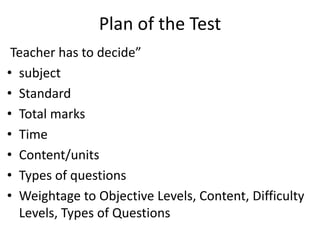
Plan of the Test
Teacher has to decide”
• subject
• Standard
• Total marks
• Time
• Content/units
• Types of questions
• Weightage to Objective Levels, Content, Difficulty
Levels, Types of Questions
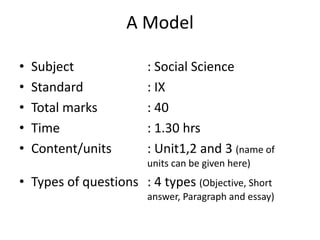
A Model
• Subject : Social Science
• Standard : IX
• Total marks : 40
• Time : 1.30 hrs
• Content/units : Unit1,2 and 3 (name of
units can be given here)
• Types of questions : 4 types (Objective, Short
answer, Paragraph and essay)
Weightage to Objectives
Objective Levels Marks
Knowledge 6
Comprehension 8
Application 12
Skill Levels 14
Total 40
Skill levels include Analysis, Synthesis and
Evaluation
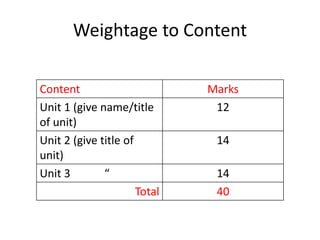
Weightage to Content
Content Marks
Unit 1 (give name/title
of unit)
12
Unit 2 (give title of
unit)
14
Unit 3 “ 14
Total 40
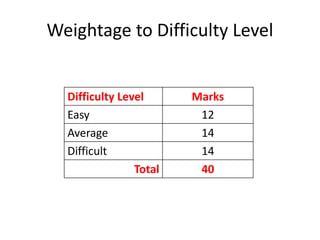
Weightage to Difficulty Level
Difficulty Level Marks
Easy 12
Average 14
Difficult 14
Total 40
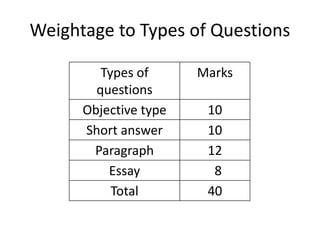
Weightage to Types of Questions
Types of
questions
Marks
Objective type 10
Short answer 10
Paragraph 12
Essay 8
Total 40
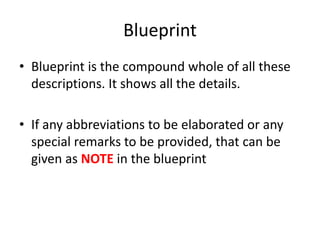
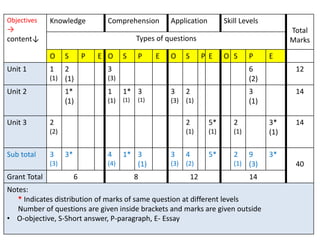
Blueprint
• Blueprint is the compound whole of all these
descriptions. It shows all the details.
• If any abbreviations to be elaborated or any
special remarks to be provided, that can be
given as NOTE in the blueprint
Objectives
→
content↓
Knowledge Comprehension Application Skill Levels
Total
MarksTypes of questions
O S P E O S P E O S P E O S P E
Unit 1 1
(1)
2
(1)
3
(3)
6
(2)
12
Unit 2 1*
(1)
1
(1)
1*
(1)
3
(1)
3
(3)
2
(1)
3
(1)
14
Unit 3 2
(2)
2
(1)
5*
(1)
2
(1)
3*
(1)
14
Sub total 3
(3)
3* 4
(4)
1* 3
(1)
3
(3)
4
(2)
5* 2
(1)
9
(3)
3*
40
Grant Total 6 8 12 14
Notes:
* Indicates distribution of marks of same question at different levels
Number of questions are given inside brackets and marks are given outside
• O-objective, S-Short answer, P-paragraph, E- Essay
PDB Blueprint
• PDB stands for Process Dimension Based
Blueprint
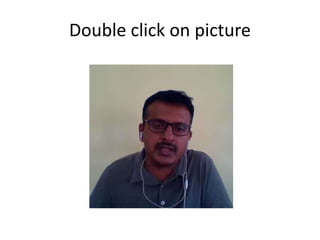
Double click on picture
Why?
• Teaching is constructivist and process based,
not behaviourist in approach.
• So evaluation also to be according to process
based learning
• Using the Revised Blooms Taxonomy
Use this link to get a brief
explanation of RBT
https://www.youtube.com/watch?v=PzQy9HMS
3Zg&t=27s
Or search in You Tube
Sankaranarayanan Paleeri on Revised Blooms
Taxonomy
PDB Blueprint
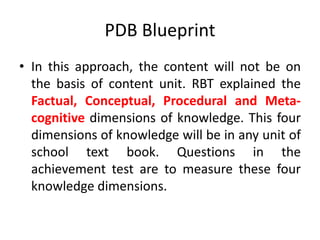
• In this approach, the content will not be on
the basis of content unit. RBT explained the
Factual, Conceptual, Procedural and Meta-
cognitive dimensions of knowledge. This four
dimensions of knowledge will be in any unit of
school text book. Questions in the
achievement test are to measure these four
knowledge dimensions.
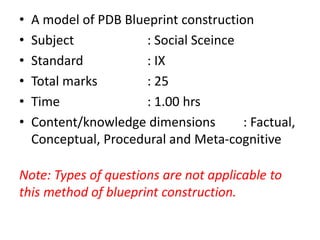
• A model of PDB Blueprint construction
• Subject : Social Sceince
• Standard : IX
• Total marks : 25
• Time : 1.00 hrs
• Content/knowledge dimensions : Factual,
Conceptual, Procedural and Meta-cognitive
Note: Types of questions are not applicable to
this method of blueprint construction.
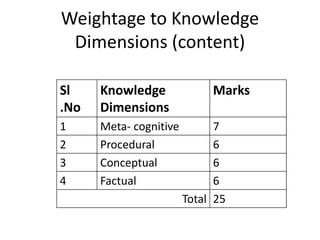
Weightage to Knowledge
Dimensions (content)
Sl
.No
Knowledge
Dimensions
Marks
1 Meta- cognitive 7
2 Procedural 6
3 Conceptual 6
4 Factual 6
Total 25
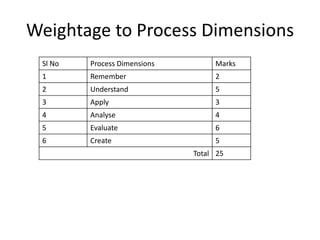
Weightage to Process Dimensions
Sl No Process Dimensions Marks
1 Remember 2
2 Understand 5
3 Apply 3
4 Analyse 4
5 Evaluate 6
6 Create 5
Total 25
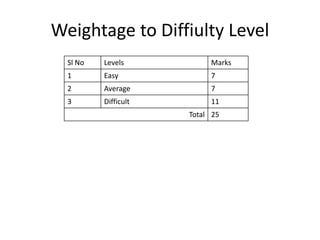
Weightage to Diffiulty Level
Sl No Levels Marks
1 Easy 7
2 Average 7
3 Difficult 11
Total 25
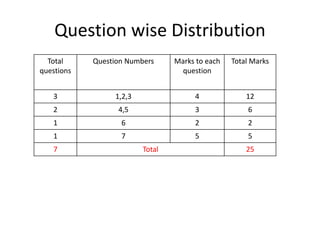
Question wise Distribution
Total
questions
Question Numbers Marks to each
question
Total Marks
3 1,2,3 4 12
2 4,5 3 6
1 6 2 2
1 7 5 5
7 Total 25
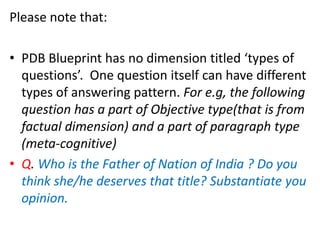
Please note that:
• PDB Blueprint has no dimension titled ‘types of
questions’. One question itself can have different
types of answering pattern. For e.g, the following
question has a part of Objective type(that is from
factual dimension) and a part of paragraph type
(meta-cognitive)
• Q. Who is the Father of Nation of India ? Do you
think she/he deserves that title? Substantiate you
opinion.
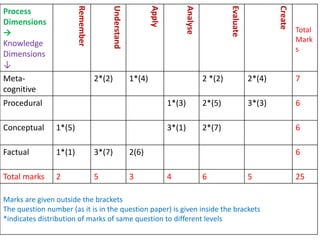
Now let’s make the blue print
Process
Dimensions
→
Knowledge
Dimensions
↓
Remember
Understand
Apply
Analyse
Evaluate
Create
Total
Mark
s
Meta-
cognitive
2*(2) 1*(4) 2 *(2) 2*(4) 7
Procedural 1*(3) 2*(5) 3*(3) 6
Conceptual 1*(5) 3*(1) 2*(7) 6
Factual 1*(1) 3*(7) 2(6) 6
Total marks 2 5 3 4 6 5 25
Marks are given outside the brackets
The question number (as it is in the question paper) is given inside the brackets
*indicates distribution of marks of same question to different levels
Major Features of PDB Blueprint
• It is easy to construct
• In constructivist method of evaluation
• The items in the achievement test are not Unit
based, but based up on knowledge
dimensions. For example, to frame a question
to test procedural knowledge the content
from any part of the proposed subject can be
considered; not from a particular unit, but
from any unit proposed for the present test.
• The question should focus on the
corresponding learning processes of the
process dimension. For example, a question
that belongs to ‘remember’ dimension should
manifest either ‘retrieving or identifying or
recalling or recognising’ (these are the
proposed processes in RBT)
• Column to each cross should be spacious in
the PDB Blueprint chart .entry in each column
may occure several times, because the
question number is to be mentioned, not total
number of questions.

Blueprint and achievemnt test

  • 1.
    Achievement Test andBlueprint construction Dr. Sankaranarayanan Paleeri Asst. Professor NSS Training College, Ottapalam, Kerala (Copyright (Patent for concept) holder in PDB Blueprint for test construction) Ph 9946681761 paleeri@gmail.com
  • 2.
    Double Click onvideo file
  • 3.
    What is anachievement test? • An achievement test is a test that measures the achievement -of knowledge- of an individual after a prescribed period of learning or training. • Achievement test measures what a learner learned in a prescribed content or concept that taught in a formal classroom/teaching learning situation for a prescribed period. • Achievement test is a formal method of evaluation.
  • 4.
    Some Characteristics • Itcan be a standardized test or teacher made test. • Developed to measure skills and learned knowledge of the learners • Conducting after a planned instruction • Test determines the level of instruction and learning for which the learner is prepared. • High score in achievement test indicates mastery on learned content.
  • 5.
    A test canbe • Paper pencil test or written test • Oral test • Perormance test • Most popular is written test
  • 6.
    By method ,the achievement test can be- • Speed test: To be completed with in a given time • Power test: No time restriction • Objective type • Subjective type • Formative • Summative
  • 7.
    A standardized Achievementtest constructed with certain norms • Finalized after try out • Items in test will be analysed on quality • Difficulty level will be maintained • Validity and reliability of the test items will be maintained
  • 8.
    General Approach orSteps to Construct a Teacher Made Achievement Test • Planning the test • -design • - preparation of blueprint • Item writing • Item editing • Preparing the final test
  • 9.
    If it isstandardised test, following steps are to be followed; • Planning the test –design - preparation of blueprint • Item writing • Item editing • Framing the test • Try out of the test • Item analysis • Preparing final draft • Establishment of validity, reliability and norms • Preparing the final test
  • 10.
    Preparation of Blueprintfor Achievement test • A blueprint of an achievement test is the detailed chart of test items • It is the design of the test in brief. It is guide for making the achievement test. • Popularly known as a three dimensional chart that details the items in an achievement test (but technically it need not be three dimensional always)
  • 11.
    Plan of theTest Teacher has to decide” • subject • Standard • Total marks • Time • Content/units • Types of questions • Weightage to Objective Levels, Content, Difficulty Levels, Types of Questions
  • 12.
    A Model • Subject: Social Science • Standard : IX • Total marks : 40 • Time : 1.30 hrs • Content/units : Unit1,2 and 3 (name of units can be given here) • Types of questions : 4 types (Objective, Short answer, Paragraph and essay)
  • 13.
    Weightage to Objectives ObjectiveLevels Marks Knowledge 6 Comprehension 8 Application 12 Skill Levels 14 Total 40 Skill levels include Analysis, Synthesis and Evaluation
  • 14.
    Weightage to Content ContentMarks Unit 1 (give name/title of unit) 12 Unit 2 (give title of unit) 14 Unit 3 “ 14 Total 40
  • 15.
    Weightage to DifficultyLevel Difficulty Level Marks Easy 12 Average 14 Difficult 14 Total 40
  • 16.
    Weightage to Typesof Questions Types of questions Marks Objective type 10 Short answer 10 Paragraph 12 Essay 8 Total 40
  • 17.
    Blueprint • Blueprint isthe compound whole of all these descriptions. It shows all the details. • If any abbreviations to be elaborated or any special remarks to be provided, that can be given as NOTE in the blueprint
  • 18.
    Objectives → content↓ Knowledge Comprehension ApplicationSkill Levels Total MarksTypes of questions O S P E O S P E O S P E O S P E Unit 1 1 (1) 2 (1) 3 (3) 6 (2) 12 Unit 2 1* (1) 1 (1) 1* (1) 3 (1) 3 (3) 2 (1) 3 (1) 14 Unit 3 2 (2) 2 (1) 5* (1) 2 (1) 3* (1) 14 Sub total 3 (3) 3* 4 (4) 1* 3 (1) 3 (3) 4 (2) 5* 2 (1) 9 (3) 3* 40 Grant Total 6 8 12 14 Notes: * Indicates distribution of marks of same question at different levels Number of questions are given inside brackets and marks are given outside • O-objective, S-Short answer, P-paragraph, E- Essay
  • 19.
    PDB Blueprint • PDBstands for Process Dimension Based Blueprint
  • 20.
  • 21.
    Why? • Teaching isconstructivist and process based, not behaviourist in approach. • So evaluation also to be according to process based learning • Using the Revised Blooms Taxonomy
  • 22.
    Use this linkto get a brief explanation of RBT https://www.youtube.com/watch?v=PzQy9HMS 3Zg&t=27s Or search in You Tube Sankaranarayanan Paleeri on Revised Blooms Taxonomy
  • 23.
    PDB Blueprint • Inthis approach, the content will not be on the basis of content unit. RBT explained the Factual, Conceptual, Procedural and Meta- cognitive dimensions of knowledge. This four dimensions of knowledge will be in any unit of school text book. Questions in the achievement test are to measure these four knowledge dimensions.
  • 24.
    • A modelof PDB Blueprint construction • Subject : Social Sceince • Standard : IX • Total marks : 25 • Time : 1.00 hrs • Content/knowledge dimensions : Factual, Conceptual, Procedural and Meta-cognitive Note: Types of questions are not applicable to this method of blueprint construction.
  • 25.
    Weightage to Knowledge Dimensions(content) Sl .No Knowledge Dimensions Marks 1 Meta- cognitive 7 2 Procedural 6 3 Conceptual 6 4 Factual 6 Total 25
  • 26.
    Weightage to ProcessDimensions Sl No Process Dimensions Marks 1 Remember 2 2 Understand 5 3 Apply 3 4 Analyse 4 5 Evaluate 6 6 Create 5 Total 25
  • 27.
    Weightage to DiffiultyLevel Sl No Levels Marks 1 Easy 7 2 Average 7 3 Difficult 11 Total 25
  • 28.
    Question wise Distribution Total questions QuestionNumbers Marks to each question Total Marks 3 1,2,3 4 12 2 4,5 3 6 1 6 2 2 1 7 5 5 7 Total 25
  • 29.
    Please note that: •PDB Blueprint has no dimension titled ‘types of questions’. One question itself can have different types of answering pattern. For e.g, the following question has a part of Objective type(that is from factual dimension) and a part of paragraph type (meta-cognitive) • Q. Who is the Father of Nation of India ? Do you think she/he deserves that title? Substantiate you opinion.
  • 30.
    Now let’s makethe blue print
  • 31.
    Process Dimensions → Knowledge Dimensions ↓ Remember Understand Apply Analyse Evaluate Create Total Mark s Meta- cognitive 2*(2) 1*(4) 2*(2) 2*(4) 7 Procedural 1*(3) 2*(5) 3*(3) 6 Conceptual 1*(5) 3*(1) 2*(7) 6 Factual 1*(1) 3*(7) 2(6) 6 Total marks 2 5 3 4 6 5 25 Marks are given outside the brackets The question number (as it is in the question paper) is given inside the brackets *indicates distribution of marks of same question to different levels
  • 32.
    Major Features ofPDB Blueprint • It is easy to construct • In constructivist method of evaluation • The items in the achievement test are not Unit based, but based up on knowledge dimensions. For example, to frame a question to test procedural knowledge the content from any part of the proposed subject can be considered; not from a particular unit, but from any unit proposed for the present test.
  • 33.
    • The questionshould focus on the corresponding learning processes of the process dimension. For example, a question that belongs to ‘remember’ dimension should manifest either ‘retrieving or identifying or recalling or recognising’ (these are the proposed processes in RBT) • Column to each cross should be spacious in the PDB Blueprint chart .entry in each column may occure several times, because the question number is to be mentioned, not total number of questions.