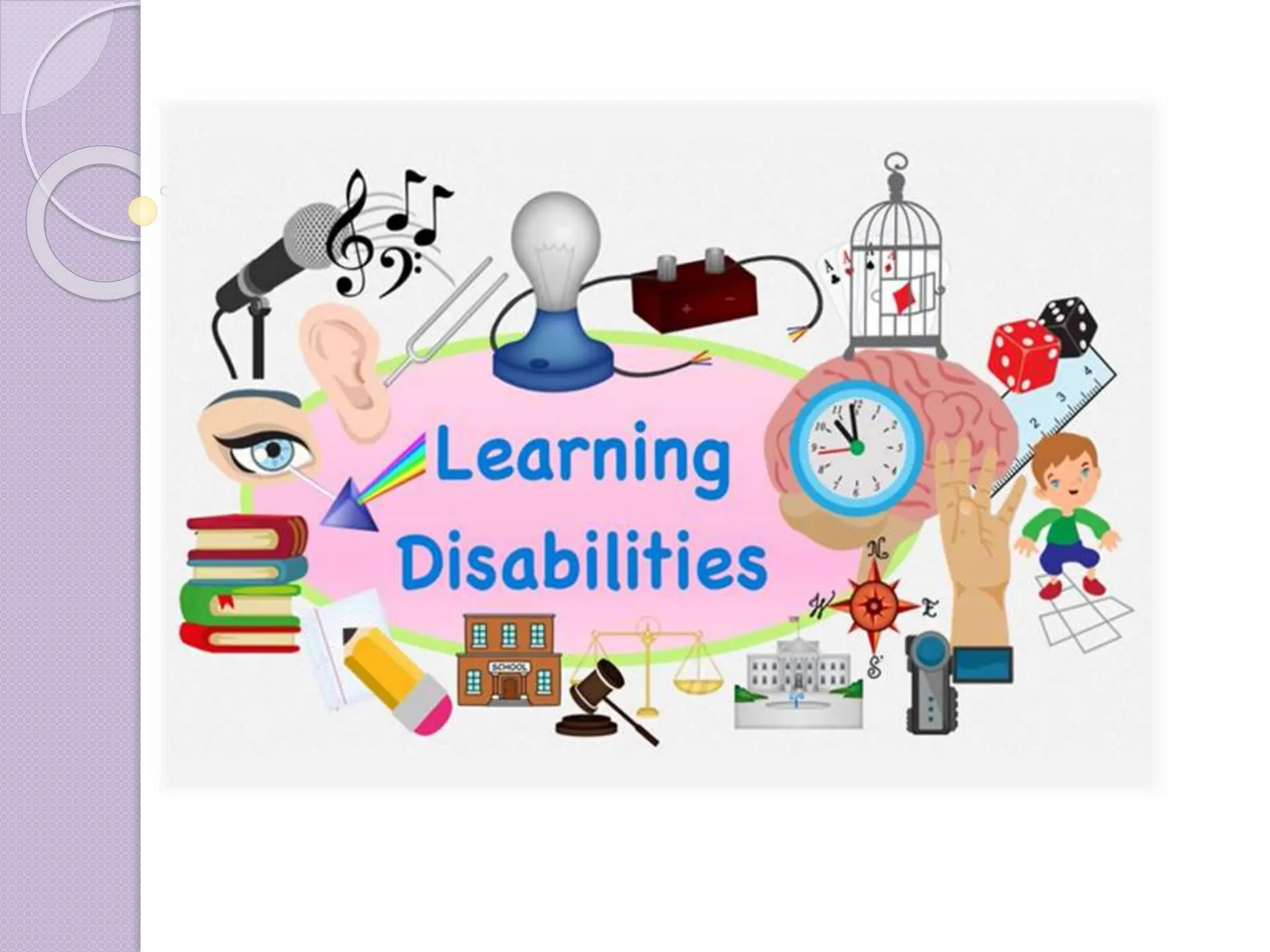
LEARNING
DISABILITIES
INTRODUCTION
Learning disabilities are a group of neuro developmental disorders that can
significantly hamper a person’s ability to learn new things. As a result, the
person may have trouble with tasks such as speaking, reading, writing,
paying attention, understanding information, remembering things,
performing mathematical calculations , or coordinating movements.
Learning disabilities occur in very young children, yet they are
usually not noticed until the child reaches school age. Learning disabilities
can be lifelong conditions. In some people, several overlapping learning
disabilities may occur. Other people may have a single, isolated learning
problem that has little impact on their lives.
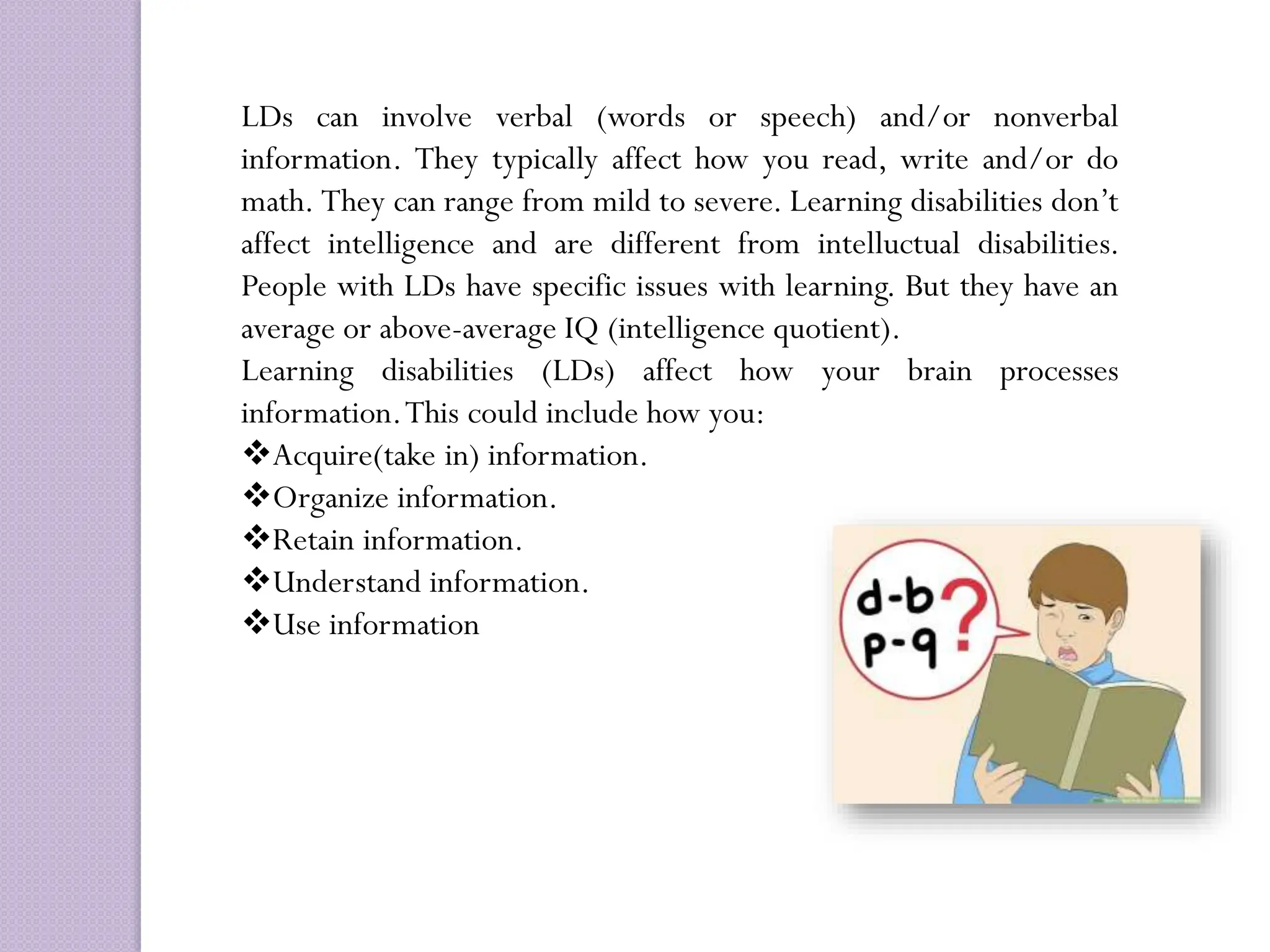
LDs can involve verbal (words or speech) and/or nonverbal
information. They typically affect how you read, write and/or do
math. They can range from mild to severe. Learning disabilities don’t
affect intelligence and are different from intelluctual disabilities.
People with LDs have specific issues with learning. But they have an
average or above-average IQ (intelligence quotient).
Learning disabilities (LDs) affect how your brain processes
information.This could include how you:
Acquire(take in) information.
Organize information.
Retain information.
Understand information.
Use information
TYPES OF LDs
Dyslexia: Dyslexia is the most common learning disability, accounting for
80% of all learning disability cases. It is a language processing disorder
characterized by difficulty with speaking, reading, writing, or understanding
words.This can cause the person's vocabulary to develop at a slower pace and
lead to issues with grammar, reading comprehension, and other language
skills.
Dysgraphia: People with dysgraphia may have difficulty putting their
thoughts into writing due to issues with vocabulary, spelling, grammar,
memory, and critical thinking.This condition is characterized by poor
handwriting, as the person may struggle with letter spacing, spatial awareness,
and motor planning. Dysgraphia can make it hard for the person to think and
write simultaneously.
Dyscalculia: Sometimes known as “math dyslexia,” this condition includes
learning disorders related to mathematics, such as difficulty with numbers,
concepts, and reasoning. People with dyscalculia may struggle to count money,
read clocks and tell time, perform mental math calculations, identify number
patterns, and apply mathematical formulae.
Auditory processing disorder (APD): People with APD may have difficulty
processing sounds because their brain misinterprets auditory information received by
the ear.As a result, they may confuse the order of sounds in certain words, or they
may not be able to distinguish between sounds such as the teacher’s voice and the
background noise in the classroom.
Language processing disorder (LPD):This is a subset ofAPD, characterized by
difficulties with processing spoken language.The person may have difficulty attaching
meaning to sound groups representing words, sentences, and stories.
Nonverbal learning disabilities (NVLD): NVLD is characterized by difficulty
interpreting nonverbal cues such as facial expressions, body language, tone of voice,
and other nonverbal signals.
Visual perceptual/visual motor deficit: People with this condition may have
difficulty with hand-eye coordination and motor activities. They may frequently lose
their spot while reading, demonstrate unusual eye movements while reading or
writing, confuse similar-looking letters, have difficulty navigating their environment,
and struggle to manage items like pens, pencils, crayons, glue, and scissors.
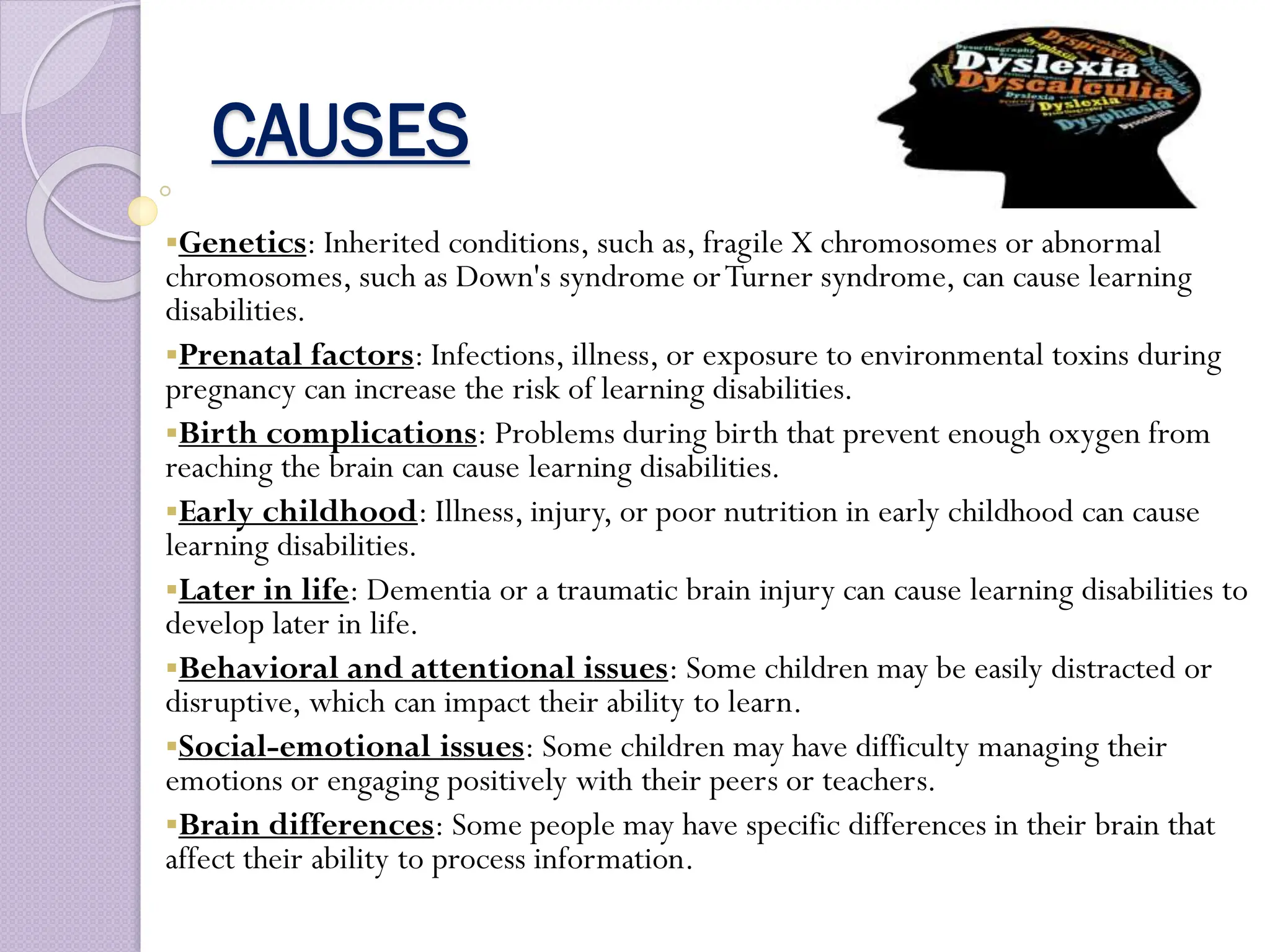
SYMPTOMS
Academic difficulties: Difficulty reading, writing, spelling, or doing math.This can
include trouble understanding new concepts, learning the alphabet, or remembering what's
been taught.
Attention and focus: Difficulty paying attention, staying focused, or following directions.
Memory: Poor memory, or trouble remembering what someone just said.
Motor skills: Clumsiness, poor coordination, or trouble with fine motor skills like cutting
with scissors.
Organization: Difficulty staying organized or losing things like homework or schoolbooks.
Behavior:Acting out, having temper tantrums, or being defiant.This can include not
wanting to go to school, avoiding assignments, or complaining about teachers.
Self-esteem: Low self-esteem or feeling like they're "stupid".
Test stress: Having more trouble than expected with tests.
o
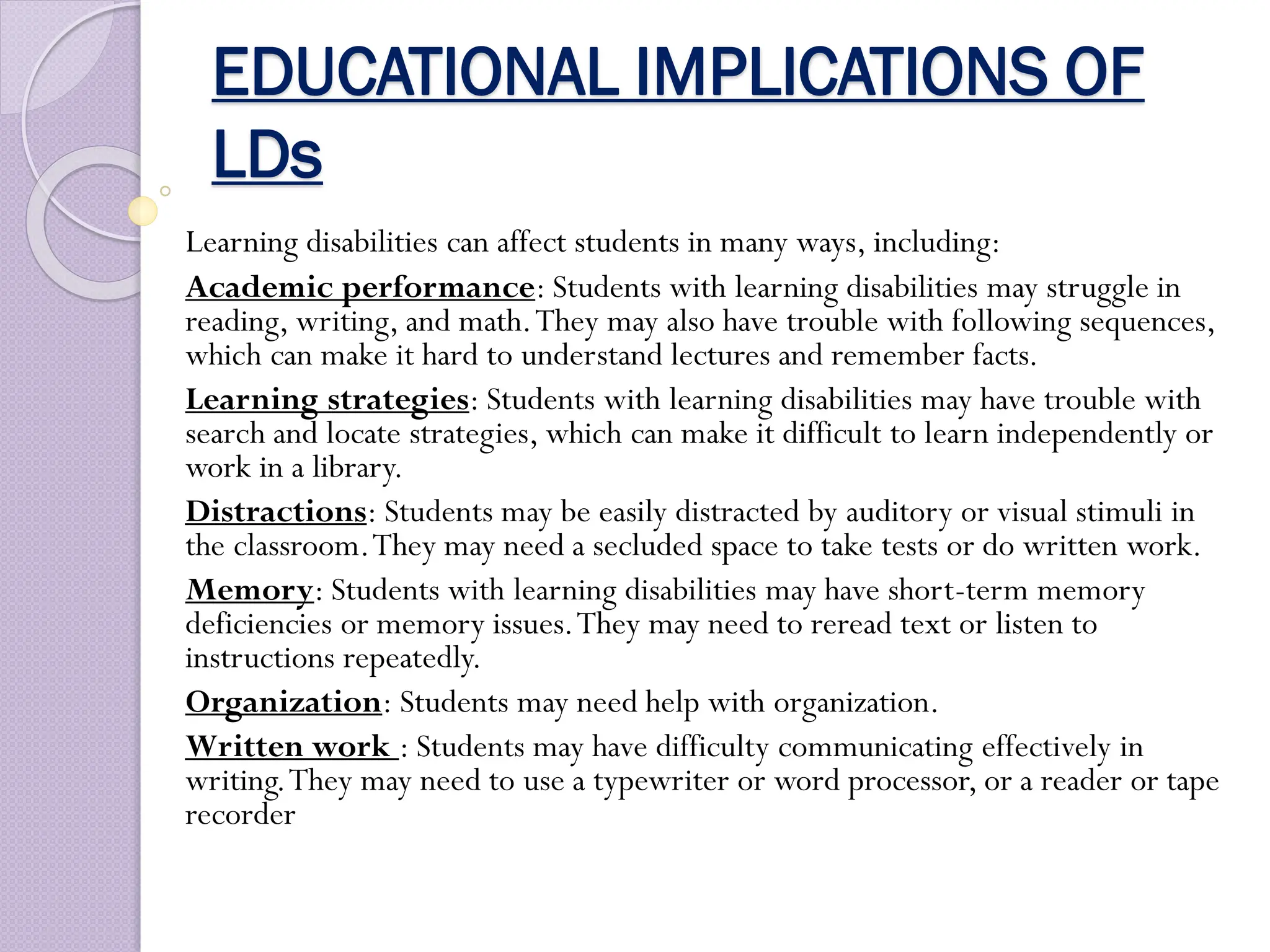
CAUSES
Genetics: Inherited conditions, such as, fragile X chromosomes or abnormal
chromosomes, such as Down's syndrome orTurner syndrome, can cause learning
disabilities.
Prenatal factors: Infections, illness, or exposure to environmental toxins during
pregnancy can increase the risk of learning disabilities.
Birth complications: Problems during birth that prevent enough oxygen from
reaching the brain can cause learning disabilities.
Early childhood: Illness, injury, or poor nutrition in early childhood can cause
learning disabilities.
Later in life: Dementia or a traumatic brain injury can cause learning disabilities to
develop later in life.
Behavioral and attentional issues: Some children may be easily distracted or
disruptive, which can impact their ability to learn.
Social-emotional issues: Some children may have difficulty managing their
emotions or engaging positively with their peers or teachers.
Brain differences: Some people may have specific differences in their brain that
affect their ability to process information.
EDUCATIONAL IMPLICATIONS OF
LDs
Learning disabilities can affect students in many ways, including:
Academic performance: Students with learning disabilities may struggle in
reading, writing, and math.They may also have trouble with following sequences,
which can make it hard to understand lectures and remember facts.
Learning strategies: Students with learning disabilities may have trouble with
search and locate strategies, which can make it difficult to learn independently or
work in a library.
Distractions: Students may be easily distracted by auditory or visual stimuli in
the classroom.They may need a secluded space to take tests or do written work.
Memory: Students with learning disabilities may have short-term memory
deficiencies or memory issues.They may need to reread text or listen to
instructions repeatedly.
Organization: Students may need help with organization.
Written work : Students may have difficulty communicating effectively in
writing.They may need to use a typewriter or word processor, or a reader or tape
recorder
DIAGNOSIS
A healthcare professional can diagnose learning disabilities.The diagnostic
process might involve:
Academic testing: The healthcare provider may administer a
standardized achievement test that checks the person’s reading, writing, and
arithmetic skills, as well as an intelligence quotient (IQ) test. If the person
performs well on the IQ test but has a lower score on the achievement test, it
could indicate that they have a learning disability.
Performance review: The healthcare provider may review and evaluate the
person’s academic, professional, social, and developmental performance.
Medical history: The healthcare provider will likely ask questions about the
person’s personal and family medical history.
Physical and neurological exam: The healthcare provider may conduct a
physical and neurological exam to check for other health conditions such as
brain diseases, mental health conditions, and developmental and intellectual
disabilities.
TREATMENT
Special education: Children with learning disabilities may benefit
from education by specially trained teachers who perform a comprehensive evaluation
of the child’s abilities and then help the child build on their strengths while
compensating for their disabilities.
Medication: Some people may need to take medication to improve their ability to
focus and concentrate.
Therapy: Psychotherapy can help people with learning disabilities deal with
emotional issues and develop coping skills.
Other interventions: People with learning disabilities may also benefit from other
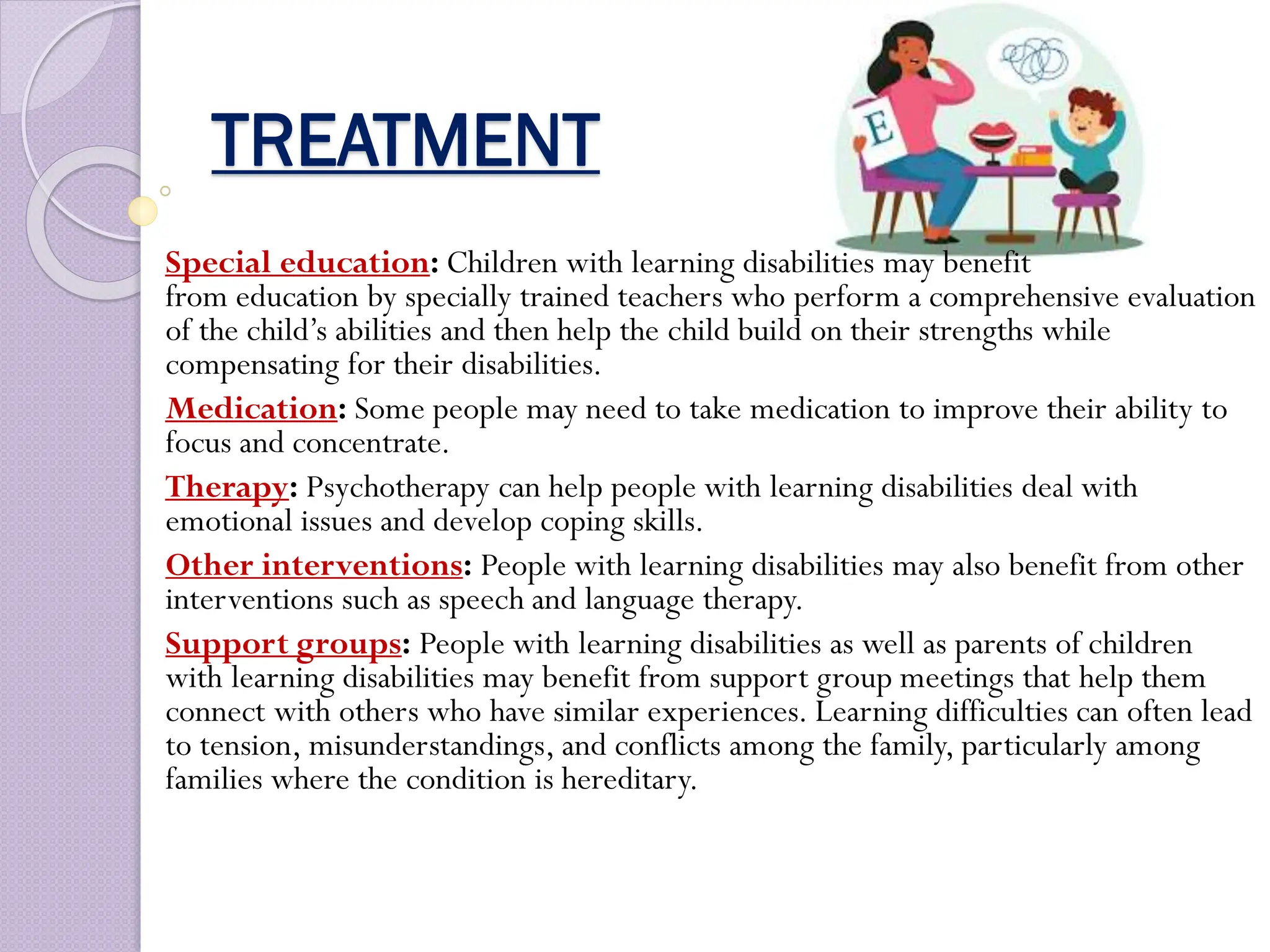
interventions such as speech and language therapy.
Support groups: People with learning disabilities as well as parents of children
with learning disabilities may benefit from support group meetings that help them
connect with others who have similar experiences. Learning difficulties can often lead
to tension, misunderstandings, and conflicts among the family, particularly among
families where the condition is hereditary.
BIBILOGRAPHY
www.verywellmind.com
www.nichd.nih.go
THANK YOU
By,
Devi P V
Bsc Home Science

presentation on learning disabilities .pdf

  • 1.
  • 2.
    INTRODUCTION Learning disabilities area group of neuro developmental disorders that can significantly hamper a person’s ability to learn new things. As a result, the person may have trouble with tasks such as speaking, reading, writing, paying attention, understanding information, remembering things, performing mathematical calculations , or coordinating movements. Learning disabilities occur in very young children, yet they are usually not noticed until the child reaches school age. Learning disabilities can be lifelong conditions. In some people, several overlapping learning disabilities may occur. Other people may have a single, isolated learning problem that has little impact on their lives.
  • 3.
    LDs can involveverbal (words or speech) and/or nonverbal information. They typically affect how you read, write and/or do math. They can range from mild to severe. Learning disabilities don’t affect intelligence and are different from intelluctual disabilities. People with LDs have specific issues with learning. But they have an average or above-average IQ (intelligence quotient). Learning disabilities (LDs) affect how your brain processes information.This could include how you: Acquire(take in) information. Organize information. Retain information. Understand information. Use information
  • 4.
    TYPES OF LDs Dyslexia:Dyslexia is the most common learning disability, accounting for 80% of all learning disability cases. It is a language processing disorder characterized by difficulty with speaking, reading, writing, or understanding words.This can cause the person's vocabulary to develop at a slower pace and lead to issues with grammar, reading comprehension, and other language skills. Dysgraphia: People with dysgraphia may have difficulty putting their thoughts into writing due to issues with vocabulary, spelling, grammar, memory, and critical thinking.This condition is characterized by poor handwriting, as the person may struggle with letter spacing, spatial awareness, and motor planning. Dysgraphia can make it hard for the person to think and write simultaneously. Dyscalculia: Sometimes known as “math dyslexia,” this condition includes learning disorders related to mathematics, such as difficulty with numbers, concepts, and reasoning. People with dyscalculia may struggle to count money, read clocks and tell time, perform mental math calculations, identify number patterns, and apply mathematical formulae.
  • 5.
    Auditory processing disorder(APD): People with APD may have difficulty processing sounds because their brain misinterprets auditory information received by the ear.As a result, they may confuse the order of sounds in certain words, or they may not be able to distinguish between sounds such as the teacher’s voice and the background noise in the classroom. Language processing disorder (LPD):This is a subset ofAPD, characterized by difficulties with processing spoken language.The person may have difficulty attaching meaning to sound groups representing words, sentences, and stories. Nonverbal learning disabilities (NVLD): NVLD is characterized by difficulty interpreting nonverbal cues such as facial expressions, body language, tone of voice, and other nonverbal signals. Visual perceptual/visual motor deficit: People with this condition may have difficulty with hand-eye coordination and motor activities. They may frequently lose their spot while reading, demonstrate unusual eye movements while reading or writing, confuse similar-looking letters, have difficulty navigating their environment, and struggle to manage items like pens, pencils, crayons, glue, and scissors.
  • 6.
    SYMPTOMS Academic difficulties: Difficultyreading, writing, spelling, or doing math.This can include trouble understanding new concepts, learning the alphabet, or remembering what's been taught. Attention and focus: Difficulty paying attention, staying focused, or following directions. Memory: Poor memory, or trouble remembering what someone just said. Motor skills: Clumsiness, poor coordination, or trouble with fine motor skills like cutting with scissors. Organization: Difficulty staying organized or losing things like homework or schoolbooks. Behavior:Acting out, having temper tantrums, or being defiant.This can include not wanting to go to school, avoiding assignments, or complaining about teachers. Self-esteem: Low self-esteem or feeling like they're "stupid". Test stress: Having more trouble than expected with tests. o
  • 7.
    CAUSES Genetics: Inherited conditions,such as, fragile X chromosomes or abnormal chromosomes, such as Down's syndrome orTurner syndrome, can cause learning disabilities. Prenatal factors: Infections, illness, or exposure to environmental toxins during pregnancy can increase the risk of learning disabilities. Birth complications: Problems during birth that prevent enough oxygen from reaching the brain can cause learning disabilities. Early childhood: Illness, injury, or poor nutrition in early childhood can cause learning disabilities. Later in life: Dementia or a traumatic brain injury can cause learning disabilities to develop later in life. Behavioral and attentional issues: Some children may be easily distracted or disruptive, which can impact their ability to learn. Social-emotional issues: Some children may have difficulty managing their emotions or engaging positively with their peers or teachers. Brain differences: Some people may have specific differences in their brain that affect their ability to process information.
  • 8.
    EDUCATIONAL IMPLICATIONS OF LDs Learningdisabilities can affect students in many ways, including: Academic performance: Students with learning disabilities may struggle in reading, writing, and math.They may also have trouble with following sequences, which can make it hard to understand lectures and remember facts. Learning strategies: Students with learning disabilities may have trouble with search and locate strategies, which can make it difficult to learn independently or work in a library. Distractions: Students may be easily distracted by auditory or visual stimuli in the classroom.They may need a secluded space to take tests or do written work. Memory: Students with learning disabilities may have short-term memory deficiencies or memory issues.They may need to reread text or listen to instructions repeatedly. Organization: Students may need help with organization. Written work : Students may have difficulty communicating effectively in writing.They may need to use a typewriter or word processor, or a reader or tape recorder
  • 9.
    DIAGNOSIS A healthcare professionalcan diagnose learning disabilities.The diagnostic process might involve: Academic testing: The healthcare provider may administer a standardized achievement test that checks the person’s reading, writing, and arithmetic skills, as well as an intelligence quotient (IQ) test. If the person performs well on the IQ test but has a lower score on the achievement test, it could indicate that they have a learning disability. Performance review: The healthcare provider may review and evaluate the person’s academic, professional, social, and developmental performance. Medical history: The healthcare provider will likely ask questions about the person’s personal and family medical history. Physical and neurological exam: The healthcare provider may conduct a physical and neurological exam to check for other health conditions such as brain diseases, mental health conditions, and developmental and intellectual disabilities.
  • 10.
    TREATMENT Special education: Childrenwith learning disabilities may benefit from education by specially trained teachers who perform a comprehensive evaluation of the child’s abilities and then help the child build on their strengths while compensating for their disabilities. Medication: Some people may need to take medication to improve their ability to focus and concentrate. Therapy: Psychotherapy can help people with learning disabilities deal with emotional issues and develop coping skills. Other interventions: People with learning disabilities may also benefit from other interventions such as speech and language therapy. Support groups: People with learning disabilities as well as parents of children with learning disabilities may benefit from support group meetings that help them connect with others who have similar experiences. Learning difficulties can often lead to tension, misunderstandings, and conflicts among the family, particularly among families where the condition is hereditary.
  • 11.
  • 12.
    THANK YOU By, Devi PV Bsc Home Science