Dr.S.Govindaraj, Assistant Professor,
Adhiparasakthi College of Education, Kalavai
@GovindarajSPh.D
Learning Disabilities –
Dyslexia and
Dyscalculia
@GovindarajS Ph.D
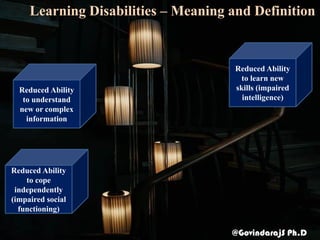
Learning Disabilities – Meaning and Definition
@GovindarajS Ph.D
Reduced Ability
to understand
new or complex
information
Reduced Ability
to learn new
skills (impaired
intelligence)
Reduced Ability
to cope
independently
(impaired social
functioning)
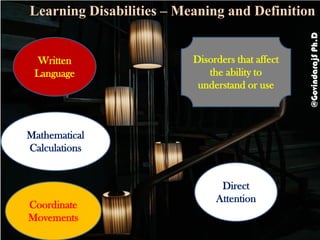
Learning Disabilities – Meaning and Definition
@GovindarajSPh.D
Disorders that affect
the ability to
understand or use
Written
Language
Mathematical
Calculations
Coordinate
Movements
Direct
Attention
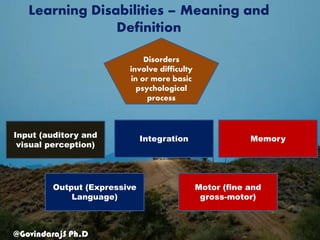
Learning Disabilities – Meaning and
Definition
@GovindarajS Ph.D
Input (auditory and
visual perception)
Disorders
involve difficulty
in or more basic
psychological
process
Integration Memory
Output (Expressive
Language)
Motor (fine and
gross-motor)
Learning Disabilities – Meaning and
Definition
@GovindarajS Ph.D
Processing
information by visual
and auditory
Difficulty
Prioritizing, organising,
doing Mathematics and
following instructions
Storing or retrieving
information
Using spoken
language
Clumsiness or
difficulty with
handwriting
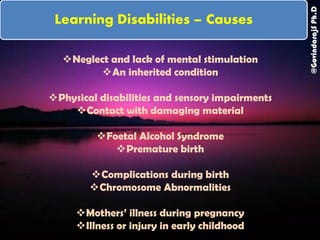
Learning Disabilities – Causes
@GovindarajSPh.D
Neglect and lack of mental stimulation
An inherited condition
Physical disabilities and sensory impairments
Contact with damaging material
Foetal Alcohol Syndrome
Premature birth
Complications during birth
Chromosome Abnormalities
Mothers’ illness during pregnancy
Illness or injury in early childhood
Learning
Disabilities –
Symptoms
@GovindarajSPh.D
Learning
Disabilities –
Symptoms
@GovindarajSPh.D
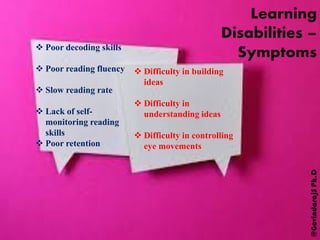
 Poor decoding skills
 Poor reading fluency
 Slow reading rate
 Lack of self-
monitoring reading
skills
 Poor retention
 Difficulty in building
ideas
 Difficulty in
understanding ideas
 Difficulty in controlling
eye movements
Learning
Disabilities –
Symptoms
@GovindarajSPh.D
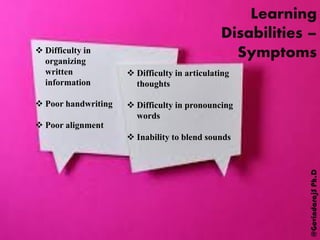
 Difficulty in
organizing
written
information
 Poor handwriting
 Poor alignment
 Difficulty in articulating
thoughts
 Difficulty in pronouncing
words
 Inability to blend sounds
Learning
Disabilities –
Symptoms
@GovindarajSPh.D
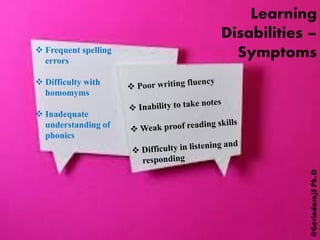
 Frequent spelling
errors
 Difficulty with
homomyms
 Inadequate
understanding of
phonics
Learning
Disabilities –
Symptoms
@GovindarajSPh.D
Difficulty in
memorizing
Poor calculation
skills
Learning
Disabilities –
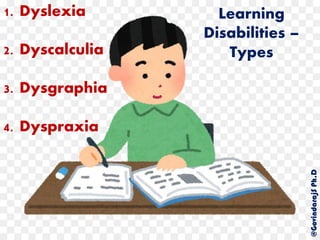
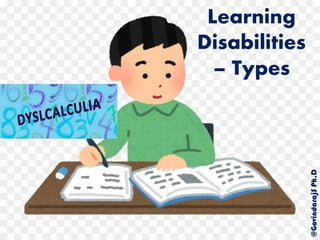
Types
1. Dyslexia
2. Dyscalculia
3. Dysgraphia
4. Dyspraxia
@GovindarajSPh.D
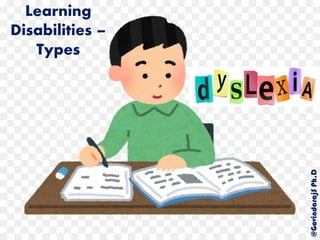
Learning
Disabilities –
Types
@GovindarajSPh.D
Dyslexia – Meaning and
Definition
@GovindarajSPh.D
 Characterized by
problems in reading,
spelling, writing,
speaking, or listening.
 Inability to process
graphic symbols.
Dyslexia – Characteristics
@GovindarajSPh.D
Problems with
∏ Identifying single words
∏ Understanding sounds in words, sound order, or rhymes
∏ Spelling
∏ Transposing letters in words
∏ Reading comprehension
∏ The spoken language
∏ Understanding directions
∏ Understanding opposites, such as up/down or early/late
∏ Handwriting
Dyslexia – Causes
@GovindarajSPh.D
• Possible family history of learning
disorders
• Difficulty learning to recognize written
words
• Difficulty rhyming
• Difficulty determining the meaning (idea
content) of a single sentence
• Writing or arithmetic learning problems
Dyslexia – Teaching Strategies
@GovindarajS Ph.D
1. Boost Self-confidence 2. Read aloud
3. Offer positive energies 4. Provide numbered steps
5. Enhanced reading, writing or listening
6. Allow time for reading, listening and understanding
7. Help with grammar and punctuation
8. Demonstrate their understanding with a spoken answer
Dyslexia – Teaching Strategies
@GovindarajSPh.D
9. Multi-sensory instruction in decoding skills
10. Repetition and review of skills
11. Intensity of intervention
12. Small group or individual instruction
13. Teaching decoding skills
14. Drilling sight words
Learning
Disabilities
– Types
@GovindarajSPh.D
@GovindarajSPh.D
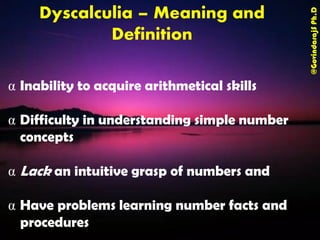
Dyscalculia – Meaning and
Definition
α Inability to acquire arithmetical skills
α Difficulty in understanding simple number
concepts
α Lack an intuitive grasp of numbers and
α Have problems learning number facts and
procedures
@GovindarajSPh.D
Dyscalculia – Meaning and
Definition
α Inability to acquire arithmetical skills
α Difficulty in understanding simple number
concepts
α Lack an intuitive grasp of numbers and
α Have problems learning number facts and
procedures
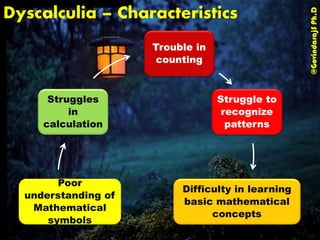
Dyscalculia – Characteristics
@GovindarajSPh.D
Trouble in
counting
Struggle to
recognize
patterns
Difficulty in learning
basic mathematical
concepts
Poor
understanding of
Mathematical
symbols
Struggles
in
calculation
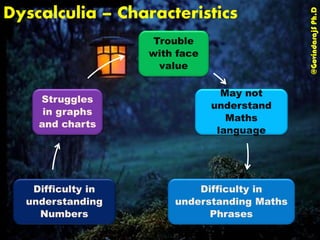
Dyscalculia – Characteristics
@GovindarajSPh.D
Trouble
with face
value
May not
understand
Maths
language
Difficulty in
understanding Maths
Phrases
Difficulty in
understanding
Numbers
Struggles
in graphs
and charts
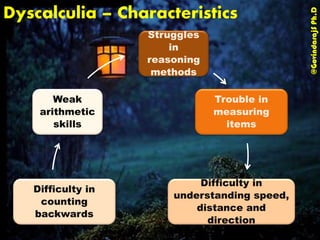
Dyscalculia – Characteristics
@GovindarajSPh.D
Struggles
in
reasoning
methods
Trouble in
measuring
items
Difficulty in
understanding speed,
distance and
direction
Difficulty in
counting
backwards
Weak
arithmetic
skills
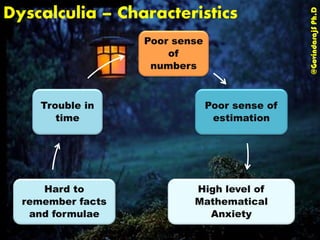
Dyscalculia – Characteristics
@GovindarajSPh.D
Poor sense
of
numbers
Poor sense of
estimation
High level of
Mathematical
Anxiety
Hard to
remember facts
and formulae
Trouble in
time
@GovindarajSPh.D
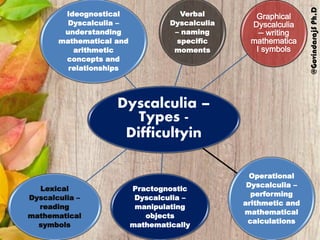
Dyscalculia –
Types -
Difficultyin
Verbal
Dyscalculia
– naming
specific
moments
Graphical
Dyscalculia
– writing
mathematica
l symbols
Operational
Dyscalculia –
performing
arithmetic and
mathematical
calculations
Practognostic
Dyscalculia –
manipulating
objects
mathematically
Lexical
Dyscalculia –
reading
mathematical
symbols
Ideognostical
Dyscalculia –
understanding
mathematical and
arithmetic
concepts and
relationships
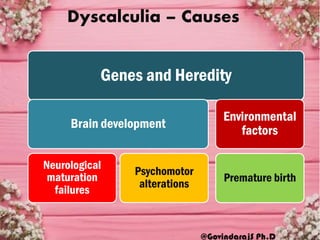
Dyscalculia – Causes
@GovindarajS Ph.D
Genes and Heredity
Brain development
Neurological
maturation
failures
Psychomotor
alterations
Environmental
factors
Premature birth
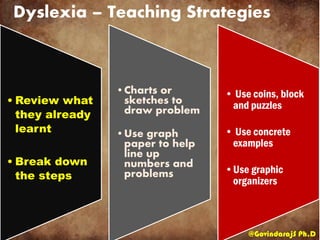
Dyslexia – Teaching Strategies
@GovindarajS Ph.D
• Review what
they already
learnt
• Break down
the steps
•Charts or
sketches to
draw problem
•Use graph
paper to help
line up
numbers and
problems
• Use coins, block
and puzzles
• Use concrete
examples
•Use graphic
organizers
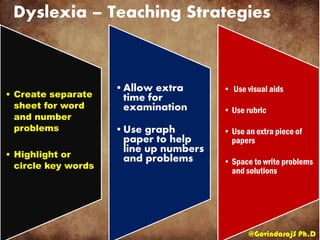
Dyslexia – Teaching Strategies
@GovindarajS Ph.D
• Create separate
sheet for word
and number
problems
• Highlight or
circle key words
•Allow extra
time for
examination
•Use graph
paper to help
line up numbers
and problems
• Use visual aids
• Use rubric
• Use an extra piece of
papers
• Space to write problems
and solutions
https://www.ninds.nih.gov/Disorders/All-Disorders/Learning-Disabilities-Information-
Page
https://ldaamerica.org/advocacy/lda-position-papers/what-are-learning-disabilities/
https://www.msjc.edu/learningskillsprogram/Learning-Disabilities-Characteristics.html
http://www.healthofchildren.com/D/Dyslexia.html
http://ldapei.ca/types-of-learning-disabilities.html
https://www.nessy.com/uk/teachers/essential-teaching-tips-dyslexia/
https://childmind.org/article/understanding-dyslexia/
https://www.dyslexia.uk.net/specific-learning-difficulties/dyscalculia/the-signs-of-
dyscalculia/
https://dyscalculiainfo.weebly.com/characteristics.html
@GovindarajS Ph.D
https://www.understood.org/en/learning-thinking-differences/child-learning-
disabilities/dyscalculia/what-is-dyscalculia
https://www.cognifit.com/pathology/dyscalculia
https://dopasolution.com/dyscalculia/
https://blog.brainbalancecenters.com/2016/02/5-strategies-for-managing-dyscalculia
Google images
https://www.pexels.com/search/hd%20background/
Unsplash.com
@GovindarajS Ph.D

Learning disabilities - Dyslexia and Dyscalculia