BASIC CONCEPT ABOUT
LEARNING DISABILITY
Presented
By
Dr. Syed Hayath Basha, Ph.D.
Assistant Professor of Education
Aligarh Muslim University Malappuram Centre
Cherukara P.O., Perinthalmanna
Dist. Malappuram
Kerala-679340 (India)
Email : hayath83n@gmail.com
Contact: +917736338828/+917382594661
02/24/18
1
WHAT ARE LEARNING DISABILITIES?
 Learning disabilities, or learning disorders, are an umbrella term
for a wide variety of learning problems.
 A learning disability is not a problem with intelligence or
motivation.
 Kids with learning disabilities aren’t lazy or dumb. In fact, most
are just as smart as everyone else.
 Their brains are simply wired differently.
 This difference affects how they receive and process
information.
 Children and adults with learning disabilities see, hear, and
understand things differently.
 This can lead to trouble with learning new information and skills,
and putting them to use.
 The most common types of learning disabilities involve problems
with reading, writing, math, reasoning, listening, and speaking.
02/24/18
2
SIGNS AND SYMPTOMS OF LEARNING
DISABILITIES AND DISORDERS: PRE-SCHOOL
AGE
 Problems pronouncing words
 Trouble finding the right word
 Difficulty rhyming
 Trouble learning the alphabet, numbers, colors,
shapes, days of the week
 Difficulty following directions or learning routines
 Difficulty controlling crayons, pencils, and scissors,
or coloring within the lines
 Trouble with buttons, zippers, snaps, learning to
tie shoes
02/24/18
3
SIGNS AND SYMPTOMS OF
LEARNING DISABILITIES: AGES 5-9
 Trouble learning the connection between letters
and sounds
 Unable to blend sounds to make words
 Confuses basic words when reading
 Slow to learn new skills
 Consistently misspells words and makes frequent
errors
 Trouble learning basic math concepts
 Difficulty telling time and remembering
sequences
02/24/18
4
SIGNS AND SYMPTOMS OF LEARNING
DISABILITIES: AGES 10-13
 Difficulty with reading comprehension or math
skills
 Trouble with open-ended test questions and word
problems
 Dislikes reading and writing; avoids reading aloud
 Poor handwriting
 Poor organizational skills (bedroom, homework,
desk is messy and disorganized)
 Trouble following classroom discussions and
expressing thoughts aloud
 Spells the same word differently in a single
document
02/24/18
5
LEARNING DISABILITIES IN
READING (DYSLEXIA)
Signs of reading difficulty include problems with:
 letter and word recognition
 understanding words and ideas
 reading speed and fluency
 general vocabulary skills
02/24/18
6
LEARNING DISABILITIES IN MATH
(DYSCALCULIA)
 Learning disabilities in math vary greatly depending
on the child’s other strengths and weaknesses.
 A child’s ability to do math will be affected
differently by a language learning disability, or a
visual disorder or a difficulty with sequencing,
memory or organization.
 A child with a math-based learning disorder may
struggle with memorization and organization of
numbers, operation signs, and number “facts” (like
5+5=10 or 5x5=25).
 Children with math learning disorders might also
have trouble with counting principles (such as
counting by twos or counting by fives) or have
difficulty telling time.
02/24/18
7
LEARNING DISABILITIES IN WRITING
(DYSGRAPHIA)
Symptoms of a written language learning disability
revolve around the act of writing. They include
problems with:
 neatness and consistency of writing
 accurately copying letters and words
 spelling consistency writing
 organization and coherence
02/24/18
8
WHAT IS DYSPRAXIA?
 Dyspraxia isn’t a sign of muscle weakness or of low intelligence.
 It’s a brain-based condition that makes it hard to plan and coordinate
physical movement.
 Children with dyspraxia tend to struggle with balance and posture.
 They may appear clumsy or “out of sync” with their environment.
 Dyspraxia goes by many names: developmental coordination disorder,
motor learning difficulty, motor planning difficulty and apraxia of speech.
 It can affect the development of gross motor skills like walking or jumping.
 It can also affect fine motor skills.
 These include things like the hand movements needed to write clearly and
the mouth and tongue movements needed to pronounce words correctly.
 Dyspraxia can affect social skills too. Children with dyspraxia may behave
immaturely even though they typically have average or above-average
intelligence.
 Kids don’t outgrow dyspraxia. But occupational therapy, physical
therapy, speech therapy and other tools and strategies can help.
 Kids can learn to work around areas of weakness and build on their
strengths.
02/24/18
9
DIFFERENT KINDS OF DYSPRAXIA
 Ideomotor dyspraxia: 
 Makes it hard to complete single-step motor tasks such as
combing hair and waving goodbye.
 Ideational dyspraxia: 
 Makes it more difficult to perform a sequence of
movements, like brushing teeth or making a bed.
 Oromotor dyspraxia, also called verbal apraxia or
apraxia of speech:
 Makes it difficult to coordinate muscle movements needed
to pronounce words.
 Kids with dyspraxia may have speech that is slurred and
difficult to understand because they’re unable to enunciate.
 Constructional dyspraxia: 
 Makes it harder to understand spatial relationships.
 Kids with this type of dyspraxia may have difficulty copying
geometric drawings or using building blocks.
02/24/18
10
LEARNING DISABILITIES IN LANGUAGE
(APHASIA/DYSPHASIA)
 Language and communication learning disabilities
involve the ability to understand or produce spoken
language.
 Language is also considered an output activity because
it requires organizing thoughts in the brain and calling
upon the right words to verbally explain something or
communicate with someone else.
 Signs of a language-based learning disorder involve
problems with verbal language skills, such as the ability
to retell a story and the fluency of speech, as well as the
ability to understand the meaning of words, parts of
speech, directions, etc.
02/24/18
11
AUDITORY AND VISUAL PROCESSING
PROBLEMS:
 The eyes and the ears are the primary means of
delivering information to the brain, a process
sometimes called “input.” If either the eyes or the ears
aren’t working properly, learning can suffer.
 Auditory processing disorder – Professionals may refer
to the ability to hear well as
 “auditory processing skills” or “receptive language.”
 The ability to hear things correctly greatly impacts the
ability to read, write and spell.
 An inability to distinguish subtle differences in sound, or
hearing sounds at the wrong speed make it difficult to
sound out words and understand the basic concepts of
reading and writing.
02/24/18
12
…CONTINUED WITH PREVIOUS.
 Visual processing disorder – Problems in
visual perception include missing subtle
 differences in shapes, reversing letters or
numbers, skipping words, skipping lines,
misperceiving depth or distance, or having
problems with eye–hand coordination.
 Professionals may refer to the work of the eyes as
“visual processing.”
 Visual perception can affect gross and fine motor
skills, reading comprehension, and math.
02/24/18
13
HOW CAN WE HELP TO CHILDREN WITH LEARNING
DISABILITIES?
 Learn the specifics about your child’s learning
disability:
 Read and learn about your child’s type of
learning disability.
 Find out how the disability affects the learning
process and what cognitive skills are involved.
 It’s easier to evaluate learning techniques if you
 understand how the learning disability affects
your child.
02/24/18
14
…CONTINUED WITH PREVIOUS.
 Research treatments, services, and new theories:
 Along with knowing about the type of learning disability
your child has, educate yourself about the most effective
treatment options available.
 This can help you advocate for your child at school and
pursue treatment at home.
 Pursue treatment and services at home:
 Even if the school doesn’t have the resources to treat
your child’s learning disability optimally, you can
pursue these options on your own at home or with a
therapist or tutor.
02/24/18
15
…CONTINUED WITH PREVIOUS.
 Nurture your child’s strengths:
 Even though children with learning disabilities
struggle in one area of learning, they may excel
in another.
 Pay attention to your child’s interests and
passions.
 Helping children with learning disorders develop
their passions and strengths will probably help
them with the areas of difficulty as well.
02/24/18
16
TYPES OF SPECIALISTS TO TEST OR DIAGNOSE
LEARNING DISABILITIES
 Clinical psychologists
 School psychologists
 Child psychiatrists
 Educational psychologists
 Developmental psychologists
 Neuropsychologist
 Psychometrist
 Occupational therapist (tests sensory disorders that can
lead to learning problems)
 Speech and language therapist
02/24/18
17
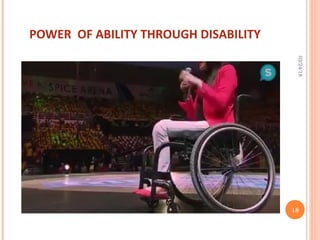
POWER OF ABILITY THROUGH DISABILITY
02/24/18
18
CONCLUSION
 Concept of Learning Disabilities
 Signs and symptoms of LDs
 Learning disabilities in Reading (Dyslexia)
 Learning disabilities in Maths (Dyscalculia)
 Leaning disabilities in Writing (Dysgraphia)
 Learning disabilities in Language
(Aphasia/Dysphasia)
 Leaning disabilities in Motor skills (Dyspraxia)
 Different kinds of dyspraxia
 Auditory and Visual Processing Problems
 Types of Specialists
 Techniques to help children with learning disabilities
02/24/18
19
REFERENCES
 https://www.ctdinstitute.org/sites/default/files/file_attachme
.
02/24/18
20
Open forum for questions
and answers
02/24/1821
THANK
YOU
NOTE:
COMMENTS, SUGGESTIONS AND QUERIES
IF ANY, MAY BE SENT TO
HAYATH83N@GMAIL.COM

Basic Concept about Learning Disability

  • 1.
    BASIC CONCEPT ABOUT LEARNINGDISABILITY Presented By Dr. Syed Hayath Basha, Ph.D. Assistant Professor of Education Aligarh Muslim University Malappuram Centre Cherukara P.O., Perinthalmanna Dist. Malappuram Kerala-679340 (India) Email : hayath83n@gmail.com Contact: +917736338828/+917382594661 02/24/18 1
  • 2.
    WHAT ARE LEARNINGDISABILITIES?  Learning disabilities, or learning disorders, are an umbrella term for a wide variety of learning problems.  A learning disability is not a problem with intelligence or motivation.  Kids with learning disabilities aren’t lazy or dumb. In fact, most are just as smart as everyone else.  Their brains are simply wired differently.  This difference affects how they receive and process information.  Children and adults with learning disabilities see, hear, and understand things differently.  This can lead to trouble with learning new information and skills, and putting them to use.  The most common types of learning disabilities involve problems with reading, writing, math, reasoning, listening, and speaking. 02/24/18 2
  • 3.
    SIGNS AND SYMPTOMSOF LEARNING DISABILITIES AND DISORDERS: PRE-SCHOOL AGE  Problems pronouncing words  Trouble finding the right word  Difficulty rhyming  Trouble learning the alphabet, numbers, colors, shapes, days of the week  Difficulty following directions or learning routines  Difficulty controlling crayons, pencils, and scissors, or coloring within the lines  Trouble with buttons, zippers, snaps, learning to tie shoes 02/24/18 3
  • 4.
    SIGNS AND SYMPTOMSOF LEARNING DISABILITIES: AGES 5-9  Trouble learning the connection between letters and sounds  Unable to blend sounds to make words  Confuses basic words when reading  Slow to learn new skills  Consistently misspells words and makes frequent errors  Trouble learning basic math concepts  Difficulty telling time and remembering sequences 02/24/18 4
  • 5.
    SIGNS AND SYMPTOMSOF LEARNING DISABILITIES: AGES 10-13  Difficulty with reading comprehension or math skills  Trouble with open-ended test questions and word problems  Dislikes reading and writing; avoids reading aloud  Poor handwriting  Poor organizational skills (bedroom, homework, desk is messy and disorganized)  Trouble following classroom discussions and expressing thoughts aloud  Spells the same word differently in a single document 02/24/18 5
  • 6.
    LEARNING DISABILITIES IN READING(DYSLEXIA) Signs of reading difficulty include problems with:  letter and word recognition  understanding words and ideas  reading speed and fluency  general vocabulary skills 02/24/18 6
  • 7.
    LEARNING DISABILITIES INMATH (DYSCALCULIA)  Learning disabilities in math vary greatly depending on the child’s other strengths and weaknesses.  A child’s ability to do math will be affected differently by a language learning disability, or a visual disorder or a difficulty with sequencing, memory or organization.  A child with a math-based learning disorder may struggle with memorization and organization of numbers, operation signs, and number “facts” (like 5+5=10 or 5x5=25).  Children with math learning disorders might also have trouble with counting principles (such as counting by twos or counting by fives) or have difficulty telling time. 02/24/18 7
  • 8.
    LEARNING DISABILITIES INWRITING (DYSGRAPHIA) Symptoms of a written language learning disability revolve around the act of writing. They include problems with:  neatness and consistency of writing  accurately copying letters and words  spelling consistency writing  organization and coherence 02/24/18 8
  • 9.
    WHAT IS DYSPRAXIA? Dyspraxia isn’t a sign of muscle weakness or of low intelligence.  It’s a brain-based condition that makes it hard to plan and coordinate physical movement.  Children with dyspraxia tend to struggle with balance and posture.  They may appear clumsy or “out of sync” with their environment.  Dyspraxia goes by many names: developmental coordination disorder, motor learning difficulty, motor planning difficulty and apraxia of speech.  It can affect the development of gross motor skills like walking or jumping.  It can also affect fine motor skills.  These include things like the hand movements needed to write clearly and the mouth and tongue movements needed to pronounce words correctly.  Dyspraxia can affect social skills too. Children with dyspraxia may behave immaturely even though they typically have average or above-average intelligence.  Kids don’t outgrow dyspraxia. But occupational therapy, physical therapy, speech therapy and other tools and strategies can help.  Kids can learn to work around areas of weakness and build on their strengths. 02/24/18 9
  • 10.
    DIFFERENT KINDS OFDYSPRAXIA  Ideomotor dyspraxia:   Makes it hard to complete single-step motor tasks such as combing hair and waving goodbye.  Ideational dyspraxia:   Makes it more difficult to perform a sequence of movements, like brushing teeth or making a bed.  Oromotor dyspraxia, also called verbal apraxia or apraxia of speech:  Makes it difficult to coordinate muscle movements needed to pronounce words.  Kids with dyspraxia may have speech that is slurred and difficult to understand because they’re unable to enunciate.  Constructional dyspraxia:   Makes it harder to understand spatial relationships.  Kids with this type of dyspraxia may have difficulty copying geometric drawings or using building blocks. 02/24/18 10
  • 11.
    LEARNING DISABILITIES INLANGUAGE (APHASIA/DYSPHASIA)  Language and communication learning disabilities involve the ability to understand or produce spoken language.  Language is also considered an output activity because it requires organizing thoughts in the brain and calling upon the right words to verbally explain something or communicate with someone else.  Signs of a language-based learning disorder involve problems with verbal language skills, such as the ability to retell a story and the fluency of speech, as well as the ability to understand the meaning of words, parts of speech, directions, etc. 02/24/18 11
  • 12.
    AUDITORY AND VISUALPROCESSING PROBLEMS:  The eyes and the ears are the primary means of delivering information to the brain, a process sometimes called “input.” If either the eyes or the ears aren’t working properly, learning can suffer.  Auditory processing disorder – Professionals may refer to the ability to hear well as  “auditory processing skills” or “receptive language.”  The ability to hear things correctly greatly impacts the ability to read, write and spell.  An inability to distinguish subtle differences in sound, or hearing sounds at the wrong speed make it difficult to sound out words and understand the basic concepts of reading and writing. 02/24/18 12
  • 13.
    …CONTINUED WITH PREVIOUS. Visual processing disorder – Problems in visual perception include missing subtle  differences in shapes, reversing letters or numbers, skipping words, skipping lines, misperceiving depth or distance, or having problems with eye–hand coordination.  Professionals may refer to the work of the eyes as “visual processing.”  Visual perception can affect gross and fine motor skills, reading comprehension, and math. 02/24/18 13
  • 14.
    HOW CAN WEHELP TO CHILDREN WITH LEARNING DISABILITIES?  Learn the specifics about your child’s learning disability:  Read and learn about your child’s type of learning disability.  Find out how the disability affects the learning process and what cognitive skills are involved.  It’s easier to evaluate learning techniques if you  understand how the learning disability affects your child. 02/24/18 14
  • 15.
    …CONTINUED WITH PREVIOUS. Research treatments, services, and new theories:  Along with knowing about the type of learning disability your child has, educate yourself about the most effective treatment options available.  This can help you advocate for your child at school and pursue treatment at home.  Pursue treatment and services at home:  Even if the school doesn’t have the resources to treat your child’s learning disability optimally, you can pursue these options on your own at home or with a therapist or tutor. 02/24/18 15
  • 16.
    …CONTINUED WITH PREVIOUS. Nurture your child’s strengths:  Even though children with learning disabilities struggle in one area of learning, they may excel in another.  Pay attention to your child’s interests and passions.  Helping children with learning disorders develop their passions and strengths will probably help them with the areas of difficulty as well. 02/24/18 16
  • 17.
    TYPES OF SPECIALISTSTO TEST OR DIAGNOSE LEARNING DISABILITIES  Clinical psychologists  School psychologists  Child psychiatrists  Educational psychologists  Developmental psychologists  Neuropsychologist  Psychometrist  Occupational therapist (tests sensory disorders that can lead to learning problems)  Speech and language therapist 02/24/18 17
  • 18.
    POWER OF ABILITYTHROUGH DISABILITY 02/24/18 18
  • 19.
    CONCLUSION  Concept ofLearning Disabilities  Signs and symptoms of LDs  Learning disabilities in Reading (Dyslexia)  Learning disabilities in Maths (Dyscalculia)  Leaning disabilities in Writing (Dysgraphia)  Learning disabilities in Language (Aphasia/Dysphasia)  Leaning disabilities in Motor skills (Dyspraxia)  Different kinds of dyspraxia  Auditory and Visual Processing Problems  Types of Specialists  Techniques to help children with learning disabilities 02/24/18 19
  • 20.
  • 21.
    Open forum forquestions and answers 02/24/1821
  • 22.
    THANK YOU NOTE: COMMENTS, SUGGESTIONS ANDQUERIES IF ANY, MAY BE SENT TO HAYATH83N@GMAIL.COM