The Concept of Group Interaction
 According to Sociologist, group interaction is the
  process of defining and responding to various actions
  and relations of individuals in social situations.
 Strauss(1968)
    defines social interaction as the way persons or groups
    act or communicate with one another.
 Zulueta(2002)
    It takes place in social, politics and economic
     institutions and social structures which give impetus to
     social relationship.
Classifications of Social Interaction
 Structural Interaction
    The nature of interaction is based on the established
     structure of the organization.
 Cultural Interaction
    They share common beliefs, ideas and similar patterns
     of behavior and employ some strategies accepted by
     their own culture in solving problems confronting them.
 Religious Interaction
    Social innovations and changes will be effective properly
     through religious organizations.
The Concept of Social Processes
 Social processes refers to any mutual
  interaction experienced by an individual or a group
  on each other in their attempt to solve problems and to
  achieve their desired goals.
 Horton & Hunt (1968)
    Social processes consists of repetitive forms of behavior
     which are commonly found in social life.
 Cole(1968)
    It also refers to a consistent pattern of social interaction
     which can be identified in the society.
Classification of Social Processes
 Social processes are classified into two:
   1. Conjunctive Social Processes
          refers to a group’s effort to maintain and practice consensus,
           cooperation, unification, and integration in the group.
  2.Disjunctive Social Processes
     refers to a process where the members’ efforts are directed
       towards disunity, disintegration, opposition and
    disorganization.
       5 MAJOR CONJUNCTIVE SOCIAL PROCESSES
          Cooperation
           - sharing the responsibility or the act of working together in order to
           achieve a common goal or vision.
           - It is a social process where people work together to achieve a
           group’s common objectives and share some benefits from it.
- Cooperaration can be classified into three major types:
 Informal Cooperation
   - This is a spontaneous give - and - take relationship. It is
   commonly known in primary groups or in Gemeinschaft
   societies.
Example:
       (0)-Boholanos (dayong cooperation in times of death and gala
   during wedding ceremonies)
       (0)-Bayanihan
       (0)-Suki
 Formal Cooperation
   - This type sets formal goals and objectives in social
   interaction
 Symbiotic Cooperation
       - type of cooperation where one or two members of society live
       together harmoniously and support one another for mutual
       interest.
       - Cooperation has several functions:
   i.     It creates social cohesion and integration among the members
          of the group.
   ii. It contributes to social stability and order.
   iii. It posters consensus and compromise in various
          social, economic and political issues.
    Accommodation
       -     adjustment of hostile individuals or groups
       -     process of establishing temporary agreements,
             compromises or negotiations among group members to be
             able to work for a particular period of time without
             friction.
– actual act of working together among individuals or groups
  in spite of differences or latent hostility.
DIFFERENT FORMS OF ACCOMMODATION
 Displacement - a process of ending a conflict using
  a scapegoat
 Conflict - occurs between persons or groups with unequal
  status.
 Superordination - Subordination - works only when it
  is impossible for one group to continue aggression against
  the more powerful group.
 Compromise - a form of accommodation where
  extreme demands are given up to achieve limited goals.
 Release from hostility

 Toleration
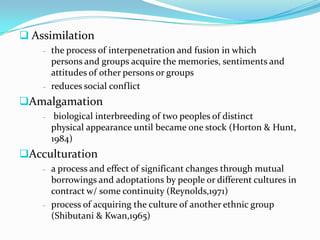
 Assimilation
    –   the process of interpenetration and fusion in which
        persons and groups acquire the memories, sentiments and
        attitudes of other persons or groups
    –   reduces social conflict
Amalgamation
    –    biological interbreeding of two peoples of distinct
        physical appearance until became one stock (Horton & Hunt,
        1984)
Acculturation
    –   a process and effect of significant changes through mutual
        borrowings and adoptations by people or different cultures in
        contract w/ some continuity (Reynolds,1971)
    –   process of acquiring the culture of another ethnic group
        (Shibutani & Kwan,1965)

Group interaction and social processes-sociology (PPT)

  • 2.
    The Concept ofGroup Interaction  According to Sociologist, group interaction is the process of defining and responding to various actions and relations of individuals in social situations.  Strauss(1968)  defines social interaction as the way persons or groups act or communicate with one another.  Zulueta(2002)  It takes place in social, politics and economic institutions and social structures which give impetus to social relationship.
  • 3.
    Classifications of SocialInteraction  Structural Interaction  The nature of interaction is based on the established structure of the organization.  Cultural Interaction  They share common beliefs, ideas and similar patterns of behavior and employ some strategies accepted by their own culture in solving problems confronting them.  Religious Interaction  Social innovations and changes will be effective properly through religious organizations.
  • 4.
    The Concept ofSocial Processes  Social processes refers to any mutual interaction experienced by an individual or a group on each other in their attempt to solve problems and to achieve their desired goals.  Horton & Hunt (1968)  Social processes consists of repetitive forms of behavior which are commonly found in social life.  Cole(1968)  It also refers to a consistent pattern of social interaction which can be identified in the society.
  • 5.
    Classification of SocialProcesses  Social processes are classified into two: 1. Conjunctive Social Processes  refers to a group’s effort to maintain and practice consensus, cooperation, unification, and integration in the group. 2.Disjunctive Social Processes  refers to a process where the members’ efforts are directed towards disunity, disintegration, opposition and disorganization. 5 MAJOR CONJUNCTIVE SOCIAL PROCESSES  Cooperation - sharing the responsibility or the act of working together in order to achieve a common goal or vision. - It is a social process where people work together to achieve a group’s common objectives and share some benefits from it.
  • 6.
    - Cooperaration canbe classified into three major types:  Informal Cooperation - This is a spontaneous give - and - take relationship. It is commonly known in primary groups or in Gemeinschaft societies. Example: (0)-Boholanos (dayong cooperation in times of death and gala during wedding ceremonies) (0)-Bayanihan (0)-Suki  Formal Cooperation - This type sets formal goals and objectives in social interaction
  • 7.
     Symbiotic Cooperation - type of cooperation where one or two members of society live together harmoniously and support one another for mutual interest. - Cooperation has several functions: i. It creates social cohesion and integration among the members of the group. ii. It contributes to social stability and order. iii. It posters consensus and compromise in various social, economic and political issues.  Accommodation - adjustment of hostile individuals or groups - process of establishing temporary agreements, compromises or negotiations among group members to be able to work for a particular period of time without friction.
  • 8.
    – actual actof working together among individuals or groups in spite of differences or latent hostility. DIFFERENT FORMS OF ACCOMMODATION  Displacement - a process of ending a conflict using a scapegoat  Conflict - occurs between persons or groups with unequal status.  Superordination - Subordination - works only when it is impossible for one group to continue aggression against the more powerful group.  Compromise - a form of accommodation where extreme demands are given up to achieve limited goals.  Release from hostility  Toleration
  • 9.
     Assimilation – the process of interpenetration and fusion in which persons and groups acquire the memories, sentiments and attitudes of other persons or groups – reduces social conflict Amalgamation – biological interbreeding of two peoples of distinct physical appearance until became one stock (Horton & Hunt, 1984) Acculturation – a process and effect of significant changes through mutual borrowings and adoptations by people or different cultures in contract w/ some continuity (Reynolds,1971) – process of acquiring the culture of another ethnic group (Shibutani & Kwan,1965)