16 January, 2012
                 Hard Determinism
                                                                         What does
                                                                         determinism mean?
                      Looking at the contrasting
                  philosophies of hard determinism
                         and libertarianism

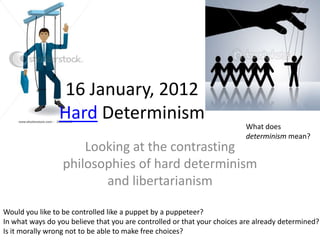
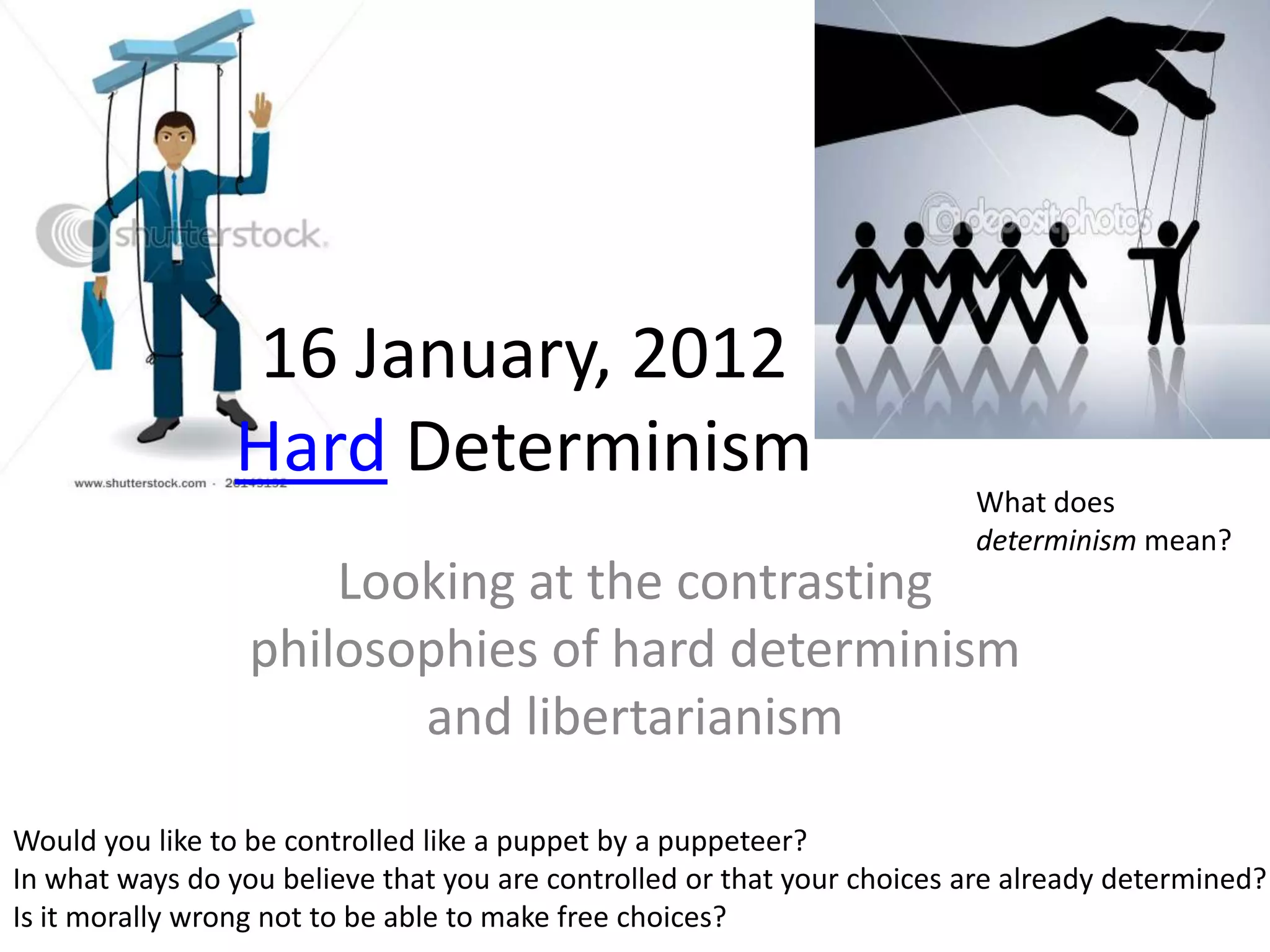
Would you like to be controlled like a puppet by a puppeteer?
In what ways do you believe that you are controlled or that your choices are already determined?
Is it morally wrong not to be able to make free choices?
TERM

• Hard determinism
  The teaching that denies that humanity has
  freewill and believes that all actions have a prior
  cause. It removes moral responsibility for actions.

What is your reaction to this teaching?
Ted Honderich
• ‘... All our choices, decisions, intentions, other
  mental events and our actions are no more
  than effects of other equally necessitated
  events.’

What does this quote mean?
What are it’s implications? How
Could it affect our society?
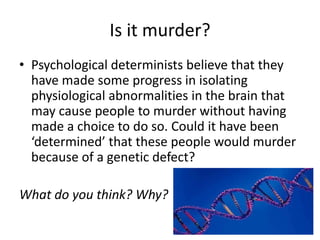
Is it murder?
• Psychological determinists believe that they
  have made some progress in isolating
  physiological abnormalities in the brain that
  may cause people to murder without having
  made a choice to do so. Could it have been
  ‘determined’ that these people would murder
  because of a genetic defect?

What do you think? Why?
• Hard determinism is the view that all choices
  are determined by other events or actions
  prior to the choice.

So, did you ‘decide’ to do A level ethics or was it
  a choice determined by other events and
  actions going right back to your birth? If so,
  what could those events and actions be?
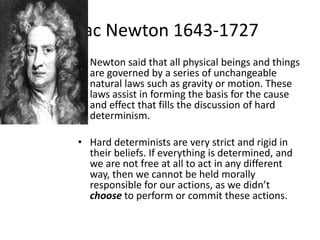
Isaac Newton 1643-1727
 • Newton said that all physical beings and things
   are governed by a series of unchangeable
   natural laws such as gravity or motion. These
   laws assist in forming the basis for the cause
   and effect that fills the discussion of hard
   determinism.

 • Hard determinists are very strict and rigid in
   their beliefs. If everything is determined, and
   we are not free at all to act in any different
   way, then we cannot be held morally
   responsible for our actions, as we didn’t
   choose to perform or commit these actions.
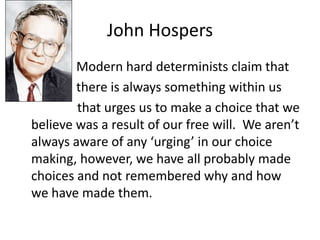
John Hospers
•           Modern hard determinists claim that
•           there is always something within us
            that urges us to make a choice that we
    believe was a result of our free will. We aren’t
    always aware of any ‘urging’ in our choice
    making, however, we have all probably made
    choices and not remembered why and how
    we have made them.
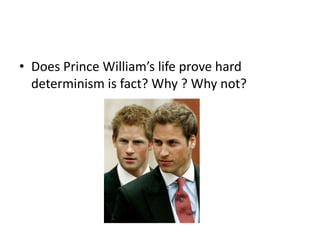
• Does Prince William’s life prove hard
  determinism is fact? Why ? Why not?
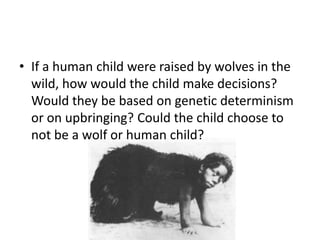
• If a human child were raised by wolves in the
  wild, how would the child make decisions?
  Would they be based on genetic determinism
  or on upbringing? Could the child choose to
  not be a wolf or human child?
LIBERTARIANISM – HUMAN
 CONDITION AND MORAL
          SELF
To understand how important free
will is to the human condition.
REVIEW
•   Determinism says that:
•   Our personality is causally determined
•   We are physically determined
•   Therefore our actions and our emotions are
    causally determined.
Libertarianism (incompatibilism)
• This theory claims that we are morally
  responsible for all our actions and are free to
  make choices.

I don’t complete my homework. Whose fault is it?
I steal a pen from the teacher. Whose fault is it?
I get drunk on a flight home from holiday. Whose
   fault is it?
Why?
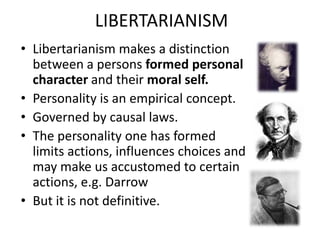
LIBERTARIANISM
• Libertarianism makes a distinction
  between a persons formed personal
  character and their moral self.
• Personality is an empirical concept.
• Governed by causal laws.
• The personality one has formed
  limits actions, influences choices and
  may make us accustomed to certain
  actions, e.g. Darrow
• But it is not definitive.
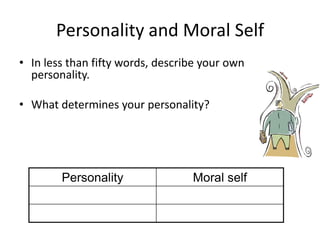
Personality and Moral Self
• In less than fifty words, describe your own
  personality.

• What determines your personality?


        Personality               Moral self
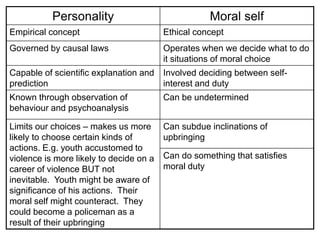
Personality                              Moral self
Empirical concept                        Ethical concept
Governed by causal laws                  Operates when we decide what to do
                                         it situations of moral choice
Capable of scientific explanation and    Involved deciding between self-
prediction                               interest and duty
Known through observation of             Can be undetermined
behaviour and psychoanalysis

Limits our choices – makes us more       Can subdue inclinations of
likely to choose certain kinds of        upbringing
actions. E.g. youth accustomed to
violence is more likely to decide on a   Can do something that satisfies
career of violence BUT not               moral duty
inevitable. Youth might be aware of
significance of his actions. Their
moral self might counteract. They
could become a policeman as a
result of their upbringing
THE MORAL SELF
• It is possible that the youths moral self will
  counteract the tendencies of his personality.
• The moral self is therefore, an ethical concept
  rather than an empirical concept.
• It is operative when we make choices.
• Most commonly this is in operation when we talk
  about making a decision between self-interest
  and duty.
• In the example of stealing / not stealing the moral
  self is able to make a causally undetermined
  choice.
THE MORAL SELF
• Through an effort of will the moral self
  overcomes the pressures of personality and
  becomes morally responsible for what they
  do.
• It is this capacity which distinguishes men
  from animals, the former are capable of moral
  choice, whist the latter are not.

• What does this idea not cover?
THE PERSONALITY AND THE MORAL
                 SELF
•   Political libertarianism investigates the relationship between the state and the
    individual.
•   We are free and morally responsible for our actions.

                           JS Mill – On Liberty

                           Contains an outspoken defence of free speech. Individuals should not be
                            crushed by the will of the many in society. The individual should be heard
                            at all times and they are the most important. the freedom of the individual
                            is primary.

                           Individuality is part of what being human is. It is part of the human
                            condition and allows the person to develop fully and in order to do this
                            they must have free speech and freedom of action. (within reason)

                           Our freedom to act marks both our moral capacity but also our personality.

                           Who I am is defined by the choices I have made in the past.
                           Freedom is important because it is an important part of what it means to
                            be a moral self.
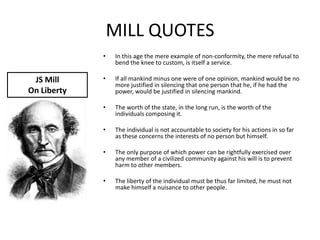
MILL QUOTES
             •   In this age the mere example of non-conformity, the mere refusal to
                 bend the knee to custom, is itself a service.

 JS Mill     •   If all mankind minus one were of one opinion, mankind would be no
                 more justified in silencing that one person that he, if he had the
On Liberty       power, would be justified in silencing mankind.

             •   The worth of the state, in the long run, is the worth of the
                 individuals composing it.

             •   The individual is not accountable to society for his actions in so far
                 as these concerns the interests of no person but himself.

             •   The only purpose of which power can be rightfully exercised over
                 any member of a civilized community against his will is to prevent
                 harm to other members.

             •   The liberty of the individual must be thus far limited, he must not
                 make himself a nuisance to other people.
Tasks
• What are the differences between
  libertarianism and hard determinism?
  Critically evaluate each view..using quotes,
  examples and opinion.
• ‘We do not possess any genuine freedom to
  act ethically’.    Discuss         10 marks

Determinism pp

  • 1.
    16 January, 2012 Hard Determinism What does determinism mean? Looking at the contrasting philosophies of hard determinism and libertarianism Would you like to be controlled like a puppet by a puppeteer? In what ways do you believe that you are controlled or that your choices are already determined? Is it morally wrong not to be able to make free choices?
  • 2.
    TERM • Hard determinism The teaching that denies that humanity has freewill and believes that all actions have a prior cause. It removes moral responsibility for actions. What is your reaction to this teaching?
  • 3.
    Ted Honderich • ‘...All our choices, decisions, intentions, other mental events and our actions are no more than effects of other equally necessitated events.’ What does this quote mean? What are it’s implications? How Could it affect our society?
  • 4.
    Is it murder? •Psychological determinists believe that they have made some progress in isolating physiological abnormalities in the brain that may cause people to murder without having made a choice to do so. Could it have been ‘determined’ that these people would murder because of a genetic defect? What do you think? Why?
  • 5.
    • Hard determinismis the view that all choices are determined by other events or actions prior to the choice. So, did you ‘decide’ to do A level ethics or was it a choice determined by other events and actions going right back to your birth? If so, what could those events and actions be?
  • 6.
    Isaac Newton 1643-1727 • Newton said that all physical beings and things are governed by a series of unchangeable natural laws such as gravity or motion. These laws assist in forming the basis for the cause and effect that fills the discussion of hard determinism. • Hard determinists are very strict and rigid in their beliefs. If everything is determined, and we are not free at all to act in any different way, then we cannot be held morally responsible for our actions, as we didn’t choose to perform or commit these actions.
  • 7.
    John Hospers • Modern hard determinists claim that • there is always something within us that urges us to make a choice that we believe was a result of our free will. We aren’t always aware of any ‘urging’ in our choice making, however, we have all probably made choices and not remembered why and how we have made them.
  • 8.
    • Does PrinceWilliam’s life prove hard determinism is fact? Why ? Why not?
  • 9.
    • If ahuman child were raised by wolves in the wild, how would the child make decisions? Would they be based on genetic determinism or on upbringing? Could the child choose to not be a wolf or human child?
  • 10.
    LIBERTARIANISM – HUMAN CONDITION AND MORAL SELF To understand how important free will is to the human condition.
  • 11.
    REVIEW • Determinism says that: • Our personality is causally determined • We are physically determined • Therefore our actions and our emotions are causally determined.
  • 12.
    Libertarianism (incompatibilism) • Thistheory claims that we are morally responsible for all our actions and are free to make choices. I don’t complete my homework. Whose fault is it? I steal a pen from the teacher. Whose fault is it? I get drunk on a flight home from holiday. Whose fault is it? Why?
  • 13.
    LIBERTARIANISM • Libertarianism makesa distinction between a persons formed personal character and their moral self. • Personality is an empirical concept. • Governed by causal laws. • The personality one has formed limits actions, influences choices and may make us accustomed to certain actions, e.g. Darrow • But it is not definitive.
  • 14.
    Personality and MoralSelf • In less than fifty words, describe your own personality. • What determines your personality? Personality Moral self
  • 15.
    Personality Moral self Empirical concept Ethical concept Governed by causal laws Operates when we decide what to do it situations of moral choice Capable of scientific explanation and Involved deciding between self- prediction interest and duty Known through observation of Can be undetermined behaviour and psychoanalysis Limits our choices – makes us more Can subdue inclinations of likely to choose certain kinds of upbringing actions. E.g. youth accustomed to violence is more likely to decide on a Can do something that satisfies career of violence BUT not moral duty inevitable. Youth might be aware of significance of his actions. Their moral self might counteract. They could become a policeman as a result of their upbringing
  • 16.
    THE MORAL SELF •It is possible that the youths moral self will counteract the tendencies of his personality. • The moral self is therefore, an ethical concept rather than an empirical concept. • It is operative when we make choices. • Most commonly this is in operation when we talk about making a decision between self-interest and duty. • In the example of stealing / not stealing the moral self is able to make a causally undetermined choice.
  • 17.
    THE MORAL SELF •Through an effort of will the moral self overcomes the pressures of personality and becomes morally responsible for what they do. • It is this capacity which distinguishes men from animals, the former are capable of moral choice, whist the latter are not. • What does this idea not cover?
  • 18.
    THE PERSONALITY ANDTHE MORAL SELF • Political libertarianism investigates the relationship between the state and the individual. • We are free and morally responsible for our actions.  JS Mill – On Liberty  Contains an outspoken defence of free speech. Individuals should not be crushed by the will of the many in society. The individual should be heard at all times and they are the most important. the freedom of the individual is primary.  Individuality is part of what being human is. It is part of the human condition and allows the person to develop fully and in order to do this they must have free speech and freedom of action. (within reason)  Our freedom to act marks both our moral capacity but also our personality.  Who I am is defined by the choices I have made in the past.  Freedom is important because it is an important part of what it means to be a moral self.
  • 19.
    MILL QUOTES • In this age the mere example of non-conformity, the mere refusal to bend the knee to custom, is itself a service. JS Mill • If all mankind minus one were of one opinion, mankind would be no more justified in silencing that one person that he, if he had the On Liberty power, would be justified in silencing mankind. • The worth of the state, in the long run, is the worth of the individuals composing it. • The individual is not accountable to society for his actions in so far as these concerns the interests of no person but himself. • The only purpose of which power can be rightfully exercised over any member of a civilized community against his will is to prevent harm to other members. • The liberty of the individual must be thus far limited, he must not make himself a nuisance to other people.
  • 20.
    Tasks • What arethe differences between libertarianism and hard determinism? Critically evaluate each view..using quotes, examples and opinion. • ‘We do not possess any genuine freedom to act ethically’. Discuss 10 marks