Social interaction &Social interaction &
Social ProcessesSocial Processes
Nature & Approaches to SocialNature & Approaches to Social
InteractionInteraction
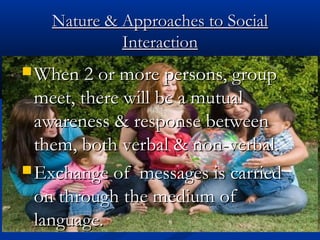
 When 2 or more persons, groupWhen 2 or more persons, group
meet, there will be a mutualmeet, there will be a mutual
awareness & response betweenawareness & response between
them, both verbal & non-verbal.them, both verbal & non-verbal.
 Exchange of messages is carriedExchange of messages is carried
on through the medium ofon through the medium of
language.language.
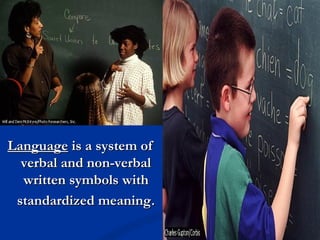
LanguageLanguage is a system ofis a system of
verbal and non-verbalverbal and non-verbal
written symbols withwritten symbols with
standardized meaningstandardized meaning..
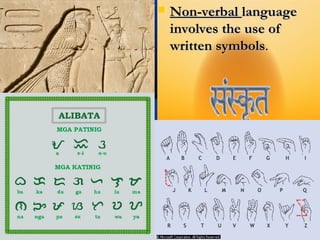
 Non-verbalNon-verbal languagelanguage
involves the use ofinvolves the use of
written symbolswritten symbols..
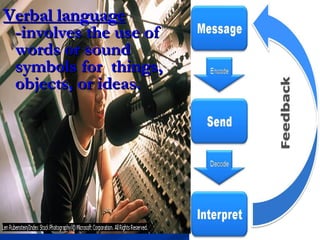
Verbal languageVerbal language
-involves the use of-involves the use of
words or soundwords or sound
symbols for things,symbols for things,
objects, or ideas.objects, or ideas.
 Social interactionSocial interaction refers to therefers to the
mutual inter stimulation &mutual inter stimulation &
response between 2 or moreresponse between 2 or more
persons and groups throughpersons and groups through
symbols, language, gestures, &symbols, language, gestures, &
expression of ideas, (PANOPIO,expression of ideas, (PANOPIO,
1997)1997)
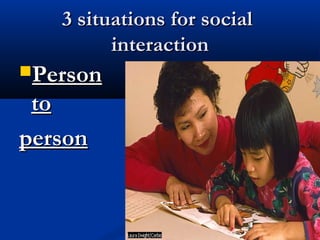
3 situations for social3 situations for social
interactioninteraction
PersonPerson
toto
personperson
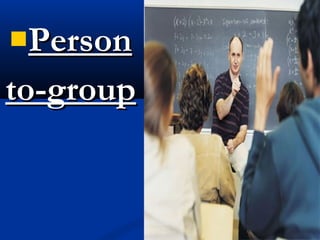
PersonPerson
to-groupto-group
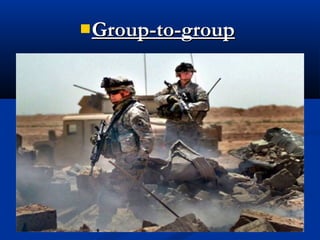
Group-to-groupGroup-to-group
2 Approaches to Social2 Approaches to Social
InteractionInteraction
a.a. SymbolicSymbolic
interactioninteraction
b.b. Functionalist viewFunctionalist view
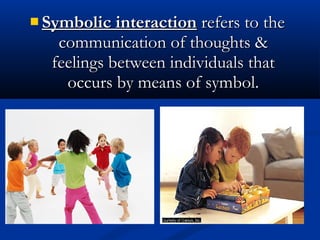
 Symbolic interactionSymbolic interaction refers to therefers to the
communication of thoughts &communication of thoughts &
feelings between individuals thatfeelings between individuals that
occurs by means of symbol.occurs by means of symbol.
Specific Approaches under SymbolicSpecific Approaches under Symbolic
InteractionInteraction
1.1. Definition of the Situation (W.IDefinition of the Situation (W.I
Thomas)Thomas)
-refers to the sociological-refers to the sociological
perspective that views theperspective that views the
meaning people attribute to ameaning people attribute to a
social setting. This process issocial setting. This process is
called “negotiated interaction”called “negotiated interaction”
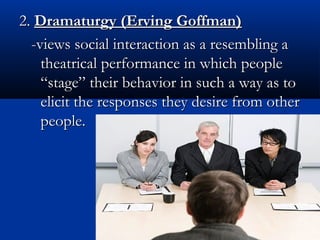
2.2. Dramaturgy (Erving Goffman)Dramaturgy (Erving Goffman)
-views social interaction as a resembling a-views social interaction as a resembling a
theatrical performance in which peopletheatrical performance in which people
“stage” their behavior in such a way as to“stage” their behavior in such a way as to
elicit the responses they desire from otherelicit the responses they desire from other
people.people.
3.3. Ethno MethodologyEthno Methodology
(Harold Garfinkel)(Harold Garfinkel)
-studies the procedures-studies the procedures
people use to make sensepeople use to make sense
of their everyday lives &of their everyday lives &
experiencesexperiences
4.4. Social Exchange (Blau &Social Exchange (Blau &
Homans)Homans)
-portrays interaction as a-portrays interaction as a
more or lessmore or less
straightforward &straightforward &
rationally calculated seriesrationally calculated series
of mutually beneficialof mutually beneficial
transactions.transactions.
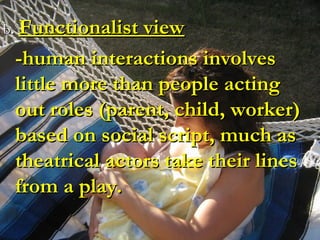
bb.. Functionalist viewFunctionalist view
-human interactions involves-human interactions involves
little more than people actinglittle more than people acting
out roles (parent, child, worker)out roles (parent, child, worker)
based on social script, much asbased on social script, much as
theatrical actors take their linestheatrical actors take their lines
from a play.from a play.
THE NATURE AND SCOPE OFTHE NATURE AND SCOPE OF
SOCIAL PROCESSESSOCIAL PROCESSES
1.1. THE NATURE OF SOCIALTHE NATURE OF SOCIAL
PROCESSPROCESS
Social ProcessSocial Process – refers to the– refers to the
recurrent and patternedrecurrent and patterned
interactions or responses ofinteractions or responses of
individuals to one anotherindividuals to one another
which have attained stability.which have attained stability.
2.2. CLASSIFICATION OF SOCIALCLASSIFICATION OF SOCIAL
PROCESSPROCESS
a.a. Based on FormationBased on Formation
1. Universal or basic processes1. Universal or basic processes
2. Derived social processes2. Derived social processes
b.b. Based on unity or oppositionBased on unity or opposition
1. Conjunctive social processes1. Conjunctive social processes
2. Disjunctive social processes2. Disjunctive social processes
BASED ON FORMATIONBASED ON FORMATION
1.1. Basic or universalBasic or universal
social processessocial processes
–– refers torefers to
patterned andpatterned and
recurrent responsesrecurrent responses
observable in allobservable in all
human societies.human societies.
Three Universal Social Processes
a. Cooperation
- involves two or more
persons joining their
intelligence, efforts, talents and
resources together to attain a
goal which can be shared. (e.g.
business partnership).
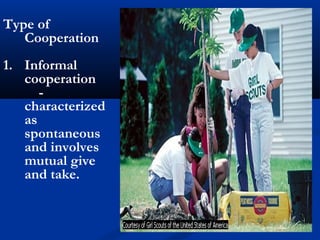
Type of
Cooperation
1. Informal
cooperation
-
characterized
as
spontaneous
and involves
mutual give
and take.
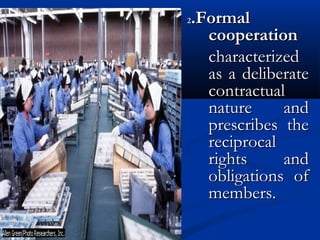
22.Formal.Formal
cooperationcooperation
characterizedcharacterized
as a deliberateas a deliberate
contractualcontractual
nature andnature and
prescribes theprescribes the
reciprocalreciprocal
rights andrights and
obligations ofobligations of
members.members.
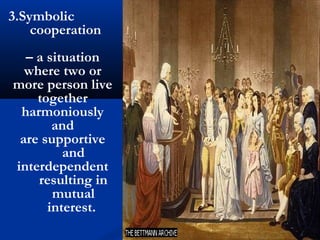
3.Symbolic
cooperation
– a situation
where two or
more person live
together
harmoniously
and
are supportive
and
interdependent
resulting in
mutual
interest.
Functions of Cooperation
- It makes for social cohesion
and integration among the
members of a group.
- It contributes to social
stability and order
- It fosters consensus and
compromise in various social
issues.
b.b. CompetitionCompetition
- it is a form of impersonalized- it is a form of impersonalized
struggle or opposition to secure astruggle or opposition to secure a
reward or goal which cannot bereward or goal which cannot be
shared. It is a form of disjointshared. It is a form of disjoint
action between opposingaction between opposing
individuals or group aimed toindividuals or group aimed to
excel, surpass or outdo theexcel, surpass or outdo the
opponent in order to achieve theopponent in order to achieve the
goal. (e.g. sportsfest; rivalry)goal. (e.g. sportsfest; rivalry)
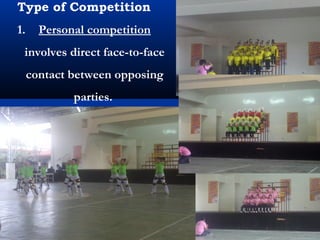
Type of Competition
1. Personal competition
involves direct face-to-face
contact between opposing
parties.
1. Impersonal competition –
involves a struggle
between persons or groups
not directly aware of each
other.
Functions of Competition
- Competing individuals or
groups try to outdo each
other and thereby
innovate ways to do so.
* Competition can be a driving force* Competition can be a driving force
to persons to develop theirto persons to develop their
potentials to the fullest and attainpotentials to the fullest and attain
maximum efficiency andmaximum efficiency and
effectiveness.effectiveness.
* Competition can develop* Competition can develop
productivity, creativity andproductivity, creativity and
ingenuity.ingenuity.
*Competition of members of a*Competition of members of a
society for certain goals and thesociety for certain goals and the
competition for scarce resourcescompetition for scarce resources
lead to variation or differentiation.lead to variation or differentiation.
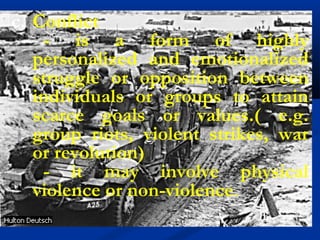
c. Conflict
- is a form of highly
personalized and emotionalized
struggle or opposition between
individuals or groups to attain
scarce goals or values.( e.g.
group riots, violent strikes, war
or revolution)
- it may involve physical
violence or non-violence.
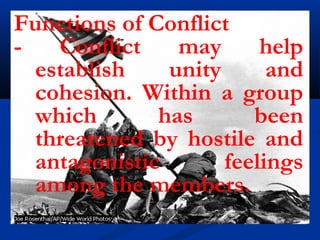
Functions of Conflict
- Conflict may help
establish unity and
cohesion. Within a group
which has been
threatened by hostile and
antagonistic feelings
among the members.
- Internal conflict becomes aInternal conflict becomes a
stabilizing and integratingstabilizing and integrating
mechanism in certain instances.mechanism in certain instances.
- Conflict provides an outlet for theConflict provides an outlet for the
expression of suppressedexpression of suppressed
emotions and frustrations.emotions and frustrations.
- Competition and conflict promoteCompetition and conflict promote
social change.social change.
2. Derived social processes
- refers to secondary social
processes that arise out of the basic
social processes.
a. Acculturation
– it is a social process where
group blends in and takes on some
characteristics of another culture.
Also called cultural borrowing/
imitation. (e.g. Christianization of
Filipinos)
c. Amalgamation
– refers to some kind of biological fusion
through intermarriage of persons coming from
different ethnic groups .(e.g. intermarriage of
Filipino and Chinese)
b. Assimilation
– it involves some kind of interpenetration or fusion of
cultural elements whereby persons or groups accept the
cultural traits, attitudes, beliefs and sentiments of
another through direct, friendly and continuous
contacts. (e.g. Filipino immigrants to American way of
life)
d. Differentiation
– refers to the creation of interest
resulting in individuals or groups
needing or wanting different things or
services rather than the same thing. It
refers to specialization or division of
labor. (e.g. adjacent stores selling
different goods)
e. Accommodation
– refers to the social process whereby
competing or conflicting individuals or
groups trash out difficulties in order to
minimize or stop the conflict.
2.2. Truce or PactTruce or Pact
–– is an agreement to cease hostilities oris an agreement to cease hostilities or
fighting for a certain period of time. (e.g.fighting for a certain period of time. (e.g.
peace negotiations)peace negotiations)
3.3. CompromiseCompromise
–– is a process of settling differences where opposing parties withdraw theiris a process of settling differences where opposing parties withdraw their
demands to adjust their relationship. It involves a give-and-takedemands to adjust their relationship. It involves a give-and-take
relationship, the mutual giving of concessions.relationship, the mutual giving of concessions.
Types of Accommodation
1. Domination
– a process that involves a dominant- subordinate relationship where
the stronger party imposes its will upon the weaker party. It involves power
relations. (e.g. hold-upper and a hold-up victim)
4. Mediation
– is a form of settling disputes where a neutral
third party intervenes and gives suggestions or
recommendations to warning nations or parties
to stop their hostilities.
5. Conciliation
– is an accommodative processes where the
third or neutral party can be anybody to settle
disputes and who may or may not give
recommendations to settle the conflict.
6. Arbitration
– it is an accommodative social process
where the neutral third party has legal
authority to decide on the conflict. The
decision is followed by opposing parties.
(e.g. judge or labor arbiter)
7. Toleration
– is a form of accommodation without
formal agreement. It is a result of the “live
and let live ”policy where conflicting
individuals or groups put up with others
without trying to modify the behavior of
the others.
BASED ON UNITY OR OPPOSITIONBASED ON UNITY OR OPPOSITION
1.1. Conjunctive Social ProcessesConjunctive Social Processes
- they refer to patterned forms of social interactions which- they refer to patterned forms of social interactions which
lead to unity, organization, cooperation and harmony. Theselead to unity, organization, cooperation and harmony. These
include cooperation, acculturation, assimilation, differentiation,include cooperation, acculturation, assimilation, differentiation,
amalgamation and accommodation.amalgamation and accommodation.
2.2. Disjunctive Social ProcessesDisjunctive Social Processes
- they refer to patterned forms of social interactions which- they refer to patterned forms of social interactions which
lead to disunity, disorganization, division, and disharmony.lead to disunity, disorganization, division, and disharmony.
These include competition and conflict.These include competition and conflict.
Social interaction and social processes.ppt(diones)

Social interaction and social processes.ppt(diones)

  • 1.
    Social interaction &Socialinteraction & Social ProcessesSocial Processes
  • 2.
    Nature & Approachesto SocialNature & Approaches to Social InteractionInteraction  When 2 or more persons, groupWhen 2 or more persons, group meet, there will be a mutualmeet, there will be a mutual awareness & response betweenawareness & response between them, both verbal & non-verbal.them, both verbal & non-verbal.  Exchange of messages is carriedExchange of messages is carried on through the medium ofon through the medium of language.language.
  • 3.
    LanguageLanguage is asystem ofis a system of verbal and non-verbalverbal and non-verbal written symbols withwritten symbols with standardized meaningstandardized meaning..
  • 4.
     Non-verbalNon-verbal languagelanguage involvesthe use ofinvolves the use of written symbolswritten symbols..
  • 5.
    Verbal languageVerbal language -involvesthe use of-involves the use of words or soundwords or sound symbols for things,symbols for things, objects, or ideas.objects, or ideas.
  • 6.
     Social interactionSocialinteraction refers to therefers to the mutual inter stimulation &mutual inter stimulation & response between 2 or moreresponse between 2 or more persons and groups throughpersons and groups through symbols, language, gestures, &symbols, language, gestures, & expression of ideas, (PANOPIO,expression of ideas, (PANOPIO, 1997)1997)
  • 7.
    3 situations forsocial3 situations for social interactioninteraction PersonPerson toto personperson
  • 8.
  • 9.
  • 10.
    2 Approaches toSocial2 Approaches to Social InteractionInteraction a.a. SymbolicSymbolic interactioninteraction b.b. Functionalist viewFunctionalist view
  • 11.
     Symbolic interactionSymbolicinteraction refers to therefers to the communication of thoughts &communication of thoughts & feelings between individuals thatfeelings between individuals that occurs by means of symbol.occurs by means of symbol.
  • 12.
    Specific Approaches underSymbolicSpecific Approaches under Symbolic InteractionInteraction 1.1. Definition of the Situation (W.IDefinition of the Situation (W.I Thomas)Thomas) -refers to the sociological-refers to the sociological perspective that views theperspective that views the meaning people attribute to ameaning people attribute to a social setting. This process issocial setting. This process is called “negotiated interaction”called “negotiated interaction”
  • 13.
    2.2. Dramaturgy (ErvingGoffman)Dramaturgy (Erving Goffman) -views social interaction as a resembling a-views social interaction as a resembling a theatrical performance in which peopletheatrical performance in which people “stage” their behavior in such a way as to“stage” their behavior in such a way as to elicit the responses they desire from otherelicit the responses they desire from other people.people.
  • 14.
    3.3. Ethno MethodologyEthnoMethodology (Harold Garfinkel)(Harold Garfinkel) -studies the procedures-studies the procedures people use to make sensepeople use to make sense of their everyday lives &of their everyday lives & experiencesexperiences
  • 15.
    4.4. Social Exchange(Blau &Social Exchange (Blau & Homans)Homans) -portrays interaction as a-portrays interaction as a more or lessmore or less straightforward &straightforward & rationally calculated seriesrationally calculated series of mutually beneficialof mutually beneficial transactions.transactions.
  • 16.
    bb.. Functionalist viewFunctionalistview -human interactions involves-human interactions involves little more than people actinglittle more than people acting out roles (parent, child, worker)out roles (parent, child, worker) based on social script, much asbased on social script, much as theatrical actors take their linestheatrical actors take their lines from a play.from a play.
  • 17.
    THE NATURE ANDSCOPE OFTHE NATURE AND SCOPE OF SOCIAL PROCESSESSOCIAL PROCESSES 1.1. THE NATURE OF SOCIALTHE NATURE OF SOCIAL PROCESSPROCESS Social ProcessSocial Process – refers to the– refers to the recurrent and patternedrecurrent and patterned interactions or responses ofinteractions or responses of individuals to one anotherindividuals to one another which have attained stability.which have attained stability.
  • 18.
    2.2. CLASSIFICATION OFSOCIALCLASSIFICATION OF SOCIAL PROCESSPROCESS a.a. Based on FormationBased on Formation 1. Universal or basic processes1. Universal or basic processes 2. Derived social processes2. Derived social processes b.b. Based on unity or oppositionBased on unity or opposition 1. Conjunctive social processes1. Conjunctive social processes 2. Disjunctive social processes2. Disjunctive social processes
  • 19.
    BASED ON FORMATIONBASEDON FORMATION 1.1. Basic or universalBasic or universal social processessocial processes –– refers torefers to patterned andpatterned and recurrent responsesrecurrent responses observable in allobservable in all human societies.human societies.
  • 20.
    Three Universal SocialProcesses a. Cooperation - involves two or more persons joining their intelligence, efforts, talents and resources together to attain a goal which can be shared. (e.g. business partnership).
  • 21.
  • 22.
    22.Formal.Formal cooperationcooperation characterizedcharacterized as a deliberateasa deliberate contractualcontractual nature andnature and prescribes theprescribes the reciprocalreciprocal rights andrights and obligations ofobligations of members.members.
  • 23.
    3.Symbolic cooperation – a situation wheretwo or more person live together harmoniously and are supportive and interdependent resulting in mutual interest.
  • 24.
    Functions of Cooperation -It makes for social cohesion and integration among the members of a group. - It contributes to social stability and order - It fosters consensus and compromise in various social issues.
  • 25.
    b.b. CompetitionCompetition - itis a form of impersonalized- it is a form of impersonalized struggle or opposition to secure astruggle or opposition to secure a reward or goal which cannot bereward or goal which cannot be shared. It is a form of disjointshared. It is a form of disjoint action between opposingaction between opposing individuals or group aimed toindividuals or group aimed to excel, surpass or outdo theexcel, surpass or outdo the opponent in order to achieve theopponent in order to achieve the goal. (e.g. sportsfest; rivalry)goal. (e.g. sportsfest; rivalry)
  • 26.
    Type of Competition 1.Personal competition involves direct face-to-face contact between opposing parties.
  • 27.
    1. Impersonal competition– involves a struggle between persons or groups not directly aware of each other.
  • 28.
    Functions of Competition -Competing individuals or groups try to outdo each other and thereby innovate ways to do so.
  • 29.
    * Competition canbe a driving force* Competition can be a driving force to persons to develop theirto persons to develop their potentials to the fullest and attainpotentials to the fullest and attain maximum efficiency andmaximum efficiency and effectiveness.effectiveness. * Competition can develop* Competition can develop productivity, creativity andproductivity, creativity and ingenuity.ingenuity. *Competition of members of a*Competition of members of a society for certain goals and thesociety for certain goals and the competition for scarce resourcescompetition for scarce resources lead to variation or differentiation.lead to variation or differentiation.
  • 30.
    c. Conflict - isa form of highly personalized and emotionalized struggle or opposition between individuals or groups to attain scarce goals or values.( e.g. group riots, violent strikes, war or revolution) - it may involve physical violence or non-violence.
  • 31.
    Functions of Conflict -Conflict may help establish unity and cohesion. Within a group which has been threatened by hostile and antagonistic feelings among the members.
  • 32.
    - Internal conflictbecomes aInternal conflict becomes a stabilizing and integratingstabilizing and integrating mechanism in certain instances.mechanism in certain instances. - Conflict provides an outlet for theConflict provides an outlet for the expression of suppressedexpression of suppressed emotions and frustrations.emotions and frustrations. - Competition and conflict promoteCompetition and conflict promote social change.social change.
  • 33.
    2. Derived socialprocesses - refers to secondary social processes that arise out of the basic social processes. a. Acculturation – it is a social process where group blends in and takes on some characteristics of another culture. Also called cultural borrowing/ imitation. (e.g. Christianization of Filipinos)
  • 34.
    c. Amalgamation – refersto some kind of biological fusion through intermarriage of persons coming from different ethnic groups .(e.g. intermarriage of Filipino and Chinese) b. Assimilation – it involves some kind of interpenetration or fusion of cultural elements whereby persons or groups accept the cultural traits, attitudes, beliefs and sentiments of another through direct, friendly and continuous contacts. (e.g. Filipino immigrants to American way of life)
  • 35.
    d. Differentiation – refersto the creation of interest resulting in individuals or groups needing or wanting different things or services rather than the same thing. It refers to specialization or division of labor. (e.g. adjacent stores selling different goods) e. Accommodation – refers to the social process whereby competing or conflicting individuals or groups trash out difficulties in order to minimize or stop the conflict.
  • 36.
    2.2. Truce orPactTruce or Pact –– is an agreement to cease hostilities oris an agreement to cease hostilities or fighting for a certain period of time. (e.g.fighting for a certain period of time. (e.g. peace negotiations)peace negotiations) 3.3. CompromiseCompromise –– is a process of settling differences where opposing parties withdraw theiris a process of settling differences where opposing parties withdraw their demands to adjust their relationship. It involves a give-and-takedemands to adjust their relationship. It involves a give-and-take relationship, the mutual giving of concessions.relationship, the mutual giving of concessions. Types of Accommodation 1. Domination – a process that involves a dominant- subordinate relationship where the stronger party imposes its will upon the weaker party. It involves power relations. (e.g. hold-upper and a hold-up victim)
  • 37.
    4. Mediation – isa form of settling disputes where a neutral third party intervenes and gives suggestions or recommendations to warning nations or parties to stop their hostilities. 5. Conciliation – is an accommodative processes where the third or neutral party can be anybody to settle disputes and who may or may not give recommendations to settle the conflict.
  • 38.
    6. Arbitration – itis an accommodative social process where the neutral third party has legal authority to decide on the conflict. The decision is followed by opposing parties. (e.g. judge or labor arbiter) 7. Toleration – is a form of accommodation without formal agreement. It is a result of the “live and let live ”policy where conflicting individuals or groups put up with others without trying to modify the behavior of the others.
  • 39.
    BASED ON UNITYOR OPPOSITIONBASED ON UNITY OR OPPOSITION 1.1. Conjunctive Social ProcessesConjunctive Social Processes - they refer to patterned forms of social interactions which- they refer to patterned forms of social interactions which lead to unity, organization, cooperation and harmony. Theselead to unity, organization, cooperation and harmony. These include cooperation, acculturation, assimilation, differentiation,include cooperation, acculturation, assimilation, differentiation, amalgamation and accommodation.amalgamation and accommodation. 2.2. Disjunctive Social ProcessesDisjunctive Social Processes - they refer to patterned forms of social interactions which- they refer to patterned forms of social interactions which lead to disunity, disorganization, division, and disharmony.lead to disunity, disorganization, division, and disharmony. These include competition and conflict.These include competition and conflict.