Assessment in HE PG Cert HE: Developing Professional Practice in HE By Rachel Stubley, School of Education and Centre for Excellence in Learning and Teaching, University of Wales, Newport 2nd December 2009
Session objectives to describe key terms and concepts in assessment to evaluate the role of assessment tools in learning to analyse own assessment practices to develop creative thinking around assessment!  
Who cares about assessment?
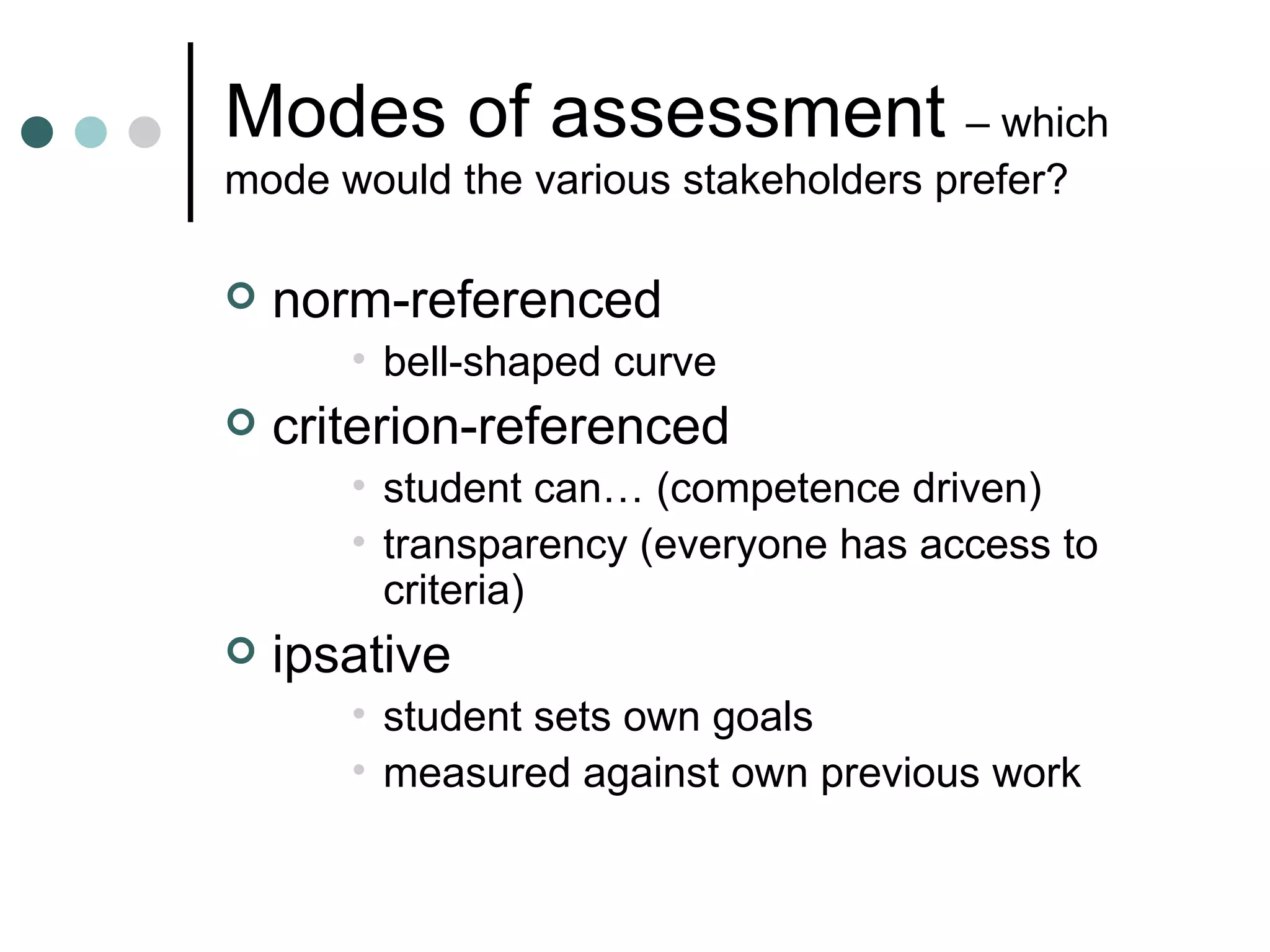
Modes of assessment  – which mode would the various stakeholders prefer? norm-referenced  bell-shaped curve criterion-referenced student can… (competence driven) transparency (everyone has access to criteria) ipsative student sets own goals  measured against own previous work
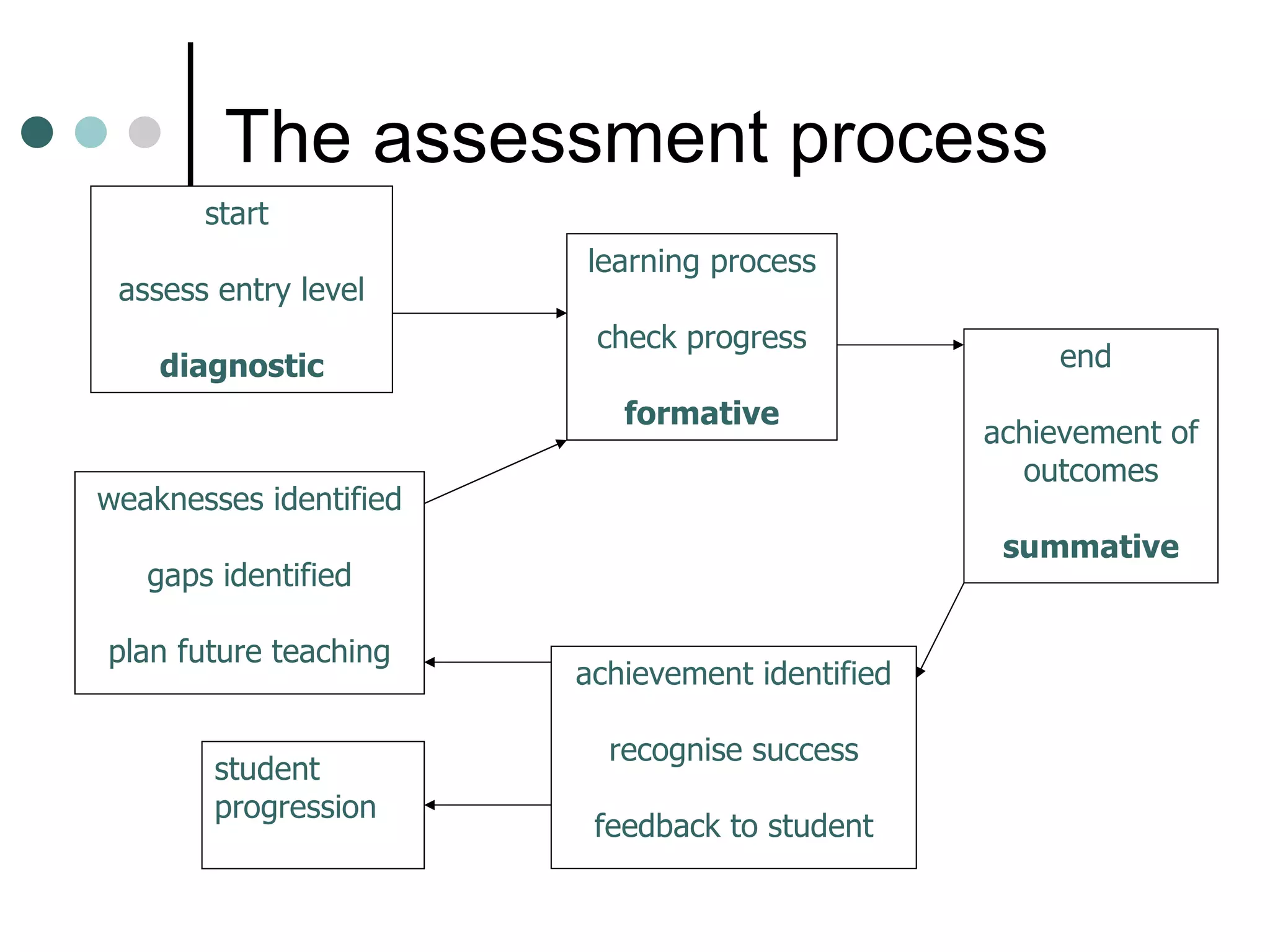
The assessment process start  assess entry level diagnostic learning process check progress formative end  achievement of outcomes summative achievement identified recognise success feedback to student weaknesses identified gaps identified plan future teaching student progression
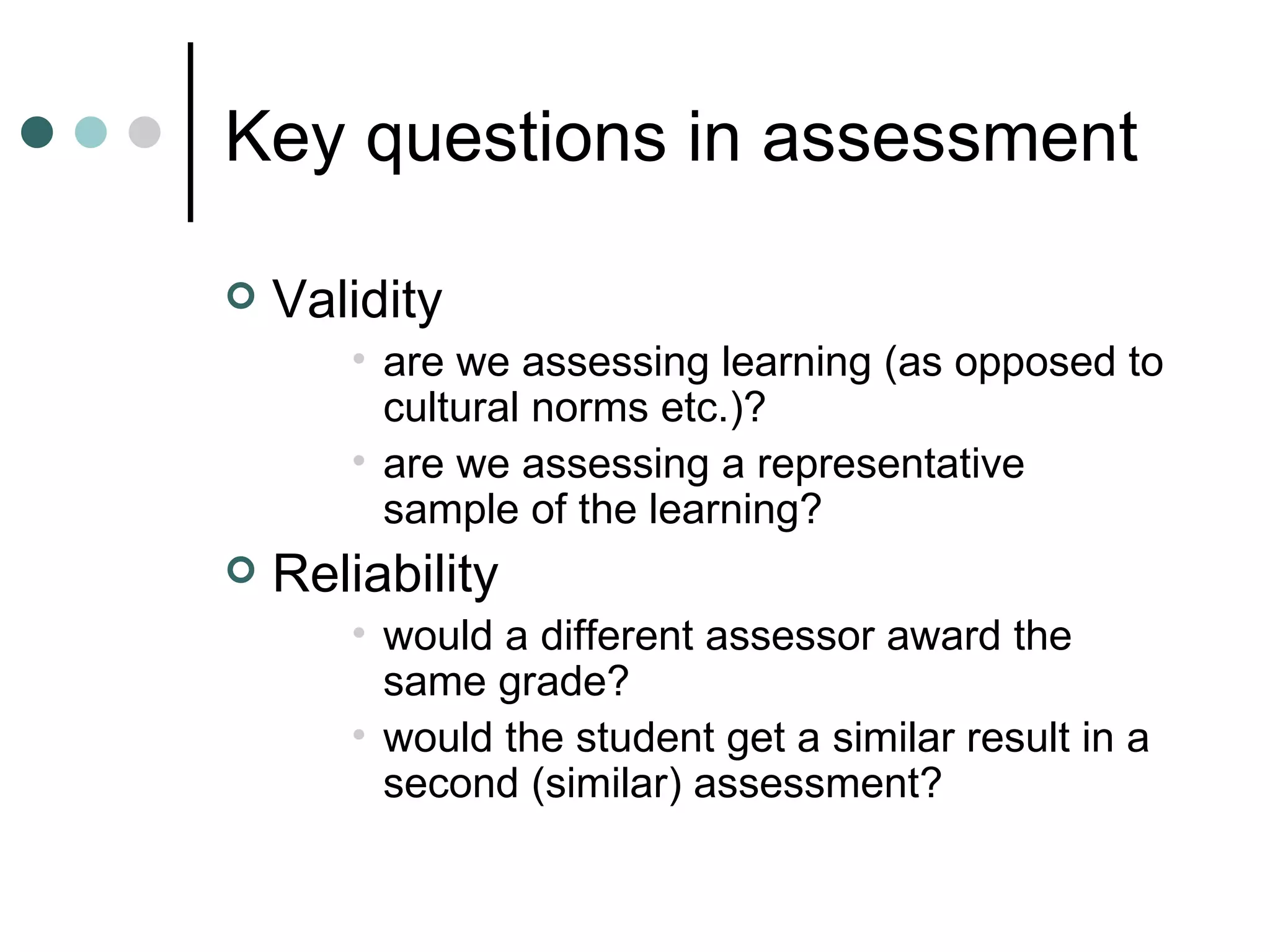
Key questions in assessment   Validity are we assessing learning (as opposed to cultural norms etc.)? are we assessing a representative sample of the learning? Reliability would a different assessor award the same grade? would the student get a similar result in a second (similar) assessment?
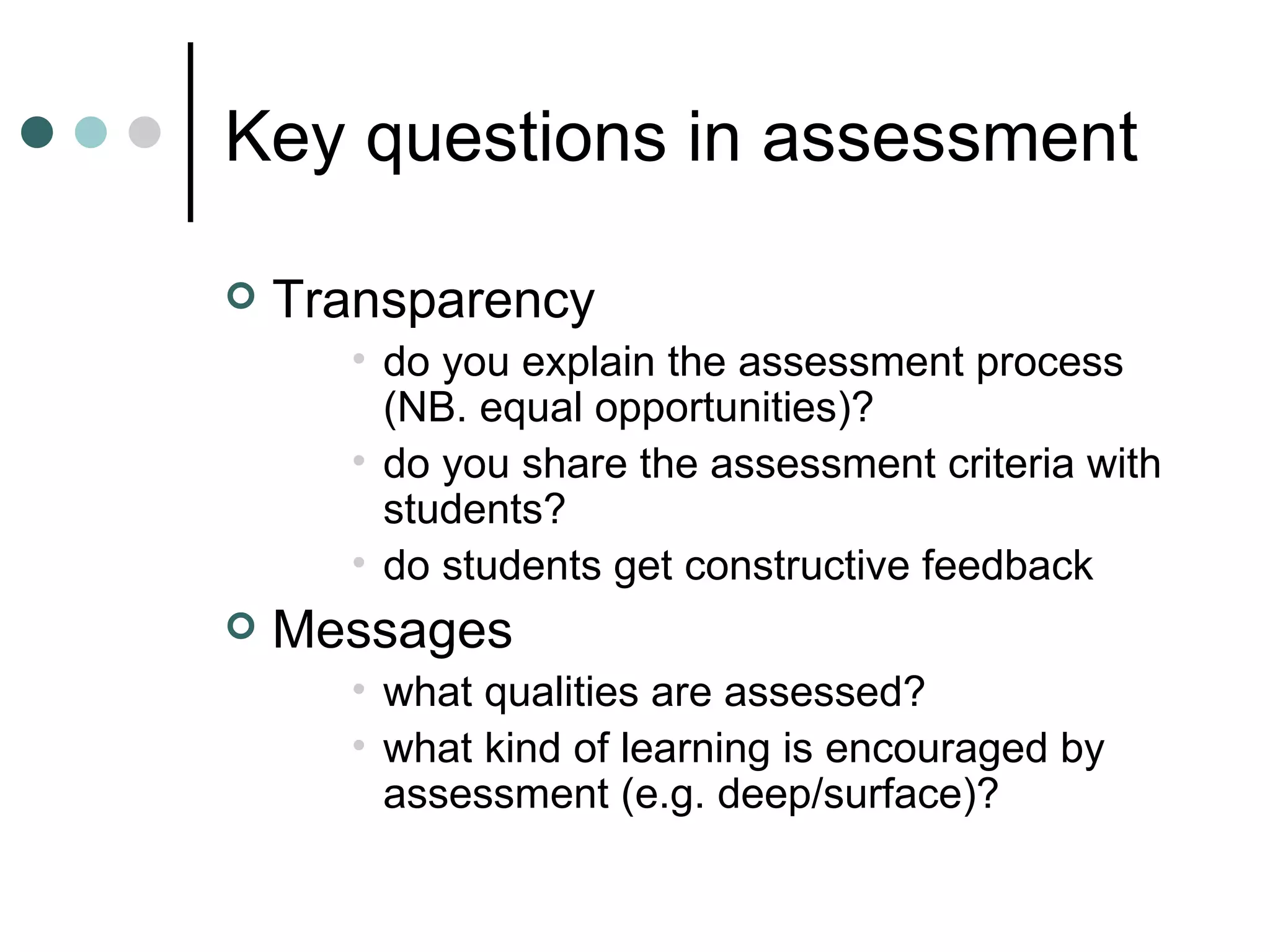
Key questions in assessment Transparency do you explain the assessment process (NB. equal opportunities)? do you share the assessment criteria with students? do students get constructive feedback Messages what qualities are assessed? what kind of learning is encouraged by assessment (e.g. deep/surface)?
Further study Assessment Reform Group at  http://arg.educ.cam.ac.uk Boud, D. & Falchikov, N. (2007)  Rethinking Assessment in Higher Education: learning for the longer term  London. Routledge HEA www.ukcle.ac.uk/resources/assessment/formative.html  (law subject centre) Schwartz, P. & Webb, G. (2002)  Assessment: case studies, experience and practice from higher education  London: Kogan Page

Assessment in Higher Education

  • 1.
    Assessment in HEPG Cert HE: Developing Professional Practice in HE By Rachel Stubley, School of Education and Centre for Excellence in Learning and Teaching, University of Wales, Newport 2nd December 2009
  • 2.
    Session objectives todescribe key terms and concepts in assessment to evaluate the role of assessment tools in learning to analyse own assessment practices to develop creative thinking around assessment! 
  • 3.
    Who cares aboutassessment?
  • 4.
    Modes of assessment – which mode would the various stakeholders prefer? norm-referenced bell-shaped curve criterion-referenced student can… (competence driven) transparency (everyone has access to criteria) ipsative student sets own goals measured against own previous work
  • 5.
    The assessment processstart assess entry level diagnostic learning process check progress formative end achievement of outcomes summative achievement identified recognise success feedback to student weaknesses identified gaps identified plan future teaching student progression
  • 6.
    Key questions inassessment Validity are we assessing learning (as opposed to cultural norms etc.)? are we assessing a representative sample of the learning? Reliability would a different assessor award the same grade? would the student get a similar result in a second (similar) assessment?
  • 7.
    Key questions inassessment Transparency do you explain the assessment process (NB. equal opportunities)? do you share the assessment criteria with students? do students get constructive feedback Messages what qualities are assessed? what kind of learning is encouraged by assessment (e.g. deep/surface)?
  • 8.
    Further study AssessmentReform Group at http://arg.educ.cam.ac.uk Boud, D. & Falchikov, N. (2007) Rethinking Assessment in Higher Education: learning for the longer term London. Routledge HEA www.ukcle.ac.uk/resources/assessment/formative.html (law subject centre) Schwartz, P. & Webb, G. (2002) Assessment: case studies, experience and practice from higher education London: Kogan Page