Foothill Energy System

       Foothill College
          Fall 2012
Big Ideas
• Modern utility systems
• Foothill’s power grid
• Renewable Energy (RE), Distributed
  generation (DG) and Intelligent Grid (IG)
• New Electricity Model
• Energy pulse of a building
• Energy Intelligence Ei = cm3
Important Energy Units
•   KW => Kilowatts (1,000 watts)
•   MW => Megawatts (1,000,000 watts)
•   kWh => Kilowatt-Hours
•   mWh => Megawatt-Hours
•   Therms => 100,000 BTU of heat capacity
•   BTU => British Thermal Units
•   Joule => one watt-second
•   KJ => Kilo Joules (~ 0.95 BTU)
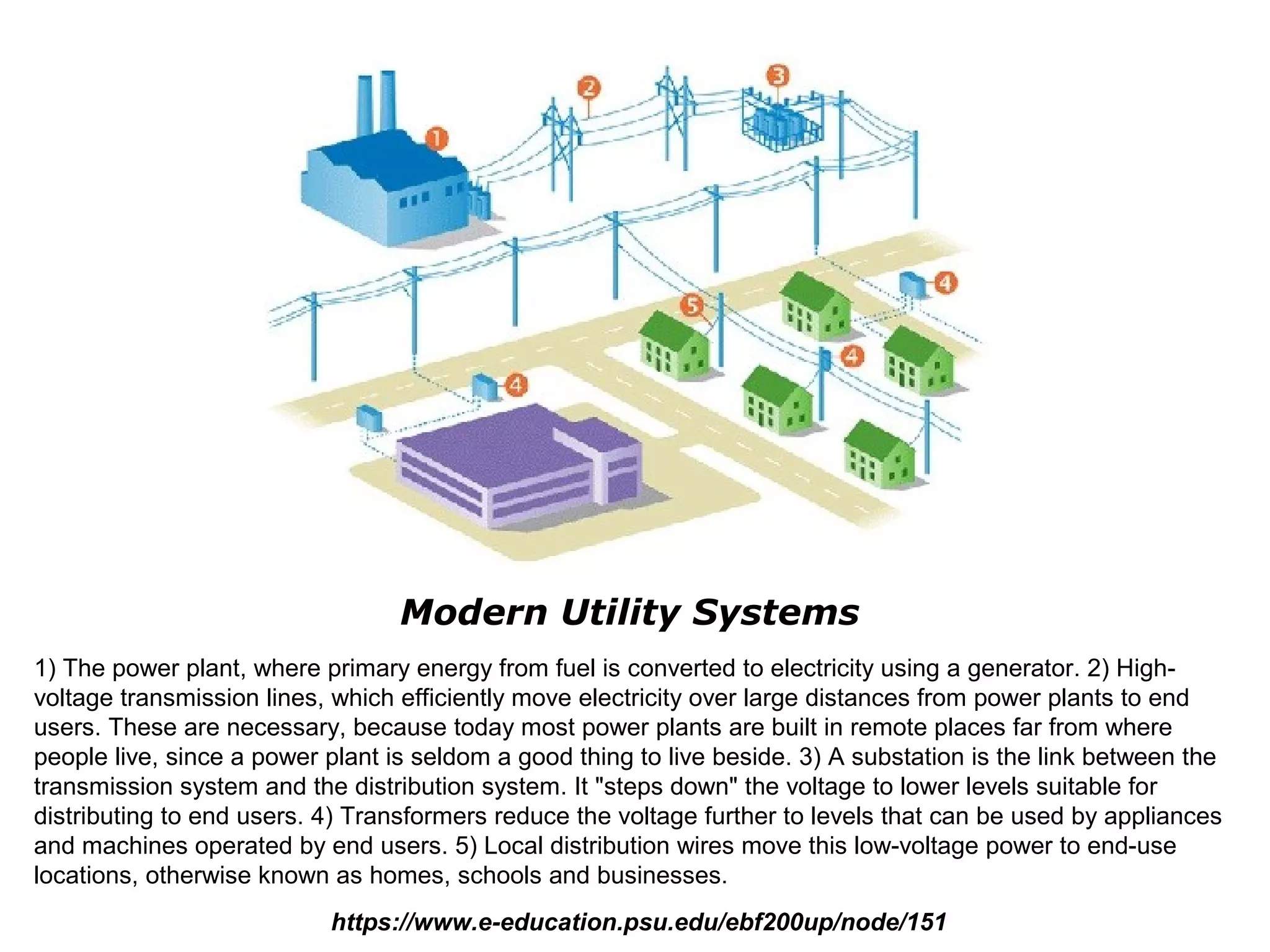
Modern Utility Systems
1) The power plant, where primary energy from fuel is converted to electricity using a generator. 2) High-
voltage transmission lines, which efficiently move electricity over large distances from power plants to end
users. These are necessary, because today most power plants are built in remote places far from where
people live, since a power plant is seldom a good thing to live beside. 3) A substation is the link between the
transmission system and the distribution system. It "steps down" the voltage to lower levels suitable for
distributing to end users. 4) Transformers reduce the voltage further to levels that can be used by appliances
and machines operated by end users. 5) Local distribution wires move this low-voltage power to end-use
locations, otherwise known as homes, schools and businesses.
                           https://www.e-education.psu.edu/ebf200up/node/151
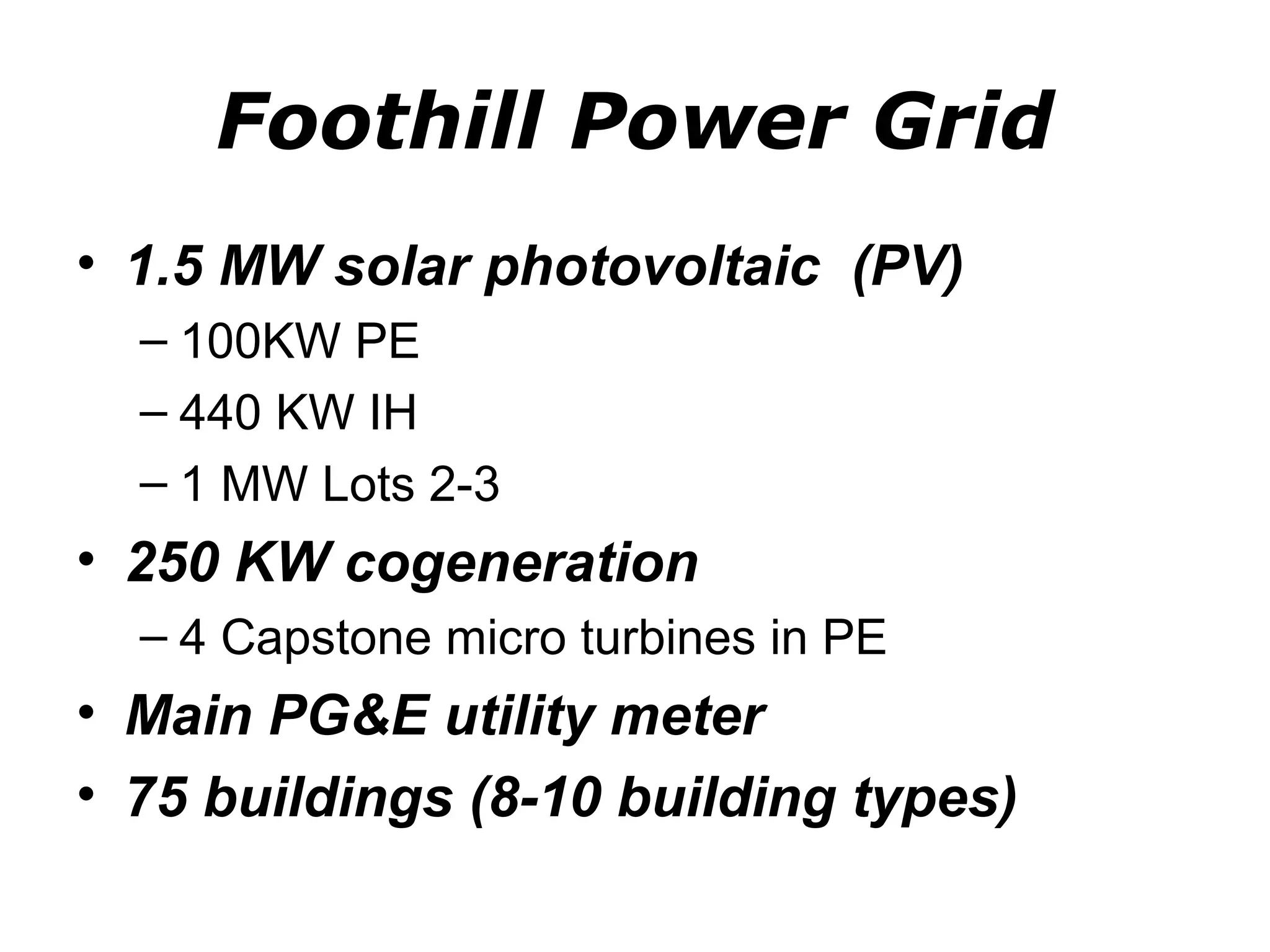
Foothill Power Grid
• 1.5 MW solar photovoltaic (PV)
  – 100KW PE
  – 440 KW IH
  – 1 MW Lots 2-3
• 250 KW cogeneration
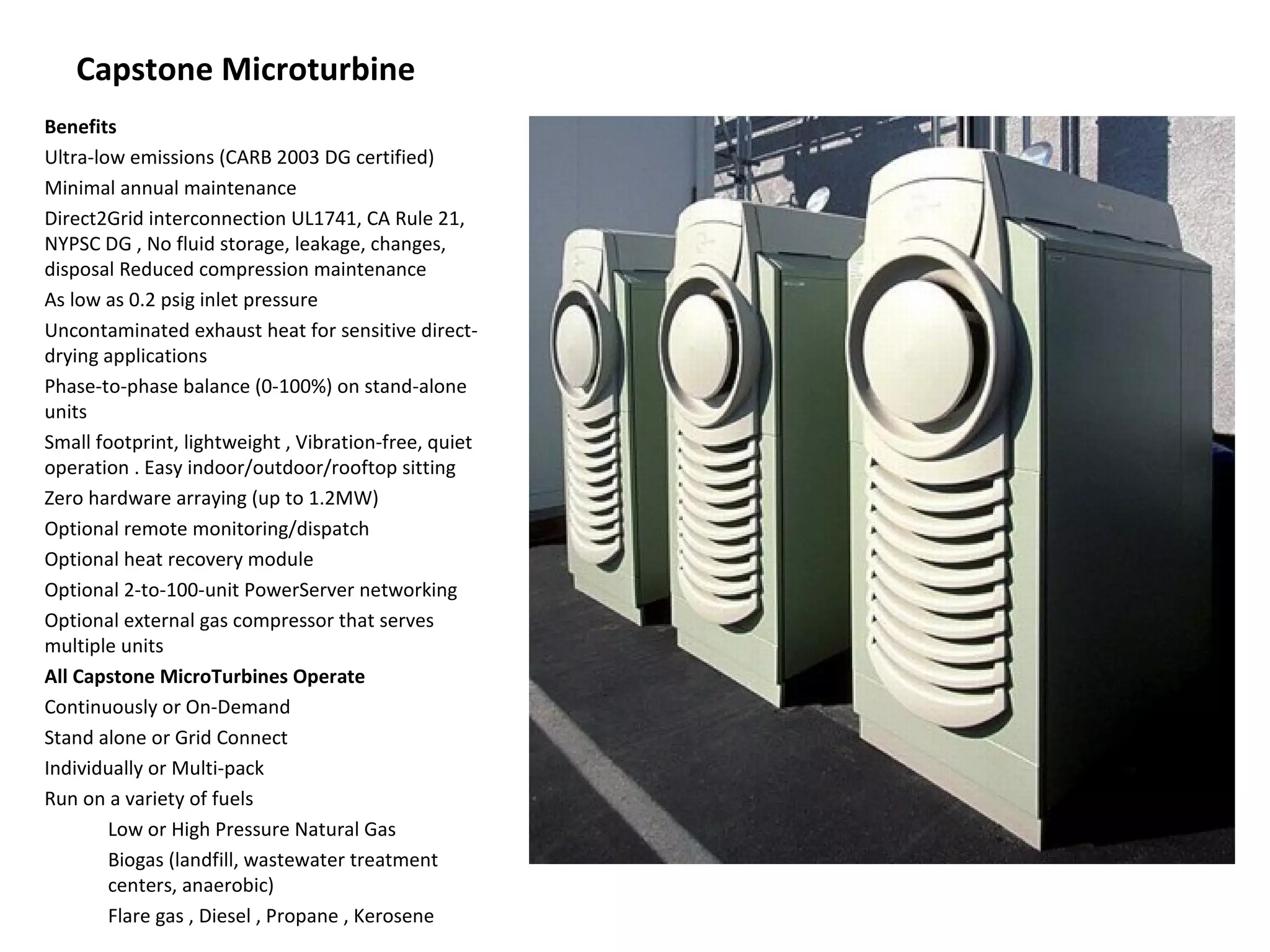
  – 4 Capstone micro turbines in PE
• Main PG&E utility meter
• 75 buildings (8-10 building types)
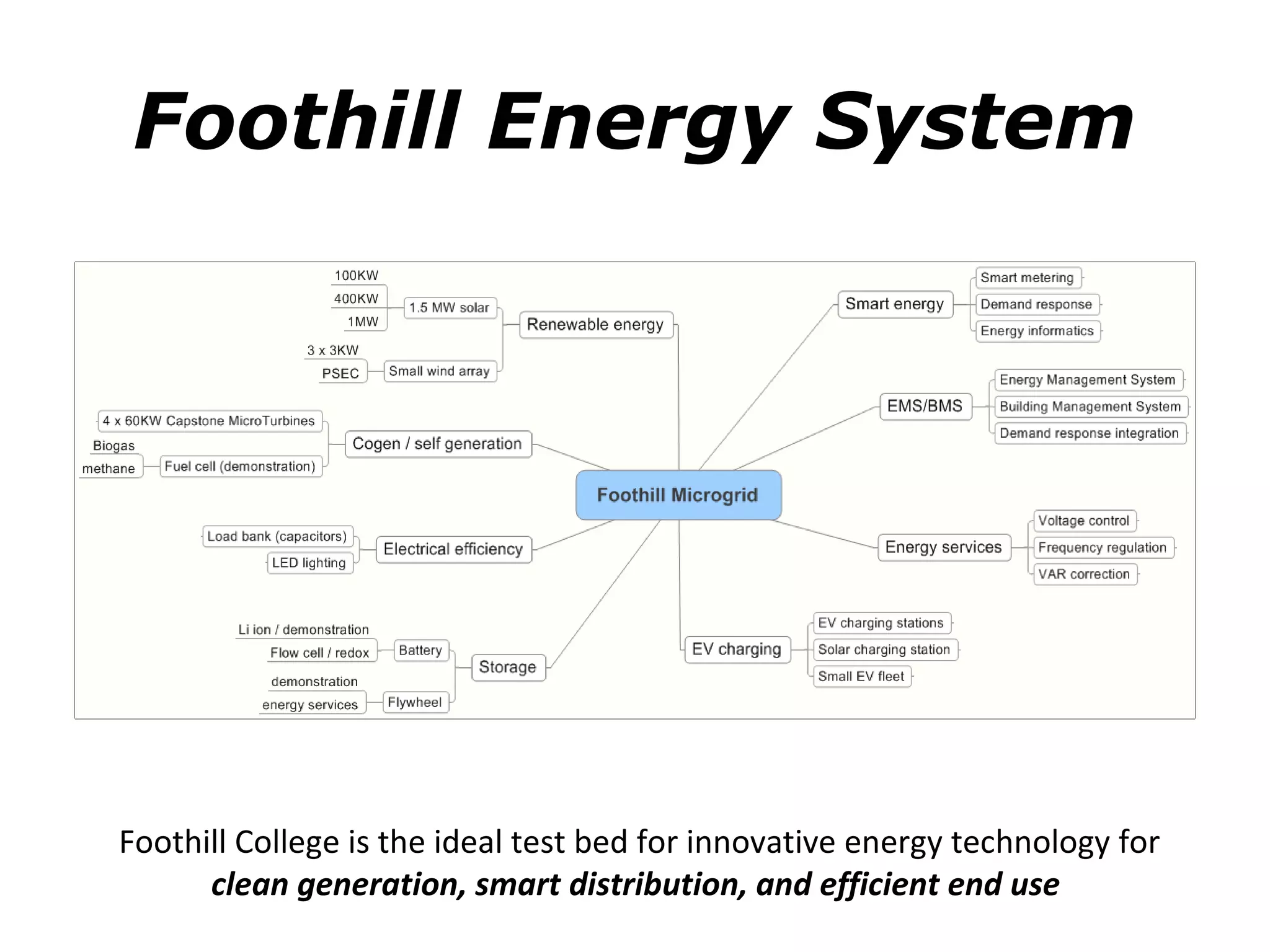
Foothill Energy System


Foothill College is the ideal test bed for innovative energy technology for
      clean generation, smart distribution, and efficient end use
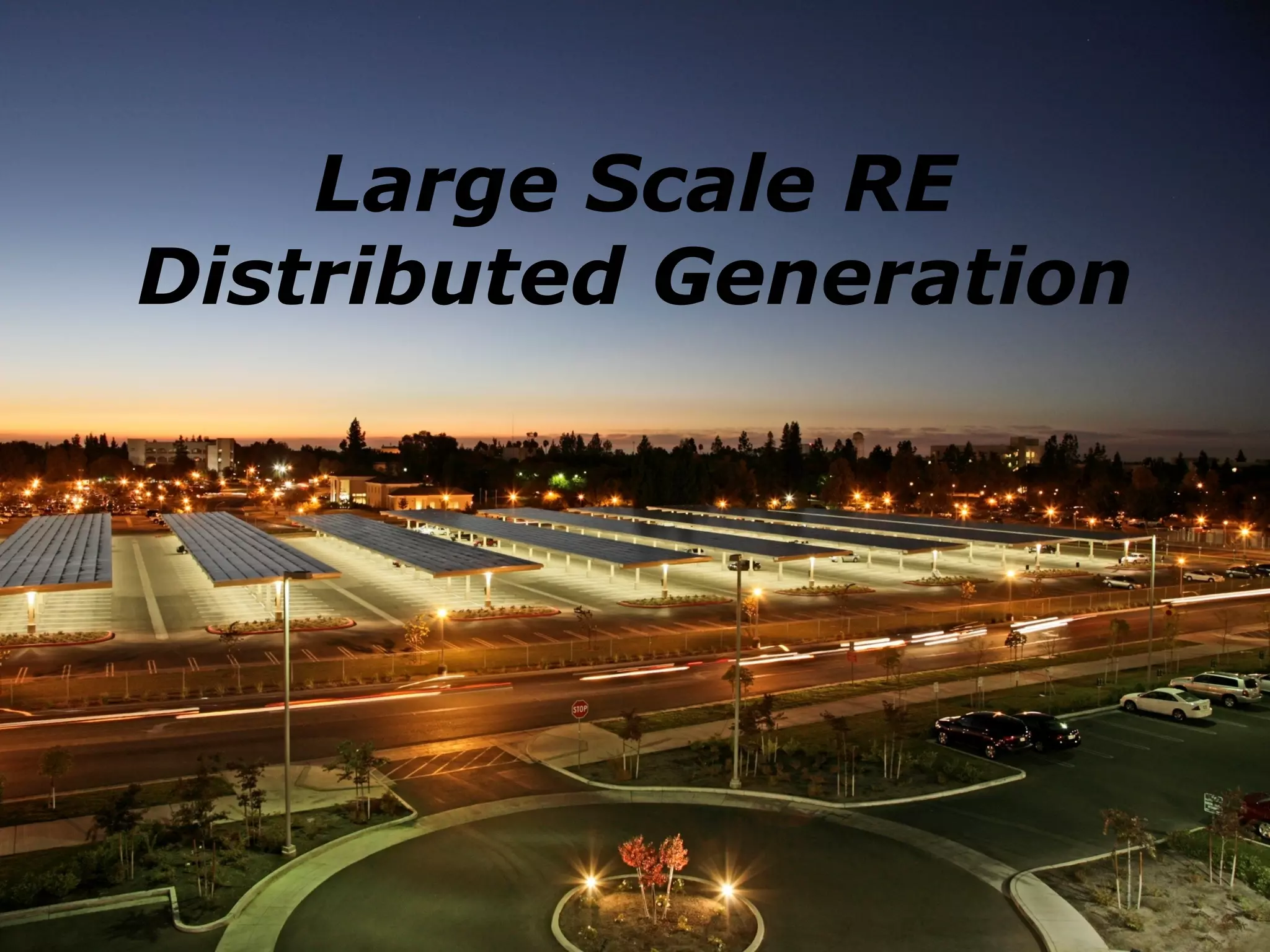
Large Scale RE
Distributed Generation
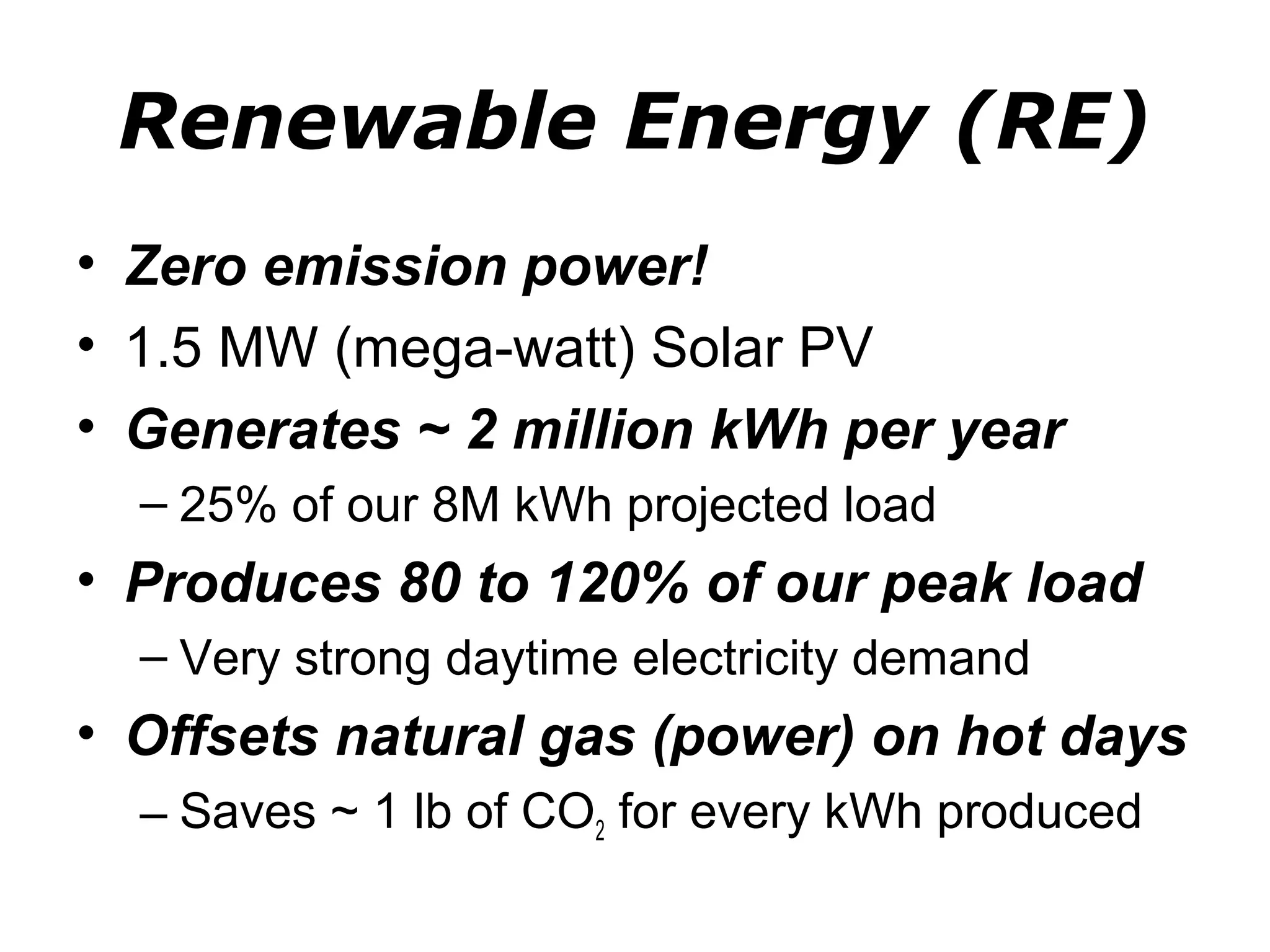
Renewable Energy (RE)
• Zero emission power!
• 1.5 MW (mega-watt) Solar PV
• Generates ~ 2 million kWh per year
  – 25% of our 8M kWh projected load
• Produces 80 to 120% of our peak load
  – Very strong daytime electricity demand
• Offsets natural gas (power) on hot days
  – Saves ~ 1 lb of CO2 for every kWh produced
Capstone Microturbine
Benefits
Ultra-low emissions (CARB 2003 DG certified)
Minimal annual maintenance
Direct2Grid interconnection UL1741, CA Rule 21,
NYPSC DG , No fluid storage, leakage, changes,
disposal Reduced compression maintenance
As low as 0.2 psig inlet pressure
Uncontaminated exhaust heat for sensitive direct-
drying applications
Phase-to-phase balance (0-100%) on stand-alone
units
Small footprint, lightweight , Vibration-free, quiet
operation . Easy indoor/outdoor/rooftop sitting
Zero hardware arraying (up to 1.2MW)
Optional remote monitoring/dispatch
Optional heat recovery module
Optional 2-to-100-unit PowerServer networking
Optional external gas compressor that serves
multiple units
All Capstone MicroTurbines Operate
Continuously or On-Demand
Stand alone or Grid Connect
Individually or Multi-pack
Run on a variety of fuels
        Low or High Pressure Natural Gas
        Biogas (landfill, wastewater treatment
        centers, anaerobic)
        Flare gas , Diesel , Propane , Kerosene
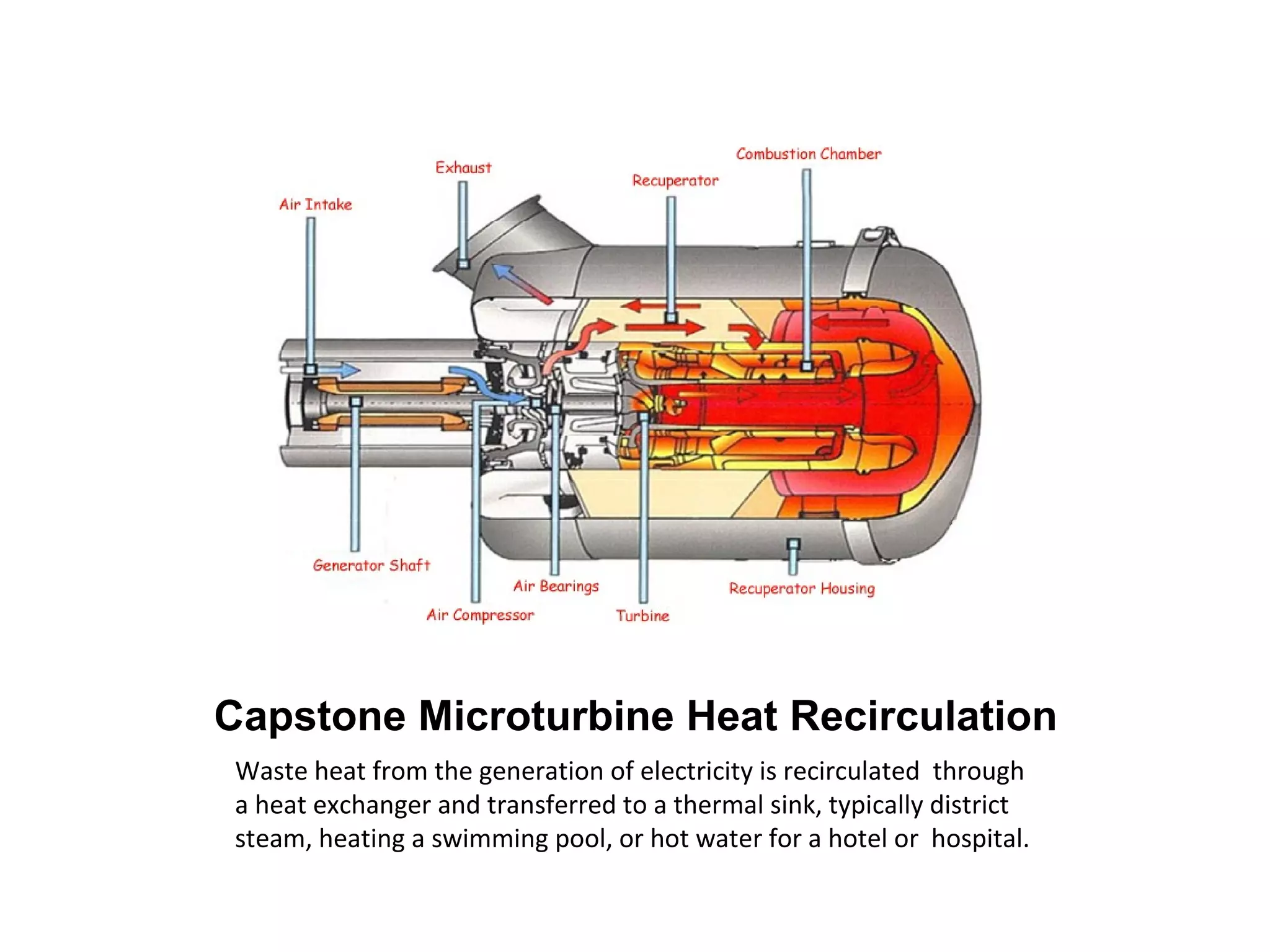
Capstone Microturbine Heat Recirculation
 Waste heat from the generation of electricity is recirculated through
 a heat exchanger and transferred to a thermal sink, typically district
 steam, heating a swimming pool, or hot water for a hotel or hospital.
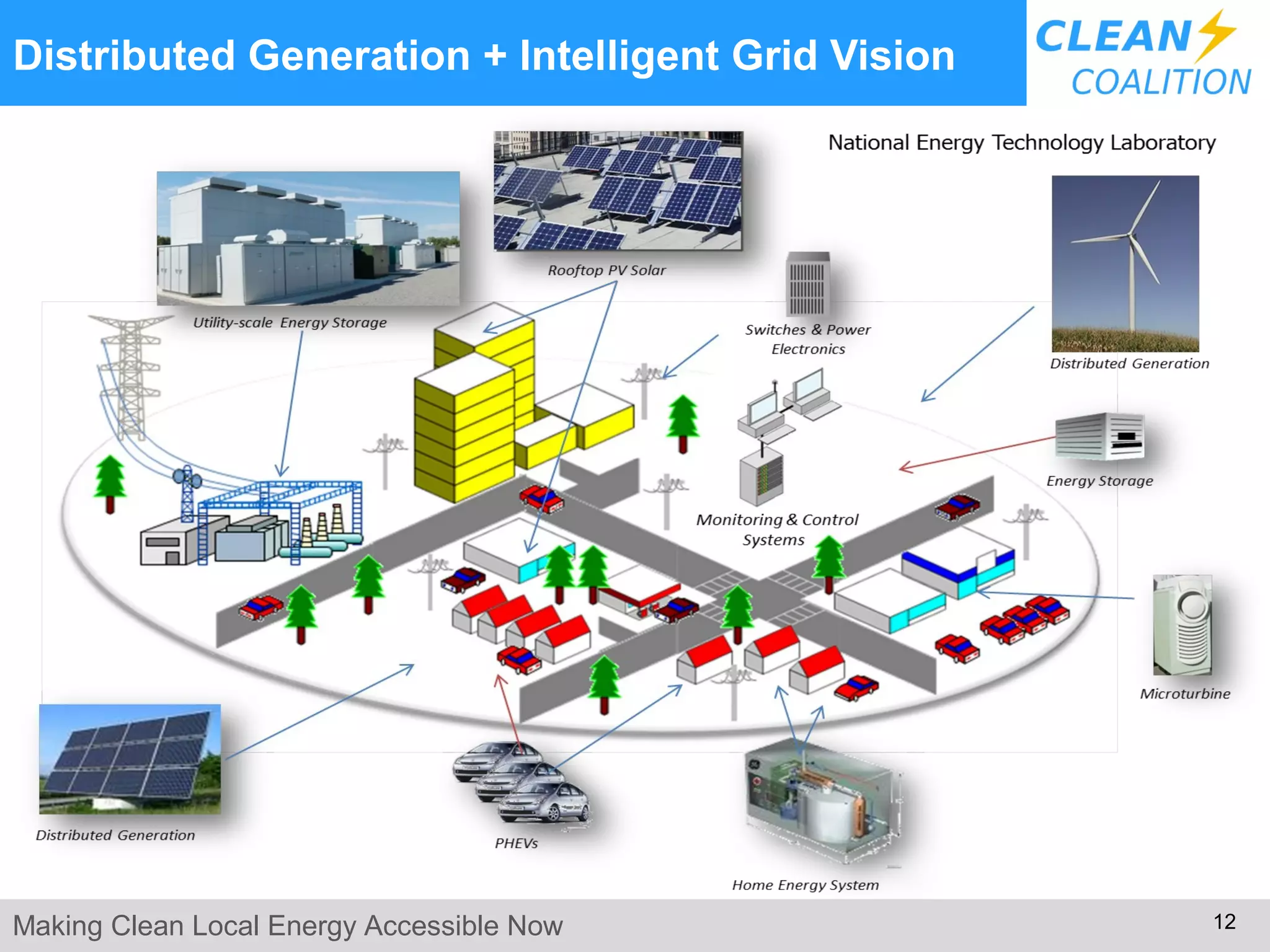
Distributed Generation (DG)

• Generating power from the inside out
• Local generation of electricity
  – Power generation “inside the meter”
• Reduces demand from central plants
• PV generation erases HVAC load
• Cogeneration heats the swimming pool
Distributed Generation + Intelligent Grid Vision


Making Clean Local Energy Accessible Now           12
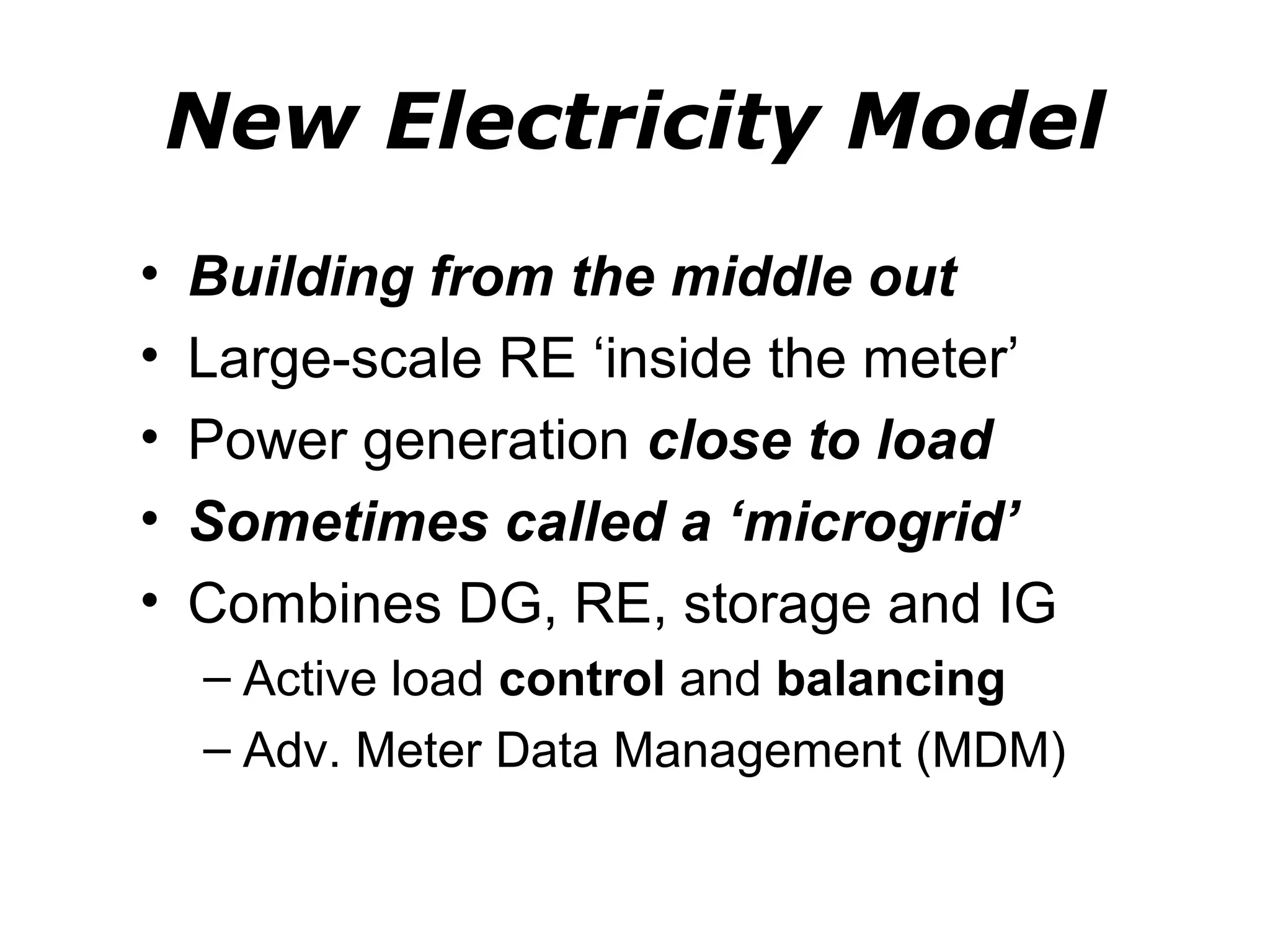
New Electricity Model
•   Building from the middle out
•   Large-scale RE ‘inside the meter’
•   Power generation close to load
•   Sometimes called a ‘microgrid’
•   Combines DG, RE, storage and IG
    – Active load control and balancing
    – Adv. Meter Data Management (MDM)
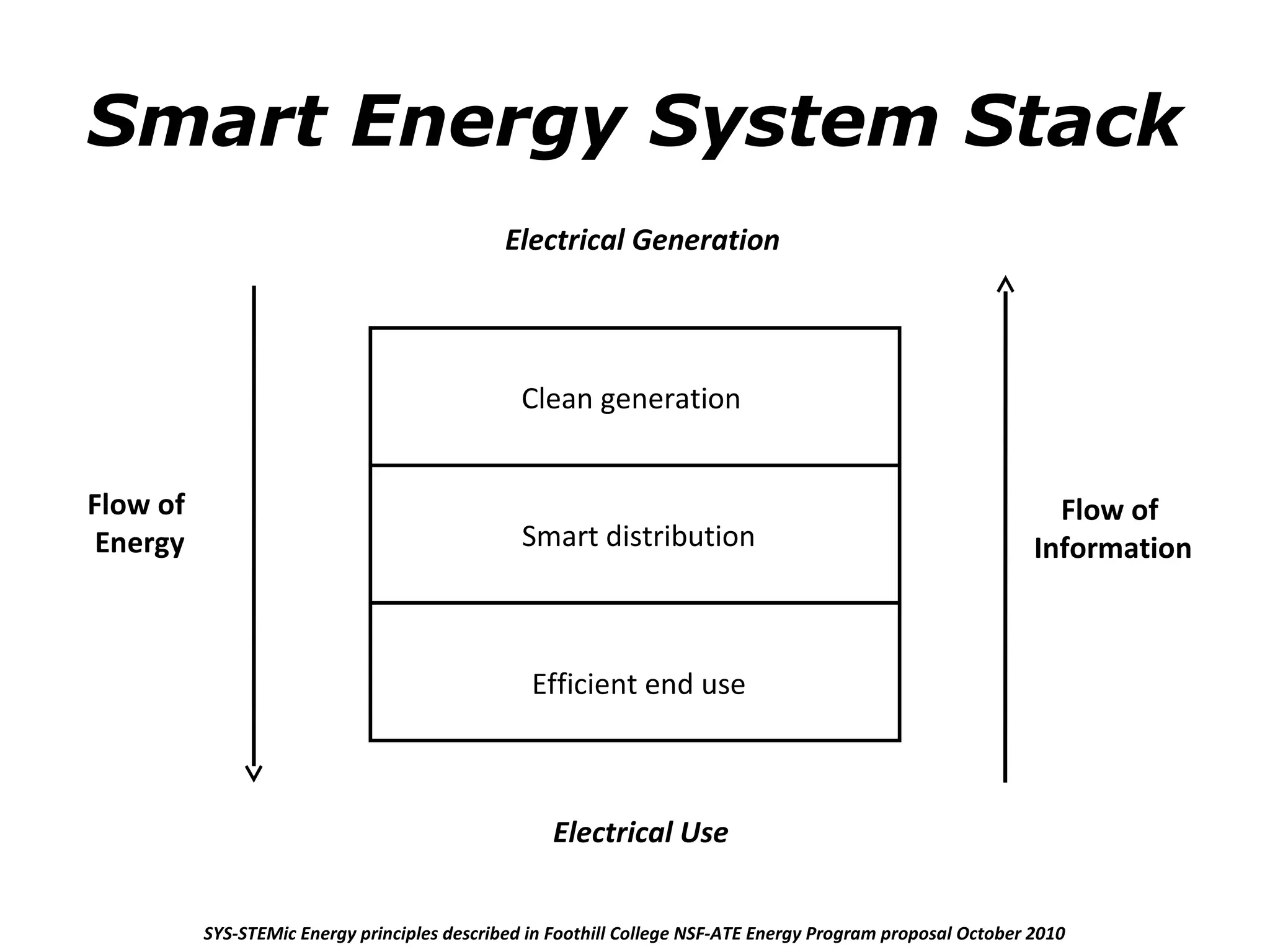
Smart Energy System Stack
                                              Electrical Generation


                                               Clean generation


Flow of                                                                                                        Flow of
 Energy                                         Smart distribution                                           Information


                                                 Efficient end use


                                                   Electrical Use


          SYS-STEMic Energy principles described in Foothill College NSF-ATE Energy Program proposal October 2010
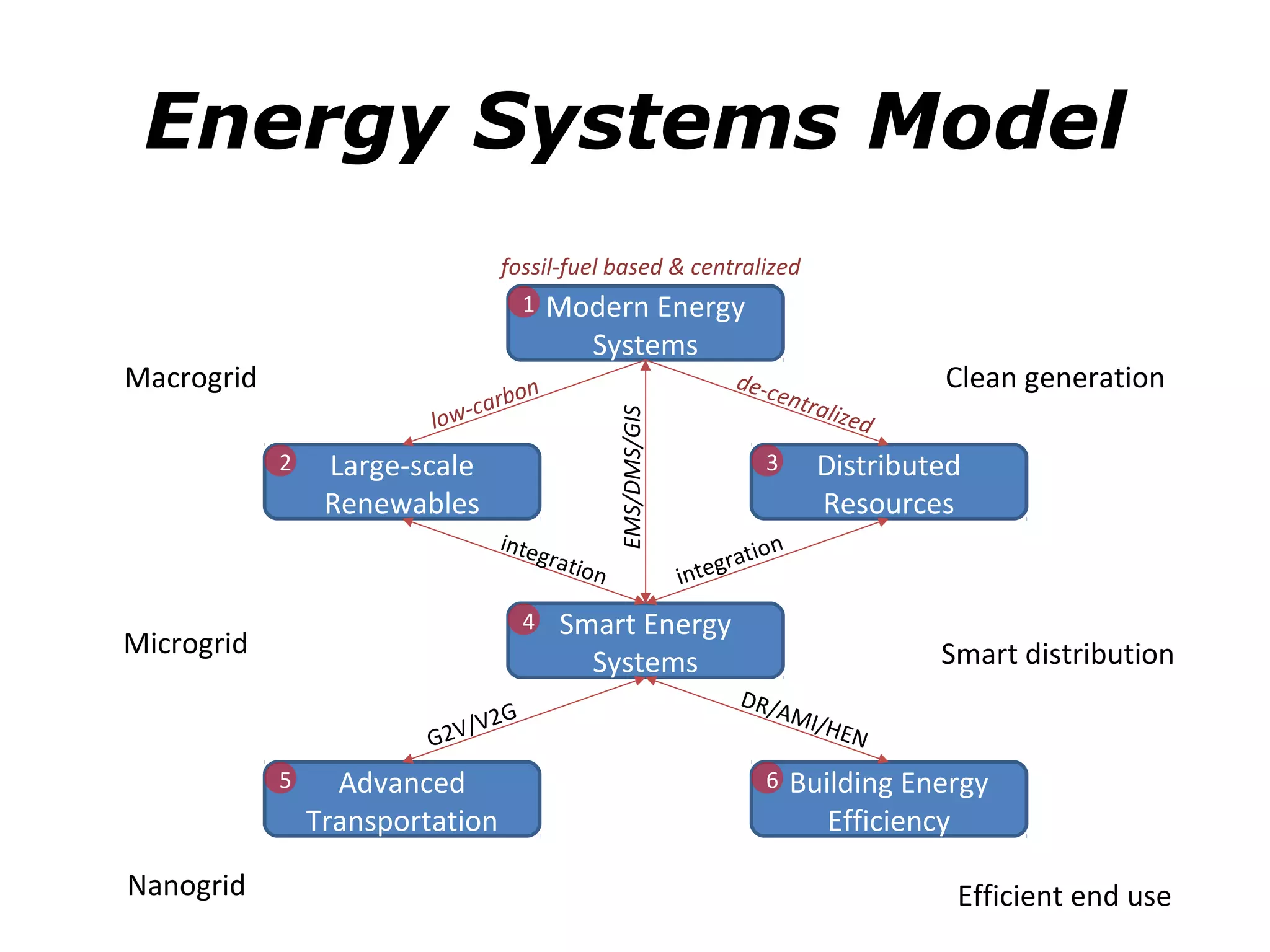
Energy Systems Model
                                   fossil-fuel based & centralized
                                      1   Modern Energy
                                            Systems
Macrogrid                                                              de-c                Clean generation
                                    bon                                     entr
                         lo   w -car                                             alize


                                                    EMS/DMS/GIS
                                                                                      d
            2    Large-scale                                               3      Distributed
                 Renewables                                                       Resources
                                  inte
                                       grat                              tion
                                           io   n                 integra

                                      4   Smart Energy
Microgrid                                                                                  Smart distribution
                                            Systems
                                                                        DR /
                                 2G                                         AM I
                         G   2V/V                                               /HEN

            5     Advanced                                                 6    Building Energy
                Transportation                                                     Efficiency

Nanogrid                                                                                    Efficient end use
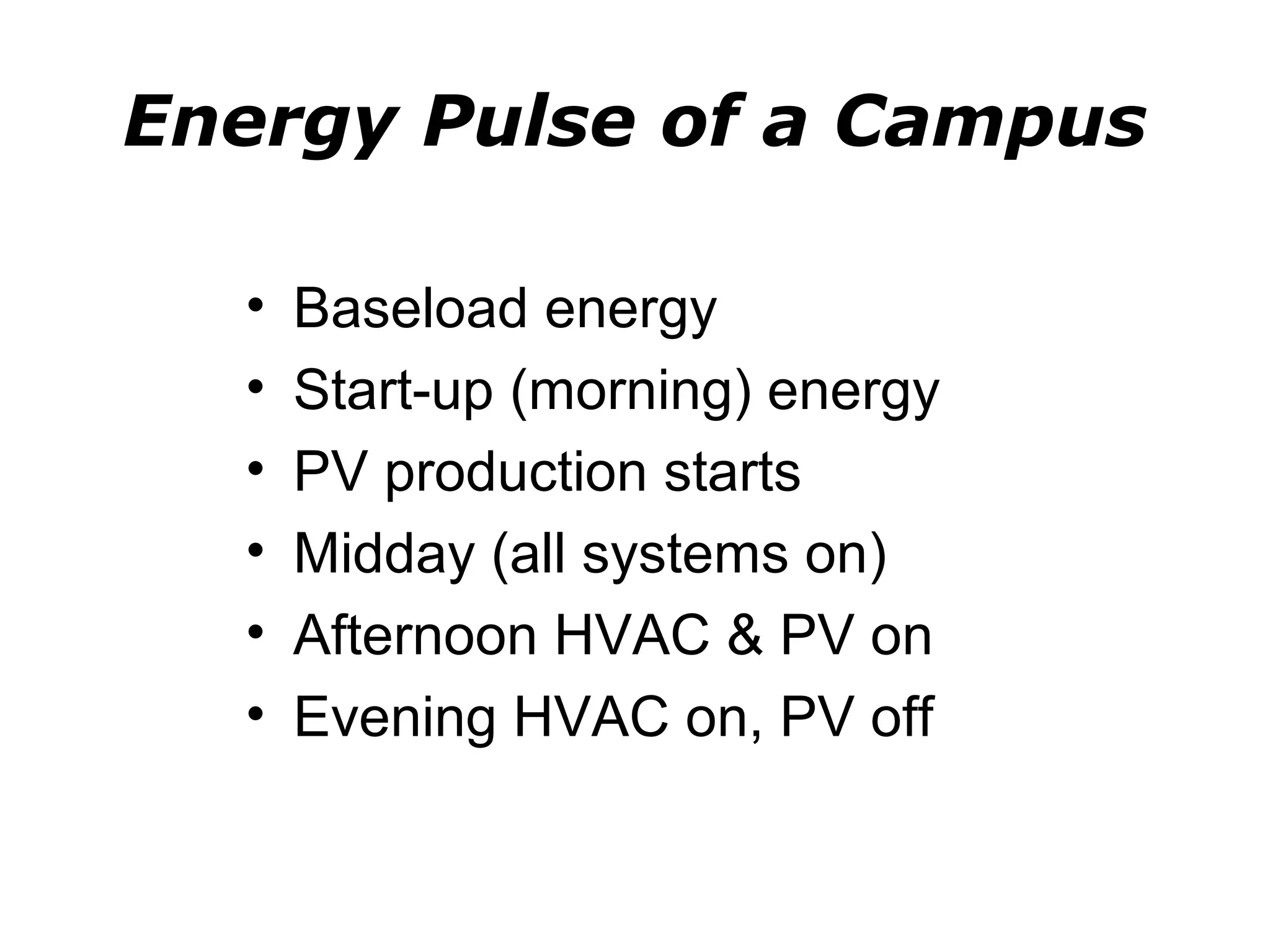
Energy Pulse of a Campus

  •   Baseload energy
  •   Start-up (morning) energy
  •   PV production starts
  •   Midday (all systems on)
  •   Afternoon HVAC & PV on
  •   Evening HVAC on, PV off
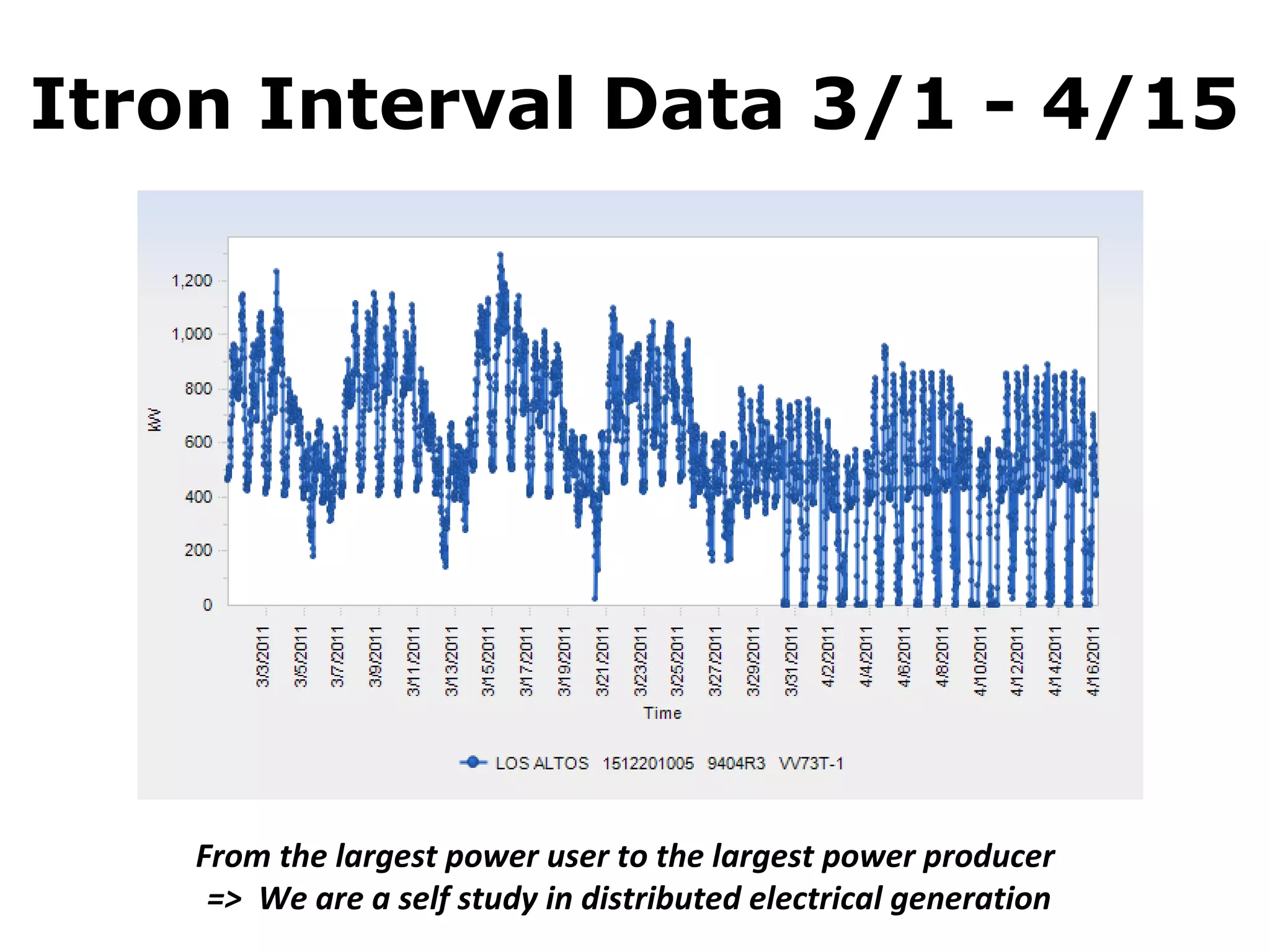
Itron Interval Data 3/1 - 4/15


    From the largest power user to the largest power producer
     => We are a self study in distributed electrical generation
Energy Intelligence =>
           Ei=cm3
• Ei=cm3
• Energy Intelligence from computational:
  – Monitoring
  – Modeling
  – Management
• Smart energy systems that integrate:
  – Clean generation, smart distribution, and
    efficient end-use (ecomagination principles)
Monitor
• Gather
  – Utility meter and bills
  – PV and cogen inverter output
  – Submetering of buildings
• Organize
  – Data by month, day, and hour
• Inspect
  – Missing or anomalous data
Model
• When, where, and how is energy used?
• Benchmarking / comparative analysis
  – How do our buildings perform compared to
    other public buildings, similar size and use?
• Time-of-Use (ToU)
  – Baseline (baseload) energy
  – Energy Pulse (Pattern of ToU)
  – Peak energy demand
Manage
• How can energy be used better?
  – Energy Management Systems (EMS) working?
  – Building Automation Controls (BAC) working?
• Have buildings been commissioned?
  – Monitoring based commissioning (MBCx)
• What efficiency projects could be done?
• Can ToU be managed to generation?
  – Alter the aggregate campus energy pulse
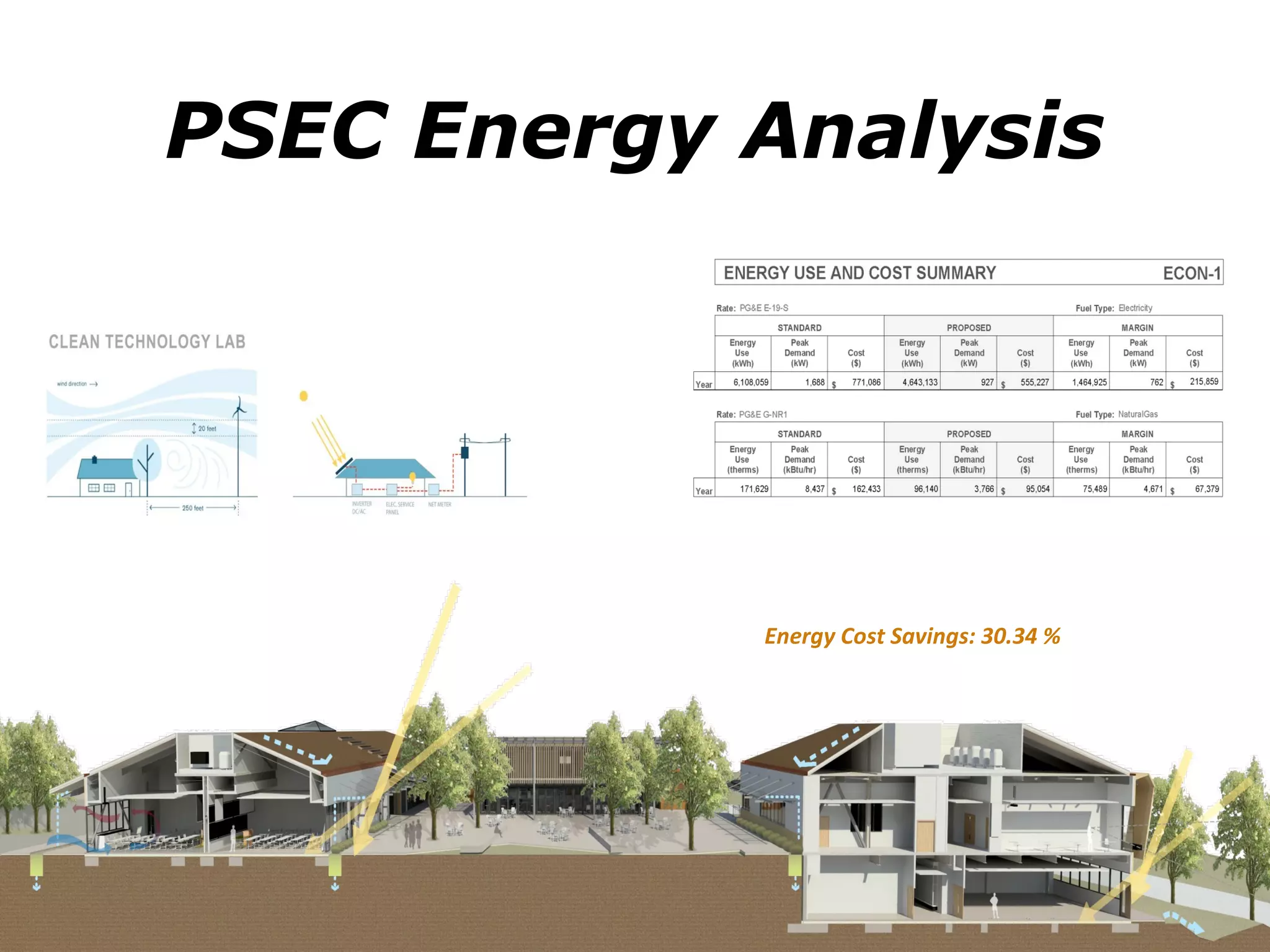
PSEC Energy Analysis
Program Analysis   Sustainable Design   Dept. Blocks/Bldg.   Space Planning   Site Analysis/Planning   Image Study


                                                                         Energy Cost Savings: 30.34 %
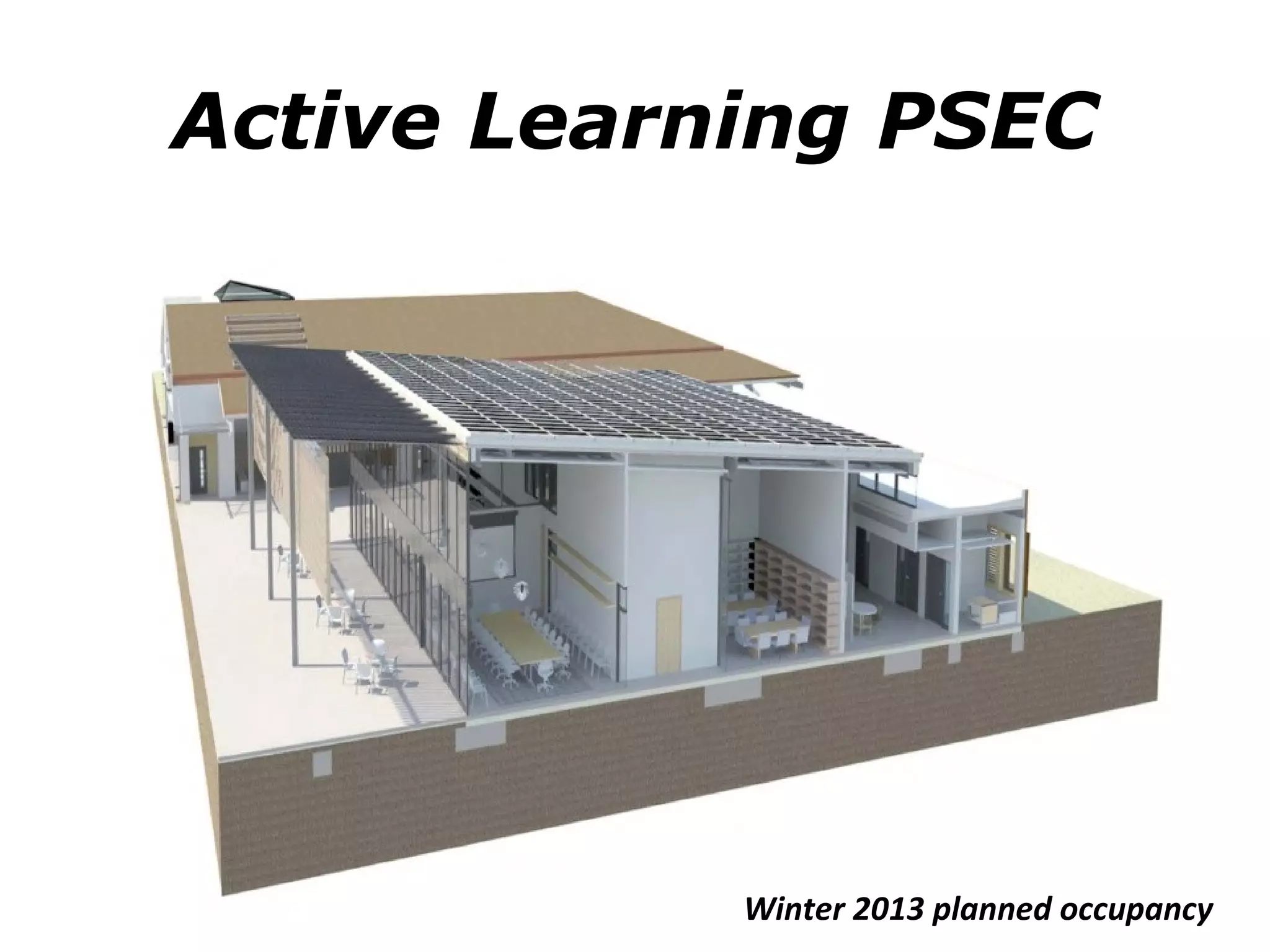
Active Learning PSEC


            Winter 2013 planned occupancy
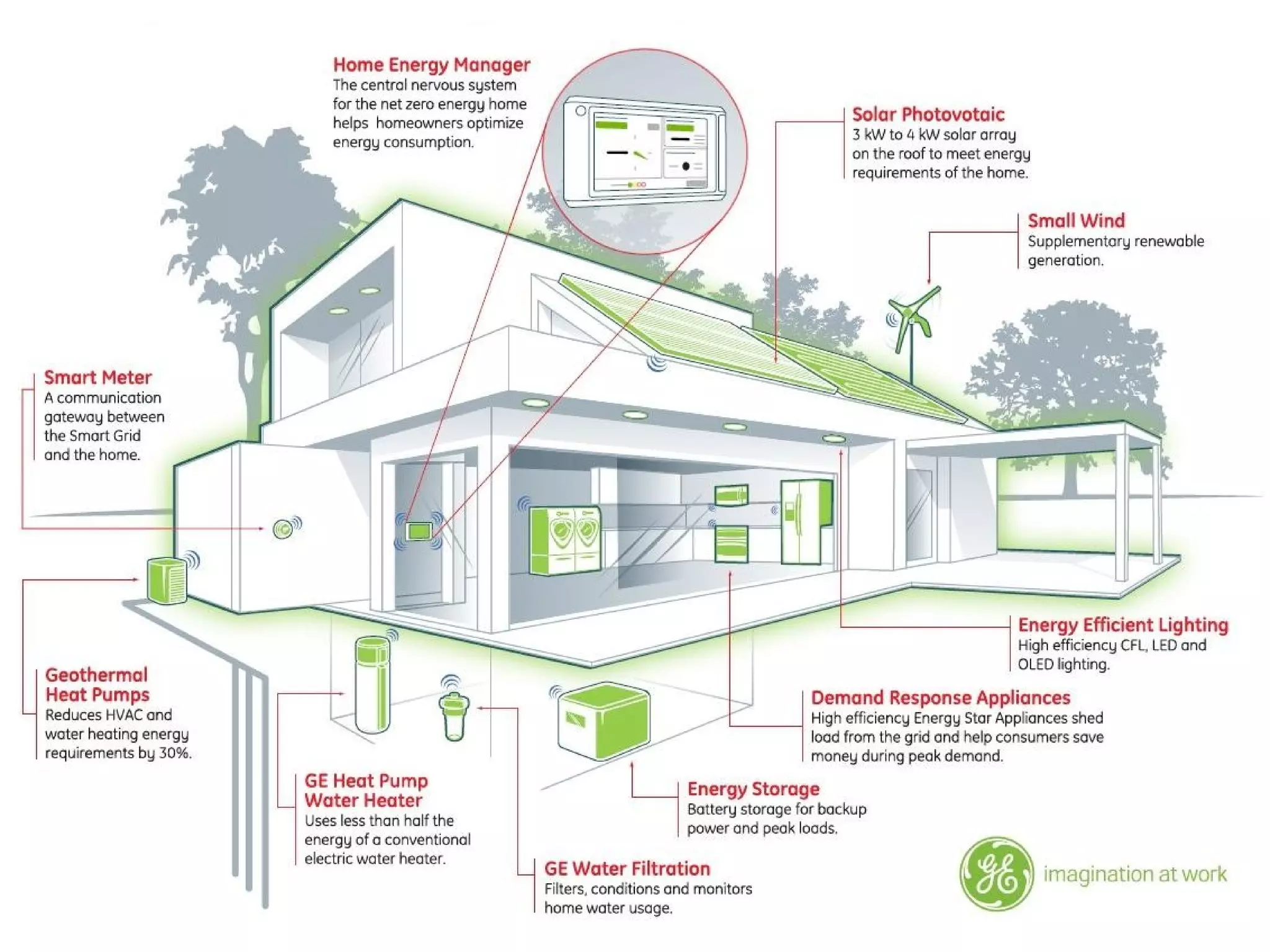
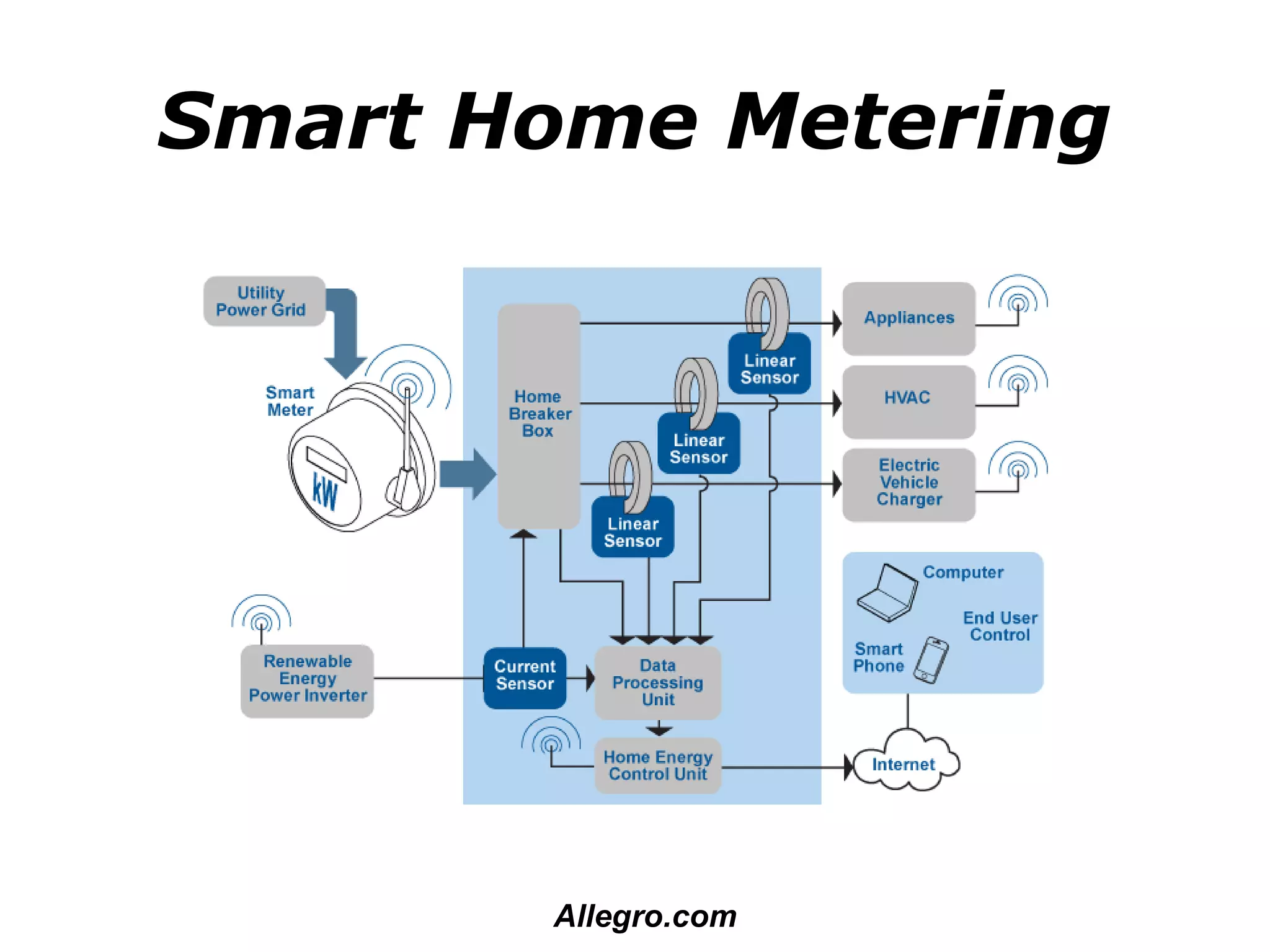
Smart Home Metering


       Allegro.com
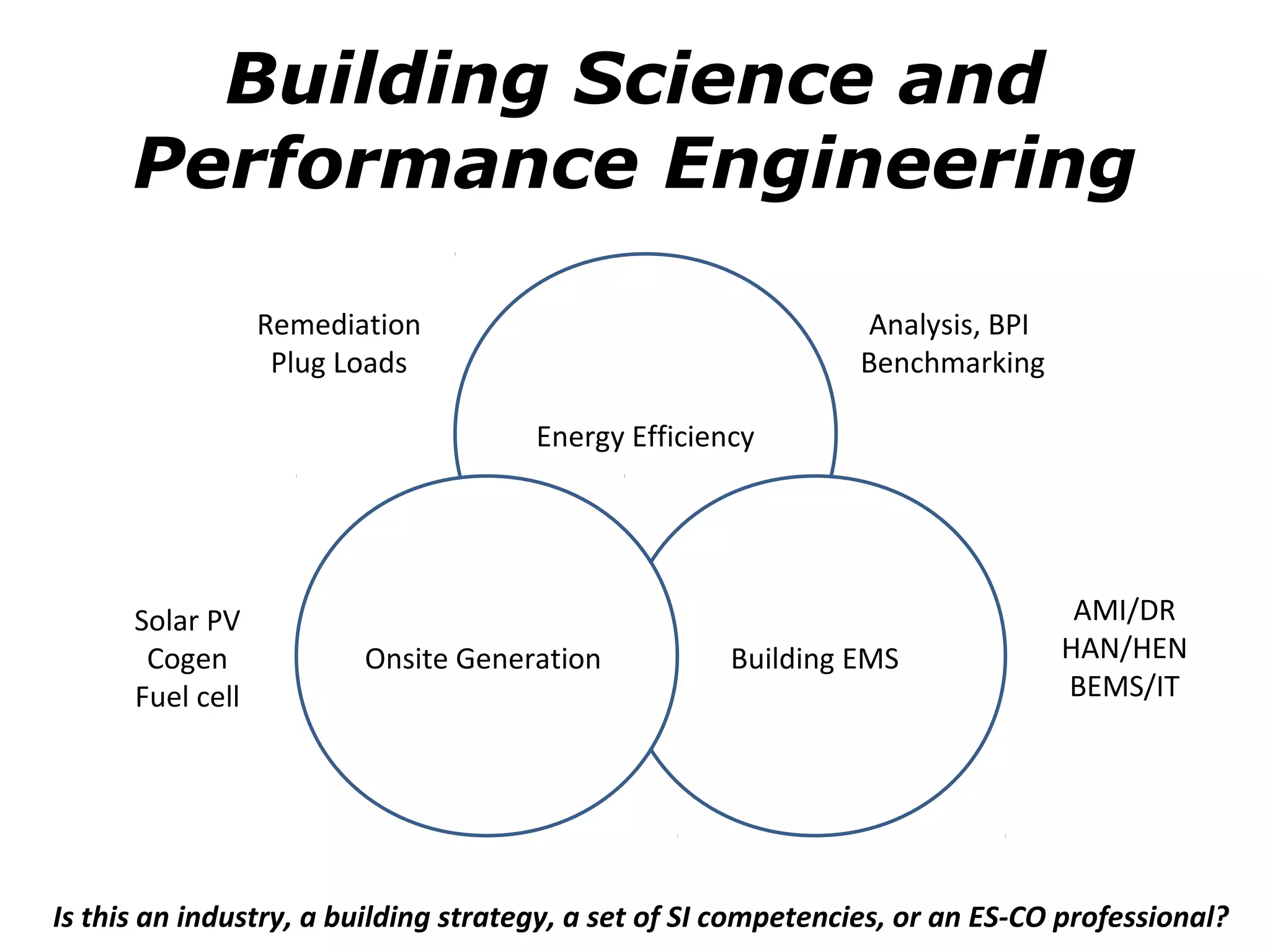
Building Science and
      Performance Engineering

                  Remediation                                  Analysis, BPI
                   Plug Loads                                  Benchmarking

                                      Energy Efficiency


      Solar PV                                                                  AMI/DR
       Cogen             Onsite Generation           Building EMS              HAN/HEN
      Fuel cell                                                                BEMS/IT


Is this an industry, a building strategy, a set of SI competencies, or an ES-CO professional?
Summary
• Foothill College’s energy system
    – PV, cogen, utility power feed
• Distributed Generation (DG)
• Intelligent Grid (IG)
• New Electricity Model
• Energy pulse of a building
• Energy Intelligence => Ei=cm3
Zimride Ridesharing

• Facebook trust platform
• Locate drivers/riders near you
• Keep track of rides, trip (VMT)
  and GHG reduction
• Ridesharing networks
• Ridesharing culture
Ridesharing Culture


 Social engineering for a world with fewer cars, less
   petroleum, and a genuine desire to collaborate
Social Transportation
        Networks => Tools


Flows of vehicles that have                   Flows of people that have
   positions and paths                      schedules and destinations

           V (P,P) <= Social Transportation Tools => P (S,D)
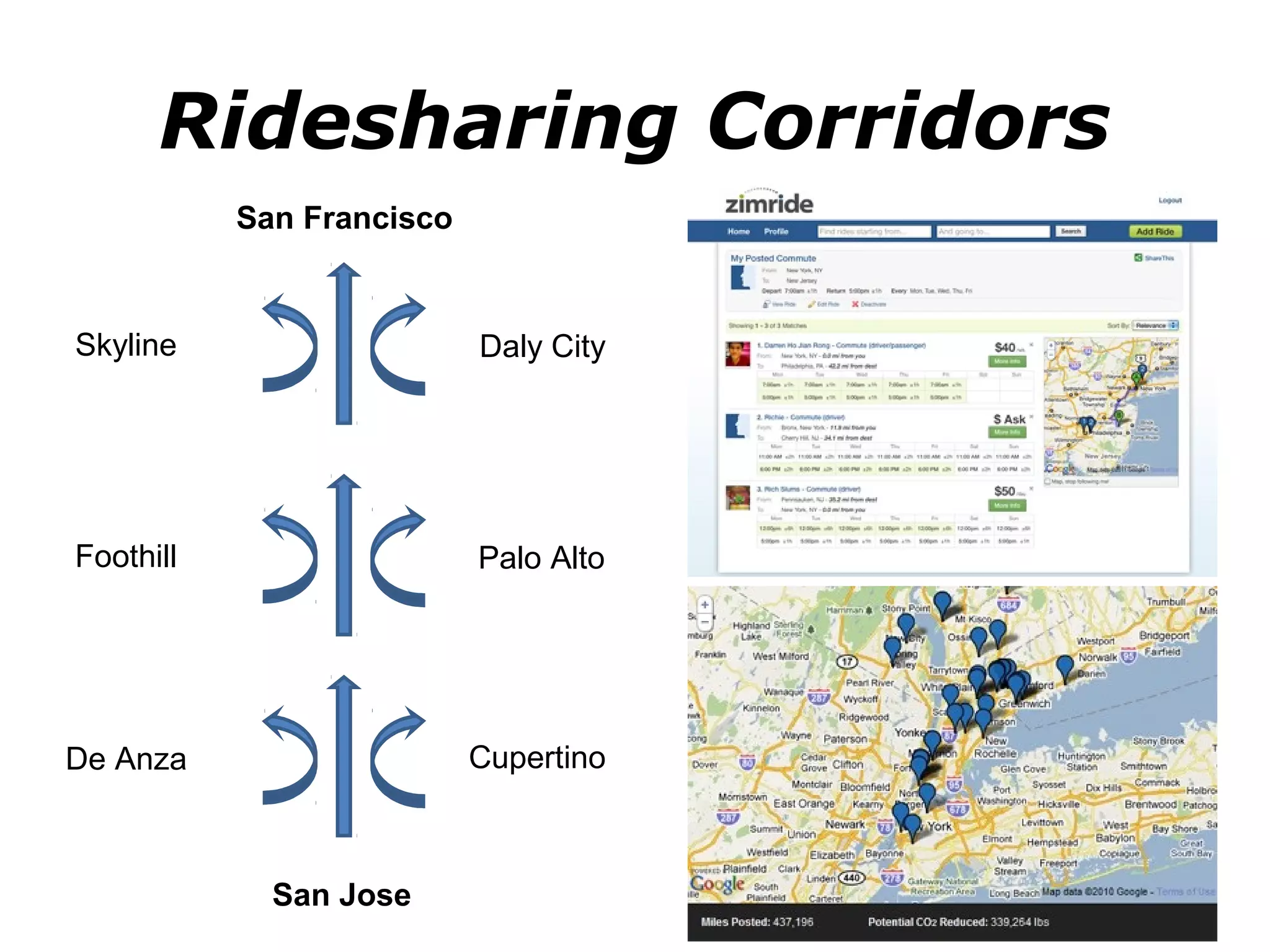
Ridesharing Corridors
           San Francisco


Skyline                    Daly City


Foothill                   Palo Alto


De Anza                    Cupertino


             San Jose

Foothill College Energy System

  • 1.
    Foothill Energy System Foothill College Fall 2012
  • 2.
    Big Ideas • Modernutility systems • Foothill’s power grid • Renewable Energy (RE), Distributed generation (DG) and Intelligent Grid (IG) • New Electricity Model • Energy pulse of a building • Energy Intelligence Ei = cm3
  • 3.
    Important Energy Units • KW => Kilowatts (1,000 watts) • MW => Megawatts (1,000,000 watts) • kWh => Kilowatt-Hours • mWh => Megawatt-Hours • Therms => 100,000 BTU of heat capacity • BTU => British Thermal Units • Joule => one watt-second • KJ => Kilo Joules (~ 0.95 BTU)
  • 4.
    Modern Utility Systems 1)The power plant, where primary energy from fuel is converted to electricity using a generator. 2) High- voltage transmission lines, which efficiently move electricity over large distances from power plants to end users. These are necessary, because today most power plants are built in remote places far from where people live, since a power plant is seldom a good thing to live beside. 3) A substation is the link between the transmission system and the distribution system. It "steps down" the voltage to lower levels suitable for distributing to end users. 4) Transformers reduce the voltage further to levels that can be used by appliances and machines operated by end users. 5) Local distribution wires move this low-voltage power to end-use locations, otherwise known as homes, schools and businesses. https://www.e-education.psu.edu/ebf200up/node/151
  • 5.
    Foothill Power Grid •1.5 MW solar photovoltaic (PV) – 100KW PE – 440 KW IH – 1 MW Lots 2-3 • 250 KW cogeneration – 4 Capstone micro turbines in PE • Main PG&E utility meter • 75 buildings (8-10 building types)
  • 6.
    Foothill Energy System FoothillCollege is the ideal test bed for innovative energy technology for clean generation, smart distribution, and efficient end use
  • 7.
  • 8.
    Renewable Energy (RE) •Zero emission power! • 1.5 MW (mega-watt) Solar PV • Generates ~ 2 million kWh per year – 25% of our 8M kWh projected load • Produces 80 to 120% of our peak load – Very strong daytime electricity demand • Offsets natural gas (power) on hot days – Saves ~ 1 lb of CO2 for every kWh produced
  • 9.
    Capstone Microturbine Benefits Ultra-low emissions(CARB 2003 DG certified) Minimal annual maintenance Direct2Grid interconnection UL1741, CA Rule 21, NYPSC DG , No fluid storage, leakage, changes, disposal Reduced compression maintenance As low as 0.2 psig inlet pressure Uncontaminated exhaust heat for sensitive direct- drying applications Phase-to-phase balance (0-100%) on stand-alone units Small footprint, lightweight , Vibration-free, quiet operation . Easy indoor/outdoor/rooftop sitting Zero hardware arraying (up to 1.2MW) Optional remote monitoring/dispatch Optional heat recovery module Optional 2-to-100-unit PowerServer networking Optional external gas compressor that serves multiple units All Capstone MicroTurbines Operate Continuously or On-Demand Stand alone or Grid Connect Individually or Multi-pack Run on a variety of fuels Low or High Pressure Natural Gas Biogas (landfill, wastewater treatment centers, anaerobic) Flare gas , Diesel , Propane , Kerosene
  • 10.
    Capstone Microturbine HeatRecirculation Waste heat from the generation of electricity is recirculated through a heat exchanger and transferred to a thermal sink, typically district steam, heating a swimming pool, or hot water for a hotel or hospital.
  • 11.
    Distributed Generation (DG) •Generating power from the inside out • Local generation of electricity – Power generation “inside the meter” • Reduces demand from central plants • PV generation erases HVAC load • Cogeneration heats the swimming pool
  • 12.
    Distributed Generation +Intelligent Grid Vision Making Clean Local Energy Accessible Now 12
  • 13.
    New Electricity Model • Building from the middle out • Large-scale RE ‘inside the meter’ • Power generation close to load • Sometimes called a ‘microgrid’ • Combines DG, RE, storage and IG – Active load control and balancing – Adv. Meter Data Management (MDM)
  • 14.
    Smart Energy SystemStack Electrical Generation Clean generation Flow of Flow of Energy Smart distribution Information Efficient end use Electrical Use SYS-STEMic Energy principles described in Foothill College NSF-ATE Energy Program proposal October 2010
  • 15.
    Energy Systems Model fossil-fuel based & centralized 1 Modern Energy Systems Macrogrid de-c Clean generation bon entr lo w -car alize EMS/DMS/GIS d 2 Large-scale 3 Distributed Renewables Resources inte grat tion io n integra 4 Smart Energy Microgrid Smart distribution Systems DR / 2G AM I G 2V/V /HEN 5 Advanced 6 Building Energy Transportation Efficiency Nanogrid Efficient end use
  • 16.
    Energy Pulse ofa Campus • Baseload energy • Start-up (morning) energy • PV production starts • Midday (all systems on) • Afternoon HVAC & PV on • Evening HVAC on, PV off
  • 17.
    Itron Interval Data3/1 - 4/15 From the largest power user to the largest power producer => We are a self study in distributed electrical generation
  • 18.
    Energy Intelligence => Ei=cm3 • Ei=cm3 • Energy Intelligence from computational: – Monitoring – Modeling – Management • Smart energy systems that integrate: – Clean generation, smart distribution, and efficient end-use (ecomagination principles)
  • 19.
    Monitor • Gather – Utility meter and bills – PV and cogen inverter output – Submetering of buildings • Organize – Data by month, day, and hour • Inspect – Missing or anomalous data
  • 20.
    Model • When, where,and how is energy used? • Benchmarking / comparative analysis – How do our buildings perform compared to other public buildings, similar size and use? • Time-of-Use (ToU) – Baseline (baseload) energy – Energy Pulse (Pattern of ToU) – Peak energy demand
  • 21.
    Manage • How canenergy be used better? – Energy Management Systems (EMS) working? – Building Automation Controls (BAC) working? • Have buildings been commissioned? – Monitoring based commissioning (MBCx) • What efficiency projects could be done? • Can ToU be managed to generation? – Alter the aggregate campus energy pulse
  • 22.
    PSEC Energy Analysis ProgramAnalysis Sustainable Design Dept. Blocks/Bldg. Space Planning Site Analysis/Planning Image Study Energy Cost Savings: 30.34 %
  • 23.
    Active Learning PSEC Winter 2013 planned occupancy
  • 25.
  • 26.
    Building Science and Performance Engineering Remediation Analysis, BPI Plug Loads Benchmarking Energy Efficiency Solar PV AMI/DR Cogen Onsite Generation Building EMS HAN/HEN Fuel cell BEMS/IT Is this an industry, a building strategy, a set of SI competencies, or an ES-CO professional?
  • 27.
    Summary • Foothill College’senergy system – PV, cogen, utility power feed • Distributed Generation (DG) • Intelligent Grid (IG) • New Electricity Model • Energy pulse of a building • Energy Intelligence => Ei=cm3
  • 28.
    Zimride Ridesharing • Facebooktrust platform • Locate drivers/riders near you • Keep track of rides, trip (VMT) and GHG reduction • Ridesharing networks • Ridesharing culture
  • 30.
    Ridesharing Culture Socialengineering for a world with fewer cars, less petroleum, and a genuine desire to collaborate
  • 31.
    Social Transportation Networks => Tools Flows of vehicles that have Flows of people that have positions and paths schedules and destinations V (P,P) <= Social Transportation Tools => P (S,D)
  • 32.
    Ridesharing Corridors San Francisco Skyline Daly City Foothill Palo Alto De Anza Cupertino San Jose