
Using Social Networking to Enhance
  Students’ Learning Experiences

            Steve C. Yuen, Ph.D.
                   Professor
     The University of Southern Mississippi
                 Steve.Yuen@usm.edu

     2010 MECA Conference, Jackson, Mississippi, February 10, 2010
What is a Social Network?
   • A social network is an online service for
     communities of people who share an interest
     with one another to collaborate.
   • A social network service focuses on building
     online communities of people who share
     interests and activities, or who are interested
     in exploring the interests and activities of
     others. Most social network services are web
     based and provide a variety of ways for users
     to interact, such as e-mail and instant
     messaging services (Wikipedia).
Barnett: Social Networking                   March 8, 2008
Universities and Social Networking.
http://www.slideshare.net/sparkbouy/universities-and-social-networking/
connected
Popular Social Networks
•Facebook

•Friendster

•LinkedIn

•MySpace

•Ning
Social Networking Factoids
• Social networks now represent the fastest growing
  Internet segment – 3 times the rate of overall
  Internet growth. (2009)
• Social networking sites are growing at the rate of
  47% annually, reaching 45% of total web users.
  (2006)
• Social networking and blogging are now the 4th
  most popular online activities, according to
  Nielsen’s recently released Global Faces and
  Networked Places report. (2009)
                                    Source: Nielson Netratings
• The most visited social networking site in the world (Nielsen
  Report, 2009),
• More than 300 million active users (Facebook,2009)
• Average user has 130 friends on the site
• More than 2 billion photos uploaded to the site each month
• More than 14 million videos uploaded each month
• 50 million Twitter users
• A monthly growth of 1,382% as reported
  by Nielsen.com in March 2009
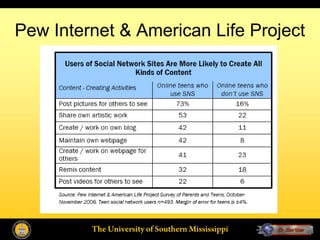
Pew Internet & American Life Project
• 2007 National Study
   – 55% all online American Youth between the age
     of 12 and 17 use social networking sites for
     communication.
Pew Internet & American Life Project
Social Learning
Social Learning
• Best explained by situated learning theory which is rooted
  in Vygotskian perspectives on learning (Lave & Wenger,
  1991)
• People learn from one another, via observation, imitation,
  and modeling. The theory has often been called a bridge
  between behaviorist and cognitive learning theories
  because it encompasses attention, memory, and
  motivation (Albert Bandura, 1977)
• Shift the view of learning from a cognitive process to a
  process of participation in the social world
• Learning emerges from engagement in social interaction
• Focus on the learning that occurs within a social context.
  It considers that people learn from one another, including
  such concepts as observational learning, imitation, and
  modeling
Social Networking in Education
• Provide a casual place of learning
• Develop literacy and communication skills
• Encourage students to express their own
  thoughts
• Provide effective collaboration and
  communication
• Offer a channel of resources and
  knowledge exchanges
Social Networking in Education
• Provide a source of social support and
  socialization for different learners
• Enhance students’ learning experiences
• Develop e-portfolios
• Form communities of practice
• Build an online learning community
• Offer immersion in a foreign language
  environment
A Case Study
• Conducted in the US and Hong Kong
• Designing and teaching two courses that
  involved the use of a social network
• Purposes
  – Obtained specific information about the process
    of the social network instructional approach
  – Investigated students’ perceptions on the use of
    social networking in education
Participants
• 30 students enrolled in graduate level courses
  in educational technology from two universities
  (USM and CUHK) during the spring semester in
  2008
• Majority of participants in both courses were
  part-time in-service teachers who were pursuing
  a master’s degree or a graduate minor in IT.
• The courses were offered in a blended learning
  or hybrid format
Design of Social Network
• Ning was chosen as an online platform to create
  a class social networking site
• Allowed students to create their own profiles;
  upload photos, audio, podcasts, and videos,
  create and join discussion groups, send
  messages and publish blogs and presentations
• Designed for private use
• Only class members in the courses were invited
  to join the class social network
• No guest or outsider was allowed to join and
  participate in the social network
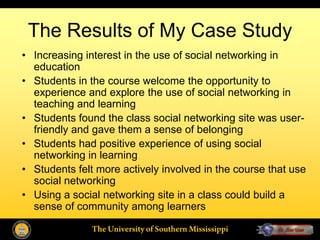
The Results of My Case Study
• Increasing interest in the use of social networking in
  education
• Students in the course welcome the opportunity to
  experience and explore the use of social networking in
  teaching and learning
• Students found the class social networking site was user-
  friendly and gave them a sense of belonging
• Students had positive experience of using social
  networking in learning
• Students felt more actively involved in the course that use
  social networking
• Using a social networking site in a class could build a
  sense of community among learners
Collective Intelligence and
                           E-Learning 2.0:
                     Implications of Web-Based
                          Communities and
                              Networking


Chapter 16 - Using Social Networking to Enhance Sense of
            Community in E-Learning Courses

               http://book.yuen.us/book1/
The End
     Questions or Comments?

 Thank You for Attending My session!

 This presentation is available on the Web at:
http://www.slideshare.net/scyuen/

Using Social Networking to Enhance Students’ Learning Experiences

  • 1.
    Using Social Networkingto Enhance Students’ Learning Experiences Steve C. Yuen, Ph.D. Professor The University of Southern Mississippi Steve.Yuen@usm.edu 2010 MECA Conference, Jackson, Mississippi, February 10, 2010
  • 4.
    What is aSocial Network? • A social network is an online service for communities of people who share an interest with one another to collaborate. • A social network service focuses on building online communities of people who share interests and activities, or who are interested in exploring the interests and activities of others. Most social network services are web based and provide a variety of ways for users to interact, such as e-mail and instant messaging services (Wikipedia). Barnett: Social Networking March 8, 2008
  • 5.
    Universities and SocialNetworking. http://www.slideshare.net/sparkbouy/universities-and-social-networking/
  • 8.
  • 9.
  • 10.
    Social Networking Factoids •Social networks now represent the fastest growing Internet segment – 3 times the rate of overall Internet growth. (2009) • Social networking sites are growing at the rate of 47% annually, reaching 45% of total web users. (2006) • Social networking and blogging are now the 4th most popular online activities, according to Nielsen’s recently released Global Faces and Networked Places report. (2009) Source: Nielson Netratings
  • 11.
    • The mostvisited social networking site in the world (Nielsen Report, 2009), • More than 300 million active users (Facebook,2009) • Average user has 130 friends on the site • More than 2 billion photos uploaded to the site each month • More than 14 million videos uploaded each month
  • 12.
    • 50 millionTwitter users • A monthly growth of 1,382% as reported by Nielsen.com in March 2009
  • 13.
    Pew Internet &American Life Project • 2007 National Study – 55% all online American Youth between the age of 12 and 17 use social networking sites for communication.
  • 14.
    Pew Internet &American Life Project
  • 15.
  • 16.
    Social Learning • Bestexplained by situated learning theory which is rooted in Vygotskian perspectives on learning (Lave & Wenger, 1991) • People learn from one another, via observation, imitation, and modeling. The theory has often been called a bridge between behaviorist and cognitive learning theories because it encompasses attention, memory, and motivation (Albert Bandura, 1977) • Shift the view of learning from a cognitive process to a process of participation in the social world • Learning emerges from engagement in social interaction • Focus on the learning that occurs within a social context. It considers that people learn from one another, including such concepts as observational learning, imitation, and modeling
  • 17.
  • 18.
    Social Networking inEducation • Provide a casual place of learning • Develop literacy and communication skills • Encourage students to express their own thoughts • Provide effective collaboration and communication • Offer a channel of resources and knowledge exchanges
  • 19.
    Social Networking inEducation • Provide a source of social support and socialization for different learners • Enhance students’ learning experiences • Develop e-portfolios • Form communities of practice • Build an online learning community • Offer immersion in a foreign language environment
  • 20.
    A Case Study •Conducted in the US and Hong Kong • Designing and teaching two courses that involved the use of a social network • Purposes – Obtained specific information about the process of the social network instructional approach – Investigated students’ perceptions on the use of social networking in education
  • 21.
    Participants • 30 studentsenrolled in graduate level courses in educational technology from two universities (USM and CUHK) during the spring semester in 2008 • Majority of participants in both courses were part-time in-service teachers who were pursuing a master’s degree or a graduate minor in IT. • The courses were offered in a blended learning or hybrid format
  • 22.
    Design of SocialNetwork • Ning was chosen as an online platform to create a class social networking site • Allowed students to create their own profiles; upload photos, audio, podcasts, and videos, create and join discussion groups, send messages and publish blogs and presentations • Designed for private use • Only class members in the courses were invited to join the class social network • No guest or outsider was allowed to join and participate in the social network
  • 30.
    The Results ofMy Case Study • Increasing interest in the use of social networking in education • Students in the course welcome the opportunity to experience and explore the use of social networking in teaching and learning • Students found the class social networking site was user- friendly and gave them a sense of belonging • Students had positive experience of using social networking in learning • Students felt more actively involved in the course that use social networking • Using a social networking site in a class could build a sense of community among learners
  • 31.
    Collective Intelligence and E-Learning 2.0: Implications of Web-Based Communities and Networking Chapter 16 - Using Social Networking to Enhance Sense of Community in E-Learning Courses http://book.yuen.us/book1/
  • 41.
    The End Questions or Comments? Thank You for Attending My session! This presentation is available on the Web at: http://www.slideshare.net/scyuen/