Social Process Theories
Social Learning Theory
Social Control Theory
Labeling Theory
Social Process
These are MICRO theories
Need both micro and macro for a “complete”
explanation of crime
Process = individual interacting with social
units or agencies over time
Social Learning Theory
Edwin Sutherland
Differential Association
Albert Bandura
Akers
(With Burgess) Differential Reinforcement
Social Learning Theory
Gerald Patterson
Social Interactional Theory
Edwin Sutherland
Degree in Sociology from the University of
Chicago (1913)
Faculty member (1930-1935)
Chicago School question: how are delinquent
cultures “transmitted” across generations?
Answer? “Differential Association”
Published and revised in his textbook from 1934-
1947
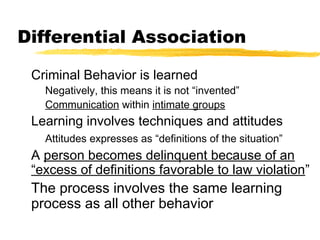
Differential Association
Criminal Behavior is learned
Negatively, this means it is not “invented”
Communication within intimate groups
Learning involves techniques and attitudes
Attitudes expresses as “definitions of the situation”
A person becomes delinquent because of an
“excess of definitions favorable to law violation”
The process involves the same learning
process as all other behavior
Differential Association
This is a GENERAL theory
Explains “white collar crimes” as well as
“street crimes”
Very abstract and vague
What are “definitions?”
What are the mechanics of learning?
Albert Bandura
Social Learning Theory (1973)
Pulled together principles of learning
Classical conditioning
Operant conditioning
Vicarious learning
Ronald Akers
Brought differential association in line
with psychological principles of learning
Differential Reinforcement theory
Now, “Social Learning Theory”
Central Concepts
Differential Association
Attitudes Toward Crime
Reinforcement
Imitation (role modeling)
Testing Social Learning
Surveys: Theory tested with 2 variables
Exposure to Deviant Peers
Attitudes Favorable Towards Crime
Variables consistently predict deviance,
but causal order is questionable
Testing Social Learning II
Experimental Studies
Don Andrews (1980) group therapy
experiments
Token Economies
“Cognitive/Behavioral Programs”
Skills Training
Reduce “Criminal Thinking Errors”
Criticisms of Social Learning and
Differential Association
Where do initial “definitions” or
“techniques” come from?
Assumption about human nature
Causal ordering is backwards
Policy Implications
If crime is learned, it can be “unlearned”
Token Economy
Role modeling
Eliminate “rationalizations,” or “criminal
thinking errors”
Learn pro-social (competing) behaviors
Training parent’s (Patterson)
Behavior contracts
Gerald Patterson
Social Interactional Theory
Focus on the Early Childhood
Effective Parents:
Monitor/Supervise their child’s behavior
Recognize deviant acts
Consistently Use Rewards and Punishment, and Role
Model Positive Behaviors
Ineffective Parents:
Natter, harsh and inconsistent punishment...
Patterson’s Social
Interactional Theory
Parenting
Context
•SES
•Grandparent’s skill
in parenting
•Single parents
•Difficult child
Parental
Efficacy
•Supervise
•Recognize
•Punish/reward
consistently
Child’s
Antisocial
Behavior

Social Process Theories

  • 1.
    Social Process Theories SocialLearning Theory Social Control Theory Labeling Theory
  • 2.
    Social Process These areMICRO theories Need both micro and macro for a “complete” explanation of crime Process = individual interacting with social units or agencies over time
  • 3.
    Social Learning Theory EdwinSutherland Differential Association Albert Bandura Akers (With Burgess) Differential Reinforcement Social Learning Theory Gerald Patterson Social Interactional Theory
  • 4.
    Edwin Sutherland Degree inSociology from the University of Chicago (1913) Faculty member (1930-1935) Chicago School question: how are delinquent cultures “transmitted” across generations? Answer? “Differential Association” Published and revised in his textbook from 1934- 1947
  • 5.
    Differential Association Criminal Behavioris learned Negatively, this means it is not “invented” Communication within intimate groups Learning involves techniques and attitudes Attitudes expresses as “definitions of the situation” A person becomes delinquent because of an “excess of definitions favorable to law violation” The process involves the same learning process as all other behavior
  • 6.
    Differential Association This isa GENERAL theory Explains “white collar crimes” as well as “street crimes” Very abstract and vague What are “definitions?” What are the mechanics of learning?
  • 7.
    Albert Bandura Social LearningTheory (1973) Pulled together principles of learning Classical conditioning Operant conditioning Vicarious learning
  • 8.
    Ronald Akers Brought differentialassociation in line with psychological principles of learning Differential Reinforcement theory Now, “Social Learning Theory” Central Concepts Differential Association Attitudes Toward Crime Reinforcement Imitation (role modeling)
  • 9.
    Testing Social Learning Surveys:Theory tested with 2 variables Exposure to Deviant Peers Attitudes Favorable Towards Crime Variables consistently predict deviance, but causal order is questionable
  • 10.
    Testing Social LearningII Experimental Studies Don Andrews (1980) group therapy experiments Token Economies “Cognitive/Behavioral Programs” Skills Training Reduce “Criminal Thinking Errors”
  • 11.
    Criticisms of SocialLearning and Differential Association Where do initial “definitions” or “techniques” come from? Assumption about human nature Causal ordering is backwards
  • 12.
    Policy Implications If crimeis learned, it can be “unlearned” Token Economy Role modeling Eliminate “rationalizations,” or “criminal thinking errors” Learn pro-social (competing) behaviors Training parent’s (Patterson) Behavior contracts
  • 13.
    Gerald Patterson Social InteractionalTheory Focus on the Early Childhood Effective Parents: Monitor/Supervise their child’s behavior Recognize deviant acts Consistently Use Rewards and Punishment, and Role Model Positive Behaviors Ineffective Parents: Natter, harsh and inconsistent punishment...
  • 14.
    Patterson’s Social Interactional Theory Parenting Context •SES •Grandparent’sskill in parenting •Single parents •Difficult child Parental Efficacy •Supervise •Recognize •Punish/reward consistently Child’s Antisocial Behavior