Emmanuel Kant
Moral and Ethical theory
Biography
 Immanuel Kant was born on April 22, 1724, in
Kaliningrad, Russia.

 In 1740 Kant entered the University of Königsberg.

 He published science papers, including "General
Natural History and Theory of the Heavens" in 1755.
Biography
 He spent 15 years as a metaphysics lecturer. In
1781, he published the first part of Critique of Pure
Reason.
 He died on February 12, 1804, in Konigsberg, Russia.
Kant’s Theory
 Represent deontological ethics


For him a right action consists solely in an action that is ruled
and justified by a rule or principle.



It was the rational and autonomous conformity of one’s will to
see right the universal moral law



Foundations of Metaphysics of Morals, explains the
philosophical foundation of morality and moral actions.
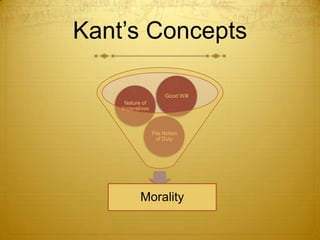
Kant’s Concepts
Good Will

Nature of
Imperatives

The Notion
of Duty

Morality
Good Will
 Only thing that is good without qualification.
 Other goods like intelligence and health can be
qualified, Good Will is good by virtue because it is the
will to follow the Moral Law.
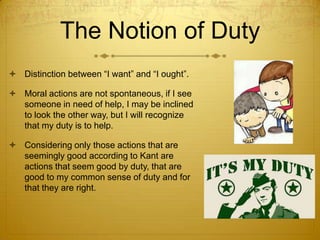
The Notion of Duty
 Distinction between “I want” and “I ought”.
 Moral actions are not spontaneous, if I see
someone in need of help, I may be inclined
to look the other way, but I will recognize
that my duty is to help.
 Considering only those actions that are
seemingly good according to Kant are
actions that seem good by duty, that are
good to my common sense of duty and for
that they are right.
The Nature of
Imperatives
 Imperatives are commands
 For kant there exist 2:
 Hypothetical Imperatives

 Categorical Imperatives
Hypothetical Imperatives
 If you want you ought. The ought or the duty is
conditioned by your desires, wants and goals.
 Our goals are grounded in SELF-INTEREST
Categorical Imperative
 The general from of DO. (Unconditioned)
 For Kant there is only one imperative command and it
is the Moral Law.

 Divided in 2 formulations
First Formulation
 “Act as if the maxim of your action were to secure
through your will a universal law of nature.”
 Meaning act as if in your will you were defining a
maximum rule for all to follow.
Second Formulation


“Act so that you treat humanity, whether in your own person or
that of another, always as an end and never as a mean.”



See if your actions are using others or affecting others, in the
meaning of never using them as a mean to achieve but always
as an end.
How to follow these
formulations?
 Kant gives some examples to use these formulations
in actual situations, these examples are divided in
duties:
 Duties Toward Oneself: to ensure self preservation
which are perfect (suicide), and for sel-cultivation
which are imperfect (promise-breaking).
 Duties Toward Others: strict and obligation which
are perfect (school work) and beneficence which are
imperfect.
Intrinsic Goodness
 Kant thinks that the only thing that is intrinsically good
is a good will.
 Right action consists solely in the conformity of an
action to a justified rule or principle.
Free Will
 We act morally, and for this to
be the case we must be
free.
 God and life after
death, otherwise morality
would make no sense.
Synthetic A Priori
 We do not follow predetermined laws. However, we
must act according to some laws, otherwise our
actions are random and without purpose.
 Rational beings must determine for themselves a set
of laws by which they will act.
Synthetic A Priori
 These laws are determined by experience.
 The rational being has to determine the synthetic a
priori – the substantive rules that can be applied prior
to experience.
Moral Worth


A person's actions
determine her moral worth.

 Taking in account these
aspects:
 Background
 Basic Idea
 Motivation
 Consequences
 Interpretation
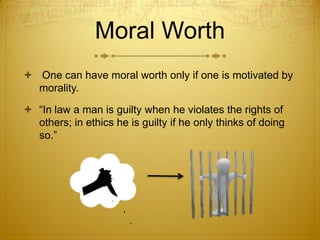
Moral Worth
 One can have moral worth only if one is motivated by
morality.
 “In law a man is guilty when he violates the rights of
others; in ethics he is guilty if he only thinks of doing
so.”
Respect
 Kant brought the notion of respect (Achtung) to the
center of moral philosophy for the first time.
 The proper object of respect is the will. Respecting a
person involves issues related to the will, knowledge
and freedom.
Respect
 Kant sees people as autonomous
eaning that they give themsleves
ther own laws.
 As a person has his own laws; the
disrespct of their laws is not
acceptable in their code.
Bibliography
1.

Online guide to Ethics and Moral Philosophy . (1996). Kant's Ethics.
Recuperado el 22 de Febrero de 2013, de Onlie guide to Ethics and Moral
Philosophy : http://caae.phil.cmu.edu/Cavalier/80130/part1/sect4/Kant.html

2.

Immanuel Kant Biography life, family, childhood, children, death, history, school, information, born, tall, t
ime. (n.d.).Encyclopedia of World Biography. Retrieved February
25, 2013, from http://www.notablebiographies.com/Jo-Ki/KantImmanuel.html#b

3.

Immanuel Kant Biography - Facts, Birthday, Life Story - Biography.com .
(n.d.). Famous Biographies & TV Shows - Biography.com . Retrieved
February 25, 2013, from http://www.biography.com/people/immanuel-kant9360144

4.

(2011). Kant's ethical theory. Retrieved February 24th. 2013, de RSRevision
from: http://www.rsrevision.com/Alevel/ethics/kant/index.htm

Emmanuel Kant Ethics

  • 1.
  • 2.
    Biography  Immanuel Kantwas born on April 22, 1724, in Kaliningrad, Russia.  In 1740 Kant entered the University of Königsberg.  He published science papers, including "General Natural History and Theory of the Heavens" in 1755.
  • 3.
    Biography  He spent15 years as a metaphysics lecturer. In 1781, he published the first part of Critique of Pure Reason.  He died on February 12, 1804, in Konigsberg, Russia.
  • 4.
    Kant’s Theory  Representdeontological ethics  For him a right action consists solely in an action that is ruled and justified by a rule or principle.  It was the rational and autonomous conformity of one’s will to see right the universal moral law  Foundations of Metaphysics of Morals, explains the philosophical foundation of morality and moral actions.
  • 5.
    Kant’s Concepts Good Will Natureof Imperatives The Notion of Duty Morality
  • 6.
    Good Will  Onlything that is good without qualification.  Other goods like intelligence and health can be qualified, Good Will is good by virtue because it is the will to follow the Moral Law.
  • 7.
    The Notion ofDuty  Distinction between “I want” and “I ought”.  Moral actions are not spontaneous, if I see someone in need of help, I may be inclined to look the other way, but I will recognize that my duty is to help.  Considering only those actions that are seemingly good according to Kant are actions that seem good by duty, that are good to my common sense of duty and for that they are right.
  • 8.
    The Nature of Imperatives Imperatives are commands  For kant there exist 2:  Hypothetical Imperatives  Categorical Imperatives
  • 9.
    Hypothetical Imperatives  Ifyou want you ought. The ought or the duty is conditioned by your desires, wants and goals.  Our goals are grounded in SELF-INTEREST
  • 10.
    Categorical Imperative  Thegeneral from of DO. (Unconditioned)  For Kant there is only one imperative command and it is the Moral Law.  Divided in 2 formulations
  • 11.
    First Formulation  “Actas if the maxim of your action were to secure through your will a universal law of nature.”  Meaning act as if in your will you were defining a maximum rule for all to follow.
  • 12.
    Second Formulation  “Act sothat you treat humanity, whether in your own person or that of another, always as an end and never as a mean.”  See if your actions are using others or affecting others, in the meaning of never using them as a mean to achieve but always as an end.
  • 13.
    How to followthese formulations?  Kant gives some examples to use these formulations in actual situations, these examples are divided in duties:  Duties Toward Oneself: to ensure self preservation which are perfect (suicide), and for sel-cultivation which are imperfect (promise-breaking).  Duties Toward Others: strict and obligation which are perfect (school work) and beneficence which are imperfect.
  • 14.
    Intrinsic Goodness  Kantthinks that the only thing that is intrinsically good is a good will.  Right action consists solely in the conformity of an action to a justified rule or principle.
  • 15.
    Free Will  Weact morally, and for this to be the case we must be free.  God and life after death, otherwise morality would make no sense.
  • 16.
    Synthetic A Priori We do not follow predetermined laws. However, we must act according to some laws, otherwise our actions are random and without purpose.  Rational beings must determine for themselves a set of laws by which they will act.
  • 17.
    Synthetic A Priori These laws are determined by experience.  The rational being has to determine the synthetic a priori – the substantive rules that can be applied prior to experience.
  • 18.
    Moral Worth  A person'sactions determine her moral worth.  Taking in account these aspects:  Background  Basic Idea  Motivation  Consequences  Interpretation
  • 19.
    Moral Worth  Onecan have moral worth only if one is motivated by morality.  “In law a man is guilty when he violates the rights of others; in ethics he is guilty if he only thinks of doing so.”
  • 20.
    Respect  Kant broughtthe notion of respect (Achtung) to the center of moral philosophy for the first time.  The proper object of respect is the will. Respecting a person involves issues related to the will, knowledge and freedom.
  • 21.
    Respect  Kant seespeople as autonomous eaning that they give themsleves ther own laws.  As a person has his own laws; the disrespct of their laws is not acceptable in their code.
  • 22.
    Bibliography 1. Online guide toEthics and Moral Philosophy . (1996). Kant's Ethics. Recuperado el 22 de Febrero de 2013, de Onlie guide to Ethics and Moral Philosophy : http://caae.phil.cmu.edu/Cavalier/80130/part1/sect4/Kant.html 2. Immanuel Kant Biography life, family, childhood, children, death, history, school, information, born, tall, t ime. (n.d.).Encyclopedia of World Biography. Retrieved February 25, 2013, from http://www.notablebiographies.com/Jo-Ki/KantImmanuel.html#b 3. Immanuel Kant Biography - Facts, Birthday, Life Story - Biography.com . (n.d.). Famous Biographies & TV Shows - Biography.com . Retrieved February 25, 2013, from http://www.biography.com/people/immanuel-kant9360144 4. (2011). Kant's ethical theory. Retrieved February 24th. 2013, de RSRevision from: http://www.rsrevision.com/Alevel/ethics/kant/index.htm