ANTONIO GRAMSCI
OVERVIEW Who was Antonio Gramsci? In what way was he a Marxist? What was Gramsci’s notion of the state and hegemony? In what way was Gramsci’s ideas a critique of democracy?
A. gramsci  (1891-1937) Italian of working-class background Political career began as a journalist for the Italian Socialist Party Founding member (and later head) of the Italian Communist Party Imprisoned for his opposition to Mussolini
gramsci’s marxisM Gramsci dwells on many elements of Marx’s thinking Dialectical Materialism Class Struggle Substructure and Superstructure He built on Marxist thought by emphasizing the role of the state and society in the dialectical process
the state Economic forces of production (substructure) affect the development of the state However, as the  superstructure  the state does not develop spontaneously nor haphazardly The state is an ethical agent in the shaping of society according to the needs of productive forces
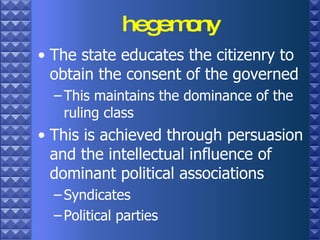
hegemony The state educates the citizenry to obtain the consent of the governed This maintains the dominance of the ruling class  This is achieved through persuasion and the intellectual influence of dominant political associations Syndicates Political parties
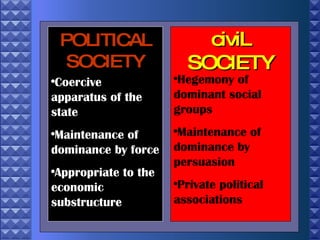
POLITICAL SOCIETY civiL SOCIETY Coercive  apparatus of the state Maintenance of dominance by force Appropriate to the economic substructure Hegemony of dominant social groups Maintenance of dominance by persuasion Private political associations
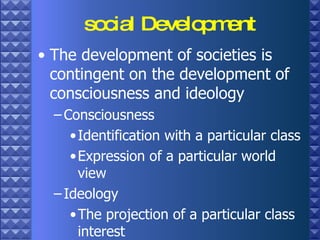
social Development The development of societies is contingent on the development of consciousness and ideology Consciousness  Identification with a particular class Expression of a particular world view Ideology The projection of a particular class interest
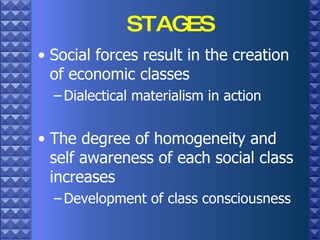
STAGES Social forces result in the creation of economic classes Dialectical materialism in action The degree of homogeneity and self awareness of each social class increases Development of class consciousness
stages The dominant group develops its own ideology and establishes its hegemony over society Dominance in civil society  Capture of the state mechanism When hegemony weakens, coercive force is necessary to maintain societal control
the critique Democracy, as the form of rule of the bourgeois, is based on bourgeois hegemony Capitalism will not collapse on its own unless the proletariat develops its own consciousness and ideology In this manner, the proletariat can achieve its own hegemony

Antonio Gramsci

  • 1.
  • 2.
    OVERVIEW Who wasAntonio Gramsci? In what way was he a Marxist? What was Gramsci’s notion of the state and hegemony? In what way was Gramsci’s ideas a critique of democracy?
  • 3.
    A. gramsci (1891-1937) Italian of working-class background Political career began as a journalist for the Italian Socialist Party Founding member (and later head) of the Italian Communist Party Imprisoned for his opposition to Mussolini
  • 4.
    gramsci’s marxisM Gramscidwells on many elements of Marx’s thinking Dialectical Materialism Class Struggle Substructure and Superstructure He built on Marxist thought by emphasizing the role of the state and society in the dialectical process
  • 5.
    the state Economicforces of production (substructure) affect the development of the state However, as the superstructure the state does not develop spontaneously nor haphazardly The state is an ethical agent in the shaping of society according to the needs of productive forces
  • 6.
    hegemony The stateeducates the citizenry to obtain the consent of the governed This maintains the dominance of the ruling class This is achieved through persuasion and the intellectual influence of dominant political associations Syndicates Political parties
  • 7.
    POLITICAL SOCIETY civiLSOCIETY Coercive apparatus of the state Maintenance of dominance by force Appropriate to the economic substructure Hegemony of dominant social groups Maintenance of dominance by persuasion Private political associations
  • 8.
    social Development Thedevelopment of societies is contingent on the development of consciousness and ideology Consciousness Identification with a particular class Expression of a particular world view Ideology The projection of a particular class interest
  • 9.
    STAGES Social forcesresult in the creation of economic classes Dialectical materialism in action The degree of homogeneity and self awareness of each social class increases Development of class consciousness
  • 10.
    stages The dominantgroup develops its own ideology and establishes its hegemony over society Dominance in civil society Capture of the state mechanism When hegemony weakens, coercive force is necessary to maintain societal control
  • 11.
    the critique Democracy,as the form of rule of the bourgeois, is based on bourgeois hegemony Capitalism will not collapse on its own unless the proletariat develops its own consciousness and ideology In this manner, the proletariat can achieve its own hegemony

Editor's Notes

  • #2 Learning Objectives: 1.) To become acquainted with Gramsci’s brand of Marxism. 2.) To understand Gramsci’s concept of hegemony and its implications in terms of assessing democratic states.