Dr. Miles Weaver,
The Business School,
Edinburgh Napier University
M.Weaver@napier.ac.uk
Building High Performance Organisations
Unit 3: Lean thinking
Unit 4: Learning Outcomes
After completing this unit you should be able to:-
• Define the differences between planning and control
activity in operations;
• Identify differing forms of demand and their significance
to operational practice;
• Understand the principles and background development of
enterprise resource planning;
• Understand the philosophy and practice of lean
operations.
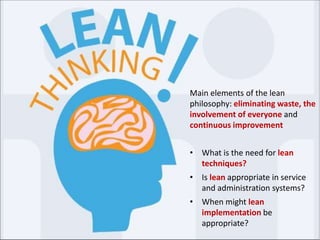
Main elements of the lean
philosophy: eliminating waste, the
involvement of everyone and
continuous improvement
• What is the need for lean
techniques?
• Is lean appropriate in service
and administration systems?
• When might lean
implementation be
appropriate?
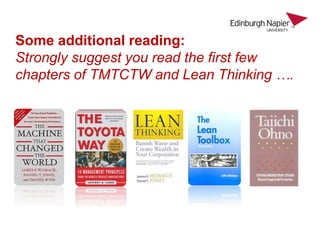
Some additional reading:
Strongly suggest you read the first few
chapters of TMTCTW and Lean Thinking ….
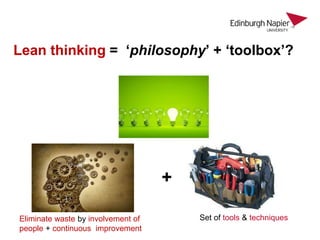
Lean thinking = ‘philosophy’ + ‘toolbox’?
+
Set of tools & techniquesEliminate waste by involvement of
people + continuous improvement
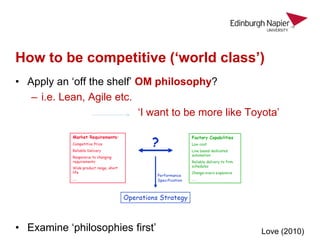
How to be competitive (‘world class’)
• Apply an ‘off the shelf’ OM philosophy?
– i.e. Lean, Agile etc.
‘I want to be more like Toyota’
• Examine ‘philosophies first’ Love (2010)
Operations philosophies
• Philosophies are prescriptive & comprehensive
– Lean (Toyota/JIT)
– Agile (QRM, Adaptive)
• ‘this is why you should do it’
• ‘this is how you should do it’
• Note: may degenerate into an ad-hoc approach, based on:
– Good practice/benchmarking
• Factory visits, competitor analysis
– Apply good/accepted ideas
• E.g. ‘we must have kanban or ERP’
– Forgets the ‘why’
• May not be coherent, co-ordinated or best use of resources Love (2010)
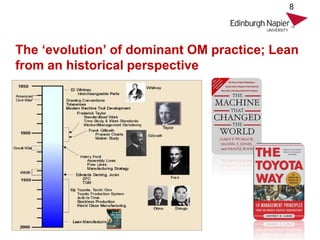
The ‘evolution’ of dominant OM practice; Lean
from an historical perspective
8
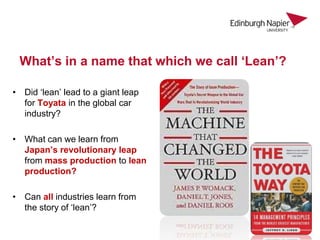
What’s in a name that which we call ‘Lean’?
• Did ‘lean’ lead to a giant leap
for Toyata in the global car
industry?
• What can we learn from
Japan’s revolutionary leap
from mass production to lean
production?
• Can all industries learn from
the story of ‘lean’?
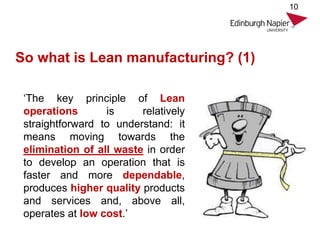
So what is Lean manufacturing? (1)
10
‘The key principle of Lean
operations is relatively
straightforward to understand: it
means moving towards the
elimination of all waste in order
to develop an operation that is
faster and more dependable,
produces higher quality products
and services and, above all,
operates at low cost.’
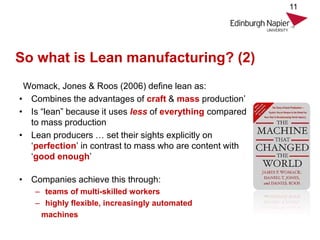
So what is Lean manufacturing? (2)
Womack, Jones & Roos (2006) define lean as:
• Combines the advantages of craft & mass production’
• Is “lean” because it uses less of everything compared
to mass production
• Lean producers … set their sights explicitly on
‘perfection’ in contrast to mass who are content with
‘good enough’
• Companies achieve this through:
– teams of multi-skilled workers
– highly flexible, increasingly automated
machines
11
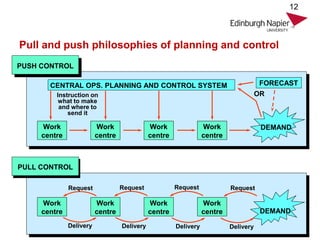
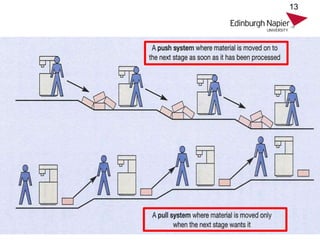
Pull and push philosophies of planning and control
12
CENTRAL OPS. PLANNING AND CONTROL SYSTEM
Work
centre
DEMANDWork
centre
Work
centre
Work
centre
Instruction on
what to make
and where to
send it
FORECAST
OR
PULL CONTROL
Work
centre
Work
centre
Work
centre
Work
centre DEMAND
Request Request Request Request
Delivery Delivery Delivery Delivery
PUSH CONTROL
13
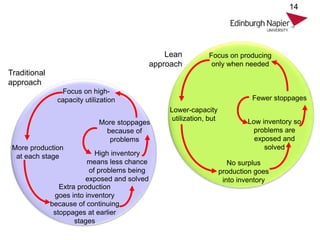
14
Lean
approach
Focus on producing
only when needed
Lower-capacity
utilization, but
No surplus
production goes
into inventory
Low inventory so
problems are
exposed and
solved
Traditional
approach
Focus on high-
capacity utilization
More production
at each stage
Extra production
goes into inventory
because of continuing
stoppages at earlier
stages
High inventory
means less chance
of problems being
exposed and solved
More stoppages
because of
problems
Fewer stoppages
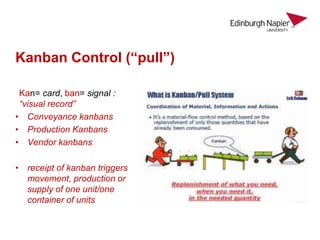
Kanban Control (“pull”)
Kan= card, ban= signal :
“visual record”
• Conveyance kanbans
• Production Kanbans
• Vendor kanbans
• receipt of kanban triggers
movement, production or
supply of one unit/one
container of units
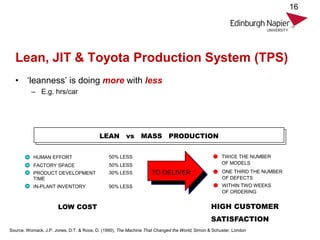
Lean, JIT & Toyota Production System (TPS)
• ‘leanness’ is doing more with less
– E.g. hrs/car
16
LOW COST HIGH CUSTOMER
SATISFACTION
TO DELIVER
TWICE THE NUMBER
OF MODELS
ONE THIRD THE NUMBER
OF DEFECTS
WITHIN TWO WEEKS
OF ORDERING
HUMAN EFFORT
FACTORY SPACE
PRODUCT DEVELOPMENT
TIME
50% LESS
50% LESS
30% LESS
90% LESSIN-PLANT INVENTORY
LEAN vs MASS PRODUCTION
Source: Womack, J.P. Jones, D.T. & Roos, D. (1990), The Machine That Changed the World, Simon & Schuster, London
Lean in Service operations (I)
Discuss in small groups how lean practice could be adopted in a service
environment. Choose an organisation and consider:
– What is Lean in practice? Is it applicable in a service
environment?
– What is Muda (waste)?
– What types of waste exist?
– What are some of the tools and techniques applied in Lean?
You might wish to consider the Whisky Experience, this University, a
Leisure facility or another example more familiar and of interest to your
group
Lean in Service Operations (II)
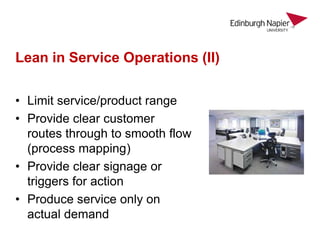
• Limit service/product range
• Provide clear customer
routes through to smooth flow
(process mapping)
• Provide clear signage or
triggers for action
• Produce service only on
actual demand
Lean in Service Operations (III)
Standardise service content
• with some flexibility in practice, maybe in terms
of number of servers at high/low points in the
demand curve
Introduce JIT supply – required
material for service provision ordered and supplied on
demand
Use common equipment/
process for multiple routes
Lean, JIT & TPS (2)
Just-in-time (JIT) was defined
by OM academics (see Slack et
al., 2011) as a target + the
means to achieve it:
• Eliminate waste by
involvement of people +
continuous improvement
– ‘waste’ = using less: people, plant,
materials, money
20
Eliminating waste (Muda)
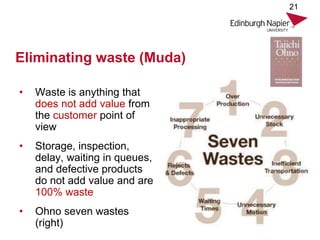
• Waste is anything that
does not add value from
the customer point of
view
• Storage, inspection,
delay, waiting in queues,
and defective products
do not add value and are
100% waste
• Ohno seven wastes
(right)
21
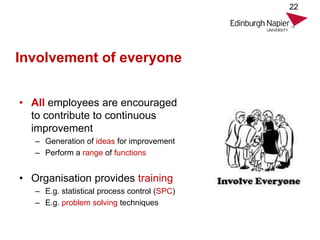
Involvement of everyone
• All employees are encouraged
to contribute to continuous
improvement
– Generation of ideas for improvement
– Perform a range of functions
• Organisation provides training
– E.g. statistical process control (SPC)
– E.g. problem solving techniques
22
Continuous improvement or ‘kaizan’ (1)
Russell and Taylor (2005) adapt Hirano (1989)
ten principles to implement a continuous
improvement effort (See Greasley, 2013):
1. Create a mind-set for improvement – do not
accept that the present way of doing things
is necessarily the best
2. Try and try again – don’t seek immediate
perfection but move to your goal by small
improvements, checking for mistakes as
you progress.
23
Continuous improvement or ‘kaizan’ (2)
3. THINK – get to the real cause of
the problem – ask why? Five
times.
4. Work in teams – use the ideas
from a number of people to
brainstorm new ways.
5. Recognise that improvement
knows no limits – get in a habit of
always looking for better ways of
doing thinks.
24
In “Toyota Production System: Beyond Large
Scale Production”, Taiichi Ohno says:
• [W]e frequently see people working ahead. Instead of waiting, the worker
works on the next job, so the waiting is hidden. If this situation is
repeated, inventory begins to accumulate at the end of the production line
or between lines. – page 59
• when we “hide the waiting”, then we create more waste – waste that can
be even more costly to the organization.
• We regard only work that is needed as real work, and define the rest as
waste. . . . we must make only the amount needed. – page 19
• I used to tell production workers one of my favourite stories about a boat
rowed by eight men. One rower might feel he is stronger than the next
and row twice as hard. This extra effort upsets the boat’s process and
moves it off course. – page 24
25
Lean, JIT & TPS (3):
Toyota Motor Corporation
• Largest vehicle
manufacturer in the world
with annual sales of over
9 million vehicles
• Success due to two
techniques, JIT and TPS
• Continual problem
solving is central to JIT
• Eliminating excess
inventory makes
problems immediately
evident
26
• Central to TPS is employee
learning and a continuing
effort to produce products
under ideal conditions
• Respect for people is
fundamental
• Small building but high levels
of production
• Subassemblies are
transferred to the assembly
line on a JIT basis
• High quality and low
assembly time per vehicle
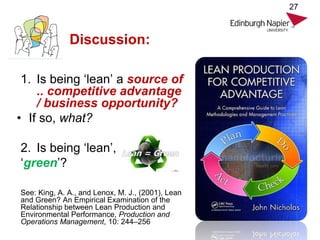
Discussion:
1. Is being ‘lean’ a source of
.. competitive advantage
/ business opportunity?
• If so, what?
2. Is being ‘lean’,
‘green’?
See: King, A. A., and Lenox, M. J., (2001), Lean
and Green? An Empirical Examination of the
Relationship between Lean Production and
Environmental Performance, Production and
Operations Management, 10: 244–256
27
Would a ‘Rose’ by any other name; smell as
‘sweet’?
Other synonyms:
• continuous flow manufacture
• high value-added manufacture
• stockless production
• low-inventory production
• fast-throughput manufacturing
• Lean Manufacturing
• Toyota production system
• short cycle time manufacturing
• In practice: applied everywhere?
– E.g. lean healthcare
28
Five Lean Principles
1. Specify what creates value from the customer
perspective
2. Identify all steps across the whole value stream
3. Make those actions that create value flow –
eliminate the root causes of waste
4. Only to the pace of customer demand – create
pull where flow is difficult
5. Strive for perfection by continually removing
successive layers of waste
29
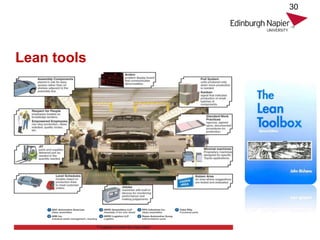
Lean tools
30
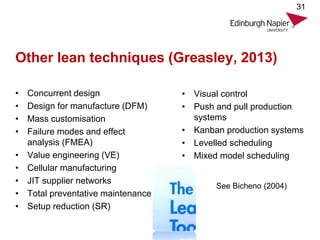
Other lean techniques (Greasley, 2013)
• Concurrent design
• Design for manufacture (DFM)
• Mass customisation
• Failure modes and effect
analysis (FMEA)
• Value engineering (VE)
• Cellular manufacturing
• JIT supplier networks
• Total preventative maintenance
• Setup reduction (SR)
• Visual control
• Push and pull production
systems
• Kanban production systems
• Levelled scheduling
• Mixed model scheduling
31
See Bicheno (2004)
Implementing lean (the ‘How’)
• The JIT-like explanation is a mixture of objectives and means
– Everyone wants to eliminate waste, they just disagree about how it
should be done!
– Lean/TPS/JIT prescribes how the objective should be attained
– This is fine if the recipe is universally applicable
• But, the JIT toolbox is rather large (See Bicheno, 2004)!
– See Bicheno (2004) toolbox
• Some actions that don’t fall too obviously into the involvement +
continuous improvement categories
– Levelled scheduling, kanban, concurrent design
• Do we use all of them, or just some?
• Recasting the objective(s) might help to clarify matters
Summary
• Key principle of lean: elimination of waste by
involving everyone through continuous
improvement
• JIT can be seen on one level as a philosophy and on
a second level as a set of tools and techniques >>
required to implement ‘lean’
• JIT and lean may be applicable in services and
administrative systems
• lots of ‘demand’ changes ( + no ‘extra’ capacity or
keep stock level low)?
33
Prescribed reading & tutorial case
• Prescribed Reading
– Unit 3: Chapters 10, 13 (Greasley, 2013) and
Chapter 3 Mangan (available online).
– You might wish to read on and learn more
about ERP systems in Chapter 14 (Greasley,
2013)
– See assignment brief for further reading
• Discussion
– Discuss in small groups how lean practice
could be adopted in a service environment
– Case Study: “It Pays to Cut Out Waste but
Not to Trim All the Value Away” (Greasley,
2013)
Case Study “It Pays to Cut Out Waste but Not to
Trim All the Value Away” (Greasley, 2013)
You will have read the case and prepared the
following question in preparation for class
discussion:
• How lean thinking can lead to the keeping of
manufacturing jobs in developed countries?
Case Study “It Pays to Cut Out Waste but Not to
Trim All the Value Away” (Greasley, 2013)
• Might local small batch supply create any problems?
(consider Toyota)
• How might the time and potential disruption for items
spent in transit feature in this discussion?
• How easy is problem solving thousands of miles away?
• How easy is “total involvement” when there is a high level
of geographic separation?
• How can “equitable HR practices “ be properly assured in
transnational activity?

Lean Thinking

  • 1.
    Dr. Miles Weaver, TheBusiness School, Edinburgh Napier University M.Weaver@napier.ac.uk Building High Performance Organisations Unit 3: Lean thinking
  • 2.
    Unit 4: LearningOutcomes After completing this unit you should be able to:- • Define the differences between planning and control activity in operations; • Identify differing forms of demand and their significance to operational practice; • Understand the principles and background development of enterprise resource planning; • Understand the philosophy and practice of lean operations.
  • 3.
    Main elements ofthe lean philosophy: eliminating waste, the involvement of everyone and continuous improvement • What is the need for lean techniques? • Is lean appropriate in service and administration systems? • When might lean implementation be appropriate?
  • 4.
    Some additional reading: Stronglysuggest you read the first few chapters of TMTCTW and Lean Thinking ….
  • 5.
    Lean thinking =‘philosophy’ + ‘toolbox’? + Set of tools & techniquesEliminate waste by involvement of people + continuous improvement
  • 6.
    How to becompetitive (‘world class’) • Apply an ‘off the shelf’ OM philosophy? – i.e. Lean, Agile etc. ‘I want to be more like Toyota’ • Examine ‘philosophies first’ Love (2010)
  • 7.
    Operations philosophies • Philosophiesare prescriptive & comprehensive – Lean (Toyota/JIT) – Agile (QRM, Adaptive) • ‘this is why you should do it’ • ‘this is how you should do it’ • Note: may degenerate into an ad-hoc approach, based on: – Good practice/benchmarking • Factory visits, competitor analysis – Apply good/accepted ideas • E.g. ‘we must have kanban or ERP’ – Forgets the ‘why’ • May not be coherent, co-ordinated or best use of resources Love (2010)
  • 8.
    The ‘evolution’ ofdominant OM practice; Lean from an historical perspective 8
  • 9.
    What’s in aname that which we call ‘Lean’? • Did ‘lean’ lead to a giant leap for Toyata in the global car industry? • What can we learn from Japan’s revolutionary leap from mass production to lean production? • Can all industries learn from the story of ‘lean’?
  • 10.
    So what isLean manufacturing? (1) 10 ‘The key principle of Lean operations is relatively straightforward to understand: it means moving towards the elimination of all waste in order to develop an operation that is faster and more dependable, produces higher quality products and services and, above all, operates at low cost.’
  • 11.
    So what isLean manufacturing? (2) Womack, Jones & Roos (2006) define lean as: • Combines the advantages of craft & mass production’ • Is “lean” because it uses less of everything compared to mass production • Lean producers … set their sights explicitly on ‘perfection’ in contrast to mass who are content with ‘good enough’ • Companies achieve this through: – teams of multi-skilled workers – highly flexible, increasingly automated machines 11
  • 12.
    Pull and pushphilosophies of planning and control 12 CENTRAL OPS. PLANNING AND CONTROL SYSTEM Work centre DEMANDWork centre Work centre Work centre Instruction on what to make and where to send it FORECAST OR PULL CONTROL Work centre Work centre Work centre Work centre DEMAND Request Request Request Request Delivery Delivery Delivery Delivery PUSH CONTROL
  • 13.
  • 14.
    14 Lean approach Focus on producing onlywhen needed Lower-capacity utilization, but No surplus production goes into inventory Low inventory so problems are exposed and solved Traditional approach Focus on high- capacity utilization More production at each stage Extra production goes into inventory because of continuing stoppages at earlier stages High inventory means less chance of problems being exposed and solved More stoppages because of problems Fewer stoppages
  • 15.
    Kanban Control (“pull”) Kan=card, ban= signal : “visual record” • Conveyance kanbans • Production Kanbans • Vendor kanbans • receipt of kanban triggers movement, production or supply of one unit/one container of units
  • 16.
    Lean, JIT &Toyota Production System (TPS) • ‘leanness’ is doing more with less – E.g. hrs/car 16 LOW COST HIGH CUSTOMER SATISFACTION TO DELIVER TWICE THE NUMBER OF MODELS ONE THIRD THE NUMBER OF DEFECTS WITHIN TWO WEEKS OF ORDERING HUMAN EFFORT FACTORY SPACE PRODUCT DEVELOPMENT TIME 50% LESS 50% LESS 30% LESS 90% LESSIN-PLANT INVENTORY LEAN vs MASS PRODUCTION Source: Womack, J.P. Jones, D.T. & Roos, D. (1990), The Machine That Changed the World, Simon & Schuster, London
  • 17.
    Lean in Serviceoperations (I) Discuss in small groups how lean practice could be adopted in a service environment. Choose an organisation and consider: – What is Lean in practice? Is it applicable in a service environment? – What is Muda (waste)? – What types of waste exist? – What are some of the tools and techniques applied in Lean? You might wish to consider the Whisky Experience, this University, a Leisure facility or another example more familiar and of interest to your group
  • 18.
    Lean in ServiceOperations (II) • Limit service/product range • Provide clear customer routes through to smooth flow (process mapping) • Provide clear signage or triggers for action • Produce service only on actual demand
  • 19.
    Lean in ServiceOperations (III) Standardise service content • with some flexibility in practice, maybe in terms of number of servers at high/low points in the demand curve Introduce JIT supply – required material for service provision ordered and supplied on demand Use common equipment/ process for multiple routes
  • 20.
    Lean, JIT &TPS (2) Just-in-time (JIT) was defined by OM academics (see Slack et al., 2011) as a target + the means to achieve it: • Eliminate waste by involvement of people + continuous improvement – ‘waste’ = using less: people, plant, materials, money 20
  • 21.
    Eliminating waste (Muda) •Waste is anything that does not add value from the customer point of view • Storage, inspection, delay, waiting in queues, and defective products do not add value and are 100% waste • Ohno seven wastes (right) 21
  • 22.
    Involvement of everyone •All employees are encouraged to contribute to continuous improvement – Generation of ideas for improvement – Perform a range of functions • Organisation provides training – E.g. statistical process control (SPC) – E.g. problem solving techniques 22
  • 23.
    Continuous improvement or‘kaizan’ (1) Russell and Taylor (2005) adapt Hirano (1989) ten principles to implement a continuous improvement effort (See Greasley, 2013): 1. Create a mind-set for improvement – do not accept that the present way of doing things is necessarily the best 2. Try and try again – don’t seek immediate perfection but move to your goal by small improvements, checking for mistakes as you progress. 23
  • 24.
    Continuous improvement or‘kaizan’ (2) 3. THINK – get to the real cause of the problem – ask why? Five times. 4. Work in teams – use the ideas from a number of people to brainstorm new ways. 5. Recognise that improvement knows no limits – get in a habit of always looking for better ways of doing thinks. 24
  • 25.
    In “Toyota ProductionSystem: Beyond Large Scale Production”, Taiichi Ohno says: • [W]e frequently see people working ahead. Instead of waiting, the worker works on the next job, so the waiting is hidden. If this situation is repeated, inventory begins to accumulate at the end of the production line or between lines. – page 59 • when we “hide the waiting”, then we create more waste – waste that can be even more costly to the organization. • We regard only work that is needed as real work, and define the rest as waste. . . . we must make only the amount needed. – page 19 • I used to tell production workers one of my favourite stories about a boat rowed by eight men. One rower might feel he is stronger than the next and row twice as hard. This extra effort upsets the boat’s process and moves it off course. – page 24 25
  • 26.
    Lean, JIT &TPS (3): Toyota Motor Corporation • Largest vehicle manufacturer in the world with annual sales of over 9 million vehicles • Success due to two techniques, JIT and TPS • Continual problem solving is central to JIT • Eliminating excess inventory makes problems immediately evident 26 • Central to TPS is employee learning and a continuing effort to produce products under ideal conditions • Respect for people is fundamental • Small building but high levels of production • Subassemblies are transferred to the assembly line on a JIT basis • High quality and low assembly time per vehicle
  • 27.
    Discussion: 1. Is being‘lean’ a source of .. competitive advantage / business opportunity? • If so, what? 2. Is being ‘lean’, ‘green’? See: King, A. A., and Lenox, M. J., (2001), Lean and Green? An Empirical Examination of the Relationship between Lean Production and Environmental Performance, Production and Operations Management, 10: 244–256 27
  • 28.
    Would a ‘Rose’by any other name; smell as ‘sweet’? Other synonyms: • continuous flow manufacture • high value-added manufacture • stockless production • low-inventory production • fast-throughput manufacturing • Lean Manufacturing • Toyota production system • short cycle time manufacturing • In practice: applied everywhere? – E.g. lean healthcare 28
  • 29.
    Five Lean Principles 1.Specify what creates value from the customer perspective 2. Identify all steps across the whole value stream 3. Make those actions that create value flow – eliminate the root causes of waste 4. Only to the pace of customer demand – create pull where flow is difficult 5. Strive for perfection by continually removing successive layers of waste 29
  • 30.
  • 31.
    Other lean techniques(Greasley, 2013) • Concurrent design • Design for manufacture (DFM) • Mass customisation • Failure modes and effect analysis (FMEA) • Value engineering (VE) • Cellular manufacturing • JIT supplier networks • Total preventative maintenance • Setup reduction (SR) • Visual control • Push and pull production systems • Kanban production systems • Levelled scheduling • Mixed model scheduling 31 See Bicheno (2004)
  • 32.
    Implementing lean (the‘How’) • The JIT-like explanation is a mixture of objectives and means – Everyone wants to eliminate waste, they just disagree about how it should be done! – Lean/TPS/JIT prescribes how the objective should be attained – This is fine if the recipe is universally applicable • But, the JIT toolbox is rather large (See Bicheno, 2004)! – See Bicheno (2004) toolbox • Some actions that don’t fall too obviously into the involvement + continuous improvement categories – Levelled scheduling, kanban, concurrent design • Do we use all of them, or just some? • Recasting the objective(s) might help to clarify matters
  • 33.
    Summary • Key principleof lean: elimination of waste by involving everyone through continuous improvement • JIT can be seen on one level as a philosophy and on a second level as a set of tools and techniques >> required to implement ‘lean’ • JIT and lean may be applicable in services and administrative systems • lots of ‘demand’ changes ( + no ‘extra’ capacity or keep stock level low)? 33
  • 34.
    Prescribed reading &tutorial case • Prescribed Reading – Unit 3: Chapters 10, 13 (Greasley, 2013) and Chapter 3 Mangan (available online). – You might wish to read on and learn more about ERP systems in Chapter 14 (Greasley, 2013) – See assignment brief for further reading • Discussion – Discuss in small groups how lean practice could be adopted in a service environment – Case Study: “It Pays to Cut Out Waste but Not to Trim All the Value Away” (Greasley, 2013)
  • 35.
    Case Study “ItPays to Cut Out Waste but Not to Trim All the Value Away” (Greasley, 2013) You will have read the case and prepared the following question in preparation for class discussion: • How lean thinking can lead to the keeping of manufacturing jobs in developed countries?
  • 36.
    Case Study “ItPays to Cut Out Waste but Not to Trim All the Value Away” (Greasley, 2013) • Might local small batch supply create any problems? (consider Toyota) • How might the time and potential disruption for items spent in transit feature in this discussion? • How easy is problem solving thousands of miles away? • How easy is “total involvement” when there is a high level of geographic separation? • How can “equitable HR practices “ be properly assured in transnational activity?

Editor's Notes

  • #28 King, A. A., and Lenox, M. J., (2001), Lean and Green? An Empirical Examination of the Relationship between Lean Production and Environmental Performance, Production and Operations Management, 10: 244–256