Unit 5:
Embedding Sustainability into Strategy II
Formulating Strategic Responses
Dr. Miles Weaver,
Edinburgh Napier University Business School
m.weaver@napier.ac.uk
@DrMilesWeaver
#BSSD17
#BSSD17
Learning outcomes
After this lecture and independent study you should be able to:-
Learning Outcomes Key Concept
LO 5.1
Evaluate the generic strategic responses to
sustainability ‘how’
Sustainable Value/
Generic Strategic Responses
LO 5.2
Discuss the difference between a ‘bolt-on’
and ‘embed’ sustainability strategy Bolt-on/Embedded Sustainability
LO 5.3
Understand how corporate and business-
level strategies are devised to develop
strategic capabilities made up of a unique
‘value bundle’ of sustainability-driven initiatives
Sustainable Value Framework /
Sustainability-driven initiatives
#BSSD17
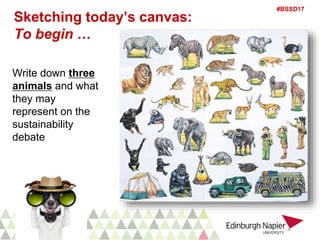
Sketching today’s canvas:
To begin …
Write down three
animals and what
they may
represent on the
sustainability
debate
#BSSD17
Keeping on track …
• The really contentious bit … requires deep thought and
reflection
• Role of business in
society
• How value is
captured and for
whom
• Profit Vs. purpose
• The roots to the
answer … the same
thing?
• John Mackey offers an
interesting perspective
on a way forward
GENERIC STRATEGIC RESPONSE
TO SUSTAINABILITY
LO 5.1 Evaluate the generic strategic responses to sustainability ‘how’
LO 5.3 Understand how corporate and business-level strategies are devised
to develop strategic capabilities made up of a unique ‘value bundle’ of
sustainability-driven initiatives
#BSSD17
Addressing sustainability issues
Organisations can develop and implement a range of strategies to
address environmental and social issues (e.g. complying with
regulations; pro-activity to gain competitive advantage)
Three important questions:
– How might an organisation turn the key global social and
environmental issues into strategic business opportunities…?
– How to incorporate environmental and social concerns into strategy?
– What level should environmental and social strategies be integrated?
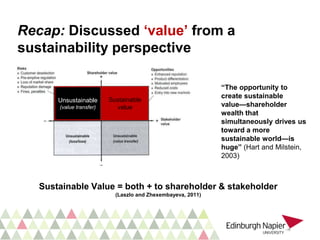
Sustainable
value
Unsustainable
(value transfer)
Sustainable Value = both + to shareholder & stakeholder
(Laszlo and Zhexembayeva, 2011)
Recap: Discussed ‘value’ from a
sustainability perspective
“The opportunity to
create sustainable
value—shareholder
wealth that
simultaneously drives us
toward a more
sustainable world—is
huge” (Hart and Milstein,
2003)
#BSSD17
The competitive landscape is constantly evolving.
Key message: value is migrating to ‘sustainable value’
positions
#BSSD17
Key message: “Beating the average”
Can we agree that everyone
wants to beat the average as
‘sustainability’ becomes a
normal part of the way
business is done?
• Today’s ‘core competences’
become tomorrow’s
‘threshold competencies’
(normal practice)
• the standard gets raised
creating a new level
playing field
• Alignment to need
defined by community
priorities
(transparency?)
#BSSD17
#BSSD17
Levels of strategic response ‘what’
Banerjee (2001) differentiates between
four levels of strategic response:
• Enterprise strategy - concerned with the
role a firm plays in society; its
fundamental mission. Suggests not much
evidence of this except in environmental
organisations
• Corporate strategy - the kinds of
businesses a firm should enter to meet its
enterprise strategy. Includes decisions on
business portfolios, markets, technologies
• Business strategy - allocating
organisational resources to achieve
competitive advantage and integrating
different business functions
• Functional strategy -planning operations
for different functions (e.g. marketing,
purchasing, distribution)
Above figure relates strategy level to strategy type
and desired outcome
#BSSD17
Devising Corporate Strategies for the
Sustainability ‘how’
Operationalising these strategic questions means addressing them in the
following ways:
Our sustainable value vision?
• Organisational purpose based on the maximisation of ‘sustainable value’.
• Concerns how the organisation fulfil this purpose, in terms of the scope of
industries and markets within which the organisation competes
• How can we address these social and environmental issues while
advancing existing business priorities?
• How do we identify and manage emerging stakeholder issues?
• What are the new sources of sustainable value (i.e. those in which
shareholder value is not created at the expense of other stakeholders)?
(Adapted from Laszlo, 2008, p.182)
Devising Competitive Strategies
for Sustainability ‘how’
• How might an organisation
turn the key global social
and environmental issues
into strategic business
opportunities …?
– … through igniting innovation into
new processes and products
– To open new, unexpected
markets
– To create consumer passion and
loyalty
– To energise the workforce and
build its loyalty
– To build sustainable supply
chains
– To radically bring down energy costs
and waste production …
… and, at the same time, build a safer,
more secure, better world ?
• What capabilities do we need to
realise the sustainability vision?
• How do we measure the
success of our sustainability?
(Adapted from Laszlo, 2008, p.182)
• Rather than just to comply with
regulations
#BSSD17
Recap: Traditional ‘business school’ thinking
• Hart (2005) proposed a basis for integrating firms’ relationship
to the natural environment into resource-based theory (a
dominant strategy school of thought) and indirectly into strategic
management (NRBV)
• Key message: one of the most important drivers of new
resources and capability development for firms will be the
constraints and challenges posed by the natural environment
(Hart, 2005)
• Developing solutions for sustainability are our opportunities
#BSSD17
Emerging views on strategy formulation
Can we agree?
• Goal is sustainable value creation
• this ‘higher purpose’ incorporates both PROFIT & PURPOSE
• Process of strategy formulation is basically the same as standard approach
except for weight given to ecological (natural) environment relative to
competitive environment (Roberts, 1995)
• Same is true for the ‘social’ environment
• Necessity is to capture the ‘value bundle’ of both stakeholders and
shareholders
• Competitive advantage is deep rooted in strategic capabilities that
incorporate a range of sustainability initiatives/actions (i.e. NRBV)
• Organisational values shape strategic choice (… quid pro quo)
#BSSD17
The Laszlo sustainability model
Requires ‘systems
thinking’ across the
supply, process and
demand chains
(to be continued …)
Measuring
Impact:
• Social
• Environmental
• Economic
#BSSD17
Sustainable Value framework
(Hart and Milstein, 2003)
#BSSD17
Sustainable Value framework
(Hart and Milstein, 2003)
Sustainability Vision strategy:
Does our corporate vision direct
us toward the solution of social
and environmental problems?
Does our vision guide the
development of new
technologies, markets, products,
and processes?
#BSSD17
Sustainable Value framework
(Hart, 1996; Hart and Milstein, 2003)
Clean Technology Strategy:
Is the environmental
performance of our products
limited by our existing
competency base?
Is there potential to realise major
improvements through new
technology?
#BSSD17
Sustainable Value framework
(Hart and Milstein, 2003)
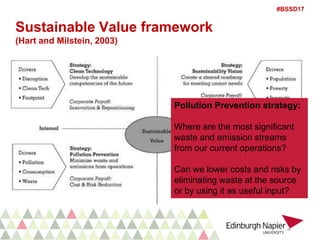
Pollution Prevention strategy:
Where are the most significant
waste and emission streams
from our current operations?
Can we lower costs and risks by
eliminating waste at the source
or by using it as useful input?
#BSSD17
Sustainable Value framework
(Hart and Milstein, 2003)
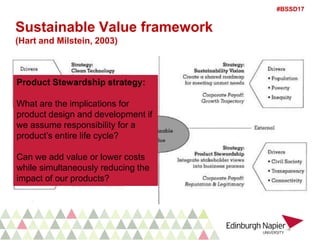
Product Stewardship strategy:
What are the implications for
product design and development if
we assume responsibility for a
product’s entire life cycle?
Can we add value or lower costs
while simultaneously reducing the
impact of our products?
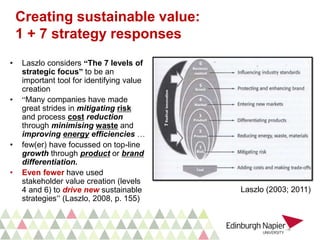
Creating sustainable value:
1 + 7 strategy responses
• Laszlo considers “The 7 levels of
strategic focus” to be an
important tool for identifying value
creation
• “Many companies have made
great strides in mitigating risk
and process cost reduction
through minimising waste and
improving energy efficiencies …
• few(er) have focussed on top-line
growth through product or brand
differentiation.
• Even fewer have used
stakeholder value creation (levels
4 and 6) to drive new sustainable
strategies” (Laszlo, 2008, p. 155)
Laszlo (2003; 2011)
#BSSD17
#BSSD17
Value destruction: It’s an added cost
“do well by doing good” seems to violate economic logic
(Laszlo & Zhexembayeva, 2011)
#BSSD17
Value creation #1: It’s risk mitigation
Avoiding its destruction
Negative sustainability impacts & negative business
consequences that follow it (Laszlo & Zhexembayeva, 2011)
#BSSD17
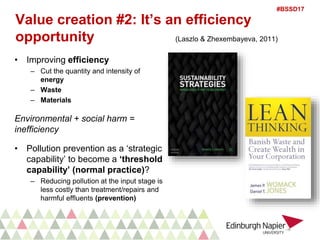
Value creation #2: It’s an efficiency
opportunity (Laszlo & Zhexembayeva, 2011)
• Improving efficiency
– Cut the quantity and intensity of
energy
– Waste
– Materials
Environmental + social harm =
inefficiency
• Pollution prevention as a ‘strategic
capability’ to become a ‘threshold
capability’ (normal practice)?
– Reducing pollution at the input stage is
less costly than treatment/repairs and
harmful effluents (prevention)
#BSSD17
Detour to “Shared Value”:
Way 2: redefining productivity in the value
chain
• Next week we shall consider the opportunities to create sustainable
value in the supply chain
• Porter and Kramer (2011) approach follows a traditional and holistic
evaluation of value chain productivity:
– Energy use
– Logistics
– Resource use
– Procurement
– Distribution
– Location
– Employee productivity
#BSSD17
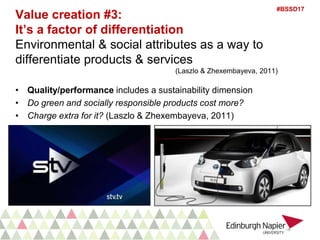
Value creation #3:
It’s a factor of differentiation
Environmental & social attributes as a way to
differentiate products & services
(Laszlo & Zhexembayeva, 2011)
• Quality/performance includes a sustainability dimension
• Do green and socially responsible products cost more?
• Charge extra for it? (Laszlo & Zhexembayeva, 2011)
#BSSD17
Value creation #4: It’s a pathway to new markets
New market opportunities when consumers demand
solutions for their environmental & social problems
(Laszlo & Zhexembayeva, 2011)
• New market – meeting the needs of
the world’s poorest 4 billion living
on less than $4 a day
• Consumer market = $5 trillion
See Hock’s lecture on ‘The Bottom of the
Pyramid’
#BSSD17
Detour to “Shared Value”:
Way 1: by reconceiving products and markets
• ‘‘Business at the Bottom of the Pyramid’’ (Prahalad and Hart, 2002;
Prahalad, 2005; Webb et al., 2010)
• Porter and Kramer define it as ‘‘satisfying unmet social needs’’ and ‘‘serving
disadvantaged communities’’ (Porter and Kramer, 2011, pp. 67-8).
• Basic argument rests on creating economies of scale for offering essential
products and services such as health, housing or credit at reasonable prices
to disadvantaged communities, thus fostering their inclusion within the formal
economy (Spitzeck and Chapman, 2012)
• Critics focus on the enhancement of social conditions in communities
(Karnani, 2007; Olsen and Boxenbaum, 2009)
#BSSD17
Value creation #5: It’s a way to protect &
enhance the brand
Brand/image rooted on perceived on environmental & social
performance (Laszlo & Zhexembayeva, 2011)
• Draw talent
• Secure loyal customers
• Become supplier-of-
choice
• Attract investors
• Goodwill with regulators
• Positioning can be gained
and lost …
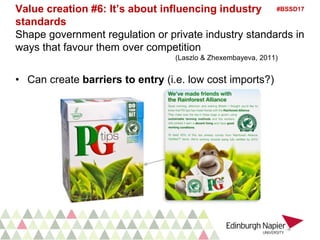
#BSSD17Value creation #6: It’s about influencing industry
standards
Shape government regulation or private industry standards in
ways that favour them over competition
(Laszlo & Zhexembayeva, 2011)
• Can create barriers to entry (i.e. low cost imports?)
#BSSD17
Value creation #7: It’s a driver of radical
innovation
Transformative whole system change
(Laszlo & Zhexembayeva, 2011)
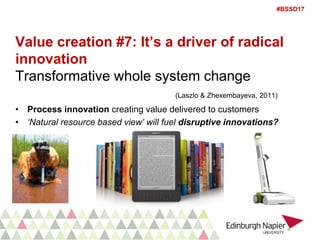
• Process innovation creating value delivered to customers
• ‘Natural resource based view’ will fuel disruptive innovations?
#BSSD17
Missing one?
Detour to “Shared Value”:
Way 3: building supportive industry clusters
• Industry clusters were found to enhance innovation,
competitiveness and knowledge exchange (Arikan, 2009; Liela et
al., 2010).
• Shared values help to:
– Align the activities of the actors within clusters (Tracy and Clark, 2003)
– Collaboration and knowledge exchange on sustainability issues in clusters
improves environmental and social performance (Anh et al., 2011).
• Interaction and alignment of several players such as suppliers,
service providers, educational institutions, NGOs and local
governments in order to attain to local development goals (Nelson,
2006; Kania and Kramer, 2011).
#BSSD17
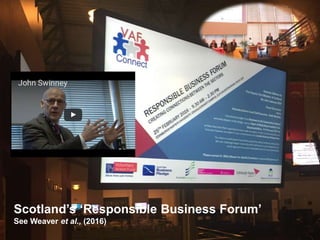
Scotland’s ‘Responsible Business Forum’
See Weaver et al., (2016)
EMBEDDING SUSTAINABILITY
LO 5.2 Discuss the difference between a ‘bolt-on’ and ‘embed’
sustainability strategy
#BSSD17
The ‘blind men and the elephant’ problem
…. ‘Bolt on’
…. ‘embed’On Youtube
#BSSD17
‘Bolt-on’ or ‘embed sustainability (I)
(Laszlo and Zhexembayeva, 2011)
Bolt-on sustainability Embedded sustainability
Goal Pursue shareholder value Pursue sustainable value
Scope Add symbolic wins at the
margins
Transform core business activities
Customer Offer “green” and “socially
responsible” products at
premium prices or with
diminished quality
Offer “smarter” solutions with no
trade-off in quality and no social
or green premium
Value
capture
Focus on risk mitigation and
improved efficiencies
Reach across all seven levels of
sustainable value creation
Value
chain
Manage company’s own
activities
Manage across the product or
service life cycle value chain
#BSSD17
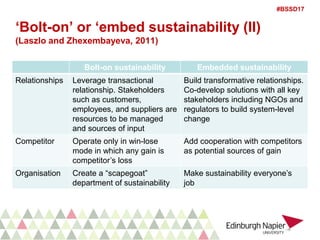
‘Bolt-on’ or ‘embed sustainability (II)
(Laszlo and Zhexembayeva, 2011)
Bolt-on sustainability Embedded sustainability
Relationships Leverage transactional
relationship. Stakeholders
such as customers,
employees, and suppliers are
resources to be managed
and sources of input
Build transformative relationships.
Co-develop solutions with all key
stakeholders including NGOs and
regulators to build system-level
change
Competitor Operate only in win-lose
mode in which any gain is
competitor’s loss
Add cooperation with competitors
as potential sources of gain
Organisation Create a “scapegoat”
department of sustainability
Make sustainability everyone’s
job
#BSSD17
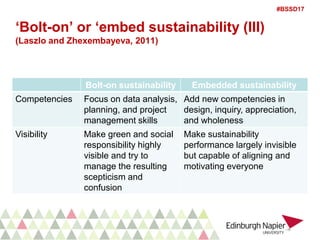
‘Bolt-on’ or ‘embed sustainability (III)
(Laszlo and Zhexembayeva, 2011)
Bolt-on sustainability Embedded sustainability
Competencies Focus on data analysis,
planning, and project
management skills
Add new competencies in
design, inquiry, appreciation,
and wholeness
Visibility Make green and social
responsibility highly
visible and try to
manage the resulting
scepticism and
confusion
Make sustainability
performance largely invisible
but capable of aligning and
motivating everyone
#BSSD17
When does Sustainability pay?
• Growing research interest in understanding the link between
sustainability and profit
• In a study of one discipline (OR) Weaver et al., (2013) found a
concentration on environmental sustainability. Primarily on efficiency
through waste and pollution protection. Little evidence on the
impact of social sustainability. But accelerating since 2010 …
• Strategists dilemma: Under what conditions does it pay?
• Leads to new strategic capabilities that underpin competitive
advantage
Summary and where next …
• Getting more stuck into the ‘how’; we need to see things differently
• Next week we will look in depth at the Laszlo model by considering
further design for sustainability value creating initiatives in the
supply chain
• We shall focus on the organisation but also propose that the
“supply chain is the new value chain” recognising Christopher
(2011) claim that it is:
“Supply chain’s that COMPETE NOT companies”

Lecture: Embeddding Sustainability into Strategy

  • 1.
    Unit 5: Embedding Sustainabilityinto Strategy II Formulating Strategic Responses Dr. Miles Weaver, Edinburgh Napier University Business School m.weaver@napier.ac.uk @DrMilesWeaver #BSSD17
  • 2.
    #BSSD17 Learning outcomes After thislecture and independent study you should be able to:- Learning Outcomes Key Concept LO 5.1 Evaluate the generic strategic responses to sustainability ‘how’ Sustainable Value/ Generic Strategic Responses LO 5.2 Discuss the difference between a ‘bolt-on’ and ‘embed’ sustainability strategy Bolt-on/Embedded Sustainability LO 5.3 Understand how corporate and business- level strategies are devised to develop strategic capabilities made up of a unique ‘value bundle’ of sustainability-driven initiatives Sustainable Value Framework / Sustainability-driven initiatives
  • 3.
    #BSSD17 Sketching today’s canvas: Tobegin … Write down three animals and what they may represent on the sustainability debate
  • 5.
    #BSSD17 Keeping on track… • The really contentious bit … requires deep thought and reflection • Role of business in society • How value is captured and for whom • Profit Vs. purpose • The roots to the answer … the same thing? • John Mackey offers an interesting perspective on a way forward
  • 6.
    GENERIC STRATEGIC RESPONSE TOSUSTAINABILITY LO 5.1 Evaluate the generic strategic responses to sustainability ‘how’ LO 5.3 Understand how corporate and business-level strategies are devised to develop strategic capabilities made up of a unique ‘value bundle’ of sustainability-driven initiatives
  • 7.
    #BSSD17 Addressing sustainability issues Organisationscan develop and implement a range of strategies to address environmental and social issues (e.g. complying with regulations; pro-activity to gain competitive advantage) Three important questions: – How might an organisation turn the key global social and environmental issues into strategic business opportunities…? – How to incorporate environmental and social concerns into strategy? – What level should environmental and social strategies be integrated?
  • 8.
    Sustainable value Unsustainable (value transfer) Sustainable Value= both + to shareholder & stakeholder (Laszlo and Zhexembayeva, 2011) Recap: Discussed ‘value’ from a sustainability perspective “The opportunity to create sustainable value—shareholder wealth that simultaneously drives us toward a more sustainable world—is huge” (Hart and Milstein, 2003)
  • 9.
    #BSSD17 The competitive landscapeis constantly evolving. Key message: value is migrating to ‘sustainable value’ positions
  • 10.
    #BSSD17 Key message: “Beatingthe average” Can we agree that everyone wants to beat the average as ‘sustainability’ becomes a normal part of the way business is done? • Today’s ‘core competences’ become tomorrow’s ‘threshold competencies’ (normal practice) • the standard gets raised creating a new level playing field • Alignment to need defined by community priorities (transparency?)
  • 11.
  • 12.
    #BSSD17 Levels of strategicresponse ‘what’ Banerjee (2001) differentiates between four levels of strategic response: • Enterprise strategy - concerned with the role a firm plays in society; its fundamental mission. Suggests not much evidence of this except in environmental organisations • Corporate strategy - the kinds of businesses a firm should enter to meet its enterprise strategy. Includes decisions on business portfolios, markets, technologies • Business strategy - allocating organisational resources to achieve competitive advantage and integrating different business functions • Functional strategy -planning operations for different functions (e.g. marketing, purchasing, distribution) Above figure relates strategy level to strategy type and desired outcome
  • 13.
    #BSSD17 Devising Corporate Strategiesfor the Sustainability ‘how’ Operationalising these strategic questions means addressing them in the following ways: Our sustainable value vision? • Organisational purpose based on the maximisation of ‘sustainable value’. • Concerns how the organisation fulfil this purpose, in terms of the scope of industries and markets within which the organisation competes • How can we address these social and environmental issues while advancing existing business priorities? • How do we identify and manage emerging stakeholder issues? • What are the new sources of sustainable value (i.e. those in which shareholder value is not created at the expense of other stakeholders)? (Adapted from Laszlo, 2008, p.182)
  • 14.
    Devising Competitive Strategies forSustainability ‘how’ • How might an organisation turn the key global social and environmental issues into strategic business opportunities …? – … through igniting innovation into new processes and products – To open new, unexpected markets – To create consumer passion and loyalty – To energise the workforce and build its loyalty – To build sustainable supply chains – To radically bring down energy costs and waste production … … and, at the same time, build a safer, more secure, better world ? • What capabilities do we need to realise the sustainability vision? • How do we measure the success of our sustainability? (Adapted from Laszlo, 2008, p.182) • Rather than just to comply with regulations
  • 15.
    #BSSD17 Recap: Traditional ‘businessschool’ thinking • Hart (2005) proposed a basis for integrating firms’ relationship to the natural environment into resource-based theory (a dominant strategy school of thought) and indirectly into strategic management (NRBV) • Key message: one of the most important drivers of new resources and capability development for firms will be the constraints and challenges posed by the natural environment (Hart, 2005) • Developing solutions for sustainability are our opportunities
  • 16.
    #BSSD17 Emerging views onstrategy formulation Can we agree? • Goal is sustainable value creation • this ‘higher purpose’ incorporates both PROFIT & PURPOSE • Process of strategy formulation is basically the same as standard approach except for weight given to ecological (natural) environment relative to competitive environment (Roberts, 1995) • Same is true for the ‘social’ environment • Necessity is to capture the ‘value bundle’ of both stakeholders and shareholders • Competitive advantage is deep rooted in strategic capabilities that incorporate a range of sustainability initiatives/actions (i.e. NRBV) • Organisational values shape strategic choice (… quid pro quo)
  • 17.
    #BSSD17 The Laszlo sustainabilitymodel Requires ‘systems thinking’ across the supply, process and demand chains (to be continued …) Measuring Impact: • Social • Environmental • Economic
  • 18.
  • 19.
    #BSSD17 Sustainable Value framework (Hartand Milstein, 2003) Sustainability Vision strategy: Does our corporate vision direct us toward the solution of social and environmental problems? Does our vision guide the development of new technologies, markets, products, and processes?
  • 20.
    #BSSD17 Sustainable Value framework (Hart,1996; Hart and Milstein, 2003) Clean Technology Strategy: Is the environmental performance of our products limited by our existing competency base? Is there potential to realise major improvements through new technology?
  • 21.
    #BSSD17 Sustainable Value framework (Hartand Milstein, 2003) Pollution Prevention strategy: Where are the most significant waste and emission streams from our current operations? Can we lower costs and risks by eliminating waste at the source or by using it as useful input?
  • 22.
    #BSSD17 Sustainable Value framework (Hartand Milstein, 2003) Product Stewardship strategy: What are the implications for product design and development if we assume responsibility for a product’s entire life cycle? Can we add value or lower costs while simultaneously reducing the impact of our products?
  • 23.
    Creating sustainable value: 1+ 7 strategy responses • Laszlo considers “The 7 levels of strategic focus” to be an important tool for identifying value creation • “Many companies have made great strides in mitigating risk and process cost reduction through minimising waste and improving energy efficiencies … • few(er) have focussed on top-line growth through product or brand differentiation. • Even fewer have used stakeholder value creation (levels 4 and 6) to drive new sustainable strategies” (Laszlo, 2008, p. 155) Laszlo (2003; 2011)
  • 24.
  • 25.
    #BSSD17 Value destruction: It’san added cost “do well by doing good” seems to violate economic logic (Laszlo & Zhexembayeva, 2011)
  • 26.
    #BSSD17 Value creation #1:It’s risk mitigation Avoiding its destruction Negative sustainability impacts & negative business consequences that follow it (Laszlo & Zhexembayeva, 2011)
  • 27.
    #BSSD17 Value creation #2:It’s an efficiency opportunity (Laszlo & Zhexembayeva, 2011) • Improving efficiency – Cut the quantity and intensity of energy – Waste – Materials Environmental + social harm = inefficiency • Pollution prevention as a ‘strategic capability’ to become a ‘threshold capability’ (normal practice)? – Reducing pollution at the input stage is less costly than treatment/repairs and harmful effluents (prevention)
  • 28.
    #BSSD17 Detour to “SharedValue”: Way 2: redefining productivity in the value chain • Next week we shall consider the opportunities to create sustainable value in the supply chain • Porter and Kramer (2011) approach follows a traditional and holistic evaluation of value chain productivity: – Energy use – Logistics – Resource use – Procurement – Distribution – Location – Employee productivity
  • 29.
    #BSSD17 Value creation #3: It’sa factor of differentiation Environmental & social attributes as a way to differentiate products & services (Laszlo & Zhexembayeva, 2011) • Quality/performance includes a sustainability dimension • Do green and socially responsible products cost more? • Charge extra for it? (Laszlo & Zhexembayeva, 2011)
  • 30.
    #BSSD17 Value creation #4:It’s a pathway to new markets New market opportunities when consumers demand solutions for their environmental & social problems (Laszlo & Zhexembayeva, 2011) • New market – meeting the needs of the world’s poorest 4 billion living on less than $4 a day • Consumer market = $5 trillion See Hock’s lecture on ‘The Bottom of the Pyramid’
  • 31.
    #BSSD17 Detour to “SharedValue”: Way 1: by reconceiving products and markets • ‘‘Business at the Bottom of the Pyramid’’ (Prahalad and Hart, 2002; Prahalad, 2005; Webb et al., 2010) • Porter and Kramer define it as ‘‘satisfying unmet social needs’’ and ‘‘serving disadvantaged communities’’ (Porter and Kramer, 2011, pp. 67-8). • Basic argument rests on creating economies of scale for offering essential products and services such as health, housing or credit at reasonable prices to disadvantaged communities, thus fostering their inclusion within the formal economy (Spitzeck and Chapman, 2012) • Critics focus on the enhancement of social conditions in communities (Karnani, 2007; Olsen and Boxenbaum, 2009)
  • 32.
    #BSSD17 Value creation #5:It’s a way to protect & enhance the brand Brand/image rooted on perceived on environmental & social performance (Laszlo & Zhexembayeva, 2011) • Draw talent • Secure loyal customers • Become supplier-of- choice • Attract investors • Goodwill with regulators • Positioning can be gained and lost …
  • 33.
    #BSSD17Value creation #6:It’s about influencing industry standards Shape government regulation or private industry standards in ways that favour them over competition (Laszlo & Zhexembayeva, 2011) • Can create barriers to entry (i.e. low cost imports?)
  • 34.
    #BSSD17 Value creation #7:It’s a driver of radical innovation Transformative whole system change (Laszlo & Zhexembayeva, 2011) • Process innovation creating value delivered to customers • ‘Natural resource based view’ will fuel disruptive innovations?
  • 35.
    #BSSD17 Missing one? Detour to“Shared Value”: Way 3: building supportive industry clusters • Industry clusters were found to enhance innovation, competitiveness and knowledge exchange (Arikan, 2009; Liela et al., 2010). • Shared values help to: – Align the activities of the actors within clusters (Tracy and Clark, 2003) – Collaboration and knowledge exchange on sustainability issues in clusters improves environmental and social performance (Anh et al., 2011). • Interaction and alignment of several players such as suppliers, service providers, educational institutions, NGOs and local governments in order to attain to local development goals (Nelson, 2006; Kania and Kramer, 2011).
  • 36.
    #BSSD17 Scotland’s ‘Responsible BusinessForum’ See Weaver et al., (2016)
  • 37.
    EMBEDDING SUSTAINABILITY LO 5.2Discuss the difference between a ‘bolt-on’ and ‘embed’ sustainability strategy
  • 38.
    #BSSD17 The ‘blind menand the elephant’ problem …. ‘Bolt on’ …. ‘embed’On Youtube
  • 39.
    #BSSD17 ‘Bolt-on’ or ‘embedsustainability (I) (Laszlo and Zhexembayeva, 2011) Bolt-on sustainability Embedded sustainability Goal Pursue shareholder value Pursue sustainable value Scope Add symbolic wins at the margins Transform core business activities Customer Offer “green” and “socially responsible” products at premium prices or with diminished quality Offer “smarter” solutions with no trade-off in quality and no social or green premium Value capture Focus on risk mitigation and improved efficiencies Reach across all seven levels of sustainable value creation Value chain Manage company’s own activities Manage across the product or service life cycle value chain
  • 40.
    #BSSD17 ‘Bolt-on’ or ‘embedsustainability (II) (Laszlo and Zhexembayeva, 2011) Bolt-on sustainability Embedded sustainability Relationships Leverage transactional relationship. Stakeholders such as customers, employees, and suppliers are resources to be managed and sources of input Build transformative relationships. Co-develop solutions with all key stakeholders including NGOs and regulators to build system-level change Competitor Operate only in win-lose mode in which any gain is competitor’s loss Add cooperation with competitors as potential sources of gain Organisation Create a “scapegoat” department of sustainability Make sustainability everyone’s job
  • 41.
    #BSSD17 ‘Bolt-on’ or ‘embedsustainability (III) (Laszlo and Zhexembayeva, 2011) Bolt-on sustainability Embedded sustainability Competencies Focus on data analysis, planning, and project management skills Add new competencies in design, inquiry, appreciation, and wholeness Visibility Make green and social responsibility highly visible and try to manage the resulting scepticism and confusion Make sustainability performance largely invisible but capable of aligning and motivating everyone
  • 42.
    #BSSD17 When does Sustainabilitypay? • Growing research interest in understanding the link between sustainability and profit • In a study of one discipline (OR) Weaver et al., (2013) found a concentration on environmental sustainability. Primarily on efficiency through waste and pollution protection. Little evidence on the impact of social sustainability. But accelerating since 2010 … • Strategists dilemma: Under what conditions does it pay? • Leads to new strategic capabilities that underpin competitive advantage
  • 43.
    Summary and wherenext … • Getting more stuck into the ‘how’; we need to see things differently • Next week we will look in depth at the Laszlo model by considering further design for sustainability value creating initiatives in the supply chain • We shall focus on the organisation but also propose that the “supply chain is the new value chain” recognising Christopher (2011) claim that it is: “Supply chain’s that COMPETE NOT companies”

Editor's Notes

  • #2 http://twitterfontana.com Happy Burns Ye Jacobbites: https://youtu.be/-e7eqCldZ7E Ae Fond Kiss - Eddi Reader https://www.youtube.com/watch?v=BJwy2cm9QTo
  • #5 How are these companies making PROFIT (growing) and addressing one or more of the major challenges to sustainability (instilled in its PURPOSE)?
  • #8 http://plana.marksandspencer.com/index.php?action=PublicHomeDisplay
  • #18 Sub-process 1 : discover value opportunities 1. Understand the current (shareholder/stakeholder) value position 2. Anticipate future (stakeholder) expectations 3. Set sustainable value initiatives (to reduce negative impacts/increase positive impacts) Sub-process 2 : create (sustainable) value 4. Design value creation initiatives (which will add financial and societal value) 5. Develop the business case (to secure resources and commitment) 6. Capture the value (by implementing the initiatives) Feedback loop and meta-discipline : 7. Validate the results and capture learning (measure progress through ‘social accounting’) 8. (Throughout the process) build sustainable value organisational capacity to deliver shareholder/stakeholder value Roberts (1995) suggests a number of key issues need to be considered prior to building an environmental strategy: Time horizon - especially for investment decisions and ‘payback’ requirements; current and future requirements? Priorities - what are most significant factors to take into account both now and in future? Autonomy - how far should the various branches of an enterprise have discretion over behaviour/decisions? Internal culture - to what extent is this conducive to change?
  • #29 Environmental management considerations have been applied to supply chain context since the 1990s (Bloemhof-Ruwaard et al., 1995; Lewis, 1997). These early publications already foresaw that once sustainability considerations become strategic they will include supply chain considerations (Lewis, 1997). Today, sustainable supply chain issues include carbon trading, waste treatment, resource consumption as well as sub-contracting (Chaabane et al., 2011) and managing supply chains sustainably can create competitive advantages (Reuter et al., 2010). Porter and Kramer’s second approach to shared value strategies follows this tradition and consists of a holistic evaluation of value chain productivity in terms of energy use, logistics, resource use, procurement, distribution, location and employee productivity (Porter and Kramer, 2011, pp. 68-71).
  • #32 Way 1: reconceiving products and markets This approach has been described previously as ‘‘Business at the Bottom of the Pyramid’’ (Prahalad and Hart, 2002; Prahalad, 2005; Webb et al., 2010). Porter and Kramer define it as ‘‘satisfying unmet social needs’’ and ‘‘serving disadvantaged communities’’ (Porter and Kramer, 2011, pp. 67-8). While this approach is not without critics especially considering the enhancement of social conditions in communities (Karnani, 2007; Olsen and Boxenbaum, 2009) the basic argument rests on creating economies of scale for offering essential products and services such as health, housing or credit at reasonable prices to disadvantaged communities, thus fostering their inclusion within the formal economy. Several cases exist demonstrating innovative approaches such as the Aravind Eye Hospital in the area of health (Shah and Murty, 2004), Cemex’s programme ‘‘Patrimonio Hoy’’ in the area of housing (Letelier et al., 2003), or the Grameen Bank in the area of finance (Yunus and Jolis, 1999).
  • #36 Case studies have further shown that collaboration and knowledge exchange on sustainability issues in clusters improves environmental and social performance (Anh et al., 2011).