© 2013 ICOPE - All rights reserved.
LEAN MANAGEMENT
BASICS
© 2013 ICOPE - All rights reserved.
OVERVIEW ON LEAN MANAGEMENT
What is Lean
Why to use Lean
Where to use Lean
When to use Lean
5S
8 Wastes
Standard work
Visual Management
INTRODUCTION TO THE PROGRAM – PART 2
© 2013 ICOPE - All rights reserved.
LEAN MANAGEMENT
IMPROVE PHASE – PART 6
© 2013 ICOPE - All rights reserved.
WHAT IS LEAN MANAGEMENT
LEAN Management:
It is a customer focussed waste elimination method that makes the process and
there by organization lean (eliminating Fat)
In a Lean company, employees always look to improve their skills and improve the
processes. Products and Services are driven in right amounts, to right location, at
the right time and in the right condition.
Lean Thinking
The Goal of Lean Thinking is the creation of a continuous stream which delivers
customer value with the least waste of resources within the shortest possible
time.
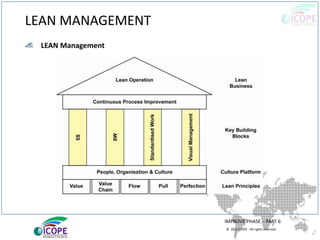
The Building blocks of Lean Management are 5s, 8 Wastes, Visual Management
and Standardised work
IMPROVE PHASE – PART 6
© 2013 ICOPE - All rights reserved.
LEAN MANAGEMENT
LEAN Management
IMPROVE PHASE – PART 6
© 2013 ICOPE - All rights reserved.
WHY LEAN
IMPROVE PHASE – PART 6
© 2013 ICOPE - All rights reserved.
WHY TO USE LEAN – BENEFITS
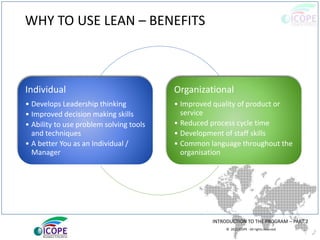
Individual
• Develops Leadership thinking
• Improved decision making skills
• Ability to use problem solving tools
and techniques
• A better You as an Individual /
Manager
Organizational
• Improved quality of product or
service
• Reduced process cycle time
• Development of staff skills
• Common language throughout the
organisation
INTRODUCTION TO THE PROGRAM – PART 2
© 2013 ICOPE - All rights reserved.
WHERE TO USE LEAN
IMPROVE PHASE – PART 6
© 2013 ICOPE - All rights reserved.
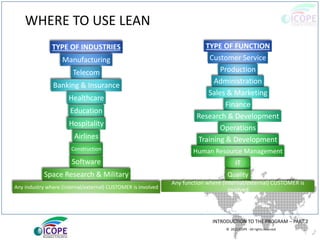
WHERE TO USE LEAN
TYPE OF INDUSTRIES
Manufacturing
Telecom
Banking & Insurance
Healthcare
Education
Hospitality
Airlines
Construction
Software
Space Research & Military
Any industry where (internal/external) CUSTOMER is involved
TYPE OF FUNCTION
Customer Service
Production
Administration
Sales & Marketing
Finance
Research & Development
Operations
Training & Development
Human Resource Management
IT
Quality
Any function where (internal/external) CUSTOMER is
involved
INTRODUCTION TO THE PROGRAM – PART 2
© 2013 ICOPE - All rights reserved.
WHEN TO USE LEAN
IMPROVE PHASE – PART 6
© 2013 ICOPE - All rights reserved.
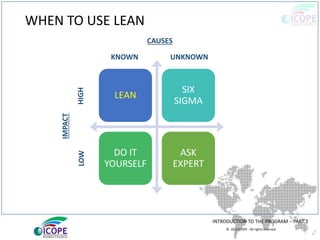
WHEN TO USE LEAN
LEAN
SIX
SIGMA
DO IT
YOURSELF
ASK
EXPERT
IMPACT
CAUSES
KNOWN UNKNOWN
LOWHIGH
INTRODUCTION TO THE PROGRAM – PART 2
© 2013 ICOPE - All rights reserved.
5S
IMPROVE PHASE – PART 6
© 2013 ICOPE - All rights reserved.
5S
What is 5S:
5S is a methodology which helps us to better organise our workplace in order
to improve safety/controls and productivity
5S is the foundation on which to build a leaner organisation
Where 5S is used?
At any work station or work place. Traditionally used on the shop floor, but
equally relevant in office environments, service, on-site works and even
computer file storage.
IMPROVE PHASE – PART 6
© 2013 ICOPE - All rights reserved.
5S – Cycle
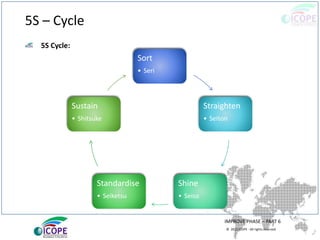
5S Cycle:
IMPROVE PHASE – PART 6
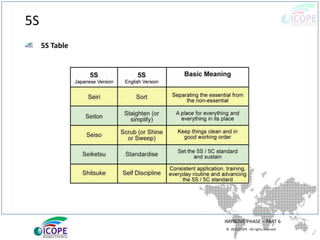
Sort
• Seri
Straighten
• Seiton
Shine
• Seiso
Standardise
• Seiketsu
Sustain
• Shitsuke
© 2013 ICOPE - All rights reserved.
5S
IMPROVE PHASE – PART 6
5S Description
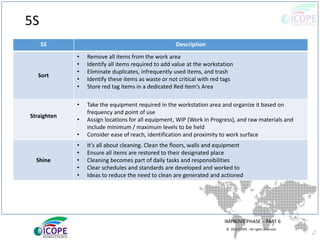
Sort
• Remove all items from the work area
• Identify all items required to add value at the workstation
• Eliminate duplicates, infrequently used items, and trash
• Identify these items as waste or not critical with red tags
• Store red tag items in a dedicated Red Item’s Area
Straighten
• Take the equipment required in the workstation area and organize it based on
frequency and point of use
• Assign locations for all equipment, WIP (Work In Progress), and raw materials and
include minimum / maximum levels to be held
• Consider ease of reach, identification and proximity to work surface
Shine
• It’s all about cleaning. Clean the floors, walls and equipment
• Ensure all items are restored to their designated place
• Cleaning becomes part of daily tasks and responsibilities
• Clear schedules and standards are developed and worked to
• Ideas to reduce the need to clean are generated and actioned
© 2013 ICOPE - All rights reserved.
5S
IMPROVE PHASE – PART 6
5S Description
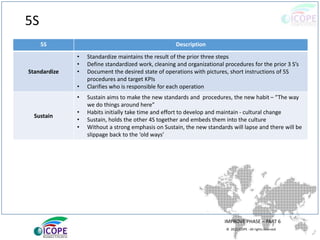
Standardize
• Standardize maintains the result of the prior three steps
• Define standardized work, cleaning and organizational procedures for the prior 3 S’s
• Document the desired state of operations with pictures, short instructions of 5S
procedures and target KPIs
• Clarifies who is responsible for each operation
Sustain
• Sustain aims to make the new standards and procedures, the new habit – “The way
we do things around here”
• Habits initially take time and effort to develop and maintain - cultural change
• Sustain, holds the other 4S together and embeds them into the culture
• Without a strong emphasis on Sustain, the new standards will lapse and there will be
slippage back to the ‘old ways’
© 2013 ICOPE - All rights reserved.
5S
5S Table
IMPROVE PHASE – PART 6
© 2013 ICOPE - All rights reserved.
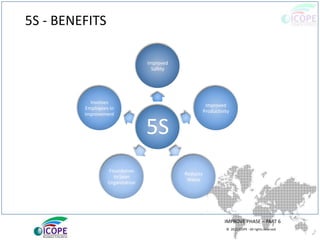
5S - BENEFITS
IMPROVE PHASE – PART 6
5S
Improved
Safety
Improved
Productivity
Reduces
Waste
Foundation
to Lean
Organization
Involves
Employees in
improvement
© 2013 ICOPE - All rights reserved.
8 WASTES
IMPROVE PHASE – PART 6
© 2013 ICOPE - All rights reserved.
WASTE
VSM Key Terms:
Waste: Any activity that consumes time and resources like manpower,
machinery, money etc., and does not contribute in meeting the customer
requirements.
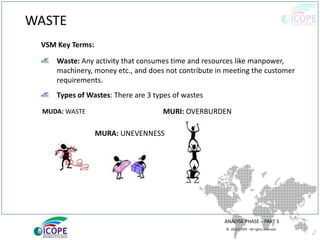
Types of Wastes: There are 3 types of wastes
ANALYSE PHASE – PART 5
MUDA: WASTE
MURA: UNEVENNESS
MURI: OVERBURDEN
© 2013 ICOPE - All rights reserved.
TYPES OF WASTES
VSM Key Terms:
Types of Wastes:
MUDA: Any activity in the process that does not add value. MUDA is not creating
value for the customer. In short: WASTE
MURA: Any variation leading to unbalanced situations. In short: UNEVENNESS,
inconsistent, irregular.
Mura exists when workflow is out of balance and workload is inconsistent and not
incompliance with the standard.
MURI: Any activity asking unreasonable stress or effort from personnel, material
or equipment. In short: OVERBURDEN
Muri means: a too heavy mental- or physical burden. For machinery Muri means:
expecting a machine to do more than it is capable of or has been designed to do.
ANALYSE PHASE – PART 5
© 2013 ICOPE - All rights reserved.
8 - DEADLY WASTES
Types of Muda (Wastes):
Muda is again classified in to 8 types as follows.
The popular acronym for the 8 wastes - DOWNTIME
Defects
Over Production
Waiting
Not using employee creativity
Transportation
Inventory
Motion
Extra Processing
ANALYSE PHASE – PART 5
© 2013 ICOPE - All rights reserved.
8 - DEADLY WASTES
ANALYSE PHASE – PART 5
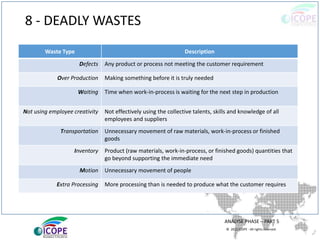
Waste Type Description
Defects Any product or process not meeting the customer requirement
Over Production Making something before it is truly needed
Waiting Time when work-in-process is waiting for the next step in production
Not using employee creativity Not effectively using the collective talents, skills and knowledge of all
employees and suppliers
Transportation Unnecessary movement of raw materials, work-in-process or finished
goods
Inventory Product (raw materials, work-in-process, or finished goods) quantities that
go beyond supporting the immediate need
Motion Unnecessary movement of people
Extra Processing More processing than is needed to produce what the customer requires
© 2013 ICOPE - All rights reserved.
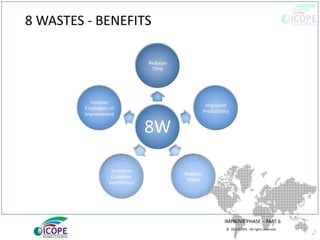
8 WASTES - BENEFITS
IMPROVE PHASE – PART 6
8W
Reduces
Time
Improved
Productivity
Reduces
Waste
Improves
Customer
Satisfaction
Involves
Employees in
improvement
© 2013 ICOPE - All rights reserved.
VISUAL MANAGEMENT
IMPROVE PHASE – PART 6
© 2013 ICOPE - All rights reserved.
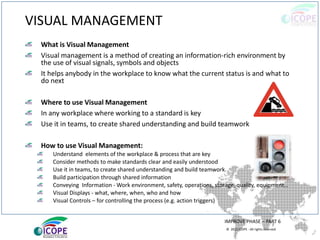
VISUAL MANAGEMENT
What is Visual Management
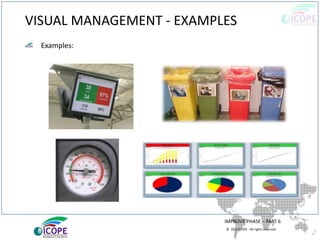
Visual management is a method of creating an information-rich environment by
the use of visual signals, symbols and objects
It helps anybody in the workplace to know what the current status is and what to
do next
Where to use Visual Management
In any workplace where working to a standard is key
Use it in teams, to create shared understanding and build teamwork
How to use Visual Management:
Understand elements of the workplace & process that are key
Consider methods to make standards clear and easily understood
Use it in teams, to create shared understanding and build teamwork.
Build participation through shared information
Conveying Information - Work environment, safety, operations, storage, quality, equipment…
Visual Displays - what, where, when, who and how
Visual Controls – for controlling the process (e.g. action triggers)
IMPROVE PHASE – PART 6
© 2013 ICOPE - All rights reserved.
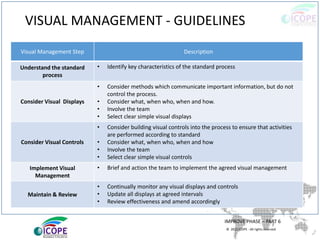
VISUAL MANAGEMENT - GUIDELINES
IMPROVE PHASE – PART 6
Visual Management Step Description
Understand the standard
process
• Identify key characteristics of the standard process
Consider Visual Displays
• Consider methods which communicate important information, but do not
control the process.
• Consider what, when who, when and how.
• Involve the team
• Select clear simple visual displays
Consider Visual Controls
• Consider building visual controls into the process to ensure that activities
are performed according to standard
• Consider what, when who, when and how
• Involve the team
• Select clear simple visual controls
Implement Visual
Management
• Brief and action the team to implement the agreed visual management
Maintain & Review
• Continually monitor any visual displays and controls
• Update all displays at agreed intervals
• Review effectiveness and amend accordingly
© 2013 ICOPE - All rights reserved.
VISUAL MANAGEMENT - EXAMPLES
Examples:
IMPROVE PHASE – PART 6
© 2013 ICOPE - All rights reserved.
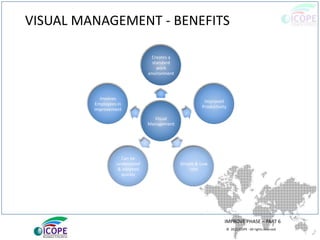
VISUAL MANAGEMENT - BENEFITS
IMPROVE PHASE – PART 6
Visual
Management
Creates a
standard
work
environment
Improved
Productivity
Simple & Low
cost
Can be
understood
& adopted
quickly
Involves
Employees in
improvement
© 2013 ICOPE - All rights reserved.
STANDARD WORK
CONTROL PHASE – PART 7
© 2013 ICOPE - All rights reserved.
STANDARD WORK
CONTROL PHASE – PART 7
What is Standard Work
A simple written description of the safest, highest quality, and most efficient way
known to perform a particular task, (i.e. a checklist to lead someone through the
task).
It describes the only acceptable way to do the process.
Expected to be continually improved
Includes the amount of time allotted to hand-off the task to the next step of the
process.
Focuses on the process, not the equipment or materials
Reduces variation, increases consistency
© 2013 ICOPE - All rights reserved.
STANDARD WORK - STEPS
CONTROL PHASE – PART 7
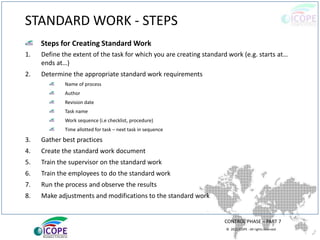
Steps for Creating Standard Work
1. Define the extent of the task for which you are creating standard work (e.g. starts at…
ends at…)
2. Determine the appropriate standard work requirements
Name of process
Author
Revision date
Task name
Work sequence (i.e checklist, procedure)
Time allotted for task – next task in sequence
3. Gather best practices
4. Create the standard work document
5. Train the supervisor on the standard work
6. Train the employees to do the standard work
7. Run the process and observe the results
8. Make adjustments and modifications to the standard work
© 2013 ICOPE - All rights reserved.
STANDARD WORK – DOs & DON’Ts
CONTROL PHASE – PART 7
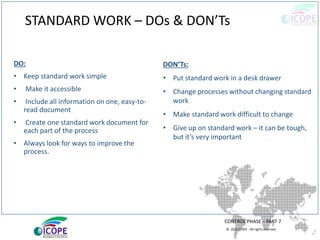
DON’Ts:
• Put standard work in a desk drawer
• Change processes without changing standard
work
• Make standard work difficult to change
• Give up on standard work – it can be tough,
but it’s very important
DO:
• Keep standard work simple
• Make it accessible
• Include all information on one, easy-to-
read document
• Create one standard work document for
each part of the process
• Always look for ways to improve the
process.
© 2013 ICOPE - All rights reserved.
STANDARD WORK – TEMPLATE
CONTROL PHASE – PART 7
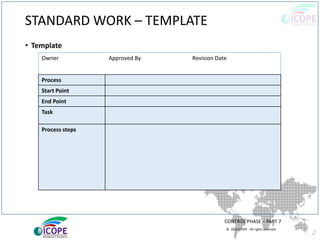
• Template
Owner Approved By Revision Date
Process
Start Point
End Point
Task
Process steps
© 2013 ICOPE - All rights reserved.
STANDARD WORK - BENEFITS
IMPROVE PHASE – PART 6
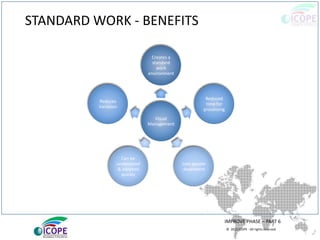
Visual
Management
Creates a
standard
work
environment
Reduced
time for
processing
Less people
dependent
Can be
understood
& adopted
quickly
Reduces
Variation
© 2013 ICOPE - All rights reserved.
Thank you . . .
IMPROVE PHASE – PART 6

Lean Management Basics

  • 1.
    © 2013 ICOPE- All rights reserved. LEAN MANAGEMENT BASICS
  • 2.
    © 2013 ICOPE- All rights reserved. OVERVIEW ON LEAN MANAGEMENT What is Lean Why to use Lean Where to use Lean When to use Lean 5S 8 Wastes Standard work Visual Management INTRODUCTION TO THE PROGRAM – PART 2
  • 3.
    © 2013 ICOPE- All rights reserved. LEAN MANAGEMENT IMPROVE PHASE – PART 6
  • 4.
    © 2013 ICOPE- All rights reserved. WHAT IS LEAN MANAGEMENT LEAN Management: It is a customer focussed waste elimination method that makes the process and there by organization lean (eliminating Fat) In a Lean company, employees always look to improve their skills and improve the processes. Products and Services are driven in right amounts, to right location, at the right time and in the right condition. Lean Thinking The Goal of Lean Thinking is the creation of a continuous stream which delivers customer value with the least waste of resources within the shortest possible time. The Building blocks of Lean Management are 5s, 8 Wastes, Visual Management and Standardised work IMPROVE PHASE – PART 6
  • 5.
    © 2013 ICOPE- All rights reserved. LEAN MANAGEMENT LEAN Management IMPROVE PHASE – PART 6
  • 6.
    © 2013 ICOPE- All rights reserved. WHY LEAN IMPROVE PHASE – PART 6
  • 7.
    © 2013 ICOPE- All rights reserved. WHY TO USE LEAN – BENEFITS Individual • Develops Leadership thinking • Improved decision making skills • Ability to use problem solving tools and techniques • A better You as an Individual / Manager Organizational • Improved quality of product or service • Reduced process cycle time • Development of staff skills • Common language throughout the organisation INTRODUCTION TO THE PROGRAM – PART 2
  • 8.
    © 2013 ICOPE- All rights reserved. WHERE TO USE LEAN IMPROVE PHASE – PART 6
  • 9.
    © 2013 ICOPE- All rights reserved. WHERE TO USE LEAN TYPE OF INDUSTRIES Manufacturing Telecom Banking & Insurance Healthcare Education Hospitality Airlines Construction Software Space Research & Military Any industry where (internal/external) CUSTOMER is involved TYPE OF FUNCTION Customer Service Production Administration Sales & Marketing Finance Research & Development Operations Training & Development Human Resource Management IT Quality Any function where (internal/external) CUSTOMER is involved INTRODUCTION TO THE PROGRAM – PART 2
  • 10.
    © 2013 ICOPE- All rights reserved. WHEN TO USE LEAN IMPROVE PHASE – PART 6
  • 11.
    © 2013 ICOPE- All rights reserved. WHEN TO USE LEAN LEAN SIX SIGMA DO IT YOURSELF ASK EXPERT IMPACT CAUSES KNOWN UNKNOWN LOWHIGH INTRODUCTION TO THE PROGRAM – PART 2
  • 12.
    © 2013 ICOPE- All rights reserved. 5S IMPROVE PHASE – PART 6
  • 13.
    © 2013 ICOPE- All rights reserved. 5S What is 5S: 5S is a methodology which helps us to better organise our workplace in order to improve safety/controls and productivity 5S is the foundation on which to build a leaner organisation Where 5S is used? At any work station or work place. Traditionally used on the shop floor, but equally relevant in office environments, service, on-site works and even computer file storage. IMPROVE PHASE – PART 6
  • 14.
    © 2013 ICOPE- All rights reserved. 5S – Cycle 5S Cycle: IMPROVE PHASE – PART 6 Sort • Seri Straighten • Seiton Shine • Seiso Standardise • Seiketsu Sustain • Shitsuke
  • 15.
    © 2013 ICOPE- All rights reserved. 5S IMPROVE PHASE – PART 6 5S Description Sort • Remove all items from the work area • Identify all items required to add value at the workstation • Eliminate duplicates, infrequently used items, and trash • Identify these items as waste or not critical with red tags • Store red tag items in a dedicated Red Item’s Area Straighten • Take the equipment required in the workstation area and organize it based on frequency and point of use • Assign locations for all equipment, WIP (Work In Progress), and raw materials and include minimum / maximum levels to be held • Consider ease of reach, identification and proximity to work surface Shine • It’s all about cleaning. Clean the floors, walls and equipment • Ensure all items are restored to their designated place • Cleaning becomes part of daily tasks and responsibilities • Clear schedules and standards are developed and worked to • Ideas to reduce the need to clean are generated and actioned
  • 16.
    © 2013 ICOPE- All rights reserved. 5S IMPROVE PHASE – PART 6 5S Description Standardize • Standardize maintains the result of the prior three steps • Define standardized work, cleaning and organizational procedures for the prior 3 S’s • Document the desired state of operations with pictures, short instructions of 5S procedures and target KPIs • Clarifies who is responsible for each operation Sustain • Sustain aims to make the new standards and procedures, the new habit – “The way we do things around here” • Habits initially take time and effort to develop and maintain - cultural change • Sustain, holds the other 4S together and embeds them into the culture • Without a strong emphasis on Sustain, the new standards will lapse and there will be slippage back to the ‘old ways’
  • 17.
    © 2013 ICOPE- All rights reserved. 5S 5S Table IMPROVE PHASE – PART 6
  • 18.
    © 2013 ICOPE- All rights reserved. 5S - BENEFITS IMPROVE PHASE – PART 6 5S Improved Safety Improved Productivity Reduces Waste Foundation to Lean Organization Involves Employees in improvement
  • 19.
    © 2013 ICOPE- All rights reserved. 8 WASTES IMPROVE PHASE – PART 6
  • 20.
    © 2013 ICOPE- All rights reserved. WASTE VSM Key Terms: Waste: Any activity that consumes time and resources like manpower, machinery, money etc., and does not contribute in meeting the customer requirements. Types of Wastes: There are 3 types of wastes ANALYSE PHASE – PART 5 MUDA: WASTE MURA: UNEVENNESS MURI: OVERBURDEN
  • 21.
    © 2013 ICOPE- All rights reserved. TYPES OF WASTES VSM Key Terms: Types of Wastes: MUDA: Any activity in the process that does not add value. MUDA is not creating value for the customer. In short: WASTE MURA: Any variation leading to unbalanced situations. In short: UNEVENNESS, inconsistent, irregular. Mura exists when workflow is out of balance and workload is inconsistent and not incompliance with the standard. MURI: Any activity asking unreasonable stress or effort from personnel, material or equipment. In short: OVERBURDEN Muri means: a too heavy mental- or physical burden. For machinery Muri means: expecting a machine to do more than it is capable of or has been designed to do. ANALYSE PHASE – PART 5
  • 22.
    © 2013 ICOPE- All rights reserved. 8 - DEADLY WASTES Types of Muda (Wastes): Muda is again classified in to 8 types as follows. The popular acronym for the 8 wastes - DOWNTIME Defects Over Production Waiting Not using employee creativity Transportation Inventory Motion Extra Processing ANALYSE PHASE – PART 5
  • 23.
    © 2013 ICOPE- All rights reserved. 8 - DEADLY WASTES ANALYSE PHASE – PART 5 Waste Type Description Defects Any product or process not meeting the customer requirement Over Production Making something before it is truly needed Waiting Time when work-in-process is waiting for the next step in production Not using employee creativity Not effectively using the collective talents, skills and knowledge of all employees and suppliers Transportation Unnecessary movement of raw materials, work-in-process or finished goods Inventory Product (raw materials, work-in-process, or finished goods) quantities that go beyond supporting the immediate need Motion Unnecessary movement of people Extra Processing More processing than is needed to produce what the customer requires
  • 24.
    © 2013 ICOPE- All rights reserved. 8 WASTES - BENEFITS IMPROVE PHASE – PART 6 8W Reduces Time Improved Productivity Reduces Waste Improves Customer Satisfaction Involves Employees in improvement
  • 25.
    © 2013 ICOPE- All rights reserved. VISUAL MANAGEMENT IMPROVE PHASE – PART 6
  • 26.
    © 2013 ICOPE- All rights reserved. VISUAL MANAGEMENT What is Visual Management Visual management is a method of creating an information-rich environment by the use of visual signals, symbols and objects It helps anybody in the workplace to know what the current status is and what to do next Where to use Visual Management In any workplace where working to a standard is key Use it in teams, to create shared understanding and build teamwork How to use Visual Management: Understand elements of the workplace & process that are key Consider methods to make standards clear and easily understood Use it in teams, to create shared understanding and build teamwork. Build participation through shared information Conveying Information - Work environment, safety, operations, storage, quality, equipment… Visual Displays - what, where, when, who and how Visual Controls – for controlling the process (e.g. action triggers) IMPROVE PHASE – PART 6
  • 27.
    © 2013 ICOPE- All rights reserved. VISUAL MANAGEMENT - GUIDELINES IMPROVE PHASE – PART 6 Visual Management Step Description Understand the standard process • Identify key characteristics of the standard process Consider Visual Displays • Consider methods which communicate important information, but do not control the process. • Consider what, when who, when and how. • Involve the team • Select clear simple visual displays Consider Visual Controls • Consider building visual controls into the process to ensure that activities are performed according to standard • Consider what, when who, when and how • Involve the team • Select clear simple visual controls Implement Visual Management • Brief and action the team to implement the agreed visual management Maintain & Review • Continually monitor any visual displays and controls • Update all displays at agreed intervals • Review effectiveness and amend accordingly
  • 28.
    © 2013 ICOPE- All rights reserved. VISUAL MANAGEMENT - EXAMPLES Examples: IMPROVE PHASE – PART 6
  • 29.
    © 2013 ICOPE- All rights reserved. VISUAL MANAGEMENT - BENEFITS IMPROVE PHASE – PART 6 Visual Management Creates a standard work environment Improved Productivity Simple & Low cost Can be understood & adopted quickly Involves Employees in improvement
  • 30.
    © 2013 ICOPE- All rights reserved. STANDARD WORK CONTROL PHASE – PART 7
  • 31.
    © 2013 ICOPE- All rights reserved. STANDARD WORK CONTROL PHASE – PART 7 What is Standard Work A simple written description of the safest, highest quality, and most efficient way known to perform a particular task, (i.e. a checklist to lead someone through the task). It describes the only acceptable way to do the process. Expected to be continually improved Includes the amount of time allotted to hand-off the task to the next step of the process. Focuses on the process, not the equipment or materials Reduces variation, increases consistency
  • 32.
    © 2013 ICOPE- All rights reserved. STANDARD WORK - STEPS CONTROL PHASE – PART 7 Steps for Creating Standard Work 1. Define the extent of the task for which you are creating standard work (e.g. starts at… ends at…) 2. Determine the appropriate standard work requirements Name of process Author Revision date Task name Work sequence (i.e checklist, procedure) Time allotted for task – next task in sequence 3. Gather best practices 4. Create the standard work document 5. Train the supervisor on the standard work 6. Train the employees to do the standard work 7. Run the process and observe the results 8. Make adjustments and modifications to the standard work
  • 33.
    © 2013 ICOPE- All rights reserved. STANDARD WORK – DOs & DON’Ts CONTROL PHASE – PART 7 DON’Ts: • Put standard work in a desk drawer • Change processes without changing standard work • Make standard work difficult to change • Give up on standard work – it can be tough, but it’s very important DO: • Keep standard work simple • Make it accessible • Include all information on one, easy-to- read document • Create one standard work document for each part of the process • Always look for ways to improve the process.
  • 34.
    © 2013 ICOPE- All rights reserved. STANDARD WORK – TEMPLATE CONTROL PHASE – PART 7 • Template Owner Approved By Revision Date Process Start Point End Point Task Process steps
  • 35.
    © 2013 ICOPE- All rights reserved. STANDARD WORK - BENEFITS IMPROVE PHASE – PART 6 Visual Management Creates a standard work environment Reduced time for processing Less people dependent Can be understood & adopted quickly Reduces Variation
  • 36.
    © 2013 ICOPE- All rights reserved. Thank you . . . IMPROVE PHASE – PART 6