
Unit 2: Business in Society
Tutorial Two:
Creating Shared Value
CREATING SHARED VALUE
LO 2.4 Explain the concept of ‘shared value’ (SV), clearly
distinguishing SV from a traditional view of CSR
"Creating Shared Value" Harvard Business Review's Top Article of 2011 (5:28)
https://youtu.be/rfoHW4V_cgA
Discussion questions
1. Discuss the relative
merits of the
SHARED VALUE
concept
2. What are the
criticisms?
Creating Shared Value: Redefining the Role of Business in Society
Mark R. Kramer, at the 3rd Global Peter Drucker Forum on November 3rd, 2011
https://youtu.be/CPxdH-2dVFA
Emerging view on the purpose of business
Porter and Kramer (2011) proposes the concept of shared value: addressing a social
issue with a business model and argue:
“Capitalism is under siege ... Diminished trust in business is causing
political leaders to set policies that sap economic growth .... Business is
caught in a vicious circle ... The purpose of the corporation must be
redefined around SHARED VALUE”
“There's a fundamental opportunity for business today to impact and address these social
problems, and this opportunity is the largest business opportunity we see in business”
(Porter, 2013)
Three opportunities for companies to CSV (Porter and Kramer, 2013):
1. By reconceiving products and markets
2. By redefining productivity in the value chain
3. By enabling local cluster development
(Porter, TEDGlobal, 2013)
• In a Scottish context, the third sector attracts £4.9 billion in funding from various
sources, using SCVO statistics 34% (£1,686m) comes in from the public sector (includes
local, devolved and national governments) when only 1.5% (73m) comes from the private
sector (Weaver, Crossan, Tan & Paxton, forthcoming).
• Median donation by FTSE 100 companies have trebled from £1m in 2007 to £3 million in
2012 (CAF Bank, 2014)
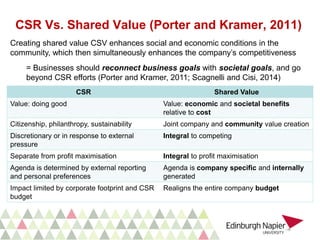
CSR Vs. Shared Value (Porter and Kramer, 2011)
CSR Shared Value
Value: doing good Value: economic and societal benefits
relative to cost
Citizenship, philanthropy, sustainability Joint company and community value creation
Discretionary or in response to external
pressure
Integral to competing
Separate from profit maximisation Integral to profit maximisation
Agenda is determined by external reporting
and personal preferences
Agenda is company specific and internally
generated
Impact limited by corporate footprint and CSR
budget
Realigns the entire company budget
Creating shared value CSV enhances social and economic conditions in the
community, which then simultaneously enhances the company’s competitiveness
= Businesses should reconnect business goals with societal goals, and go
beyond CSR efforts (Porter and Kramer, 2011; Scagnelli and Cisi, 2014)
(Porter and Kramer, 2013,
pp. 8)
Critical thought: Many of
your examples demonstrate
the connection between
building a competitive
advantage and addressing a
social issue?
Keep collating these ideas in
everyday life
Discussion questions
1. Discuss the relative
merits of the
SHARED VALUE
concept
2. What are the
criticisms?
The Strengths and Weaknesses of the
Shared Value Concept (Crane et al., 2014)
“ what about … people and their relationships”?
(… Social capital)
Sustainable Capitalism (Asia Global Institute, October 2012 Hong Kong) (7:37)
Final thought to take-away: how should businesses work with civil society (the third sector)
and government in addressing environmental and social challenges?
https://youtu.be/77SPFSW9bHc

Tutorial on Creating Shared Value

  • 1.
    Unit 2: Businessin Society Tutorial Two: Creating Shared Value
  • 2.
    CREATING SHARED VALUE LO2.4 Explain the concept of ‘shared value’ (SV), clearly distinguishing SV from a traditional view of CSR
  • 3.
    "Creating Shared Value"Harvard Business Review's Top Article of 2011 (5:28) https://youtu.be/rfoHW4V_cgA
  • 4.
    Discussion questions 1. Discussthe relative merits of the SHARED VALUE concept 2. What are the criticisms?
  • 5.
    Creating Shared Value:Redefining the Role of Business in Society Mark R. Kramer, at the 3rd Global Peter Drucker Forum on November 3rd, 2011 https://youtu.be/CPxdH-2dVFA
  • 6.
    Emerging view onthe purpose of business Porter and Kramer (2011) proposes the concept of shared value: addressing a social issue with a business model and argue: “Capitalism is under siege ... Diminished trust in business is causing political leaders to set policies that sap economic growth .... Business is caught in a vicious circle ... The purpose of the corporation must be redefined around SHARED VALUE” “There's a fundamental opportunity for business today to impact and address these social problems, and this opportunity is the largest business opportunity we see in business” (Porter, 2013) Three opportunities for companies to CSV (Porter and Kramer, 2013): 1. By reconceiving products and markets 2. By redefining productivity in the value chain 3. By enabling local cluster development
  • 7.
    (Porter, TEDGlobal, 2013) •In a Scottish context, the third sector attracts £4.9 billion in funding from various sources, using SCVO statistics 34% (£1,686m) comes in from the public sector (includes local, devolved and national governments) when only 1.5% (73m) comes from the private sector (Weaver, Crossan, Tan & Paxton, forthcoming). • Median donation by FTSE 100 companies have trebled from £1m in 2007 to £3 million in 2012 (CAF Bank, 2014)
  • 8.
    CSR Vs. SharedValue (Porter and Kramer, 2011) CSR Shared Value Value: doing good Value: economic and societal benefits relative to cost Citizenship, philanthropy, sustainability Joint company and community value creation Discretionary or in response to external pressure Integral to competing Separate from profit maximisation Integral to profit maximisation Agenda is determined by external reporting and personal preferences Agenda is company specific and internally generated Impact limited by corporate footprint and CSR budget Realigns the entire company budget Creating shared value CSV enhances social and economic conditions in the community, which then simultaneously enhances the company’s competitiveness = Businesses should reconnect business goals with societal goals, and go beyond CSR efforts (Porter and Kramer, 2011; Scagnelli and Cisi, 2014)
  • 9.
    (Porter and Kramer,2013, pp. 8) Critical thought: Many of your examples demonstrate the connection between building a competitive advantage and addressing a social issue? Keep collating these ideas in everyday life
  • 10.
    Discussion questions 1. Discussthe relative merits of the SHARED VALUE concept 2. What are the criticisms?
  • 11.
    The Strengths andWeaknesses of the Shared Value Concept (Crane et al., 2014) “ what about … people and their relationships”? (… Social capital)
  • 12.
    Sustainable Capitalism (AsiaGlobal Institute, October 2012 Hong Kong) (7:37) Final thought to take-away: how should businesses work with civil society (the third sector) and government in addressing environmental and social challenges? https://youtu.be/77SPFSW9bHc

Editor's Notes

  • #2 http://twitterfontana.com
  • #6 https://youtu.be/CPxdH-2dVFA
  • #7 “So how could we tap into the power of business to address the fundamental problems that we face? Imagine if we could do that, because if we could do it, we could scale. We could tap into this enormous resource pool and this organizational capacity” (Porter, 2013).
  • #8 Most wealth in business … only business can create resources … when it can meet a need … when it makes a profit …. How do we tap into this? It’s the ‘profit’ that makes it scalable
  • #9  See tutorial notes
  • #13 Miles: By creating ‘shared spaces’ for CSV to happen (prefer the term “co-created value”)? Co-created focuses on the “inputs” and “outcome” when CSV is more shallow, on “benefits”, the outcomes to business (with a societal impact).