Lean Thinking Banish Waste & Create Wealth in Your Corporation By: James P. Womack & Daniel Jones Book Report By: Billy Wiggins
Why Was This Book Written? A follow up to  The Machine That Changed the World. Written to Enlighten Management on the Transformation to a Lean System.
Contents of Book Lean Principles From Thinking to Action Lean Enterprise Epilogue
I. Lean Principles Value The Value Stream Flow Pull Perfection
1. Value Anything which does not provide value is MUDA or waste. Antidote to Muda is Lean Thinking. Value is Specified by the Customer.
An Example of Defining Value (and Muda) The Authors mapped the process of traveling. The itinerary included air travel and Ground Travel from Herefordshire to Crete. The Result: 13 hrs of travel time; 7 hours actually spent going somewhere and a total of 23 process steps.
2. The Value Stream To determine the value stream, map the steps required to produce the product and classify into 3 categories Actions which create value Actions that create no value but are required Actions that create no value and are not needed.
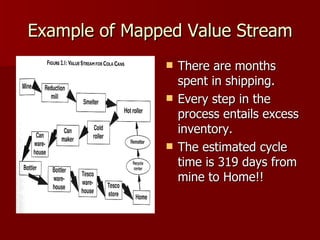
Example of Mapped Value Stream There are months spent in shipping. Every step in the process entails excess inventory. The estimated cycle time is 319 days from mine to Home!!
3. Flow 3 steps must be taken together to achieve flow Focus on the product. Ignore traditional boundaries (flow is counterintuitive). Rethink specific work practices (Kaizens).
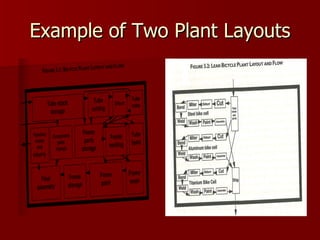
Example of Two Plant Layouts
Example Continued The Lean Layout utilizes: JIT (Just-in-Time) which prevents inventory build up before or after each process step. Small batches. Quick machine changeovers. Cells for complete products vs. Mass Production. Takt (production time/customer demand). This equates into flow and level scheduling.
4. Pull Definition – A system of cascading production & delivery activities in which nothing is produced by the upstream supplier until the downstream customer signals a need. A Kanban is a visual signal which signals the need for parts by a downstream customer.
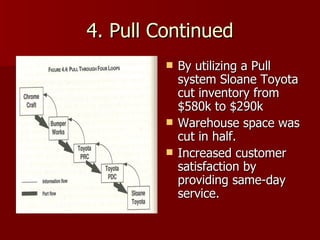
4. Pull Continued By utilizing a Pull system Sloane Toyota cut inventory from $580k to $290k Warehouse space was cut in half. Increased customer satisfaction by providing same-day service.
5. Perfection Complete elimination of Muda is impossible. Repeat Kaizens is the path to approaching perfection. FNGP made dramatic improvements through repeat kaizens.
II. From Thinking to Action The Simple Case – Lantech A Harder Case – Wiremold Co. The Acid Test - Pratt & Whitney Lean Thinking vs. German Technik – Porshe Mighty Toyota; Tiny Showa An Action Plan
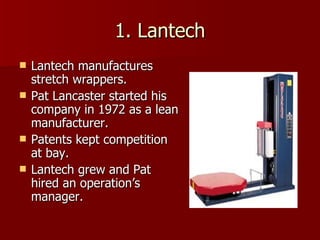
1. Lantech Lantech manufactures stretch wrappers. Pat Lancaster started his company in 1972 as a lean manufacturer. Patents kept competition at bay. Lantech grew and Pat hired an operation’s manager.
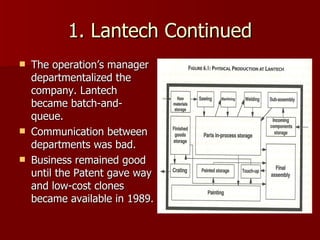
1. Lantech Continued The operation’s manager departmentalized the company. Lantech became batch-and- queue. Communication between departments was bad. Business remained good until the Patent gave way and low-cost clones became available in 1989.
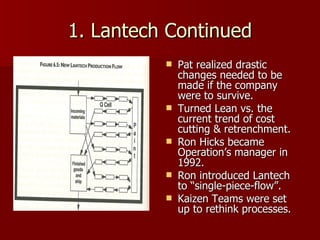
1. Lantech Continued Pat realized drastic changes needed to be made if the company were to survive. Turned Lean vs. the current trend of cost cutting & retrenchment. Ron Hicks became Operation’s manager in 1992. Ron introduced Lantech to “single-piece-flow”. Kaizen Teams were set up to rethink processes.
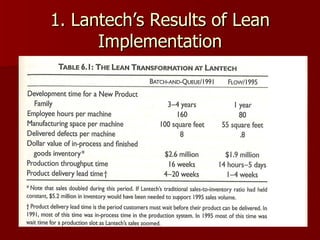
1. Lantech’s Results of Lean Implementation
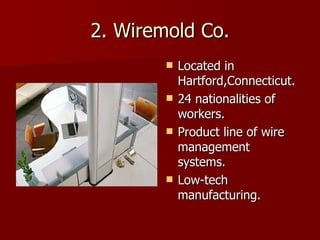
2. Wiremold Co. Located in Hartford,Connecticut. 24 nationalities of workers. Product line of wire management systems. Low-tech manufacturing.
2. Wiremold Continued Family owned and operated since 1900. In 1970 hired professional management. Business Market seemed to have no growth potential. The company embraced TQM. TQM was critically short on implementation details. In 1991 the company was in crisis after implementing JIT in the wrong way. Pull and flow was not implemented because no one knew how.
2. Wiremold Continued In 1991 Art Byrne was hired as the “Change Agent”. Art had successfully implemented in 8 companies of which he was in charge. Art decreased the workforce by offering early retirement and released 10% of management that didn’t embrace lean management (anchor draggers). Transformed the organizational from highly hierarchical to several product teams.
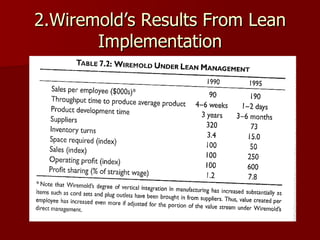
2. Wiremold Continued Art trained the employees in lean principles followed by kaizen exercises. Buy in from the employees was critical. Managers were instructed by Art to convert every process into pull and continuous flow. Art had 100’s of kaizen activities going simultaneously. Art had “scoreboards” posted of simple quantitative performance indicators. He also guaranteed that jobs would not be lost due to lean implementation.
2.Wiremold’s Results From Lean Implementation
3. Pratt & Whitney The Acid Test !! Makers of Military and Commercial Jet Engines. 51,000 employees (1990). 11 million shop hours of work annually.
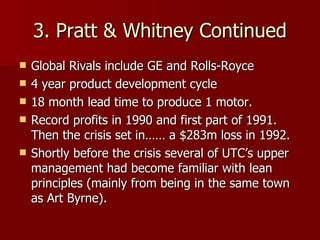
3. Pratt & Whitney Continued Global Rivals include GE and Rolls-Royce 4 year product development cycle 18 month lead time to produce 1 motor. Record profits in 1990 and first part of 1991. Then the crisis set in…… a $283m loss in 1992. Shortly before the crisis several of UTC’s upper management had become familiar with lean principles (mainly from being in the same town as Art Byrne).
3. Pratt & Whitney Continued Mark Coran resolved to implement lean thinking at Pratt. Coran hired Bob D’Amore who had learned lean principles at Harley-Davidson during their turn around period in the 80’s. D’Amore charged with going through every production activity at Pratt and transforming it into a continuous flow. (Kaikaiku).
3. Pratt & Whitney Continued George David, a lean thinker, became president of UTC. This gave needed support to Coran & D’Amore. Sensei’s Iwata and Nakao were contracted from under GE (another lucky break). George David hired Karl Krapek as Pratt’s president. Krapek was also a lean thinker. Krapek had to downsize to a substainable number of employees for the long haul.
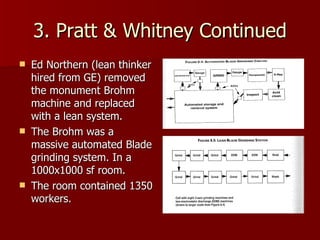
3. Pratt & Whitney Continued Ed Northern (lean thinker hired from GE) removed the monument Brohm machine and replaced with a lean system. The Brohm was a massive automated Blade grinding system. In a 1000x1000 sf room. The room contained 1350 workers.
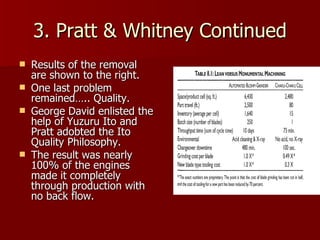
3. Pratt & Whitney Continued Results of the removal are shown to the right. One last problem remained….. Quality. George David enlisted the help of Yuzuru Ito and Pratt adobted the Ito Quality Philosophy. The result was nearly 100% of the engines made it completely through production with no back flow.
3. Pratt & Whitney Continued Karl Krapek further reduced the organizational chart to product development component centers and operation module centers. Pratt & Whitney is still today on its lean journey. February 15 th  2006, Wall Street Journal story notes that Pratt and Whitney may begin to produce replacement parts for GE’s Jet Engines.
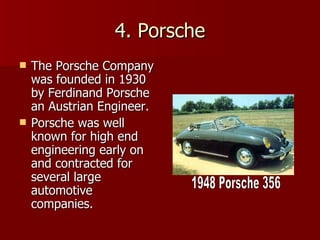
4. Porsche The Porsche Company was founded in 1930 by Ferdinand Porsche an Austrian Engineer. Porsche was well known for high end engineering early on and contracted for several large automotive companies. 1948 Porsche 356
4. Porsche Continued Porsche was a classic German firm. Held in family hands until 1972. Porsche had an intense focus on its product. The organization was hierarchical in German form consisting of gruppen meisters, meisters, and ober meister. One of Porsche’s striking features was its craftsmanship.
4. Porsche Continued The shop floor was not involved in the design; therefore, products were high on performance but low on manufacturability and serviceability. Porsche accepted the fact that suppliers would ship products late and defective. Errors in the finished product were corrected by highly skilled craftsman after the automobile rolled off of the line.
4. Porsche Continued The Crisis In 1987 Porsche’s sales dropped from a peak of 50,000 cars to 14,000 cars. Porsche blamed the sales drop on the market not realizing something within the company was wrong. By 1989 sales declined further. Porsche decided to pursue only high end cars and leave affordable cars to the Japanese.
4. Porsche Continued The Crisis Prices had to be dropped by 30% to address currency realignment. Wendelin Wiedeking was brought in for the job. Profits had slid in 90-91 from $10m to a loss of $40m. Porsche’s fundamental problem was cost. Wiedeking had managers read and study  The Machine That Changed The World  and planned study trips to Japan.  No one in Japan considered Porsche as serious competition so they were very free about showing the Germans everything.
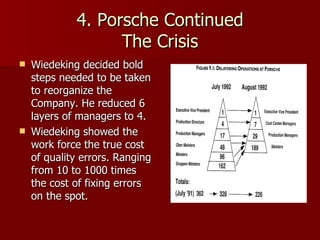
4. Porsche Continued The Crisis Wiedeking decided bold steps needed to be taken to reorganize the Company. He reduced 6 layers of managers to 4. Wiedeking showed the work force the true cost of quality errors. Ranging from 10 to 1000 times the cost of fixing errors on the spot.
4. Porsche Continued Chihiro Nakao In desperation Wiedeking was able to negotiate with Chihiro Nakao to implement lean thinking at Porsche. Nakao’s first objective was to turn a “warehouse”  into a factory by reducing a mountain of inventory. He cut shelf heights from 2.5 meters to 1.3 meters. “Everyone could see everyone else” with the shelves cut down.
4. Porsche Continued Nakao had Wiedeking cut the shelves as a defining moment. Historically, senior German managers did not touch anything in the plant. The head count of employees was decreased 30% over 3 years through attrition. (We have seen this in all cases so far.) Nakao had Wiedeking reduce the number of suppliers from over 950 to 300 and label 60 as critical. Porsche was also required to work with suppliers in implementing lean principles.
4. Porsche Continued Since Porsche is a small company any product change is a “bet the company” decision. Wiedeking decided that Porsche should stick to the niche it created and produced a mid-priced and an upscale 2 seat automobile (Boxster). Wiedeking redefined what a Porschje is.
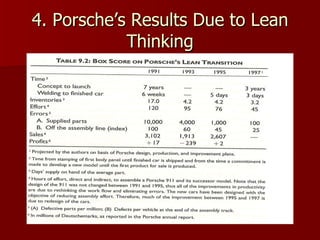
4. Porsche’s Results Due to Lean Thinking
5. Showa Manufacturing Showa Manufacturing is over 100 years old. Showa manufactures radiators and boilers. In 1979 with the second oil shock demand for industrial products slumped and expansions were put on hold. Showa’s president Tetsu Yamamato contacted Taiichi Ohno for guidance. Ohno had transformed Toyota into a Lean enterprise.
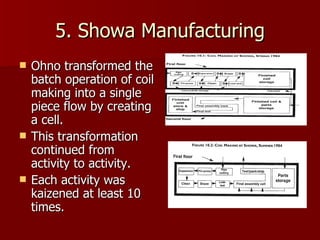
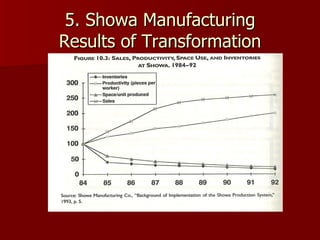
5. Showa Manufacturing Ohno transformed the batch operation of coil making into a single piece flow by creating a cell. This transformation continued from activity to activity. Each activity was kaizened at least 10 times.
5. Showa Manufacturing Results of Transformation
An Action Plan Getting Started. Change Agent – Find someone (it may be you!) with the lean knowledge, energy, and courage to see the change implemented. Get lean knowledge  Find a lever – seize an opportunity to implement lean principles Map value streams – Look for ways to eliminate muda and implement flow
Action Plan Getting started continued. Begin Kaikaiku – look for radical improvements and then kaizen and re-kaizen. Expand your scope – move quickly from one activity to the next
Action Plan Create a new organization Reorganize by product family Create a lean function Devise a policy for excess people Devise a growth strategy Remove anchor draggers Instill “Perfection” Install lean business systems. Complete the transformation.
III. Lean Enterprise A Channel for the Stream; A Valley for the Channel Dreaming About Perfection
A Channel for the Stream; A Valley for the Channel “ We are putting the entire value stream for specific products relentlessly in the foreground and rethinking every aspect of jobs,careers,functions, and firms in order to correctly specify value and make it flow continuously along the whole length of the stream as pulled by the customer in pursuit of perfection”.
Dreaming About Perfection There are hardly any lean enterprises in the authors sense of the term “where value creation is smoothly linked from concept to launch, order to delivery, and raw material into the arms of the consumerand on through the life cycle of the good or service”. Perfection is not a destination but a journey.
The End.

Lean thinking

  • 1.
    Lean Thinking BanishWaste & Create Wealth in Your Corporation By: James P. Womack & Daniel Jones Book Report By: Billy Wiggins
  • 2.
    Why Was ThisBook Written? A follow up to The Machine That Changed the World. Written to Enlighten Management on the Transformation to a Lean System.
  • 3.
    Contents of BookLean Principles From Thinking to Action Lean Enterprise Epilogue
  • 4.
    I. Lean PrinciplesValue The Value Stream Flow Pull Perfection
  • 5.
    1. Value Anythingwhich does not provide value is MUDA or waste. Antidote to Muda is Lean Thinking. Value is Specified by the Customer.
  • 6.
    An Example ofDefining Value (and Muda) The Authors mapped the process of traveling. The itinerary included air travel and Ground Travel from Herefordshire to Crete. The Result: 13 hrs of travel time; 7 hours actually spent going somewhere and a total of 23 process steps.
  • 7.
    2. The ValueStream To determine the value stream, map the steps required to produce the product and classify into 3 categories Actions which create value Actions that create no value but are required Actions that create no value and are not needed.
  • 8.
    Example of MappedValue Stream There are months spent in shipping. Every step in the process entails excess inventory. The estimated cycle time is 319 days from mine to Home!!
  • 9.
    3. Flow 3steps must be taken together to achieve flow Focus on the product. Ignore traditional boundaries (flow is counterintuitive). Rethink specific work practices (Kaizens).
  • 10.
    Example of TwoPlant Layouts
  • 11.
    Example Continued TheLean Layout utilizes: JIT (Just-in-Time) which prevents inventory build up before or after each process step. Small batches. Quick machine changeovers. Cells for complete products vs. Mass Production. Takt (production time/customer demand). This equates into flow and level scheduling.
  • 12.
    4. Pull Definition– A system of cascading production & delivery activities in which nothing is produced by the upstream supplier until the downstream customer signals a need. A Kanban is a visual signal which signals the need for parts by a downstream customer.
  • 13.
    4. Pull ContinuedBy utilizing a Pull system Sloane Toyota cut inventory from $580k to $290k Warehouse space was cut in half. Increased customer satisfaction by providing same-day service.
  • 14.
    5. Perfection Completeelimination of Muda is impossible. Repeat Kaizens is the path to approaching perfection. FNGP made dramatic improvements through repeat kaizens.
  • 15.
    II. From Thinkingto Action The Simple Case – Lantech A Harder Case – Wiremold Co. The Acid Test - Pratt & Whitney Lean Thinking vs. German Technik – Porshe Mighty Toyota; Tiny Showa An Action Plan
  • 16.
    1. Lantech Lantechmanufactures stretch wrappers. Pat Lancaster started his company in 1972 as a lean manufacturer. Patents kept competition at bay. Lantech grew and Pat hired an operation’s manager.
  • 17.
    1. Lantech ContinuedThe operation’s manager departmentalized the company. Lantech became batch-and- queue. Communication between departments was bad. Business remained good until the Patent gave way and low-cost clones became available in 1989.
  • 18.
    1. Lantech ContinuedPat realized drastic changes needed to be made if the company were to survive. Turned Lean vs. the current trend of cost cutting & retrenchment. Ron Hicks became Operation’s manager in 1992. Ron introduced Lantech to “single-piece-flow”. Kaizen Teams were set up to rethink processes.
  • 19.
    1. Lantech’s Resultsof Lean Implementation
  • 20.
    2. Wiremold Co.Located in Hartford,Connecticut. 24 nationalities of workers. Product line of wire management systems. Low-tech manufacturing.
  • 21.
    2. Wiremold ContinuedFamily owned and operated since 1900. In 1970 hired professional management. Business Market seemed to have no growth potential. The company embraced TQM. TQM was critically short on implementation details. In 1991 the company was in crisis after implementing JIT in the wrong way. Pull and flow was not implemented because no one knew how.
  • 22.
    2. Wiremold ContinuedIn 1991 Art Byrne was hired as the “Change Agent”. Art had successfully implemented in 8 companies of which he was in charge. Art decreased the workforce by offering early retirement and released 10% of management that didn’t embrace lean management (anchor draggers). Transformed the organizational from highly hierarchical to several product teams.
  • 23.
    2. Wiremold ContinuedArt trained the employees in lean principles followed by kaizen exercises. Buy in from the employees was critical. Managers were instructed by Art to convert every process into pull and continuous flow. Art had 100’s of kaizen activities going simultaneously. Art had “scoreboards” posted of simple quantitative performance indicators. He also guaranteed that jobs would not be lost due to lean implementation.
  • 24.
    2.Wiremold’s Results FromLean Implementation
  • 25.
    3. Pratt &Whitney The Acid Test !! Makers of Military and Commercial Jet Engines. 51,000 employees (1990). 11 million shop hours of work annually.
  • 26.
    3. Pratt &Whitney Continued Global Rivals include GE and Rolls-Royce 4 year product development cycle 18 month lead time to produce 1 motor. Record profits in 1990 and first part of 1991. Then the crisis set in…… a $283m loss in 1992. Shortly before the crisis several of UTC’s upper management had become familiar with lean principles (mainly from being in the same town as Art Byrne).
  • 27.
    3. Pratt &Whitney Continued Mark Coran resolved to implement lean thinking at Pratt. Coran hired Bob D’Amore who had learned lean principles at Harley-Davidson during their turn around period in the 80’s. D’Amore charged with going through every production activity at Pratt and transforming it into a continuous flow. (Kaikaiku).
  • 28.
    3. Pratt &Whitney Continued George David, a lean thinker, became president of UTC. This gave needed support to Coran & D’Amore. Sensei’s Iwata and Nakao were contracted from under GE (another lucky break). George David hired Karl Krapek as Pratt’s president. Krapek was also a lean thinker. Krapek had to downsize to a substainable number of employees for the long haul.
  • 29.
    3. Pratt &Whitney Continued Ed Northern (lean thinker hired from GE) removed the monument Brohm machine and replaced with a lean system. The Brohm was a massive automated Blade grinding system. In a 1000x1000 sf room. The room contained 1350 workers.
  • 30.
    3. Pratt &Whitney Continued Results of the removal are shown to the right. One last problem remained….. Quality. George David enlisted the help of Yuzuru Ito and Pratt adobted the Ito Quality Philosophy. The result was nearly 100% of the engines made it completely through production with no back flow.
  • 31.
    3. Pratt &Whitney Continued Karl Krapek further reduced the organizational chart to product development component centers and operation module centers. Pratt & Whitney is still today on its lean journey. February 15 th 2006, Wall Street Journal story notes that Pratt and Whitney may begin to produce replacement parts for GE’s Jet Engines.
  • 32.
    4. Porsche ThePorsche Company was founded in 1930 by Ferdinand Porsche an Austrian Engineer. Porsche was well known for high end engineering early on and contracted for several large automotive companies. 1948 Porsche 356
  • 33.
    4. Porsche ContinuedPorsche was a classic German firm. Held in family hands until 1972. Porsche had an intense focus on its product. The organization was hierarchical in German form consisting of gruppen meisters, meisters, and ober meister. One of Porsche’s striking features was its craftsmanship.
  • 34.
    4. Porsche ContinuedThe shop floor was not involved in the design; therefore, products were high on performance but low on manufacturability and serviceability. Porsche accepted the fact that suppliers would ship products late and defective. Errors in the finished product were corrected by highly skilled craftsman after the automobile rolled off of the line.
  • 35.
    4. Porsche ContinuedThe Crisis In 1987 Porsche’s sales dropped from a peak of 50,000 cars to 14,000 cars. Porsche blamed the sales drop on the market not realizing something within the company was wrong. By 1989 sales declined further. Porsche decided to pursue only high end cars and leave affordable cars to the Japanese.
  • 36.
    4. Porsche ContinuedThe Crisis Prices had to be dropped by 30% to address currency realignment. Wendelin Wiedeking was brought in for the job. Profits had slid in 90-91 from $10m to a loss of $40m. Porsche’s fundamental problem was cost. Wiedeking had managers read and study The Machine That Changed The World and planned study trips to Japan. No one in Japan considered Porsche as serious competition so they were very free about showing the Germans everything.
  • 37.
    4. Porsche ContinuedThe Crisis Wiedeking decided bold steps needed to be taken to reorganize the Company. He reduced 6 layers of managers to 4. Wiedeking showed the work force the true cost of quality errors. Ranging from 10 to 1000 times the cost of fixing errors on the spot.
  • 38.
    4. Porsche ContinuedChihiro Nakao In desperation Wiedeking was able to negotiate with Chihiro Nakao to implement lean thinking at Porsche. Nakao’s first objective was to turn a “warehouse” into a factory by reducing a mountain of inventory. He cut shelf heights from 2.5 meters to 1.3 meters. “Everyone could see everyone else” with the shelves cut down.
  • 39.
    4. Porsche ContinuedNakao had Wiedeking cut the shelves as a defining moment. Historically, senior German managers did not touch anything in the plant. The head count of employees was decreased 30% over 3 years through attrition. (We have seen this in all cases so far.) Nakao had Wiedeking reduce the number of suppliers from over 950 to 300 and label 60 as critical. Porsche was also required to work with suppliers in implementing lean principles.
  • 40.
    4. Porsche ContinuedSince Porsche is a small company any product change is a “bet the company” decision. Wiedeking decided that Porsche should stick to the niche it created and produced a mid-priced and an upscale 2 seat automobile (Boxster). Wiedeking redefined what a Porschje is.
  • 41.
    4. Porsche’s ResultsDue to Lean Thinking
  • 42.
    5. Showa ManufacturingShowa Manufacturing is over 100 years old. Showa manufactures radiators and boilers. In 1979 with the second oil shock demand for industrial products slumped and expansions were put on hold. Showa’s president Tetsu Yamamato contacted Taiichi Ohno for guidance. Ohno had transformed Toyota into a Lean enterprise.
  • 43.
    5. Showa ManufacturingOhno transformed the batch operation of coil making into a single piece flow by creating a cell. This transformation continued from activity to activity. Each activity was kaizened at least 10 times.
  • 44.
    5. Showa ManufacturingResults of Transformation
  • 45.
    An Action PlanGetting Started. Change Agent – Find someone (it may be you!) with the lean knowledge, energy, and courage to see the change implemented. Get lean knowledge Find a lever – seize an opportunity to implement lean principles Map value streams – Look for ways to eliminate muda and implement flow
  • 46.
    Action Plan Gettingstarted continued. Begin Kaikaiku – look for radical improvements and then kaizen and re-kaizen. Expand your scope – move quickly from one activity to the next
  • 47.
    Action Plan Createa new organization Reorganize by product family Create a lean function Devise a policy for excess people Devise a growth strategy Remove anchor draggers Instill “Perfection” Install lean business systems. Complete the transformation.
  • 48.
    III. Lean EnterpriseA Channel for the Stream; A Valley for the Channel Dreaming About Perfection
  • 49.
    A Channel forthe Stream; A Valley for the Channel “ We are putting the entire value stream for specific products relentlessly in the foreground and rethinking every aspect of jobs,careers,functions, and firms in order to correctly specify value and make it flow continuously along the whole length of the stream as pulled by the customer in pursuit of perfection”.
  • 50.
    Dreaming About PerfectionThere are hardly any lean enterprises in the authors sense of the term “where value creation is smoothly linked from concept to launch, order to delivery, and raw material into the arms of the consumerand on through the life cycle of the good or service”. Perfection is not a destination but a journey.
  • 51.