1
©The McGraw-Hill Companies, Inc., 2006
Chapter 10
Supply Chain Strategy
2
Supply-Chain Management
Measuring Supply-Chain Performance
Bullwhip Effect
Outsourcing
Value Density
Mass Customization
OBJECTIVES
3
What is a Supply Chain?
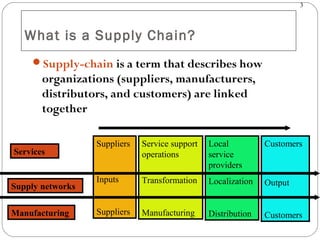
Supply-chain is a term that describes how
organizations (suppliers, manufacturers,
distributors, and customers) are linked
together
Suppliers
Inputs
Suppliers
Service support
operations
Transformation
Manufacturing
Local
service
providers
Localization
Distribution
Customers
Output
Customers
Services
Supply networks
Manufacturing
4
What is Supply Chain Management?
Supply-chain management is a total system
approach to managing the entire flow of
information, materials, and services from raw-
material suppliers through factories and
warehouses to the end customer
5
Formulas for Measuring Supply-Chain
Performance
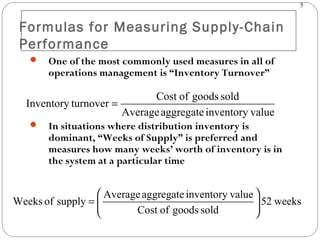
 One of the most commonly used measures in all of
operations management is “Inventory Turnover”
 In situations where distribution inventory is
dominant, “Weeks of Supply” is preferred and
measures how many weeks’ worth of inventory is in
the system at a particular time
valueinventoryaggregateAverage
soldgoodsofCost
turnoverInventory =
weeks52
soldgoodsofCost
valueinventoryaggregateAverage
supplyofWeeks 





=
6
Example of Measuring Supply-
Chain Performance
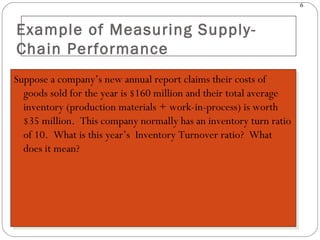
Suppose a company’s new annual report claims their costs of
goods sold for the year is $160 million and their total average
inventory (production materials + work-in-process) is worth
$35 million. This company normally has an inventory turn ratio
of 10. What is this year’s Inventory Turnover ratio? What
does it mean?
Suppose a company’s new annual report claims their costs of
goods sold for the year is $160 million and their total average
inventory (production materials + work-in-process) is worth
$35 million. This company normally has an inventory turn ratio
of 10. What is this year’s Inventory Turnover ratio? What
does it mean?
7
Example of Measuring Supply-Chain
Performance (Continued)
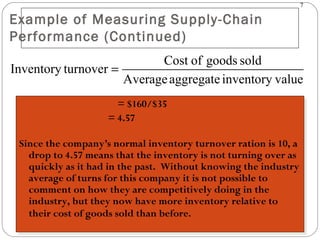
= $160/$35
= 4.57
Since the company’s normal inventory turnover ration is 10, a
drop to 4.57 means that the inventory is not turning over as
quickly as it had in the past. Without knowing the industry
average of turns for this company it is not possible to
comment on how they are competitively doing in the
industry, but they now have more inventory relative to
their cost of goods sold than before.
= $160/$35
= 4.57
Since the company’s normal inventory turnover ration is 10, a
drop to 4.57 means that the inventory is not turning over as
quickly as it had in the past. Without knowing the industry
average of turns for this company it is not possible to
comment on how they are competitively doing in the
industry, but they now have more inventory relative to
their cost of goods sold than before.
valueinventoryaggregateAverage
soldgoodsofCost
turnoverInventory =
8
Bullwhip Effect
Order
Quantity
Time
Retailer’s Orders
Order
Quantity
Time
Wholesaler’s Orders
Order
Quantity
Time
Manufacturer’s Orders
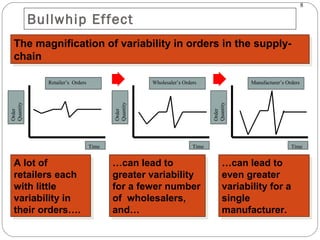
The magnification of variability in orders in the supply-
chain
The magnification of variability in orders in the supply-
chain
A lot of
retailers each
with little
variability in
their orders….
A lot of
retailers each
with little
variability in
their orders….
…can lead to
greater variability
for a fewer number
of wholesalers,
and…
…can lead to
greater variability
for a fewer number
of wholesalers,
and…
…can lead to
even greater
variability for a
single
manufacturer.
…can lead to
even greater
variability for a
single
manufacturer.
9
Hau Lee’s Concepts of Supply Chain
Management
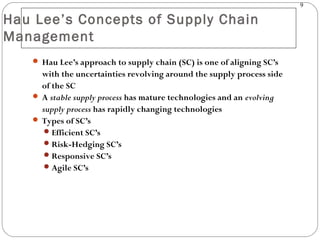
 Hau Lee’s approach to supply chain (SC) is one of aligning SC’s
with the uncertainties revolving around the supply process side
of the SC
 A stable supply process has mature technologies and an evolving
supply process has rapidly changing technologies
 Types of SC’s
Efficient SC’s
Risk-Hedging SC’s
Responsive SC’s
Agile SC’s
10
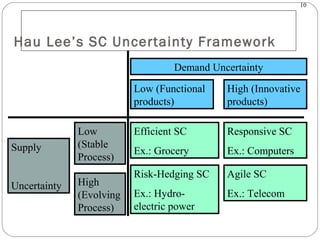
Hau Lee’s SC Uncertainty Framework
Demand Uncertainty
Low (Functional
products)
High (Innovative
products)
Efficient SC
Ex.: Grocery
Responsive SC
Ex.: Computers
Risk-Hedging SC
Ex.: Hydro-
electric power
Agile SC
Ex.: Telecom
Low
(Stable
Process)
High
(Evolving
Process)
Supply
Uncertainty
11
What is Outsourcing?
Outsourcing is defined as the act of moving a firm’s
internal activities and decision responsibility to
outside providers
12
Reasons to Outsource
Organizationally-driven
Improvement-driven
Financially-driven
Revenue-driven
Cost-driven
Employee-driven
13
Value Density
Value density is defined as the value of an item
per pound of weight
It is used as an important measure when
deciding where items should be stocked
geographically and how they should be shipped
14
Mass Customization
Mass customization is a term used to describe
the ability of a company to deliver highly
customized products and services to different
customers
The key to mass customization is effectively
postponing the tasks of differentiating a
product for a specific customer until the
latest possible point in the supply-chain
network

Supply chain strategy

  • 1.
    1 ©The McGraw-Hill Companies,Inc., 2006 Chapter 10 Supply Chain Strategy
  • 2.
    2 Supply-Chain Management Measuring Supply-ChainPerformance Bullwhip Effect Outsourcing Value Density Mass Customization OBJECTIVES
  • 3.
    3 What is aSupply Chain? Supply-chain is a term that describes how organizations (suppliers, manufacturers, distributors, and customers) are linked together Suppliers Inputs Suppliers Service support operations Transformation Manufacturing Local service providers Localization Distribution Customers Output Customers Services Supply networks Manufacturing
  • 4.
    4 What is SupplyChain Management? Supply-chain management is a total system approach to managing the entire flow of information, materials, and services from raw- material suppliers through factories and warehouses to the end customer
  • 5.
    5 Formulas for MeasuringSupply-Chain Performance  One of the most commonly used measures in all of operations management is “Inventory Turnover”  In situations where distribution inventory is dominant, “Weeks of Supply” is preferred and measures how many weeks’ worth of inventory is in the system at a particular time valueinventoryaggregateAverage soldgoodsofCost turnoverInventory = weeks52 soldgoodsofCost valueinventoryaggregateAverage supplyofWeeks       =
  • 6.
    6 Example of MeasuringSupply- Chain Performance Suppose a company’s new annual report claims their costs of goods sold for the year is $160 million and their total average inventory (production materials + work-in-process) is worth $35 million. This company normally has an inventory turn ratio of 10. What is this year’s Inventory Turnover ratio? What does it mean? Suppose a company’s new annual report claims their costs of goods sold for the year is $160 million and their total average inventory (production materials + work-in-process) is worth $35 million. This company normally has an inventory turn ratio of 10. What is this year’s Inventory Turnover ratio? What does it mean?
  • 7.
    7 Example of MeasuringSupply-Chain Performance (Continued) = $160/$35 = 4.57 Since the company’s normal inventory turnover ration is 10, a drop to 4.57 means that the inventory is not turning over as quickly as it had in the past. Without knowing the industry average of turns for this company it is not possible to comment on how they are competitively doing in the industry, but they now have more inventory relative to their cost of goods sold than before. = $160/$35 = 4.57 Since the company’s normal inventory turnover ration is 10, a drop to 4.57 means that the inventory is not turning over as quickly as it had in the past. Without knowing the industry average of turns for this company it is not possible to comment on how they are competitively doing in the industry, but they now have more inventory relative to their cost of goods sold than before. valueinventoryaggregateAverage soldgoodsofCost turnoverInventory =
  • 8.
    8 Bullwhip Effect Order Quantity Time Retailer’s Orders Order Quantity Time Wholesaler’sOrders Order Quantity Time Manufacturer’s Orders The magnification of variability in orders in the supply- chain The magnification of variability in orders in the supply- chain A lot of retailers each with little variability in their orders…. A lot of retailers each with little variability in their orders…. …can lead to greater variability for a fewer number of wholesalers, and… …can lead to greater variability for a fewer number of wholesalers, and… …can lead to even greater variability for a single manufacturer. …can lead to even greater variability for a single manufacturer.
  • 9.
    9 Hau Lee’s Conceptsof Supply Chain Management  Hau Lee’s approach to supply chain (SC) is one of aligning SC’s with the uncertainties revolving around the supply process side of the SC  A stable supply process has mature technologies and an evolving supply process has rapidly changing technologies  Types of SC’s Efficient SC’s Risk-Hedging SC’s Responsive SC’s Agile SC’s
  • 10.
    10 Hau Lee’s SCUncertainty Framework Demand Uncertainty Low (Functional products) High (Innovative products) Efficient SC Ex.: Grocery Responsive SC Ex.: Computers Risk-Hedging SC Ex.: Hydro- electric power Agile SC Ex.: Telecom Low (Stable Process) High (Evolving Process) Supply Uncertainty
  • 11.
    11 What is Outsourcing? Outsourcingis defined as the act of moving a firm’s internal activities and decision responsibility to outside providers
  • 12.
  • 13.
    13 Value Density Value densityis defined as the value of an item per pound of weight It is used as an important measure when deciding where items should be stocked geographically and how they should be shipped
  • 14.
    14 Mass Customization Mass customizationis a term used to describe the ability of a company to deliver highly customized products and services to different customers The key to mass customization is effectively postponing the tasks of differentiating a product for a specific customer until the latest possible point in the supply-chain network