
Lean Production
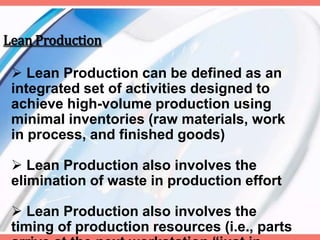
 Lean Production can be defined as an
integrated set of activities designed to
achieve high-volume production using
minimal inventories (raw materials, work
in process, and finished goods)
 Lean Production also involves the
elimination of waste in production effort
 Lean Production also involves the
timing of production resources (i.e., parts
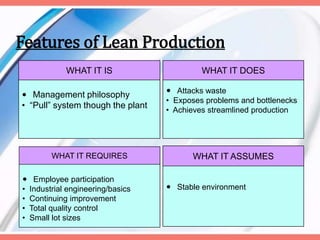
Features of Lean Production
• Management philosophy
• “Pull” system though the plant
WHAT IT IS
• Employee participation
• Industrial engineering/basics
• Continuing improvement
• Total quality control
• Small lot sizes
WHAT IT REQUIRES
• Attacks waste
• Exposes problems and bottlenecks
• Achieves streamlined production
WHAT IT DOES
• Stable environment
WHAT IT ASSUMES
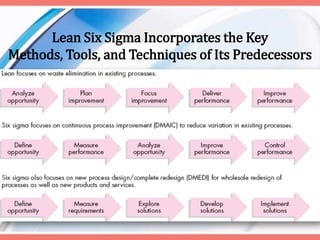
Lean Six Sigma Incorporates the Key
Methods, Tools, and Techniques of Its Predecessors
The Toyota Production System
 Based on two philosophies:
1. Elimination of waste
2. Respect for people
Elimination of Waste
1. Focused factory networks
2. Group technology
3. Quality at the source
4. JIT production
5. Uniform plant loading
6. Kanban production control system
7. Minimized setup times
Respect for People
Level payrolls
Cooperative employee unions
Subcontractor networks
Bottom-round management style
Quality circles (Small Group
Involvement Activities or SGIA’s)
Toyota Production System’s Four Rules
1. All work shall be highly specified as to
content, sequence, timing, and outcome
2. Every customer-supplier connection must
be direct, and there must be an
unambiguous yes-or-no way to send
requests and receive responses
3. The pathway for every product and
service must be simple and direct
4. Any improvement must be made in
Lean Implementation Requirements: Design Flow
Process
Link operations
Balance workstation capacities
Redesign layout for flow
Emphasize preventive
maintenance
Reduce lot sizes
Reduce setup/changeover time
Lean Implementation Requirements: Total Quality
Control
Worker responsibility
Measure SQC
Enforce compliance
Fail-safe methods
Automatic inspection
Lean Implementation Requirements: Stabilize
Schedule
 Level Schedule
 Underutilized Capacity
 Establish freeze windows
Lean Implementation Requirements: Kanban-
Pull
Demand pull
Back flush
Reduce lot sizes
Lean Implementation Requirements: Work with
Vendors
Reduce lead times
Frequent deliveries
Project usage requirements
Quality expectations
Lean Implementation Requirements: Reduce
Inventory More
Look for other areas
Stores
Transit
Carousels
Conveyors
Lean Implementation Requirements:
Improve Product Design
Standard product configuration
Standardize and reduce number of
parts
Process design with product
design
Lean in Services (Examples)
Organize Problem-Solving Groups
Upgrade Housekeeping
Upgrade Quality
Clarify Process Flows
Revise Equipment and Process
Technologies
Lean in Services (Examples)
Level the Facility Load
Eliminate Unnecessary Activities
Reorganize Physical Configuration
Introduce Demand-Pull Scheduling
Develop Supplier Networks
Thank You...

Lean Process and Production

  • 2.
    Lean Production  LeanProduction can be defined as an integrated set of activities designed to achieve high-volume production using minimal inventories (raw materials, work in process, and finished goods)  Lean Production also involves the elimination of waste in production effort  Lean Production also involves the timing of production resources (i.e., parts
  • 3.
    Features of LeanProduction • Management philosophy • “Pull” system though the plant WHAT IT IS • Employee participation • Industrial engineering/basics • Continuing improvement • Total quality control • Small lot sizes WHAT IT REQUIRES • Attacks waste • Exposes problems and bottlenecks • Achieves streamlined production WHAT IT DOES • Stable environment WHAT IT ASSUMES
  • 4.
    Lean Six SigmaIncorporates the Key Methods, Tools, and Techniques of Its Predecessors
  • 5.
    The Toyota ProductionSystem  Based on two philosophies: 1. Elimination of waste 2. Respect for people
  • 6.
    Elimination of Waste 1.Focused factory networks 2. Group technology 3. Quality at the source 4. JIT production 5. Uniform plant loading 6. Kanban production control system 7. Minimized setup times
  • 7.
    Respect for People Levelpayrolls Cooperative employee unions Subcontractor networks Bottom-round management style Quality circles (Small Group Involvement Activities or SGIA’s)
  • 8.
    Toyota Production System’sFour Rules 1. All work shall be highly specified as to content, sequence, timing, and outcome 2. Every customer-supplier connection must be direct, and there must be an unambiguous yes-or-no way to send requests and receive responses 3. The pathway for every product and service must be simple and direct 4. Any improvement must be made in
  • 9.
    Lean Implementation Requirements:Design Flow Process Link operations Balance workstation capacities Redesign layout for flow Emphasize preventive maintenance Reduce lot sizes Reduce setup/changeover time
  • 10.
    Lean Implementation Requirements:Total Quality Control Worker responsibility Measure SQC Enforce compliance Fail-safe methods Automatic inspection
  • 11.
    Lean Implementation Requirements:Stabilize Schedule  Level Schedule  Underutilized Capacity  Establish freeze windows
  • 12.
    Lean Implementation Requirements:Kanban- Pull Demand pull Back flush Reduce lot sizes
  • 13.
    Lean Implementation Requirements:Work with Vendors Reduce lead times Frequent deliveries Project usage requirements Quality expectations
  • 14.
    Lean Implementation Requirements:Reduce Inventory More Look for other areas Stores Transit Carousels Conveyors
  • 15.
    Lean Implementation Requirements: ImproveProduct Design Standard product configuration Standardize and reduce number of parts Process design with product design
  • 16.
    Lean in Services(Examples) Organize Problem-Solving Groups Upgrade Housekeeping Upgrade Quality Clarify Process Flows Revise Equipment and Process Technologies
  • 17.
    Lean in Services(Examples) Level the Facility Load Eliminate Unnecessary Activities Reorganize Physical Configuration Introduce Demand-Pull Scheduling Develop Supplier Networks
  • 18.