LEAN
PRODUCTION
A presentation by
Marcelo Augusto A. Cosgayon
DEFINITION
Lean manufacturing or lean production,
often simply "lean", is a systematic method for
the elimination of waste ("Muda") within a
manufacturing system.
Lean also takes into account waste created
through overburden ("Muri") and waste
created through unevenness in work loads
("Mura").
WASTE (MUDA)
Anything other than the minimum amount of
equipment, materials, parts, space, and time
that are absolutely essential to add value to
the product.
KINDS OF WASTE (TIMWOOD)
1. Transporting
2. Inventory
3. Movement
4. Waiting
5. Overproduction
6. Over Processing
7. Defects
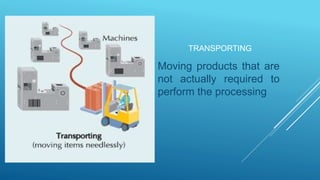
TRANSPORTING
Moving products that are
not actually required to
perform the processing
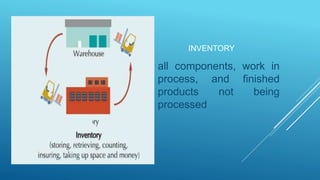
INVENTORY
all components, work in
process, and finished
products not being
processed
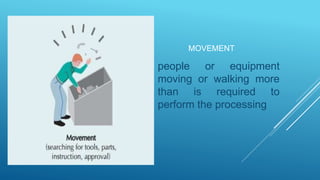
MOVEMENT
people or equipment
moving or walking more
than is required to
perform the processing
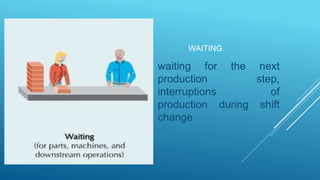
WAITING
waiting for the next
production step,
interruptions of
production during shift
change
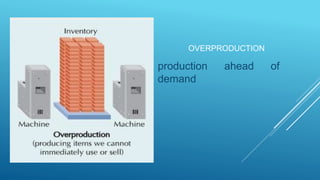
OVERPRODUCTION
production ahead of
demand
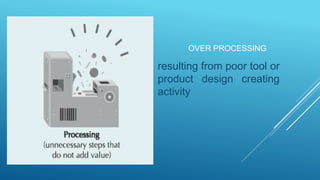
OVER PROCESSING
resulting from poor tool or
product design creating
activity
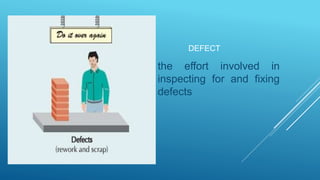
DEFECT
the effort involved in
inspecting for and fixing
defects
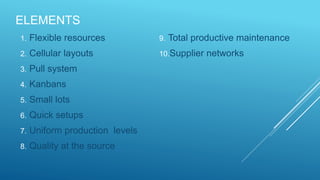
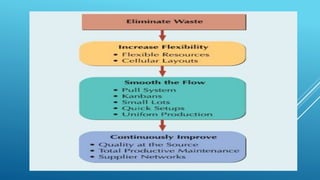
ELEMENTS
1. Flexible resources
2. Cellular layouts
3. Pull system
4. Kanbans
5. Small lots
6. Quick setups
7. Uniform production levels
8. Quality at the source
9. Total productive maintenance
10.Supplier networks
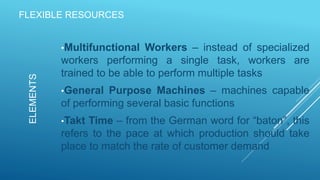
FLEXIBLE RESOURCES
•Multifunctional Workers – instead of specialized
workers performing a single task, workers are
trained to be able to perform multiple tasks
•General Purpose Machines – machines capable
of performing several basic functions
•Takt Time – from the German word for “baton”, this
refers to the pace at which production should take
place to match the rate of customer demand
ELEMENTS
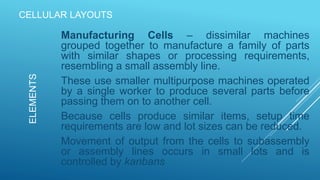
CELLULAR LAYOUTS
Manufacturing Cells – dissimilar machines
grouped together to manufacture a family of parts
with similar shapes or processing requirements,
resembling a small assembly line.
These use smaller multipurpose machines operated
by a single worker to produce several parts before
passing them on to another cell.
Because cells produce similar items, setup time
requirements are low and lot sizes can be reduced.
Movement of output from the cells to subassembly
or assembly lines occurs in small lots and is
controlled by kanbans
ELEMENTS
PULL SYSTEM
Pull System – relies on demand instead of supply
to provide a continuous flow of materials and parts
in the production process.
This eliminates the need for high inventory of
materials and parts to avoid stockouts and a
stoppage of work. It also prevents overproduction
and underproduction because workers only produce
what is needed and no more and no less.
ELEMENTS
ELEMENTS
Kanban - a card that corresponds to a standard
quantity of production. These cards contain basic
information such as part number, brief description,
type of container, unit load (i.e., quantity per
container), preceding station (where it came from),
and subsequent station (where it goes to).
Kanbans are essential for the push system to work
by determining when work should be done
KANBANS
SMALL LOTS
Products are manufactured in small lots at a time.
This improves quality and reduces lead time
because processes can be physically moved closer
together and transportation between stations can be
simplified. Quality problems can also be easily
detected.
These allow for remedial measures to be
undertaken more quickly
ELEMENTS
QUICK SETUPS
Setup times can be reduced by:
1. Separate internal setup from external setup
2. Convert internal setup to external setup
3. Streamline all aspects of setup
4. Perform setup activities in parallel or eliminate
them entirely
ELEMENTS
UNIFORM PRODUCTION LEVELS
Lean production systems require a uniform
production level in order to maintain the flow of
production created by the pull system, kanbans,
small lots, and quick setups.
This is done by smoothing the production
requirements on the final assembly line by making
accurate forecasts of demand.
ELEMENTS
QUALITY AT THE SOURCE
Extremely high quality parts are essential for lean
systems to work.
There is no extra inventory to act as a buffer against
defective units and producing poor quality items that
need to be reworked or rejected later on is a waste
that must be eliminated
ELEMENTS
TOTAL PRODUCTIVE MAINTENANCE
Periodic preventive maintenance is required to
prevent breakdown of machines that will cause work
stoppages and an interruption in the production
process.
Total Productive Maintenance combines the practice
of preventive maintenance with the concepts of total
quality: employee involvement, decisions based on
data, zero defects, and a strategic focus
ELEMENTS
SUPPLIER NETWORKS
Reliability of suppliers and the synchronization of
their production to the needs of the customer are
essential to the success of lean production.
This can be done by
ELEMENTS
1. Long-term supplier contracts
2. Synchronized production
3. Supplier certification
4. Mixed loads and frequent
deliveries
5. Precise delivery schedules
6. Standardized, sequenced delivery
7. Locating in close proximity to the
customer
BENEFITS
1. Reduced inventory
2. Improved quality
3. Lower costs
4. Reduced space
requirements
5. Shorter lead time
6. Increased productivity
7. Greater flexibility
8. Better relations with
suppliers
9. Simplified scheduling and
control activities
10. Increased capacity
11. Better use of human
resources
12. More product variety
DRAWBACKS
1. Requires steady demand to maintain production flow
2. Requires discipline
3. Not applicable to production of high volume repetitive
items
4. Vulnerable to unexpected changes in demand or supply

0201B Lean Production

  • 1.
  • 2.
    DEFINITION Lean manufacturing orlean production, often simply "lean", is a systematic method for the elimination of waste ("Muda") within a manufacturing system. Lean also takes into account waste created through overburden ("Muri") and waste created through unevenness in work loads ("Mura").
  • 3.
    WASTE (MUDA) Anything otherthan the minimum amount of equipment, materials, parts, space, and time that are absolutely essential to add value to the product.
  • 4.
    KINDS OF WASTE(TIMWOOD) 1. Transporting 2. Inventory 3. Movement 4. Waiting 5. Overproduction 6. Over Processing 7. Defects
  • 5.
    TRANSPORTING Moving products thatare not actually required to perform the processing
  • 6.
    INVENTORY all components, workin process, and finished products not being processed
  • 7.
    MOVEMENT people or equipment movingor walking more than is required to perform the processing
  • 8.
    WAITING waiting for thenext production step, interruptions of production during shift change
  • 9.
  • 10.
    OVER PROCESSING resulting frompoor tool or product design creating activity
  • 11.
    DEFECT the effort involvedin inspecting for and fixing defects
  • 12.
    ELEMENTS 1. Flexible resources 2.Cellular layouts 3. Pull system 4. Kanbans 5. Small lots 6. Quick setups 7. Uniform production levels 8. Quality at the source 9. Total productive maintenance 10.Supplier networks
  • 14.
    FLEXIBLE RESOURCES •Multifunctional Workers– instead of specialized workers performing a single task, workers are trained to be able to perform multiple tasks •General Purpose Machines – machines capable of performing several basic functions •Takt Time – from the German word for “baton”, this refers to the pace at which production should take place to match the rate of customer demand ELEMENTS
  • 15.
    CELLULAR LAYOUTS Manufacturing Cells– dissimilar machines grouped together to manufacture a family of parts with similar shapes or processing requirements, resembling a small assembly line. These use smaller multipurpose machines operated by a single worker to produce several parts before passing them on to another cell. Because cells produce similar items, setup time requirements are low and lot sizes can be reduced. Movement of output from the cells to subassembly or assembly lines occurs in small lots and is controlled by kanbans ELEMENTS
  • 16.
    PULL SYSTEM Pull System– relies on demand instead of supply to provide a continuous flow of materials and parts in the production process. This eliminates the need for high inventory of materials and parts to avoid stockouts and a stoppage of work. It also prevents overproduction and underproduction because workers only produce what is needed and no more and no less. ELEMENTS
  • 17.
    ELEMENTS Kanban - acard that corresponds to a standard quantity of production. These cards contain basic information such as part number, brief description, type of container, unit load (i.e., quantity per container), preceding station (where it came from), and subsequent station (where it goes to). Kanbans are essential for the push system to work by determining when work should be done KANBANS
  • 18.
    SMALL LOTS Products aremanufactured in small lots at a time. This improves quality and reduces lead time because processes can be physically moved closer together and transportation between stations can be simplified. Quality problems can also be easily detected. These allow for remedial measures to be undertaken more quickly ELEMENTS
  • 19.
    QUICK SETUPS Setup timescan be reduced by: 1. Separate internal setup from external setup 2. Convert internal setup to external setup 3. Streamline all aspects of setup 4. Perform setup activities in parallel or eliminate them entirely ELEMENTS
  • 20.
    UNIFORM PRODUCTION LEVELS Leanproduction systems require a uniform production level in order to maintain the flow of production created by the pull system, kanbans, small lots, and quick setups. This is done by smoothing the production requirements on the final assembly line by making accurate forecasts of demand. ELEMENTS
  • 21.
    QUALITY AT THESOURCE Extremely high quality parts are essential for lean systems to work. There is no extra inventory to act as a buffer against defective units and producing poor quality items that need to be reworked or rejected later on is a waste that must be eliminated ELEMENTS
  • 22.
    TOTAL PRODUCTIVE MAINTENANCE Periodicpreventive maintenance is required to prevent breakdown of machines that will cause work stoppages and an interruption in the production process. Total Productive Maintenance combines the practice of preventive maintenance with the concepts of total quality: employee involvement, decisions based on data, zero defects, and a strategic focus ELEMENTS
  • 23.
    SUPPLIER NETWORKS Reliability ofsuppliers and the synchronization of their production to the needs of the customer are essential to the success of lean production. This can be done by ELEMENTS 1. Long-term supplier contracts 2. Synchronized production 3. Supplier certification 4. Mixed loads and frequent deliveries 5. Precise delivery schedules 6. Standardized, sequenced delivery 7. Locating in close proximity to the customer
  • 24.
    BENEFITS 1. Reduced inventory 2.Improved quality 3. Lower costs 4. Reduced space requirements 5. Shorter lead time 6. Increased productivity 7. Greater flexibility 8. Better relations with suppliers 9. Simplified scheduling and control activities 10. Increased capacity 11. Better use of human resources 12. More product variety
  • 25.
    DRAWBACKS 1. Requires steadydemand to maintain production flow 2. Requires discipline 3. Not applicable to production of high volume repetitive items 4. Vulnerable to unexpected changes in demand or supply