Lean into KaizenLean into Kaizen
An introduction to theAn introduction to the
Toyota Production SystemToyota Production System
And Lean ProductionAnd Lean Production
IntroductionIntroduction

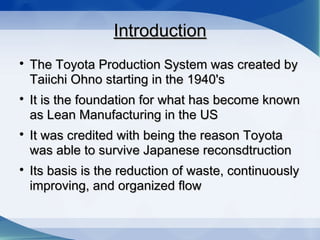
The Toyota Production System was created byThe Toyota Production System was created by
Taiichi Ohno starting in the 1940'sTaiichi Ohno starting in the 1940's

It is the foundation for what has become knownIt is the foundation for what has become known
as Lean Manufacturing in the USas Lean Manufacturing in the US

It was credited with being the reason ToyotaIt was credited with being the reason Toyota
was able to survive Japanese reconsdtructionwas able to survive Japanese reconsdtruction

Its basis is the reduction of waste, continuouslyIts basis is the reduction of waste, continuously
improving, and organized flowimproving, and organized flow
The Main AspectsThe Main Aspects

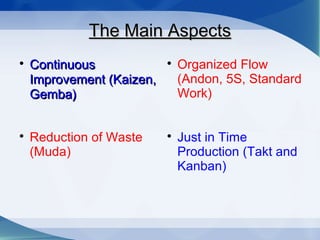
ContinuousContinuous
Improvement (Kaizen,Improvement (Kaizen,
Gemba)Gemba)

Organized Flow
(Andon, 5S, Standard
Work)

Just in Time
Production (Takt and
Kanban)

Reduction of Waste
(Muda)
Continuous ImprovementContinuous Improvement

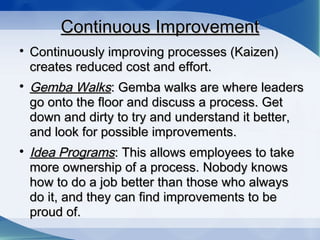
Continuously improving processes (Kaizen)Continuously improving processes (Kaizen)
creates reduced cost and effort.creates reduced cost and effort.

Gemba WalksGemba Walks: Gemba walks are where leaders: Gemba walks are where leaders
go onto the floor and discuss a process. Getgo onto the floor and discuss a process. Get
down and dirty to try and understand it better,down and dirty to try and understand it better,
and look for possible improvements.and look for possible improvements.

Idea ProgramsIdea Programs: This allows employees to take: This allows employees to take
more ownership of a process. Nobody knowsmore ownership of a process. Nobody knows
how to do a job better than those who alwayshow to do a job better than those who always
do it, and they can find improvements to bedo it, and they can find improvements to be
proud of.proud of.
Ideas for ImplementationIdeas for Implementation

Create an idea program for in processCreate an idea program for in process
employees.employees.

Require management to learn processes toRequire management to learn processes to
look for improvement.look for improvement.

Do mixed Kaizen Events with both lower levelDo mixed Kaizen Events with both lower level
and upper level employees to analyze aand upper level employees to analyze a
process for improvement/ waste reducingprocess for improvement/ waste reducing
ideas.ideas.
Organized FlowOrganized Flow

5S5S: Sort, Set in Order, Shine, Standardize,: Sort, Set in Order, Shine, Standardize,
Sustain. This creates an organized workplaceSustain. This creates an organized workplace
with little misplacement, and easliy spotablewith little misplacement, and easliy spotable
defects.defects.

AndonAndon: This is a method for immediately: This is a method for immediately
alerting management or downsteam processesalerting management or downsteam processes
of a problem. It normally consists of a warningof a problem. It normally consists of a warning
light.light.

Standard WorkStandard Work: Standardizing work makes: Standardizing work makes
work more memorizable and creates lesswork more memorizable and creates less
variation/defects.variation/defects.
Ideas for ImplementationIdeas for Implementation

Create a standard location for all tools andCreate a standard location for all tools and
supplies.supplies.

Create a beacon or email notification system forCreate a beacon or email notification system for
alerting the rest of the team of problems.alerting the rest of the team of problems.

The Japanese set aside time for cleaning andThe Japanese set aside time for cleaning and
organizing, this lets everyone get together, getorganizing, this lets everyone get together, get
everything organized, and gets people closer toeverything organized, and gets people closer to
the ground level to spot defects.the ground level to spot defects.
Reduction of The 7 WastesReduction of The 7 Wastes
One of the mainOne of the main
purposes ofpurposes of
TPS/Lean isTPS/Lean is
reduction of the 7reduction of the 7
wastes (muda). Anywastes (muda). Any
reduction of overusereduction of overuse
is considered anis considered an
improvement on aimprovement on a
process. Essentially,process. Essentially,
how will each piece orhow will each piece or
action influence theaction influence the
customer?customer?

Overtransportation

Overinventory/Supply

Motion

Waiting/ Waste of
Time

Overproduction

Over Processing &
Unnecissary Actions

Defects
Ideas for ImplementationIdeas for Implementation

What supplies do you have to many of for thatWhat supplies do you have to many of for that
days work?days work?

Who has to move around/ work the hardest inWho has to move around/ work the hardest in
their process? Is it taking them more time?their process? Is it taking them more time?

Is every piece and process REALLY benefittingIs every piece and process REALLY benefitting
the customer?the customer?

Some companies don't have chairs, as itSome companies don't have chairs, as it
requires more motion, and standing/stretchingrequires more motion, and standing/stretching
while at a desk allows clearer thought andwhile at a desk allows clearer thought and
ideas (thats why you have your best ideas inideas (thats why you have your best ideas in
the shower!)the shower!)
Just in Time ProductionJust in Time Production
Timing is everything. By making goods as theyTiming is everything. By making goods as they
are ordered or only creating buffers of what youare ordered or only creating buffers of what you
KNOW will need to be shipped, you can reduceKNOW will need to be shipped, you can reduce
production hours, reduce storage space (andproduction hours, reduce storage space (and
therefore costs), and reduce the costs of parts.therefore costs), and reduce the costs of parts.
Many companies take this further by creating aMany companies take this further by creating a
rate for employee to benchmark how muchrate for employee to benchmark how much
work should be done in a given time. This waywork should be done in a given time. This way
you can standardize output and see whosyou can standardize output and see whos
working hard!working hard!
Ideas for ImplementationIdeas for Implementation

Create rates that employees must meet. ThisCreate rates that employees must meet. This
will let you know how much you can produce inwill let you know how much you can produce in
a given time.a given time.

Create a organize resupply structure. OnlyCreate a organize resupply structure. Only
resupply when needed, and know how long itresupply when needed, and know how long it
takes to get those supplies (this cuts storagetakes to get those supplies (this cuts storage
and buying costs).and buying costs).

Resupply Cards (Kanban cards) can be used,Resupply Cards (Kanban cards) can be used,
or automatic low inventory emails will work.or automatic low inventory emails will work.
Then you never run out, but never keep tooThen you never run out, but never keep too
much!much!

Lean Into Kaizen

  • 1.
    Lean into KaizenLeaninto Kaizen An introduction to theAn introduction to the Toyota Production SystemToyota Production System And Lean ProductionAnd Lean Production
  • 2.
    IntroductionIntroduction  The Toyota ProductionSystem was created byThe Toyota Production System was created by Taiichi Ohno starting in the 1940'sTaiichi Ohno starting in the 1940's  It is the foundation for what has become knownIt is the foundation for what has become known as Lean Manufacturing in the USas Lean Manufacturing in the US  It was credited with being the reason ToyotaIt was credited with being the reason Toyota was able to survive Japanese reconsdtructionwas able to survive Japanese reconsdtruction  Its basis is the reduction of waste, continuouslyIts basis is the reduction of waste, continuously improving, and organized flowimproving, and organized flow
  • 3.
    The Main AspectsTheMain Aspects  ContinuousContinuous Improvement (Kaizen,Improvement (Kaizen, Gemba)Gemba)  Organized Flow (Andon, 5S, Standard Work)  Just in Time Production (Takt and Kanban)  Reduction of Waste (Muda)
  • 4.
    Continuous ImprovementContinuous Improvement  Continuouslyimproving processes (Kaizen)Continuously improving processes (Kaizen) creates reduced cost and effort.creates reduced cost and effort.  Gemba WalksGemba Walks: Gemba walks are where leaders: Gemba walks are where leaders go onto the floor and discuss a process. Getgo onto the floor and discuss a process. Get down and dirty to try and understand it better,down and dirty to try and understand it better, and look for possible improvements.and look for possible improvements.  Idea ProgramsIdea Programs: This allows employees to take: This allows employees to take more ownership of a process. Nobody knowsmore ownership of a process. Nobody knows how to do a job better than those who alwayshow to do a job better than those who always do it, and they can find improvements to bedo it, and they can find improvements to be proud of.proud of.
  • 5.
    Ideas for ImplementationIdeasfor Implementation  Create an idea program for in processCreate an idea program for in process employees.employees.  Require management to learn processes toRequire management to learn processes to look for improvement.look for improvement.  Do mixed Kaizen Events with both lower levelDo mixed Kaizen Events with both lower level and upper level employees to analyze aand upper level employees to analyze a process for improvement/ waste reducingprocess for improvement/ waste reducing ideas.ideas.
  • 6.
    Organized FlowOrganized Flow  5S5S:Sort, Set in Order, Shine, Standardize,: Sort, Set in Order, Shine, Standardize, Sustain. This creates an organized workplaceSustain. This creates an organized workplace with little misplacement, and easliy spotablewith little misplacement, and easliy spotable defects.defects.  AndonAndon: This is a method for immediately: This is a method for immediately alerting management or downsteam processesalerting management or downsteam processes of a problem. It normally consists of a warningof a problem. It normally consists of a warning light.light.  Standard WorkStandard Work: Standardizing work makes: Standardizing work makes work more memorizable and creates lesswork more memorizable and creates less variation/defects.variation/defects.
  • 7.
    Ideas for ImplementationIdeasfor Implementation  Create a standard location for all tools andCreate a standard location for all tools and supplies.supplies.  Create a beacon or email notification system forCreate a beacon or email notification system for alerting the rest of the team of problems.alerting the rest of the team of problems.  The Japanese set aside time for cleaning andThe Japanese set aside time for cleaning and organizing, this lets everyone get together, getorganizing, this lets everyone get together, get everything organized, and gets people closer toeverything organized, and gets people closer to the ground level to spot defects.the ground level to spot defects.
  • 8.
    Reduction of The7 WastesReduction of The 7 Wastes One of the mainOne of the main purposes ofpurposes of TPS/Lean isTPS/Lean is reduction of the 7reduction of the 7 wastes (muda). Anywastes (muda). Any reduction of overusereduction of overuse is considered anis considered an improvement on aimprovement on a process. Essentially,process. Essentially, how will each piece orhow will each piece or action influence theaction influence the customer?customer?  Overtransportation  Overinventory/Supply  Motion  Waiting/ Waste of Time  Overproduction  Over Processing & Unnecissary Actions  Defects
  • 9.
    Ideas for ImplementationIdeasfor Implementation  What supplies do you have to many of for thatWhat supplies do you have to many of for that days work?days work?  Who has to move around/ work the hardest inWho has to move around/ work the hardest in their process? Is it taking them more time?their process? Is it taking them more time?  Is every piece and process REALLY benefittingIs every piece and process REALLY benefitting the customer?the customer?  Some companies don't have chairs, as itSome companies don't have chairs, as it requires more motion, and standing/stretchingrequires more motion, and standing/stretching while at a desk allows clearer thought andwhile at a desk allows clearer thought and ideas (thats why you have your best ideas inideas (thats why you have your best ideas in the shower!)the shower!)
  • 10.
    Just in TimeProductionJust in Time Production Timing is everything. By making goods as theyTiming is everything. By making goods as they are ordered or only creating buffers of what youare ordered or only creating buffers of what you KNOW will need to be shipped, you can reduceKNOW will need to be shipped, you can reduce production hours, reduce storage space (andproduction hours, reduce storage space (and therefore costs), and reduce the costs of parts.therefore costs), and reduce the costs of parts. Many companies take this further by creating aMany companies take this further by creating a rate for employee to benchmark how muchrate for employee to benchmark how much work should be done in a given time. This waywork should be done in a given time. This way you can standardize output and see whosyou can standardize output and see whos working hard!working hard!
  • 11.
    Ideas for ImplementationIdeasfor Implementation  Create rates that employees must meet. ThisCreate rates that employees must meet. This will let you know how much you can produce inwill let you know how much you can produce in a given time.a given time.  Create a organize resupply structure. OnlyCreate a organize resupply structure. Only resupply when needed, and know how long itresupply when needed, and know how long it takes to get those supplies (this cuts storagetakes to get those supplies (this cuts storage and buying costs).and buying costs).  Resupply Cards (Kanban cards) can be used,Resupply Cards (Kanban cards) can be used, or automatic low inventory emails will work.or automatic low inventory emails will work. Then you never run out, but never keep tooThen you never run out, but never keep too much!much!