Lean Manufacturing Takeaways SCLC / ECC Spring Meeting April 26 th , 2007
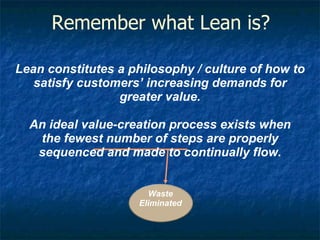
Waste Eliminated Lean constitutes a philosophy / culture of how to satisfy customers’ increasing demands for greater value. An ideal value-creation process exists when the fewest number of steps are properly sequenced and made to continually flow. Remember what Lean is?
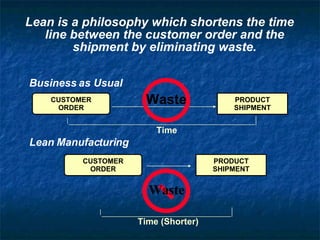
PRODUCT SHIPMENT CUSTOMER ORDER Lean is a philosophy which shortens the time line between the customer order and the shipment by eliminating waste. Time Business as Usual Lean Manufacturing PRODUCT SHIPMENT CUSTOMER ORDER Time (Shorter) Waste Waste
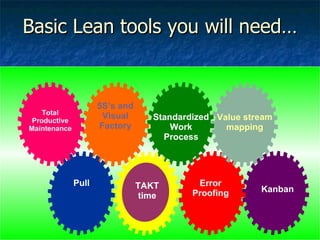
Basic Lean tools you will need… Kanban 5S’s and Visual Factory Pull Standardized Work Process TAKT time Error Proofing Value stream mapping Total Productive Maintenance
Implementing Lean - Leadership An  inspired  leader at the top is required, somebody who takes responsibility for change. Operating managers need continual education and assessment to assure no backsliding. Change agent has to fully understand Lean Thinking . Remove the anchor draggers early. Small groups who simply can not accept new ideas. Make sure Upper Management drives the initiative. (Top Down approach is essential).
No cookie cutter approach; needs to take into account current culture, resources, etc. Look upstream and downstream. Include entire organization (at some point in time). Emphasize that lean is a process, don’t try to jump to an end solution. Focus on culture, not tools. Listen to consultant’s ideas and adapt them to your needs.  Don’t follow all recipes exactly as presented. Implementing Lean - Organization
A plan for lean is like a 1 year forecast. So the process needs frequent modification. Adapt tools as needed. Don’t force the use of a tool if there is no need. Create a Lean accounting system (ABC is of great help) around value stream costing. You still need financial accounting for GAAP requirements. Adjust metrics to support new culture. Implementing Lean - Organization
Focus on matching execution & resources to capabilities. Careful with taking in too much. Mapping  processes raise awareness about current states and spark new ideas to improve. Involve & inform all the stakeholders from the bottom up. Make small incremental changes constantly rather than one time change.  Communicate the plan with clarity to all employees. Implementing Lean - Execution
Focus on results (key metrics)… Get data for the last 5 years. Benchmark your plant against the best plants worldwide. Compare your results against your own history. If there is no perceived urgent need, people will not perceive the need to change and will not change. Create scorecard to measure baseline metrics. Set goals and  time frames  for success criteria. Implementing Lean – Goal Setting
Have a communication strategy that includes: Mechanism to keep everyone informed. Mechanism to handle improvement ideas. Establish Roles and Responsibilities clearly.  Audit the compliance of the roles and responsibilities. Teams must have authority and resources to exist. Establish PBL process for teams to structure proper meetings, to set accountability and focus on metrics. When designing work groups, try to have small teams. Implementing Lean – People
Certify your staff on Lean Management techniques, prior to implementation. Spread lean techniques through intensive training across staff level. Cross train employees before implementation of module. Train personnel on “soft skills” prior to the start of the pilot. Implementing Lean – Training
Have a well defined group compensation system in place before implementation.   Pay system has to achieve behavioral changes that impact bottom line business results. Manage new pay system. Include indirects in your compensation scheme. Set non-monetary reward systems as well. Implementing Lean – Compensation
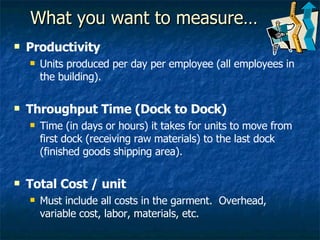
What you want to measure… Productivity  Units produced per day per employee (all employees in the building). Throughput Time (Dock to Dock) Time (in days or hours) it takes for units to move from first dock (receiving raw materials) to the last dock (finished goods shipping area). Total Cost / unit Must include all costs in the garment.  Overhead, variable cost, labor, materials, etc.
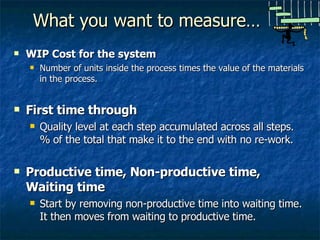
What you want to measure… WIP Cost for the system Number of units inside the process times the value of the materials in the process. First time through Quality level at each step accumulated across all steps.  % of the total that make it to the end with no re-work. Productive time, Non-productive time, Waiting time Start by removing non-productive time into waiting time.  It then moves from waiting to productive time.
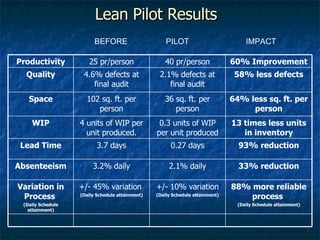
Lean Pilot Results BEFORE PILOT IMPACT 88% more reliable process  (Daily Schedule attainment) +/- 10% variation (Daily Schedule attainment) +/- 45% variation  (Daily Schedule attainment) Variation in Process  (Daily Schedule attainment) 33% reduction 2.1% daily 3.2% daily Absenteeism 13 times less units in inventory 0.3 units of WIP per unit produced 4 units of WIP per unit produced. WIP 93% reduction 0.27 days 3.7 days Lead Time 64% less sq. ft. per person 36 sq. ft. per person 102 sq. ft. per person Space 58% less defects 2.1% defects at final audit 4.6% defects at final audit Quality 60% Improvement 40 pr/person 25 pr/person Productivity
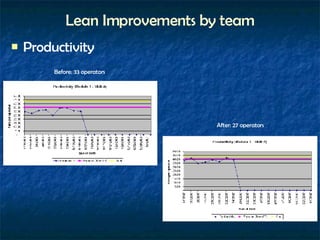
Lean Improvements by team Productivity Before: 33 operators After: 27 operators
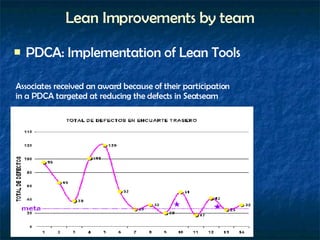
PDCA: Implementation of Lean Tools Associates received an award because of their participation in a PDCA targeted at reducing the defects in Seatseam Lean Improvements by team
Evidence of Progress toward Lean Increased capacity Higher inventory turns More available floor space Improved workplace organization Improved quality: reduced scrap / re-work Reduced inventories: raw, WIP, FG Reduced lead times Greater gross margin Improved participation & morale
Lean resources www.lean.org www.productivityinc.com www.productivitypress.com www.leanadvisors.com

Lean Mfg Takeawayssharing

  • 1.
    Lean Manufacturing TakeawaysSCLC / ECC Spring Meeting April 26 th , 2007
  • 2.
    Waste Eliminated Leanconstitutes a philosophy / culture of how to satisfy customers’ increasing demands for greater value. An ideal value-creation process exists when the fewest number of steps are properly sequenced and made to continually flow. Remember what Lean is?
  • 3.
    PRODUCT SHIPMENT CUSTOMERORDER Lean is a philosophy which shortens the time line between the customer order and the shipment by eliminating waste. Time Business as Usual Lean Manufacturing PRODUCT SHIPMENT CUSTOMER ORDER Time (Shorter) Waste Waste
  • 4.
    Basic Lean toolsyou will need… Kanban 5S’s and Visual Factory Pull Standardized Work Process TAKT time Error Proofing Value stream mapping Total Productive Maintenance
  • 5.
    Implementing Lean -Leadership An inspired leader at the top is required, somebody who takes responsibility for change. Operating managers need continual education and assessment to assure no backsliding. Change agent has to fully understand Lean Thinking . Remove the anchor draggers early. Small groups who simply can not accept new ideas. Make sure Upper Management drives the initiative. (Top Down approach is essential).
  • 6.
    No cookie cutterapproach; needs to take into account current culture, resources, etc. Look upstream and downstream. Include entire organization (at some point in time). Emphasize that lean is a process, don’t try to jump to an end solution. Focus on culture, not tools. Listen to consultant’s ideas and adapt them to your needs. Don’t follow all recipes exactly as presented. Implementing Lean - Organization
  • 7.
    A plan forlean is like a 1 year forecast. So the process needs frequent modification. Adapt tools as needed. Don’t force the use of a tool if there is no need. Create a Lean accounting system (ABC is of great help) around value stream costing. You still need financial accounting for GAAP requirements. Adjust metrics to support new culture. Implementing Lean - Organization
  • 8.
    Focus on matchingexecution & resources to capabilities. Careful with taking in too much. Mapping processes raise awareness about current states and spark new ideas to improve. Involve & inform all the stakeholders from the bottom up. Make small incremental changes constantly rather than one time change. Communicate the plan with clarity to all employees. Implementing Lean - Execution
  • 9.
    Focus on results(key metrics)… Get data for the last 5 years. Benchmark your plant against the best plants worldwide. Compare your results against your own history. If there is no perceived urgent need, people will not perceive the need to change and will not change. Create scorecard to measure baseline metrics. Set goals and time frames for success criteria. Implementing Lean – Goal Setting
  • 10.
    Have a communicationstrategy that includes: Mechanism to keep everyone informed. Mechanism to handle improvement ideas. Establish Roles and Responsibilities clearly. Audit the compliance of the roles and responsibilities. Teams must have authority and resources to exist. Establish PBL process for teams to structure proper meetings, to set accountability and focus on metrics. When designing work groups, try to have small teams. Implementing Lean – People
  • 11.
    Certify your staffon Lean Management techniques, prior to implementation. Spread lean techniques through intensive training across staff level. Cross train employees before implementation of module. Train personnel on “soft skills” prior to the start of the pilot. Implementing Lean – Training
  • 12.
    Have a welldefined group compensation system in place before implementation. Pay system has to achieve behavioral changes that impact bottom line business results. Manage new pay system. Include indirects in your compensation scheme. Set non-monetary reward systems as well. Implementing Lean – Compensation
  • 13.
    What you wantto measure… Productivity Units produced per day per employee (all employees in the building). Throughput Time (Dock to Dock) Time (in days or hours) it takes for units to move from first dock (receiving raw materials) to the last dock (finished goods shipping area). Total Cost / unit Must include all costs in the garment. Overhead, variable cost, labor, materials, etc.
  • 14.
    What you wantto measure… WIP Cost for the system Number of units inside the process times the value of the materials in the process. First time through Quality level at each step accumulated across all steps. % of the total that make it to the end with no re-work. Productive time, Non-productive time, Waiting time Start by removing non-productive time into waiting time. It then moves from waiting to productive time.
  • 15.
    Lean Pilot ResultsBEFORE PILOT IMPACT 88% more reliable process (Daily Schedule attainment) +/- 10% variation (Daily Schedule attainment) +/- 45% variation (Daily Schedule attainment) Variation in Process (Daily Schedule attainment) 33% reduction 2.1% daily 3.2% daily Absenteeism 13 times less units in inventory 0.3 units of WIP per unit produced 4 units of WIP per unit produced. WIP 93% reduction 0.27 days 3.7 days Lead Time 64% less sq. ft. per person 36 sq. ft. per person 102 sq. ft. per person Space 58% less defects 2.1% defects at final audit 4.6% defects at final audit Quality 60% Improvement 40 pr/person 25 pr/person Productivity
  • 16.
    Lean Improvements byteam Productivity Before: 33 operators After: 27 operators
  • 17.
    PDCA: Implementation ofLean Tools Associates received an award because of their participation in a PDCA targeted at reducing the defects in Seatseam Lean Improvements by team
  • 18.
    Evidence of Progresstoward Lean Increased capacity Higher inventory turns More available floor space Improved workplace organization Improved quality: reduced scrap / re-work Reduced inventories: raw, WIP, FG Reduced lead times Greater gross margin Improved participation & morale
  • 19.
    Lean resources www.lean.orgwww.productivityinc.com www.productivitypress.com www.leanadvisors.com