Lean Project Management Superfactory ®  Lean Enterprise Series
Agenda Introduction The Seven Principals The Difference of a Lean Project  Lean Project Framework Implementation Summary
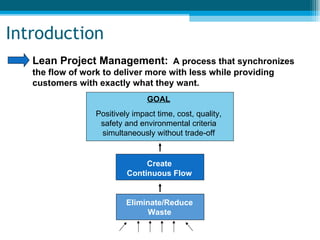
Introduction Lean Project Management:   A process that synchronizes the flow of work to deliver more with less while providing customers with exactly what they want. GOAL Positively impact time, cost, quality, safety and environmental criteria simultaneously without trade-off Create Continuous Flow Eliminate/Reduce Waste
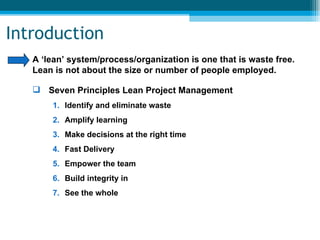
Introduction A ‘lean’ system/process/organization is one that is waste free.  Lean is not about the size or number of people employed. Seven Principles Lean Project Management Identify and eliminate waste Amplify learning Make decisions at the right time Fast Delivery Empower the team Build integrity in See the whole
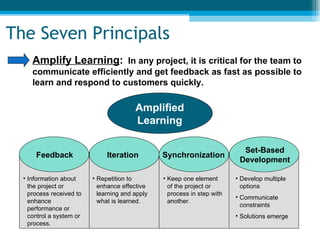
Amplify Learning :   In any project, it is critical for the team to communicate efficiently and get feedback as fast as possible to learn and respond to customers quickly. Amplified Learning Feedback Iteration Synchronization Set-Based Development Information about the project or process received to enhance performance or control a system or process.  Repetition to enhance effective learning and apply what is learned. Keep one element of the project or process in step with another. Develop multiple options Communicate constraints Solutions emerge The Seven Principals
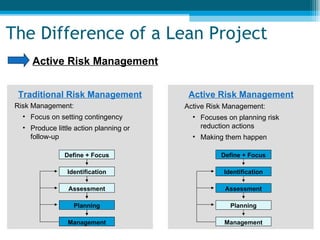
Active Risk Management Traditional Risk Management Active Risk Management Risk Management: Focus on setting contingency Produce little action planning or follow-up Active Risk Management: Focuses on planning risk reduction actions Making them happen The Difference of a Lean Project Define + Focus Identification Assessment Planning Management Define + Focus Identification Assessment Planning Management
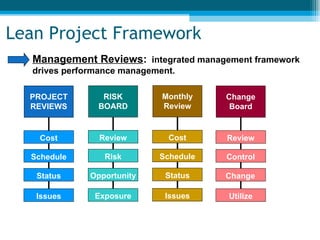
Management Reviews :   integrated management framework drives performance management. Lean Project Framework PROJECT REVIEWS Cost Schedule Status Issues RISK BOARD Review Risk Opportunity Exposure Monthly Review Cost Schedule Status Issues Change Board Review Control Change Utilize
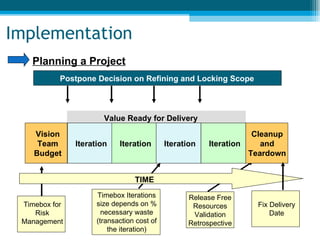
Planning a Project Implementation Postpone Decision on Refining and Locking Scope Vision Team Budget Iteration Iteration Iteration Iteration Cleanup and Teardown TIME Value Ready for Delivery Timebox for Risk Management Timebox Iterations size depends on % necessary waste (transaction cost of the iteration) Release Free Resources Validation Retrospective Fix Delivery Date

Lean Project Management Sample

  • 1.
    Lean Project ManagementSuperfactory ® Lean Enterprise Series
  • 2.
    Agenda Introduction TheSeven Principals The Difference of a Lean Project Lean Project Framework Implementation Summary
  • 3.
    Introduction Lean ProjectManagement: A process that synchronizes the flow of work to deliver more with less while providing customers with exactly what they want. GOAL Positively impact time, cost, quality, safety and environmental criteria simultaneously without trade-off Create Continuous Flow Eliminate/Reduce Waste
  • 4.
    Introduction A ‘lean’system/process/organization is one that is waste free. Lean is not about the size or number of people employed. Seven Principles Lean Project Management Identify and eliminate waste Amplify learning Make decisions at the right time Fast Delivery Empower the team Build integrity in See the whole
  • 5.
    Amplify Learning : In any project, it is critical for the team to communicate efficiently and get feedback as fast as possible to learn and respond to customers quickly. Amplified Learning Feedback Iteration Synchronization Set-Based Development Information about the project or process received to enhance performance or control a system or process. Repetition to enhance effective learning and apply what is learned. Keep one element of the project or process in step with another. Develop multiple options Communicate constraints Solutions emerge The Seven Principals
  • 6.
    Active Risk ManagementTraditional Risk Management Active Risk Management Risk Management: Focus on setting contingency Produce little action planning or follow-up Active Risk Management: Focuses on planning risk reduction actions Making them happen The Difference of a Lean Project Define + Focus Identification Assessment Planning Management Define + Focus Identification Assessment Planning Management
  • 7.
    Management Reviews : integrated management framework drives performance management. Lean Project Framework PROJECT REVIEWS Cost Schedule Status Issues RISK BOARD Review Risk Opportunity Exposure Monthly Review Cost Schedule Status Issues Change Board Review Control Change Utilize
  • 8.
    Planning a ProjectImplementation Postpone Decision on Refining and Locking Scope Vision Team Budget Iteration Iteration Iteration Iteration Cleanup and Teardown TIME Value Ready for Delivery Timebox for Risk Management Timebox Iterations size depends on % necessary waste (transaction cost of the iteration) Release Free Resources Validation Retrospective Fix Delivery Date