Your Agenda is our Agenda….
Course Topics
 Introduction to Business Process Management (BPM).
 What is BPM?
 Core Components of BPM.
 What You Need to Know to Implement and Operate a
Successful BPM Program.
 Tools that Supports BPM.
 Summary.
© Metaspire LLC All Rights Reserved.
2
Introduction
 Business process management (BPM) is a management approach focused on
aligning all aspects of an organization with the wants and needs of clients. It is a
holistic management approach [1] that promotes business effectiveness and
efficiency while striving for innovation, flexibility, and integration with technology.
Business process management attempts to improve processes continuously. It
could therefore be described as a "process optimization process." It is argued that
BPM enables organizations to be more efficient, more effective and more capable
of change than a functionally focused, traditional hierarchical management
approach. – Wiki
 Business process management provides governance of a business's process
environment to improve agility and operational performance. – Gartner Group
 BPM: the discipline that improves measurable business performance for
stakeholders, through ongoing optimization and synchronization of enterprise-
wide process capabilities. – The BPM Group
© Metaspire LLC All Rights Reserved.
3
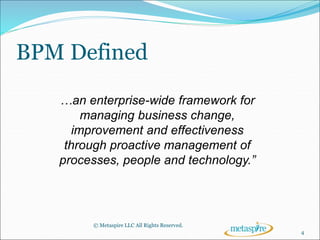
BPM Defined
© Metaspire LLC All Rights Reserved.
…an enterprise-wide framework for
managing business change,
improvement and effectiveness
through proactive management of
processes, people and technology.”
4
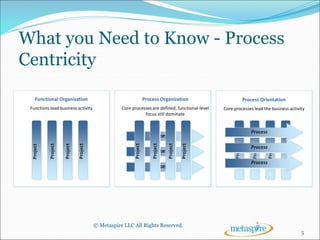
What you Need to Know - Process
Centricity
Project
Project
Project
Project
Functional Organization
Functions lead business activity
Process
Process
ProcessProject
Project
Project
Project
Process Organization
Core processes are defined; functional-level
focus still dominate
Project
Project
Project
Project
Process
Process
Process
Process Orientation
Core processes lead the business activity
© Metaspire LLC All Rights Reserved.
5
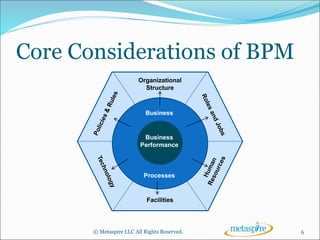
Core Considerations of BPM
Organizational
Structure
Facilities
Business
Processes
Business
Performance
© Metaspire LLC All Rights Reserved. 6
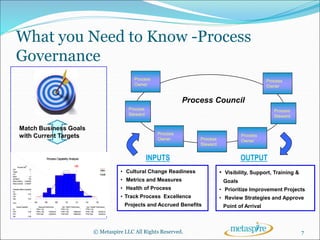
What you Need to Know -Process
Governance
Process
Owner
Process
Steward
Process
Steward
Process
Steward
Process
Owner
Process
Owner
Process
Owner
Process Council
Match Business Goals
with Current Targets
• Cultural Change Readiness
• Metrics and Measures
• Health of Process
• Track Process Excellence
Projects and Accrued Benefits
• Visibility, Support, Training &
Goals
• Prioritize Improvement Projects
• Review Strategies and Approve
Point of Arrival
INPUTS OUTPUT
© Metaspire LLC All Rights Reserved. 7
1.61.41.21.00.80.60.4
USLUSL
Process Capability Analysis
PPMTotal
PPM>USL
PPM<LSL
PPMTotal
PPM>USL
PPM<LSL
PPMTotal
PPM>USL
PPM<LSL
Ppk
PPL
PPU
Pp
Cpm
Cpk
CPL
CPU
Cp
StDev(Overall)
StDev(Within)
Sample N
Mean
LSL
Target
USL
140436.23
140436.23
*
158655.26
158655.26
*
130000.00
130000.00
*
0.36
*
0.36
*
*
0.33
*
0.33
*
0.185467
0.200000
100
1.0
*
*
1.2
Exp. "Overall" PerformanceExp. "Within" PerformanceObserved PerformanceOverall Capability
Potential(Within) Capability
Process Dat
a
Within
Overall
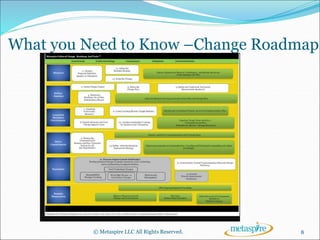
What you Need to Know –Change Roadmap
© Metaspire LLC All Rights Reserved. 8
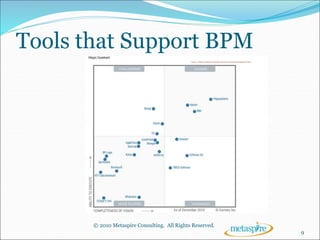
Tools that Support BPM
© 2010 Metaspire Consulting. All Rights Reserved.
9
Summary
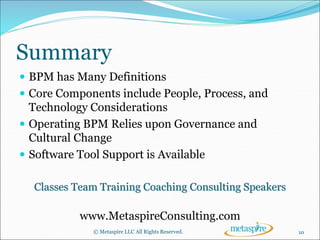
 BPM has Many Definitions
 Core Components include People, Process, and
Technology Considerations
 Operating BPM Relies upon Governance and
Cultural Change
 Software Tool Support is Available
Classes Team Training Coaching Consulting Speakers
www.MetaspireConsulting.com
© Metaspire LLC All Rights Reserved. 10

Bpm teaser

  • 1.
    Your Agenda isour Agenda….
  • 2.
    Course Topics  Introductionto Business Process Management (BPM).  What is BPM?  Core Components of BPM.  What You Need to Know to Implement and Operate a Successful BPM Program.  Tools that Supports BPM.  Summary. © Metaspire LLC All Rights Reserved. 2
  • 3.
    Introduction  Business processmanagement (BPM) is a management approach focused on aligning all aspects of an organization with the wants and needs of clients. It is a holistic management approach [1] that promotes business effectiveness and efficiency while striving for innovation, flexibility, and integration with technology. Business process management attempts to improve processes continuously. It could therefore be described as a "process optimization process." It is argued that BPM enables organizations to be more efficient, more effective and more capable of change than a functionally focused, traditional hierarchical management approach. – Wiki  Business process management provides governance of a business's process environment to improve agility and operational performance. – Gartner Group  BPM: the discipline that improves measurable business performance for stakeholders, through ongoing optimization and synchronization of enterprise- wide process capabilities. – The BPM Group © Metaspire LLC All Rights Reserved. 3
  • 4.
    BPM Defined © MetaspireLLC All Rights Reserved. …an enterprise-wide framework for managing business change, improvement and effectiveness through proactive management of processes, people and technology.” 4
  • 5.
    What you Needto Know - Process Centricity Project Project Project Project Functional Organization Functions lead business activity Process Process ProcessProject Project Project Project Process Organization Core processes are defined; functional-level focus still dominate Project Project Project Project Process Process Process Process Orientation Core processes lead the business activity © Metaspire LLC All Rights Reserved. 5
  • 6.
    Core Considerations ofBPM Organizational Structure Facilities Business Processes Business Performance © Metaspire LLC All Rights Reserved. 6
  • 7.
    What you Needto Know -Process Governance Process Owner Process Steward Process Steward Process Steward Process Owner Process Owner Process Owner Process Council Match Business Goals with Current Targets • Cultural Change Readiness • Metrics and Measures • Health of Process • Track Process Excellence Projects and Accrued Benefits • Visibility, Support, Training & Goals • Prioritize Improvement Projects • Review Strategies and Approve Point of Arrival INPUTS OUTPUT © Metaspire LLC All Rights Reserved. 7 1.61.41.21.00.80.60.4 USLUSL Process Capability Analysis PPMTotal PPM>USL PPM<LSL PPMTotal PPM>USL PPM<LSL PPMTotal PPM>USL PPM<LSL Ppk PPL PPU Pp Cpm Cpk CPL CPU Cp StDev(Overall) StDev(Within) Sample N Mean LSL Target USL 140436.23 140436.23 * 158655.26 158655.26 * 130000.00 130000.00 * 0.36 * 0.36 * * 0.33 * 0.33 * 0.185467 0.200000 100 1.0 * * 1.2 Exp. "Overall" PerformanceExp. "Within" PerformanceObserved PerformanceOverall Capability Potential(Within) Capability Process Dat a Within Overall
  • 8.
    What you Needto Know –Change Roadmap © Metaspire LLC All Rights Reserved. 8
  • 9.
    Tools that SupportBPM © 2010 Metaspire Consulting. All Rights Reserved. 9
  • 10.
    Summary  BPM hasMany Definitions  Core Components include People, Process, and Technology Considerations  Operating BPM Relies upon Governance and Cultural Change  Software Tool Support is Available Classes Team Training Coaching Consulting Speakers www.MetaspireConsulting.com © Metaspire LLC All Rights Reserved. 10

Editor's Notes

  • #3 As we begin this introductory lesson, it is important to understand some key concepts regarding Business Process Management (BPM). This course has been designed to provide a brief overview of these concepts so that you will be able to determine whether you would like to continue a more in-depth education with our formal course. Here, we will review: a common working definition of BPM as a whole the key concepts and practices that comprise BPM critical success factors for setting up and operating an effective BPM program Various software packages that support BPM
  • #4 If we search the Internet or examine a number of books and you’ll find a plethora of definitions of what “BPM” is. For the most part, however, you’ll find a common set of characteristics: A Strategic (not tactical) focus on managing an enterprise “horizontally” by processes instead of “vertical” organizational silos Continuous examination, improvement, and optimization of business functions Ability to realize more agility in changing business functions to meet competitive and regulatory demands A focused and seamless integration with intended automation (IT) support for enabling business functions Synchronization and “handholding” with related competencies such as Organizational Design, Change Management, and Six Sigma Justin, this is the hyperlink location for the “holistic management” text in blue but wasn’t sure if you’d be able to activate the link - http://en.wikipedia.org/wiki/Holism
  • #5 For our purposes, let’s consider a common definition of “BPM” as “…an enterprise-wide framework for managing business change, improvement and effectiveness through proactive management of processes, people, and technology.
  • #6 What you Need to Know - Process Centricity. The graphics on this slide show the movement from vertical to horizontal thinking. In a Functional Organization the focus is on managing people, goals and measures vertically. In a Process Organization, core processes are defined, and the focus still dominates on a project level. In Process Orientation focuses on continuously improving processes end to end and maintaining a Process Improvement mind set horizontally. At the core framework for BPM is the notion of management of business processes. But what does this mean in the real world? First, unlike organizational hierarchies, a key mantra of BPM is the management of “horizontal” business processes. That is, business functions that span organizational boundaries in order to achieve the end objective of service excellence in customer “moments of truth”’ (those points at which the business process interacts with a customer). As you can probably tell, this orientation of process centricity differs immensely from the hierarchical, smoke-stack management of processes that occur only within one’s organizational boundaries. As a company’s BPM efforts begin, typically functions are managed vertically within organizations…even though those exact processes comprise higher level functions that in turn cross organizational boundaries. You will then notice that a company will begin to define its core processes, say “Sell Passenger Seats” or “Operate Flight Schedule” for an airline. These major functions clearly cross organizational boundaries and require excellence at literally hundreds of customer touch points. Yet still, improvement efforts can continue to be managed vertically. Not until an organization matures to see that business processes DRIVE operational excellence and achievement of key metrics will a company realize the true framework of BPM. Although Process Orientation is a higher evolution of how work is being done and is independent of methodology; process management will tweak or change, structure, tools, measures and rewards in order to support the process orientation environment thus improving overall end to end process performance.
  • #7 The over-arching goal that guides BPM can be collectively considered “improved business performance”. This can be defined in many ways – ability to meet competitive pressures quicker and better; enabling cost advantages over competitors; ability to produce more with less resources, improved adherence to regulatory rules, and the list goes on… The implications of this definition are more far-reaching: we must understand the inter-relationships between business process orientation and management - and those competencies and capabilities with which the core of the business processes interact. Such competencies as policies, rules, technology, organizational structure and the like all play a part in an effectively integrated BPM framework.
  • #8 Effective BPM requires effective process governance…it’s that simple. Many organizations pursue BPM initiatives, yet lack the fortitude to enable and conduct the governance of those same processes they truly wish to improve. This is a recipe for failure. Process owners must be accountable for their end-to-end processes and realization of desired improved metrics and KPI’s. This is a core foundational tenant of a sound BPM program. In an ever-evolving process organization, the process owners continually monitor and actively improve their business functions. Governance processes and procedures are implemented to enable this active management. Rewards and consequences align with goal achievement, problem resolution, and key metric and KPI achievement.
  • #9 Change Management is a mindset, a series of techniques designed to: Ensure that human variables are addressed and Ensure changes are managed into a positive history At Metaspire we use this cultural change roadmap to guide us through the BPM process. The cultural change tools in this roadmap are designed to assist Process-Focused Professionals in leading organizational change leveraging business process management and six sigma disciplines. This roadmap can be customized to launch a Process Excellence mindset within the organization. The purpose of this roadmap is to gain leadership and target support. It ties the Voice of the "Customer" (internal Customer or otherwise) with that of the Employees (targets) performing the work.
  • #10 There are a variety of companies that support business process management. It’s important to note that some companies view BPM as primarily a set of technology used to enable automated execution of business processes. This orientation results in selection of tools that are primarily driven by a decision-making process focused on technology solutions. Other companies, in addition to BPM execution engines, offer tool sets that support Business and Enterprise Architecture development. These tools provide the ability to develop comprehensive models of business operations from both business and technology perspectives. They tend to drive business decision-making and simulation of business processes independent of technology implementations.
  • #11 This introductory session provided a basic overview of BPM, its fundamental concepts and things you need to know to implement and operate a BPM program. Obviously there is much more to cover to gain a full understanding of BPM. We invite you to enroll in our online BPM seminar series to learn more.