Leadership 12- © 2009 Prentice-Hall Inc.  All rights reserved.
Chapter Learning Objectives After studying this chapter, you should be able to: Define leadership and contrast leadership and management. Summarize the conclusions of trait theories. Identify the central tenets and main limitations of behavioral theories. Assess contingency theories of leadership by their level of support. Contrast the interactive theories (path-goal and leader-member exchange). Identify the situational variables in the leader-participation model. Show how U.S. managers might need to adjust their leadership approaches in Brazil, France, Egypt, and China. © 2009 Prentice-Hall Inc.  All rights reserved. 12-
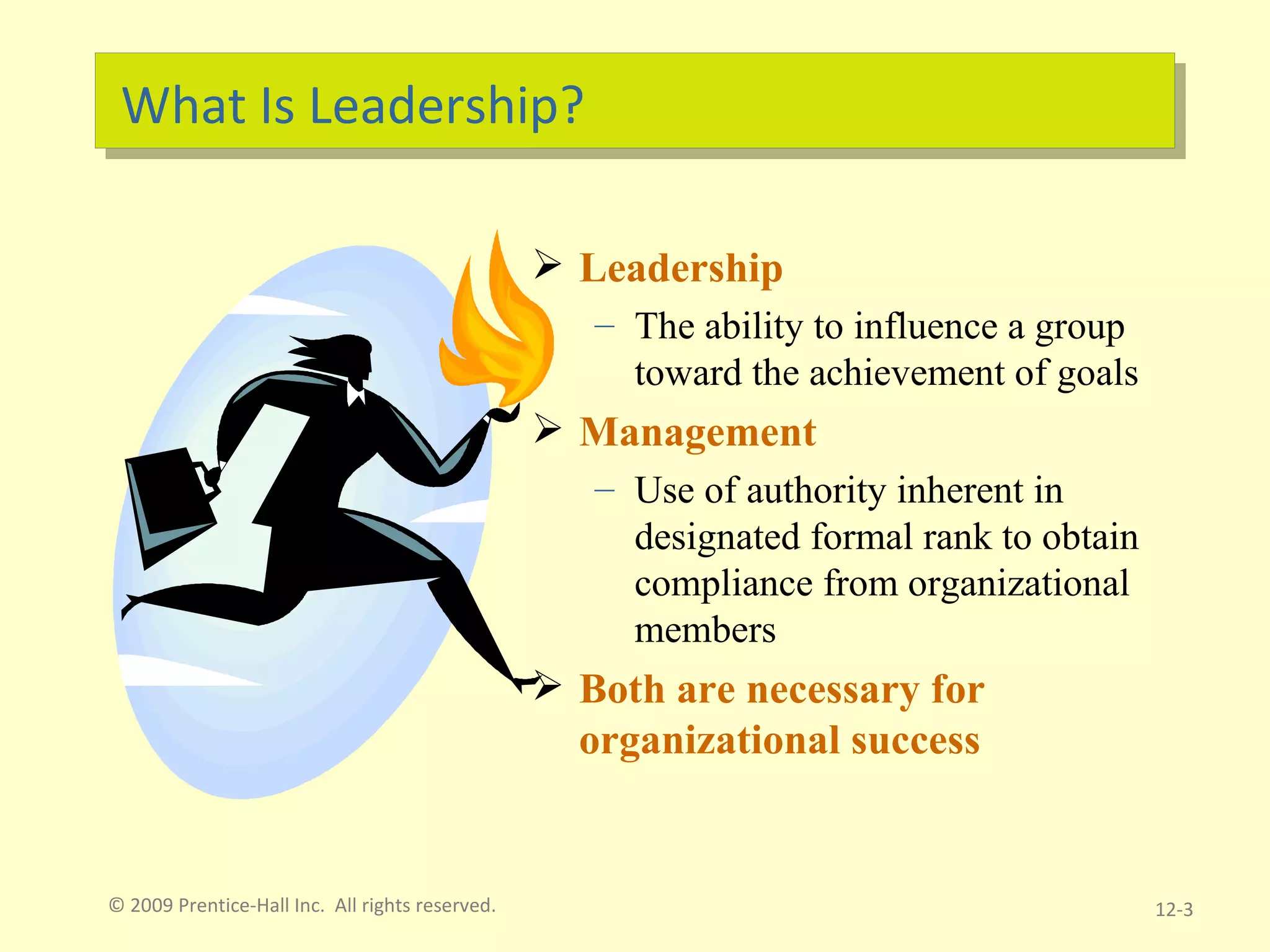
What Is Leadership? Leadership The ability to influence a group toward the achievement of goals Management Use of authority inherent in designated formal rank to obtain compliance from organizational members Both are necessary for organizational success © 2009 Prentice-Hall Inc.  All rights reserved. 12-
Trait Theories of Leadership Theories that consider personality, social, physical, or intellectual traits to differentiate leaders from nonleaders Not very useful until matched with the Big Five Personality Framework Leadership Traits Extroversion Conscientiousness Openness  Emotional Intelligence (Qualified)  Traits can predict leadership, but they are better at predicting leader emergence than effectiveness. © 2009 Prentice-Hall Inc.  All rights reserved. 12-
Behavioral Theories of Leadership Theories proposing that specific behaviors differentiate leaders from nonleaders Differences between theories of leadership: Trait theory: leadership is inherent, so we must identify the leader based on his or her traits Behavioral theory: leadership is a skill set and can be taught to anyone, so we must identify the proper behaviors to teach potential leaders © 2009 Prentice-Hall Inc.  All rights reserved. 12-
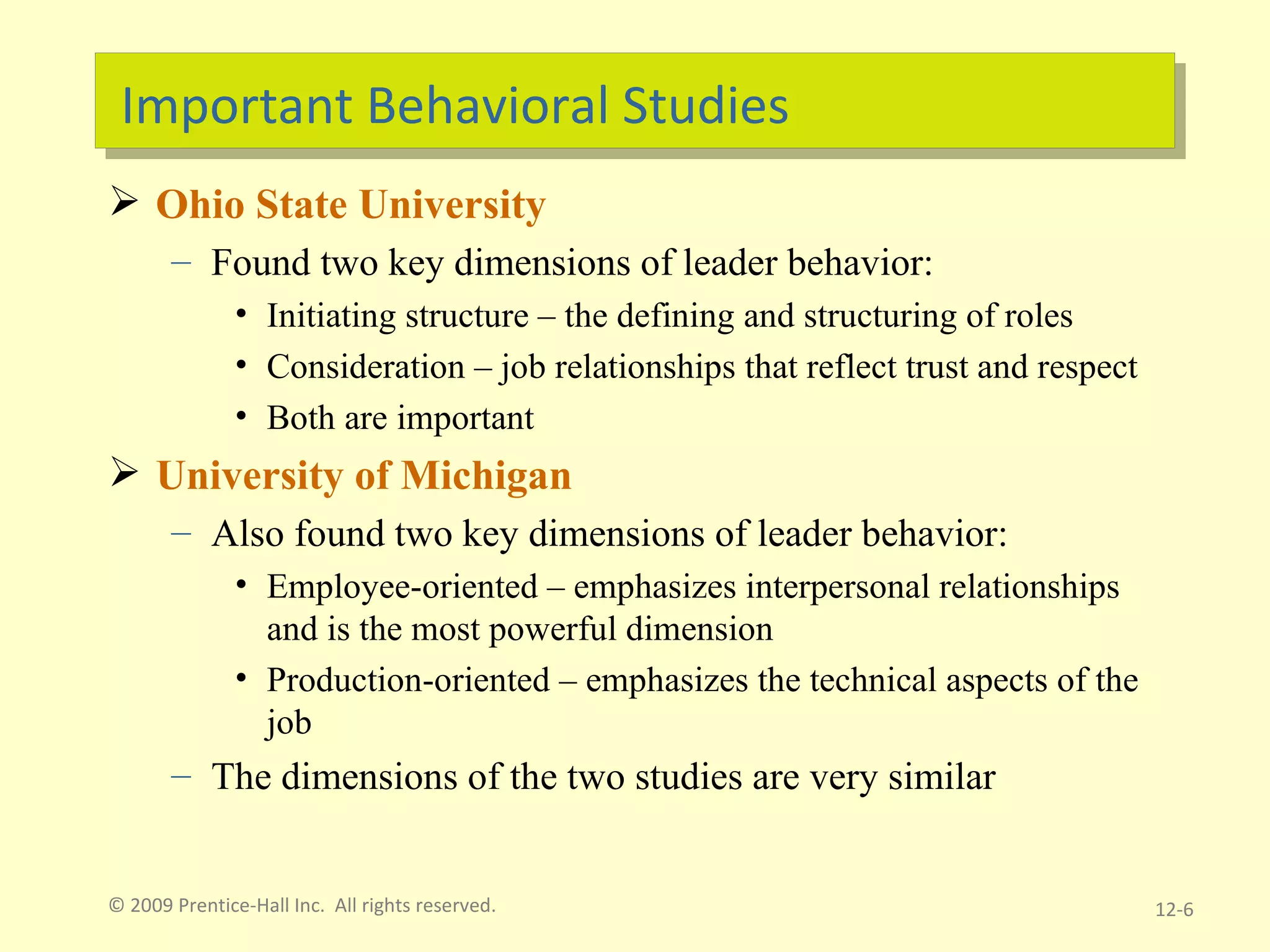
Important Behavioral Studies Ohio State University  Found two key dimensions of leader behavior: Initiating structure – the defining and structuring of roles Consideration – job relationships that reflect trust and respect Both are important University of Michigan Also found two key dimensions of leader behavior: Employee-oriented – emphasizes interpersonal relationships and is the most powerful dimension Production-oriented – emphasizes the technical aspects of the job The dimensions of the two studies are very similar © 2009 Prentice-Hall Inc.  All rights reserved. 12-
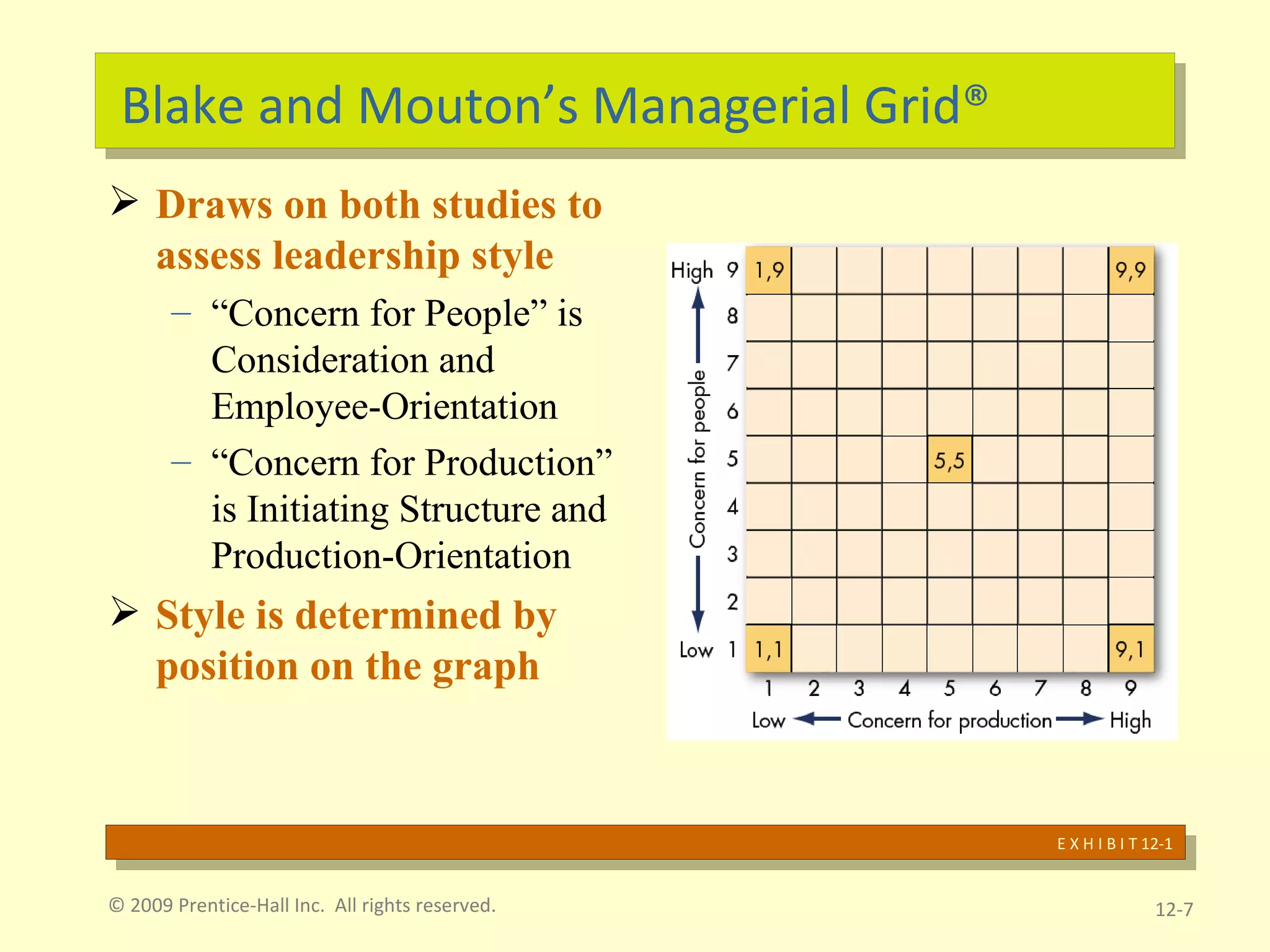
Blake and Mouton’s Managerial Grid® Draws on both studies to assess leadership style “ Concern for People” is Consideration and Employee-Orientation “ Concern for Production” is Initiating Structure and Production-Orientation  Style is determined by position on the graph © 2009 Prentice-Hall Inc.  All rights reserved. 12- E X H I B I T 12-1
Contingency Theories While trait and behavior theories do help us understand leadership, an important component is missing: the environment in which the leader exists Contingency Theory deals with this additional aspect of leadership effectiveness studies Three key theories: Fielder’s Model Hersey and Blanchard’s Situational Leadership Theory Path-Goal Theory © 2009 Prentice-Hall Inc.  All rights reserved. 12-
Fiedler Model Effective group performance depends on the proper match between leadership style and the situation Assumes that leadership style (based on orientation revealed in LPC questionnaire) is fixed Considers Three Situational Factors: Leader-member relations: degree of confidence and trust in the leader Task structure: degree of structure in the jobs Position power: leader’s ability to hire, fire, and reward For effective leadership: must change to a leader who fits the situation or change the situational variables to fit the current leader © 2009 Prentice-Hall Inc.  All rights reserved. 12-
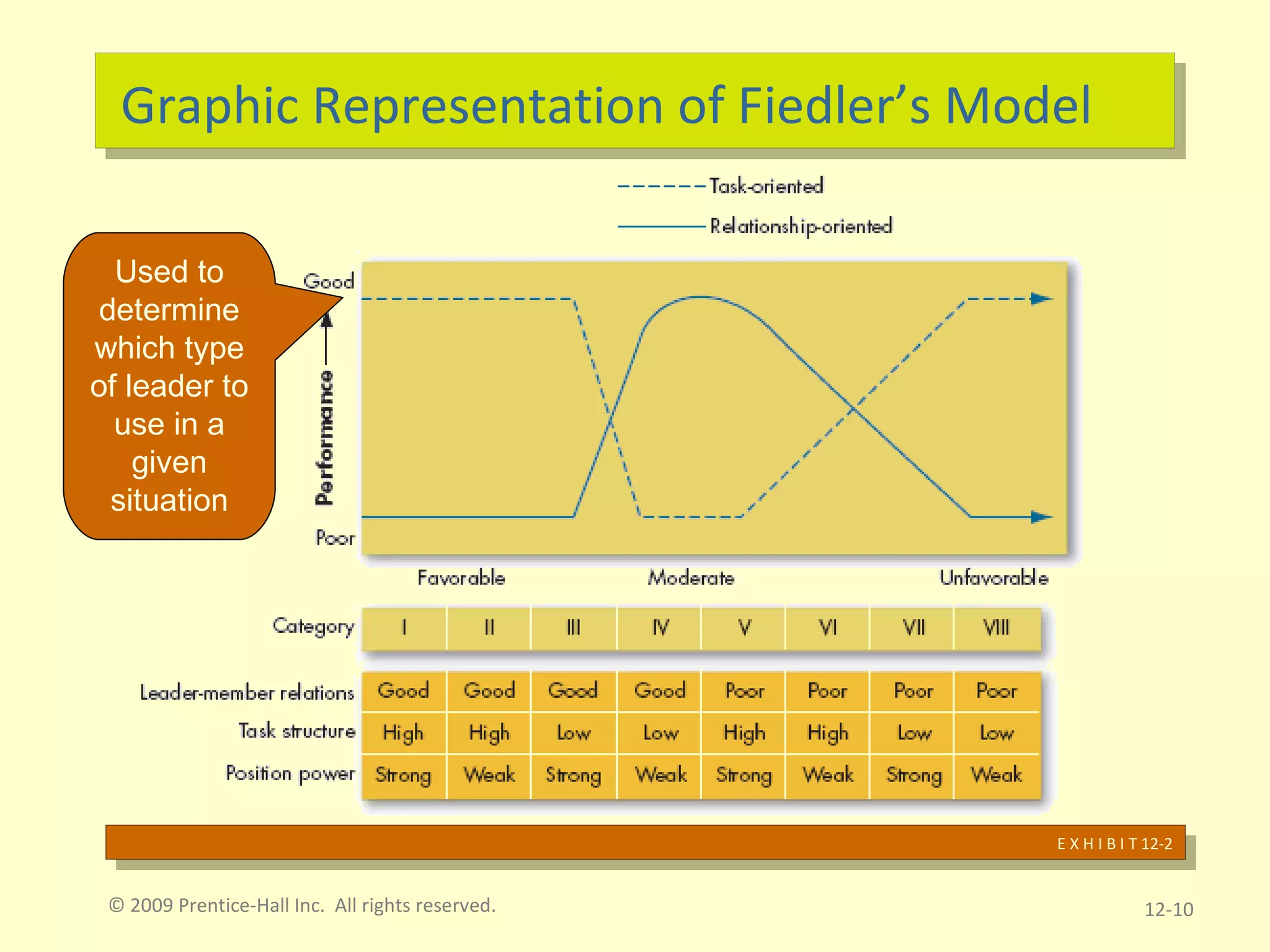
Graphic Representation of Fiedler’s Model © 2009 Prentice-Hall Inc.  All rights reserved. 12- E X H I B I T 12-2 Used to determine which type of leader to use in a given situation
Assessment of Fiedler’s Model Positives: Considerable evidence supports the model, especially if the original eight situations are grouped into three © 2009 Prentice-Hall Inc.  All rights reserved. 12- Problems: The logic behind the LPC scale is not well understood LPC scores are not stable Contingency variables are complex and hard to determine
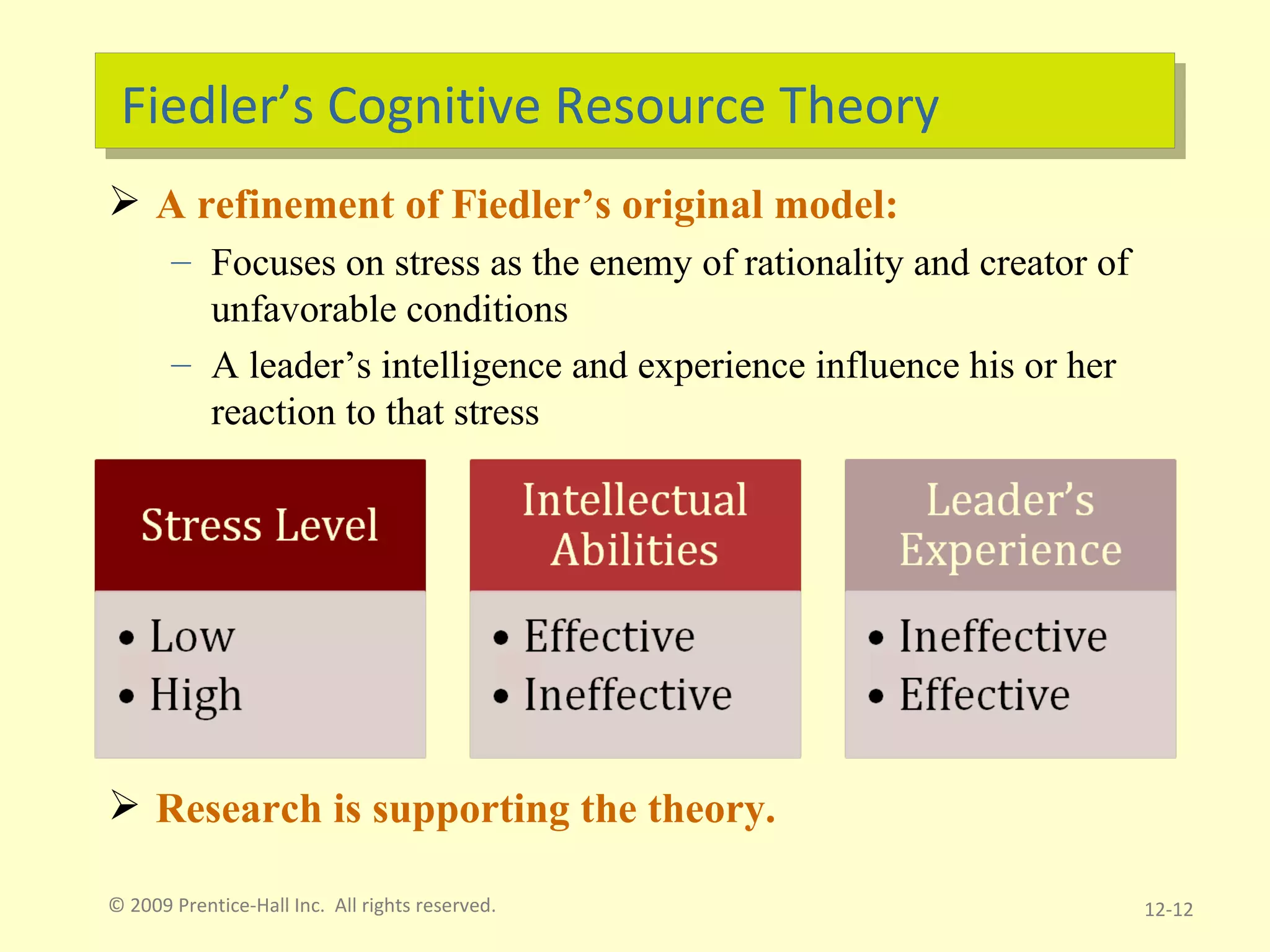
Fiedler’s Cognitive Resource Theory A refinement of Fiedler’s original model: Focuses on stress as the enemy of rationality and creator of unfavorable conditions A leader’s intelligence and experience influence his or her reaction to that stress Research is supporting the theory. © 2009 Prentice-Hall Inc.  All rights reserved. 12-
Hersey & Blanchard’s Situational Leadership A model that focuses on follower “readiness” Followers can accept or reject the leader Effectiveness depends on the followers’ response to the leader’s actions “ Readiness” is  the extent to which people have the  ability  and  willingness  to accomplish a specific task A paternal model:  As the child matures, the adult releases more and more control over the situation As the workers become more ready, the leader becomes more  laissez-faire An intuitive model that does not get much support from the research findings © 2009 Prentice-Hall Inc.  All rights reserved. 12-
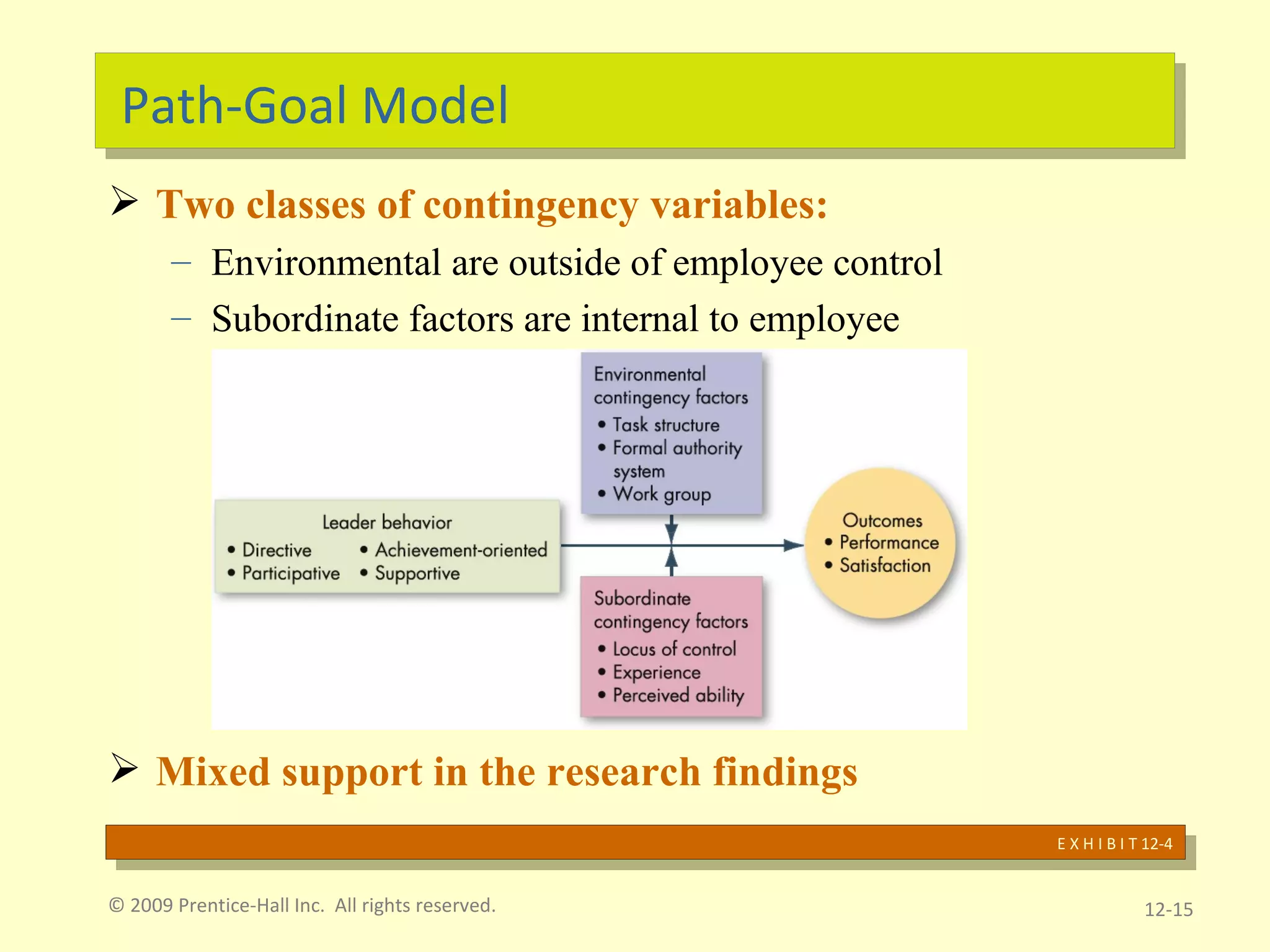
House’s Path-Goal Theory Builds from the Ohio State studies and the expectancy theory of motivation The Theory:  Leaders provide followers with information, support, and resources to help them achieve their goals Leaders help clarify the “path” to the worker’s goals Leaders can display multiple leadership types Four types of leaders: Directive: focuses on the work to be done Supportive: focuses on the well-being of the worker Participative: consults with employees in decision-making Achievement-Oriented: sets challenging goals © 2009 Prentice-Hall Inc.  All rights reserved. 12-
Path-Goal Model Two classes of contingency variables: Environmental are outside of employee control Subordinate factors are internal to employee Mixed support in the research findings  © 2009 Prentice-Hall Inc.  All rights reserved. 12- E X H I B I T 12-4
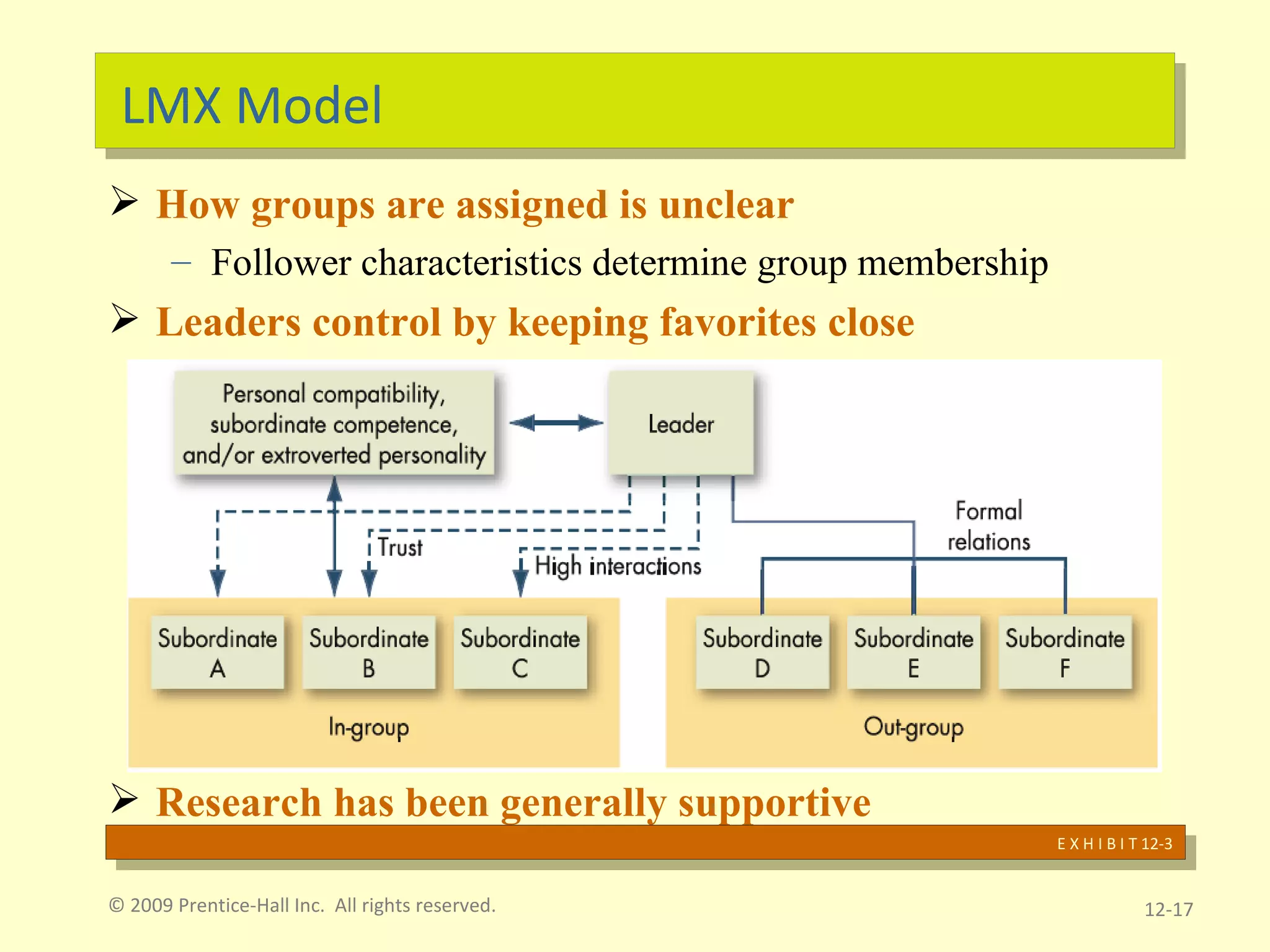
Leader-Member Exchange (LMX) Theory A response to the failing of contingency theories to account for followers and heterogeneous leadership approaches to individual workers LMX Premise: Because of time pressures, leaders form a special relationship with a small group of followers: the “in-group” This in-group is trusted and gets more time and attention from the leader (more “exchanges”) All other followers are in the “out-group” and get less of the leader’s attention and tend to have formal relationships with the leader (fewer “exchanges”) Leaders pick group members early in the relationship  © 2009 Prentice-Hall Inc.  All rights reserved. 12-
LMX Model How groups are assigned is unclear Follower characteristics determine group membership Leaders control by keeping favorites close Research has been generally supportive © 2009 Prentice-Hall Inc.  All rights reserved. 12- E X H I B I T 12-3
Yroom and Yetton’s Leader-Participation Model How  a leader makes decisions is as important as  what  is decided Premise: Leader behaviors must adjust to reflect task structure “ Normative” model: tells leaders how participative to be in their decision-making of a decision tree Five leadership styles Twelve contingency variables Research testing for both original and modified models has not been encouraging  Model is overly complex © 2009 Prentice-Hall Inc.  All rights reserved. 12- E X H I B I T 12-5
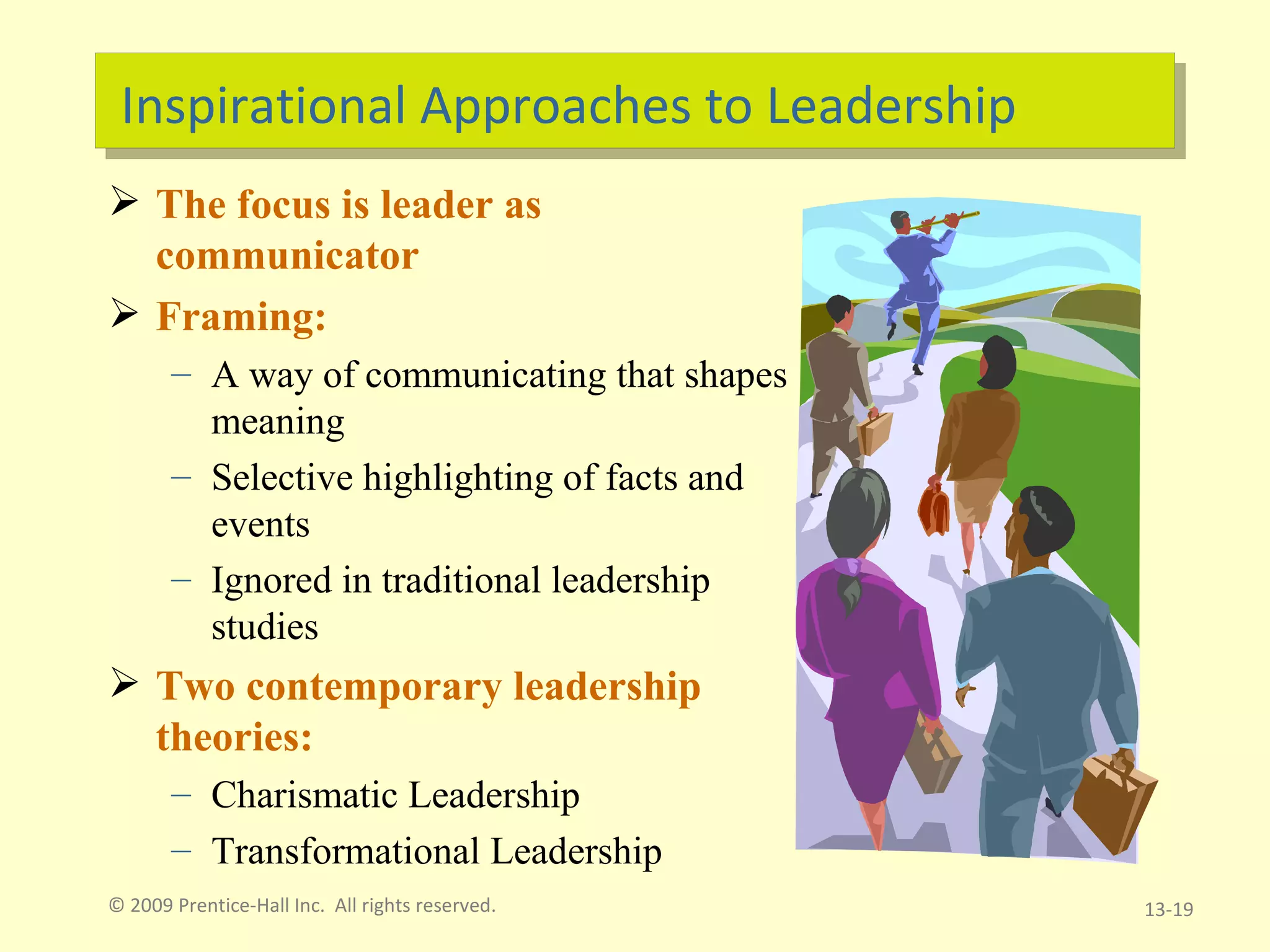
Inspirational Approaches to Leadership The focus is leader as communicator Framing: A way of communicating that shapes meaning Selective highlighting of facts and events Ignored in traditional leadership studies Two contemporary leadership theories:  Charismatic Leadership Transformational Leadership © 2009 Prentice-Hall Inc.  All rights reserved. 13-
Charismatic Leadership House’s Charismatic Leadership Theory: Followers make attributions of heroic or extraordinary leadership abilities when they observe certain behaviors Four characteristics of charismatic leaders: Have a vision Are willing to take personal risks to achieve the vision Are sensitive to follower needs Exhibit behaviors that are out of the ordinary Traits and personality are related to charisma People can be trained to exhibit charismatic behaviors © 2009 Prentice-Hall Inc.  All rights reserved. 13- E X H I B I T 13-1
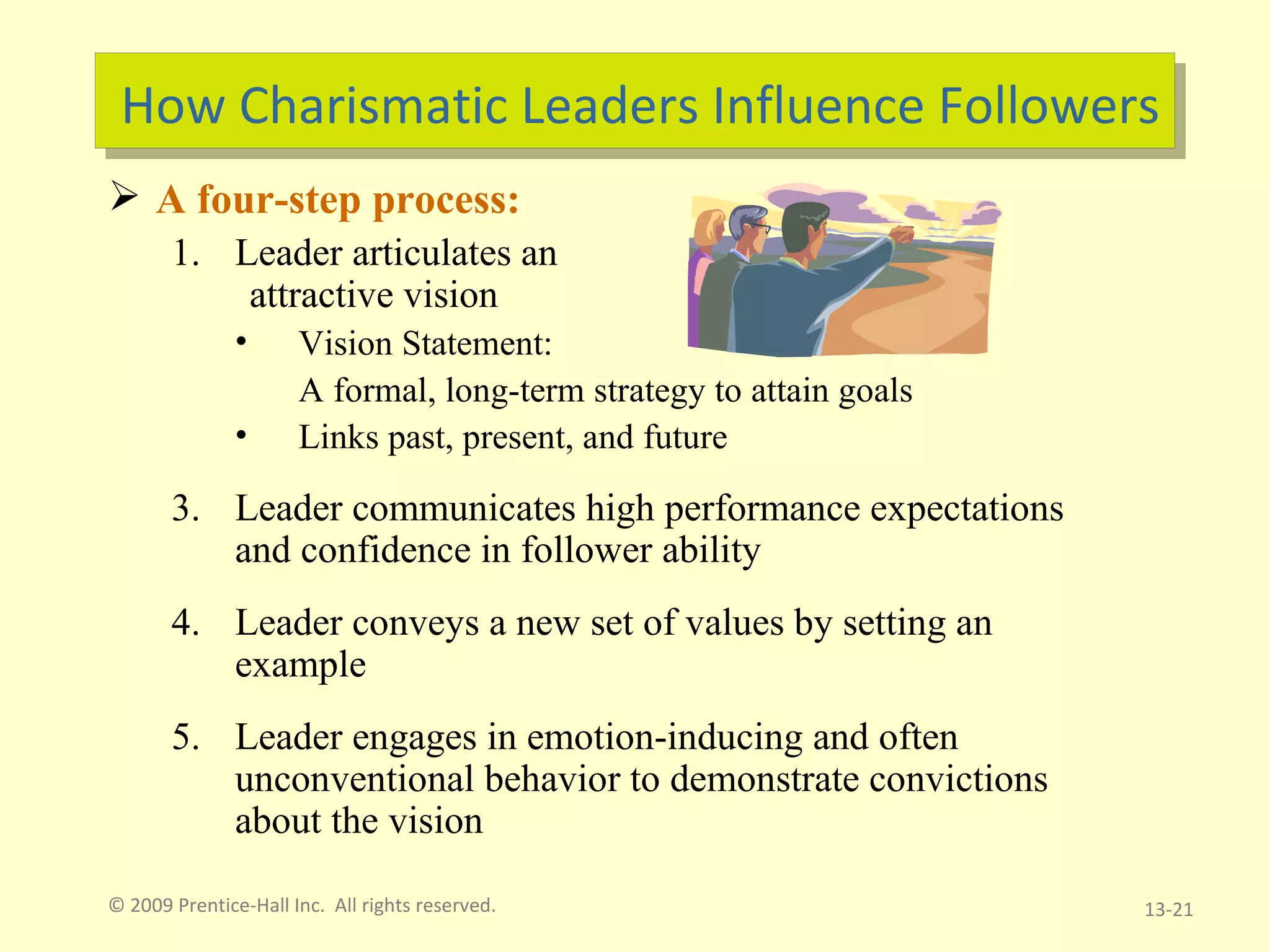
How Charismatic Leaders Influence Followers A four-step process: Leader articulates an  attractive vision Vision Statement:  A formal, long-term strategy to attain goals Links past, present, and future Leader communicates high performance expectations and confidence in follower ability Leader conveys a new set of values by setting an example Leader engages in emotion-inducing and often unconventional behavior to demonstrate convictions about the vision © 2009 Prentice-Hall Inc.  All rights reserved. 13-
Charismatic Leadership Issues Importance of vision Must be inspirational, value-centered, realizable, and given with superior imagery and articulation Charismatic effectiveness and situation Charisma works best when: The follower’s task has an ideological component There is a lot of stress and uncertainty in the environment The leader is at the upper level of the organization Followers have low self-esteem and self-worth Dark Side of Charisma Ego-driven charismatics allow their self-interest and personal goals to override the organization’s goals © 2009 Prentice-Hall Inc.  All rights reserved. 13-
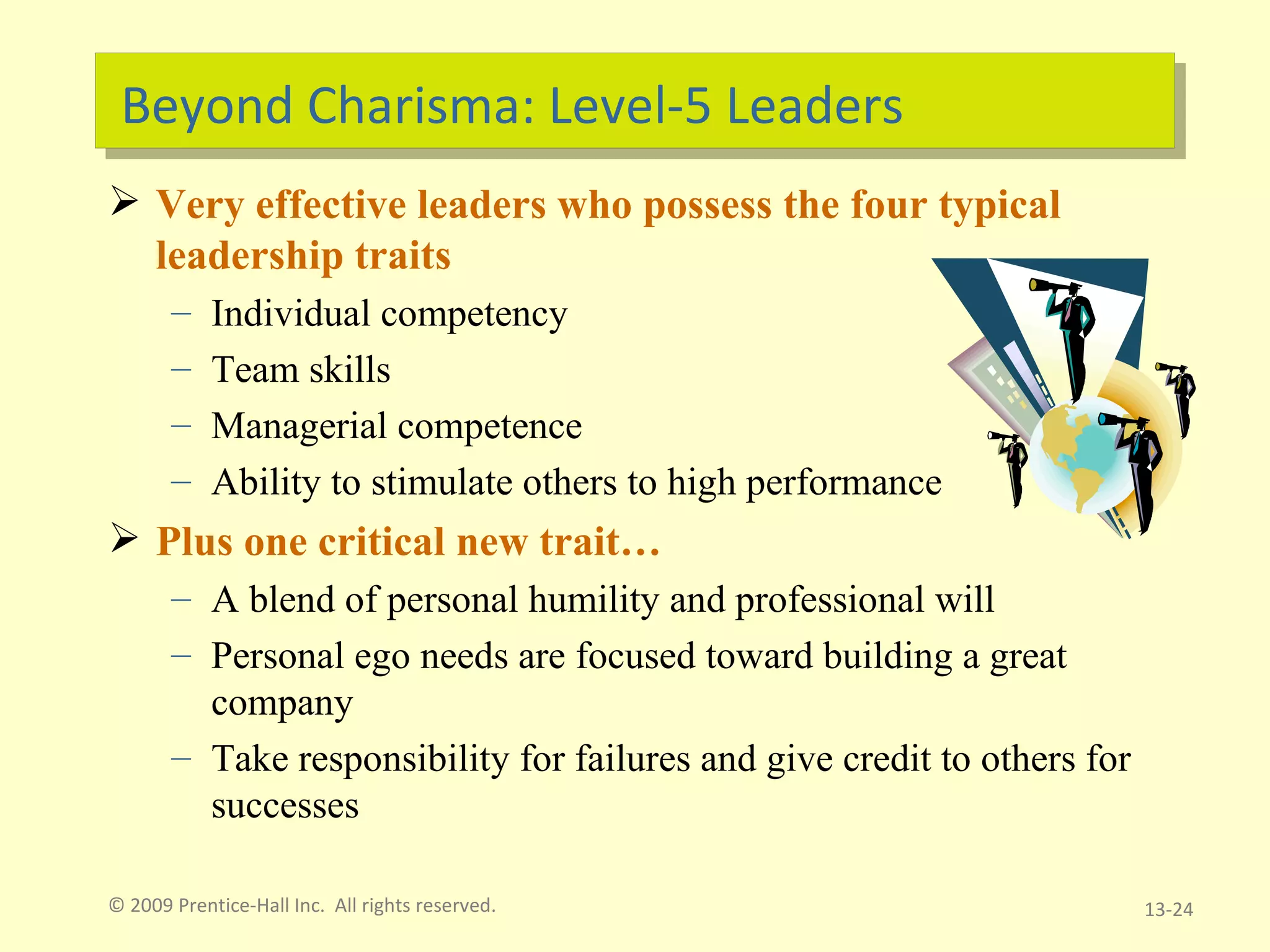
Beyond Charisma: Level-5 Leaders Very effective leaders who possess the four typical leadership traits  Individual competency Team skills Managerial competence Ability to stimulate others to high performance Plus one critical new trait…  A blend of personal humility and professional will Personal ego needs are focused toward building a great company Take responsibility for failures and give credit to others for successes © 2009 Prentice-Hall Inc.  All rights reserved. 13-
Transactional & Transformational Leadership Transactional Leaders Leaders who guide or motivate their followers in the direction of established goals by clarifying role and task requirements Transformational Leaders Inspire followers to transcend their own self-interests for the good of the organization; they can have a profound and extraordinary effect on followers Not opposing, but complementary, approaches to leadership Great transformational leaders must also be transactional; only one type is not enough for success © 2009 Prentice-Hall Inc.  All rights reserved. 13-
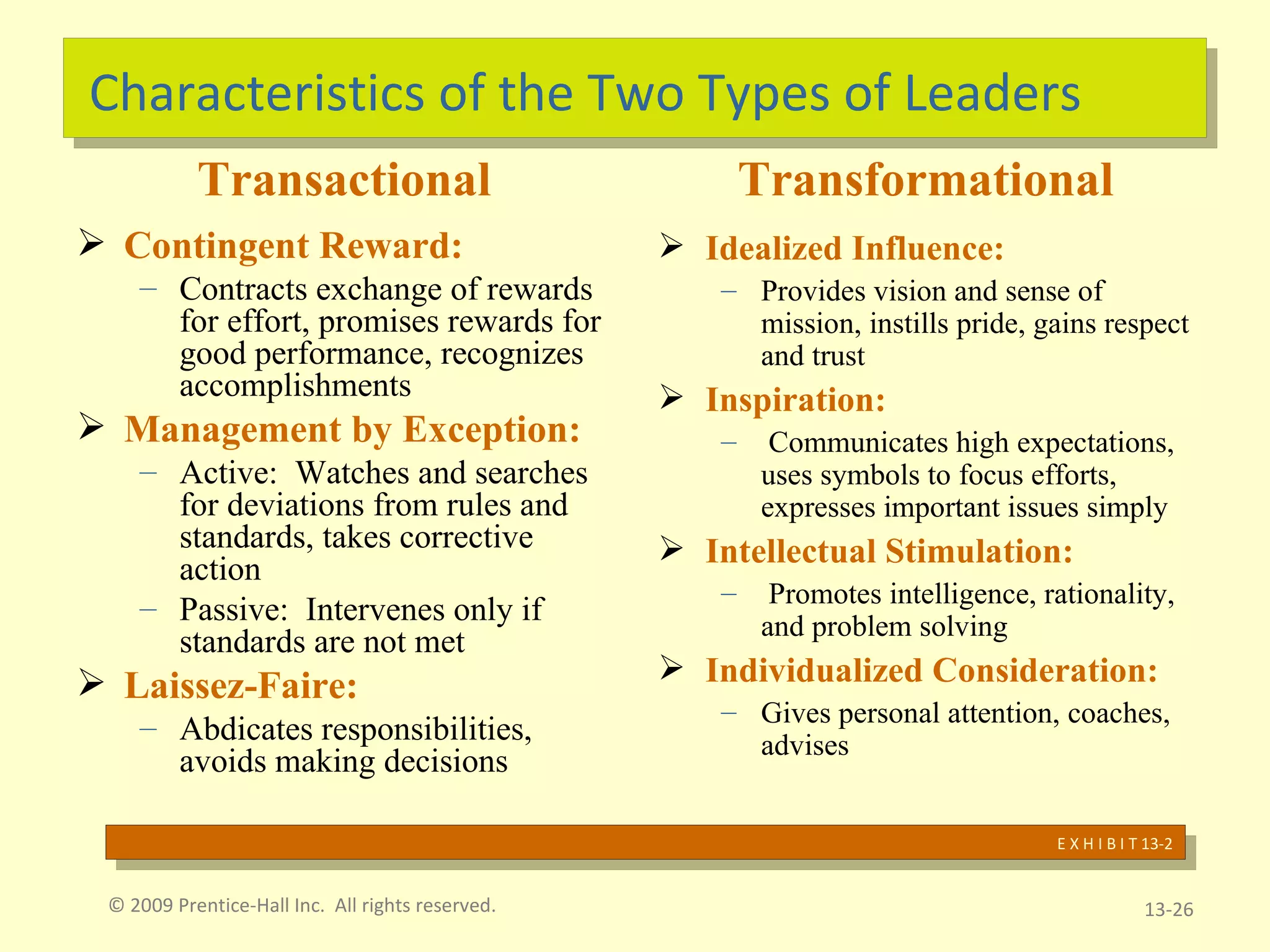
Characteristics of the Two Types of Leaders Transactional Contingent Reward:  Contracts exchange of rewards for effort, promises rewards for good performance, recognizes accomplishments Management by Exception: Active:  Watches and searches for deviations from rules and standards, takes corrective action Passive:  Intervenes only if standards are not met Laissez-Faire:  Abdicates responsibilities, avoids making decisions Transformational Idealized Influence:  Provides vision and sense of mission, instills pride, gains respect and trust Inspiration: Communicates high expectations, uses symbols to focus efforts, expresses important issues simply Intellectual Stimulation: Promotes intelligence, rationality, and problem solving Individualized Consideration:  Gives personal attention, coaches, advises © 2009 Prentice-Hall Inc.  All rights reserved. 13- E X H I B I T 13-2
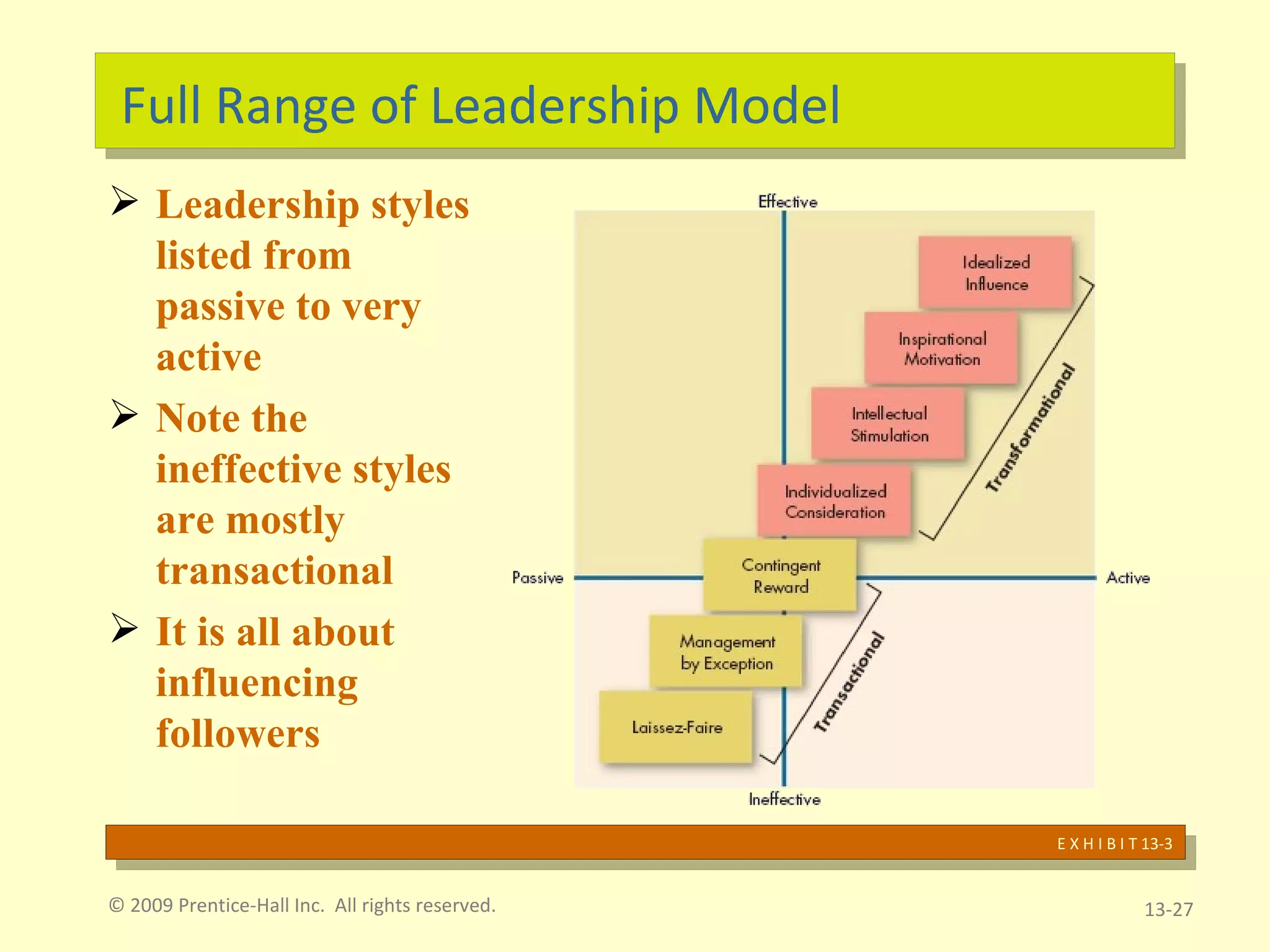
Full Range of Leadership Model Leadership styles listed from passive to very active Note the ineffective styles are mostly transactional It is all about influencing followers © 2009 Prentice-Hall Inc.  All rights reserved. 13- E X H I B I T 13-3
Issues with Transformational Leadership Basis for Action: Transformational leadership works by encouraging followers to be more innovative and creative and by providing ambitious goals Evaluation Based on the Research: This theory does show high correlations with desired outcomes This style of leadership can be taught Transformational vs. Charismatic Leadership: Similar concepts, but transformational leadership may be considered a broader concept than charisma. Instrument-based testing shows the measures to be roughly equivalent  © 2009 Prentice-Hall Inc.  All rights reserved. 13-
Contemporary Leadership Roles: Mentoring Mentor: A senior employee who sponsors and supports a less-experienced employee (a protégé) Good teachers present ideas clearly, listen, and empathize Two functions:  Career Coaching, assisting, sponsoring  Psychosocial Counseling, sharing, acting as a role model Can be formal or informal Mentors tend to select protégés who are similar to them in background: may restrict minorities and women © 2009 Prentice-Hall Inc.  All rights reserved. 13-
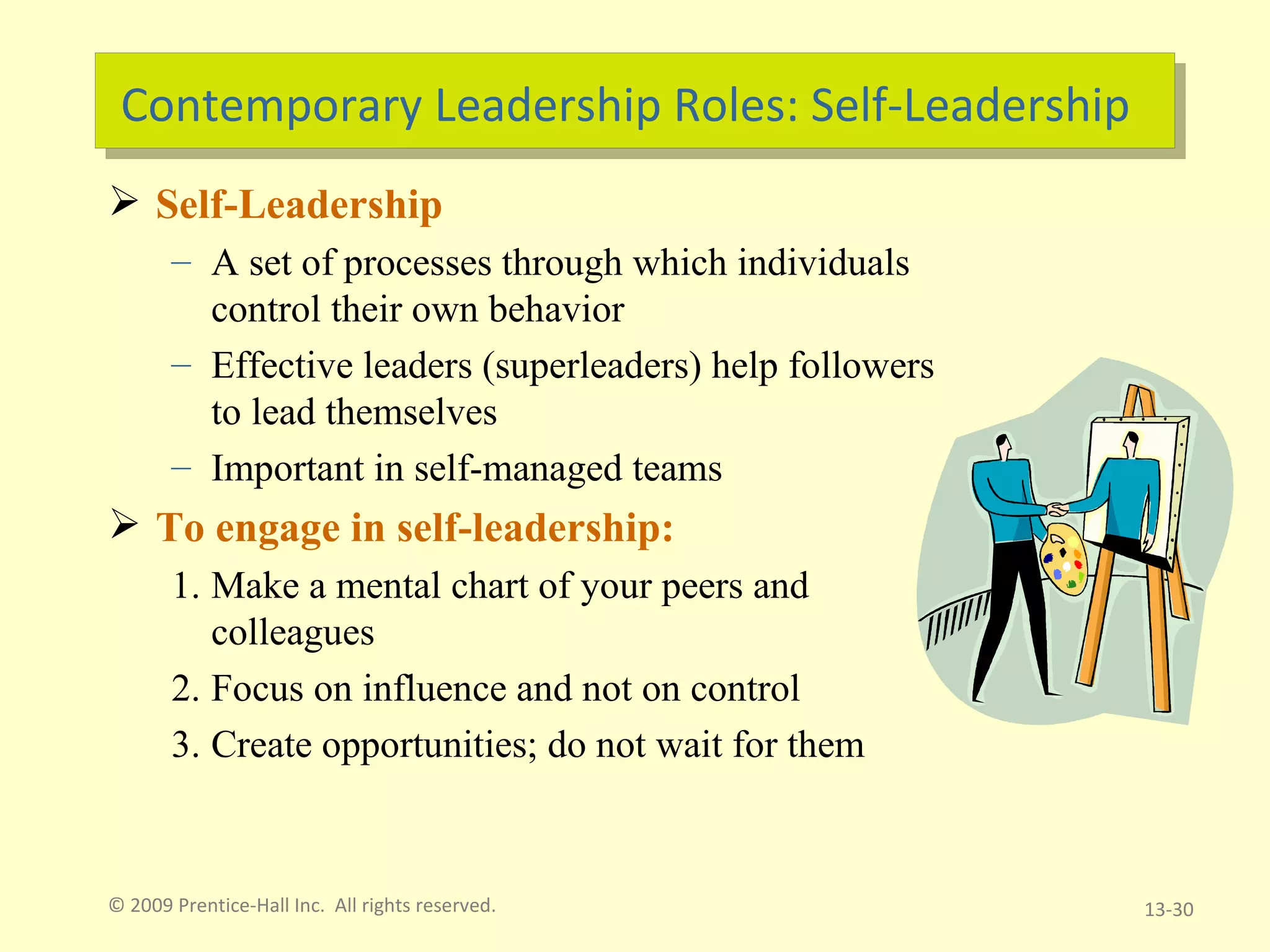
Contemporary Leadership Roles: Self-Leadership Self-Leadership A set of processes through which individuals control their own behavior Effective leaders (superleaders) help followers to lead themselves Important in self-managed teams To engage in self-leadership: Make a mental chart of your peers and colleagues Focus on influence and not on control Create opportunities; do not wait for them © 2009 Prentice-Hall Inc.  All rights reserved. 13-
Contemporary Leadership Roles: Online Leadership Leadership at a Distance: Building Trust The lack of face-to-face contact in electronic communications removes the nonverbal cues that support verbal interactions. There is no supporting context to assist the receiver with interpretation of an electronic communication. The structure and tone of electronic messages can strongly affect the response of receivers. An individual’s verbal and written communications may not follow the same style. Writing skills will likely become an extension of interpersonal skills. © 2009 Prentice-Hall Inc.  All rights reserved. 13-
Finding and Creating Effective Leaders Selection Review specific requirements for the job Use tests that identify personal traits associated with leadership, measure self-monitoring, and assess emotional intelligence Conduct personal interviews to determine candidate’s fit with the job Keep a list of potential candidates Training Recognize that all people are not equally trainable Teach skills that are necessary for employees to become effective leaders Provide behavioral training to increase the development potential of nascent charismatic employees © 2009 Prentice-Hall Inc.  All rights reserved. 13-
© 2009 Prentice-Hall Inc.  All rights reserved. 12- Please Visit Us At : http://wanbk.page.tl

Chapter 11

  • 1.
    Leadership 12- ©2009 Prentice-Hall Inc. All rights reserved.
  • 2.
    Chapter Learning ObjectivesAfter studying this chapter, you should be able to: Define leadership and contrast leadership and management. Summarize the conclusions of trait theories. Identify the central tenets and main limitations of behavioral theories. Assess contingency theories of leadership by their level of support. Contrast the interactive theories (path-goal and leader-member exchange). Identify the situational variables in the leader-participation model. Show how U.S. managers might need to adjust their leadership approaches in Brazil, France, Egypt, and China. © 2009 Prentice-Hall Inc. All rights reserved. 12-
  • 3.
    What Is Leadership?Leadership The ability to influence a group toward the achievement of goals Management Use of authority inherent in designated formal rank to obtain compliance from organizational members Both are necessary for organizational success © 2009 Prentice-Hall Inc. All rights reserved. 12-
  • 4.
    Trait Theories ofLeadership Theories that consider personality, social, physical, or intellectual traits to differentiate leaders from nonleaders Not very useful until matched with the Big Five Personality Framework Leadership Traits Extroversion Conscientiousness Openness Emotional Intelligence (Qualified) Traits can predict leadership, but they are better at predicting leader emergence than effectiveness. © 2009 Prentice-Hall Inc. All rights reserved. 12-
  • 5.
    Behavioral Theories ofLeadership Theories proposing that specific behaviors differentiate leaders from nonleaders Differences between theories of leadership: Trait theory: leadership is inherent, so we must identify the leader based on his or her traits Behavioral theory: leadership is a skill set and can be taught to anyone, so we must identify the proper behaviors to teach potential leaders © 2009 Prentice-Hall Inc. All rights reserved. 12-
  • 6.
    Important Behavioral StudiesOhio State University Found two key dimensions of leader behavior: Initiating structure – the defining and structuring of roles Consideration – job relationships that reflect trust and respect Both are important University of Michigan Also found two key dimensions of leader behavior: Employee-oriented – emphasizes interpersonal relationships and is the most powerful dimension Production-oriented – emphasizes the technical aspects of the job The dimensions of the two studies are very similar © 2009 Prentice-Hall Inc. All rights reserved. 12-
  • 7.
    Blake and Mouton’sManagerial Grid® Draws on both studies to assess leadership style “ Concern for People” is Consideration and Employee-Orientation “ Concern for Production” is Initiating Structure and Production-Orientation Style is determined by position on the graph © 2009 Prentice-Hall Inc. All rights reserved. 12- E X H I B I T 12-1
  • 8.
    Contingency Theories Whiletrait and behavior theories do help us understand leadership, an important component is missing: the environment in which the leader exists Contingency Theory deals with this additional aspect of leadership effectiveness studies Three key theories: Fielder’s Model Hersey and Blanchard’s Situational Leadership Theory Path-Goal Theory © 2009 Prentice-Hall Inc. All rights reserved. 12-
  • 9.
    Fiedler Model Effectivegroup performance depends on the proper match between leadership style and the situation Assumes that leadership style (based on orientation revealed in LPC questionnaire) is fixed Considers Three Situational Factors: Leader-member relations: degree of confidence and trust in the leader Task structure: degree of structure in the jobs Position power: leader’s ability to hire, fire, and reward For effective leadership: must change to a leader who fits the situation or change the situational variables to fit the current leader © 2009 Prentice-Hall Inc. All rights reserved. 12-
  • 10.
    Graphic Representation ofFiedler’s Model © 2009 Prentice-Hall Inc. All rights reserved. 12- E X H I B I T 12-2 Used to determine which type of leader to use in a given situation
  • 11.
    Assessment of Fiedler’sModel Positives: Considerable evidence supports the model, especially if the original eight situations are grouped into three © 2009 Prentice-Hall Inc. All rights reserved. 12- Problems: The logic behind the LPC scale is not well understood LPC scores are not stable Contingency variables are complex and hard to determine
  • 12.
    Fiedler’s Cognitive ResourceTheory A refinement of Fiedler’s original model: Focuses on stress as the enemy of rationality and creator of unfavorable conditions A leader’s intelligence and experience influence his or her reaction to that stress Research is supporting the theory. © 2009 Prentice-Hall Inc. All rights reserved. 12-
  • 13.
    Hersey & Blanchard’sSituational Leadership A model that focuses on follower “readiness” Followers can accept or reject the leader Effectiveness depends on the followers’ response to the leader’s actions “ Readiness” is the extent to which people have the ability and willingness to accomplish a specific task A paternal model: As the child matures, the adult releases more and more control over the situation As the workers become more ready, the leader becomes more laissez-faire An intuitive model that does not get much support from the research findings © 2009 Prentice-Hall Inc. All rights reserved. 12-
  • 14.
    House’s Path-Goal TheoryBuilds from the Ohio State studies and the expectancy theory of motivation The Theory: Leaders provide followers with information, support, and resources to help them achieve their goals Leaders help clarify the “path” to the worker’s goals Leaders can display multiple leadership types Four types of leaders: Directive: focuses on the work to be done Supportive: focuses on the well-being of the worker Participative: consults with employees in decision-making Achievement-Oriented: sets challenging goals © 2009 Prentice-Hall Inc. All rights reserved. 12-
  • 15.
    Path-Goal Model Twoclasses of contingency variables: Environmental are outside of employee control Subordinate factors are internal to employee Mixed support in the research findings © 2009 Prentice-Hall Inc. All rights reserved. 12- E X H I B I T 12-4
  • 16.
    Leader-Member Exchange (LMX)Theory A response to the failing of contingency theories to account for followers and heterogeneous leadership approaches to individual workers LMX Premise: Because of time pressures, leaders form a special relationship with a small group of followers: the “in-group” This in-group is trusted and gets more time and attention from the leader (more “exchanges”) All other followers are in the “out-group” and get less of the leader’s attention and tend to have formal relationships with the leader (fewer “exchanges”) Leaders pick group members early in the relationship © 2009 Prentice-Hall Inc. All rights reserved. 12-
  • 17.
    LMX Model Howgroups are assigned is unclear Follower characteristics determine group membership Leaders control by keeping favorites close Research has been generally supportive © 2009 Prentice-Hall Inc. All rights reserved. 12- E X H I B I T 12-3
  • 18.
    Yroom and Yetton’sLeader-Participation Model How a leader makes decisions is as important as what is decided Premise: Leader behaviors must adjust to reflect task structure “ Normative” model: tells leaders how participative to be in their decision-making of a decision tree Five leadership styles Twelve contingency variables Research testing for both original and modified models has not been encouraging Model is overly complex © 2009 Prentice-Hall Inc. All rights reserved. 12- E X H I B I T 12-5
  • 19.
    Inspirational Approaches toLeadership The focus is leader as communicator Framing: A way of communicating that shapes meaning Selective highlighting of facts and events Ignored in traditional leadership studies Two contemporary leadership theories: Charismatic Leadership Transformational Leadership © 2009 Prentice-Hall Inc. All rights reserved. 13-
  • 20.
    Charismatic Leadership House’sCharismatic Leadership Theory: Followers make attributions of heroic or extraordinary leadership abilities when they observe certain behaviors Four characteristics of charismatic leaders: Have a vision Are willing to take personal risks to achieve the vision Are sensitive to follower needs Exhibit behaviors that are out of the ordinary Traits and personality are related to charisma People can be trained to exhibit charismatic behaviors © 2009 Prentice-Hall Inc. All rights reserved. 13- E X H I B I T 13-1
  • 21.
    How Charismatic LeadersInfluence Followers A four-step process: Leader articulates an attractive vision Vision Statement: A formal, long-term strategy to attain goals Links past, present, and future Leader communicates high performance expectations and confidence in follower ability Leader conveys a new set of values by setting an example Leader engages in emotion-inducing and often unconventional behavior to demonstrate convictions about the vision © 2009 Prentice-Hall Inc. All rights reserved. 13-
  • 22.
    Charismatic Leadership IssuesImportance of vision Must be inspirational, value-centered, realizable, and given with superior imagery and articulation Charismatic effectiveness and situation Charisma works best when: The follower’s task has an ideological component There is a lot of stress and uncertainty in the environment The leader is at the upper level of the organization Followers have low self-esteem and self-worth Dark Side of Charisma Ego-driven charismatics allow their self-interest and personal goals to override the organization’s goals © 2009 Prentice-Hall Inc. All rights reserved. 13-
  • 23.
    Charismatic Leadership IssuesImportance of vision Must be inspirational, value-centered, realizable, and given with superior imagery and articulation Charismatic effectiveness and situation Charisma works best when: The follower’s task has an ideological component There is a lot of stress and uncertainty in the environment The leader is at the upper level of the organization Followers have low self-esteem and self-worth Dark Side of Charisma Ego-driven charismatics allow their self-interest and personal goals to override the organization’s goals © 2009 Prentice-Hall Inc. All rights reserved. 13-
  • 24.
    Beyond Charisma: Level-5Leaders Very effective leaders who possess the four typical leadership traits Individual competency Team skills Managerial competence Ability to stimulate others to high performance Plus one critical new trait… A blend of personal humility and professional will Personal ego needs are focused toward building a great company Take responsibility for failures and give credit to others for successes © 2009 Prentice-Hall Inc. All rights reserved. 13-
  • 25.
    Transactional & TransformationalLeadership Transactional Leaders Leaders who guide or motivate their followers in the direction of established goals by clarifying role and task requirements Transformational Leaders Inspire followers to transcend their own self-interests for the good of the organization; they can have a profound and extraordinary effect on followers Not opposing, but complementary, approaches to leadership Great transformational leaders must also be transactional; only one type is not enough for success © 2009 Prentice-Hall Inc. All rights reserved. 13-
  • 26.
    Characteristics of theTwo Types of Leaders Transactional Contingent Reward: Contracts exchange of rewards for effort, promises rewards for good performance, recognizes accomplishments Management by Exception: Active: Watches and searches for deviations from rules and standards, takes corrective action Passive: Intervenes only if standards are not met Laissez-Faire: Abdicates responsibilities, avoids making decisions Transformational Idealized Influence: Provides vision and sense of mission, instills pride, gains respect and trust Inspiration: Communicates high expectations, uses symbols to focus efforts, expresses important issues simply Intellectual Stimulation: Promotes intelligence, rationality, and problem solving Individualized Consideration: Gives personal attention, coaches, advises © 2009 Prentice-Hall Inc. All rights reserved. 13- E X H I B I T 13-2
  • 27.
    Full Range ofLeadership Model Leadership styles listed from passive to very active Note the ineffective styles are mostly transactional It is all about influencing followers © 2009 Prentice-Hall Inc. All rights reserved. 13- E X H I B I T 13-3
  • 28.
    Issues with TransformationalLeadership Basis for Action: Transformational leadership works by encouraging followers to be more innovative and creative and by providing ambitious goals Evaluation Based on the Research: This theory does show high correlations with desired outcomes This style of leadership can be taught Transformational vs. Charismatic Leadership: Similar concepts, but transformational leadership may be considered a broader concept than charisma. Instrument-based testing shows the measures to be roughly equivalent © 2009 Prentice-Hall Inc. All rights reserved. 13-
  • 29.
    Contemporary Leadership Roles:Mentoring Mentor: A senior employee who sponsors and supports a less-experienced employee (a protégé) Good teachers present ideas clearly, listen, and empathize Two functions: Career Coaching, assisting, sponsoring Psychosocial Counseling, sharing, acting as a role model Can be formal or informal Mentors tend to select protégés who are similar to them in background: may restrict minorities and women © 2009 Prentice-Hall Inc. All rights reserved. 13-
  • 30.
    Contemporary Leadership Roles:Self-Leadership Self-Leadership A set of processes through which individuals control their own behavior Effective leaders (superleaders) help followers to lead themselves Important in self-managed teams To engage in self-leadership: Make a mental chart of your peers and colleagues Focus on influence and not on control Create opportunities; do not wait for them © 2009 Prentice-Hall Inc. All rights reserved. 13-
  • 31.
    Contemporary Leadership Roles:Online Leadership Leadership at a Distance: Building Trust The lack of face-to-face contact in electronic communications removes the nonverbal cues that support verbal interactions. There is no supporting context to assist the receiver with interpretation of an electronic communication. The structure and tone of electronic messages can strongly affect the response of receivers. An individual’s verbal and written communications may not follow the same style. Writing skills will likely become an extension of interpersonal skills. © 2009 Prentice-Hall Inc. All rights reserved. 13-
  • 32.
    Finding and CreatingEffective Leaders Selection Review specific requirements for the job Use tests that identify personal traits associated with leadership, measure self-monitoring, and assess emotional intelligence Conduct personal interviews to determine candidate’s fit with the job Keep a list of potential candidates Training Recognize that all people are not equally trainable Teach skills that are necessary for employees to become effective leaders Provide behavioral training to increase the development potential of nascent charismatic employees © 2009 Prentice-Hall Inc. All rights reserved. 13-
  • 33.
    © 2009 Prentice-HallInc. All rights reserved. 12- Please Visit Us At : http://wanbk.page.tl