Presentation on:
Fiedler’sContingencyTheory
ofLeadership
 Hassan Samoon 2K17/MBA/75
 Syed Mushtaque Hussain 2K17/MBA/123
 Deep Sagar Mahraj 2K17/MBA/28
 Zafar Ali Almani 2K17/MBA/135
 Weedhant Lal Khatri 2K17/MBA/132
 Ali Shan Mughal 2K17/MBA/14
 Abdul Wahab Memon 2K17/MBA/42
 Zulfiqar Memon 2K17/MBA/141
 Nadeem Ahmed Rajper 2K17/MBA/83
Overview
Biography of Author
Fiedler’s Contingency Theory
Advantages
Disadvantages
Introduction of
Fiedler’s Contingency Theory
In 1958, Fred E. Fiedler developed the contingency leadership theory
(“Fiedler’s Contingency Theory“)
Leadership style is based on leaders personality (trait theory) and
behaviors (behavioral theory) therefore, it is constant
Leader should change the situation not the style
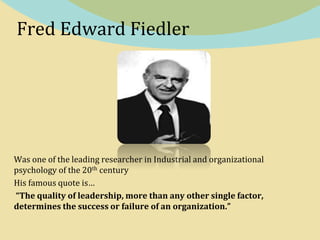
Fred Edward Fiedler
Was one of the leading researcher in Industrial and organizational
psychology of the 20th century
His famous quote is…
“The quality of leadership, more than any other single factor,
determines the success or failure of an organization.”
Cont…
 Was born on July 13, 1922 at Vienna, Austria
 In 1938, at the age of 16 Fiedler emigrated from Austria (Vienna) to
US.
 Completed School graduation on 1940
 He studied at the University of Chicago. Fiedler 1st obtained his master
‘s degree (MSc) in psychology in 1947 and later he obtain his doctorate
(Ph.D) within the field of Clinical psychology in 1949.
Cont…
 Fred continued to study various areas of activity in the field of effective
leadership.
 The result of these years of study can be found in the ground breaking
book Theory of Leadership Effectiveness , which was published in
1967.
Contingency…?
Contingency means “it depends.” One thing depends on
other things, and for a leader to be effective there must be
an appropriate fit between the leader’s behavior and style
and the followers and the situation.
A good way to describe contingency is “if & then”. If this is
the way my situation is, then this is the best way for me to
manage in this situation.
Fiedler’s Contingency Theory
 Fiedler’s contingency theory is one of the contingency theories that
states that effective leadership depend not only on the style of leading
but on the control over the situation.
 This is also known as leader match theory because it tries to match
leaders to appropriate situations
 A leader’s effectiveness depends on how well the leader’s style fits the
context
 The theory was developed by studying the styles of leaders in
situations and whether they were effective (primarily in military
organizations)
Cont…
 Theory is a class of behavior theory that contend that there is no one
best way of organization/leading and that an
organizational/leadership style that is effective in some situation may
not be successful
 In others word: The optimal organization/leadership style is
contingent upon various internal and external constraints
 These constraints may include: the size of the org, how it adapts to its
environment, difference among resources and operations activities,
managerial assumption to employees, strategies, technologies used, etc
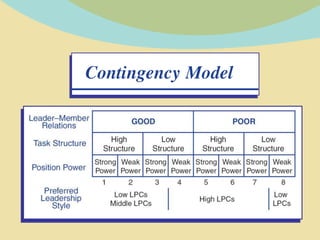
 This theory is concerned with Situations Favorableness &
Leadership Style
 Situation Favorableness
Situational favorableness of your particular situation. This depends
on three distinct factors
1. Task Structure
2. Leader/members relations
3. Positioning power
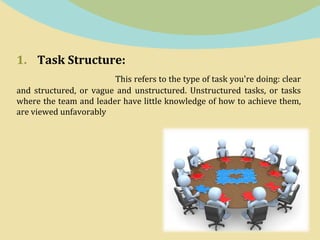
1. Task Structure:
This refers to the type of task you're doing: clear
and structured, or vague and unstructured. Unstructured tasks, or tasks
where the team and leader have little knowledge of how to achieve them,
are viewed unfavorably
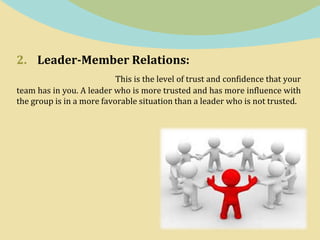
2. Leader-Member Relations:
This is the level of trust and confidence that your
team has in you. A leader who is more trusted and has more influence with
the group is in a more favorable situation than a leader who is not trusted.
3. Leader's Position Power:
This is the amount of power you have to direct
the group, and provide reward or punishment. The more power you have,
the more favorable your situation.
 LeadershipStyles
Identifying leadership style is the first step in using the model. Fiedler
believed that leadership style is fixed, and it can be measured using a
scale he developed called Least-Preferred Co-Worker (LPC) Scale
Cont…
LPC (Least Preferred Coworker) Scale
 Used to measure a person’s leadership style
 For example, it measures your style by having you describe a coworker
with whom you had difficulty completing a job. (not necessarily
someone you dislike, but someone with whom you least like to work
with)
 After you choose this person, the LPC instrument asks you to describe
your coworker on 18 sets of adjectives
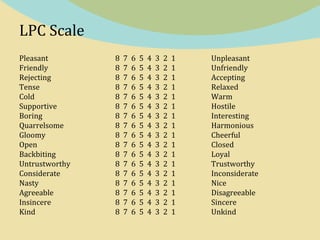
LPC Scale
Pleasant 8 7 6 5 4 3 2 1 Unpleasant
Friendly 8 7 6 5 4 3 2 1 Unfriendly
Rejecting 8 7 6 5 4 3 2 1 Accepting
Tense 8 7 6 5 4 3 2 1 Relaxed
Cold 8 7 6 5 4 3 2 1 Warm
Supportive 8 7 6 5 4 3 2 1 Hostile
Boring 8 7 6 5 4 3 2 1 Interesting
Quarrelsome 8 7 6 5 4 3 2 1 Harmonious
Gloomy 8 7 6 5 4 3 2 1 Cheerful
Open 8 7 6 5 4 3 2 1 Closed
Backbiting 8 7 6 5 4 3 2 1 Loyal
Untrustworthy 8 7 6 5 4 3 2 1 Trustworthy
Considerate 8 7 6 5 4 3 2 1 Inconsiderate
Nasty 8 7 6 5 4 3 2 1 Nice
Agreeable 8 7 6 5 4 3 2 1 Disagreeable
Insincere 8 7 6 5 4 3 2 1 Sincere
Kind 8 7 6 5 4 3 2 1 Unkind
Cont…
Scoring
Your final score is the total of the numbers you circled on the 18 scales
57 or less = Low LPC (task motivated)
58-63 = Middle LPC (socio-independent leaders, self directed and not
overly concerned with the task or with how others view them)
64 or above = High LPC (motivated by relationships)
Leadership styles
Leadership styles are either task motivated or relationship motivated
 The model says that task-oriented leaders usually view their LPCs
more negatively, resulting in a lower score. Fiedler called these low
LPC-leaders. He said that low LPCs are very effective at completing
tasks. They're quick to organize a group to get tasks and projects done.
Relationship-building is a low priority.
 However, relationship-oriented leaders usually view their LPCs more
positively, giving them a higher score. These are high-LPC leaders. High
LPCs focus more on personal connections, and they're good at avoiding
and managing conflict. They're better able to make complex decisions.
How contingency theory works
By measuring a leader’s LPC score and three situational variables, one
can predict whether the leader is going to be successful in a particular
setting.
It is important to note that contingency theory stresses that leaders are
NOT successful in all situations.
There are four important ideas of Contingency Theory are:
 There is no universal or one best way to manage.
 The design of an organizations and its sub systems must fit with the
environment
 Effective organizations not only have a proper fit with the environment
but also between its sub system and…
 The needs of an organization or better satisfied when it Is properly
design and the management style is appropriate both to the tasks
under taken and the nature of work group
Advantages of Contingency Theory
 Fiedler's contingency theory/model measures the effectiveness of a
group's performance based on the leadership style and the situation of
the group.
 It is used to help management choose suitable leaders for each work
group type.
Advantages of Contingency Theory
 Prescriptive
 Expertise and Research
 Leader Identification
 Flexibility
 Prescriptive:
 This model provides managers with a tool to create effective groups by
modifying several variables.
 According to Fiedler's contingency model, there is not only one type of
successful leadership style, but each leader type can thrive in the right
group setting.
 The model provides a number of factors management can modify to
improve the efficiency of the group. For instance, according to Fiedler's
theory, an impersonal but task-oriented leader can be effective in a
group as long as the group is highly structured and has clearly defined
tasks.
 Expertise and Research:
 Fiedler's contingency model was created by Fred Edward Fiedler,
professor emeritus of management and organization at the University
of Washington in Seattle.
 Since Fiedler published his model in 1976 as part of his work "A
Theory of Leadership Effectiveness," the model has been thoroughly
tested by many researchers, such as Strobe and Garcia in 1981 and
Ahmed Sakr Ahour in 1972.
 The abundance of published papers on this model provide a wealth of
material to use when applying the model to a specific context.
 Leader Identification:
 Fiedler's model gives organizations a quick method to identify the best
potential leaders for a particular group.
 The theory includes a least preferred co-worker (LPC) scale, which
helps management identify the human relations orientation and the
task orientation of possible leaders.
 Leaders with a task orientation are best suited for groups in which
they have a high level of control and supervise clearly defined tasks.
 On the other hand, leaders with a relationship orientation can use their
interpersonal skills to get the job done and can deal with complex
issues when making decisions.
 Flexibility:
 This theory is designed as a contingency model and does not claim to
describe all possible situations.
 It is precisely because the model only purports to provide ballpark
results that it is flexible enough to adapt to a wide variety of groups,
leaders and group-leader relationships.
 For instance, if a group has a leader with low human relations skills,
Fiedler's model still gives management the option of creating an
effective group by providing clearly defined tasks and increasing the
ability of the leader to provide rewards or punishment to subordinates.
Disadvantages of Contingency Theory
 Constant changes to environment/structure of the organization-
challenging for management
 Difficult to accurately choose the most suitable contingency
approach/plan
 No clear procedure/guidelines to follow- dependent on business
 It is questionable whether Fiedler’s contingency theory is valid in all
situations, such as when neither the task is well defined and no choice
of leaders is to be had, except once with bad personalities
Cont…
 A disadvantage would be cost/resources spent on plan if the plan is
never implemented (nothing goes wrong)
 An all-encompassing contingency plan would tend to have a negative
impact on business/investors
Questions...?
Thank You…!!!


Fielder Contingency theory of leadership by Hassan Samoon

  • 2.
    Presentation on: Fiedler’sContingencyTheory ofLeadership  HassanSamoon 2K17/MBA/75  Syed Mushtaque Hussain 2K17/MBA/123  Deep Sagar Mahraj 2K17/MBA/28  Zafar Ali Almani 2K17/MBA/135  Weedhant Lal Khatri 2K17/MBA/132  Ali Shan Mughal 2K17/MBA/14  Abdul Wahab Memon 2K17/MBA/42  Zulfiqar Memon 2K17/MBA/141  Nadeem Ahmed Rajper 2K17/MBA/83
  • 3.
    Overview Biography of Author Fiedler’sContingency Theory Advantages Disadvantages
  • 4.
    Introduction of Fiedler’s ContingencyTheory In 1958, Fred E. Fiedler developed the contingency leadership theory (“Fiedler’s Contingency Theory“) Leadership style is based on leaders personality (trait theory) and behaviors (behavioral theory) therefore, it is constant Leader should change the situation not the style
  • 5.
    Fred Edward Fiedler Wasone of the leading researcher in Industrial and organizational psychology of the 20th century His famous quote is… “The quality of leadership, more than any other single factor, determines the success or failure of an organization.”
  • 6.
    Cont…  Was bornon July 13, 1922 at Vienna, Austria  In 1938, at the age of 16 Fiedler emigrated from Austria (Vienna) to US.  Completed School graduation on 1940  He studied at the University of Chicago. Fiedler 1st obtained his master ‘s degree (MSc) in psychology in 1947 and later he obtain his doctorate (Ph.D) within the field of Clinical psychology in 1949.
  • 7.
    Cont…  Fred continuedto study various areas of activity in the field of effective leadership.  The result of these years of study can be found in the ground breaking book Theory of Leadership Effectiveness , which was published in 1967.
  • 8.
    Contingency…? Contingency means “itdepends.” One thing depends on other things, and for a leader to be effective there must be an appropriate fit between the leader’s behavior and style and the followers and the situation. A good way to describe contingency is “if & then”. If this is the way my situation is, then this is the best way for me to manage in this situation.
  • 9.
    Fiedler’s Contingency Theory Fiedler’s contingency theory is one of the contingency theories that states that effective leadership depend not only on the style of leading but on the control over the situation.  This is also known as leader match theory because it tries to match leaders to appropriate situations  A leader’s effectiveness depends on how well the leader’s style fits the context  The theory was developed by studying the styles of leaders in situations and whether they were effective (primarily in military organizations)
  • 10.
    Cont…  Theory isa class of behavior theory that contend that there is no one best way of organization/leading and that an organizational/leadership style that is effective in some situation may not be successful  In others word: The optimal organization/leadership style is contingent upon various internal and external constraints  These constraints may include: the size of the org, how it adapts to its environment, difference among resources and operations activities, managerial assumption to employees, strategies, technologies used, etc  This theory is concerned with Situations Favorableness & Leadership Style
  • 11.
     Situation Favorableness Situationalfavorableness of your particular situation. This depends on three distinct factors 1. Task Structure 2. Leader/members relations 3. Positioning power
  • 12.
    1. Task Structure: Thisrefers to the type of task you're doing: clear and structured, or vague and unstructured. Unstructured tasks, or tasks where the team and leader have little knowledge of how to achieve them, are viewed unfavorably
  • 13.
    2. Leader-Member Relations: Thisis the level of trust and confidence that your team has in you. A leader who is more trusted and has more influence with the group is in a more favorable situation than a leader who is not trusted.
  • 14.
    3. Leader's PositionPower: This is the amount of power you have to direct the group, and provide reward or punishment. The more power you have, the more favorable your situation.
  • 15.
     LeadershipStyles Identifying leadershipstyle is the first step in using the model. Fiedler believed that leadership style is fixed, and it can be measured using a scale he developed called Least-Preferred Co-Worker (LPC) Scale
  • 16.
    Cont… LPC (Least PreferredCoworker) Scale  Used to measure a person’s leadership style  For example, it measures your style by having you describe a coworker with whom you had difficulty completing a job. (not necessarily someone you dislike, but someone with whom you least like to work with)  After you choose this person, the LPC instrument asks you to describe your coworker on 18 sets of adjectives
  • 17.
    LPC Scale Pleasant 87 6 5 4 3 2 1 Unpleasant Friendly 8 7 6 5 4 3 2 1 Unfriendly Rejecting 8 7 6 5 4 3 2 1 Accepting Tense 8 7 6 5 4 3 2 1 Relaxed Cold 8 7 6 5 4 3 2 1 Warm Supportive 8 7 6 5 4 3 2 1 Hostile Boring 8 7 6 5 4 3 2 1 Interesting Quarrelsome 8 7 6 5 4 3 2 1 Harmonious Gloomy 8 7 6 5 4 3 2 1 Cheerful Open 8 7 6 5 4 3 2 1 Closed Backbiting 8 7 6 5 4 3 2 1 Loyal Untrustworthy 8 7 6 5 4 3 2 1 Trustworthy Considerate 8 7 6 5 4 3 2 1 Inconsiderate Nasty 8 7 6 5 4 3 2 1 Nice Agreeable 8 7 6 5 4 3 2 1 Disagreeable Insincere 8 7 6 5 4 3 2 1 Sincere Kind 8 7 6 5 4 3 2 1 Unkind
  • 18.
    Cont… Scoring Your final scoreis the total of the numbers you circled on the 18 scales 57 or less = Low LPC (task motivated) 58-63 = Middle LPC (socio-independent leaders, self directed and not overly concerned with the task or with how others view them) 64 or above = High LPC (motivated by relationships)
  • 20.
    Leadership styles Leadership stylesare either task motivated or relationship motivated  The model says that task-oriented leaders usually view their LPCs more negatively, resulting in a lower score. Fiedler called these low LPC-leaders. He said that low LPCs are very effective at completing tasks. They're quick to organize a group to get tasks and projects done. Relationship-building is a low priority.  However, relationship-oriented leaders usually view their LPCs more positively, giving them a higher score. These are high-LPC leaders. High LPCs focus more on personal connections, and they're good at avoiding and managing conflict. They're better able to make complex decisions.
  • 21.
    How contingency theoryworks By measuring a leader’s LPC score and three situational variables, one can predict whether the leader is going to be successful in a particular setting. It is important to note that contingency theory stresses that leaders are NOT successful in all situations.
  • 22.
    There are fourimportant ideas of Contingency Theory are:  There is no universal or one best way to manage.  The design of an organizations and its sub systems must fit with the environment  Effective organizations not only have a proper fit with the environment but also between its sub system and…  The needs of an organization or better satisfied when it Is properly design and the management style is appropriate both to the tasks under taken and the nature of work group
  • 23.
    Advantages of ContingencyTheory  Fiedler's contingency theory/model measures the effectiveness of a group's performance based on the leadership style and the situation of the group.  It is used to help management choose suitable leaders for each work group type.
  • 24.
    Advantages of ContingencyTheory  Prescriptive  Expertise and Research  Leader Identification  Flexibility
  • 25.
     Prescriptive:  Thismodel provides managers with a tool to create effective groups by modifying several variables.  According to Fiedler's contingency model, there is not only one type of successful leadership style, but each leader type can thrive in the right group setting.  The model provides a number of factors management can modify to improve the efficiency of the group. For instance, according to Fiedler's theory, an impersonal but task-oriented leader can be effective in a group as long as the group is highly structured and has clearly defined tasks.
  • 26.
     Expertise andResearch:  Fiedler's contingency model was created by Fred Edward Fiedler, professor emeritus of management and organization at the University of Washington in Seattle.  Since Fiedler published his model in 1976 as part of his work "A Theory of Leadership Effectiveness," the model has been thoroughly tested by many researchers, such as Strobe and Garcia in 1981 and Ahmed Sakr Ahour in 1972.  The abundance of published papers on this model provide a wealth of material to use when applying the model to a specific context.
  • 27.
     Leader Identification: Fiedler's model gives organizations a quick method to identify the best potential leaders for a particular group.  The theory includes a least preferred co-worker (LPC) scale, which helps management identify the human relations orientation and the task orientation of possible leaders.  Leaders with a task orientation are best suited for groups in which they have a high level of control and supervise clearly defined tasks.  On the other hand, leaders with a relationship orientation can use their interpersonal skills to get the job done and can deal with complex issues when making decisions.
  • 28.
     Flexibility:  Thistheory is designed as a contingency model and does not claim to describe all possible situations.  It is precisely because the model only purports to provide ballpark results that it is flexible enough to adapt to a wide variety of groups, leaders and group-leader relationships.  For instance, if a group has a leader with low human relations skills, Fiedler's model still gives management the option of creating an effective group by providing clearly defined tasks and increasing the ability of the leader to provide rewards or punishment to subordinates.
  • 29.
    Disadvantages of ContingencyTheory  Constant changes to environment/structure of the organization- challenging for management  Difficult to accurately choose the most suitable contingency approach/plan  No clear procedure/guidelines to follow- dependent on business  It is questionable whether Fiedler’s contingency theory is valid in all situations, such as when neither the task is well defined and no choice of leaders is to be had, except once with bad personalities
  • 30.
    Cont…  A disadvantagewould be cost/resources spent on plan if the plan is never implemented (nothing goes wrong)  An all-encompassing contingency plan would tend to have a negative impact on business/investors
  • 31.
  • 32.