THE
CONTINGENCY
LEADERSHIP
THEORY
GROUP MEMBERS
 MONICA SINGH
 PRANITA PADTE

 SUNIL KUMAR

 ARIF RATHORE

 PAYEL GHOSH

 ANUP KUMAR
THE CONTINGENCY LEADERSHIP
THEORY
 Itsa class of behavioral theory that claims
  that there is no best way to organize a
  corporation,
 To lead a company, or

 To make decisions. Instead, the optimal
  course of action is contingent (dependent)
  upon the internal and external situations
 Several contingency approaches were
  developed in the late 1960s.
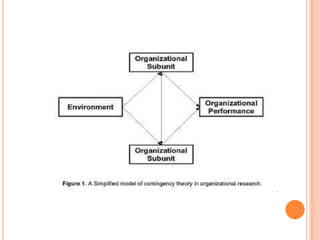
 Contingency    theories of leadership focus
  on particular variables related to the
  environment
 According to this theory, no leadership
  style is best in all situations.
 Success depends upon a number of
  variables, including the leadership
  style, qualities of the followers and
  aspects of the situation.
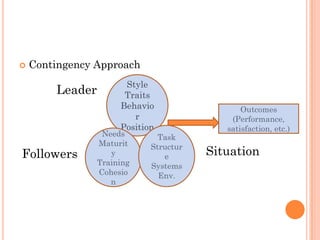
   Contingency Approach
                       Style
        Leader         Traits
                      Behavio                  Outcomes
                         r                  (Performance,
                      Position             satisfaction, etc.)
                  Needs        Task
                 Maturit     Structur
Followers           y           e       Situation
                 Training    Systems
                 Cohesio       Env.
                    n
 The leader's ability to lead is contingent
  upon various situational factors, including
 The leader's preferred style

 The capabilities

 Behaviors of followers and also various
  other situational factors.
 There   is not one single ideal
  approach to leading because
  circumstances vary.
 Change the behavior according to the
  situation.
 These particular 'situational' or
  'contingency' models offer a framework or
  guide for being flexible and adaptable
  when leading.
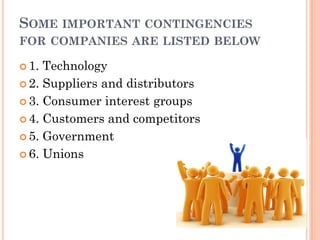
SOME IMPORTANT CONTINGENCIES
FOR COMPANIES ARE LISTED BELOW

 1. Technology
 2. Suppliers and distributors

 3. Consumer interest groups

 4. Customers and competitors

 5. Government

 6. Unions
MODELS IN CONTINGENCY LEADERSHIP
THEORY

 Kurt Lewin's Three Styles model
 Tannenbaum and Schmidt's Leadership Behavior
  Continuum model
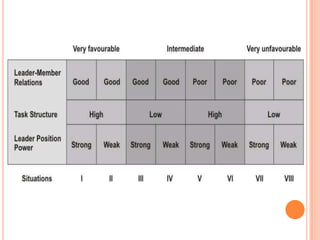
 The Fiedler Contingency model

 Path-Goal theory

 Hersey & Blanchard's Situational Leadership
  model(s)
 Bolman & Deal's Four-Frame model
HOW TO APPLY IT
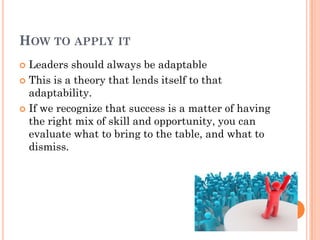
 Leaders should always be adaptable
 This is a theory that lends itself to that
  adaptability.
 If we recognize that success is a matter of having
  the right mix of skill and opportunity, you can
  evaluate what to bring to the table, and what to
  dismiss.
STRENGTHS

 Many    researchers have tested it and was
  proven valid and reliable approach to
  explaining how leadership can be achieved
 Has a broadened understanding
 Predictive, so therefore provides useful
  information about the type of leadership
 Does not require that people are effective in
  all situations.
 Data collected from this theory can be useful
LIMITATIONS
 It has been criticized because it has failed to
  explain fully why people with certain leadership
  styles are more effective in some situations then
  others
 Sometimes mismatch between the leader and the
  situation in the workplace
 Various aspects of environment has to be
  considered
CONCLUSION
 Its very important for a leader to possess
  the quality of taking decisions in different
  situations
 Acting differently in different situations

 Think differently in different situations

 Various factors

 Circumstances play important role in this
  theory
THANK YOU

The contingency leadership theory

  • 1.
  • 2.
    GROUP MEMBERS  MONICASINGH  PRANITA PADTE  SUNIL KUMAR  ARIF RATHORE  PAYEL GHOSH  ANUP KUMAR
  • 3.
    THE CONTINGENCY LEADERSHIP THEORY Itsa class of behavioral theory that claims that there is no best way to organize a corporation,  To lead a company, or  To make decisions. Instead, the optimal course of action is contingent (dependent) upon the internal and external situations  Several contingency approaches were developed in the late 1960s.
  • 4.
     Contingency theories of leadership focus on particular variables related to the environment  According to this theory, no leadership style is best in all situations.  Success depends upon a number of variables, including the leadership style, qualities of the followers and aspects of the situation.
  • 7.
    Contingency Approach Style Leader Traits Behavio Outcomes r (Performance, Position satisfaction, etc.) Needs Task Maturit Structur Followers y e Situation Training Systems Cohesio Env. n
  • 8.
     The leader'sability to lead is contingent upon various situational factors, including  The leader's preferred style  The capabilities  Behaviors of followers and also various other situational factors.
  • 9.
     There is not one single ideal approach to leading because circumstances vary.  Change the behavior according to the situation.  These particular 'situational' or 'contingency' models offer a framework or guide for being flexible and adaptable when leading.
  • 10.
    SOME IMPORTANT CONTINGENCIES FORCOMPANIES ARE LISTED BELOW  1. Technology  2. Suppliers and distributors  3. Consumer interest groups  4. Customers and competitors  5. Government  6. Unions
  • 11.
    MODELS IN CONTINGENCYLEADERSHIP THEORY  Kurt Lewin's Three Styles model  Tannenbaum and Schmidt's Leadership Behavior Continuum model  The Fiedler Contingency model  Path-Goal theory  Hersey & Blanchard's Situational Leadership model(s)  Bolman & Deal's Four-Frame model
  • 12.
    HOW TO APPLYIT  Leaders should always be adaptable  This is a theory that lends itself to that adaptability.  If we recognize that success is a matter of having the right mix of skill and opportunity, you can evaluate what to bring to the table, and what to dismiss.
  • 13.
    STRENGTHS  Many researchers have tested it and was proven valid and reliable approach to explaining how leadership can be achieved  Has a broadened understanding  Predictive, so therefore provides useful information about the type of leadership  Does not require that people are effective in all situations.  Data collected from this theory can be useful
  • 14.
    LIMITATIONS  It hasbeen criticized because it has failed to explain fully why people with certain leadership styles are more effective in some situations then others  Sometimes mismatch between the leader and the situation in the workplace  Various aspects of environment has to be considered
  • 15.
    CONCLUSION  Its veryimportant for a leader to possess the quality of taking decisions in different situations  Acting differently in different situations  Think differently in different situations  Various factors  Circumstances play important role in this theory
  • 16.