What is Leadership?What is Leadership?
Definition
◦ The process of influencing people to direct their efforts
toward the achievement of some particular goal or goals.
◦ Effective leadership involves the ability to inspire and
influence the thinking, attitudes, and behavior of people
(i.e. to motivate).
Leadership theories
◦ Theories X,Y and Z
◦ Leadership Styles
Theories X,Y and ZTheories X,Y and Z
Articulate fundamental beliefs (assumptions)
about the nature of people:
◦ Theory X – people are basically lazy; coercion and
threats of punishment often are necessary to get them to
work
◦ Theory Y – under the right conditions people not only
will work hard but will seek increased responsibility and
challenge
◦ Theory Z – workers seek opportunities to participate in
management and are motivated by teamwork and
responsibility sharing
Authoritarian LeadershipAuthoritarian Leadership
McGraw-Hill/Irwin © 2006 The McGraw-Hill Companies, Inc. All rights reserved.
Adapted from Figure 13–1: Leader–Subordinate Interactions
Authoritarian Leader
Subordinate Subordinate Subordinate
One-way downward flow of information and
influence from authoritarian leader to
subordinates.
Use of work-centered behavior designed to ensure
task accomplishment.
Authoritarian LeadershipAuthoritarian Leadership
 Leader makes all the decisions and passes the directives to
subordinates who are expected to carry these out under very close
supervision.
 Any subordinates’ attempt at questioning the directives given are
discouraged.There is little or no opportunity for subordinates to
develop initiative and creativity.
 Employee behavior is closely controlled through such means as
punishment, reward, arbitrary rules, and task orientation.
 The authoritarian leadership style is based upon the assumption that
the leader knows everything and knows what is best for the
organization. Employees are ignorant, indolent, lack ambition, dislike
responsibility, and prefer to be led.
 Employees cannot be trusted to do what is right for the organization.
Unlimited authority is thus rightly vested in the leader.
 Authoritarian leaders can be arrogant, hostile, boastful, and egotistical.
I want both of you to. . .
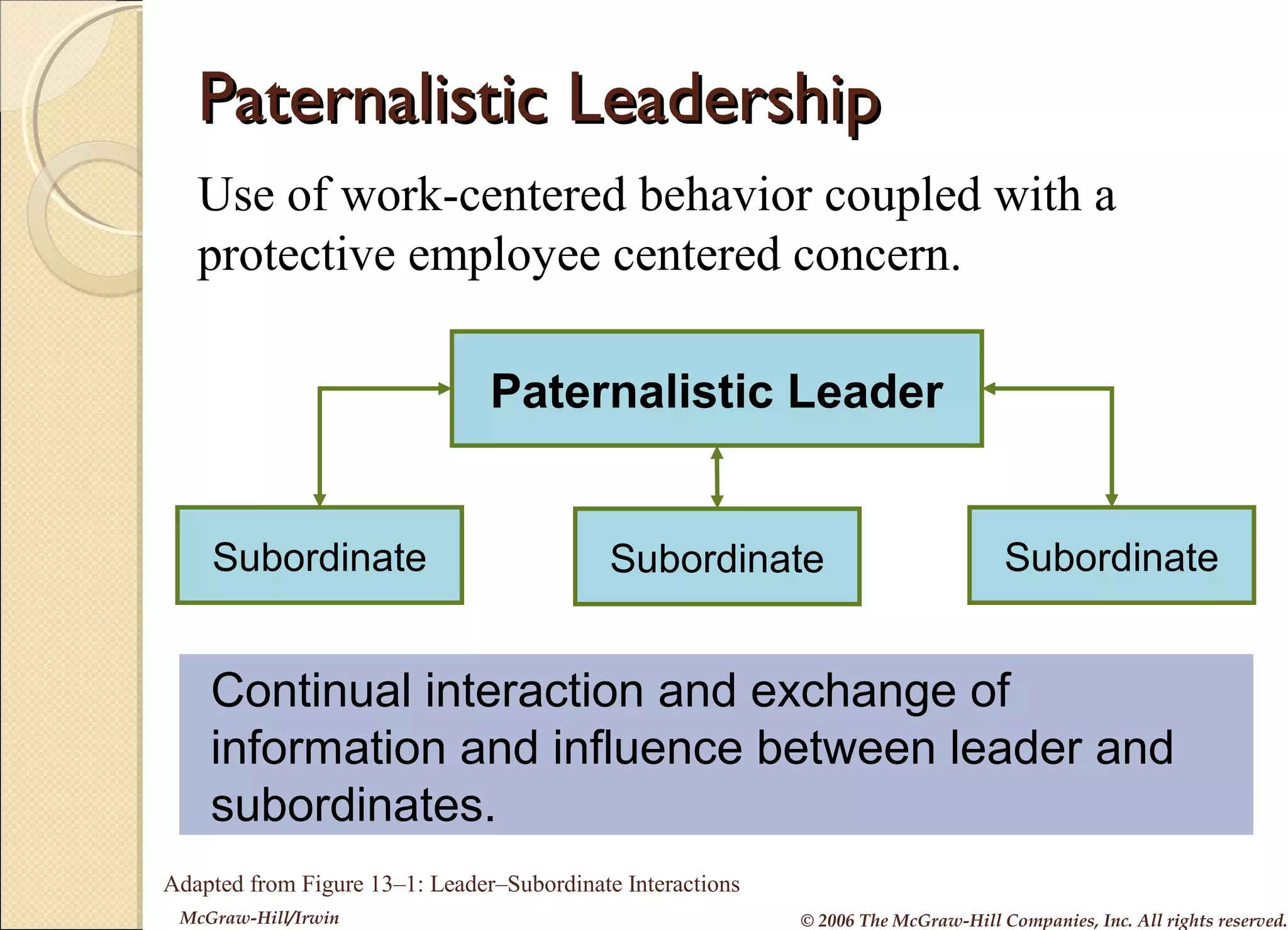
Paternalistic LeadershipPaternalistic Leadership
McGraw-Hill/Irwin © 2006 The McGraw-Hill Companies, Inc. All rights reserved.
Adapted from Figure 13–1: Leader–Subordinate Interactions
Paternalistic Leader
Subordinate Subordinate Subordinate
Continual interaction and exchange of
information and influence between leader and
subordinates.
Use of work-centered behavior coupled with a
protective employee centered concern.
Paternalistic LeadershipPaternalistic Leadership
 Paternalistic managers give more attention to the social needs
and views of their workers.
 They consult employees over issues and listen to their feedback or
opinions.The manager will however make the actual decisions (in
the best interests of the workers) as they believe the staff still need
direction.
 Typical paternalistic manager most of the times explains the specific
reason as to why he has taken certain actions in management and
for his employees. 
 Decisions take into account the best interests of the employees as
well as the business.
 Communication is generally downward, but feedback to the
management is encouraged to maintain morale.
 This style can be highly advantageous when it engenders loyalty
from the employees.
You two take care of the problem while I go. . .
Participative LeadershipParticipative Leadership
McGraw-Hill/Irwin © 2006 The McGraw-Hill Companies, Inc. All rights reserved.
Adapted from Figure 13–1: Leader–Subordinate Interactions
Participative Leader
Subordinate Subordinate Subordinate
Continual interaction and exchange of
information and influence between leader and
subordinates. Authority highly decentralized.
Use of both work- or task-centered and people
centered approaches to leading subordinates.
Participative LeadershipParticipative Leadership
 Subordinates are encouraged to express their ideas and make
suggestions. However, leader maintains the final decision making
authority.
 It is characterized by a structured but cooperative approach to
decision making. It focuses on group relationships and sensitivity to
the people in the organization.
 Fosters professional competence -supervision is minimal as individuals
take the responsibility for their behavior.
 Normally used when leader has part of the information, and
employees have other parts. Note that a leader is not expected to
know everything — this is why they employ knowledgeable and skillful
employees.
 Mutual benefit — it allows employees to become part of the team
and able to make better decisions.
 Participative leaders sell ideas.They tend to be warm, confident, and
friendly.
Let's work together to solve this.
Transformational LeadershipTransformational Leadership
Transformational leaders are characterized by four
interrelated factors:
◦ Idealized Influence – charismatic and admired; able to
enhance pride, loyalty, and confidence, and align
followers with a common purpose or vision
◦ Inspirational Motivation – extremely effective in
articulating their vision, mission, and beliefs
◦ Intellectual Stimulation – lead others to question old
paradigms and accept new views of the world
◦ Individualized Consideration – able to diagnose
and elevate the needs of each of their followers
Transformational LeadershipTransformational Leadership
 Transformational leadership is defined as a leadership
approach that causes change in individuals and social
systems. In its ideal form, it creates valuable and positive
change in the followers with the end goal of developing
followers into leaders. Enacted in its authentic form,
transformational leadership enhances the motivation, morale
and performance of his followers through a variety of
mechanisms.These include connecting the follower's sense
of identity and self to the mission and the collective identity
of the organization; being a role model for followers that
inspires them; challenging followers to take greater
ownership for their work, and understanding the strengths
and weaknesses of followers, so the leader can align
followers with tasks that optimise their performance.
Scientific leadershipScientific leadership
 Standard methods for doing a job - the worker is not
required to think, only the leader
 Bureaucratic organizations the result: carefully
designed hierarchy of authority, with clearly defined
responsibilities
◦ Functions specialized, information and control centralized
◦ Uniform application of standard rules and procedures
The new leadershipThe new leadership
The transformational leader
◦ creates, communicates and embodies a vision which can influence
changes in the attitudes and assumptions of subordinates
◦ builds their commitment inspires trust, confidence and loyalty
Bass (1985) compares this with the traditional,
transactional leader
◦ has more of a ‘business-like’ relation with subordinates
◦ appeals to the self-interest of all parties
Bass maintains that business needs both types of
leadership: the most effective leaders combine the two
styles
Cultural contingency factorsCultural contingency factors
 Leaders may be forced to alter their leadership behaviour to
conform to the cultural realities they face, e.g.
◦ in large power distance cultures an ideal leader may well be
expected to display great authority, to the benefit of those
being led
◦ in some cultures which prefer rules and avoid ambiguities the
leader may well need to give strong direction
 A further contingency factor: the cultural profile of the leader
who is making decisions as to how best to lead
GenderGender
 Gender stereotypes may hamper developing an appropriate
effective style of leadership
 Overcoming these stereotypes, while focusing on the
characteristics appropriate to the position, is the key task of any
candidate for leadership, whether male or female
 Male and female leaders, it appears, display differing behavioural
tendencies whatever their country of origin
 Although leadership style may be based on gender, differences in
the leadership style employed are based more on culture than
on gender

Leadership Style

  • 1.
    What is Leadership?Whatis Leadership? Definition ◦ The process of influencing people to direct their efforts toward the achievement of some particular goal or goals. ◦ Effective leadership involves the ability to inspire and influence the thinking, attitudes, and behavior of people (i.e. to motivate). Leadership theories ◦ Theories X,Y and Z ◦ Leadership Styles
  • 2.
    Theories X,Y andZTheories X,Y and Z Articulate fundamental beliefs (assumptions) about the nature of people: ◦ Theory X – people are basically lazy; coercion and threats of punishment often are necessary to get them to work ◦ Theory Y – under the right conditions people not only will work hard but will seek increased responsibility and challenge ◦ Theory Z – workers seek opportunities to participate in management and are motivated by teamwork and responsibility sharing
  • 3.
    Authoritarian LeadershipAuthoritarian Leadership McGraw-Hill/Irwin© 2006 The McGraw-Hill Companies, Inc. All rights reserved. Adapted from Figure 13–1: Leader–Subordinate Interactions Authoritarian Leader Subordinate Subordinate Subordinate One-way downward flow of information and influence from authoritarian leader to subordinates. Use of work-centered behavior designed to ensure task accomplishment.
  • 4.
    Authoritarian LeadershipAuthoritarian Leadership Leader makes all the decisions and passes the directives to subordinates who are expected to carry these out under very close supervision.  Any subordinates’ attempt at questioning the directives given are discouraged.There is little or no opportunity for subordinates to develop initiative and creativity.  Employee behavior is closely controlled through such means as punishment, reward, arbitrary rules, and task orientation.  The authoritarian leadership style is based upon the assumption that the leader knows everything and knows what is best for the organization. Employees are ignorant, indolent, lack ambition, dislike responsibility, and prefer to be led.  Employees cannot be trusted to do what is right for the organization. Unlimited authority is thus rightly vested in the leader.  Authoritarian leaders can be arrogant, hostile, boastful, and egotistical. I want both of you to. . .
  • 5.
    Paternalistic LeadershipPaternalistic Leadership McGraw-Hill/Irwin© 2006 The McGraw-Hill Companies, Inc. All rights reserved. Adapted from Figure 13–1: Leader–Subordinate Interactions Paternalistic Leader Subordinate Subordinate Subordinate Continual interaction and exchange of information and influence between leader and subordinates. Use of work-centered behavior coupled with a protective employee centered concern.
  • 6.
    Paternalistic LeadershipPaternalistic Leadership Paternalistic managers give more attention to the social needs and views of their workers.  They consult employees over issues and listen to their feedback or opinions.The manager will however make the actual decisions (in the best interests of the workers) as they believe the staff still need direction.  Typical paternalistic manager most of the times explains the specific reason as to why he has taken certain actions in management and for his employees.   Decisions take into account the best interests of the employees as well as the business.  Communication is generally downward, but feedback to the management is encouraged to maintain morale.  This style can be highly advantageous when it engenders loyalty from the employees. You two take care of the problem while I go. . .
  • 7.
    Participative LeadershipParticipative Leadership McGraw-Hill/Irwin© 2006 The McGraw-Hill Companies, Inc. All rights reserved. Adapted from Figure 13–1: Leader–Subordinate Interactions Participative Leader Subordinate Subordinate Subordinate Continual interaction and exchange of information and influence between leader and subordinates. Authority highly decentralized. Use of both work- or task-centered and people centered approaches to leading subordinates.
  • 8.
    Participative LeadershipParticipative Leadership Subordinates are encouraged to express their ideas and make suggestions. However, leader maintains the final decision making authority.  It is characterized by a structured but cooperative approach to decision making. It focuses on group relationships and sensitivity to the people in the organization.  Fosters professional competence -supervision is minimal as individuals take the responsibility for their behavior.  Normally used when leader has part of the information, and employees have other parts. Note that a leader is not expected to know everything — this is why they employ knowledgeable and skillful employees.  Mutual benefit — it allows employees to become part of the team and able to make better decisions.  Participative leaders sell ideas.They tend to be warm, confident, and friendly. Let's work together to solve this.
  • 9.
    Transformational LeadershipTransformational Leadership Transformationalleaders are characterized by four interrelated factors: ◦ Idealized Influence – charismatic and admired; able to enhance pride, loyalty, and confidence, and align followers with a common purpose or vision ◦ Inspirational Motivation – extremely effective in articulating their vision, mission, and beliefs ◦ Intellectual Stimulation – lead others to question old paradigms and accept new views of the world ◦ Individualized Consideration – able to diagnose and elevate the needs of each of their followers
  • 10.
    Transformational LeadershipTransformational Leadership Transformational leadership is defined as a leadership approach that causes change in individuals and social systems. In its ideal form, it creates valuable and positive change in the followers with the end goal of developing followers into leaders. Enacted in its authentic form, transformational leadership enhances the motivation, morale and performance of his followers through a variety of mechanisms.These include connecting the follower's sense of identity and self to the mission and the collective identity of the organization; being a role model for followers that inspires them; challenging followers to take greater ownership for their work, and understanding the strengths and weaknesses of followers, so the leader can align followers with tasks that optimise their performance.
  • 11.
    Scientific leadershipScientific leadership Standard methods for doing a job - the worker is not required to think, only the leader  Bureaucratic organizations the result: carefully designed hierarchy of authority, with clearly defined responsibilities ◦ Functions specialized, information and control centralized ◦ Uniform application of standard rules and procedures
  • 12.
    The new leadershipThenew leadership The transformational leader ◦ creates, communicates and embodies a vision which can influence changes in the attitudes and assumptions of subordinates ◦ builds their commitment inspires trust, confidence and loyalty Bass (1985) compares this with the traditional, transactional leader ◦ has more of a ‘business-like’ relation with subordinates ◦ appeals to the self-interest of all parties Bass maintains that business needs both types of leadership: the most effective leaders combine the two styles
  • 13.
    Cultural contingency factorsCulturalcontingency factors  Leaders may be forced to alter their leadership behaviour to conform to the cultural realities they face, e.g. ◦ in large power distance cultures an ideal leader may well be expected to display great authority, to the benefit of those being led ◦ in some cultures which prefer rules and avoid ambiguities the leader may well need to give strong direction  A further contingency factor: the cultural profile of the leader who is making decisions as to how best to lead
  • 14.
    GenderGender  Gender stereotypesmay hamper developing an appropriate effective style of leadership  Overcoming these stereotypes, while focusing on the characteristics appropriate to the position, is the key task of any candidate for leadership, whether male or female  Male and female leaders, it appears, display differing behavioural tendencies whatever their country of origin  Although leadership style may be based on gender, differences in the leadership style employed are based more on culture than on gender