Learning Objectives
Leader’sType
Leader’s Model
Leader’s Character
Intelligence and Personality
Communication and Motivation
3.
Leader Types
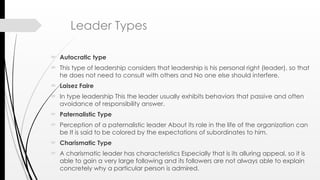
Autocratictype
This type of leadership considers that leadership is his personal right (leader), so that
he does not need to consult with others and No one else should interfere.
Laisez Faire
In type leadership This the leader usually exhibits behaviors that passive and often
avoidance of responsibility answer.
Paternalistic Type
Perception of a paternalistic leader About its role in the life of the organization can
be It is said to be colored by the expectations of subordinates to him.
Charismatic Type
A charismatic leader has characteristics Especially that is its alluring appeal, so it is
able to gain a very large following and its followers are not always able to explain
concretely why a particular person is admired.
4.
Leader Types
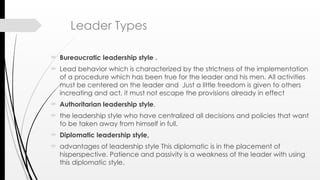
Bureaucraticleadership style .
Lead behavior which is characterized by the strictness of the implementation
of a procedure which has been true for the leader and his men. All activities
must be centered on the leader and Just a little freedom is given to others
increating and act, it must not escape the provisions already in effect
Authoritarian leadership style,
the leadership style who have centralized all decisions and policies that want
to be taken away from himself in full.
Diplomatic leadership style,
advantages of leadership style This diplomatic is in the placement of
hisperspective. Patience and passivity is a weakness of the leader with using
this diplomatic style.
5.
Leader Types
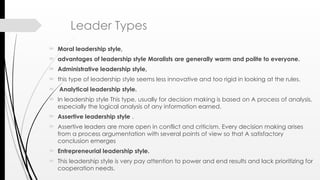
Moralleadership style,
advantages of leadership style Moralists are generally warm and polite to everyone.
Administrative leadership style,
this type of leadership style seems less innovative and too rigid in looking at the rules.
Analytical leadership style.
In leadership style This type, usually for decision making is based on A process of analysis,
especially the logical analysis of any information earned.
Assertive leadership style .
Assertive leaders are more open in conflict and criticism. Every decision making arises
from a process argumentation with several points of view so that A satisfactory
conclusion emerges
Entrepreneurial leadership style.
This leadership style is very pay attention to power and end results and lack prioritizing for
cooperation needs.
6.
Leader Types
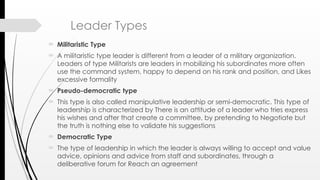
MilitaristicType
A militaristic type leader is different from a leader of a military organization.
Leaders of type Militarists are leaders in mobilizing his subordinates more often
use the command system, happy to depend on his rank and position, and Likes
excessive formality
Pseudo-democratic type
This type is also called manipulative leadership or semi-democratic. This type of
leadership is characterized by There is an attitude of a leader who tries express
his wishes and after that create a committee, by pretending to Negotiate but
the truth is nothing else to validate his suggestions
Democratic Type
The type of leadership in which the leader is always willing to accept and value
advice, opinions and advice from staff and subordinates, through a
deliberative forum for Reach an agreement
7.
Leadership Model
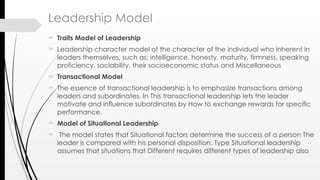
TraitsModel of Leadership
Leadership character model of the character of the individual who inherent in
leaders themselves, such as: intelligence, honesty, maturity, firmness, speaking
proficiency, sociability, their socioeconomic status and Miscellaneous
Transactional Model
The essence of transactional leadership is to emphasize transactions among
leaders and subordinates. In This transactional leadership lets the leader
motivate and influence subordinates by How to exchange rewards for specific
performance.
Model of Situational Leadership
The model states that Situational factors determine the success of a person The
leader is compared with his personal disposition. Type Situational leadership
assumes that situations that Different requires different types of leadership also
8.
Leadership Model
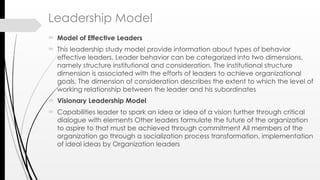
Modelof Effective Leaders
This leadership study model provide information about types of behavior
effective leaders. Leader behavior can be categorized into two dimensions,
namely structure institutional and consideration. The institutional structure
dimension is associated with the efforts of leaders to achieve organizational
goals. The dimension of consideration describes the extent to which the level of
working relationship between the leader and his subordinates
Visionary Leadership Model
Capabilities leader to spark an idea or idea of a vision further through critical
dialogue with elements Other leaders formulate the future of the organization
to aspire to that must be achieved through commitment All members of the
organization go through a socialization process transformation, implementation
of ideal ideas by Organization leaders
9.
Leadership Model
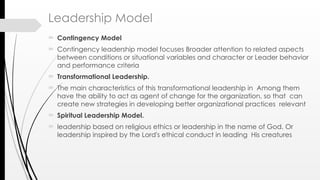
ContingencyModel
Contingency leadership model focuses Broader attention to related aspects
between conditions or situational variables and character or Leader behavior
and performance criteria
Transformational Leadership.
The main characteristics of this transformational leadership in Among them
have the ability to act as agent of change for the organization, so that can
create new strategies in developing better organizational practices relevant
Spiritual Leadership Model.
leadership based on religious ethics or leadership in the name of God. Or
leadership inspired by the Lord's ethical conduct in leading His creatures
10.
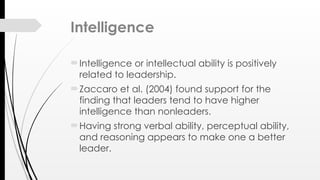
Intelligence
Intelligence or intellectualability is positively
related to leadership.
Zaccaro et al. (2004) found support for the
finding that leaders tend to have higher
intelligence than nonleaders.
Having strong verbal ability, perceptual ability,
and reasoning appears to make one a better
leader.
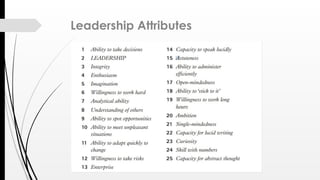
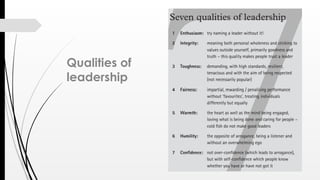
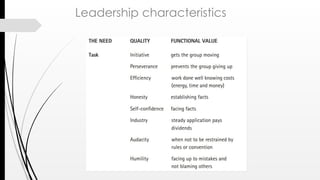
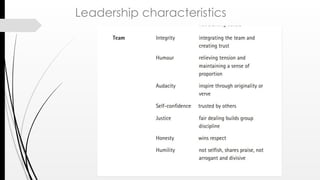
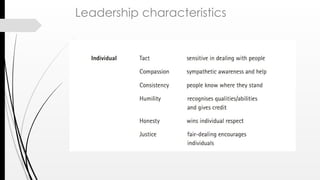
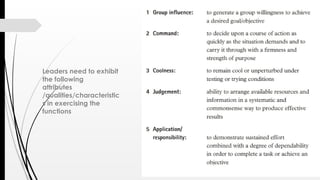
Leaders need toexhibit
the following
attributes
/qualities/characteristic
s in exercising the
functions
18.
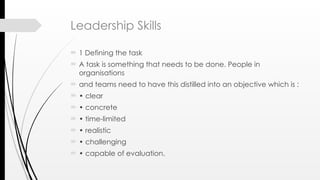
Leadership Skills
1Defining the task
A task is something that needs to be done. People in
organisations
and teams need to have this distilled into an objective which is :
• clear
• concrete
• time-limited
• realistic
• challenging
• capable of evaluation.
19.
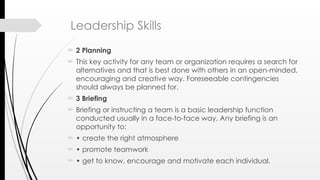
Leadership Skills
2Planning
This key activity for any team or organization requires a search for
alternatives and that is best done with others in an open-minded,
encouraging and creative way. Foreseeable contingencies
should always be planned for.
3 Briefing
Briefing or instructing a team is a basic leadership function
conducted usually in a face-to-face way. Any briefing is an
opportunity to:
• create the right atmosphere
• promote teamwork
• get to know, encourage and motivate each individual.
20.
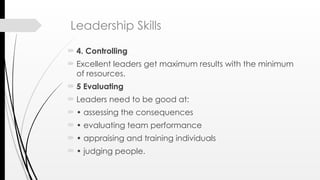
Leadership Skills
4.Controlling
Excellent leaders get maximum results with the minimum
of resources.
5 Evaluating
Leaders need to be good at:
• assessing the consequences
• evaluating team performance
• appraising and training individuals
• judging people.
21.
Leadership Skills
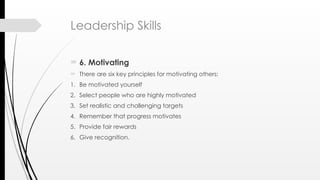
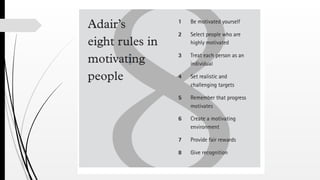
6.Motivating
There are six key principles for motivating others:
1. Be motivated yourself
2. Select people who are highly motivated
3. Set realistic and challenging targets
4. Remember that progress motivates
5. Provide fair rewards
6. Give recognition.
22.
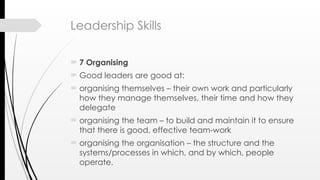
Leadership Skills
7Organising
Good leaders are good at:
organising themselves – their own work and particularly
how they manage themselves, their time and how they
delegate
organising the team – to build and maintain it to ensure
that there is good, effective team-work
organising the organisation – the structure and the
systems/processes in which, and by which, people
operate.
23.
Leadership Skills
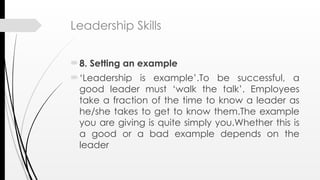
8. Settingan example
‘Leadership is example’.To be successful, a
good leader must ‘walk the talk’. Employees
take a fraction of the time to know a leader as
he/she takes to get to know them.The example
you are giving is quite simply you.Whether this is
a good or a bad example depends on the
leader
24.
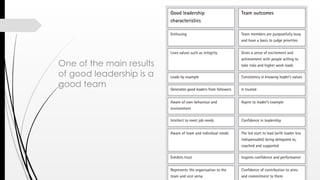
One of themain results
of good leadership is a
good team
Big Five PersonalityTraits
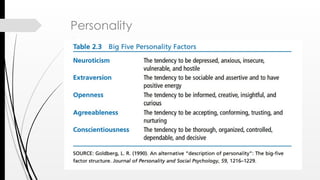
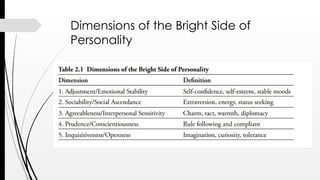
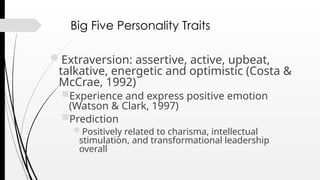
Extraversion: assertive, active, upbeat,
talkative, energetic and optimistic (Costa &
McCrae, 1992)
Experience and express positive emotion
(Watson & Clark, 1997)
Prediction
Positively related to charisma, intellectual
stimulation, and transformational leadership
overall
28.
Big Five PersonalityTraits
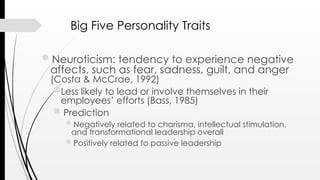
Neuroticism: tendency to experience negative
affects, such as fear, sadness, guilt, and anger
(Costa & McCrae, 1992)
Less likely to lead or involve themselves in their
employees’ efforts (Bass, 1985)
Prediction
Negatively related to charisma, intellectual stimulation,
and transformational leadership overall
Positively related to passive leadership
29.
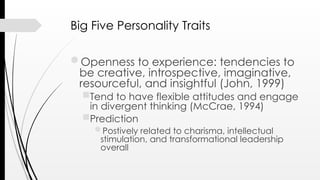
Big Five PersonalityTraits
Openness to experience: tendencies to
be creative, introspective, imaginative,
resourceful, and insightful (John, 1999)
Tend to have flexible attitudes and engage
in divergent thinking (McCrae, 1994)
Prediction
Postively related to charisma, intellectual
stimulation, and transformational leadership
overall
30.
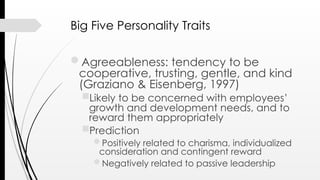
Big Five PersonalityTraits
Agreeableness: tendency to be
cooperative, trusting, gentle, and kind
(Graziano & Eisenberg, 1997)
Likely to be concerned with employees’
growth and development needs, and to
reward them appropriately
Prediction
Positively related to charisma, individualized
consideration and contingent reward
Negatively related to passive leadership
31.
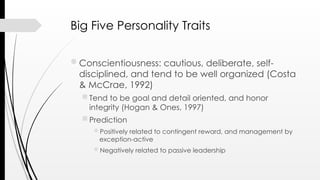
Big Five PersonalityTraits
Conscientiousness: cautious, deliberate, self-
disciplined, and tend to be well organized (Costa
& McCrae, 1992)
Tend to be goal and detail oriented, and honor
integrity (Hogan & Ones, 1997)
Prediction
Positively related to contingent reward, and management by
exception-active
Negatively related to passive leadership
32.
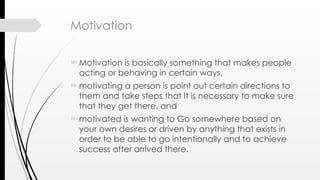
Motivation
Motivation is basicallysomething that makes people
acting or behaving in certain ways,
motivating a person is point out certain directions to
them and take steps that It is necessary to make sure
that they get there, and
motivated is wanting to Go somewhere based on
your own desires or driven by anything that exists in
order to be able to go intentionally and to achieve
success after arrived there.
33.
3C Motivation
Motivationis the desire to utilize business by higher levels to
achieve organizational goals. Leveraging the higher. You
want to utilize and encourage company performance You
increase then the motivation so that the performance of
others or your employees is greater.
Motivation is determined by 3 things that we call the Three
C's of Motivation, namely:
Collaboration,
Content and
Choice,
Two basic formsof motivation
Artificial motivation (Extrinsic),
which is what is done to people to motivate
them.
Intrinsic motivation,
which are factors that come from within oneself
that influence people to behave or to move in a
certain direction
36.
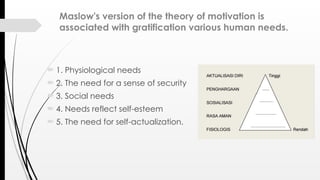
Maslow's version ofthe theory of motivation is
associated with gratification various human needs.
1. Physiological needs
2. The need for a sense of security
3. Social needs
4. Needs reflect self-esteem
5. The need for self-actualization.
37.
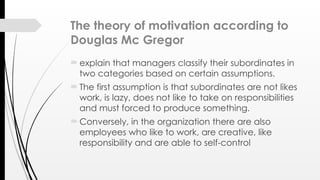
The theory ofmotivation according to
Douglas Mc Gregor
explain that managers classify their subordinates in
two categories based on certain assumptions.
The first assumption is that subordinates are not likes
work, is lazy, does not like to take on responsibilities
and must forced to produce something.
Conversely, in the organization there are also
employees who like to work, are creative, like
responsibility and are able to self-control
38.
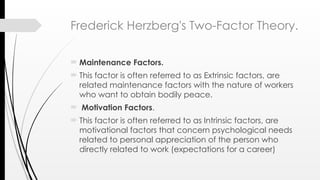
Frederick Herzberg's Two-FactorTheory.
Maintenance Factors.
This factor is often referred to as Extrinsic factors, are
related maintenance factors with the nature of workers
who want to obtain bodily peace.
Motivation Factors.
This factor is often referred to as Intrinsic factors, are
motivational factors that concern psychological needs
related to personal appreciation of the person who
directly related to work (expectations for a career)
39.
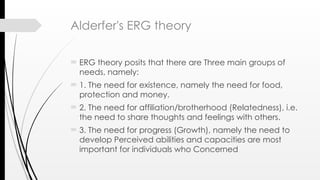
Alderfer's ERG theory
ERG theory posits that there are Three main groups of
needs, namely:
1. The need for existence, namely the need for food,
protection and money.
2. The need for affiliation/brotherhood (Relatedness), i.e.
the need to share thoughts and feelings with others.
3. The need for progress (Growth), namely the need to
develop Perceived abilities and capacities are most
important for individuals who Concerned
40.
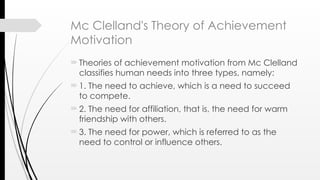
Mc Clelland's Theoryof Achievement
Motivation
Theories of achievement motivation from Mc Clelland
classifies human needs into three types, namely:
1. The need to achieve, which is a need to succeed
to compete.
2. The need for affiliation, that is, the need for warm
friendship with others.
3. The need for power, which is referred to as the
need to control or influence others.
41.
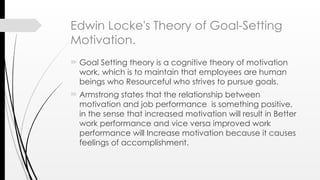
Edwin Locke's Theoryof Goal-Setting
Motivation.
Goal Setting theory is a cognitive theory of motivation
work, which is to maintain that employees are human
beings who Resourceful who strives to pursue goals.
Armstrong states that the relationship between
motivation and job performance is something positive,
in the sense that increased motivation will result in Better
work performance and vice versa improved work
performance will Increase motivation because it causes
feelings of accomplishment.
43.
Communication
Communication skills inall forms,
including non-verbal communication,
need to be worked at and improved
to ensure you understand people
and they understand you
44.
Issues in communication
You must be in social contact with the other person or
people
You must want to communicate
It is better to risk familiarity than be condemned to
remoteness
The best way to empower others is to impart information
(along with the delegated authority to make decisions
and act on the information given)
Get out of your office – meet, listen, provide information
and give people the context in which they operate – to
communicate and encourage
45.
Issues in communication
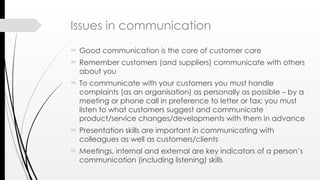
Good communication is the core of customer care
Remember customers (and suppliers) communicate with others
about you
To communicate with your customers you must handle
complaints (as an organisation) as personally as possible – by a
meeting or phone call in preference to letter or fax; you must
listen to what customers suggest and communicate
product/service changes/developments with them in advance
Presentation skills are important in communicating with
colleagues as well as customers/clients
Meetings, internal and external are key indicators of a person’s
communication (including listening) skills
46.
Issues in communication
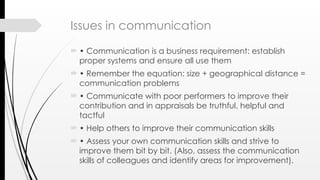
• Communication is a business requirement: establish
proper systems and ensure all use them
• Remember the equation: size + geographical distance =
communication problems
• Communicate with poor performers to improve their
contribution and in appraisals be truthful, helpful and
tactful
• Help others to improve their communication skills
• Assess your own communication skills and strive to
improve them bit by bit. (Also, assess the communication
skills of colleagues and identify areas for improvement).
47.
Personal communication skills
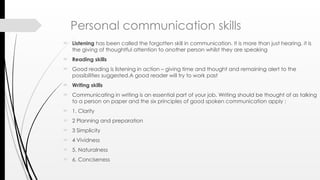
Listening has been called the forgotten skill in communication. It is more than just hearing, it is
the giving of thoughtful attention to another person whilst they are speaking
Reading skills
Good reading is listening in action – giving time and thought and remaining alert to the
possibilities suggested.A good reader will try to work past
Writing skills
Communicating in writing is an essential part of your job. Writing should be thought of as talking
to a person on paper and the six principles of good spoken communication apply :
1. Clarity
2 Planning and preparation
3 Simplicity
4 Vividness
5. Naturalness
6. Conciseness
48.
Speaking and presentationskills
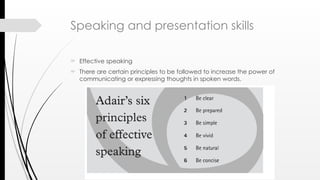
Effective speaking
There are certain principles to be followed to increase the power of
communicating or expressing thoughts in spoken words.
49.
Presentation skills
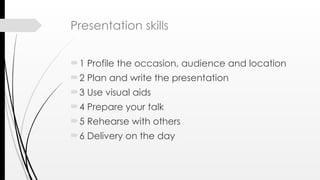
1 Profilethe occasion, audience and location
2 Plan and write the presentation
3 Use visual aids
4 Prepare your talk
5 Rehearse with others
6 Delivery on the day
50.
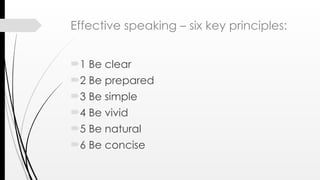
Effective speaking –six key principles:
1 Be clear
2 Be prepared
3 Be simple
4 Be vivid
5 Be natural
6 Be concise


![03 - Project Management Process Group [Online Class] - FGD.pdf](https://cdn.slidesharecdn.com/ss_thumbnails/03-projectmanagementprocessgrouponlineclass-fgd-250925212720-fe6ee97b-thumbnail.jpg?width=640&height=640&fit=bounds)
![02 - Project Management and IT Context [Online Class].pdf](https://cdn.slidesharecdn.com/ss_thumbnails/02-projectmanagementanditcontextonlineclass-250925212631-5bfaa477-thumbnail.jpg?width=640&height=640&fit=bounds)
![01 - IT Project Management [Online Class].pdf](https://cdn.slidesharecdn.com/ss_thumbnails/01-itprojectmanagementonlineclass-250925212537-9e4d0d6b-thumbnail.jpg?width=640&height=640&fit=bounds)
![04 - Project Integration [Online Class].pdf](https://cdn.slidesharecdn.com/ss_thumbnails/04-projectintegrationonlineclass-250925212349-5585e7bd-thumbnail.jpg?width=640&height=640&fit=bounds)


