Overview
Chapters 1 to 4
A First Look at
Communication Theory
9th Edition
Griffin, Ledbetter & Sparks
Intro to Communication Theory
Aitza M. Haddad Nunez, J.D., LL.M.
Chapter 1: Launching your Study of Communication Theory
Chapter 2: Talk About Theory
Chapter 3: Weighting the Words
Chapter 4: Mapping the Territory
Quiz #1
Overview
Chapter 1:
Launching your
Study of
Communication
Theory
Pages 1 – 12
What is a Theory and What does it Do?
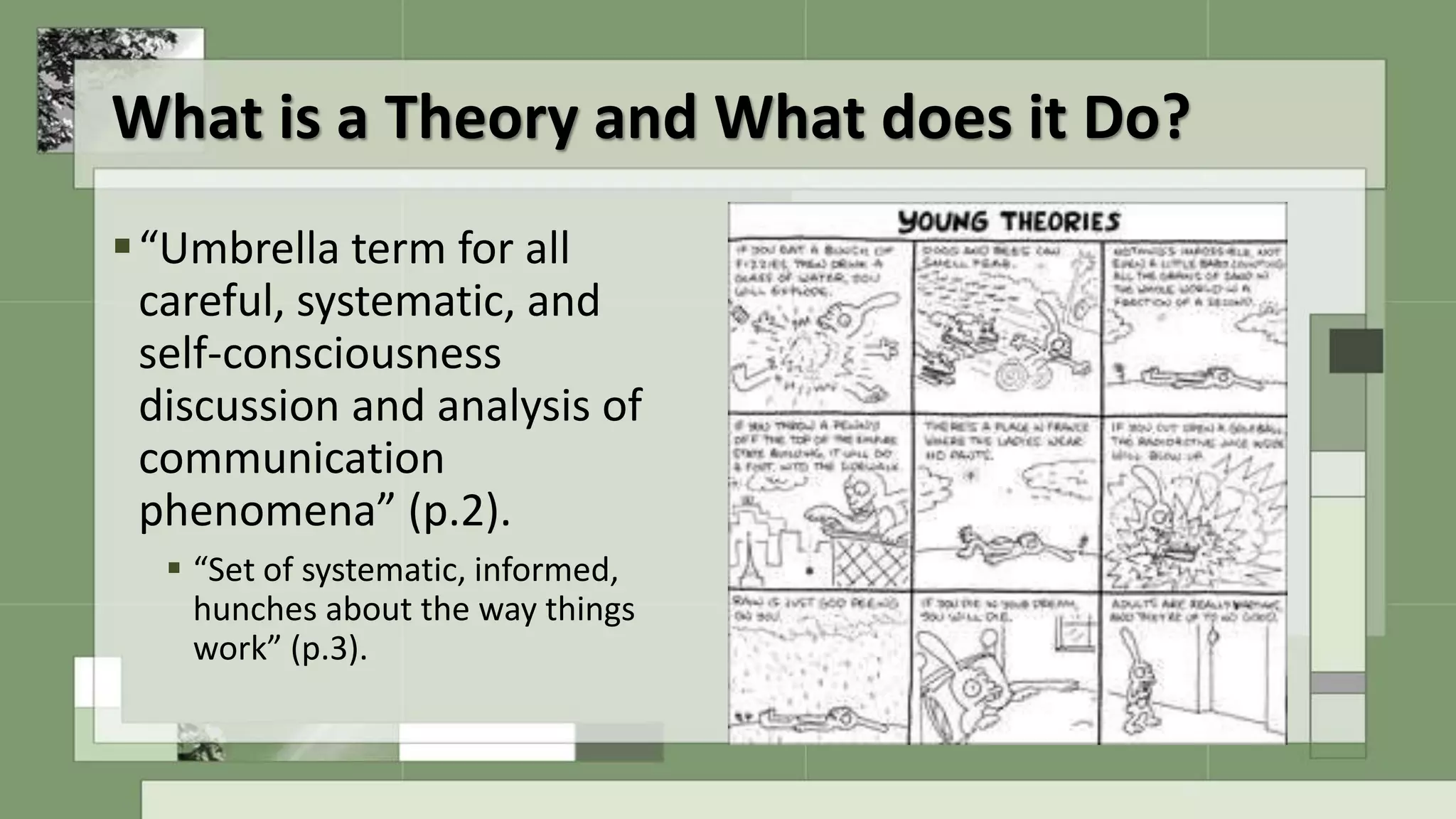
“Umbrella term for all
careful, systematic, and
self-consciousness
discussion and analysis of
communication
phenomena” (p.2).
 “Set of systematic, informed,
hunches about the way things
work” (p.3).
 Not enough to think carefully about an idea…
 Theorists have a responsibility to cast light on the subject of study by:
 Reading, Talking, Observing, and Experimenting
 Having a degree of familiarity with alternative explanations and interpretations
 Integrated system of concepts…
 Specific and clear links among the informed hunches.
 Ideas tied together into a unified whole – No one-shot claims
Set of systematic, informed, hunches…
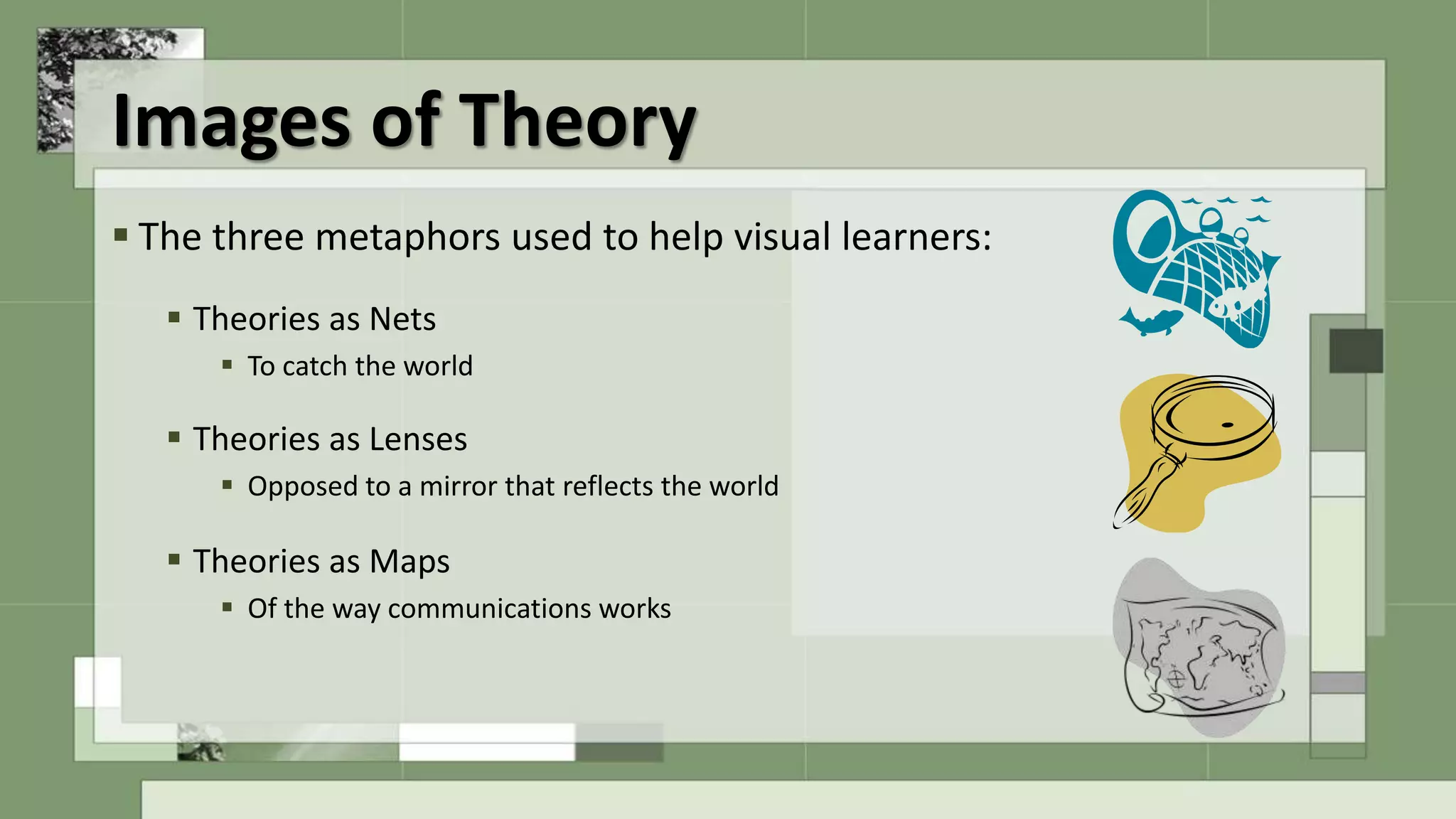
 The three metaphors used to help visual learners:
 Theories as Nets
 To catch the world
 Theories as Lenses
 Opposed to a mirror that reflects the world
 Theories as Maps
 Of the way communications works
Images of Theory
Not one definition – Concept is seriously overburderned.
 Essential feautures:
“Relational process of creating and interpreting messages that elicit a response”
1. Messages – Texts
2. Creation of Messages – Conscious choice of text form and substance
3. Interpretation of Messages – Words don’t mean things, people means things
4. A Relational Process – One cannot step into the same river twice
5. Messages that Elicit a Response – Communication must provoke a response
And What is Communication?
Activity 1: So What is a Theory?
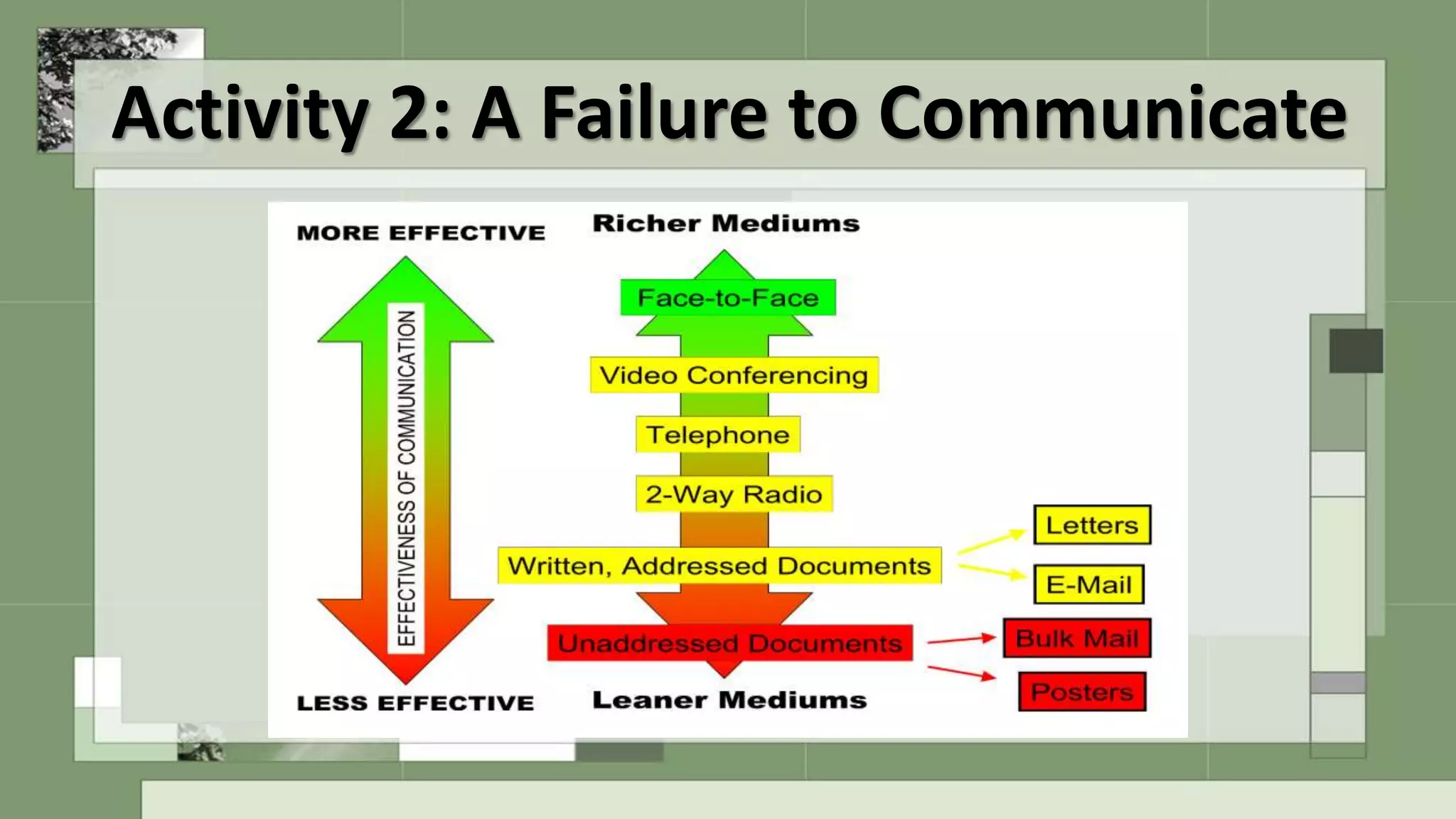
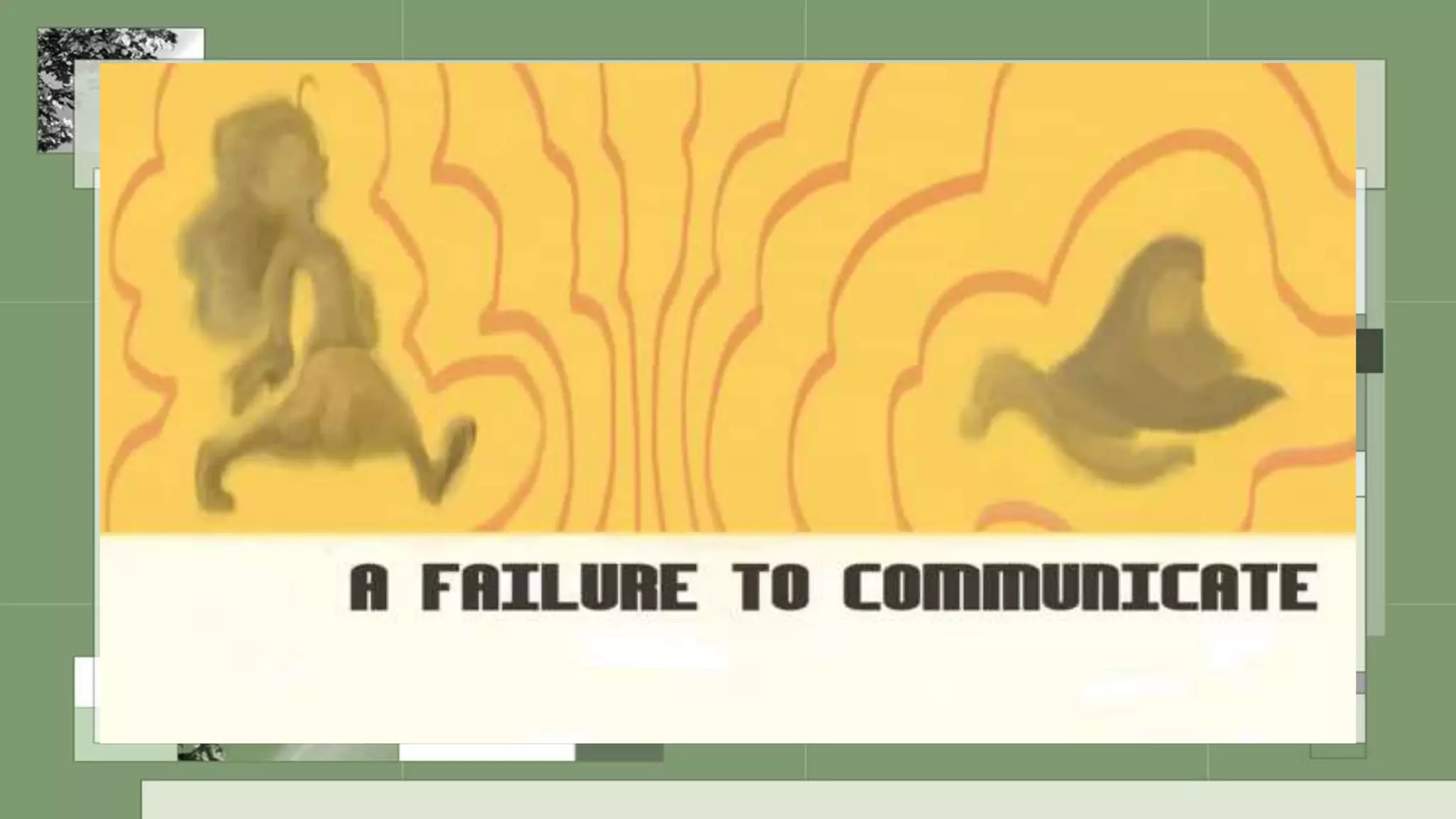
Activity 2: A Failure to Communicate
Chapter 2:
Talk About
Theory
Pages 13 – 23
An Objective Approach
 Social Scientists – Why an event produced a specific sentiment and
whether it resulted in action.
 After observation, a theory is identified or constructed to offer insights about
what it was observed.
 Resonance Principle of Communication
 Persuasion – arguments v. memories
 Theory Validation
 “Objective test to identify if a theory is faulty” (p.14)
 Theory + Research
An Interpretative Approach
Archetypal Myths
Draw upon universal
experiences
 Carl Jung – “collective
unconscious”
 Michael Osborn –
Archetypes touches off
“depth responses” that
emotionally resonate at
the core of our being (p.15)
Objective v. Interpretative
 Approaches to communication study differ in:
 Starting point, Method and Conclusion
 Assumptions about ways of arriving to knowledge
 The core of human nature, questions of value, and the purpose of having
theory
 Objective → Scientist → Objective Scholar
 Interpretative
 “[A]ll rhetorical critics do interpretative analysis, not all interpretative scholars are
rhetoricians” (p.16).
 Interpretative Scholars
 Rhetoricians, humanists, postmodernists, or critical scholars
Truth v. Multiple Realities
 Epistemology
 “[W]e all inevitably make assumptions about the nature of knowledge” (p.16).
 Scientists
 Good Theory = Faithful representations of the way the world really is.
 Science seeks to be bias-free – evidence should speak for itself.
 No one person can know it all → Pool of findings to build a collective body of knowledge
about how the world works.
 “[O]nce a principle is discovered and validated, it will continue to hold true as long as
conditions remain relatively the same” (p.16)
 Interpreters
 Truth is socially constructed through communication
 “Text may have multiple meanings” (p.17).
Determinism v. Free Will
 Question of Human Choice
 Hard-line determinists – every move we make is the result of heredity and
environment.
 Scientists – Stress the forces that shape human behavior
 Free will purists – every human act is ultimately voluntary (p.17)
 Interpretative Scholars
 Focus on conscious choices made by individuals
 Language
 Reflects theorists views of human nature
 “I had to” v. “I decided to” / “In order to” and “So that”
 “[A]s individual freedom goes up, predictability of behavior goes down” (p.18)
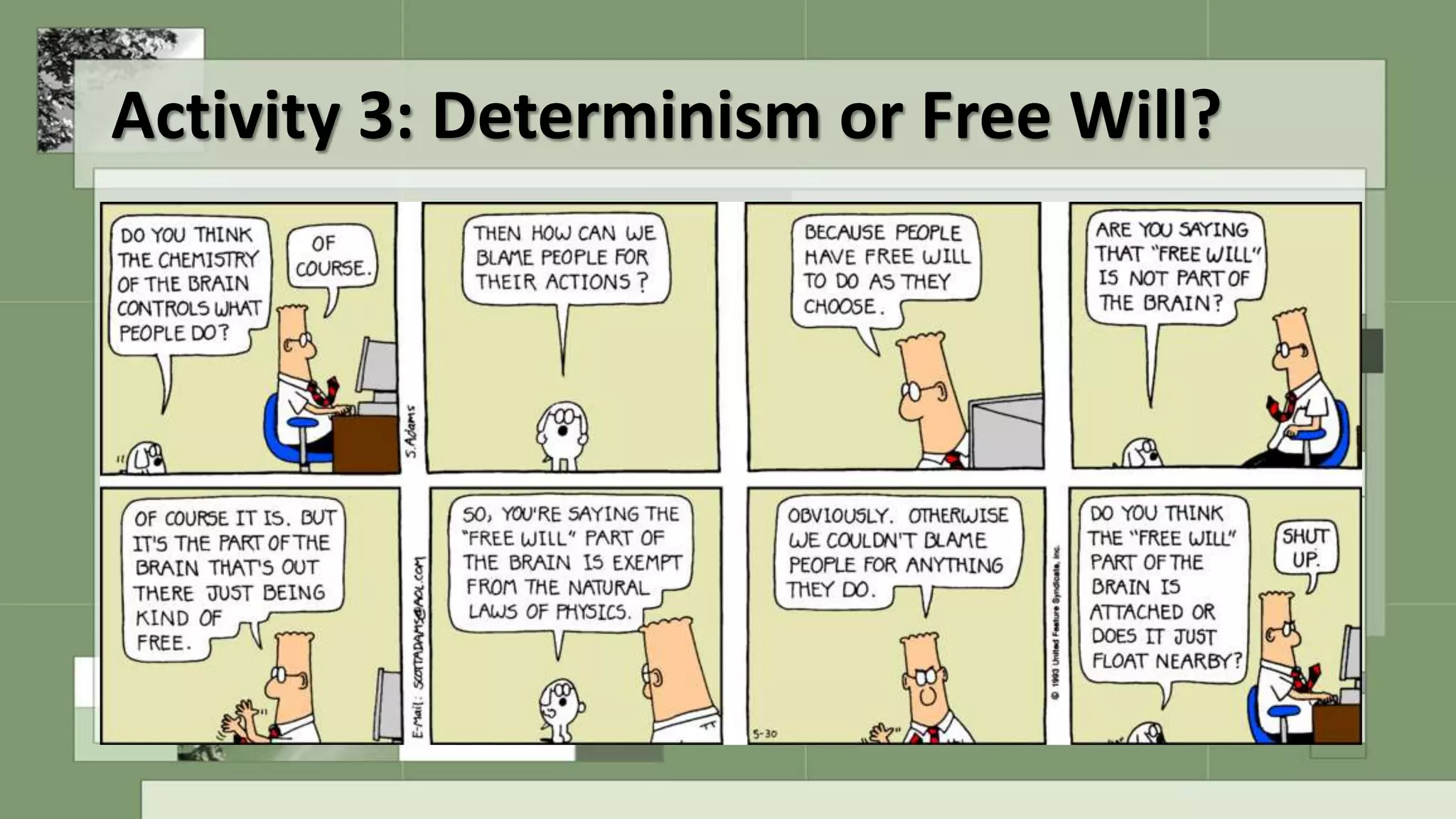
Activity 3: Determinism or Free Will?
Now listen…
Objective v. Emancipation
 “Significant decisions are value laden”
 Value – priorities and issues of relative worth.
 “Traffic light that guide what we think, feel, and do” (p.18)
 Behavioral Scientists → Empirical Evidence
 Critical Interpreters → “[K]nowledge is never neutral” (p.19)
 Seeks to emancipate = liberate people from oppression of any sort
 Stan Deetz
 General Communication Theories have two priorities:
1. Effectiveness – successful communication / persuasion
2. Participation – increase point of views / difference, opposition and independence
Universal Laws v. Interpretative Guides
 Behavioral Scientists
 “Pin down universal laws of human behavior that cover a variety of
situations” (p.19)
 Theory Testing
 Hunch of ideas about how the world works → Hypothesis → Test after Test
 Rhetorical Critic
 Strive “to interpret a particular communication text in a specific context”
(p.19)
 “[E]xplores the web of meaning that constitutes human existence” (p.20)
 No Theory Testing
 Theory tells “what to look for,” “what to make of it,” and “whether to consider it significant”
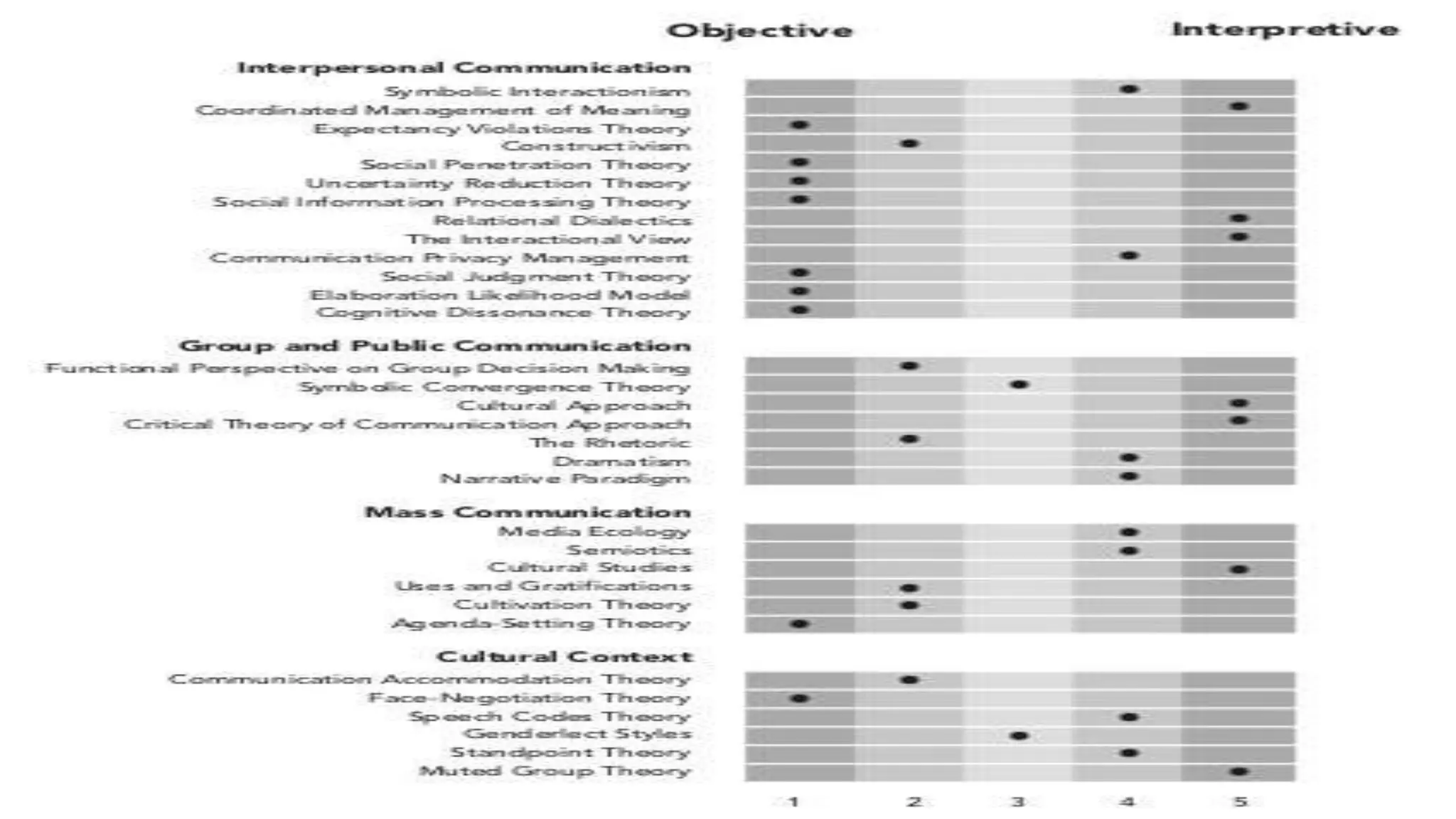
*Next: Classification of Communication Theories According to Objective /Interpretive Worldview (p.22)
Chapter 3:
Weighting
the Words
Pages 24 – 36
What is a Scientific Theory?
Making a Good Objective Theory
 A good objective theory:
1. Predicts what will happen
 We are dealing with things we can see, hear, touch, smell and taste over and over again
 Probability and tendencies → Not absolute certainty
 A specific type of communication triggers a particular response
 People will use certain types of communication depending upon pre-existing factor
2. Explains an event or human behavior to draw order to an existing chaos
 Abraham Kaplan
 “[T]heory is a way of making sense out if a disturbing situation”
Making a Good Objective Theory
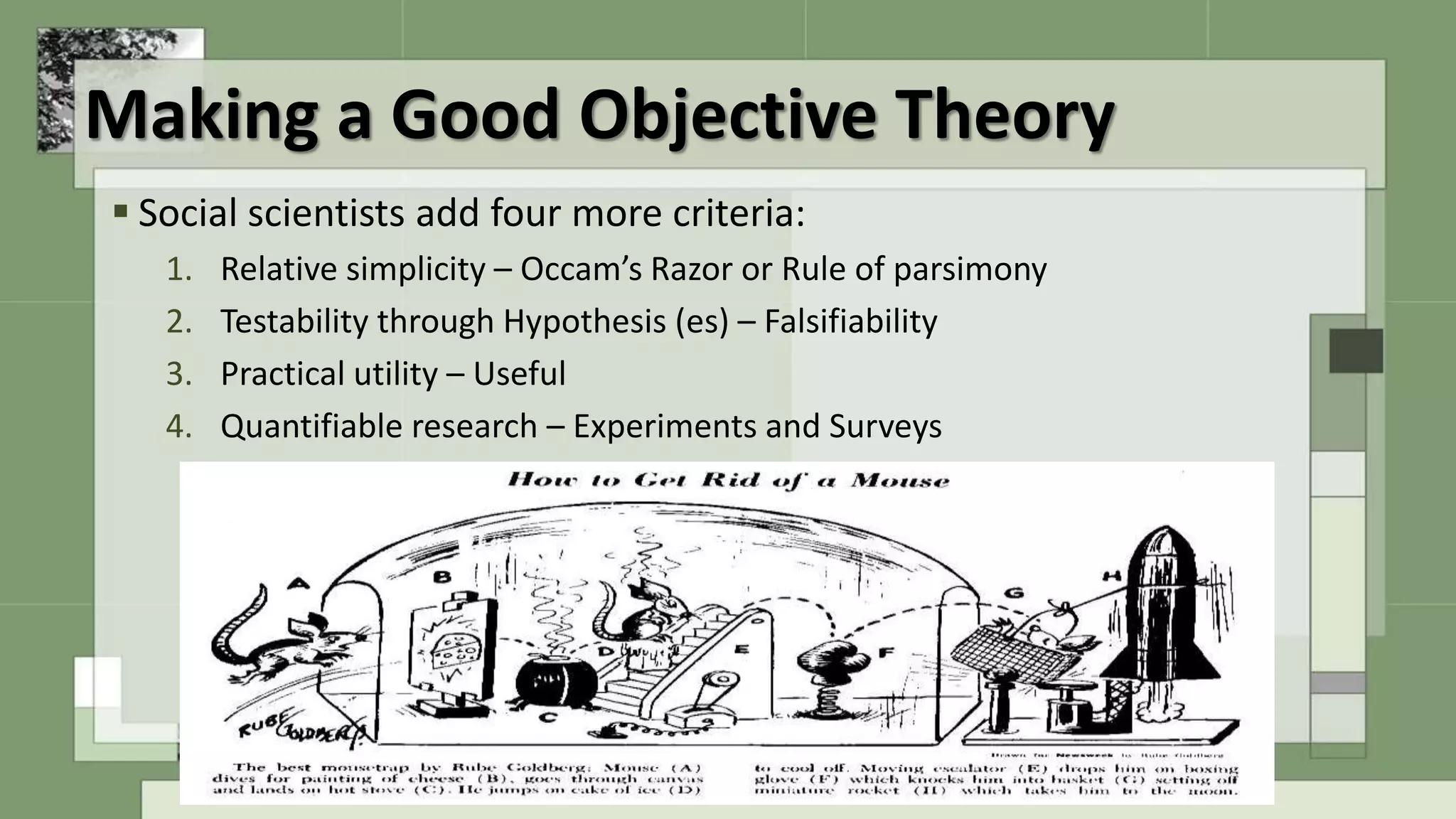
 Social scientists add four more criteria:
1. Relative simplicity – Occam’s Razor or Rule of parsimony
2. Testability through Hypothesis (es) – Falsifiability
3. Practical utility – Useful
4. Quantifiable research – Experiments and Surveys
Making a Good Interpretive Theory
 Although there is no six-point set of criteria, interpretive theories
should accomplish some or all of these functions:
 Identification and clarification of values – Power relations and structures
 Create new understanding of people – Self –referential imperative
 Inspire aesthetic appreciation – Organized creativity
 Stimulate agreement – Widespread debate and analysis
 Reform society – Challenge to the Status Quo
 Conduct qualitative research – Textual Analysis and Ethnography
Activity #4a
Activity #4b
Contested Turf & Common Ground
 Mutual respect for each other’s curiosity about the communication and
recognition of the value of each other’s work and contributions.
 And understanding of the need for a balance in rigor and imagination.
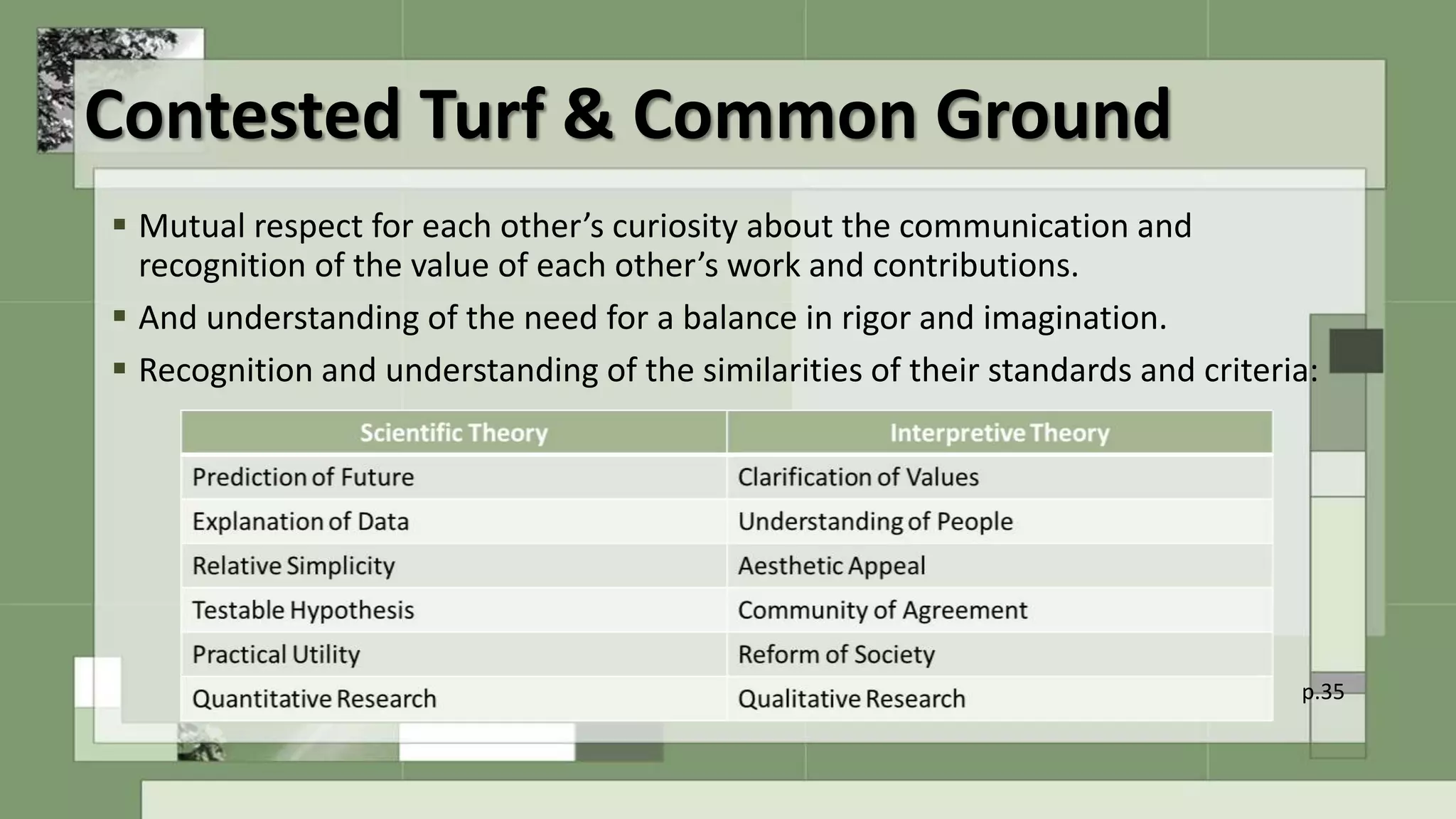
 Recognition and understanding of the similarities of their standards and criteria:
p.35
Chapter 4:
Mapping
the
TerritoryPages 37 – 50
Seven Traditions of Communication Theory
 Professor Robert Craig from University of Colorado
 “Communication theory is the systematic and thoughtful response of
communication scholars to questions posed as humans interact with one
another” (p.37).
 These already stablished traditions offer “distinct, alternative
vocabularies” that describe different “ways of conceptualizing
communication problems and practices” (p.38).
 Some share common grounds
 Some are fenced off each other by conflicting goals and assumptions
The Socio-Psychological Tradition
 Believe in the existence of communication truths that can be
discovered by careful, systematic observation.
 “Cause-and-effect relationships that will predict the results when people
communicate” (p.38)
 How can I get others to change?
 Researchers look for what it is instead of what ought to be
 “Harold Kelley’s interactional theory […] suggests that close relationships are
characterized by “strength, frequency, diversity, and duration” (p.39)
 This type of research design would allow to predict which pairs were likely to be friends
forever.
The Cybernetic Tradition
 Cybernetics = Artificial intelligence
 “Friendships don’t exit in a vacuum; they are embedded in a network that
processes social information” (p.40)
 Social network experiment
 Amount of communication
 Closeness of relationship
 Commitment to see it continue
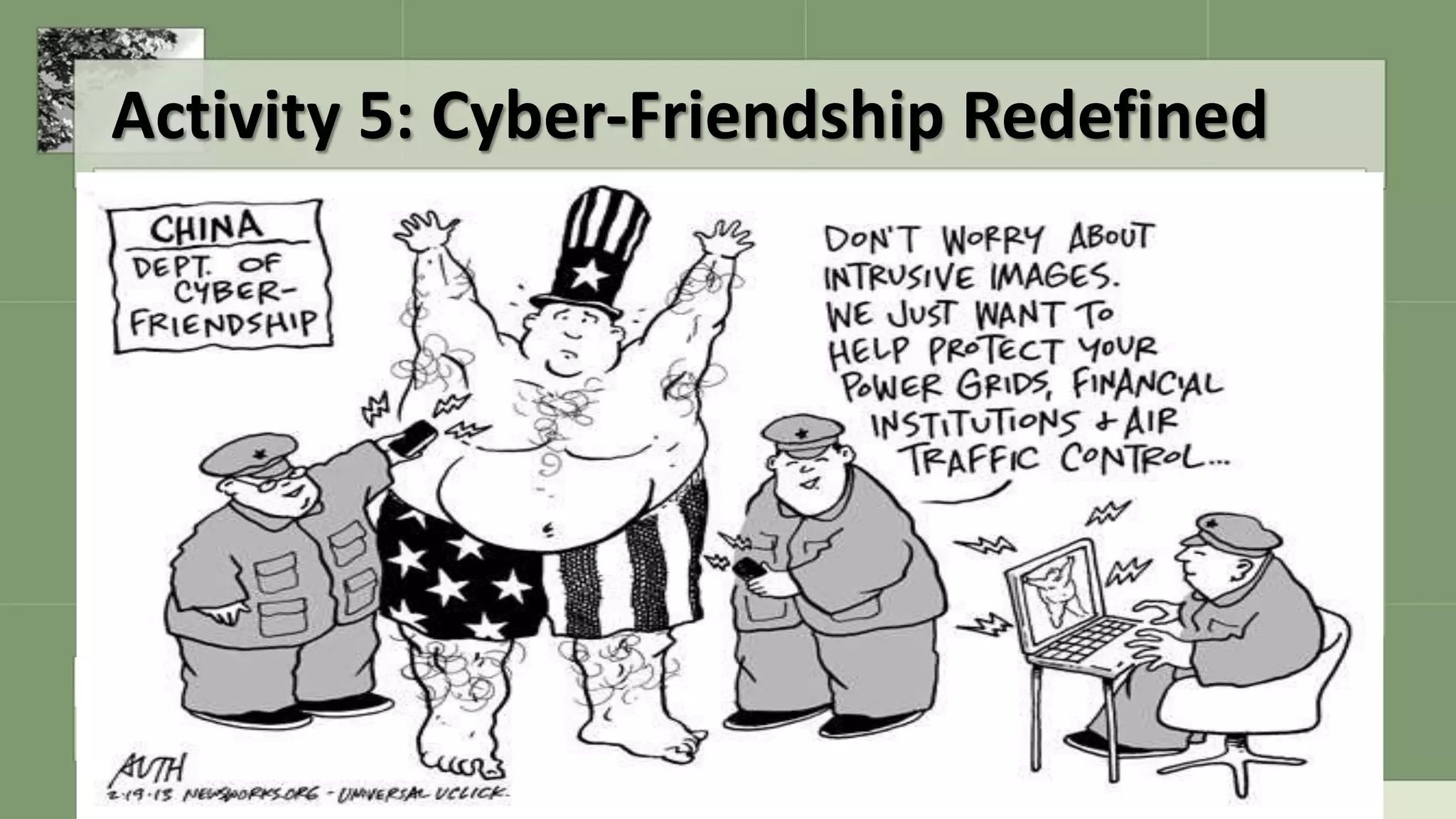
Activity 5: Cyber-Friendship Redefined
The Rhetorical Tradition
 How to best present a case
 Characterized by:
 A conviction that speech distinguishes humans from animals
 A confidence that public address delivered in a democratic forum is the best
way to solve political problems
 An appropriate setting for audience adaptation
 Oratorical training as the cornerstone of a leader’s education
 An idea that rhetoric is more art than science
 A history of male dominance and a female struggle for a right to speak in
public
Activity #6: Effective Rhetoric
The Semiotic Tradition
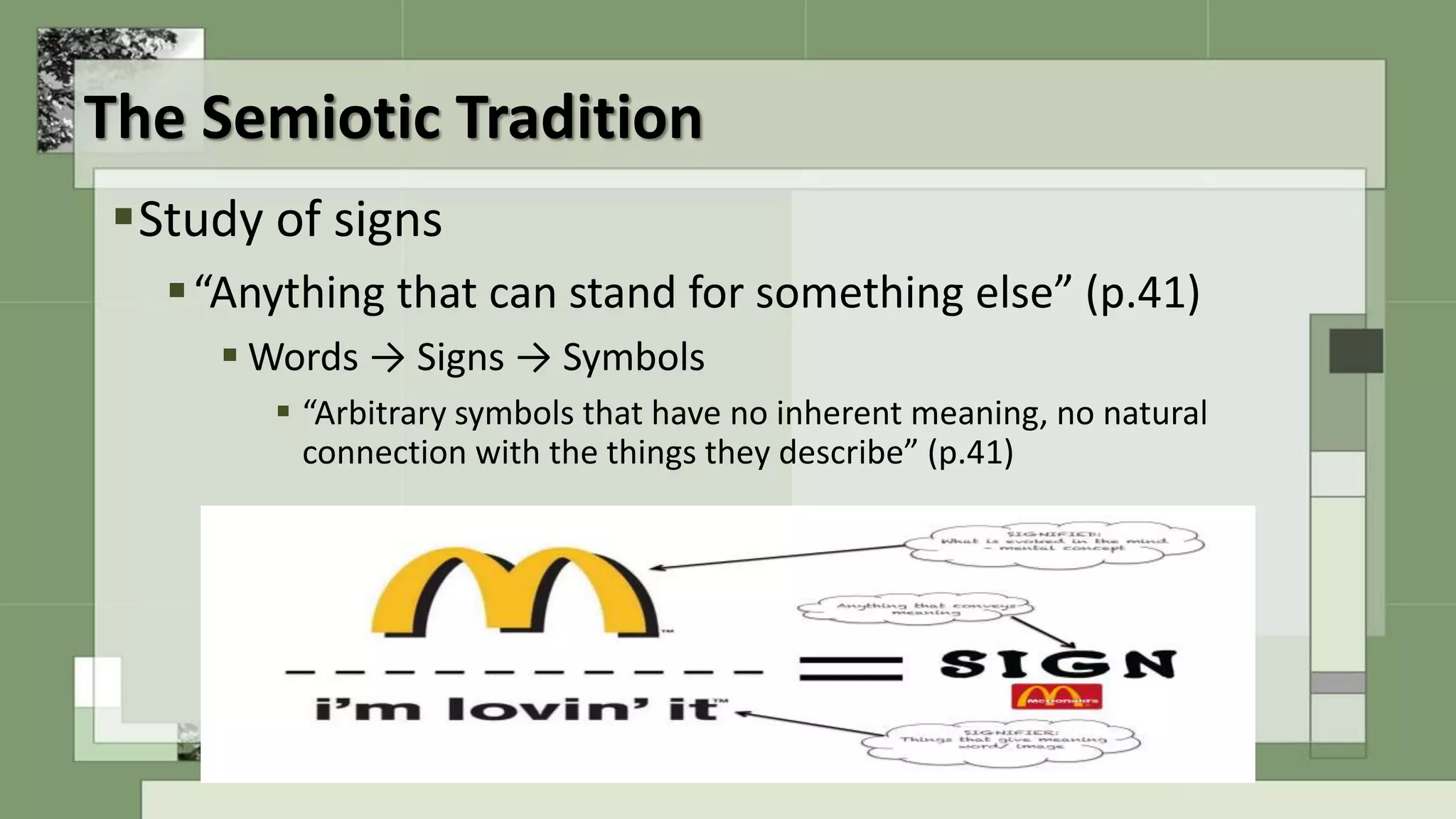
Study of signs
“Anything that can stand for something else” (p.41)
 Words → Signs → Symbols
 “Arbitrary symbols that have no inherent meaning, no natural
connection with the things they describe” (p.41)
Activity #7: Signs and symbols everywhere
The Socio-Cultural Tradition
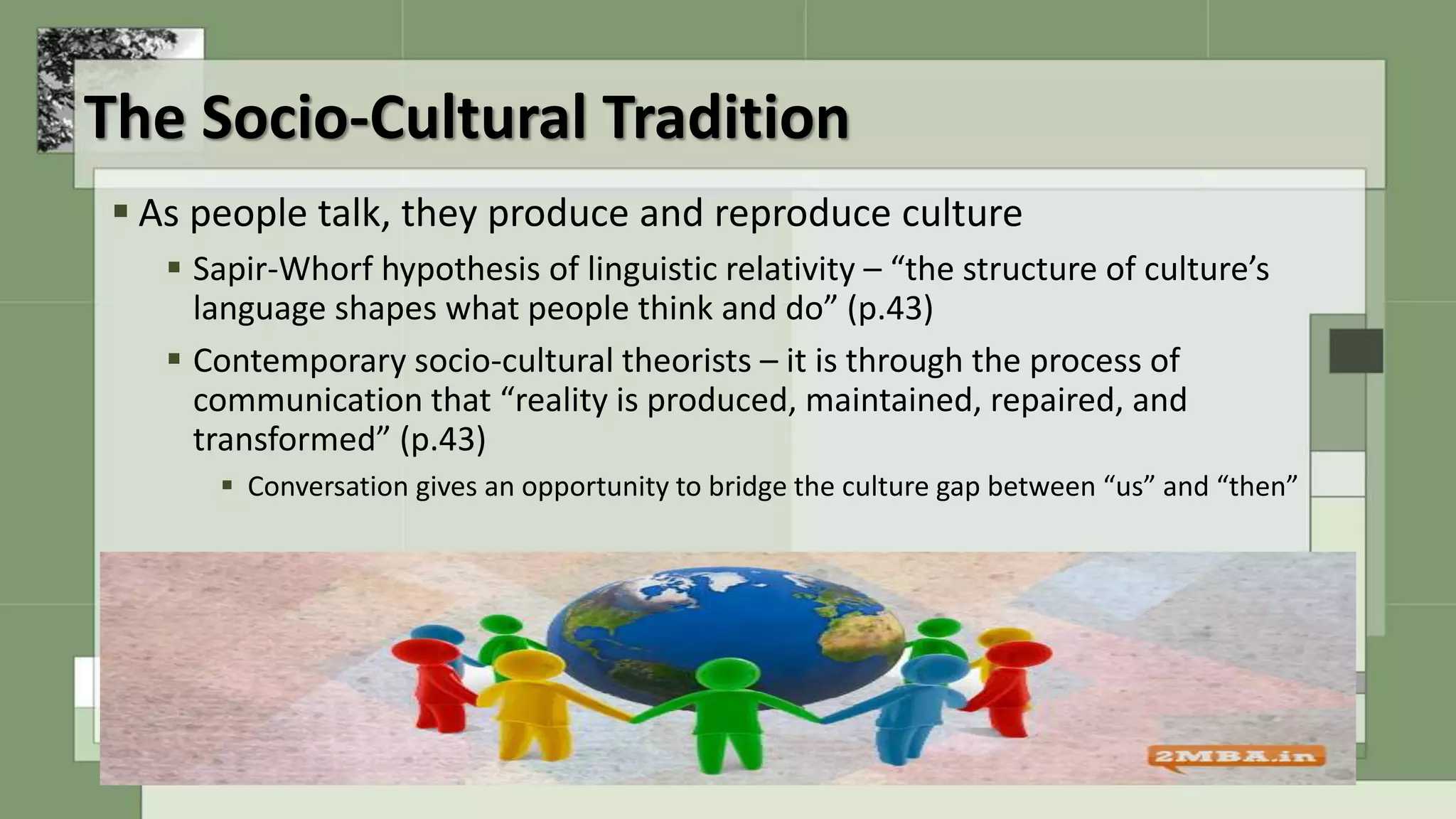
 As people talk, they produce and reproduce culture
 Sapir-Whorf hypothesis of linguistic relativity – “the structure of culture’s
language shapes what people think and do” (p.43)
 Contemporary socio-cultural theorists – it is through the process of
communication that “reality is produced, maintained, repaired, and
transformed” (p.43)
 Conversation gives an opportunity to bridge the culture gap between “us” and “then”
The Critical Tradition
 Frankfurt School of Thought – Tests the ideas of Karl Marx
 Rejects the economic determinism yet carries the tradition of critiquing
society.
 Consistently challenge three features of contemporary society:
1. Control of language to perpetuate power imbalances
 Emancipation
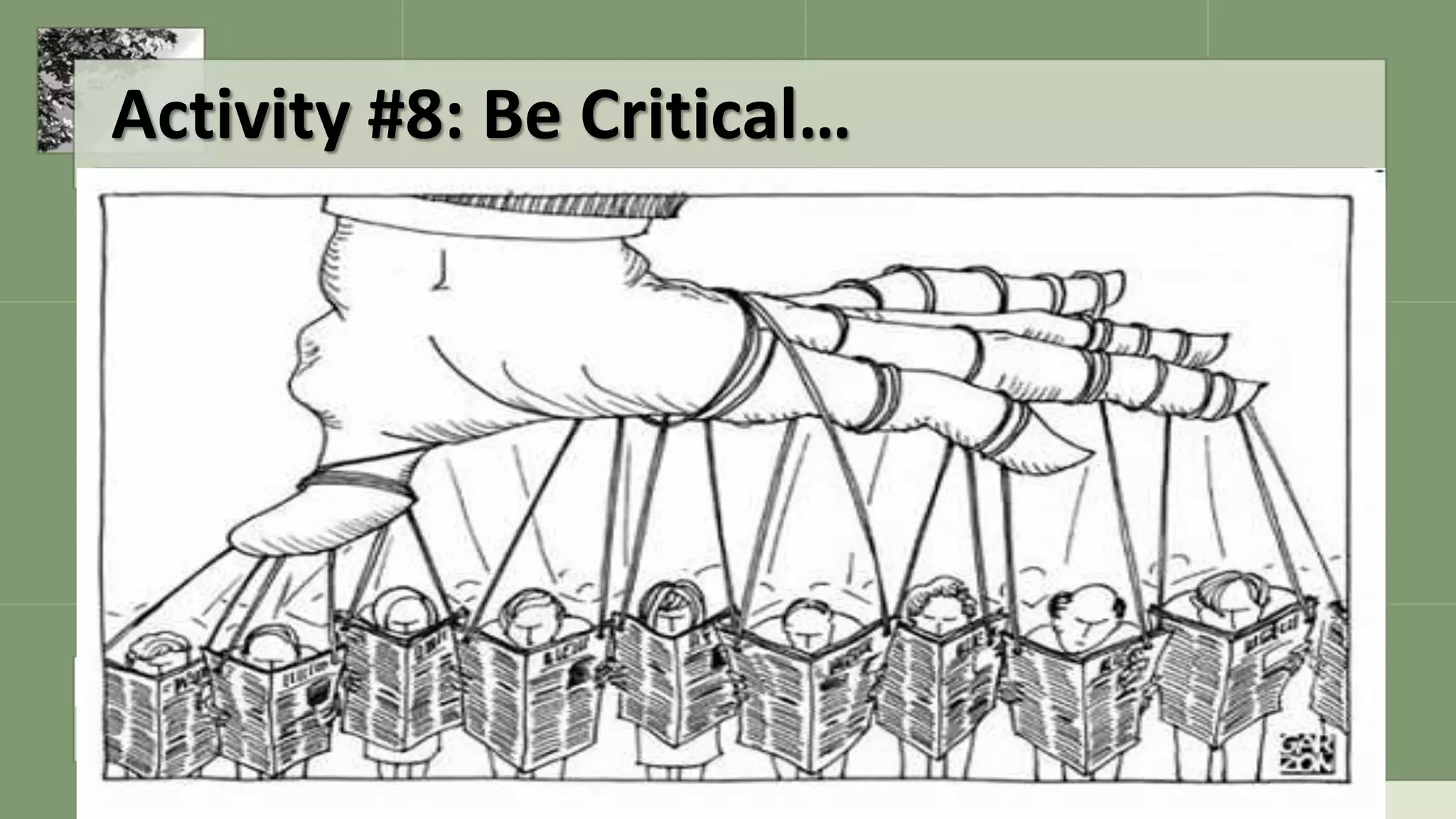
2. The role of mass media in dulling sensitivity to repression
 Reproduction of the dominant ideology to distract people from recognizing injustices
3. Blind reliance on the scientific method and uncritical acceptance of empirical findings
 “Science is not the value-free pursuit of knowledge that it claims to be” (p.44)
Activity #8: Be Critical…
The Phenomenological Tradition
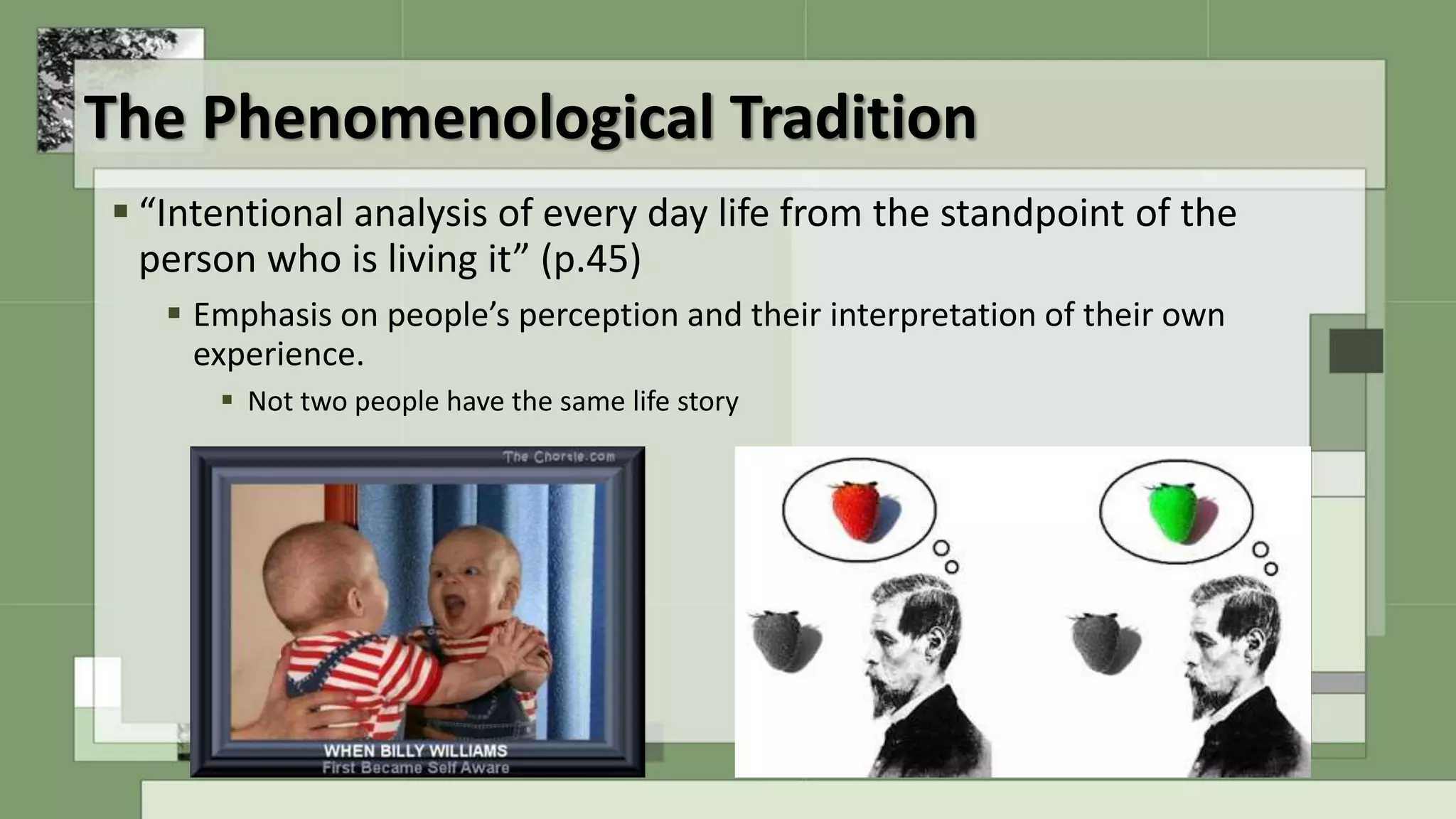
 “Intentional analysis of every day life from the standpoint of the
person who is living it” (p.45)
 Emphasis on people’s perception and their interpretation of their own
experience.
 Not two people have the same life story
Fencing the Field of Communication Theory
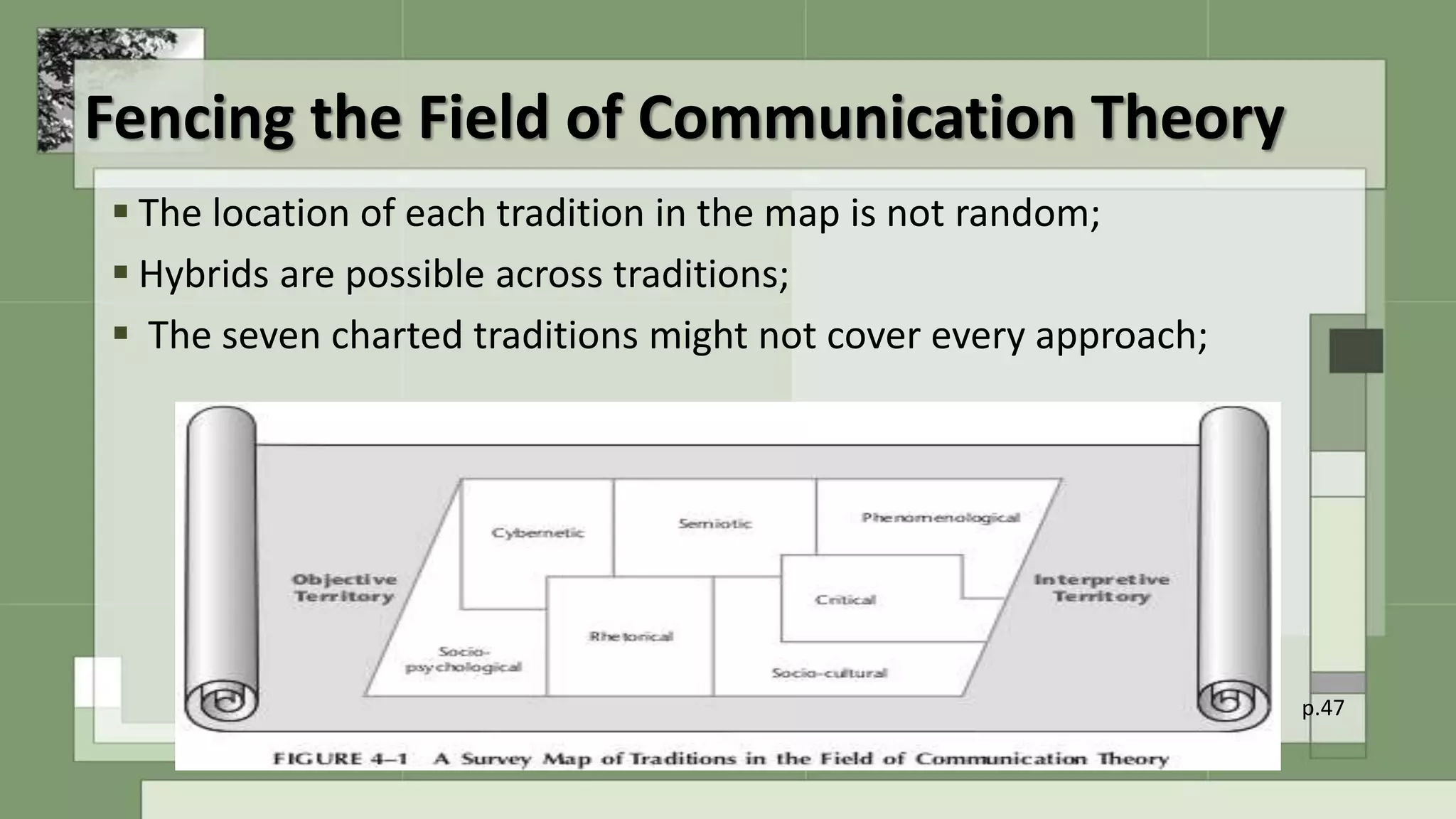
 The location of each tradition in the map is not random;
 Hybrids are possible across traditions;
 The seven charted traditions might not cover every approach;
p.47
Ethical v. Effective Communication
The Ethical Tradition
 Ethical responsibility or Ethical Relativism?
 Ethical v. Effective
 NCA Credo for Ethical Communication
 What is ethical?
 Honesty v. Lying
 Truthfulness, accuracy, honesty and reason
 Responsibility for the short and long term consequences
 Understand and respect before evaluating and responding
 Many ethical theorists come out of the interpretive traditions
Activity #9: Applying Communication Traditions
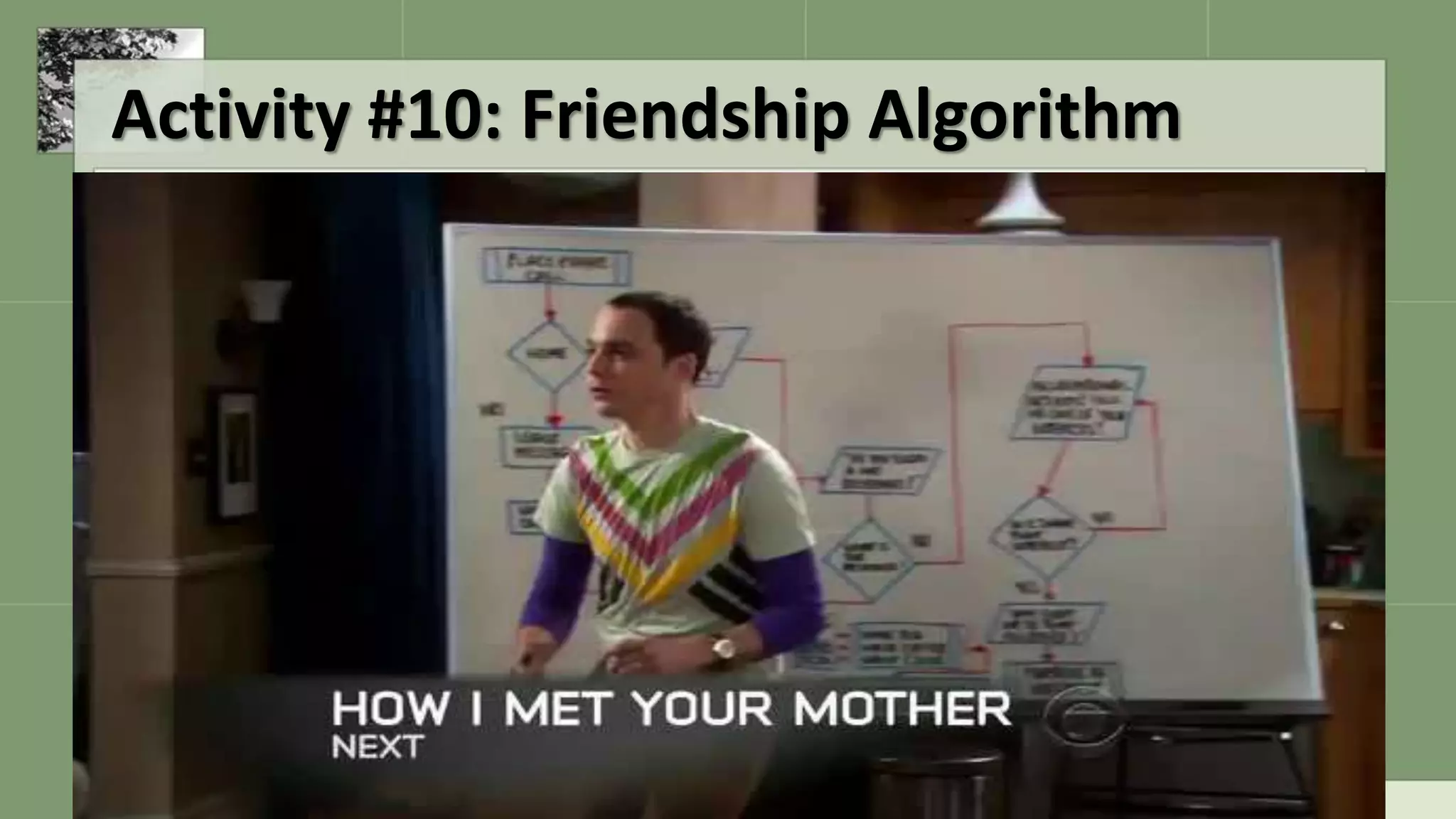
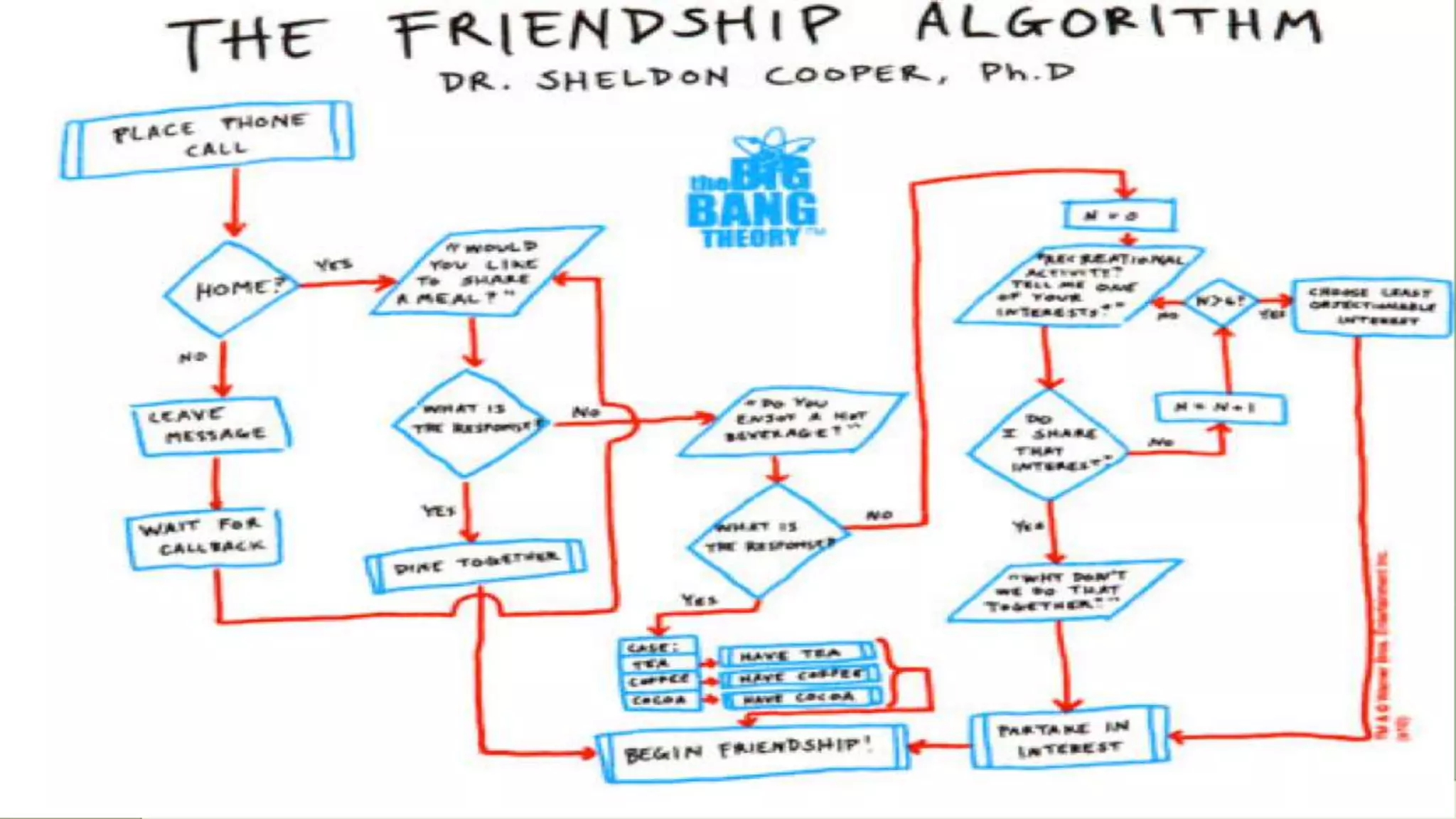
Activity #10: Friendship Algorithm
QUESTIONS

Introduction to Communication Theory

  • 1.
    Overview Chapters 1 to4 A First Look at Communication Theory 9th Edition Griffin, Ledbetter & Sparks Intro to Communication Theory Aitza M. Haddad Nunez, J.D., LL.M.
  • 2.
    Chapter 1: Launchingyour Study of Communication Theory Chapter 2: Talk About Theory Chapter 3: Weighting the Words Chapter 4: Mapping the Territory Quiz #1 Overview
  • 3.
    Chapter 1: Launching your Studyof Communication Theory Pages 1 – 12
  • 4.
    What is aTheory and What does it Do? “Umbrella term for all careful, systematic, and self-consciousness discussion and analysis of communication phenomena” (p.2).  “Set of systematic, informed, hunches about the way things work” (p.3).
  • 5.
     Not enoughto think carefully about an idea…  Theorists have a responsibility to cast light on the subject of study by:  Reading, Talking, Observing, and Experimenting  Having a degree of familiarity with alternative explanations and interpretations  Integrated system of concepts…  Specific and clear links among the informed hunches.  Ideas tied together into a unified whole – No one-shot claims Set of systematic, informed, hunches…
  • 6.
     The threemetaphors used to help visual learners:  Theories as Nets  To catch the world  Theories as Lenses  Opposed to a mirror that reflects the world  Theories as Maps  Of the way communications works Images of Theory
  • 7.
    Not one definition– Concept is seriously overburderned.  Essential feautures: “Relational process of creating and interpreting messages that elicit a response” 1. Messages – Texts 2. Creation of Messages – Conscious choice of text form and substance 3. Interpretation of Messages – Words don’t mean things, people means things 4. A Relational Process – One cannot step into the same river twice 5. Messages that Elicit a Response – Communication must provoke a response And What is Communication?
  • 8.
    Activity 1: SoWhat is a Theory?
  • 9.
    Activity 2: AFailure to Communicate
  • 11.
  • 12.
    An Objective Approach Social Scientists – Why an event produced a specific sentiment and whether it resulted in action.  After observation, a theory is identified or constructed to offer insights about what it was observed.  Resonance Principle of Communication  Persuasion – arguments v. memories  Theory Validation  “Objective test to identify if a theory is faulty” (p.14)  Theory + Research
  • 13.
    An Interpretative Approach ArchetypalMyths Draw upon universal experiences  Carl Jung – “collective unconscious”  Michael Osborn – Archetypes touches off “depth responses” that emotionally resonate at the core of our being (p.15)
  • 14.
    Objective v. Interpretative Approaches to communication study differ in:  Starting point, Method and Conclusion  Assumptions about ways of arriving to knowledge  The core of human nature, questions of value, and the purpose of having theory  Objective → Scientist → Objective Scholar  Interpretative  “[A]ll rhetorical critics do interpretative analysis, not all interpretative scholars are rhetoricians” (p.16).  Interpretative Scholars  Rhetoricians, humanists, postmodernists, or critical scholars
  • 15.
    Truth v. MultipleRealities  Epistemology  “[W]e all inevitably make assumptions about the nature of knowledge” (p.16).  Scientists  Good Theory = Faithful representations of the way the world really is.  Science seeks to be bias-free – evidence should speak for itself.  No one person can know it all → Pool of findings to build a collective body of knowledge about how the world works.  “[O]nce a principle is discovered and validated, it will continue to hold true as long as conditions remain relatively the same” (p.16)  Interpreters  Truth is socially constructed through communication  “Text may have multiple meanings” (p.17).
  • 16.
    Determinism v. FreeWill  Question of Human Choice  Hard-line determinists – every move we make is the result of heredity and environment.  Scientists – Stress the forces that shape human behavior  Free will purists – every human act is ultimately voluntary (p.17)  Interpretative Scholars  Focus on conscious choices made by individuals  Language  Reflects theorists views of human nature  “I had to” v. “I decided to” / “In order to” and “So that”  “[A]s individual freedom goes up, predictability of behavior goes down” (p.18)
  • 17.
  • 18.
  • 19.
    Objective v. Emancipation “Significant decisions are value laden”  Value – priorities and issues of relative worth.  “Traffic light that guide what we think, feel, and do” (p.18)  Behavioral Scientists → Empirical Evidence  Critical Interpreters → “[K]nowledge is never neutral” (p.19)  Seeks to emancipate = liberate people from oppression of any sort  Stan Deetz  General Communication Theories have two priorities: 1. Effectiveness – successful communication / persuasion 2. Participation – increase point of views / difference, opposition and independence
  • 20.
    Universal Laws v.Interpretative Guides  Behavioral Scientists  “Pin down universal laws of human behavior that cover a variety of situations” (p.19)  Theory Testing  Hunch of ideas about how the world works → Hypothesis → Test after Test  Rhetorical Critic  Strive “to interpret a particular communication text in a specific context” (p.19)  “[E]xplores the web of meaning that constitutes human existence” (p.20)  No Theory Testing  Theory tells “what to look for,” “what to make of it,” and “whether to consider it significant” *Next: Classification of Communication Theories According to Objective /Interpretive Worldview (p.22)
  • 22.
  • 23.
    What is aScientific Theory?
  • 24.
    Making a GoodObjective Theory  A good objective theory: 1. Predicts what will happen  We are dealing with things we can see, hear, touch, smell and taste over and over again  Probability and tendencies → Not absolute certainty  A specific type of communication triggers a particular response  People will use certain types of communication depending upon pre-existing factor 2. Explains an event or human behavior to draw order to an existing chaos  Abraham Kaplan  “[T]heory is a way of making sense out if a disturbing situation”
  • 25.
    Making a GoodObjective Theory  Social scientists add four more criteria: 1. Relative simplicity – Occam’s Razor or Rule of parsimony 2. Testability through Hypothesis (es) – Falsifiability 3. Practical utility – Useful 4. Quantifiable research – Experiments and Surveys
  • 26.
    Making a GoodInterpretive Theory  Although there is no six-point set of criteria, interpretive theories should accomplish some or all of these functions:  Identification and clarification of values – Power relations and structures  Create new understanding of people – Self –referential imperative  Inspire aesthetic appreciation – Organized creativity  Stimulate agreement – Widespread debate and analysis  Reform society – Challenge to the Status Quo  Conduct qualitative research – Textual Analysis and Ethnography
  • 27.
  • 28.
  • 29.
    Contested Turf &Common Ground  Mutual respect for each other’s curiosity about the communication and recognition of the value of each other’s work and contributions.  And understanding of the need for a balance in rigor and imagination.  Recognition and understanding of the similarities of their standards and criteria: p.35
  • 30.
  • 31.
    Seven Traditions ofCommunication Theory  Professor Robert Craig from University of Colorado  “Communication theory is the systematic and thoughtful response of communication scholars to questions posed as humans interact with one another” (p.37).  These already stablished traditions offer “distinct, alternative vocabularies” that describe different “ways of conceptualizing communication problems and practices” (p.38).  Some share common grounds  Some are fenced off each other by conflicting goals and assumptions
  • 32.
    The Socio-Psychological Tradition Believe in the existence of communication truths that can be discovered by careful, systematic observation.  “Cause-and-effect relationships that will predict the results when people communicate” (p.38)  How can I get others to change?  Researchers look for what it is instead of what ought to be  “Harold Kelley’s interactional theory […] suggests that close relationships are characterized by “strength, frequency, diversity, and duration” (p.39)  This type of research design would allow to predict which pairs were likely to be friends forever.
  • 33.
    The Cybernetic Tradition Cybernetics = Artificial intelligence  “Friendships don’t exit in a vacuum; they are embedded in a network that processes social information” (p.40)  Social network experiment  Amount of communication  Closeness of relationship  Commitment to see it continue
  • 34.
  • 35.
    The Rhetorical Tradition How to best present a case  Characterized by:  A conviction that speech distinguishes humans from animals  A confidence that public address delivered in a democratic forum is the best way to solve political problems  An appropriate setting for audience adaptation  Oratorical training as the cornerstone of a leader’s education  An idea that rhetoric is more art than science  A history of male dominance and a female struggle for a right to speak in public
  • 36.
  • 37.
    The Semiotic Tradition Studyof signs “Anything that can stand for something else” (p.41)  Words → Signs → Symbols  “Arbitrary symbols that have no inherent meaning, no natural connection with the things they describe” (p.41)
  • 38.
    Activity #7: Signsand symbols everywhere
  • 39.
    The Socio-Cultural Tradition As people talk, they produce and reproduce culture  Sapir-Whorf hypothesis of linguistic relativity – “the structure of culture’s language shapes what people think and do” (p.43)  Contemporary socio-cultural theorists – it is through the process of communication that “reality is produced, maintained, repaired, and transformed” (p.43)  Conversation gives an opportunity to bridge the culture gap between “us” and “then”
  • 40.
    The Critical Tradition Frankfurt School of Thought – Tests the ideas of Karl Marx  Rejects the economic determinism yet carries the tradition of critiquing society.  Consistently challenge three features of contemporary society: 1. Control of language to perpetuate power imbalances  Emancipation 2. The role of mass media in dulling sensitivity to repression  Reproduction of the dominant ideology to distract people from recognizing injustices 3. Blind reliance on the scientific method and uncritical acceptance of empirical findings  “Science is not the value-free pursuit of knowledge that it claims to be” (p.44)
  • 41.
    Activity #8: BeCritical…
  • 42.
    The Phenomenological Tradition “Intentional analysis of every day life from the standpoint of the person who is living it” (p.45)  Emphasis on people’s perception and their interpretation of their own experience.  Not two people have the same life story
  • 43.
    Fencing the Fieldof Communication Theory  The location of each tradition in the map is not random;  Hybrids are possible across traditions;  The seven charted traditions might not cover every approach; p.47
  • 44.
    Ethical v. EffectiveCommunication
  • 45.
    The Ethical Tradition Ethical responsibility or Ethical Relativism?  Ethical v. Effective  NCA Credo for Ethical Communication  What is ethical?  Honesty v. Lying  Truthfulness, accuracy, honesty and reason  Responsibility for the short and long term consequences  Understand and respect before evaluating and responding  Many ethical theorists come out of the interpretive traditions
  • 46.
    Activity #9: ApplyingCommunication Traditions
  • 47.
  • 49.

Editor's Notes

  • #6 specification of the relationship among concepts or ideas laid out Do the young theories reached this level? No. They are a one shot claim.
  • #21 In short, you cant fully understand a theory if you are not familiar with its underlying assumptions about truth, human nature, the purpose of the theory, and its values.
  • #22 Classification of Communication Theories According to Objective /Interpretive Worldview (p.22) The way we learn (how we perceive and acquire information) has a lot to do with our preference in how we interpret the world and everything in it. The four bipolar scales. Sensing v. Intituion
  • #25 Even the best theory may only be able to speak about people in general, rather than about specific individuals (p.25).
  • #33 Broken down, the key to a Perfect Friendship is based on the relationship between:      The perfect number of close friends, ideally n ≤ 4 (ideal number of close friends is up to four), where     Close friends ideally should be made up of one part Trustworthiness, one part Loyalty and one part sense of Humour, so CF=T+L+H, carefully considered with     The frequency of contact with your close friends (ideal is two to three times a week) alongside     The wider circle of friends, w ≤ 20, (ideal number of close friends is up to 20) and     The percentage of friends that are of the opposite sex, ideally p=25 (friendship group should be made up of 25% of the opposite sex)
  • #35 Activity #6: Based on what we have discussed in class until now, write the first thing that comes to your mind after reading this comic strip.
  • #37 What did Lorne Lutch’s did (specifically) that made his message more effective? Why did Nick Naylor took the money?
  • #39 Give an example taken form your every day life in where a sign stands for something else… Example: Tie or sock in a knob.
  • #42 Power relation in the word friend?
  • #46 National Communication Association (See Apendix C)
  • #47 Watch this short video. Provide a short explanation of the same using each one of the 7 traditions of communication and the ethical tradition as well.
  • #48 Watch Dr. Cooper’s explanation of his Friendship Algorithm. Now, create your own algorithm based on your own theory of how friendships work today using one of the seven theories. Be creative!
  • #49 Use as an example.